Museum of Civilization

It’s nearing the end of the semester. Teachers are writing final exams; students are presenting culminating projects. I’m visiting classrooms to see some of the exemplary work my colleagues and their students have been doing.

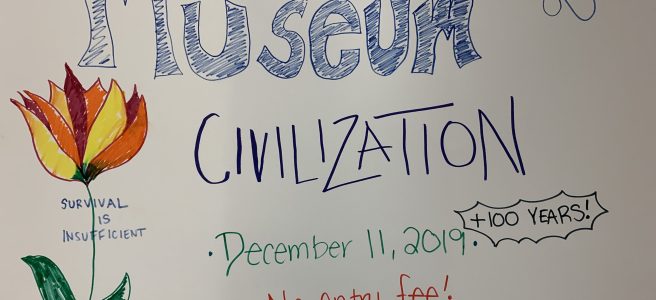
Earlier this week, my colleague Sarah Gessel and her students mounted an exhibition in the Media Center called the “Museum of Civilization.” It was a curation assignment, inspired by Station Eleven, a post-apocalyptic novel by Emily St. John Mandel that has become a staple of the English curriculum following an all-community read that our English teachers had a hand in designing.

A character in that novel establishes a “museum of civilization,” an exhibit at the deserted airport, of the world as it used to be. Mrs. Gessel wanted her students to understand how objects become symbols of individuals as well as of the collective. She wanted her students to understand that their individual dreams and ambitions, their likes and loves, their pastimes and pleasures, their actions and accomplishments encapsulate them as individuals and, collectively, characterize their generation. She wanted them to think critically about the objects in their lives that capture the essence of each of them. Here was Mrs. Gessel’s assignment:

Background: In Station Eleven, we learn that Clark is the keeper of the Museum of Civilization at the airport. There, he preserves items of the past that represent mankind before the flu. 

Question: What three things would you personally put in a Museum of Civilization a hundred years from now that would represent you as a whole? You may not use a phone.

Assignment:

  1. Choose three items that represent you as a person.
  2. Create a display “From the collection of ___________ (you)”. Your collection should contain a brief description of who you are (written in 3rd person!), including birth year.
  3. For your display, you must have the actual item.  If that is not possible, a picture will have to do.
  4. For each item, you will create an informational label (like you see in a museum under an artifact). It should contain:
    1. The time period it is from
    2. Its use or symbolism
    3. Why the object was important to him or her
    4. What it tells the future about the person  
  5. Here is a very basic, rough idea of what I am looking for…except yours should be real…not on a document.

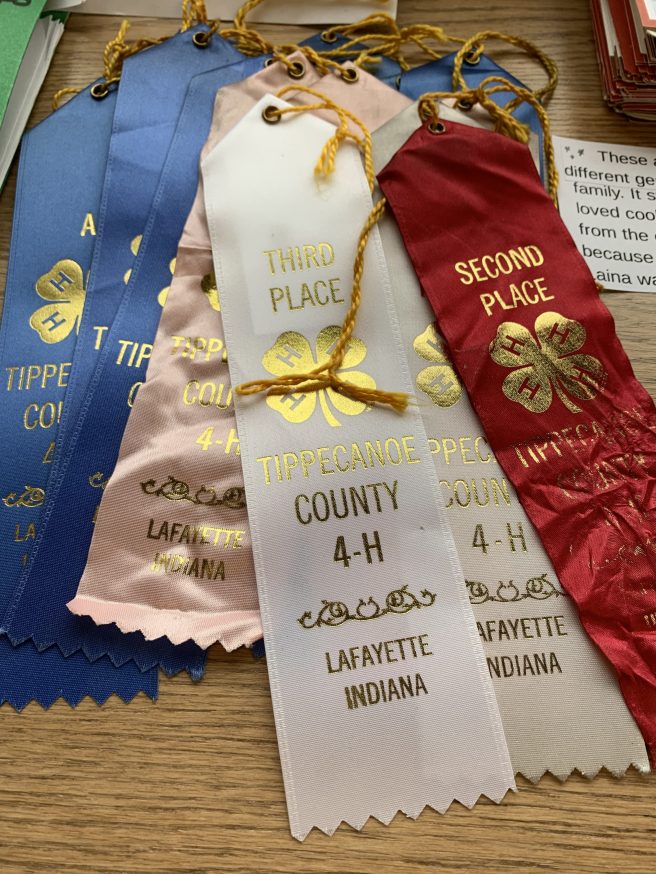
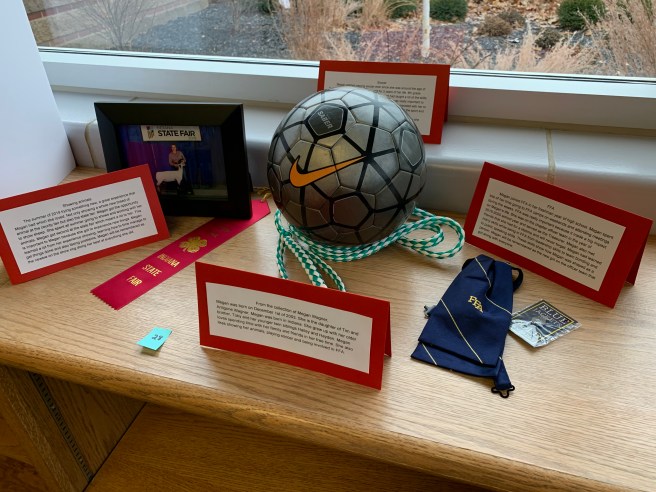
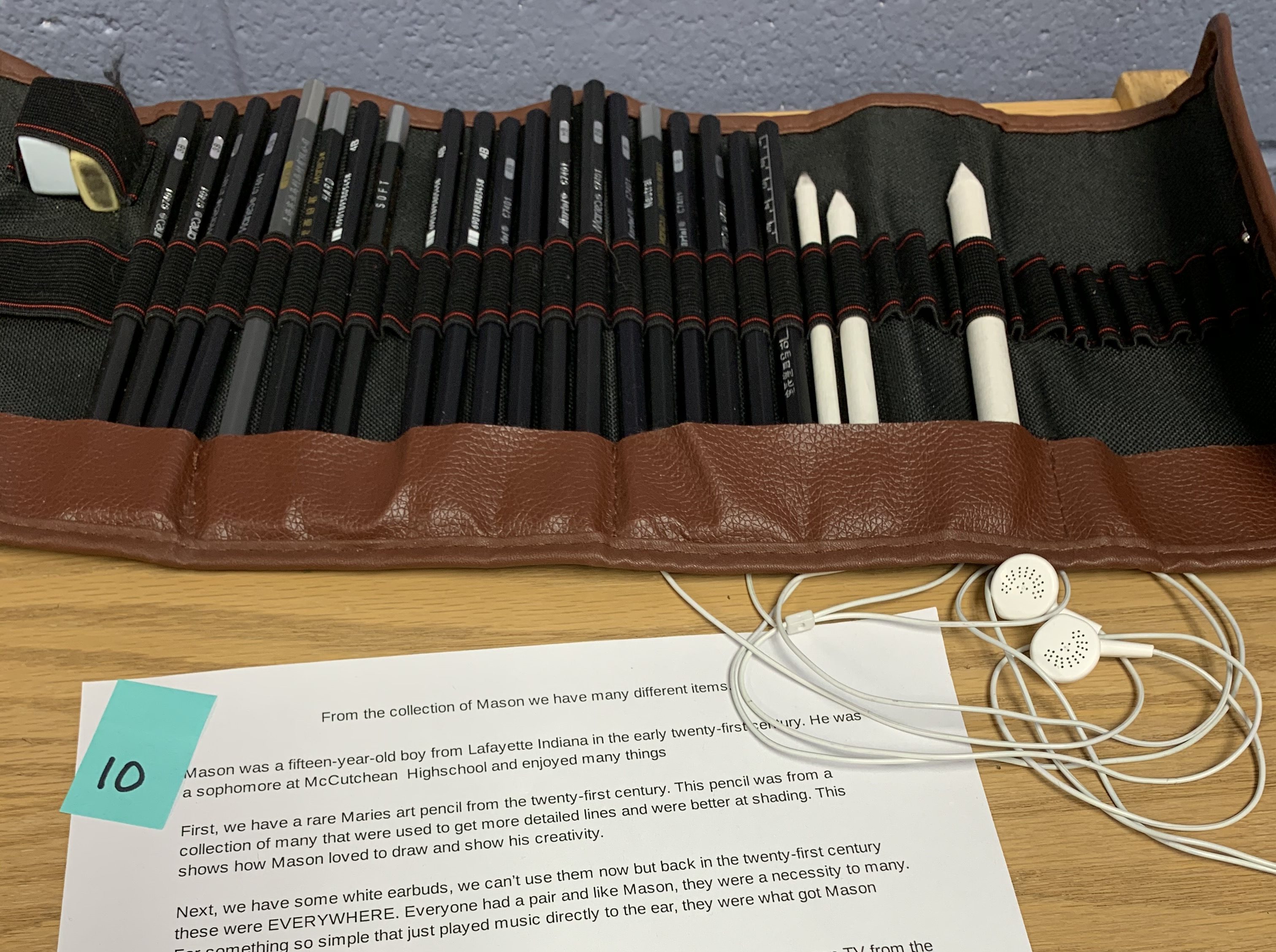
Here are some of the items students brought to school:
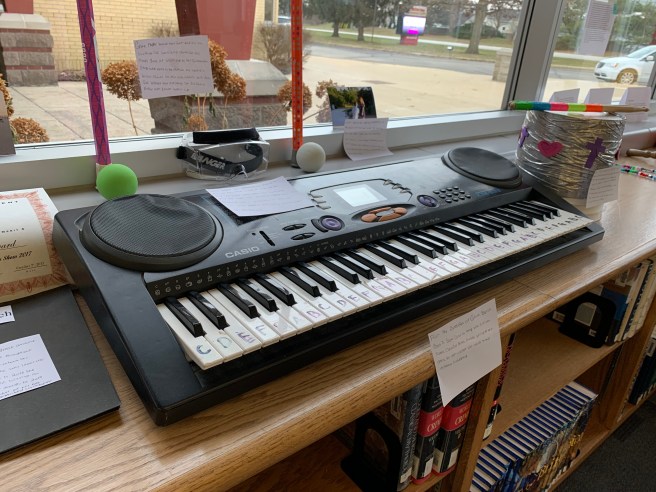
Some of their artifacts were poignant–a necklace made with a dear friend, now deceased; a stack of recipes from a grandmother; an old movie camera that launched what might well become a career:

Yes, there were earbuds and screens, but not many. In fact, what I noticed in addition to the wide variety of artifacts was the overwhelming lack of electronics. Admittedly, Ms. Gessel forbade phones, but earbuds and other electronic paraphernalia did not dominate the displays. Instead, there were the indicators of family, friendship and faith. Of interest in the arts, organized sports, and individual artistic pursuits. In children, in 4-H, in books, in cooking. Ms. Gessel’s students, like most teenagers if critics would just look beneath the surface, are not the zombie-like, plugged-in and tuned-out youth so often caricatured. These are kids I want to know better, unique and interesting individuals who are going to be in charge of a world I want to live in.

And here’s what happened afterward, after the spectators left, after the voting by gallery-goers was over, after the grades were assigned: The students looked at each other’s displays and something spontaneous occurred. Here’s what Ms. Gessel wrote to me:

My heart is full as I am sitting here thinking of the time we just spent last hour enjoying each other’s company as a class. All of their “stuff” is great, but what made so many of those items in there come to life were the kids. Watching them ask each other to play their instrument or sing or dance or compliment each other’s artwork or just comment on how nice it was just to chill with each other and listen…WOW. No museum can hold that amount of wonder or life. This is why I teach and am still teaching!
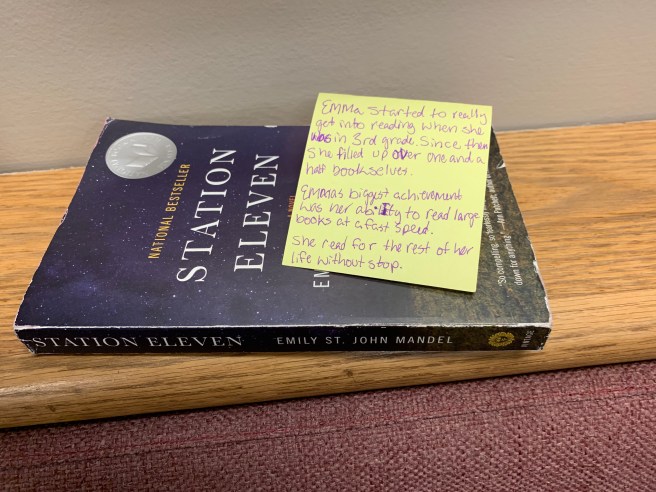
If you would like to know more about curation as an instructional tool, click here to read this article by Jennifer Gonzalez in Cult of Pedagogy.

A Christmas Memory

An exquisite teaching moment, one that still takes my breath away. Take the time this month to explore holiday classics and recall your own memorable classroom moments. Sweet, sweet gifts that last longer than the moment.

In years when I was not running behind by December, when I hadn’t lingered too long on To Kill a Mockingbird or Great Expectations or any other of the books my freshmen read, back when so many days weren’t set aside for standardized tests and final exams and AR assessments, back when I had control of the calendar, I liked to set aside the last several instructional days of the semester for Christmas literature. Sometimes we read A Christmas Carol, sometimes Dylan Thomas’ “A Child’s Christmas in Wales,” sometimes Truman Capote’s “A Christmas Memory.” My favorite, of course, was the latter—for two reasons. First, because the story lends itself to the students writing their own memoirs about Christmas—always a delight to read—and then, because I loved watching my students come slowly to the realization that the little boy narrator of “A Christmas Memory” and Dill Harris in To Kill a Mockingbird were one and the same person.

That was, of course, when such knowledge was still a revelation. Today, because of the Internet mostly, kids already know. This upset me at first. A perfectly wonderful epiphany: smashed. But I got over it. (The real Buddy as the model for Dill isn’t the only literary surprise the Internet has ruined. These days the kids know before they read the Odyssey or their first Shakespearean play that Homer wasn’t one person and Shakespeare may not have been Shakespeare.)

But back when Buddy/Dill was still a surprise, we’d read the story together—parts of it, at least, aloud.  Knowing where the story goes, I’d have trouble when the kites begin their ascent to the sky, when Queenie buries her bone, when Buddy’s best friend, Sook, says, “I could leave the world with today in my eyes.”  It was worse than that, actually.  I’d get choked up at the very beginning—when Sook first says: “Oh my! It’s fruitcake weather!”

The story is so rich:

  • In figurative language: “a pillow as wet as a widow’s handkerchief,” “the blaze of her heart,” and the stove “like a lighted pumpkin.”
  • In catalogues, or lists: the uses of the dilapidated baby carriage, the ways Sook and Buddy make money, the recipients of the fruitcakes, the contents of the trunk in the attic, the Christmas presents from the others, and most especially, the things Sook “has never done and the things she has done, does do.”
  • In sensory imagery: the ingredients in the fruitcakes, Haha Jones’ scar, the ornaments for the tree, Miss Sook dropping the kettle on the kitchen floor to awaken the sleeping relatives, Miss Sook herself in her gray sweater and Lincoln-like face.
  • The trip to cut the Christmas tree is a Christmas message all by itself, capped by Miss Sook’s response to the lazy mill-owner’s wife who tries to buy the tree, who tells the soulmates that they can always get another one. No, replies Miss Sook, “There’s never two of anything.”

It was easy after that to direct my students to their own best memories, to remembrances of grandparents, of favorite gifts, of pets who’d long since left them, to ritual and tradition, to ornaments they hang on the tree with delight year after year after year, to  Christmas confections, to sights and sounds and tastes that, unbeknownst to them, had been laid down already—at 13, 14—in layers of sweetness that will forever define Christmas in their hearts. They loved writing their own memoirs—evoking images, searching for similes, reaching for symbols like the kites that would carry their stories into light air. One year, a girl named Sarah wrote and wrote and wrote. Her lists were exquisite; her images, poignant beyond what was imaginable for her age. “She’s a writer,” her friends all said.  “You should have seen her in middle school.” Indeed.

But my favorite part of the lesson came after we had talked about style, after we had talked about Sook, after we had understood the message. I would ask the students to think about the boy, about Buddy. Until now, the focus had been on Sook—her superstitions, her quirkiness, her simplicity; on Haha Jones’ sudden philanthropy; on the relatives’ insensitivity; on the humor in Queenie’s sampling the leftover whiskey.

I asked my students to think about Buddy. “Is there anyone you’ve met this semester that Buddy reminds you of?” I’d ask them. A few literal ones would scan the list of kids they’d met that semester, their first in the high school. A few caught on to the fact that I was talking  about literary characters, who, to me and to them, too, were as real as any flesh and bone teenagers in the building.

The room is quiet. The students scan their memories, open their notebooks, reflect, try to remember the characters we’ve met.

I wait.

A hand at last. A voice, so quiet. Becca ventures an answer: “Dill?”

The room stays quiet. They take it in. Then, an almost audible, collective gasp.

Yes.

She’s got it.

Oh, that is so cool.

A Christmas memory.

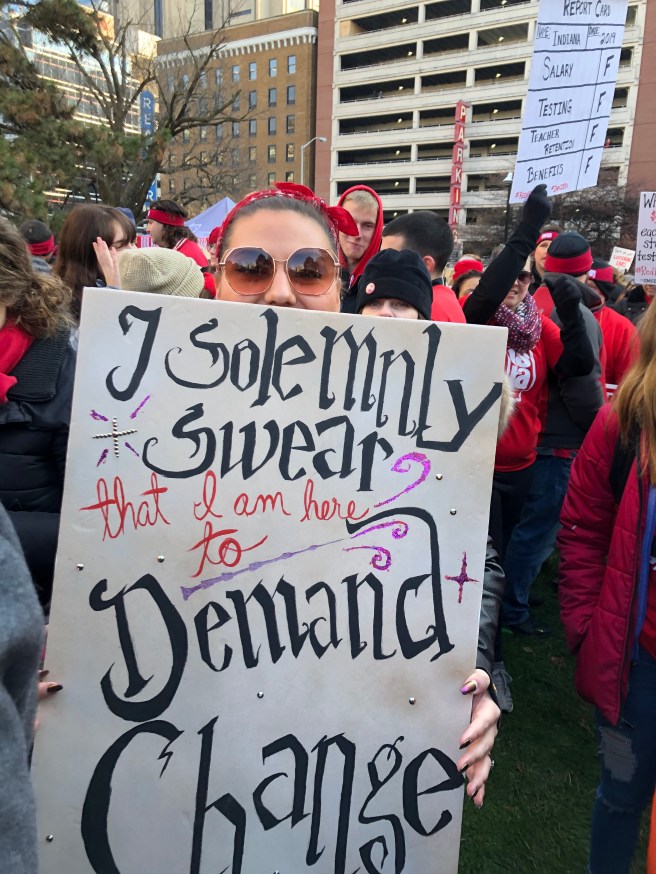
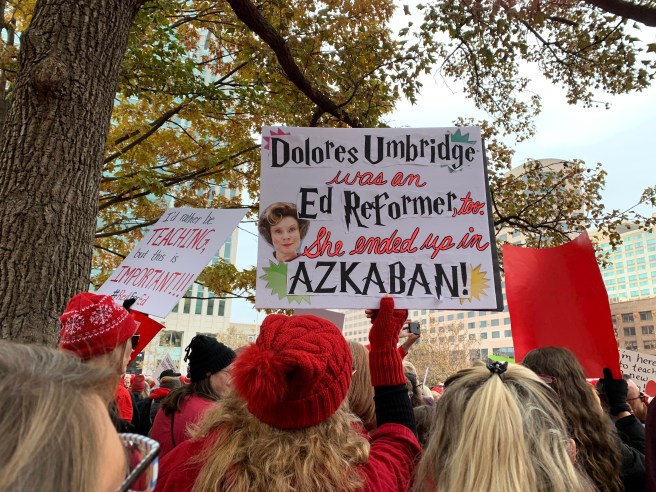
#RedforEd: Signs of the Time

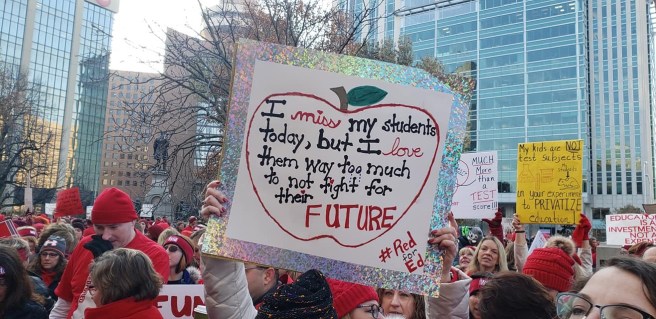
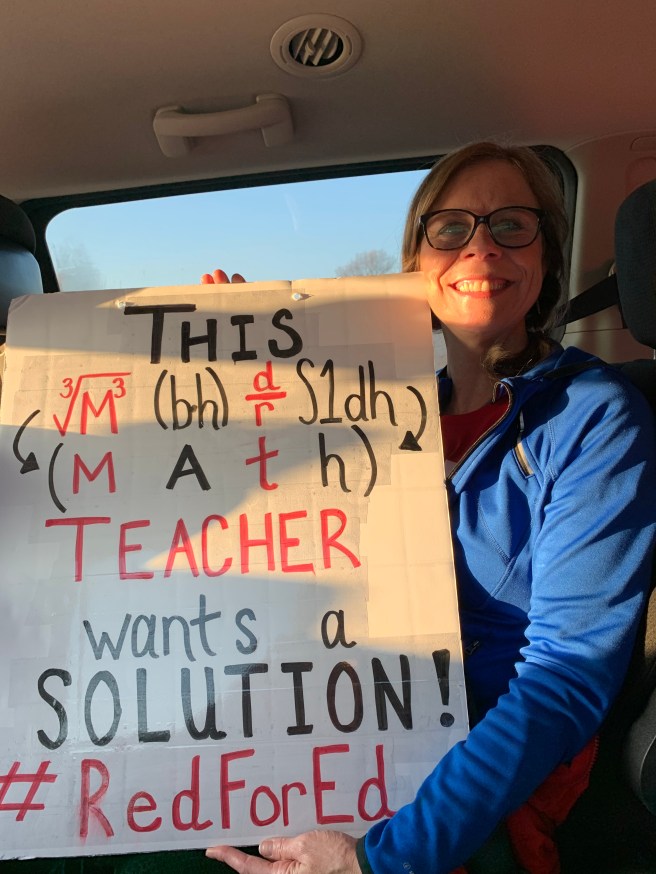
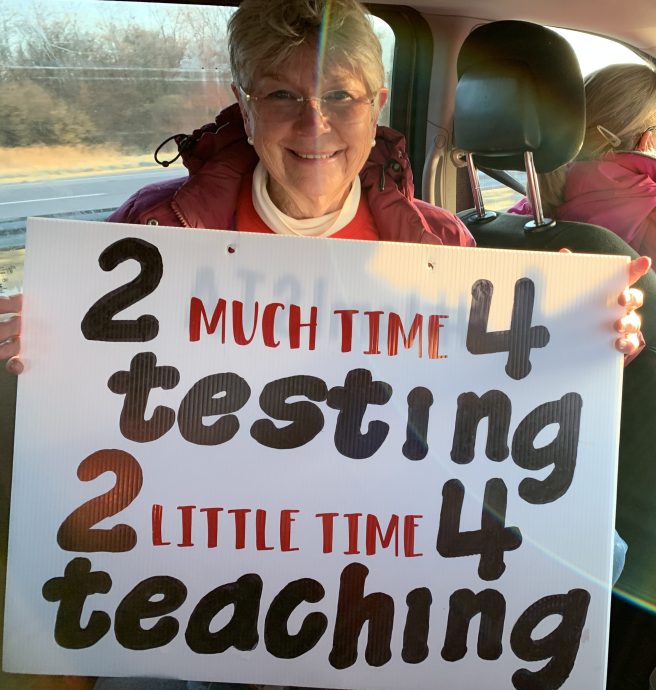
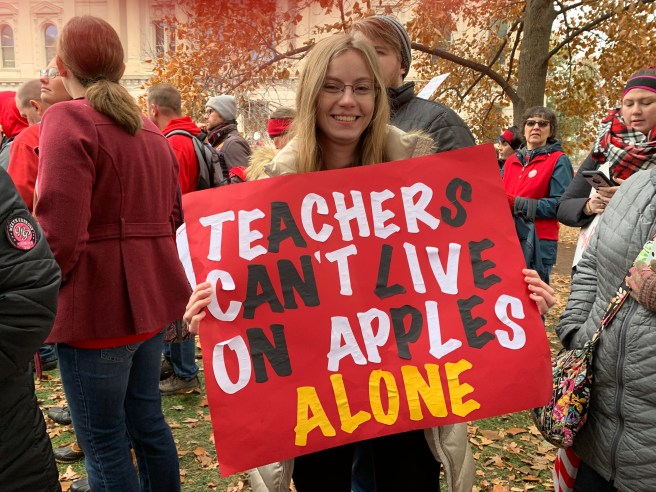
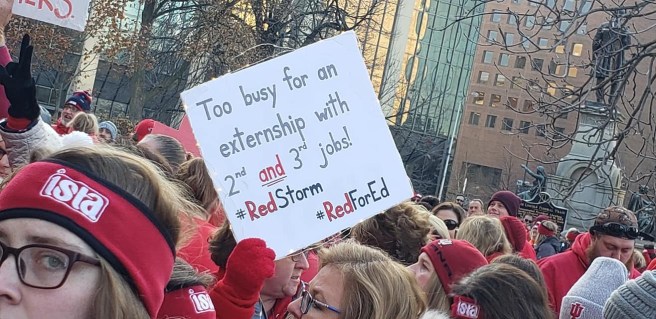
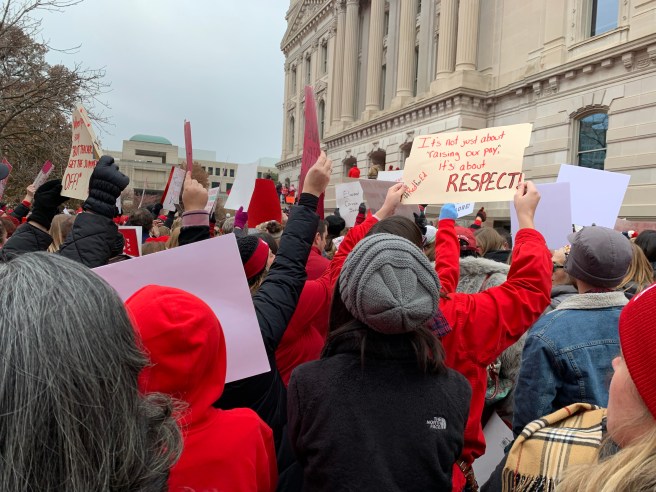
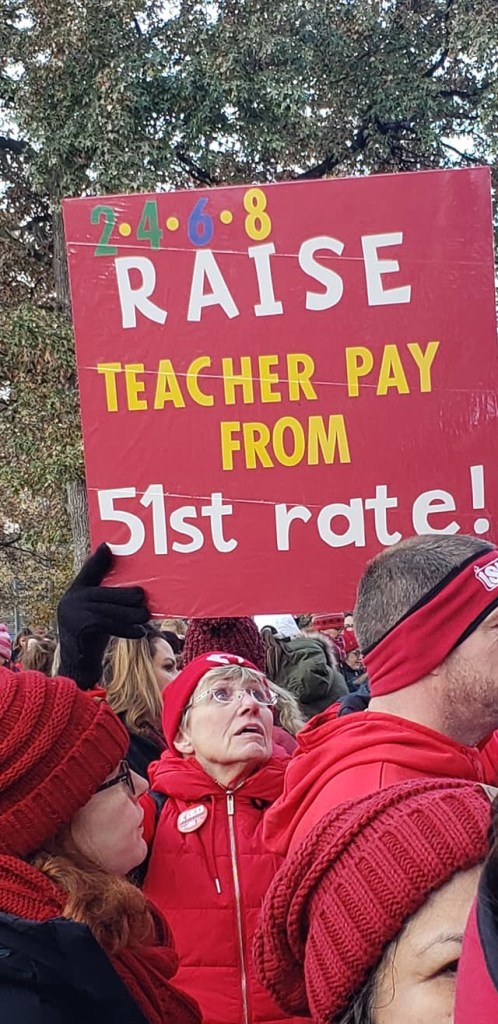
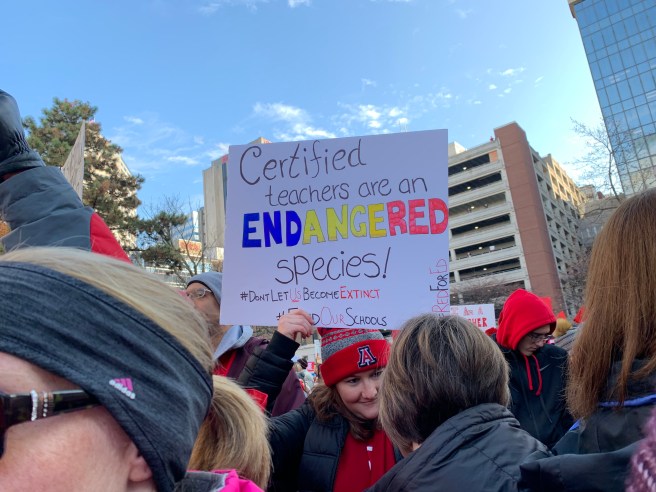
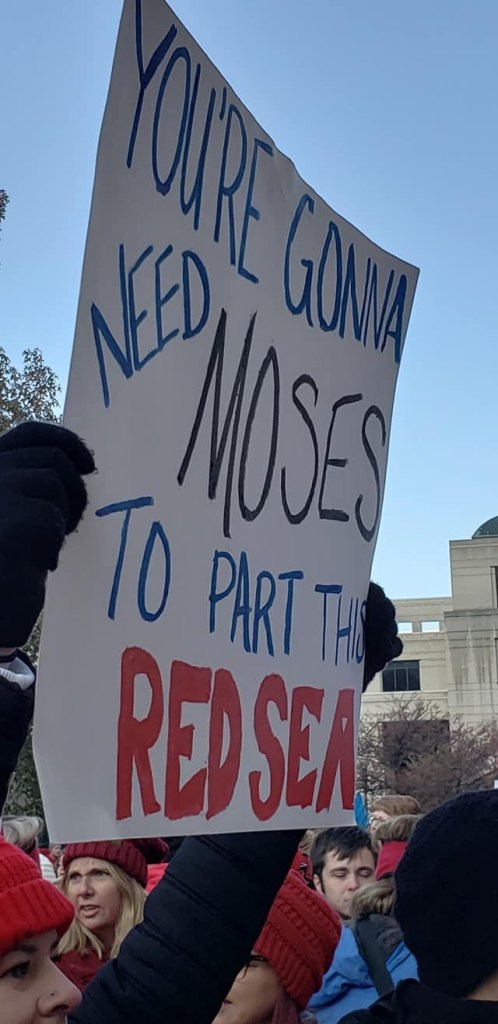
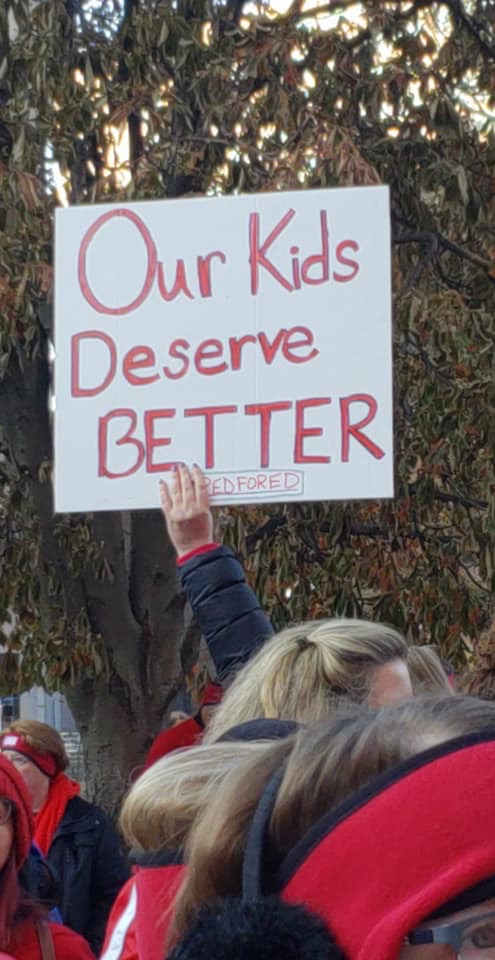
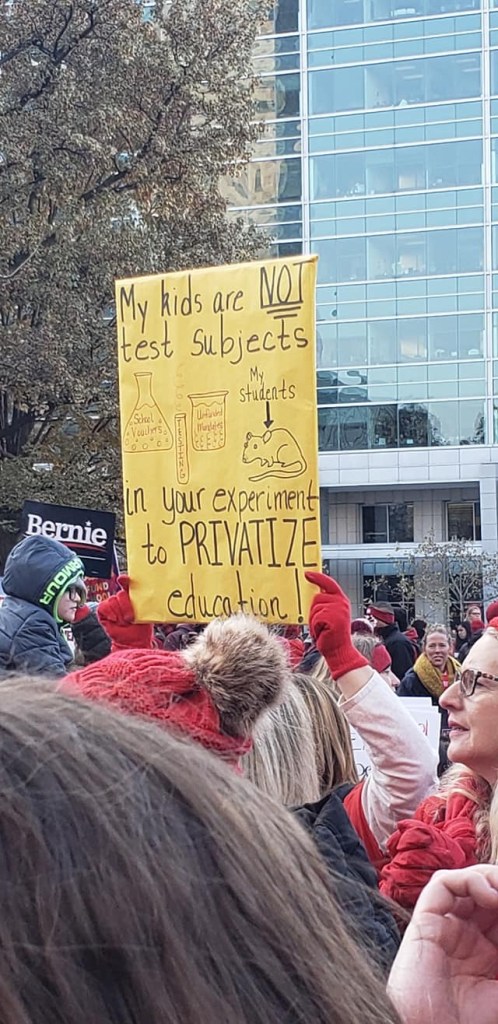
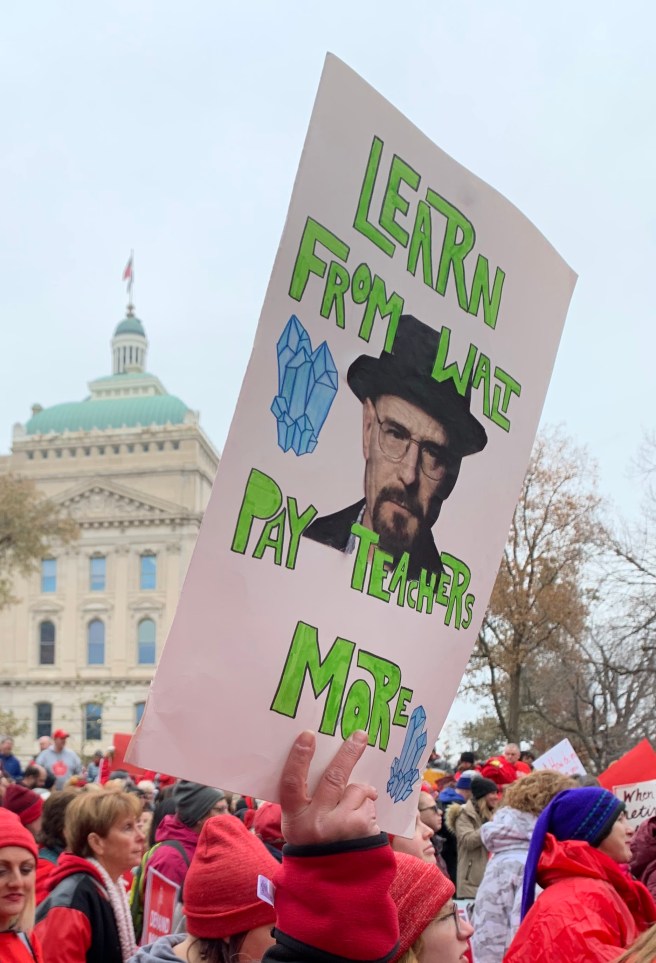
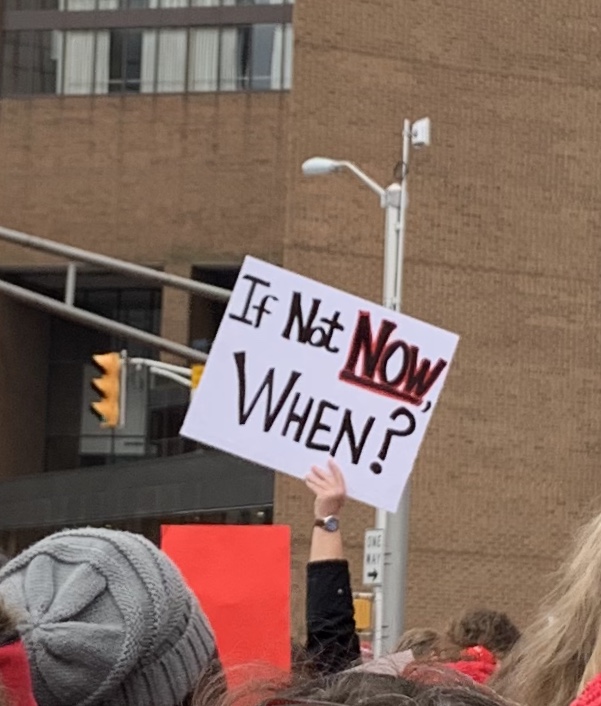
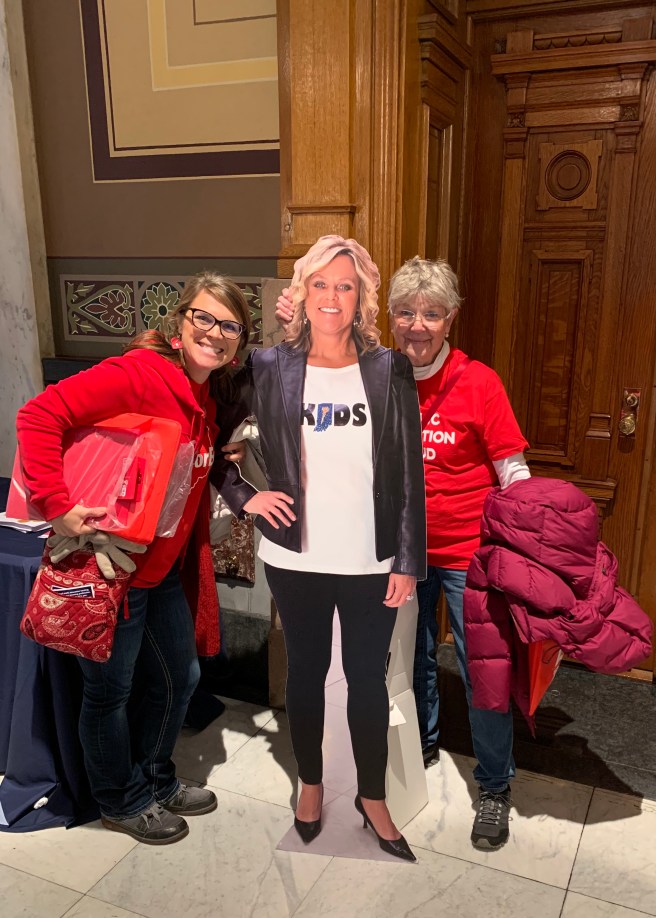
From inside our car on the way to the #RedforEd rally in Indianapolis yesterday, to the gathering on the Statehouse lawn, to the hallways of the capitol building itself, the signs told our story–more eloquently, more imaginatively, more impactfully than anything except maybe the aerial shot of the sea of teachers dressed in red.

Image may contain: crowd, tree, sky and outdoor

Students, students! What do you see? I see my teachers, fighting for me!

It was cold in the morning, but the predicted rain held off until noon, and even then, the sprinkles didn’t dampen the fervor of the teachers and their supporters nor deter the steady stream of arrivals. As one sign said:

When this many teachers show up, you know you have homework!

  • We are here because we love your kids!
  • Time to use my teacher voice!
  • Don’t stand by! Stand up! Stand strong” Stand together! #RedforEd!

The signs clarified the issues:

  • Teach more, test less.
  • It’s not a shortage, its a crisis!
  • Teachers just wanna have funds!
  • Who can justify #100 million every year for standardized testing?
  • I’m certified in economics. Do you need my help?
  • You wouldn’t be a legislator without educators!
  • My students are more than a test score!
  • Teach more, test less!

And finally, this one carried by a boy about 9 or 10:

Too many of me, not enough of them!

#Red for Ed! Indianapolis, November 19, 2019 #RedforEd

Some of the teachers from McCutcheon High School

Why We Teach, 2019

Only a few years ago, the “office humor” that circulated among educators on the Internet went something like this: “You know you’re a teacher if…” 

The ensuing list of indicators would have made anyone outside the profession wonder why on earth a person would become a teacher in the first place, never mind staying on year after year. The list highlighted job features like these:

  • no social life from August to June
  • high susceptibility to chicken pox, colds, sore throats, and flu 
  • a compulsion to put grades on grocery lists, telephone messages, and junk mail

But office humor these days is dark. It’s more than simple comic relief. Teacher salaries are lower than ever and the workload itself is greater: more students, more classes, more documentation, more standardized tests. Snowplow parents, the glare of the media, and public shaming on Facebook. Fewer substitutes, less funding for programs, and even less money for teachers. All of it is true. All of it is anguishing.

So why in the world would anyone become a teacher? Why would they stay on?

Because there’s another story.

  • It’s the young woman whose resume landed her a full-time job–the resume you gave up your lunch period to help her compose.
  • It’s the math students you’ve driven to Saturday competitions and the art students you’ve entered in contests so they can test their strengths and hone their skills.
  • It’s the “struggler” who didn’t like to read, the one you worried about and stayed after school to help, who finally confessed when he finished a novel you suggested, “This is the first book I’ve ever read cover to cover.  I really liked it, too.”
  • It’s the girl who said, “I didn’t have any friends until I joined your club!
  • It’s the student whose lines you listened to over and over and over again until you could recite them yourself–but the play was a success and the student was a star.
  • It’s the ones you’ve stayed up all night for at the after-prom and the lock-in. 
  • It’s the ones you’ve monitored early in the morning on “study table”–it kept them eligible for sports and it kept them in school.
  • It’s the ones you’ve written college recommendations for and hugged  when they told you the good news: “I’ve been accepted!”
  • It’s the ones you’ve helped in the library when they “couldn’t find anything.”
  • It’s the boy who said, “You made me work.  You taught me how to study–and now I’m going to college!”  This is the boy you agonized about on the weekends and lost sleep over at night because no one at home seemed to be helping.
  • It’s the ones who’ve come back from Middle School to say, “You really did know what skills I’d need in sixth grade!”
  • It’s the children for whom you’ve been a stand-in parent on Family Nights.
  • It’s the ones you’ve taught how to run computer programs–students who weren’t even in your classes.
  • It’s the ones for whom you’ve paid the field trip charge.
  • It’s the ones to whom you’ve given lunch money.
  • It’s the ones you’ve bought winter coats.
  • It’s the children upon whose doorsteps you’ve left holiday gifts–and then driven quickly away.
  • And it’s the light in their eyes and the lift in their voices when they learn how to read, or convert fractions, or understand covalence, or give a speech, or shoot a basket, or play the clarinet, or fix a car’s transmission…  

 Ask any educator: stories like these are the sustaining force in our professional lives, the compensation for those skipped lunches, sleepless nights, constant criticism, and endless piles of paperwork that consume the evenings and weekends. 

It’s the kids.  They’re the reason why we teach and the reason why we stay.

A Harvest of Lessons

It’s harvest time now in the Midwest. Driving across central Indiana and Illinois last weekend, I noticed all the harvesters in the fields, the golden pyramids of corn in the grain carts, the dust that swirled around the car from combines close to the highway. I wasn’t the one driving, so I had some time to gaze into those fields and reflect on some valuable lessons taught to me by my students—specifically, by my FFA students.

I live in a farming community and have taught in the same (at one time, mostly) rural district since the early 1980s. I grew up in the town where John Deere’s headquarters are still located and where J. I. Case, Minneapolis-Moline, and Allis-Chalmers all had manufacturing plants. Moline, Illinois: The Plow City, it was called.

But I was not a farm kid myself. I was pretty ignorant, when I first started teaching in Indiana, not of the importance of farming, but of the realities of farm life.

I learned some important lessons early on.

That very first year I was teaching 8th grade English, and in early May, I assigned a research paper to my students. Our school library was pitifully small; the only non-fiction sources on the shelves were encyclopedias and magazines like Good Housekeeping and US News and World Report. Not likely we’d find information on the various topics I’d asked students to choose from. So I did the logical thing: I required kids to go to the public library. In some cases, that meant as much as 40 miles round trip on a week night.

A dad set me straight right away. His son delivered a handwritten note the very next day (This was pre-email, pre-telephones in the classroom, and certainly pre-cell phones): “Mrs. Powley, This is planting season. My son is needed in the fields. He will not be going to the library after school.”

In my city life experience, going to the library was routine. It had never occurred to me that a family wouldn’t just drop everything at any time and take their son or daughter to town. I can’t remember now if we changed the boy’s topic or if I found resources for him myself or whether I waived the library requirement—but I sure learned something about flexibility from this experience. More than that, I learned how important it was to know and understand my students and their lives outside my classroom. Had I known more about the community I was in, I would have done what I did the next year: I still required the students to go to the public library—but I moved the assignment to March.

Another year, my teacher was a student who didn’t seem to take my senior composition class very seriously. He was frequently late with assignments and often tardy to my first-hour class. One day, after I’d repeatedly tried to shame him into caring about what I had to offer, he came bursting into the classroom half an hour into the lesson. He slipped into his seat and tried to avoid creating a ruckus, but he was out of breath and his shoes were all muddy. I was on the verge of chastising him once again when he blurted out, “The cows got out!” Suddenly, pronoun antecedents didn’t seem so important, and I learned something about humility. This boy was carrying a man-sized load on his family’s farm. No wonder he was behind all the time. In this case, the office excused his tardy–and I approved.

In another class, another year, yet another student talked to me—talked to the class, really, in an oral report on the pioneers of the West—about the way the soil compacted wherever the wagon trains rolled. The traces of their travel remained, showed up decades later in fields where crop growth lagged in just those places the wheels had turned over and over again. The same is true today when heavy machinery packs the earth—in forests, in fields, and even in sand. In this case, the lesson for me was about variety. Not always doing the same thing I’d done the year before and the year before that. Plowing fresh ground and rotating crops means richer conditions and better yield. The same was true of my lessons, my units, the books we read, the papers we wrote. I stayed fresh and my classes were more engaging for it.

In any community, there are mores and considerations that teachers need to understand in order to serve their students. That doesn’t mean we surrender our authority or give over our instruction, but rather, that we work in harmony with the people we serve. That’s one reason why parent-teacher conferences are important. We learn more about the families in our communities—who they are, what they do, what they hope for and expect from their children and from us. And parents learn about us—who we are, what matters to us, what we have to offer and what we expect from our students. Successful teachers develop partnerships with their students’ parents.

It’s why coaching a sport or sponsoring a club matters. It’s why attending school events registers positively with students and parents. We show we care about our kids and care about community when we show up, give of our time, engage. We build rapport. When we understand the community, we know when to be flexible, when to show some humility, and when it’s time to try something new.

All of these lessons, a rich harvest, taken from the fields and learned over time in my American classroom.

What Teachers Can Do for the Children at the Border

Reporters were let in—but only to a limited area of the Clint, TX facility. No pictures allowed. No interviews with the children being held there. No inspection beyond the prescribed tour route. No visible evidence of toys or books or art supplies or anything to distract children during the day—except one TV in one small area and a basketball hoop outdoors where no children were playing.

But supplies and food—and yes, toothbrushes—were on the shelves in the storerooms the reporters were allowed to see—suggesting, of course, that the children were being fed and cared for.

This facility was designed for 100 occupants for an 8-12 hour stay. Instead, as many as 700 were held at one time and for as long as 30 days. Then, lawyers went public with information about the inhumane conditions.  By the time reporters got in, “only” 300 children were being held there. Shortly after that, 249 children were removed—and then 100 were brought back in.

This morning, another report has surfaced. This one includes interviews the lawyers had with the children, the occupants of the facility. The children verify what the lawyers originally reported: ill-fed and ill-cared for children, filthy conditions, sickness, and neglect. In short, conditions that inflict trauma that will last a lifetime.

The current conditions are deplorable, dangerous, nightmarish. For these children, imprisonment follows the horror of separation from their parents. But even if current conditions are alleviated, these children have already suffered from trauma that will mark their entire lives.  We know from the ACES studies conducted years ago by the Center for Disease Control and Prevention and from our personal experience in the classroom with our own students—American-born as well as immigrants and refugees—that childhood trauma impacts learning. It interferes with cognitive processing, provokes inappropriate behavior, results in poor mental health, and leads to medical problems, social problems, economic problems in adulthood. In other words, a lifetime of strains on society. We know from the research on epigenetics that trauma is processed in our genes–and transmitted to future generations. So this nightmare does not end.

When these children are released to their families in America, they will soon or eventually be in our classrooms where we will do what teachers always do: help them, teach them, love them–fiercely. But we will not be able to erase their experience. If they are returned to their own countries, they will be further damaged by desperate conditions that will not have changed in their absence. At Clint, TX and other detention centers in this country, we are creating future miseries as well as current ones for these children.

Perhaps the monies appropriated by Congress yesterday will alleviate this situation and similar ones at other centers. But if our attention is diverted, new situations and new abuses will surface. One bill passed by Congress and one stroke of a pen will not permanently solve the problem, will not prevent recurrence. The money will run out and the outrage will settle down—unless we remain vigilant, committed to righting this wrong, and vocal.

We are teachers. We have experience with childhood trauma. Who better to speak for the children? We must educate ourselves about what is happening to immigrant and refugee children now; send money to organizations working for their well-being when we can; write and call our representatives in Congress with our concerns; reach out to our colleagues, our students, their parents, and our friends; and let our voices be heard—over and over again. We owe it to the children.

Further Reading:

Pitzer, Andrea. ‘Some Suburb of Hell’: America’s New Concentration Camp System. NYR Daily, New York Review of Books, 21 June 2019. 

Romero, Simon. “‘Don’t Talk to Her’: A Glimpse Inside a Troubled Border Station Housing Migrant Children.” New York Times, New York Times.com, 26 June 2019.  

Rose, Joel and Bobby Allyn. Scenes Of Tearful, Flu-Stricken And Underfed Migrant Kids Emerge In New Accounts.” npr, 27 June 2019. 

Saving the Lake

Dear Readers and Followers,

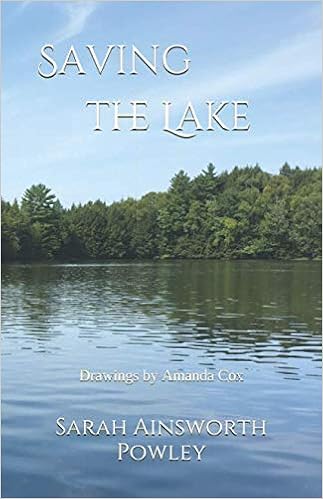
You may have wondered what has happened to me. I haven’t been blogging much this past semester.  My writing energies have been directed toward completing a book I began 25 years ago: Saving the Lake.  I am excited to tell you that it is available now on Amazon. This book is definitely about education, but it’s a very personal education story.  And in this case, my American classroom was outside, in the woods of northern Wisconsin. Here’s what the back cover says:

  A string of freshwater lakes nestled on a 2200 acre woodland preserve in Langlade County, Wisconsin, had been the summer setting for my family for four generations. I wanted to write about this natural environment, weaving experiences from my childhood with knowledge of the natural world, but I was an English teacher and it had been years since college biology. I needed to educate myself.
Armed with identification keys, mosquito netting, a camera and a notebook, I stepped into the Wisconsin woods to learn first hand about the lakes and the forest and to observe the changes in this woodland environment as the summer progressed. But it was grief that powered my quest, and some matter of the heart as much as ecology that I was seeking to understand.

This book is a memoir of family and place, a story of loss and recovery and learning to let go. 

The summer of study and reflection chronicled in this story was funded by a 1993 Lilly Teacher Creativity Fellowship Award.

If you teach in Indiana, you know about the Lilly grants. Every year, the Lilly Endowment (the philanthropic arm of the Lilly pharmaceutical company) awards grants to teachers so they can pursue a passion that will renew and refresh their spirit. The spillover to the classroom is just that: renewal.  For most people, a Lilly grant is life-changing. It certainly was for me.

My Lilly grant took me both back in time and forward in time. This past September, I returned to the Northwoods with my brother, to revisit the places we had known and loved as children and as adults. Suddenly, there was an epilogue to this story, and I took the manuscript out of the family trunk.

My amazing colleague Amanda Cox, with whom I have collaborated for years on science topics and science writing, urged me to publish the book. She produced the beautiful drawings that accent each chapter and helped me with the technicalities of independently publishing on AmazonHave a look! 

Night in Rwanda

Reading this post again today, on the 25th anniversary of the genocide in Rwanda, and on the start of the 38th Holocaust Remembrance Conference in my home town,  is chilling. If you are my former student–or even if you are not–what do you see? Do you remember? What can you do? Every voice matters.  https://sarahpowley.wordpress.com/2012/04/28/night-in-rwanda/


Improve Their Reading While They’re Reading

You’ve set them up to read with understanding, but is there anything students can be doing while they are reading that will help them understand?  A lot of kids just seem to drift away when they start reading…

Students are taught “during reading” practices throughout elementary school. When they get to secondary school, teachers stop using the language of reading and stop reminding students to employ the practices their elementary teachers have taught them. Maybe we should take a step back. Here are several of those “during reading” practices that secondary teachers can encourage, too:

Self-monitoring: All readers need to stay on top of their understanding. Most of us do all right with stories, but when it comes to non-fiction, especially if the text is difficult, we can get lost–or drift away. One strategy that helps is to consciously summarize the text at the end of each paragraph or chunk of text. Many of us do this automatically. A teacher taught us the trick or maybe we learned it on our own.

So it is with students. If a student can’t articulate the main idea of the paragraph, then understanding is incomplete. Coach them to stop, summarize (to themselves) what they’ve just read, and then go on. That means reading will take longer. Tell them that taking longer is okay. Non-fiction, especially, is harder than fiction–words and concepts are new, not as easily assimilated as when you are reading a story.

This lack of understanding is also one of the main reasons plagiarism happens. The student doesn’t understand what he or she has read; thus, can’t summarize. What sometimes is called “laziness” or mistaken for deliberate cheating is really lack of comprehension. Have the student practice summarizing a chunk of reading aloud–as if explaining to a parent–before writing a sentence or paragraph for their research report.

Visualizing. Elementary students are taught to make a movie in their heads. If it’s fiction, they are taught to create a mental storyboard. If it’s non-fiction, they’re taught to diagram, chart, map, or create a mental table as well as storyboard the content. The very popular sketch noting, or visual notetaking, is a variation on this theme. Ask students to draw what they have read and see what happens. Some kids thrive on this way of processing information.

Relate to prior knowledge: When reading an informational piece, ask students to form hypotheses about the text (predict) rather than simply recall prior knowledge. They’ll read with the purpose, then, of discovering whether their hypotheses are correct.  Also, by NOT asking for personal experience stories (elicited by the “Have you ever…” question), their connections will be connections to real content, not just to the mention of a topic. For a really insightful description of this kind of questioning, read The Comprehension Experience. (If you’re local, borrow it from me.)

Make connections to the text as they read: This is similar to the concept of connecting to prior knowledge, but it’s about teaching students to make even more connections while they are reading than they already have. To consider how the idea they are reading is like, unlike, supports, contradicts, etc. something they’ve read, seen, heard, tasted, or experienced before. For example, any cook will tell you that when they read a recipe, they’re thinking not just about the ingredients for the recipe at hand, but how that recipe is a variation on another they know–how the addition of one certain spice and the removal of another will affect a taste they already know.

Recently, I watched a video of a teacher working with her 7th grade class on a percent problem. Before they ever learned the formula for solving the problem, the teacher asked the students to consider how this problem was like other percent problems they’d encountered and how it was different. Later, the students went on to solve the problem, of course, but first they considered “same” and “different” and that helped them make sense of the new problem.

Use text structures to help them understand: In fiction, text structure means the story arc. Students learn this structure from the cradle (if their parents read to them).  As humans, we’re “hard-wired” for story anyway. That means we try instinctively to make a story out of information we receive.

Except for chronological order (which is, of course, related to “story”), the structures of non-fiction aren’t so readily apparent: cause/effect, problem/solution, analysis, order of importance, comparison/contrast. Help students learn the markers for these structures so they can get a mental outline of the text before they start reading. For example, you can augment understanding by simply saying something like this: “In this article, the author discusses two different interpretations of this historical event and gives his opinion on those interpretations.” By outlining the article for the students, you’ve boosted their comprehension of it from the get-go. Probst and Beers eludidate non-fiction structures in their second Notice and Note book, Reading Non-fiction. (You can borrow this one from me, too.)

Question themselves: Do I understand? What can I do if I don’t? Where did I stop understanding? Should I go back? Should I slow down?  (The answer is “yes.”)

When a text is difficult because the content is new, or we’re tired, or too much is going on externally, all of us stop paying attention when we read. This can happen with fiction and non-fiction. Students have been trained to be conscious of having lost the thread. Most know to go back to the place where they last remember understanding and start over at that spot. As secondary teachers, we can remind them of that strategy for recovery.

Be conscious of skimming patterns: What students are liable to do when they first start drifting is to skim; that is, to puddle-jump across the lines of text, one line at a time. Skimming is a perfectly fine way to take in information when all you want is the gist or if it’s the first time through a piece of difficult text.  But all too often, this “academic” skimming turns into Z and F.

Z and F skimming styles are unconscious but entirely natural patterns of eye movement that web designers capitalize upon to ease our intake of social media and website content. Because so many of our students spend so much time on social media, these skimming patterns may have become second nature to them.

The layout of a social media page like Facebook, Instagram or Twitter is an F pattern. Google searches come back in an F pattern. Websites, especially places you want to order merchandise from, are set up to read in a Z. Neither of these skimming patterns is efficient for academic articles or for textbooks, whether print or electronic.

The task for us is to alert students to Z and F so they can monitor their skimming behavior and adjust to the kind of skimming that’s appropriate for academic texts and textbooks, whether in print or electronic: puddle-jumping.

 Reading comprehension is an amorphous, abstract thing. Our ability to understand what we read doesn’t grow in a linear fashion or at a measured pace. It’s hard to pin down–no different than holding on to a cloud. What we do know is this: The more we read, the more we understand; the more we understand, the more we bring to the next text we read. Learning how to help yourself understand what you read doesn’t end after elementary school, and there’s a lot we secondary teachers can do to boost our students’ understanding.

Balancing Act

In view of recent events, a comment on “snowplow parenting”:

Sarah Powley's avatarIn an American Classroom

Earlier in the week, we had sleet and freezing rain; falling temperatures in the early hours of the day created patches of ice on the roads and walks.  Driving to school that morning, I saw a small figure straddling the sidewalk a block ahead of me: a very tiny woman, I thought, trying to walk on the ice.  Her arms were extended parallel to the sidewalk, and they jerked alternately up and down, in the way of someone trying to maintain balance.  She wasn’t making much progress.

But as I drew closer, I realized that the little old woman I was seeing from behind was actually a very young girl.  Her pink cotton scarf was tied babushka fashion, and her snow jacket was too big. She wore a skirt that peeked out from under the jacket and hardly covered her knees. Heavy black boots with thick rubber soles accentuated her thin legs…

View original post 665 more words