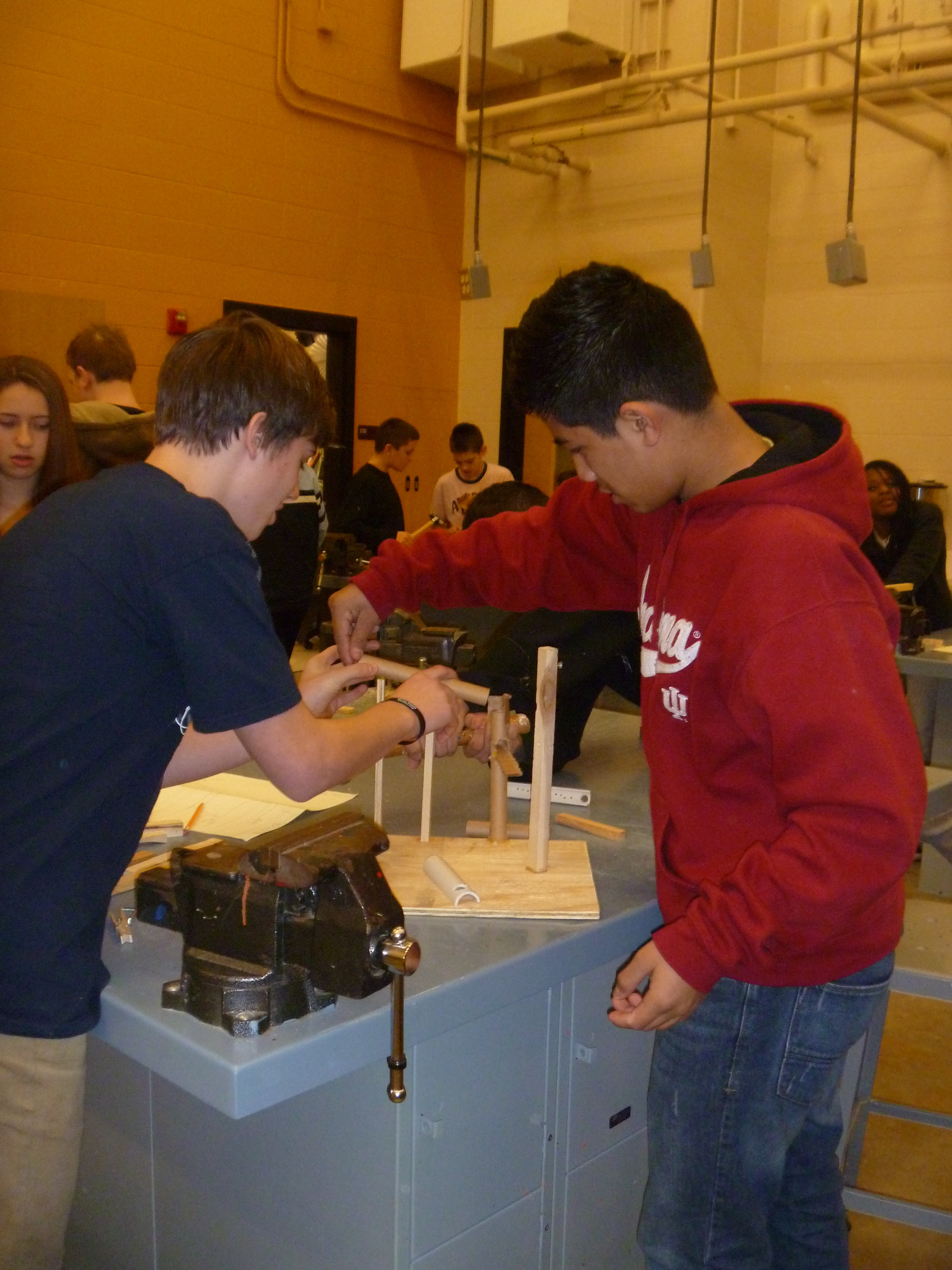
 It was a system he’d devised for grouping students that led me into my colleague’s 8th grade Industrial Technology class:
He knows, given a choice, that students will sit with their friends. So on the first day of school, when his 8th graders come into the lab setting where they will sit four to a table, he lets them do that. What he further observes is that those self-selected groups tend to be homogeneous—most everyone is a member of some social group: the brains, the preps, the slackers, etc. Kids (and adults, it must be said) are usually friends with the people who are most like they are.
But for many of the projects in IT—Project-Lead-the-Way’s Gateway to Engineering course—a heterogeneously grouped team works better. So, to get the kids into such groups without their realizing they’ve been strategically placed, this savvy teacher puts a coffee cup on each table. In each cup are pieces of paper numbered 1,2,3,4. Everyone draws a number. Basically, all the ones become a group, all the twos, all the threes, etc. If the group needs to be smaller, it can be subdivided, but divided or not, what happens is that every group includes someone from each of the social groups—and the kids think they’ve been drawing numbers randomly. No hard feelings for a student who might not have been picked. No subtle labeling by the teacher when he or she divides the kids up.
Leave it to an IT teacher to work out the mechanics of social engineering.
I stayed on that day to watch these teams at work on their Rube Goldberg projects. You remember who Rube Goldberg was: an inventor, an engineer, and a Pulitzer Prize-winning editorial cartoonist who drew elaborate machines to perform simple tasks. His name has become an adjective in the English language to designate any complex solution to a simple problem.
In sixth grade, these students had learned about the six simple machines:
- incline plane
- wedge
- screw
- lever (3 classes, depending upon where the fulcrum is located relative to the load)
- wheel and axle
- pulley
Now their task was to design a system that would use all six machines at least once to transfer energy from a given point on a 12” x 12” plywood base in a minimum of 3 seconds. A longer time is better—this is Rube Goldberg after all! Ultimately, all the complex machines would attach in a line. Students would have to devise the transitional steps between any two.
By the time I got there, toward the end of the semester, kids had already done the reading for this unit. They’d already learned the vocabulary (Try words like these and tell me they aren’t Tier 3 language: force, friction, gravity, mechanical advantage, open loop system, kinetic energy, potential energy, prototype, torque, velocity, work. Not to mention the names of the six simple machines themselves.)
The students had already been to the computers to find five common examples of each of the six simple machines: things like ramps to load or offload heavy equipment, door stops, circular slides on playgrounds, teeter-totters, wheelbarrows, shovels, rolling pins, and window shades. The research component of this project teaches kids to open their eyes to the world around them—and the amazing display of human invention that is all around us.
 They’d already drawn their plans, and those were spread out on the tables as the kids gathered materials and assembled their machines. The supplies came from random materials my colleague had salvaged, scrounged, selected, and squirreled away just for this project: odd pieces of lumber, random pieces of metal, old bits of hardware, spools, caps, plastic parts of unknown origin, cardboard and whatnot. To an outside observer, the junk pile looked like trash—but it was treasure to these aspiring inventors.
They were keeping track of their “costs” as well. While no purchased parts are allowed for these projects, the students keep a running list of the costs they incur for the materials they consume, for the use of tools, even for the teacher’s “consulting time.” At the end, cost figures into the overall evaluation of their finished product.
I watched kids consult, make adjustments, compare the product to the plan, test their device. Painstakingly. Thoughtfully. Respectfully.
 And when the bell rang, I looked around: All the tables were clear, the projects had been stowed until the next day, quiet had descended. Actually, the quiet was more the cessation of the power saws than the kids voices—because their voices had been collaborative in tone; their words, purposeful. Everyone had been contributing to the group effort; no one was a lone ranger.
There was nothing random about this class at all.
Leave it to an IT teacher to make complexity, simple: To teach kids upper level thinking skills, problem-solution strategies, skills of collaboration, math applications, and a whole lot of vocabulary, comprehension, and discipline-specific writing.
I was blown away.




 In an American Classroom