What’s in a Name?

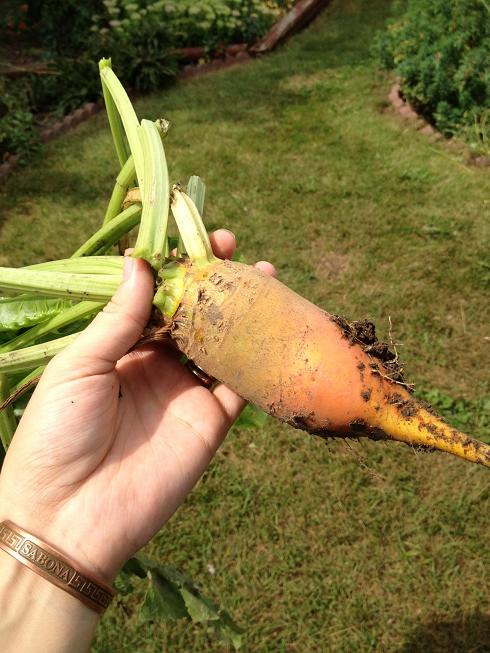
mangel-wurzels2The other day at lunch I asked a colleague who farms if she had ever raised mangel-wurzels. She started laughing, “No,” she said, “but what a name.”

What prompted the question is that a former student had sent me a few photographs of the mangel-wurzels in her garden. They’re ready to harvest, and back in the spring when she told me she’d included these ungainly root vegetables—beets, not turnips, usually fed to animals—I asked her to send pictures.

Mangel-wurzels—unforgettable in the silliness of their name–feature in the song Old Major teaches to the animals in Orwell’s classic allegory of the Russian Revolution and the subsequent years under Stalin, Animal Farm.

This story about overworked and underfed farm animals, who are inspired by Old Major’s words and brought to the point of delirium by the promise of a limitless bounty of “wheat and barley, oats and hay/Clover, beans, and mangel-wurzels” that will be theirs when Mr. Jones (“Tyrant Man”) is overthrown, is satirical. Many students need help recognizing that, even though Orwell writes that “it was a stirring tune, something between ‘Clementine’ and ‘La Cucaracha.’”

For the most part, middle schoolers, 9th graders, even Honors 9th graders haven’t been schooled in satire yet, but the mention of mangel-wurzels tips them off–especially after the whole class sings the song together from beginning to end. That’s what I used to do when I was teaching Animal Farm. Students were startled when I began a sprightly rendition of “Beasts of England,” belting it out to the tune of “Clementine.” I invited them to join in. Right away a few did, but most hesitated. I didn’t waver (even though I felt self-conscious, too) and eventually the others joined in for the sheer fun of it. In a good year, the singing became quite spirited—especially after the giggling started: which was when we got to the word mangel-wurzels.

That inspired and absurd song—its sprightly tempo, the mangel-wurzels, the “rings from our noses,” the “golden future time”—all of it—helps students recognize other points of satire in the first chapter. For example:

  • Mr. Jones, unsteady on his feet, drunk, tottering up to bed to his snoring wife
  • Old Major, a boar with a vision—and a pedigree (He was exhibited under the name Willingdon Beauty)
  • The various animals with their human traits
  • The cat voting on both sides of question “Are rats comrades?”
  • Old Major mentioning that when he was ”a little pig,” his mother used to sing to him
  • The animals readily learning the words to “Beasts of England” and singing the song five times straight before they awaken Mr. Jones

In the next chapter, after the Rebellion, the animals take Mr. Jones’ hams out of the farmhouse to give them a proper burial, and Molly, the white mare, prances and preens in front of a mirror, admiring her hair ribbons.

It’s just silly. And that’s the way that satire starts.

But Animal Farm doesn’t stay silly for long. Satire is not the same thing as parody. Because of those human characteristics—particularly those of Clover, the motherly cart-horse and Boxer, the long-suffering, devoted and steady work horse—the students identify with the animals and become invested in their struggle to make a success of the farm. But when Napoleon squirrels away the milk and apples and later when he tells the assembly that Snowball is a traitor, the students see his duplicity and share the animals’ befuddlement. When the sheep are murdered, the animals are horrified—and so are the students. When Boxer is taken to the knacker’s, the students are outraged—and hurt. They feel the betrayal, too—just as Orwell intended.

What’s in a name? Orwell choosing an absurdedly named root vegetable to represent the hope and promise of rebellion—the utopia of Old Major’s vision—is an early clue that Animal Farm is satire. Looking back from the end of the book, it’s also Orwell’s final word on the subject. In his view, the ideal is impossible. It is the nature of power to corrupt; eventually, the new leaders will morph into the old, again there will be masters and slaves.

Mankind can achieve and sustain egalitarian self-rule?

Nonsense!

Poppycock!

Mangel-wurzels!

Winners All

Norman Borlaug: not exactly a household name. But it should be. The father of the Green Revolution, Norman Borlaug has “saved more lives than any other person who has ever lived.” That’s not hyperbole, that quote from the Atlantic Monthly.

He was awarded the Nobel Prize in 1970 for his work in developing disease-resistant varieties of wheat, a breakthrough development that he pioneered in Mexico, and replicated in India and Pakistan, expanding the technology to rice and saving millions of lives in the process.

In 1986, he established the World Food Prize to recognize individuals in the field of agriculture whose advancements in science have had a significant impact on the elimination of world hunger.

Later still, in 1994, Norman Borlaug established the World Food Prize Youth Institute, a competition in which high school students study food security issues in countries around the world. After months of research and essay writing, students submit their essays and then present their work orally at regional competitions. The winners there attend the World Food Prize Institute in Des Moines, Iowa, where they interact with some of the most prestigious scientists in the world, learning more about solutions to world hunger and exchanging ideas with these leaders in the field.

We—my high school and my coaching colleague and I—are sending students to Iowa in October: one who ranks among the top five participants in our region and an alternate! Actually, we have a third student who has “advanced,” but she’s a senior this year and therefore can’t compete next fall.

If you read my post “Second Skin,” you know there was one boy who needed help with his citations: He’s our alternate—and he probably will attend. How gratifying is that for the two hours we spent sitting across from each other at a table, whipping those citations into shape???

This past April 4th and 5th, students from the competing schools in Indiana gathered at Purdue (with their coaches) to present their work, exchange ideas, and learn about food science at Purdue. On Thursday evening, the students presented their research findings to panels of experts—Purdue professors from various departments whose own research endeavors concern issues of world hunger. The professors had read all of the students’ research papers—carefully, as we soon discovered—and then queried the students about their research. In small groups and in front of their peers, the students defended their research and their solutions by answering the questions posed by these experts.

This was nothing like the comfortable audience of peers students face in their English or speech classes. The professors were certainly respectful—even friendly—but there was a formality to the setting that high school students rarely experience. The professors posed tough questions and pulled no punches in their questioning. In one case, a professor told a student her statistics were faulty. No gentle suggestion that she “might want to check her facts” as high school teachers sometimes gingerly write in the margins of an ill-researched paper. Nope. “Your statistics are wrong.” Flat out.

You could almost hear the students gasp.

But this is the big leagues. Facts must be right, and when they aren’t, a student needs to know.

After the oral presentations, which we discovered later weighed heavily in the selection of finalists, the students reflected on the process of writing, researching, and presenting their work and conversed with the experts who had questioned them. They gained insight into the way that scientists think, advice on how they could help people in the developing world—even what courses to take in college to combine their specific academic interests and the urge to help globally. One of our students—who wants to go into an engineering field—was told to “look for opportunities to collaborate” with other departments. The opportunities abound, a professor told her, to make a global impact through engineering—for example, in developing relatively simple agricultural tools. He explained that shovels, for example, are designed with adult males in mind–but in some countries, it is women and children who are the chief agriculturalists.

Because of my responsibilities in other schools, I could not attend the day on campus that followed on Friday, but my colleague was there with our five students. She told me that they were welcomed at breakfast by Dr. Jay Akridge, Dean of the College of Agriculture.  He applauded the research efforts of all of the participants and, more importantly, validated their selflessness in, at such a young age, wanting to make a difference in the world.  During the rest of the morning, the students were introduced to classes and majors at Purdue that would allow them to pursue their area of interest further.

At lunch in the Purdue Memorial Union, the students listened to two Purdue World Food Prize winners, Phil Nelson (2007) and Gabeisa Eijeta (2009).  Both men spoke of their research and explained that by first identifying a need, they had been able to discover or invent a solution that had made a difference for people in many poverty-stricken nations.

In the afternoon, the high school students attended sessions in agronomy, biochemistry, agriculture and biological engineering and food science.  Each of these sessions involved a hands-on experience.  For example, in a visit to the Biochemistry Department, the students loaded and ran an electrophoretic gel to identify a fictitious bacteria found in “homemade” yogurt.  In the Agronomy Department, a researcher led the students through a demonstration of some basics of soil chemistry and explained how different soil types affect product growth.

On Friday afternoon, students received written feedback on their research papers and had an opportunity to reflect again on the World Food Prize experience from start to finish. I was there for the wrap-up and was able to listen to the students articulate their take-aways from the World Food Prize experience. In general, students remarked that they had not only benefitted personally from the experience, but that they had been inspired because they had participated in a project “bigger than themselves.” Many said their eyes had been opened, their lives changed.

A week later, the results were announced. That is when we learned that several of our five students would advance. But the fact is, we have five winners. For all of these students, the prize is not the public recognition of their accomplishment, not the resume item or the activity they can list on their college applications, but the insight they have gained, the perseverance they have practiced, the skills they have mastered. Their hearts have been touched by the depth of their exposure to issues of poverty and hunger and their minds have been expanded beyond what they could have imagined when they first began their research.

Norman Borlaug intended to enter the field of forestry. In fact, he had a job lined up with the US Forest Service after graduation from college. However, tight money during the Depression delayed his start by six months. While he waited, Borlaug decided to stay on at the University of Minnesota and take some more classes. One day, quite by chance, he attended a lecture on plant pathology that changed the direction of his life. He decided not to take that job with the Forest Service and, instead, entered the Ph.D. program in plant pathology. The rest, as they say, is history.

Our students took a chance on a competition that was time-consuming and intellectually demanding, on a writing project that wasn’t easy, on an endeavor for which every reward has been intrinsic—not an easy sell for sixteen- and seventeen-year-olds.  But look what has happened. Is it possible, just possible, that in signing on for the World Food Prize competition, by studying the topic and factor that they did, they have found direction for their life work?

Every night, one in seven people in the world goes to bed hungry. It is possible that one of these amazing students will someday make a discovery that changes those odds?  Imagine. It could happen.

Candy in My Mouth

April is National Poetry Month, so it was a perfect time for my colleague (a middle school English Language Arts teacher) and I to plan and present a lesson on how to read a poem. I’d been talking about one of my favorite methods for unraveling meaning in poetry, and she invited me to demonstrate for her 6th graders.

Offer me a chance to teach?  It’s like giving me candy.

I selected three poems, two from the textbook, and a charming one I remembered from a  long time ago, Eve Merriam’s lovely invitation to enjoy poetry, “How to Eat a Poem”:

Don’t be polite.
Bite in.
Pick it up with your fingers and lick the juice that
may run down your chin.
It is ready and ripe now, whenever you are.

You do not need a knife or fork or spoon
or plate or napkin or tablecloth.

For there is no core
or stem
or rind
or pit
or seed
or skin
to throw away.

I have always loved this sweet, delicious comparison between a poem and a piece of fruit—especially juicy fruits, like peaches and pears and watermelon, where the deliciousness runs like a river, all down your front. The poem seemed like a great hook.

The second poem I chose was from the text: Gary Soto’s “Ode to Family Photographs.” Soto’s poem is a list of images—descriptions of bad family photos—images gone awry because the photographer was no good with a camera.

This is the pond, and these are my feet. 
This is the rooster, and this is more of my feet. 

Mama was never good at pictures.

This is a statue of a famous general who lost an arm, 
And this is me with my head cut off. 

This is a trash can chained to a gate, 
This is my father with his eyes half-closed. 

This is a photograph of my sister 
And a giraffe looking over her shoulder. 

This is our car’s front bumper. 
This is a bird with a pretzel in its beak. 
This is my brother Pedro standing on one leg on a rock, 
With a smear of chocolate on his face. 

Mama sneezed when she looked
Behind the camera: the snapshots are blurry,
The angles dizzy as a spin on a merry-go-round.

But we had fun when Mama picked up the camera. 
How can I tell? 
Each of us is laughing hard. 
Can you see? I have candy in my mouth.

I expected opportunities to talk about the individual pictures; to notice the two switches to italics (not italics, here) whenever the narrator stops to explain about Mama; to look at the possible meanings of that last line, candy in my mouth; to examine the writer’s tone—nostalgic about those family moments, kind—even amused—in his assessment of Mama.

The third poem was Emily Dickinson’s 4-line nugget, “Fame is a Bee,” all about the allure of fame, its glamour, its backlash, its transitory nature. Perfect for kids in thrall to performers on American Idol.

Fame is a bee.
It has a song–
It has a sting–
Ah, too, it has a wing.

As I planned it, we’d do the Merriam poem first, then the Dickinson one, and end with Soto. I’d lead the students to learn and use the words ode, stanza, image, voice, metaphor, and tone. The objective—beyond making the terms a part of their working vocabulary—was to show them a method they could use on their own to figure out the meaning of a poem. What I wanted above all was to excite the students about poetry. I planned to leave them at the end with a little present—a personal poetry reader for each child—a bright yellow card decorated with a fruit sticker and the words, “Bite in!” A reminder of Merriam’s poem; a reminder of our class period together.

My sequencing of the lesson would have been good—it would have worked—but when I met with my colleague to fine tune the lesson, “good” turned into “outstanding.” That’s the beauty of instructional coaching—two heads are better than one. I knew the strategy and I picked the poems, but she had the genius to put it all together in a way that would capture the kids.

When we started talking about the lesson, we knew we’d need a hook. My colleague had just the idea. She loves games. In fact, her classroom is decorated with boxes of games, game boards, game pieces. And she had a wonderful one she had grabbed at a garage sale: Awkward Family Photographs, a collection of perfectly awful family pictures. Her idea was to have a handful of cards on each table when the kids came in. We’d let them look at the photos for a few minutes, talk about why they were funny or scary or stupid, and then launch into the Soto poem. P1020407

So that’s what we did on the appointed day. She set up the hook and after a few minutes of laughing together at the pictures, I read the Soto poem aloud. The kids followed along.

“I don’t get it,” Daniel said flat out at the end. We loved that. It was the perfect entrée to the slow reveal.

I moved to the interactive whiteboard, the centerpiece of the strategy. The “screen block” tool would cover the poem and I would expose one line at a time, asking questions of the students to show them how the poet constructed meaning, line by line by line.

And the technology failed. It had worked in the morning before class. What had happened?  No time to twist our hands, throw them up in despair. Gamely, we went on, directing the students to look at each line of the poem in turn until we reached the end.

Of course, because of the Awkward Family Photographs, the kids caught on to the images immediately. That meant a lot of fun conversation about what was happening when Mama snapped the picture—what she intended to capture with her camera and what she actually got. Favorite line? This is me with my head cut off.

“How could he take a picture of himself with his head cut off?”

“But remember the line, Mama was never good at pictures?

“What new piece of information did you get there?”

“Oh! Mama’s taking the pictures!

We lingered on the stanzas about Mama. “How does he feel about his mama?” I asked at the end of the second one. “What’s his tone when he talks about her?”

“He isn’t mad at her!”

“He thinks she’s funny. He says, Each of us is laughing hard.”

One girl said, “It’s kind of like when people say, ‘You gotta love her!’ when they mean a person drives them crazy but they love her anyway.”

And what’s this last line: I have candy in my mouth?

Silence.

Think metaphor, kids.  Poets and words…children and candy.  All sweet.

“The experiences were sweet and he’s writing about them.”

“Uh-huh. We call that ‘nostalgia,’ when you look back on something and remember it so fondly.”

“He enjoyed those times.”

“Maybe it’s just candy in my mouth.”

“Either way.”

We looked at “Fame is a Bee” next.   The poem seems so obvious that I was surprised the kids were puzzled when I read it through. But they remembered the word metaphor, could tell me it was a comparison, so I called on them to brainstorm the pros and cons of fame.

“Money!”

“Limosines!”

“Mansions!”

“Paparazzi!”

“No privacy!”

“Stuff on the Internet.”

“And what if you don’t make it on American Idol?”

“People forget you.”

And then we started brainstorming the attributes of a bee: the buzz, the sting, the pollination—good for the flowers—honey…and…

“I got it!” Clayton shouted out before we even finished. And line by line, he explained the connection. He was popping up and down in his seat he was so excited.

Alyssa, the thinker: “But you know, wings can carry you anywhere. The wing doesn’t have to mean ‘forgotten.’ It could mean carrying you to another place…”

I love an independent thinker.

Finally, “How to Eat a Poem.”

An implied metaphor, we said, when they saw there was no “one thing is another” as a metaphor lays it out.

One boy was sure the juice was from a cheeseburger, but the unraveling strategy worked like it should when someone else pointed out ripe. “Cheeseburgers aren’t ripe.”

“And ready when you are! It’s always there, just waiting for you.”

“It’s definitely not a cheeseburger. Cheeseburgers don’t have pits or seeds or stems!”

“But the poem isn’t like a fruit because there’s nothing to throw away.”

Not a word or a punctuation mark or a break in the page to spare. Yep, they got it.

My colleague and I had a ball. I did the lesson myself the first time through, but with the next class, she was asking the kids questions, too. The third time around, even more so. The technology never did work. No matter. She did the next two presentations solo (I was somewhere else in the building), but for the last period (she has six classes and 170 kids!), by which time I had returned, we decided to function as a tag team. By then we had expanded the lesson so much that we only got through two of the poems! That was okay. She would do the third the next day. The students would be reading more poetry, using their texts and the poetry readers I’d made for them. P1030329

“I wish we could always be two heads on a lesson,” she said. “What’s our district thinking, not hiring two teachers per room?”

What are they thinking, indeed?  That’s what coaching is all about.

It was sweet all day.

Second Skin

I slipped into the task like putting on a second skin.

Since the beginning of this semester, I’ve been working with a high school science teacher on a project tailor-made for co-teaching. She had gotten wind of an essay contest—the World Food Prize Essay Contest for high school students, sponsored by Purdue University, home to two World Food Prize winners. The contest is an opportunity for high school students to learn about and address issues of food insecurity around the world. What this teacher proposed was a melding of our areas of expertise—science and English—with the added fillip for both of us of the international focus.

In December, I perused the contest particulars.

The format was fundamentally a problem-solution paper. Background on the country came first. In the sample paper provided by Purdue, the winner from last year had painted a picture of Afghanistan in condensed, tightly written prose that led directly to the paper’s thesis: The central issues surrounding food insecurity in Afghanistan and some solutions that would alleviate them. Then, a lengthy and thoroughly researched discussion of those problems and solutions, and finally, a summation and restatement of the thesis. All of this, of course, documented with in-text citations and a works cited page in MLA format.

It was certainly a longer paper and a more complicated research project than any of our students would ever have undertaken—but not impossible at all. Especially when we broke the paper down for the kids and laid it out in steps for them. You notice, I am already saying “our kids.” It didn’t take me long to feel like a teacher of kids again.

Writing a research paper is one of the most difficult tasks high school students undertake. It’s a long process, and that’s hard in itself for kids with attention spans that last no longer than a Facebook post. Then, reading is involved—and with that, the pesky but fundamental comprehension skills of paraphrasing and summarizing. Then, the organizing of all that information: in the day, with index cards, each labeled with the author, title, page number, topic and subtopic, and perhaps—if I had been your teacher—marked as a paraphrase, a summary, a quote, or a basic fact.

We don’t do that anymore. Today, kids keep binders that contain printouts of the articles they’ve found, all tabbed alphabetically and highlighted for easy access to information the student intends to use in the paper. Increasingly, as they and we become more eco-conscious, the students don’t even keep binders. They create folders on their desktops. For the organized among them, this works just fine. For the others, it’s the beginning of a nightmare.

Some teachers still require outlines, a skill to be taught all by itself. I used to demand sentence outlines because the students would be forced to think their  papers through. Some of the first problems arise at this point: Just knowing the difference between a topic and its support befuddles some kids. They’ll use a quote for a main idea and a fact as a topic. But if their outlines are complete, I can read them and tell the students where the holes are. A few students will realize that with a sentence outline and well-organized index cards or binders, the paper will write itself.

For some students, actually writing the paper is the stumbling block. It means sitting in a chair for a long period of time and composing one sentence after another until the end.

But it’s not the end: Now come the in-text citations and the bibliography or works cited page. For some students, this is the trickiest part because it requires having kept track of all their resources (those index cards or the tabbed binders again) and having developed a system for keying all the quotes, statistics, examples, stories, facts, and details that they used for support to the ideas in the outline. For kids who can’t keep their lockers or their bedrooms tidy, this is a sorting and classifying task like no other!

And it’s still not the end: editing and proofreading and cross-checking the citations remain. And nowadays, even one more step: submission of the document to a plagiarism detection program like Turn It In, the advent of which was a boon to exhausted teachers, who used to have to google suspect lines or search through the students’ binders and cards to prove the student had copied. (You dare not even hint at plagiarism without the proof in hand!) Used as it’s intended, though, and done soon enough before the paper is due, the program serves as a plagiarism prevention program. I know many kids who have been saved from academic disaster by Turn It In, and I’d far rather coach a kid through the process of paraphrasing than nab him or her for plagiarism.

Are you tired just reading all this?

And you don’t have to read the papers! Or send them back for revisions and read them a second time!

Are you impressed with the sheer complexity of the task?  Me, too. I am always proud of my students when they reach the end of this task—even if their papers aren’t stellar, they’ve accomplished a complex task.  Perfection will come with maturity, experience, and the incentive of researching a topic they really care about (which they’ll do increasingly as they narrow down their academic pursuits to their life’s work).

So I knew very well what the World Peace Prize essay contestants would face as they researched a topic they knew nothing about—a country and its problems with food insecurity—and wrote the longest and most thoroughly documented paper they’d ever attempted. But I also knew that any student who elected to enter this contest would be self-motivated (no grades involved, no extra credit), willing to read, and immensely capable.

So yes, we had to help some of them select a country from a list of over 100 and choose a factor (the contest organizers presented them with a list of 19 factors that impact food security), help others select resources and evaluate those resources for credibility and authority, and talk all of them through their research—help them make sense of what they had read. But this was kind of fun for us as teachers. My colleague and I got wrapped up in the topic ourselves.

We both read the students’ early drafts and made suggestions for revisions (We were excited that we noticed and commented on the very same things) and then, at the end, I helped them with the documentation and works cited page by cross-checking their citations.

One boy did need major help with this part—and so I spent two hours yesterday teaching him how to do it, sitting beside him as he hunted out the source of each statistic and quote, each example and fact. I sat across from him while he reconstructed his works cited page and watched as he formatted the paper to meet the contest requirements. It’s not that he hadn’t been taught this process before, but I suspect such things had never mattered to him before.

But he was receptive yesterday—because suddenly, such things did matter. These papers were going out into the real world, would be read by a real audience, and since the boy cared immensely about his topic and had written a very strong paper, he really cared that he got the citations and the works cited page right.

My colleague submitted the papers yesterday after school. We think there are some among them that could be winners…but in truth, all of the students are winners. They completed this difficult task and have taken away a lifetime understanding of a serious global issue and a skill set for research that will make any paper they write from here on out, a breeze.

And I had the delicious experience of co-teaching with a colleague I admire, watching her coach the students in high-level analysis of substantial and substantive scientific information and using again myself the teaching skills I have learned over a lifetime spent in the classroom.

It was a win all around.

Chocolate Scramble

191

I don’t ordinarily distribute candy to students as an incentive, but when I am introducing Animal Farm to 9th graders, I need to acquaint them with the concepts of communism and capitalism.

To do this, I engage them in a simulation activity I learned from an amazing social studies teacher. In this simulation, Hershey’s kisses equal money. But I don’t tell the students that until later. I just come in one day and start inexplicably throwing chocolate around.

If the principal came into my room for a 10-minute walk-though just as I was throwing the Hershey’s kisses up into the air and saying “Go for it,” he might well wonder what I was up to. In light of the scramble that ensues—kids bolting from their chairs, dropping to the floor, reaching, stretching, even covering the chocolate pieces with their bodies—I could just hope that he knows me well enough to believe there’s method in my madness.

Capitalism, I could tell him, and maybe he’d see that kids diving under tables and greedily scooping up kisses by the armful resembles the drive to amass a fortune. Maybe he’d see the girl with the big heart slip a few pieces of chocolate to someone who has none and recognize the philanthropic impulse. Maybe he’d see the kids who are seated at the back of the room or trapped behind furniture and realize they represent the disadvantaged in our society. “Not fair!” he’d hear a few kids cry—and see them sit there, mad.

If he came in later, when I was redistributing the chocolate evenly, would he see the gratitude of those who had nothing, suddenly having something?  Or would he see the complaisance of those who hadn’t been willing to scramble, smiling smugly when they got some chocolate anyway?  Would he see the frustration of the ones who put had effort into the game, no longer having so much?  “Not fair!” he’d hear them cry. Or would he think I was just offering up candy that day and making sure—in good teacher fashion—that it was shared equally, that everyone got the same amount?

He might come in later when a discussion about these two economic systems was underway. Would he wonder why the kids weren’t naming the systems? I wouldn’t stop to explain that I hadn’t yet labeled them: If I had, the students’ discussion would be informed by what they already knew or had heard somewhere. In this simulation, the scrambling represents the American system, capitalism: The students might not be able—or willing—to point out its flaws. The other system is one they’ve already, by age 14, come to regard negatively. They might not be able—or willing—to discuss communism without bias.

But this way, with chocolate as the symbol and no names named, the students conclude that neither system is perfect.

And then I name them, the systems (and reveal the learning objective for the day, hidden from the kids until now so as not to spoil the discovery aspect of this lesson): Students will understand and discuss the advantages and disadvantages of two economic systems—capitalism and communism.

Looking at the activity as a vocabulary exercise, what better way to make meanings permanent than with a physical activity? For learning words, the research tells us that kinesthetic connections create the strongest memory bonds of all.

Or, if I think about it as a strategy for stimulating higher level thinking, the discussion is really a comparison/contrast exercise—We know that one of the best ways to understand one thing is to juxtapose it with another and examine the points of similarity and difference. So it’s analytical.

And as a stategy to build familiarity prior to reading a text, which is what an English teacher also needs to do, the simulation works perfectly. Suddenly the excesses of Mr. Jones of Manor Farm are made real, and the intent of the rebellious animals—to share equally in the work and the profits of the farm—are understandable.

But of course, what begins idealistically in Orwell’s classic deteriorates rapidly. The introduction of Napoleon and Snowball turns Animal Farm into another thing altogether.

“Not fair!’ the students cry when the milk and apples are reserved for the pigs. “Not fair!” when the pigs begin sleeping in beds. “Not fair!” when confessions are forced and animals executed. More than “Not fair!” when Boxer is sent to the knacker’s. Kids sometimes cry tears, not just foul, when they realize, with the betrayal of Boxer, the depth of Napoleon’s deceit. At the end of the book, when the pigs are walking on their hind legs and carrying whips in their hooves, when the other animals see Napoleon and Pilkington playing poker and raising toasts to each other, the pigs and the men around the poker table indistinguishable from each other, the destruction of Animal Farm is complete.

And now, a third term—totalitarianism—presented visually with the image of Napoleon, drunk with power and playing cards with Pilkington. The stage is set for another analysis task: tracing what happened at Animal Farm, step-by-step, in order to see exactly how the animals were deceived. And then for another: drawing the allegorical connection between what happens on Animal Farm and the Russian Revolution.

What goes on in a classroom is so much more complex than what meets the eye. Throwing chocolate around, indeed!

It’s ideas that teachers send flying through the air—and lessons like “Chocolate Scramble” that land them in students’ minds.

PS: That amazing social studies teacher? My daughter. Thanks, Elizabeth. This simulation worked for me for years–and when I left the classroom, I passed it along to my colleagues. Isn’t that what teachers do? Share the wealth?

The Text, The Students, and Me

“Mrs. Powley! How do you know all this stuff?”

I sometimes heard that question when I was the teacher at the front of the room, leading my students through Great Expectations, Huckleberry Finn, To Kill a Mockingbird, The Great Gatsby…and a library of other literary staples in the English Language Arts canon.

Such a remark was gratifying to hear because what it really meant was that the students had been awed by the text.

“I’ll never be able to read a book like that,” they would say.

“Yes, you will,” I’d answer. “It takes practice.”

And I had to be honest: “Do you think all this comes to me the very first time I read a book?”

I reread the text, I told them, every single time I taught it.  And every single time, I picked up on more subtleties, developed more insight, made more connections within the story and to the world outside my classroom.

“That’s what I’m trying to teach you,” I’d say. “How to read.”

Lately, I’ve been reading a lot about an instructional strategy called “close reading.”  It’s the opposite of reading to get the gist of a piece; that is, reading to summarize.  The Common Core Standards document sets out as its aim that students should be able to “deeply” analyze a piece of “rich text”—it doesn’t matter whether fiction or non-fiction—in order to understand how an author has constructed meaning.

A close reading of text is a rereading of a small slice of a story (or something that is short to begin with, like a poem or an essay)—perhaps rereading it many times. Then, through careful inspection of words, sentences, paragraphs, and the way they work as parts and together as a whole, the teacher leads the students to discern the author’s meaning.  Students are guided to provide “textual evidence” that the author’s meaning is what it is. They can’t  guess, based only their prior knowledge and a cursory look at the words on the page, what the author intends.  This means, practically, that a Cliff Note’s acquaintanceship with the text won’t cut it.

The more I have read, these past few months, about “close reading,” the more familiar it has seemed to me. That’s because, in the very best of my literature lessons, that is what I had been working at for years.

Reading about this “new” instructional strategy has set me to thinking about my long journey through pedagogy and practice, about all the strategies and instructional supports I’ve used throughout the years as I’ve tried to help students make meaning of words on a page.

When I began teaching, the hardest thing for me was to get a good class discussion going.  I didn’t seem to ask the kinds of questions that led to scintillating discussions of life, death, and everything important in between, the kinds of discussions star teachers reported having, discussions where the classroom rhetoric soared and kids came away with life-changing notions about the universe and their place in it.

My questions were the standard ones—and don’t get me wrong, they weren’t unimportant—about the plot of a story, the characters in it, the symbols, point of view, setting, and how they all contributed to the themes of whatever book we were reading.  I’d plod along, chapter by chapter, and it seemed to me the conversation was stiff.  I wasn’t sure where discussions might go, what kids might say, so I pretty much stuck to the script.  Still, kids read the books and told me they enjoyed them.  (Some didn’t, I’m sure.)

I thought maybe the stiffness came from the way I was approaching the stories, so for a while I depended upon the textbook to set the pace. Sometimes, I found, those questions were fine, but sometimes I thought they required the kids to make fantastic leaps of insight.  Other times I thought they didn’t emphasize what was really important.

Like a lot of novice teachers, I used to think the textbook company was the authority on curriculum and instruction. I guess I imagined the editors sitting around having deep conversations about theories of writing instruction and seminal works of literature and the evolution of the novel as an art form.  Presumably, those fervent conversations ended with the editors scurrying to their office cubicles, like monks burning with the faith, to annotate a text and develop the accompanying questions.

Eventually, thank goodness, I realized that the editors were concerned with real things—like wooing customers and cutting production costs—and that the actual writing of the text and the materials to go with it were contracted to consultants.  Thus, the questions in the textbook were only as good as the consultant who wrote them.  And that consultant was a human being—just like me.  With that bit of enlightenment, I felt justified in choosing not to use the questions at the end or to use only some of them.

I tried various “frames” for asking questions. One that teachers use frequently to develop comprehension skills sorts questions into a three-tiered hierarchy. The first questions are “right there” in the text—a student has only to skim and scan for the answer; the second ones require making inferences—the student finds two (or more) bits of information and puts them together in her head. The third tier questions require the student to make a connection to something else she has learned in English class or in another class or even to something she knows from life experience.  Not bad, this frame, but it didn’t always serve my purpose.

There are 4-level frames and other 3-level frames, too, but none of them were fail safe structures. Besides, I’m an English teacher, and what I really wanted—increasingly so as the years went by—was for kids to see how the metaphorical language worked, how the word choice mattered, how images supported meaning, how rhetorical devices helped the writer accomplish his or her purpose.  I was interested in how the author made meaning, in the craft of writing.

I grew to dislike the 4-pound literary anthology that, for the most part, gave students snippets of text (the last one devoted exactly one page to Moby-Dick), the easiest or shortest story an author had written, and poems that were perhaps the most accessible to students but not necessarily the richest.  Today, a typical anthology is accompanied by an even heavier teacher’s edition, the pages so packed on the sides and along the bottom with suggestions for teaching that the literary text in question is condensed to 8-point type.  I could barely read it.

And that doesn’t include the ancillary materials supplied by the publisher—supplementary vocabulary instruction, grammar exercises, practice tests, overhead transparencies, writing prompts, and daily oral language items (DOL, as we say in the business)—that escalate the cost of these anthologies. So much help for the teacher is provided that I found it paralyzing.  Too many choices.

I yearned for it to be just the text, the students, and me.

And that is how I came to “close reading,” even though I had never heard the term.  I stopped plodding through the anthology, stopped trying to create artificial discussions, stopped trying to cover everything.  From a chunk of text that I believed was pivotal in terms of the story or central to developing the themes of a book or key to understanding the author’s style, I’d ask questions that demanded a close look at word choice, at sentence structure, at metaphorical language, at rhetorical devices. Slowly, sometimes dramatically, big ideas would emerge. Then kids would say, “I get it!” or “Wow!” or “Oh, my gosh.” They’d grasp the beauty of what the author had accomplished and appreciate—really appreciate—how she had accomplished it.  Sometimes we made connections from there—to their own worlds or to other things we’d talked about or they’d learned elsewhere—but these connections stemmed from real knowledge of the text, not from idle remarks, snatched from thin air.

Of course, “close reading” is not all that I did in the classroom.  And I wish I could say this kind of epiphany happened every day and every time I taught a poem, an essay, a story, or a passage from a book.  It didn’t.  But when it did, it came about from something deep inside the text, the students, and me. And it came often enough that I know this “close reading” strategy isn’t just another instructional fad.

Besides, the best teachers I know do the very same thing.  They bring their students face-to-face with the words in the text. We don’t all follow the same procedures or choose to emphasize the same thing, but we get the same results: Kids learn to read, really read.

A Christmas Memory

IMG_0531In years when I was not running behind by December, when I hadn’t lingered too long on To Kill a Mockingbird or Great Expectations or any other of the books my freshmen read, back when so many days weren’t set aside for standardized tests and final exams and AR assessments, back when I had control of the calendar, I liked to set aside the last several instructional days of the semester for Christmas literature. Sometimes we read A Christmas Carol, sometimes Dylan Thomas’ “A Child’s Christmas in Wales,” sometimes Truman Capote’s “A Christmas Memory.” My favorite, of course, was the latter—for two reasons. First, because the story lends itself to the students writing their own memoirs about Christmas—always a delight to read—and then, because I loved watching my students come slowly to the realization that the little boy narrator of “A Christmas Memory” and Dill Harris in To Kill a Mockingbird were one and the same person.
That was, of course, when such knowledge was still a revelation. Today, because of the Internet mostly, kids already know. This upset me at first. A perfectly wonderful epiphany: smashed. But I got over it. (The real Buddy as the model for Dill isn’t the only literary surprise the Internet has ruined. These days the kids know before they read the Odyssey or their first Shakespearean play that Homer wasn’t one person and Shakespeare may not have been Shakespeare.)

But back when Buddy/Dill was still a surprise, we’d read the story together—parts of it, at least, aloud.  Knowing where the story goes, I’d have trouble when the kites begin their ascent to the sky, when Queenie buries her bone, when Buddy’s best friend, Sook, says, “I could leave the world with today in my eyes.”  It was worse than that, actually.  I’d get choked up at the very beginning—when Sook first says: “Oh my! It’s fruitcake weather!”

The story is so rich:

  • In figurative language: “a pillow as wet as a widow’s handkerchief,” “the blaze of her heart,” and the stove “like a lighted pumpkin.”
  • In catalogues, or lists: the uses of the dilapidated baby carriage, the ways Sook and Buddy make money, the recipients of the fruitcakes, the contents of the trunk in the attic, the Christmas presents from the others, and most especially, the things Sook “has never done and the things she has done, does do.”
  • In sensory imagery: the ingredients in the fruitcakes, Haha Jones’ scar, the ornaments for the tree, Miss Sook dropping the kettle on the kitchen floor to awaken the sleeping relatives, Miss Sook herself in her gray sweater and Lincoln-like face.
  • The trip to cut the Christmas tree is a Christmas message all by itself, capped by Miss Sook’s response to the lazy mill-owner’s wife who tries to buy the tree, who tells the soulmates that they can always get another one. No, replies Miss Sook, “There’s never two of anything.”

It was easy after that to direct my students to their own best memories, to remembrances of grandparents, of favorite gifts, of pets who’d long since left them, to ritual and tradition, to ornaments they hang on the tree with delight year after year after year, to  Christmas confections, to sights and sounds and tastes that, unbeknownst to them, had been laid down already—at 13, 14—in layers of sweetness that will forever define Christmas in their hearts. They loved writing their own memoirs—evoking images, searching for similes, reaching for symbols like the kites that would carry their stories into light air. One year, a girl named Sarah wrote and wrote and wrote. Her lists were exquisite; her images, poignant beyond what was imaginable for her age. “She’s a writer,” her friends all said.  “You should have seen her in middle school.” Indeed.

But my favorite part of the lesson came after we had talked about style, after we had talked about Sook, after we had understood the message. I would ask the students to think about the boy, about Buddy. Until now, the focus had been on Sook—her superstitions, her quirkiness, her simplicity; on Haha Jones’ sudden philanthropy; on the relatives’ insensitivity; on the humor in Queenie’s sampling the leftover whiskey.

I asked my students to think about Buddy. “Is there anyone you’ve met this semester that Buddy reminds you of?” I’d ask them. A few literal ones would scan the list of kids they’d met that semester, their first in the high school. A few caught on to the fact that I was talking  about literary characters, who, to me and to them, too, were as real as any flesh and bone teenagers in the building.

The room is quiet. The students scan their memories, open their notebooks, reflect, try to remember the characters we’ve met.

I wait.

A hand at last. A voice, so quiet. Becca ventures an answer: “Dill?”

The room stays quiet. They take it in. Then, an almost audible, collective gasp.

Yes.

She’s got it.

Oh, that is so cool.

A Christmas memory.

Unsung Heroes, Reprise

Last week I received an unexpected email from the director of the West Lafayette Public Library, Nick Schenkel.  In a book talk on our local NPR station, he had reviewed the collection of essays my 9th grade Honors English class had written and published last spring; he was writing to invite me to listen. Unsung Heroes in Our Community, Volume III was the culmination of a year of carefully planned instruction on my part and intense research, personal interviews, and many, many revisions on the part of the students.  In late May, we celebrated the publication of the book with a festive reception for the heroes in our high school media center.

When you write anything, you wonder if it will find an audience and what that audience will think. Accordingly, I went right to the WBAA website to find and listen to the review. As my browser searched out the recording, I speculated about the content of the 10-minute spot. What would be the focus? Would it be on the work of the heroes or the work of the students?  Which of the stories would Nick retell? Who among my students would be featured? What would the overall appraisal be?

I listened intently.

First, I was gratified that each hero was mentioned—certainly, a few were highlighted—but every person was represented. The students had worked in groups of three to research their topic and interview the hero they were honoring; thus, all of them were recognized for their work. Then I was excited: I wanted to listen to the review again, this time with my students—now 10th graders—and watch their reaction to Nick’s comments and his praise (Yes!)  for their work. Their current teacher graciously let me steal some of her time with them to do so. Sitting in a classroom again with these remarkable kids and listening to what the librarian said took us all right back to last spring when we had worked together so intensely for so long.

Nick opens his review by explaining that Unsung Heroes “spotlights local residents with big hearts and big imaginations.”  The students nodded, stole looks at one another, smiled at me. The librarian goes on to say that each essay exemplifies “Hoosier can-do”—and I thought about how the students’ work itself illustrates the same thing. When we first began the project, the very idea of writing a book had seemed preposterous to them—but the students had persevered, completed the task, and now were hearing genuine, unsolicited praise for a book that Nick calls an “uplift for our spirits.” Like a detective, Nick had read the text, discerned the evolution of the final product, and in his review, he illuminates not only the content of Unsung Heroes, but the process by which it was accomplished.

In the published book, each essay is followed by the students’ personal reflections on the process.  In her reflection, Alesia repeats the definition of a hero that the class had generated: Motivated by his or her values, beliefs, or compassion for others, a hero is a person who, with no expectation of recognition or reward, when confronted by a disaster, an injustice, or a need, inspires and helps others—at the risk of losing something valuable.  Nick zeroes in on that definition in his review, pronouncing it “as good as any I have read.”  We basked in the glow of those seven words, knowing that developing that definition had been our very first step. It had taken the students two instructional days to list all the attributes of a hero they could think of and then capture the essence of those qualities in short, precise phrases. We worked at the ENO board to put all of their ideas into one (long) grammatical sentence—not an easy feat.  Can you imagine having debates about prepositional phrases and commas  and dashes with 9th graders? Well, we had them. Two days—100 minutes—to write a definition might seem extravagant, but 28 kids had to agree on every word. Just as importantly, having a clear definition was critical to the success of the project. It guided the students in selecting the heroes in the first place and later on in composing the text.

Nick mentioned the research the students did—a long and arduous process in which they investigated their hero’s cause and then wrote a traditional term paper complete with an annotated bibliography and a works cited page. Then came the interviews—when the students met their heroes face-to-face—and the follow-up: emails, phone calls, and second and third meetings in some cases. And then the drafts of the essays—and the seemingly endless revisions.

Oh yes. The revisions. I read and responded to the students’ first efforts, reading for structure and coherence. Then I read again—still for structure and coherence. The students read each other’s work—for clarity and  detail. Revisions followed and the students read again—their own and each other’s essays. Sentence structure, word choice, transitions: they checked on these.  Finally, finally, there was the line editing—the grammar that had to be checked, the questions about punctuation that had to answered, the intricacies of prepositional phrases and adjective clause placements that had to be determined. Revision went on—it seemed to them—forever.

One transition was particularly pesky. The students who were writing an essay about the chairperson of our local community health clinic needed to profile the  clinic’s founder, a different person, first, and then transition into the discussion of the chairperson’s work. The first time I listened to Nick’s review, I nearly jumped out of my seat at his mention of that particular segue. He says it was effected “effortlessly.”  When the kids heard that, they grinned broadly.  The fact is, I must have sent that piece back half a dozen times because the transition was choppy; ultimately, the students got it right. That it seemed so smooth to Nick made all the red ink, the returns, the frustration, and the perseverance so worth it. The power of revision: illustrated for us right there on the radio. Could a teacher ask for more?

At one point Nick explains to the radio audience that these essays were written by teams of students “in the best tradition of committee writing.”  The team approach had posed a design problem for me as a teacher. Voice is so important in writing, and I had been afraid that voice would be lost if the students worked collaboratively. Indeed, as McKaylee wrote later, in her reflection on the process, “One of the most challenging aspects of the Unsung Heroes project was to allow the paper to smoothly flow, camouflaging the fact that it was written by three authors instead of one.”  When I hit upon the idea of including each student’s personal reflection in the book, the problem of voice was resolved—and the book is the better for the reflections. Though their heroes have inspired them and made permanent imprints on their lives, in the end, Nick is right:  The reflections are often the most “compelling and thought-filled” pieces in the book.  When he read a portion of  Kory’s reflection, captured a line that Sherrie wrote, repeated Eric’s lovely tribute to the special education teacher in our own building, these three blushed, slid down in their seats, felt the hot pride of authorship that comes when a story has hit home.

“What do you think?” I asked at the end of the broadcast. “How does it feel to listen to the review?”

“It gives me goose bumps,” said Megan, who was sitting next to me. This wasn’t hyperbole. There were little bumps all over her arms.

It gave me goose bumps, too.

Thank you, Nick. Thank you for affirming me as a teacher, my students as writers, and the heroes’ stories as inspiration for us all.

Small World After All

After we’ve read To Kill a Mockingbird

After we’ve read Great Expectations

After we’ve read When We Get There and The Secret Life of Bees and Cold Sassy Tree or any of a number of other stories about coming of age in America, I ask my students: Is growing up the same in other countries and cultures?  In other cultures, is there a specific age at which you are declared to be an adult? Is there an event, like a Quinceanera, to signify the passage from childhood to adulthood?  Does it take a “confrontation experience”—like Jem’s encounter with the truth about the justice system—to push  you into adulthood? Does reaching majority in other cultures bring entitlements—a driver’s license, the right to vote, responsibility for your debts?  Or is the growing up process a gradual one, a transition that occurs naturally over time and is unmarked by ritual, decree, or event?

What’s it like to come of age in other lands?

This is International Education week—just the right time to describe one of my favorite assignments—and one my students have always liked as well.  I call the assignment “International Fair.”

The students’ first task is to select a book, fiction or non-fiction, about growing up in another country or about someone from an ethnic or cultural minority coming of age in this country. In my classroom,  I have a shelf of books about young people in other countries—or immigrants and refugees in this country—and many more books are in our school library. Our media specialist helps me out by pulling the books ahead of time so kids can find them quickly and peruse them easily until they find one they like.

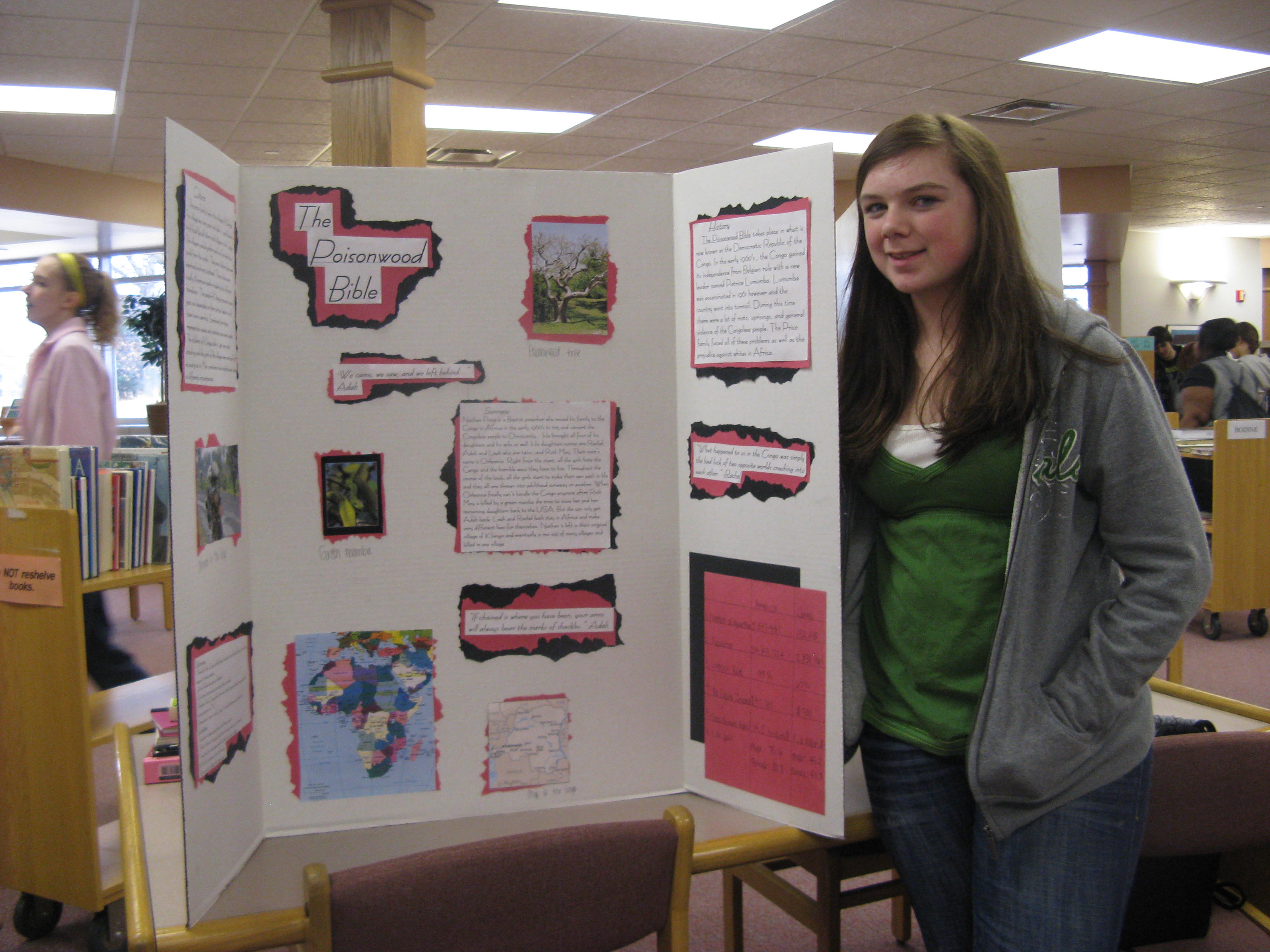
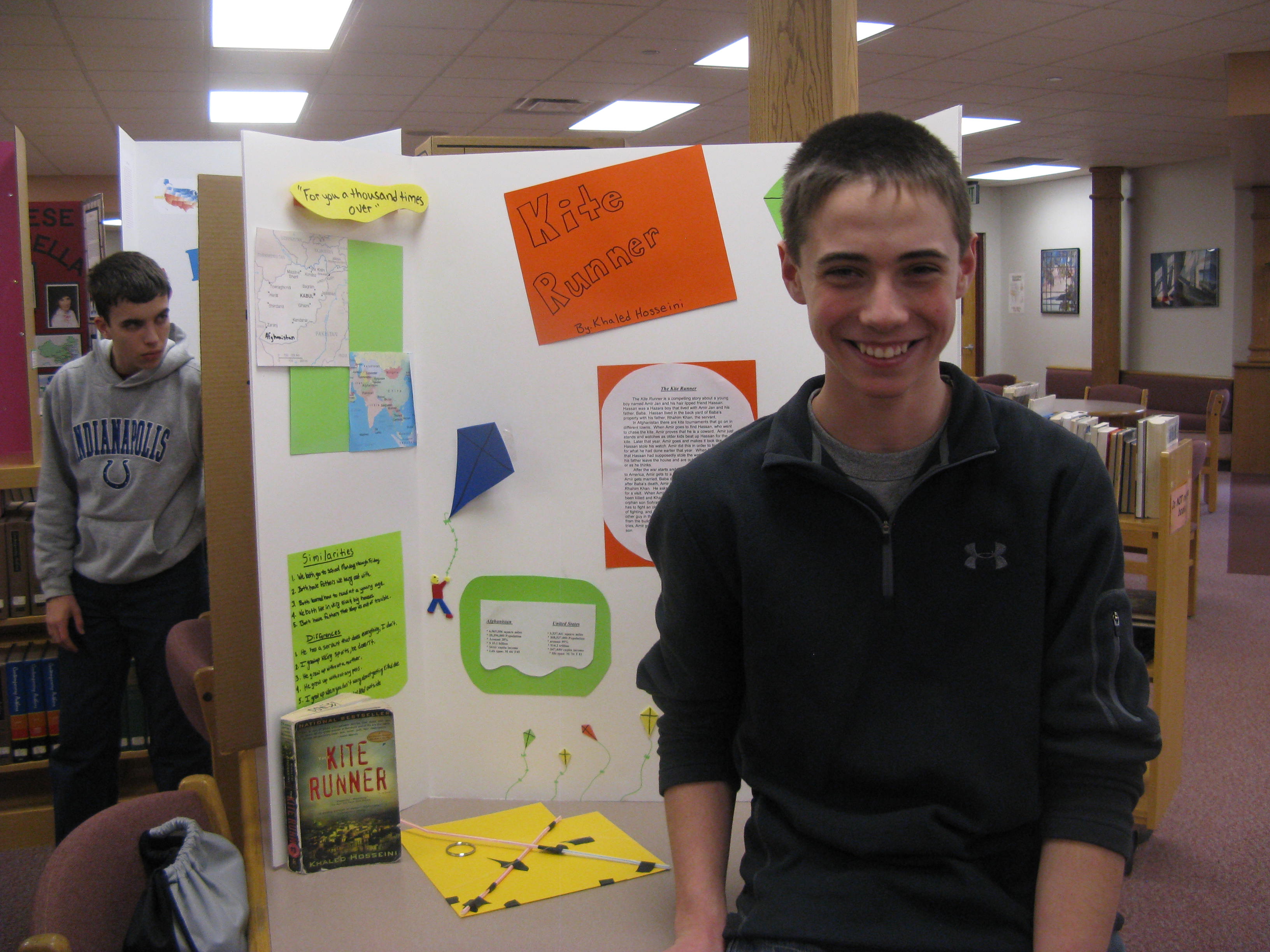
Next, each student creates a stand-alone, 3-sided poster—the kind that is used for science fair projects. The goal is to create a poster that makes the story as appealing as possible, but at the same time conveys something of the history and culture of the country portrayed in the book.

The poster must include

1.       Author’s name and title

2.       A summary of the book (about 300 words)

3.       Two maps—one of the country where the story takes place with the city or region highlighted and one of the continent in which the country is located.

4.       A paragraph about the history of the country during the time period of the book (again, about 300 words)

5.       A paragraph about pertinent religious or cultural characteristics of the particular cultural group described in the book OR a description of the relevant cultural characteristics of the country overall if the main character is not from an ethnic minority (not to exceed 300 words)

6.       A bulleted list of at least 5 differences and at least 5 similarities between a teenager growing up in Indiana and the character in the book.

7.       A comparison table showing the following pieces of information about the country or region compared to the United States:

  •  Number of square miles
  • Population
  • Literacy rate
  • Gross domestic product
  • Per capita income
  • Average life span (m & f)

But there can be more: Students sometimes include photographs, symbols, clothing,  3-DIMG_2782 objects or pictures of objects, or decorations that capture the feel of the country. They may include important sayings or proverbs from the culture, quotes from the book, other pertinent maps, or even their own assessment of the book or recommendations for other books with a similar theme.

The most successful posters are eye-catching and colorful, but even a student with little talent in art can create an appealing poster with some help from a computer and just the most basic understanding of design. I give the students these simple directions: Type your paragraphs, keep the design uncomplicated, use construction paper to frame the typed paragraphs, and be consistent with the fonts and point size.

IMG_2787On the day the posters are due, we set them up in the library and students give book talks about the work they’ve read.  I want them not only to summarize the story, but to connect the dots between the story they have read and the demographics, historical facts, and other statistical information they have gleaned.  I ask them to expand upon the similarities and differences that they have noted between themselves and the characters in the book.  Sometimes—for extra credit—they’ll offer their classmates “international fare”—regional food that they’ve prepared themselves (Parents have to sign a form indicating that their child actually prepared the food. I am not interested in giving Mom or Dad extra credit.)

Invariably, the students’ lists of similarities and differences are the most interesting part ofIMG_2793 the presentation. Depending upon what they’ve read, the students notice differences in family relationships, in family size, in the size of American homes versus homes in other countries. They’ll see disparities in possessions, in schooling, in opportunities. They’ll see differences in wealth, in medical care, in the availability of food; differences in transportation, occupations, and expectations. Some are surprised, even shocked by what they learn because some of these stories are violent and horrifying. Some are just plain sad. Resilience is a common theme. But for the most part, students also discover similarities between themselves and the person they are reading about, and those commonalities allow them to identify with the characters.

The individuals in the stories my students read have families that, like their own, love them, occasionally smother them, sometimes annoy them, always are important to them. They encounter teenagers from far away who also have dreams and aspirations; characters who respond to injustice and inequity just as they do; young men and women who are disappointed, delighted, rewarded or punished, teased or tolerated, loved or hated. They find kindred spirits in people from other countries—and learn that stereotypes are just that and outward appearances can be deceiving.  In short, they learn that what makes us human—our emotional responses to the people and events in our lives—is common to all of us, no matter where we grow up.

IMG_2796In the past, the posters have remained in the library for a month or so—long enough for other students to see them and perhaps be enticed to read one of the books for themselves. But even if their classmates don’t choose to check out a book, the posters attract attention and alert other students to a world larger than the one they know.  As for my students, reading a book about someone from another country helps them learn an opposite and important truth: The world is actually much smaller than they might have supposed.

In case you’d like to try this for yourself, here are the books on my shelf. You’ll need to check the reading levels and match the book with the particular student. Some of these are adult books, suitable for advanced readers; others are for middle schoolers.  If you know of a title I haven’t listed, please add to my list by commenting below. I’m always on the lookout for another good book.

FICTION     
Title  Author Country
Roots  and Wings Many  Ly Cambodian-American
Spud John  Vander Ruit South Africa
Power  of One Bryce Courtenay South Africa
A  Thousand Splendid Suns Khalid  Hosseini Afghanistan
The   Kite Runner Khalid  Hosseini Afghanistan
Bless   Me, Ultima Rudolfo  A. Anaya Hispanic/New   Mexico
China Boy Guss  Lee Chinese-American
In   the Time of the Butterflies Julia  Alverez Dominican Republic
Yo! Julia  Alverez Dominican Republic
How  the Garcia Girls Lost Their Accents Julia  Alverez Dominican Republic/ America
In  the Name of Salome Julia  Alverez Dominican Republic
The  Namesake Jhumpa  Lamiri Indian-American
The  Poisonwood Bible Barbara  Kingsolver Congo
The  Syringa Tree Pamela  Gien South Africa
The  Invisible Thread Yoshiko  Uchida Japanese-American
When  My Name was Keoko Linda  Sue Park Korea
The  Joy Luck Club Amy  Tan China   & Chinese/American
Habibi Naomi   hihab Nye Israel/Palestine
Snow  Falling on Cedars David  Guterman Japanese-American
Farewell  to Manzanar Jeane  Houston Japanese-American
Zoli Colum  McCann Romani   in Eastern Europe
Swimming  in the Monsoon Sea Shyam  Selvadurai Sri Lanka
NON-FICTION
                          
Stealing  Buddha’s Dinner Bich  Minh Nguyen Vietnamese-American
The House at Sugar Beach Helene  Cooper Liberia
First They Killed My Father Loung  Ung Cambodia
They  Took My Father Mayme  Sevander USSR
The Lost Boys of the Sudan Mark Bixler Sudan/Kenya/Ethiopia
There is No Me without You Melissa  Fay Greene Ethiopia
They Poured Fire on Us from the Sky Deng, Deng, and Ajax Sudan/Kenya/Ethiopia
When I Was Puerto Rican Esmeralda  Santiago Puerto   Rican-American
Leaving Mother Lake Yang   Namu China (Moso culture)
The Endless Steppe Esther  Hautzig USSR
Growing Up in Moscow Kathy  Young USSR
The Diary of a Young Girl Anne Frank Nazi-occupied   Holland
The Children of Willesden Lane Mona Golabek England during WWII (Jewish refugees: kindertransport)
All But My Life Gerda   Weismann Klein Nazi   Germany
The Bite of the Mango Mariatu   Kamara Sierra Leone
A Long Way Gone Ishmael   Beah Sierra Leone
The Kids from Nowhere George   Guthridge Eskimos in Alaska
Lipstick Jihad Azadeh Moareni Iran
The Price of Stones Twesigye Kaguri Uganda
A Beginner’s Guide to Acting English Shappi Khorsandi Iran/England

Questioning the Quality

In Mark Twain’s classic Huckleberry Finn, Huck, the son of an abusive, alcoholic father, stumbles upon the Grangerfords, a family of some wealth. Huck calls them “the quality,” and at first he is awed by the Grangerfords—by their possessions, by their manners, even by the sentimental poetry of their dead daughter Emmaline. The Grangerfords, for all their “gentility,” have sustained a feud with their neighbors, the Shepherdsons, for countless years. When Huck’s new friend, Buck Grangerford, is killed in a shootout with the Shepherdsons, Huck realizes that the Grangerfords’ fortune and finery are quality only on the surface; underneath, these people are vengeful and brutal murderers. Their wealth disguises the poverty of their souls. Through the use of irony, Twain reveals the important truth that the family you are born into is not the determiner of character. True aristocracy is not about class, but character.

Harper Lee comes from the same tradition.

Here’s another selection from To Kill a Mockingbird, a passage from Chapter 13, shortly after Aunt Alexandra has come to Maycomb, unbidden, to keep an eye on Scout and Jem while the Tom Robinson trial is underway. In my 9th grade class, we’ve been talking about Harper Lee’s technique in revealing Atticus’s character, and this passage presents him in contrast with his sister, whose notions of Southern aristocracy run counter to Atticus’s fundamental belief in the equality of all people. Alexandra has asked Atticus to talk to the children about their background, but in this scene, Harper Lee lets the reader know how Atticus really feels about his sister’s notions of class superiority.

“How do you know,” I ask the students when I begin reading this passage aloud, “that Atticus is uncomfortable in this conversation? That the children are uncomfortable? As I read, pay attention to the details that tell you.”

Before bedtime I was in Jem’s room trying to borrow a book when Atticus knocked and entered. He sat on the edge of Jem’s bed, looked at us soberly, then he grinned.

Here I’d interrupt myself and ask, “What does this word soberly mean? We’ve already learned that Atticus doesn’t drink.”

It’s important to ask a question about a word like soberly. Many students have only heard the word in the context of drinking alcohol. Such a misinterpretation could seriously affect the way they read the rest of the passage.

Someone supplies the meaning—seriously—and I go on.

“Er—h’rm,” he said. He was beginning to preface some things he said with a throaty noise, and I thought he must at last be getting old, but he looked the same. “I don’t know how to say this,” he began.

Well, just say it,” said Jem. “Have we done something?”

Our father was actually fidgeting. “No, I just want to explain to you that—your Aunt Alexandra asked me—son, you know you’re a Finch, don’t you?”

“That’s what I’ve been told.” Jem looked out of the corners of his eyes. His voice rose uncontrollably. “Atticus, what’s the matter?”

Atticus crossed his knees and folded his arms. “I’m trying to tell you the facts of life.”

Jem’s disgust deepened. “I know all that stuff,” he said.

Atticus suddenly became serious. In his lawyer’s voice, without a shade of inflection, he said, “Your aunt has asked me to try and impress upon you and Jean Louise that you are not from run-of-the-mill people, that you are the product of several generations gentle breeding—“ Atticus paused, watching me locate an elusive redbug on my leg.

About here I stop again and ask the students to explain what “gentle breeding” means. It’s the central idea of the passage, so the meaning must be clear. The two words aren’t hard ones, but combined, they convey an entirely different idea than either word alone. Breeding, the students have little trouble with. But juxtaposed with gentle? Eventually someone hits on refined, or a similar word. But that produces puzzlement—until they remember Aunt Alexandra’s obsession with social status.

“It means you come from a high class!”

“It means you’re better than everyone else.”

“It’s snobby.”

“Gentle breeding,” he continued, when I had found and scratched it, “and that you should try to live up to your name—“ Atticus persevered in spite of us: “She asked me to tell you you must try to behave like the little lady and gentleman that you are. She wants to talk to you about the family and what it’s meant to Maycomb County through the years, so you’ll have some idea of who you are, so you might be moved to behave accordingly,” he concluded at a gallop.

Stunned, Jem and I looked at each other, then at Atticus, whose collar seemed to worry him. We did not speak to him.

Again, just in case, I stop to ask what collar seemed to worry him means. Some students have trouble with idioms, so this is a good chance to make the expression clear.

“He was doing like this,” someone volunteers. “You know, running his finger under it like this.” The student demonstrates. “But really, it means he’s uncomfortable.”

“Oh, yeah. That’s why he was talking so fast.”

“He was fidgeting, it says.”

“And that throaty noise. He’s coughing to clear his throat.”

“He’s nervous!”

Presently I picked up a comb from Jem’s dresser and ran its teeth along the edge.

“Stop that noise,” Atticus said.

His curtness stung me. The comb was midway in its journey, and I banged it down. For no reason, I felt myself beginning to cry, but I could not stop. This was not my father. My father never thought these thoughts. My father never spoke so. Aunt Alexandra had put him up to this, somehow. Through my tears I saw Jem standing in a similar pool of isolation, his head cocked to one side.

“One more detail that tells you Atticus is uncomfortable?”

“His tone! Scout says His curtness stung me.”

“What details tell us the children are uncomfortable?

“Scout says This was not my father.”

“Before that?”

“The comb. She isn’t thinking about what she’s doing. She’s thinking about what he’s saying and runs it down the dresser edge.”

“Before that?”

“She won’t look at him. She’s picking at a bug on her leg.”

“So she’s uncomfortable. Is Jem?”

“Yes, he’s looking out of the corners of his eyes at Atticus. Like he’s suspicious.”

“And Scout says he’s in a similar pool of isolation. That means she feels alone and he does, too. They feel like Atticus has left them. This isn’t the real Atticus.”

“What can you conclude about Atticus’s point of view? How does he really feel about being ‘a Finch’?”

“He doesn’t believe all that.”

And indeed, a few paragraphs later, Atticus tells the children to “forget it.”

Finally, a question to stretch the students’ understanding: “How do you think Harper Lee, the author, feels about this issue of background? Is she on Aunt Alexandra’s side or Atticus’s?”

“Well, she’s arranged the details so we think Aunt Alexandra’s point of view is wrong.”

“She’s presented the scene through Scout’s eyes.”

“Yes, that’s right. But is there something else—something in the text we haven’t focused on in this way?”

Sometimes I give the students a hint: It’s a bit of irony.

Then another if they haven’t hit upon it: “Gentle breeding—“

“Oh! All the while Atticus is talking about ‘background,’ Scout is picking at a bug. Then she scratches it.”

“She’s the opposite of refined!”

“And then the author writes gentle breeding again!”

Very sly.

“So what does Harper Lee think?”

“All that class stuff is a lot of hooey.”

Kids can spot prevarication and deception in a heartbeat, so they have no trouble grasping the tenor of this passage and little difficulty seeing that the passage underscores, in the end, the integrity of the hero. What they need help with is understanding the craft of fiction and explaining how the author made her point and revealed her attitude. How any author makes a point. That is done with questions, questions whose answers are grounded in the text. Asking them is the teacher’s job. Answering them, the students’.

Yep. “The quality”: A lot of hooey.

In the tradition of Huckleberry Finn.