A Grammar Lesson

From To Kill a Mockingbird by Harper Lee:

Daylight…in my mind, the night faded. It was daytime and the neighborhood was busy. Miss Stephanie Crawford crossed the street to tell the latest to Miss Rachel. Miss Maudie bent over her azaleas. It was summertime, and two children scampered down the sidewalk toward a man approaching in the distance. The man waved, and the children raced each other to him.

It was still summertime, and the children came closer. A boy trudged down the sidewalk dragging a fishing pole behind him. A man stood waiting with his hands on his hips. Summertime, and his children played in the front yard with their friend, enacting a strange little drama of their own invention.

It was fall, and his children fought on the sidewalk in front of Mrs. Dubose’s. The boy helped his sister to her feet, and they made their way home. Fall, and his children trotted to and fro around the corner, the day’s woes and triumphs on their faces. They stopped at an oak tree, delighted, puzzled, apprehensive.

Winter, and his children shivered at the front gate, silhouetted against a blazing house. Winter, and a man walked into the street, dropped his glasses, and shot a dog.

Summer, and he watched his children’s heart break. Autumn again, and Boo’s children needed him.

Once they understand that Boo killed Bob Ewell, another issue looms for the students. We haven’t talked about Boo’s motive for stabbing Bob, and by now they realize this: Every action has a motive. Of course the students know Boo cares about the children. He leaves gifts for them in a live oak tree (until his brother Nathan cements up the hole): a broken pocket watch, a spelling medal, soap dolls, chewing gum, and other artifacts of a young boy’s life. But how deep is this caring? What is its nature?

The answer is in the paragraph above, which appears at the very end of the book when Scout is standing on the Radley porch. I read this section slowly, carefully—sometimes two times before anyone notices the author’s sleight of pen.

Finally, this comes, sometimes tentatively, sometimes in an explosion of understanding:

“’Boo’s children needed him.’ He thinks of Jem and Scout as his children!”

“He left presents for them in the tree.”

“The pocket watch! Fathers give their sons their watches.”

“He put a blanket around Scout at the fire!”

“But the text says ‘A man walked into the street, fired a gun’: That’s Atticus.”

“This is confusing.”

I ask them then to think about what the author has done and to find the exact place in the text where she does it.

“She says ‘his children’ and we think Atticus.”

“But she means Boo. We assumed Atticus…”

“Because all the details are about him!”

“Because he’s their father!”

“Because we know the rule!”

We’ve been talking about pronouns for some time. I’ve pounded the rule into their heads, and they can recite it from memory: Every pronoun has an antecedent with which it must agree in case, number, and gender. Antecedent comes from Latin: ante (before) and cedere (to go). The term makes perfect sense: The antecedent comes before the pronoun.

“The true antecedent comes after the noun here!’

I can almost hear low whistles.

Slick.

They like it.

And they understand the depth of Boo’s feeling. He cares for Scout and Jem as a parent does—and parents would do anything to protect their children. Even put themselves at risk to come to their children’s rescue.

So in a way, this lesson, just like the last one, is about the danger of making assumptions—and this blog entry is a plug for grammar instruction.

Sure, the students could “get it”—could understand they’d been misled—without knowing the rule. I could have said that the author just flipped the men’s names to create an effect. But the trick is more subtle than that. Atticus’ name is never used. Understanding the technicalities of Harper Lee’s maneuver reveals to the students—maybe for the first time—that author’s craft their work. Understanding precisely what occurred in the text tells the students that writers are deliberate.

I’m not saying no teacher will ever have to visit pronoun antecedents again with these students. No, it takes repeated interactions with any concept to make the point indelibly. But being able to use the language of grammar to explain the author’s technique gives students a sense of authority, of control over language.

We want students to do close analysis of text—meanings of words, arrangement of details, syntactical analysis. Grammar helps us do this.

All by itself, though, grammar instruction can be pretty dull for a whole lot of kids. Granted, there are some who take to it. (Believe it or not, one year I met after-school with a group of grammar devotees who called themselves “The Diagramming Club.”) But for most young students, we need to hang our grammar lessons on some kind of hook.

Harper Lee’s is a classy one.
Who Killed Bob Ewell?

Students rarely understand exactly what happens at the end of To Kill a Mockingbird. I like to use their befuddlement strategically to help them put the clues together.

Heck Tate puts them together very quickly when he discovers Bob Ewell dead under the oak tree near the Radley’s house. Heck takes Ewell’s switchblade from the scene and later tells Atticus he “took it off a drunk man.” My students take that remark at face value. Bob Ewell is a drunk and Heck’s a sheriff, so the students make the assumption that Heck picked up the knife earlier in the evening on his usual rounds. They don’t imagine that a law enforcement officer would tamper with the evidence to perpetrate a cover-up. But making those two assumptions is how even Atticus is temporarily misled.

Heck’s motive, of course, is to protect Boo, the children’s reclusive, awkward, ghost-like neighbor. Ultimately, Boo—if he killed Bob Ewell—would be acquitted of the murder charge he’d face, but in the interim, he’d be subjected to a trial and then to a storm of appreciation from the town folk.

I could just tell the students what happened, but that is never my preferred style. Instead, I have them act out the ending of the book because, through role-playing, they discern the answer for themselves. The process of discovery is not only fun, it’s a chance at the beginning of the year for the students to delve deep into a text and to have an analytical discussion without the formality of hands in the air.

I take volunteers for the various roles and urge the students to reread the text carefully so they can act the story out just as it happens. Even so, the next day, when I hold up two plastic knives labeled “switchblade” and “kitchen knife” and say that the actors who need the knives should take them, they all look at one another mystified. Usually the student playing Heck, thinking I’m just supplying props to make the scene more realistic, takes the switchblade. That leaves the kitchen knife for Bob Ewell—another error.

The troupe of actors retreats to the hallway to block out their performance. Meanwhile, I tell the rest of the students: “They’re going to make a mistake. It’s your job to figure out what they got wrong—so follow along in the text.”

While the group in the hall is blocking the scene—and having their own discussion about those two knives—the other students and I move all the desks to the back of the room. We clear a large space at the front of the room and sit on the floor more or less like a theater audience or in chairs that are informally arranged in front of the “stage.”

The actors enter, books in hand, Scout yelling “Cecil Jacobs is a big wet he-en!”

Jem puts his hand on her head, steering her along, and Bob Ewell enters, stalking the two children as they make their way across the classroom to the corner designated as the Finch home. The students read the lines aloud and carry out the actions indicated. I read the narration.

Boo hears the children, comes out of his house, pulls Bob away from Jem, and then…

Sometimes the actors show Boo stabbing Bob with the kitchen knife. Sometimes they show Bob falling on his knife. Sometimes there’s a radical deviation from the text and the troupe tries to show that Jem killed Bob. After all, that’s what Atticus first thinks. Depending upon what the students have decided to do with the switchblade, more difficulty can arise when Heck Tate comes along to examine the body. In any case, the students’ first error is usually at the tree, and the second one occurs when Heck examines the body.

In many years of doing this, only once did a group nail the ending on the first try.

It takes a series of mental leaps to realize that
• Bob had a switchblade.
• Boo had a kitchen knife.
• Boo stabbed Bob with the kitchen knife.
• Bob then had both knives—a switchblade in his hand and a kitchen knife “up under his ribs”
• Heck relieved Bob of the switchblade.
• No one will question Bob “falling on his knife.”
• Heck Tate reasons that justice is ultimately served because Boo would be acquitted in a trial and the man responsible for Tom Robison’s conviction is now dead.

By now, the actors have stopped acting and are huddled up on the floor with the audience. I am off to the side or somewhere in the mix, asking pertinent questions. But the students are talking to each other, looking back at the text, and arguing constructively over what took place. They lead each other through the sequence of events and untangle the circumstances that lead Heck Tate to his declaration. They support their claims with textual evidence and counter each other’s errors the same way. It’s awesome to watch.

In the end, we have an animated conversation about Heck Tate’s preemptive decision to “let the dead bury the dead this time.” He tells Atticus— emphatically—“I’m the sheriff of Maycomb County and Bob Ewell fell on his knife,” leaving Atticus with no questions, no choice, and no responsibility for not pursuing justice, in this case to the point of injustice.

There’s more than one hero in Maycomb County, the students conclude.

This lesson, of course, is an example of the constructivist approach to reading comprehension. Through close examination of the text, the students discern for themselves the author’s meaning. They’re collaborating to put the puzzle pieces together, and they’re actively involved in the process. With or without the name—constructivist approach—this is a powerful way to engage kids, build skills of textual analysis, and have a lot of fun the same time.

And the answer is Boo. The kids just proved it.

Figure It Out: A Reading Comprehension Lesson

I’m a big fan of structuring lessons so that students can figure things out on their own. In the education world, what I am talking about is sometimes called the constructivist approach, sometimes called inquiry-based learning, sometimes called—well, whatever the name, lessons learned this way usually stick—and in the act of discovery, students are empowered as learners.

Here’s an example of what I mean: a reading comprehension lesson involving allusions—in this case, in the context of one of my favorite books, To Kill a Mockingbird. The goal is to show students how allusions enrich the meaning of a text—how to spot them, how to decode them, how to make meaning of what is frequently an analogy.

For example, take this dialogue between Scout and Jem, in Chapter 2:

“Don’t worry, Scout, “ Jem confronted me. “Our teacher says Miss Caroline’s introducing a new way of teaching. She learned about it in college. It’ll be in all the grades soon. You don’t have to learn much out of books that way.—it’s like if you wanta learn about cows, you go milk one, see?”

“Yeah Jem, but I don’t wanta study cows, I—”

“Sure you do. You hafta know about cows, they’re a big part of life in Maycomb County.”

I contented myself with asking Jem if he’d lost his mind.

“I’m just trying to tell you the new way they’re teachin’ the first grade, stubborn. It’s the Dewey Decimal System.”

Students might be vaguely puzzled by “Dewey Decimal System,” but they could just as easily pass right over the reference. If they do, though, they miss the humor in Jem’s misnomer. That’s the way allusions work, I explain to them. They aren’t necessary to understanding the plot, but knowing that Jem is confusing a library cataloguing system with the education reformer John Dewey is funny. Furthermore, in this short passage, we get a glimpse of Jem as an occasionally annoying big brother who isn’t as smart as he thinks he is. Since this is a sibling type many students know first-hand, this depiction of Jem rings true and helps some students to directly and immediately identify with Scout.

That’s the concept. To get started with the lesson, I print and cut into slim strips a list of other allusions from To Kill a Mockingbird, put the strips in a hat, and pass the hat around the room. Students “draw” a strip, and I tell them that the first part of their assignment is to figure out the literal meaning of the words on the strip. (The same strategy could be used with any text that is heavily allusive. I’ve used it with Shauna Seliy’s coming-of-age story, When We Get There, and with Charles Dickens’ Great Expectations, for example.)

This part of the assignment used to be more difficult than it is now. Years ago, before Google, before Wikipedia, before the website To Kill a Mockingbird: The Student Survival Guide (www.lausd.k12.ca.us/Belmont_HS/tkm/), I’d take my students to the library so they could look through books and print encyclopedias to find the answers. Some of the allusions weren’t so easily identifiable, so I’d allow them to ask other people for help—other people but me, that is. My lips were sealed—except to suggest books they might check or to provide hints that would send them in a fruitful direction. After they knew what they had—sometimes a parent would, understandably, just tell them—they’d have to find at least two print sources that explained the allusion and then summarize the meaning and document their sources.

I still ask my students to do this, but thanks to electronic searches, it’s the easy part of the assignment now.

The next step is finding the allusion in context. They’re spread throughout the novel, so while I distribute the strips early on, it will be late in the story before the task is completed by everyone. Once the students come upon their allusions, they write a paragraph explaining the allusion’s purpose in the text. This can be challenging for young readers; nevertheless, they often make amazing connections and articulate insights that astonish me.

Some allusions, such as “Maycomb County had just been told it had nothing to fear but fear itself [my italics],” help the reader establish the time period of the story. So do items like “linotype machine,” or “flivver,” or “Ladies Law.” Other allusions establish place: “Jitney Jungle” and “Bellingrath Gardens,” for example, make explicit that this story takes place in the South. These allusions authenticate what the author has already told us: the setting is Maycomb County, Alabama. Some “place” allusions supply deeper background information as well: “Stonewall Jackson ran the Creeks up the creek” is a reference to the intersection of Alabama history, Native American history, and Finch family history.

There are some tougher ones, though, like “Lord Melbourne,” a British parliamentarian who loved the ladies. When Uncle Jack tells Scout about Lord Melbourne in response to her asking him what a “whore-lady” is, he reveals his discomfort in discussing adult topics with children. His circumlocution, of course, contrasts with Atticus’ straightforward responses to his children. Thus, the allusion to Lord Melbourne (which is obscure for most readers, not just 9th graders) helps to build the character of both men. A student could have read the paragraph, been temporarily confused, but ultimately not concerned, because the allusion does not advance the plot. And yet, “getting” the reference to Lord Melbourne deepens the reader’s understanding.

So does this one, another reference made by Uncle Jack: When he and Atticus are discussing the upcoming trial of Tom Robinson—whom Atticus has been appointed to defend—Uncle Jack remarks, “’Let this cup pass from you,’ eh?‘” Untangling that one means linking the Biblical reference to Christ’s prayer in the Garden of Gethsemane—O my Father, if it be possible, let this cup pass from me: nevertheless not as I will, but as you will (Matthew 26:39)—to Atticus’ wish that he didn’t have to step into the role of defense attorney in what he knows will be a losing battle. He knows as well that defending Tom Robinson will stir up the town: His children may be the targets of people’s vitriol, and he could lose them in a backlash. Nevertheless, in the same conversation with Uncle Jack, Atticus is clear. He says that he couldn’t ask his children to obey him if he didn’t defend Tom. He will comply with the court order. A student could, of course, explicitly make the Christ symbol connection—but, more likely for a 9th grader, the student who understands the allusion will see the analogy between Christ’s situation and Atticus’ and understand that the comparison supports the picture of Atticus that has building throughout the story: He will do what he must. He will do the right thing.

But the task of building meaning isn’t over. It isn’t enough, to my mind, for a student to know only his or her own allusion. Sometimes, depending upon curriculum needs, I’ve had students report out on their allusion while the others take notes, but this process takes more time than I often have. Recently, I’ve accomplished my purpose much more expediently by posting the students’ work on the walls of the classroom.

Each paper has three parts: the paragraph from the text where the allusion appears, the explanation of the allusion, and then the paragraph about its purpose or how it enriches the meaning. The students circulate around the room, pen and paper in hand, and take notes on what their peers have written. This takes about one class period. I keep silent, read over the students’ shoulders, check the written work to be sure the students have explained their allusions clearly and correctly. Misunderstandings are infrequent, I find. If something isn’t quite right, it’s usually easy enough to question the student on the side, and he or she will see the confusion and make the adjustment on the spot.

By the end of the hour, each student has compiled a list of allusions and their meanings. In essence, they have taught each other some pretty sophisticated vocabulary and deepened each other’s understanding of the text. They’ve also learned a valuable reading skill: how to identify and figure out an allusion. A short matching quiz the next day confirms that the “vocabulary” has been learned (Most kids score 100%), but more importantly, the students come away understanding what an allusion is and how one works in a text.

Imagine how tedious this would have been if I had stopped in our reading to explain every one of these connections. I would have grown tired of the sound of my voice—and the kids would have yawned. Openly.

Instead, they figured it all out on their own, taught each other, and know they can do the same thing independently with the next book they read. That’s empowerment.

This Enormous Business

For thirty-one years, my school year began with the opening sentence from Harper Lee’s matchless story of courage, compassion, and coming-of-age, To Kill a Mockingbird. It was nothing short of privilege to introduce 9th graders to Jem and Scout, their father Atticus, and their playmate Dill; to rural Alabama in the 1930s; to racism and injustice in the days of Jim Crow; and to the idea that in coming face-to-face with an unvarnished and painful reality, one comes of age.

Sometimes that moment of truth is called a “confrontation experience.”

When the trial is over and Tom Robinson is found guilty, Jem is confused and upset. He cries first, then broods, questioning Atticus intently as he puzzles through the injustice of the verdict. Miss Maudie, the children’s insightful neighbor from across the street, bakes a cake the next morning, but alters her custom of preparing three small cakes—one each for Jem and Scout and Dill—and makes only two. Jem’s portion is to come from the big cake. In this way, she signals her understanding that Jem has grown up: He has emerged from the experience of the trial, changed. Many students—as Jem himself does—miss the significance of that culinary symbolism.

So just after my students have read Chapter 22, the chapter with the cake paragraph that begins “It was Jem’s turn to cry,” I introduce this poem by Gwendolyn Brooks. I project it on the ENO board and read it aloud once, all the way through.

One Wants A Teller In A Time Like This

One wants a teller in a time like this

One’s not a man, one’s not a woman grown
To bear enormous business all alone.

One cannot walk this winding street with pride
Straight-shouldered, tranquil-eyed,
Knowing one knows for sure the way back home.
One wonders if one has a home.

One is not certain if or why or how.
One wants a Teller now:

Put on your rubbers and you won’t catch a cold
Here’s hell, there’s heaven. Go to Sunday School
Be patient, time brings all good things–(and cool
Strong balm to calm the burning at the brain?)

Behold,
Love’s true, and triumphs; and God’s actual.

Occasionally, a student will “get” the poem immediately, but the majority of my 9th graders are mystified. Why am I introducing this poem? What does it have to do with the story? Focused on the verdict itself—which they are eager to talk about even though they had predicted it—they don’t think of the impact of the decision on the children.

“Who in the story do you think this poem could be about?” I ask.

“Atticus,” someone always guesses. “He lost the trial.”

So. They got the gist of the poem. It’s about someone who is depressed.

“But Atticus knew he would lose—and he thinks they’ve taken a step forward because the jury deliberated for two hours,” someone else corrects.

“Tom? He lost and now he’s going to prison.”

“Boo.” Another guess.

“Miss Maudie.” A wilder guess.

Funny—if they’d examine their own reactions—shock, outrage, grief—when the verdict is announced, they’d see immediately that the poem points to Jem.

But Jem is not the “hero” of the story—or even an important protagonist like Tom Robinson or Boo. We’ve talked as a class about the symbolism of the mad dog and related rabies to the mental disease of prejudice. We’ve focused on character development and identified Atticus as the hero. We’ve examined Atticus’ definition of courage in the Mrs. Dubose chapter. But, besides noting that the children are catalysts for action and establishing that Jean Louise (the adult Scout) is a reflective narrator, we haven’t talked much yet about Jem and Scout. So far, they haven’t been a thematic focus.

I suggest that we take the poem apart, line by line. From this moment on, I am largely silent. I simply cover the poem and proceed to expose one line at a time. With its lovely “reveal” function, the ENO board helps me with this technique, but I used to do the same thing with an overhead projector. Baring even that, I could write the poem on the board, one line at a time. The strategy captures my students. They are good detectives, and they eagerly put their skills of observation to work.

First, the title: enigmatic, evocative, puzzling. Why the capitalized ‘One’? And then, it turns out, the title is the first line. The first line stands alone, the students notice. Why?

Then the phrase, “One’s not a man, not a woman grown.”

“So it’s not about Atticus.”

“But what is ‘this enormous business’?”

“It doesn’t say.”

“Whoever he is, he’s walking a crooked path.”

“He’s lost.”

“Unsure.”

“Confused.”

“He—or she—can’t find his home, maybe doesn’t have one.”

“Is this about a homeless person?”

“No, I think it’s about safety. Home is safety.”

“It’s about certainty. This person is uncertain.”

“Something terrible has happened.”

“Look at those words–‘if or when or how.’ Those are question words. This person’s questions are unanswered.”

“But why is ‘Teller’ capitalized in the next line?”

“He wants someone to answer his questions. To tell him the answers. A Teller.”

By this time, several students realize it is Jem’s reaction to the verdict that I am focusing on. I can barely contain them from blurting out their epiphany, and epiphany it is: They squirm in their seats; their arms pump up and down; their faces convey urgency. Others catch on. The class knows.

But what is this last stanza? Look: The font changes. And how are all those things connected?

“‘Rubbers’ are boots,” someone says. “What do they have to do with Sunday School?”

“’Heaven and hell’.” That’s Sunday School.”

“They’re opposites. Like black and white, or right and wrong.”

“Oh I get it! The new font is the Teller talking!”

“Yes! The Teller is telling the person what to do.”

“What to think.”

“How to behave.”

“That’s what he wants. A Teller.”

“Yes. A Teller makes things simple.”

But then the font changes back.

“What’s ‘balm’?”

“Like lip balm. A salve.”

“Oh! It’s ‘One’ again—questioning the Teller. It’s ‘One’ not finding an answer.”

“Not accepting an answer.”

“And the Teller speaks again, telling him everything is okay.”

“Except he doesn’t believe it. Whatever has happened is so bad, he even questions God.”

“Wow.”

And then, silence.

When we resume talking, students are quick to say—and confident now in saying—that “One” is anyone, so the poem can apply universally. “This enormous business” is unspecified for the same reason—and that means the poem can apply to many situations.

Too many of my students have already experienced tragedy, grief, and despair in their own lives. They make the jump to divorce, separation, untimely death, to betrayal by a friend, to abandonment by an adult—to myriad experiences that could force a person to confront an unpleasant truth—and come of age.

And then they know how Jem felt.

Silence again.

Quite often, someone in the class offers a final idea.

“You know, this may be about growing up, but even adults feel this way sometimes. My mom did when my dad left.”

How right that observation is. There is no time limit on innocence, no age limit on hope.

“So it could be about Atticus. He could have felt that way and then resolved his feeling by thinking the two-hour delay in the verdict was a step forward.”

It could be, indeed. Enormous business can level us all, even a hero.

I love teaching this lesson and the technique of “unveiling” a poem. As students pick out the clues, they build meaning and expand their understanding beyond the text. They see the relevance to the story we are reading, but they can apply the meaning of the poem to their own lives as well. They think deeply about an idea—in this case, the transformative effect of a confrontation experience.

What else is wonderful is that they figure the poem out for themselves.

I don’t tell them anything.

Thys Boke is Myne

Thys Boke is Myne Prince Henry: An inscription in a copy of Cicero, belonging to Henry VIII when he was a boy.*

What is it that makes us write our names in our books, amass collections of books, enthusiastically lend our books to friends (but keep a record so we can call them back)? When we do cull our collections and take stacks to used book dealers, why do we cross out our names or obliterate them with labels? If someone has inscribed a book for us—a gift—we hesitate to let it go, and if we have books passed down from our parents, our grandparents, their parents before them, well, these simply cannot be discarded.

Maybe I shouldn’t be using first person plural here. Maybe the problem is unique to me. But I don’t think so. I’ve seen too many crossed out names in books I’ve picked up in second hand stores.

Whatever else Henry VIII the adult was, he read widely as a child and even became a writer himself. I like to think that the impulse to write his name in his Latin book—to assert his ownership—was not just proprietary in the way he acquired weapons and wives, but that it sprang from the same impulse I respond to when I write my name in a book. When I say I own a book, it is not just the physical entity that I mean belongs to me. I am saying that the contents have become a part of me, have shaped my identity, and have influenced my thought. When someone I don’t know well looks at my personal library—whether at school or at home—I feel just a little bit invaded, like that person has a window into my mind, has gotten a glimpse of my soul.

Understanding this explains why, at a used book sale, I buy copies of books I already own—it’s as if I’m retrieving a lost part of myself. Thys boke is myne! Not the library’s, not Earl Avenue Books’, not Buy the Book’s. Myne!

For some years now, I’ve been collecting the books I read as a preschooler or during early elementary school years, repossessing myself, so to speak. I know these books not by title, but by their images. I’ve instantly recognized Me, Too (a fluffy yellow duck) and The Little Small Red Hen, both found resting unceremoniously in antique dealers’ cubbies. I have no trouble recognizing the Dick and Jane readers, primers peopled by those ever-ebullient, always co-operative, never unpleasant—but sadly, monosyllabic—children, Dick and Jane, and their little sister, Sally, whom I loved best because she had my name. And their pets: Spot and Puff.

On summer afternoons in upper elementary school, my best friend Anne and I were allowed to go downtown to the public library where, once we had exhausted the children’s collection, which was located in the basement, we moved to the junior high shelves, also in the basement. There, I discovered books that came in series: Little House on the Prairie, Anne of Green Gables, and the Betsy-Tacy books. Betsy Ray, growing up in a small town in Minnesota around the turn of the century, wanted to be a writer. So did I. I stuck with Betsy well into junior high. At one point during those years, two friends and I playacted the three best friends of the series, and I wrote to the author, Maud Hart Lovelace, to tell her of this marvelous fact: We fit her characters to a tee. She graciously replied, in her own hand, on a card that featured an illustration of Betsy, taken from one of the books. I still have that card, and as an adult, from used book dealers online, I bought the Betsy books I’d lost over the years. Pristine copies are collector’s items now, but I kind of like my worn library copies because the public library is where I first found Betsy.

Later, my friend Anne and I wheedled our way into the adult stacks, located upstairs. Attitudes about reading were different in the day. Librarians, I am sure, had a proprietary interest in the books themselves, and they seemed to disapprove of children getting “above” themselves, reading stories that were too old for them or books with words they surely wouldn’t know. I can remember having to tell a librarian once what a book was about in order to satisfy her need to be certain of my reading ability. Once we got upstairs and into the dark, towering stacks, Anne wanted to start with the A’s and read every book all the way to Z, but we got waylaid and then stuck in the H’s, captured by another series, this one by Grace Livingston Hill. But I went on to discover Carl Sandburg and McKinley Cantor and Sinclair Lewis, and I read many, many British classics that I took from those stacks.

In 8th grade, I traveled by train from my home in Illinois to my cousins’ home in Seattle. I brought a big book with me: Gone with the Wind. It was the first really thick book I’d read, and when I closed the cover on the last page, I remember feeling that I’d crossed some kind of threshold. I read two more fat books that summer: The Silver Chalice (I loved to swirl the name “Joseph of Arimathea” around in my mouth) and Not as a Stranger (considered risqué—even more evidence that I’d crossed some threshold). The poetry of Emily Dickinson—and Dorothy Parker’s acerbic verse—I remember from summer reading. Jane Eyre was a summer book sometime in high school, and so was Betty Smith’s A Tree Grows in Brooklyn (a recent choice of the book club I belong to!). The summer after my junior year, I gave my heart to Henry David Thoreau, whose Walden I still read and sometimes have been lucky enough to teach, and senior summer it was Huxley and Orwell who captured my imagination with Brave New World and 1984.

What does all this reminiscing about summer reading have to do with my American classroom? My teachers—and my parents, of course—encouraged me to read, both by example and by mandate. My first grade teacher taught me to read, and all of my teachers helped me to love books. Many of those teachers presented me with a summer reading list, knowing full well that it is in the long, languid days of summer that children and teenagers have the time and disposition to sink into books, abandon obligation, and let the characters and ideas therein become a part of themselves. When I left my classroom almost a month ago, I gave away my paperback books, the ones that had been housed in my classroom on a revolving display case, a hand-me-down from the school library. All year I’d been recommending the books on that rack; in the end, I offered them free to my students. They snapped them up. One boy needed a shopping bag.

I hope this is a summer of books for them. I hope they will love them, write their names in them, and make the contents their own. And I hope they will remember me, the giver. I did not erase or sully my name. I left it on the first page: Sarah Powley. Thys boke was myne.

And now, I am settling down with my own reading list, a mix of history and science and literature and books on instructional coaching. I’ll be back in the fall, rejuvenated, reeducated, and ready to take on my new responsibilities and resume this blog. Happy summer everyone! Happy reading!

*The Folger Shakespeare Library’s exhibit of people and their books, displayed during the winter of 2002-2003, took its name from Henry’s assertion of ownership.

A Travel Journal Worth Keeping

School’s out, the grade book is closed, and the room has been cleared for summer maintenance. For many students, attention has turned to summer travel. Some will be going on exchanges, others traveling with their families. Here’s the handout I share with students who are going abroad for the first time.

Of course they’ll take pictures and send them back home—theirs is, after all, the world of the iPhone and Facebook—but some things can’t be captured in photographs. I encourage my students to record the sights and sounds of other countries and the experiences they have as they travel in words as well as photographic images. And then, of course, they’ll have lots to write about when they return to the classroom and need story starters for their essays.

First of all, I tell them, there is no single way to keep a travel journal (except that you have to write in it or you won’t have one.) Your journal can be an old-fashioned diary—one that summarizes each day from dawn to dusk. This type of journal is sometimes called a chronicle because it details, in the order of what happened, everything about the day: what you did, who you saw, what you experienced, where you went, what you ate, or just some of this. Or, your journal can be topical (you write on just certain subjects and don’t necessarily record every last thing you did). It can be thematic (you write about ideas and how you see them play out in events and people you encounter). It can be a sketchbook. That’s right: You draw your way through the day—or in this case, the trip. It can be a scrapbook of odds and ends you collect as you go and paste right into the pages alongside your thoughts, observations, summaries, and sketches. In other words, the journal is yours—your business, your record, your expression of yourself, your portrait in words (mostly) of what you see hear, smell, taste, touch, sense, experience, and understand on your journey.

A journal can be a diary with a lock and key, a spiral notebook, a fancy blank book (lined or unlined pages) from someplace like Barnes and Noble, a sketchbook (unlined pages), or even a 3-ring binder! It can be any size that’s convenient for you. But here are my preferences for journal-keeping (based on years of keeping them):

• A spiral binding so the book will open flat—makes it easier to write on the left hand pages.
• An elastic band that slips around the front and back to hold anything loose you’ve slipped inside (of course, this can be accomplished with a big, fat rubber band, too).
• Lined pages—but, if you’re likely to want to sketch, you might prefer unlined pages. In that case, take a sheet of blank paper and draw heavy lines on it–thick ones, dark enough to show through the blank page. Slip the lined piece of paper under a blank page and presto: lined pages!
• Not so big you can’t slip it in your purse or backpack. Not so small you can’t write very much.
• A glue stick (slip it in your purse or pocket)
• Pockets (make these with index cards and scotch tape) on the inside of the front and back covers. You will use the pockets to keep stuff too big to paste into your journal.

Getting Started:

It may help to get started to imagine an audience. It might be your parents, with whom you will share your book when you get back. It might be a friend. It might be an imaginary friend. It might even be just you yourself that you’re writing to. But most people have an audience in mind—maybe subconsciously—when they sit down to write. If a “known” audience will help you, consciously pick someone to think about when you write. That way, you’ll “speak” directly to that person, in a natural voice, and you’ll think of the details that person would need to know to understand. This is very much like writing a letter. (Some very powerful diaries have been composed as letters. Remember Anne Frank’s diary to “Dear Kitty”?) Other people, however, prefer to just “free-write.” Do what suits you.

Naturally, you are going to apply everything you have ever learned about descriptive writing from every English teacher you’ve ever had. You know: appeal to the senses, think in metaphors, relish similes and other figures of speech, write about one thing by comparing it to another, choose vivid words, use action verbs, include details, details, details—etc., etc., etc. Besides all that, which is VERY IMPORTANT and ABSOLUTELY BASIC, here are some practical suggestions for things to notice and write about :

What to Write About:

Jokes you are told—what someone thinks is funny tells you a lot about their world.

Conversations—just a few lines that are provocative or thoughtful will begin a journal entry in an interesting way and capture the flavor of what you learned. Just by itself, with no elaboration, conversation is interesting to read. For example, I had this conversation with two girls who were translating for me when I was in Russia in 1998. (Both girls were named Anya.) Their summary of the teacher’s omniscience stays with me because I recorded the conversation.

In Russian schools, students sit two to a desk—a “seatmate” it is called.
I said to Anya 1 and Anya 2 that I was impressed they didn’t poke each other, they said, “Oh, we poke.” And then I did see one boy whack his diligent seatmate with a ruler.
“Seatmates are an advantage,” Anya 1 said. “If I don’t understand something, my seatmate can help me.”
“What’s to prevent cheating during an exam?” I asked.
“The discipline, “ they answered. “The teacher knows.”

Lists. Make a list of items in a room, books on a shelf, ingredients in a cupboard, CDs or videos in a rack, things on the table, foods in the market, music on the radio, vendors on the street, merchandise in a shop, breads in the bakery, people on the train, foods at a party. The list will capture the flavor without much further description.

Draw a floor plan of your host’s apartment if you are staying with a family. Label the rooms and explain who sleeps where. Later, if you are able to take pictures of the apartment, it will help your family and friends at home to visualize it.

Recipes for foods you liked. Ask your host mother to show you how to make a favorite bread or dessert. She will be pleased, and you will have an authentic recipe to share.

Journal Entry Starters:

Three things I should have brought…
Three things I didn’t need to bring…
Three things I didn’t expect…
Three things I’ll never forget…

Things I love about Russia (or any country)…
Things I miss about the USA…
Things that made me sad…
Things that made me glad…

Keep a record of the weather
Keep a record of the number of times you hear a certain word or slang expression
Keep a record of the dogs you see, or cats, or kinds of cars, or popular songs
Keep a record of the American products you see for sale

A surprise
A disappointment
A moment of gratification
A moment of annoyance
A wish
A hope
A dream

Take a walk down the street. Who else is on the street? How many and what kinds of cars pass you? How many animals do you see? What buildings do you pass? How are they different from buildings in America? What is beneath your feet? Straight ahead? What do you smell? What do you see on the horizon? What’s the prettiest thing you see? The ugliest? What feeling do you get, walking down the street?

Go shopping. Describe the procedure. What if you didn’t have a friend to help you? What would be the dangers for you? What would perplex you? Frustrate you? Confuse you? What are the advantages of buying items the way it is done in this country? Disadvantages? Compare and contrast with shopping protocols in America.

Watch TV. IT doesn’t matter whether you understand the words. Record the types of shows, the length of each one, the commercials (if there are any), the pictures that are shown. Who is the audience for each of the shows? How is TV in this country different from American TV? How many channels are there? How many American shows did you see? What were they? How many shows imported from other countries? How much news do you hear about the USA? How much about other countries? Compare international news abroad with international news in the USA.

Describe a dinner/breakfast. What did you eat? How was the table set? What were you served? Were you expected to eat everything on your plate? Did you like it? If you didn’t, how did you balance politeness with preference? What was dessert? How long did dinner last? Did the whole family talk? Did everyone clear the table? Who did the dishes? Did you offer to help? Were you expected to help? What was the response to your offer to help?

Describe traveling by public transportation. How long did it take to go from one place to another? How much did it cost? What was the procedure? How did it differ from taking a city bus at home? If you traveled to school, how did the trip compare with your experiences on the big yellow school bus here at home?

And of course, write about what you did every day.

Happy travels! Don’t forget to come home and tell us all about it!

Last Lesson: Love Lesson

The climax came on Thursday with the Unsung Heroes celebration in our school library. A packed room, our heroes all there, each of them introduced by the students, who were keyed up and jittery, naturally nervous to speak in public. Sheet cakes, flowers, and picture boards decorated the room. Reporters stood at attention and interviewed the students after the program; cameras followed their every move. An audience of parents and grandparents, friends, school administrators, and at least 50 other students (most of whom had completed the Unsung Hero project themselves, last year and the year before) congratulated them. Lots of attention. Lots of emotion.

It would be natural for Friday to be falling action, for the students to feel the let-down that comes when something they’ve worked on for so long has come to an end. For me, too, Friday was likely to be falling action. But I have learned that the best way to handle emotional turbulence is to hold steady—in this case, to stay focused on a goal.

Of course we debriefed for a few minutes when the 9th graders came to class, but it wasn’t long before their comments became repetitive. I brought them back to Romeo and Juliet, which we had been reading before we took time out to plan for the party. Specifically, we came back to the structure of Shakespeare’s sonnets. My purpose statement—the learning objective—was on the whiteboard: Identify these terms (rhyme scheme, quatrain, heroic couplet, turn, meter, scan, iambic pentameter) and explain the structure of a Shakespearean sonnet.

The students turned their attention from chatter to task.

So let’s review first, I said. What’s a sonnet?

The predictable, imprecise answer: A 14-line poem about love.

Shall I compare thee to a summer’s day?
Thou art more lovely and more temperate:
Rough winds do shake the darling buds of May,
And summer’s lease hath all too short a date:
Sometime too hot the eye of heaven shines,
And often is his gold complexion dimm’d;
And every fair from fair sometime declines,
By chance or nature’s changing course untrimm’d;
But thy eternal summer shall not fade
Nor lose possession of that fair thou owest;
Nor shall Death brag thou wander’st in his shade,
When in eternal lines to time thou growest:
So long as men can breathe or eyes can see,
So long lives this and this gives life to thee.

I gave pairs of students 14 strips of paper—Sonnet 18, cut apart and jumbled up. Their task was to reconstruct the sonnet according to the rhyme scheme: abab cdcd efef gg. Of course, they already knew what quatrains and couplets are, and by discovering the sonnets embedded in Romeo and Juliet, they’d already learned Shakespeare’s typical rhyme scheme. So finding the rhymes was easy. But then they were stuck. The three quatrains were out of order. At that point, I intervened.

There’s an internal structure, too, I said, a specific logic to the sonnet. A sonnet doesn’t sprawl, loose to the page. It’s very precisely organized. Shakespeare’s sonnets work like this: Condition stated (the first quatrain); Condition Expanded (the second); Reversal, signaled by the Turn (the third); Summation. Find the turn, I directed—the word that signals a shift in thought. Ah: But. Now paraphrase the lines, summarize the quatrains. Then you’ll be able to put them in order.

You are more beautiful—and your loveliness more permanent—than a summer day, and summer itself does not last long.
As the beauty of a summer day can be diminished by heat or clouds, so the beauty in everything eventually fades.
But, not you. Your beauty will not be lost nor will you die because my poetry will capture you for eternity.
As long as life persists and people read this poem, you will be immortal.

You’ve got it! But that’s not all. There are 14 lines—now count the syllables in each line. Ten. Yes, ten in every line–arranged in iambic pentameter.

What’s that?

The ENO board—the interactive whiteboard—made it easy to mark the syllables, to show them what meter is, what scansion means: unaccented, accented; unaccented accented: 5 times per line. Now read it aloud, exaggerating the accented syllables. (I modeled—imagine that!—and they joined in.)

It’s rap!

Yes! Same rhythm, but now read it the way that Shakespeare would. Draw out some syllables, elevate the pitch on others, emphasize some words, minimize others: Sheer poetry.

So what’s a Shakespearean sonnet? A 14-line poem about love, written in iambic pentameter with an abab cdcd efef gg rhyme scheme, composed of three quatrains and a couplet, arranged to reveal a progression of thought in which the poet states a condition, expands upon it, turns (or reverses) the thought in line 9, and sums up the idea in a concluding heroic couplet.

And then, as if on cue, the bell rang.

We’ll have falling action all next week, too, as we do what normally happens in the denouement. We’ll tie up loose ends and review for final exams. Students will wangle for points, and some will panic, a bit too late to do much good. But this was the last instructional day, my last day to introduce new material and structure a lesson to learn it. That the topic today was the sonnet is an irony that hasn’t escaped me—for teaching has been what I have loved to do since I was a child playing school. I, as much as the kids, could have been overwhelmed by emotion today, but holding steady, keeping myself focused on the objective—keeping the kids focused on a purpose—produced in the end what I wanted—what I needed—for an ending: a lesson that was a love poem all by itself.

Teach Me How

Once, in Rwanda, I was working with the English teachers in a secondary school in Kigali on the rules for punctuating compound sentences. I had handouts, visual aids, and even a graphic that illustrated a fairly clever way to remember the rules. But, I had run out of practice sentences. We were in the school library at the time—a room with very few books but many long tables and benches to accommodate the 50-60 students in a class. As I pondered how to produce more practice sentences quickly—without the aid of a blackboard—I glanced at the shelves and saw, to my surprise, a familiar text—Writer’s Choice—a book I had used in my own high school in Indiana some years before. In fact, a whole class set—two class sets—were neatly arranged on the shelves. I got up from my seat at the table and retrieved a copy for myself and one for each teacher.

The texts had been sent from a school in Florida to this school in Kigali as a charitable donation. A gracious one, indeed—but the books had never been used. They’d been on the shelves since they had arrived. The English Department Chair shrugged when I asked her why.

I didn’t belabor the point. I just turned to the index and searched for the page numbers that corresponded with compound sentences. We all turned to the appropriate page, and I resumed my lesson.

When I was finished, the teachers began asking questions. Did this book teach capital letters? Did it teach spelling? What about other comma rules? Could I show them how I found the sentences I had been looking for? It dawned on me, suddenly, why these books had not been used. These teachers weren’t accustomed to using textbooks in the first place, but more importantly, the books themselves were baffling. They didn’t understand how our thick and elaborate American textbooks are laid out: sequenced chapters with the rules and their exceptions, each rule followed by several dizzying sets of practice sentences and quiz sets; elaborate but confusing color-coding; distracting sidebars; and suggested links to related lessons located half an inch farther into the text. They didn’t know what an index was.

Once I showed them how to use the book, the teachers were absorbed, turning the pages avidly, asking each other questions, discovering with delight the explanations for rules they themselves weren’t sure of. It wasn’t long before the English Department Chair turned to me and said, “I see now that these books are very useful.”

An impromptu lesson in how to use a textbook was more critical—and probably more lasting—than the fancy lesson I’d prepared on compound sentences.

That experience with the Rwandan teachers sticks with me because it reinforced something I’ve known for a long time but sometimes lose sight of: Process is as important as product. Mastery of process yields confidence, an attitude that is, for a young learner, far more important than content knowledge. It is confidence that enables a student to shoot for the stars. Students reach high when they are comfortable with what they’re doing, comfortable with the process. Actually, don’t we all?

It’s intellectually interesting to identify content we want our students to learn; it’s fun to develop the blueprint for a culminating project. But it’s easy for us to overlook the importance of teaching processes. How to use a database. How to run the grammar checker. How to summarize. How to use Turn It In (an online plagiarism prevention site). How to give a speech. How to make a poster aesthetically pleasing. How to write a business letter. How to set up a Works Cited page.

Sometimes the process we need to teach is a basic one. For example, part of the Unsung Heroes project (which I wrote about a few weeks ago) is learning how to write a handwritten letter. My students write thank you notes to their heroes for the time spent interviewing them and invitations to the celebration we hold when the book is published. I insist they do this on stationery, in ink, by hand. Every year I have to teach my students how to address an envelope. I used to have to show them how to find an address in the phone book. Now it’s how to find an address online. But now they know—and they won’t shy away from handwritten notes in the future. In fact, they think they’re pretty cool.

Other times, though, the process is complex. For example, English teachers are charged with teaching research skills so students can produce what used to be called “the term paper.” What we are teaching our students is a very lengthy process: choosing a topic, finding resources, reading and understanding those resources, evaluating them, writing an annotated bibliography, formulating a thesis, combing the readings for evidence to support the thesis, and then writing the paper itself–clearly, coherently, correctly—even elegantly. And finally, that miserable Works Cited page—how to do that systematically so the bibliographical entries match the internal documentation. It’s an enormous process, and at my school, we lead the students through it at least once each year. Their papers often reveal that they don’t quite understand their topic. They may treat it superficially or focus on something trivial. But really, these fledgling scholars are to be congratulated at the end: they’ve gained experience with a difficult and lengthy process that will be second nature to them when they get to college—where the content will really matter.

Sometimes we forget how important it is to teach the “how-to” part. We have a way, in our eagerness to share our own excitement about a topic or an idea, to presume in our students skills they don’t have, just as the people who sent the textbooks to Rwanda presumed the teachers there would know how to use them. We sometimes assume familiarity, make assignments our kids don’t know how to approach, or confuse them with complexity. In our enthusiasm, we don’t break a process down—or we skip teaching it altogether—and leave our students puzzled rather than confident. I’ve done it myself too many times—but I’m learning. Teaching well is a process, too.

Night in Rwanda

2009.04.15 Honors 9 Pattern of Genocide 016I have taught Holocaust literature—Night, The Diary of Anne Frank, The Children of Willesden Lane—for many years. But I cannot teach these books in the way I usually teach literary works of art. Granted, these books are not fiction, so I am spared having to chart the plot line. I know there are motifs and images and definitely themes—but my point has never been, in teaching any of these accounts, to reveal the writer’s technique. Putting such a text under the microscope of literary analysis would distance the students from the story, and I want them to hold close the visceral response they all have when they read, say, Night. Discussing Wiesel’s imagery as if he had sat down deliberately to craft a work of art instead of to tell his horrifying story to an unconscious world would be—to my mind—a sacrilege. As story, his journey through hell penetrates our unconsciousness and sears our souls. Ironically, what I could do would destroy its impact, and that I cannot do.

But the Holocaust must be taught. Genocide must be admitted and discussed. Here is what I do instead.

Most students, when they first learn about the Holocaust, do not immediately see the connection between the tragic events of WWII and their own lives in the 21st century. They think that genocide is a distant horror. But we, the adults, the teachers in the room, know about Darfur, where genocide is so fresh. We know about Cambodia, Bosnia, Rwanda, and other places that in recent history have served as the stage for mass murder.

I have been to Rwanda. My first trip there, in 2006, was undertaken specifically to study the genocide of 1994. I wanted to understand the causes and the chronology of the Rwandan genocide to see how it compared with the unfolding of the Holocaust. I learned very quickly that genocide doesn’t just happen. In fact, it follows a pattern, one that I have taught to my students ever since. (I am indebted to Gregory Stanton at Genocide Watch for his work in revealing this pattern, though I simplify it somewhat for 9th graders.)

Genocide always begins with prejudice. A power group, for a variety of reasons, marginalizes, discriminates against, isolates, and ultimately demonizes a minority. The climax is the killing, followed by a strange denouement, denial.

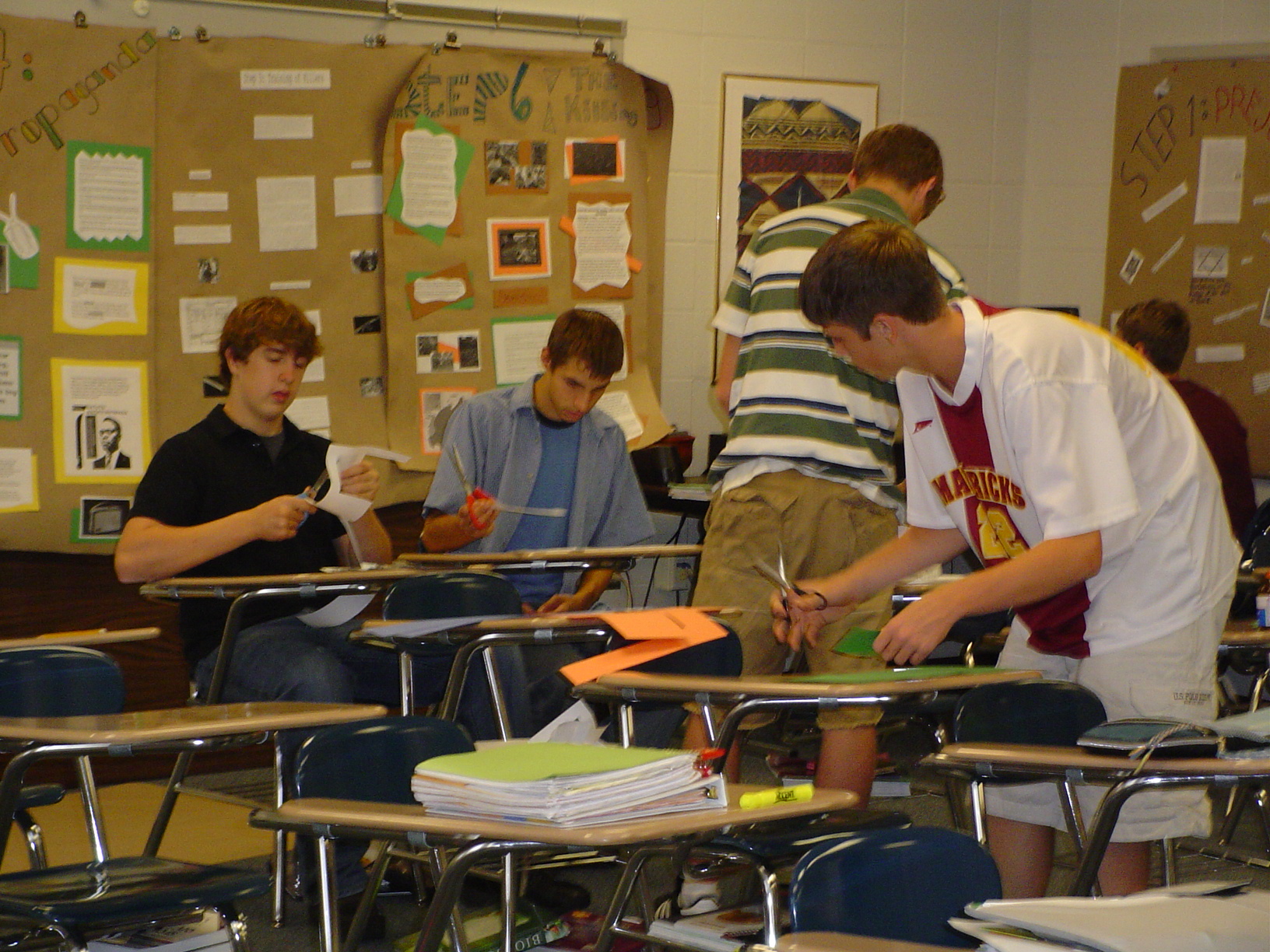
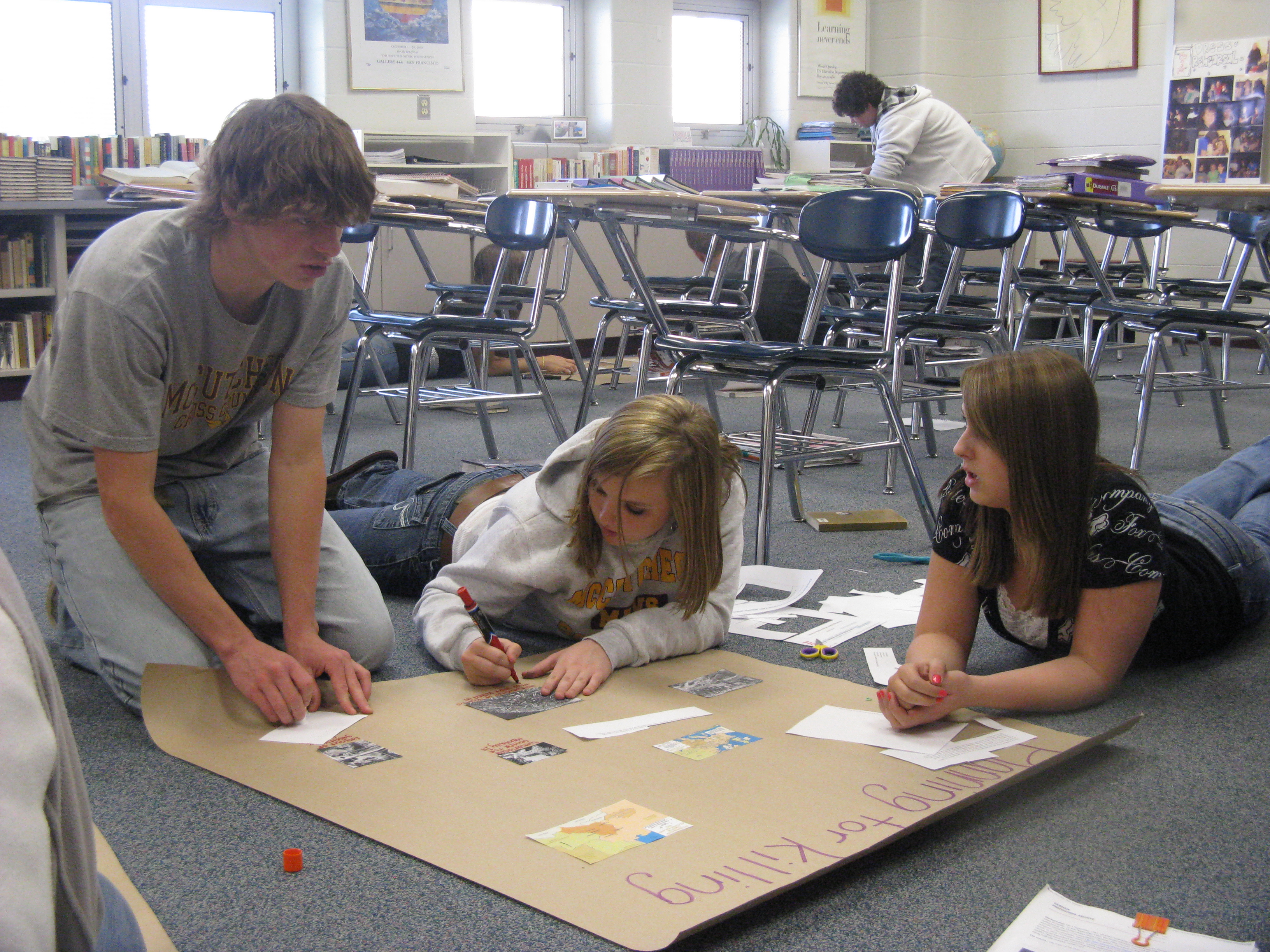
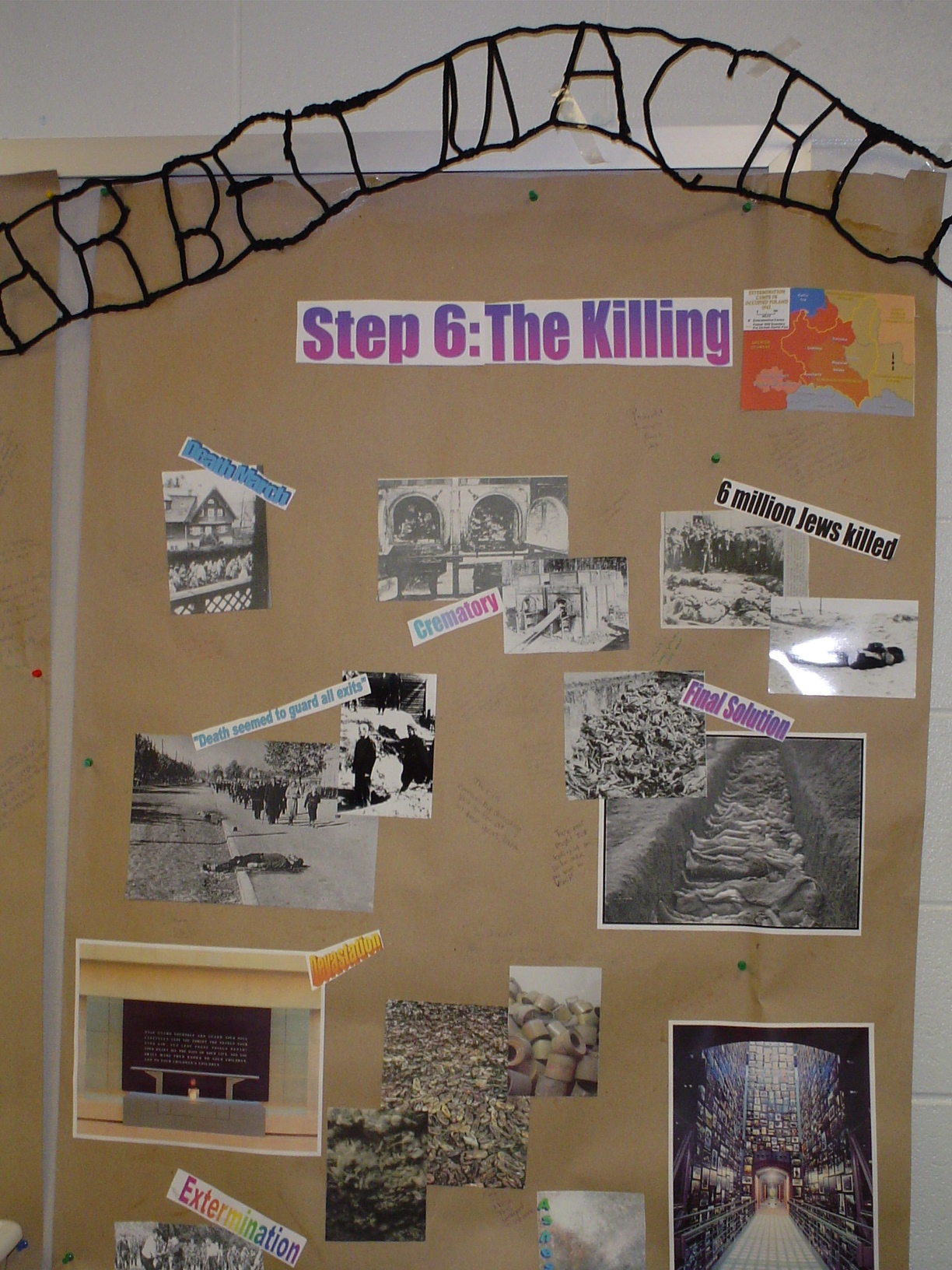
My students read Night first. They read it without a lot of preface, and they are full of questions during the three short days it takes them to finish the book. By the end, they want to know more, and it is then that I send them on a research mission. The students work collaboratively to construct poster essays that will reveal the pattern of genocide. They draw straws to form groups, and I give each group a title for the poster—the name of a stage in the pattern—and a few keywords to get them started. For the next several days, my room resembles an art studio—construction paper, scissors, rubber cement, watercolors, and magic markers dominate the landscape. Kids cluster around the tables, lie on the floor. They labor over their posters, placing pictures precisely and writing captions that capture the essence of the photographs they’ve downloaded. They know that what they are researching and presenting in their posters is too important to treat superficially, and their posters powerfully illustrate the progress from prejudice to mass murder. Pattern of Genocide 002 2009.04.15 Honors 9 Pattern of Genocide 020 Pattern of Genocide 004

We put the posters on the board and discuss the order in which they should be hung: Prejudice, Legal Discrimination, Separation and Isolation, Preparation for Killing, and Extermination—and the one that could be hung anywhere and everywhere along the continuum: Propaganda.

Then, after a brief introduction, I instruct them to repeat the research—this time researching Rwanda. They create, again, poster essays that depict the progress of the genocide there—from the identity cards issued by the Belgians when Rwanda was still a colony to the hate radio broadcasts that mobilized the Interahamwe.

Pattern of Genocide 012They hang the posters side-by-side on the whiteboards in my classroom: the Holocaust and the Rwandan genocide. I am not interested in discussions of scale—it’s not that kind of comparison. I am interested in the pattern.

By studying the Holocaust and the Rwandan genocide side-by-side, my students come to see that neither was an aberration of history. By studying the pattern, they realize that genocide has its roots in attitudes that show up in day-to-day interactions, the kinds of discriminatory behaviors they themselves encounter not just in the evening news, but in the lunchroom, on the playground, in the halls, in gym class. Sometimes we call it bullying.

My students come face-to-face with the pernicious effects of prejudice in their study of these two genocides, and they understand the importance of speaking out against ethnic jokes in the lunchroom, bullying in the halls, discriminatory laws in their state and country, and unfolding events in places like Sudan. They understand the moral imperative to be inclusive rather than exclusive, to accept rather than reject.

My students see that they can work to prevent genocide by voicing opposition to the prejudice they encounter and by engaging in activities that promote peace and understanding—both locally and globally. Sometimes it is as simple as writing letters to their Congressional representatives, to the Secretary-General of the United Nations, to the President. We live in a democracy where it is our right and our duty to let our voices be heard, to be “upstanders” for justice, not voiceless bystanders in the face of evil—and this responsibility becomes real for them.

This past week, at the United States Holocaust Memorial Museum, Elie Wiesel and President Obama spoke about genocide prevention. In fact, on the very day my students and I were having a discussion about what they could do personally to combat the forces of prejudice and discrimination, these two men were discussing what the nation could do. I watched the video that night at home: My students had said many of the very same things these compelling leaders had said. I showed the video the very next day.

Genocide survivors tell their stories—in books, films, and essays—not to create works of art that will make them famous, but with the hope that the lessons of their nightmares will not be forgotten, that people of conscience will work to stop incipient genocides before they occur and to speak out against ongoing tragedies. Teaching our children what they can do to combat evil in the world is work that teachers can do, must do.

Pattern of Genocide 010

Great Expectations: The Unsung Hero Project

I wish I’d had a tape recorder last Friday. My students were huddled in their writing groups looking at feedback from their peers—penciled remarks and notations from the other students in the class—on fourth and fifth drafts of essays each group had written. They’d traded their essays with each other, passing them around the room round robin style. In just two weeks, their work goes to press.

The manuscripts the students were looking at so intently this past Friday are the culmination of three intense months of research, interviews, and writing that they have done about individuals in our community who have met their definition of a hero. The students’ essays will be published in a book that we hope will be acquisitioned (as the previous two volumes have been) by the public libraries in our town and by the historical societies here and in our state capitol, Indianapolis.

The writing these students have been doing is for a real audience, a real purpose—and the impact of authenticity on their work has been nothing short of phenomenal. Their growth as writers has been off the charts.

Here are the sorts of things they were saying as they bent over their manuscripts, excitedly deciphering their friends’ comments and evaluating the merits of the various proofreading notations:

• They say we need to move this phrase so what it modifies is clear. They’re right.
• They think this should be a comma, but I don’t. I think it should be a semi-colon.
• Look! This is the subordinate clause rule Mrs. Powley just taught us!
• I don’t understand this comment. Emily! This is your handwriting. What do you mean here?
• Three people said “proper” water doesn’t sound right. What word should we use? We mean you can’t drink the water. Is there a word for that?
• What do we do to make this fragment into a sentence? Oh look! It connects to the noun at the end of the sentence before it. Oh! It’s an adjective clause!
• Look at this. We’ve started three paragraphs in a row the same way. We need to switch it up.

Ninth graders. Urgently resolving their own grammatical errors, punctuation mistakes, stylistic quandaries, and word choice confusions. How did this come about?

The story starts several years ago, in 2009, when I was a Fellow at the Lowell Milken Center in Ft. Scott, Kansas. I spent time there that summer planning the project that my 9th grade students have worked on now for three successive years: Unsung Heroes in Our Community. The mission of the Lowell Milken Center is to promote, through education, respect and understanding for all people. The spirit of the Center is embodied in the Hebrew expression tikkun olam, which means “to repair the world.” To accomplish its mission, the Center supports project-based learning endeavors that feature unsung heroes—people who have acted to repair the world.

The idea that drove the design of Unsung Heroes in Our Community is a reality that has bothered me for a long time: Too many young people today are without positive role models. They are without real heroes. Their knowledge of individuals in the world who have made a difference extends to celebrities and sports stars, occasionally to someone in politics. Worthy as some of these people may be, students are generally unaware of the range of actions that can be considered heroic and even more importantly, of the people in their own community who have gone out of their way to help others.

This year’s collection of student essays is the third one that profiles people in our town who have stepped forward to “repair the world.” My hope when I began this project three years ago was that these people would inspire my students, and my hopes have been fulfilled. Indeed, the “heroes” have become role models and mentors for them.

Here are a few of the comments the student made in their reflections on this project:

• We learned so much about suffering going on in the world—and not very far from us, either. [These students were writing about a couple who volunteer on the Pine Ridge Indian Reservation in South Dakota.] But we also learned that there are those that care and are willing to step up to the plate and do something about it— and they live right in our own community.

• This project has inspired me to become involved in community affairs and volunteer for organizations such as Riggs [a community health care center].

• Another thing I have learned through this project is the true definition of a hero. A hero is not just someone wearing spandex and flying high in the air with his cape trailing behind him, but someone who has a passion to help others and makes a difference without expecting any reward.

• In getting to know my hero, I have learned that, no matter what struggles life may give me, I should keep moving forward and never look at the challenges as some type of disability or setback but as a chance to prove myself and my own strength.

• With each new revision, I was inspired to make something truly great. In a sense, to make something that would do justice to what Mrs. Yates [the writer’s hero] does. I wanted to make her proud.

So, on Friday, listening to my students’ conversations, answering their questions, cheering when they figured out how to solve a writing problem by themselves, I was as happy as I’ve ever been as a teacher. My students have internalized the formal English lessons they’ve learned, they’ve successfully accomplished an enormous and meaningful task, and each of them feels the pride of achievement. They’ve learned immeasurable amounts about their community and the amazing people who live here—people who, not surprisingly, went out of their way to help 9th graders with a school project.

Most importantly, from my point of view, my students now know real heroes. In the future, when these 9th graders confront an injustice, meet with a challenge, or perceive a community need (as they undoubtedly will), I don’t just hope they will recall the courage, selflessness, and determination of their “heroes” and model their responses after them, I believe they will.

And finally, because the work they did—the research, the writing, the revision—was all for an authentic purpose, intended for a public audience, they took their writing task seriously. They really cared about the outcome: about telling their heroes’ stories accurately and well, about crafting sentences and paragraphs that are clear, coherent, correct, and even eloquent.

What could make an English teacher happier?