All Charged Up

I come from a time when girls were not encouraged to take science classes.  I struggled with math in high school, so when my teachers said I didn’t need to take chemistry or physics–the implication being I’d struggle there, too, and besides, why did a girl need chemistry or physics?–I just smiled and considered myself lucky. Big mistake. I should have been more assertive–I should have known I would be missing out. 

My good friend and colleague Cheryl McLean invited me into her class last week to observe a demonstration lesson in AP Physics I. As I watched, my own high school experience came rushing back. I realized what I had missed a long time ago, and I’m grateful now, after all these years, for the invitation to learn, right along with this class of–get this!–twenty-one girls (and one boy).  

Here’s an account of that class:

While students settled into their seats and readied their laptops, notebooks, and pencils, Mrs. McLean briskly conducted the business of the day:  due dates announced for future assignments, current papers collected, attendance taken. Then she directed the students to gather in front of the demonstration counter for an introduction to the fundamentals of electric charge.

McLean pie pans 2For the first demonstration, she used an electroscope and a charging rod. She brought a negatively charged rod close to the electroscope and the two metal “leaves” inside pushed as far away from each other as they could; a positively charged rod brought them together.  The principles: attraction and repulsion.

Ben Franklin, she told the students, coined the terms positive and negative charge.  In that way, she tapped into our collective memory of his legendary experiment with lightning.  Franklin, even I knew, wanted to establish that lightning carries electricity.  Indeed he proved that.  The negative charge from a lightning bolt struck his kite and traveled down a wet silk thread to a key at the end of the thread.  When Franklin touched the key, he received a shock.  Classic electrodynamics.

For the next demonstrations, Mrs. McLean used the van de Graaf generator, a piece of scientific equipment that looks like a giant silver lollipop.  The van de Graaf generator produces a charge by dragging a rotating belt over copper cones.  The surface of the metal “lollipop” becomes charged.
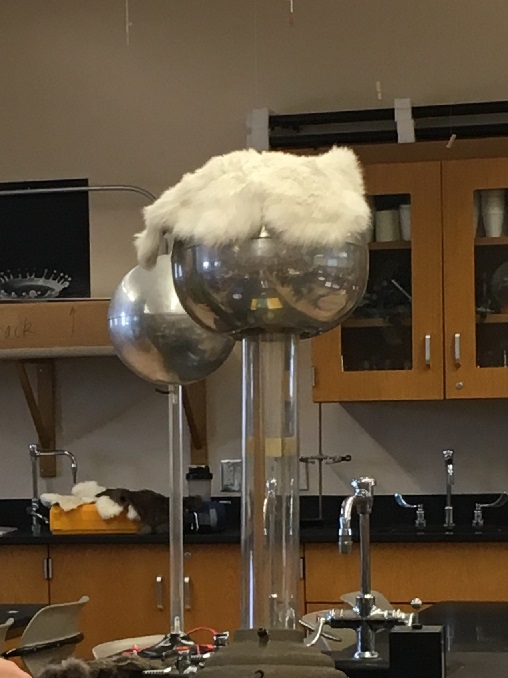
McLean peltMrs. McLean brushed the surface of a rabbit pelt with a comb. When she perched the pelt  on top of the device, the individual hairs stood on end.

Then came the “pie pan demo.” One-by-one, chicken pot pie pans, a minute ago nested in a stack on top of the van de Graaf generator, launched into the air, seemingly on their own.  Students had already observed the generator’s ability to charge an object.  Now they saw that a collection of charge can produce an electric force that exceeds the gravitational force acting on a single pie pan.  Thus, the charged pie pans achieved lift off and sailed into the air.

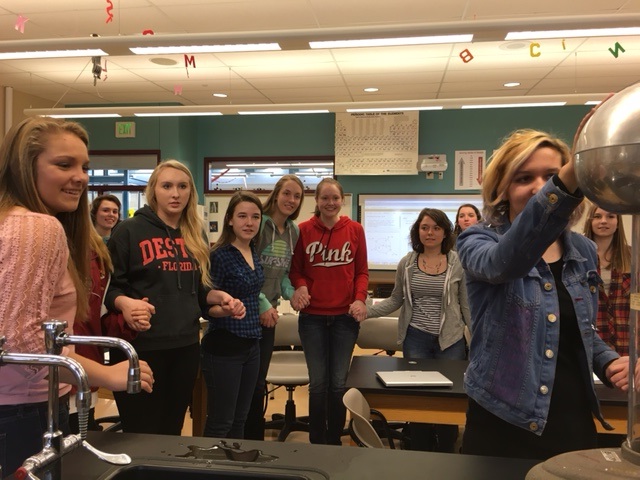
Finally, Mrs. McLean showed the students how a charge “travels.” A student touched the van de Graaf generator, received the charge, and then touched a small pool of water on the counter.  The resulting electric shock traveled, wrist to wrist, along a line of students who were holding hands. The last student was touching the counter, too—and the charge grounded.
McLean tarveling shock

AP Physics has the reputation of being a difficult class:  Tough topics, high level math.  To explain the phenomena that the students study, Mrs. McLean starts this unit, and others like it, with a demonstration of the principles the students will later explain mathematically.  “It’s not enough to do the math that explains the phenomena.  It’s important for students to know through experience what actually happens,” says Mrs. McLean.

Later in the class period, when the students were working the equations that explained the phenomena, I did get lost.  It had just been too long.

A week later, I went back to AP Physics I to ask the students if and how the demonstrations had helped them when they started doing the math.

“They helped me visualize the movement of the electrons and the protons to make positive and negative charges,” said one student.

“It was more interesting with the demonstrations,” added another. “We paid more attention.”

The final word came from a third: “And it was more fun!

Indeed it was.

I have also observed high school chemistry classes in my capacity as an instructional coach.  (You don’t need to know the content to recognize good teaching or to help someone adjust their instruction to be more effective.)  I know now that I could have understood chemistry.  I could have understood physics.  After all, I did take the full four years of math, which ended then with trigonometry and solid geometry.  The recommendation that I not take those science courses in high school is really a reflection of the time period in which I grew up.  No malice was intended.  My teachers were simply short-sighted–and I didn’t believe in myself enough to question their recommendation.

I could mourn my loss. I could get angry at having been cheated out of an education in science.  But really, I’m more grateful than I am sad or mad. Grateful to my colleagues who have invited me into their classrooms to help them, but who, probably unknowingly, have helped me as much.  In the past several years of coaching, I’ve learned quite a lot–in science, in math, and in every other subject, too. In a way, I’m getting to repeat high school. And it’s a privilege, not a penalty.  In fact, I’m all charged up about it.  Still.  After all these years.


Under Discussion: Literature Circles

P1010150Literature Circles are old hat now. English teachers everywhere–from the elementary grades through high school—use this strategy to group students by interest or by reading level. Harvey Daniels, who popularized the concept and brilliantly refined it, has published at least five books on the topic. How-to websites abound, and Pinterest is a rich resource for the props that go with establishing literature circles: the “role sheets,” question cards, sentence starters, anchor charts, choice boards, discussion guides, and rubrics.

I came to literature circles quite by accident sometime in the early 90s—before Harvey Daniels and before roles for participants in the circle had been devised. I am sure I was not alone in figuring out for myself what to do when faced with a wildly disparate group of students. All these years later, I’m still a believer in literature circles—and I encourage the use of Harvey Daniels’ role sheets (plus some of my own devising) although I’ve learned that some educators think the role sheets are limiting.

But that year, whichever year it was, I was still fairly new to teaching high school English. The course, called “Trails West,” featured books about the American West.  My class was hugely mixed in readiness and in student interests.  A few students, whom I’d had in Honors 9 English, consumed books like cookies and cake; others read poorly, infrequently, and under protest. The course was nine weeks long and the curriculum specified that the students would read three books within that time frame.

Essentially, I decided to teach thematically and, for the first unit, selected three books on aP1010623 single topic: The Western Hero (aka, the Epic Hero). The books I chose (from what was available in the bookroom) were The Virginian, the classic by Owen Wister that established the cowboy as an epic hero; True Grit, in which a young girl sets out with a grizzled old lawman to avenge her father’s murder; and Shane, a book about as close to the epic pattern as anyone could imagine. The second “unit” was about the pioneer experience; the third, the Native American experience.

Every three weeks, students chose the book they wanted to read (Miraculously, I thought, no one tried to “read down” and a few challenged themselves to “read up”). Initially, they met in groups of four or five to lay out a plan for the number of pages they’d read before the three meetings I had pre-established for them to convene and discuss the book. I supplied the questions for these meetings—the same ones for each group since the themes were the same—and in between meetings, the students read, kept a list of self-selected vocabulary words, did a mini-research project, and took direct instruction from me on topics related to the book or on other relevant English class topics.

I made bookmarks for everyone, with spaces for page numbers, so they could establish daily reading goals. They divided the number of pages in their book by the number of days to completion. Some kids didn’t need that—they could hardly put down a book they liked—but the reluctant readers enjoyed checking off the little boxes on their bookmarks that indicated they’d accomplished their 10 or 15 pages for the day. They might stop mid-chapter rather than read one more page, a mind-set I admit drove me crazy, but the bookmark served as a kind of time clock for them. When they’d completed their number of pages, they could congratulate themselves, check off a day on their bookmark, and close the book. The strategy worked. One boy, a junior, told me at the end of the year that Shane was the first book he’d read cover to cover in his entire schooling experience.

I’ve seen literature circles work when all the students are reading the same book and in Lucy, Henry, Taylorsituations like mine where students chose a text, based on their interests or their reading levels. I’ve seen literature circles work in subjects other than English and with articles rather than whole books. The online Encyclopedia Britannica presents leveled versions of its topics, and NEWSELA, a free online leveled reading site, (www.newsela.com) sends daily articles relevant to science, sports, history, the arts, current events—all kinds of subject areas—each article written at as many as four to five grade levels. The site also offers complete text sets on topics of interest to teachers of every discipline.

However you choose to implement literature circles, at the heart of the strategy is the discussion: Kids talk about what they have read. The questions the students ask and answer  go way beyond study guides and recall and comprehension recitation. Nowadays, I’d have them take turns making up their own questions, trading around the responsibility for being the discussion leader. Another person’s role is usually to summarize the pages under consideration so that everyone in the group has the facts right, but eventually, questions about the author’s purpose, concerns  about the motivation and credibility of characters, and conversations about style emerge.

Lit circles are more like adult book club conversations than teacher-directed Q and A. They’re effective at drawing students in because the conversations are genuine and everyone gets a chance to say what they think. They work as a vehicle, too, for developing fluency in academic conversation and for inculcating the manners that are necessary for civil discourse (Hence, the sentence starters and conversation rules you see on Pinterest).

I had good luck with lit circles with Honors students and struggling readers alike. In fact, my favorite memory from those Trails West days is of Pencilhead (see my blog post:       https://sarahpowley.wordpress.com/2012/04/01/pencilhead/), at that  time a reluctant reader and would-be class comedian, pulling his chair up to another group deep into discussion of the same book his group had already discussed: He wanted to hear more.

Literature Circles get kids to read more. Literature circles get them to talking more. What could be better?

_________

This post presumes you know all about Literature Circles. Perhaps you are just getting started or even still thinking about the idea. If so, here are some starter websites:

http://www.educationworld.com/a_curr/curr259.shtml A straightforward explanation of Literature Circles—what they are, how they work, why they work.

http://www.lauracandler.com/strategies/litcirclemodels.php Teaching suggestions including variations on the basic model of roles, role sheets, information on working with multi-leveled books.

http://www.litcircles.org/Overview/overview.html This site provides an overview of Literature Circles—structure, benefits, outcomes over time—in chart form.

Under Discussion: Fishbowl

Keelsing 1In my last post, I wrote about getting the students to contribute to teacher-led discussions. But sometimes, the best way to get them talking is to structure the conversation. A structured conversation, in fact, can engage students in a lesson in ways that a teacher-led discussion cannot.

The other day, I watched a master 7th grade science teacher, Miss Kimberly Keesling, lead her class through a Fishbowl debate. Her objective was a universal lesson in critical thinking: Beware of loaded words and emotional responses. Ask questions. Do your own thinking.

She drew upon a well-known hoax from the 1990s in which scientific “evidence” was deliberately used to mislead the public.

Miss Keesling distributed facts sheets to the students—papers she’d prepared listing the pros and cons of banning a mysterious substance, dihydrogen monoxide—DMHO for short. The strikes against DMHO in the realm of health alone are pretty severe. It’s

  • Colorless, odorless, tasteless
  • Accidental inhalation can be deadly
  • May cause severe burns
  • Prolonged exposure to its solid form causes severe tissue damage
  • For those who have become dependent, DHMO withdrawal means certain death
  • Has been found in excised tumors of terminal cancer patients, but is not believed to be carcinogenic

Environmental issues are also serious:

  • Is also known as hydroxic acid, and is the major component of acid rain
  • Contributes to the “greenhouse effect”
  • Is found in almost every stream, lake, and reservoir in America
  • Has caused millions of dollars of property damage in the Midwest recently
  • Contributes to the erosion of our natural landscape
  • Accelerates corrosion and rusting of many metals
  • May cause electrical failures and decreased effectiveness of automobile brakes

On the other hand, DMHO is used

  • As an industrial solvent and coolant
  • To generate power
  • In the production of Styrofoam
  • As a fire retardant
  • In the distribution of pesticides
  • As an additive in certain “junk-foods” and other food products

Miss Keesling gave the students five minutes to ask questions, study the fact sheets, and write out talking points on one side or the other. Then she took the pulse of the class. Those in favor of banning DMHO went to one side of the room; those against banning it, to the other. The Undecideds sat in the middle. She explained to the students that they were going to have a debate about DMHO, so they had to use facts.Keesling 2

It took only a few minutes then to explain the rules of Fishbowl:

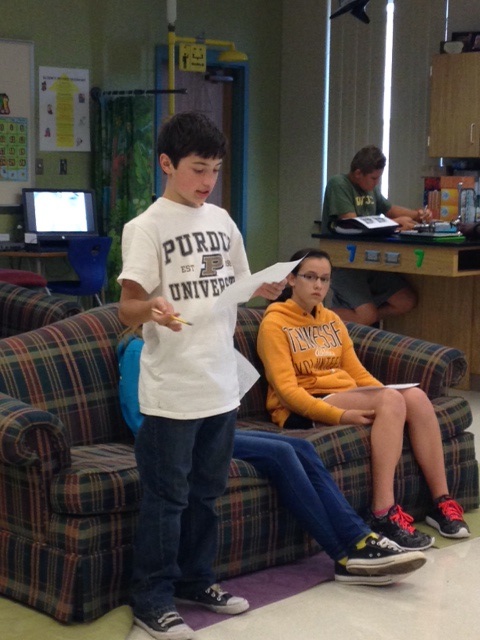
  1. Three people—volunteers, one from each group—would be at the front of the room, seated on a comfortable couch. (Usually, Fishbowl is done with two concentric circles—an inner circle and an outer circle—but the rules are malleable.) Using their notes and the fact sheets, the students would take turns presenting their point of view about DMHO.
  2. When a speaker finished, if another student wanted to support that point of view, he’d tap the speaker on the shoulder and the first speaker would sit down. In that way, only three people at a time were seated on the couch.
  3. The speakers stood up to present their arguments.

Middle schoolers love to talk, love to debate, and these students did so brilliantly. Their arguments for and against banning the mysterious substance were cogent and fact-filled. Some students were direct and succinct; others became quite animated. Within 15 minutes, just about everyone in the room had spoken. I heard impassioned and powerful statements and effective transitions such as these:

  • Although it is used to generate power…
  • It’s a risk: But life is about risk.
  • Bottom line: It kills people.

Sophisticated stuff for 7th graders. At the end, my colleague asked how many of the students had switched sides because of the arguments they heard. Some had.

Then she made the Big Reveal: DHMO is water. She broke the scientific words down into their roots and prefixes: di (2); hydrogen; mono (1); oxide. A few students caught on, clapped their hands to their foreheads: H20.

Why, she asked the students, had they come down on the side they had? All the claims and counterclaims are true—but they had been duped. Who had even asked what DMHO was before they began?  No one. What had swayed them? They had heard the facts, stacked on one side or the other as they were—all of them true, all of them convincing—and formed an opinion, often a very strong one. Why?

What followed were insightful responses that boiled down to this: The use of strong, emotional words such as kill, severe tissue damage, withdrawal, “greenhouse effect,” found in tumors… It was easy to be led to a conclusion.

And that was her point. Scientists have to investigate dispassionately. Scientists have to examine the facts. Scientists have to ask questions. They can’t be swayed by emotional language.

And it’s not just scientists. These students were quick to point out that television, politicians, advertising—they’re all guilty of using emotional language to influence their audiences. Everyone needs to be vigilant. Everyone needs to think before they jump to a conclusion about something they know nothing about.

The Fishbowl strategy proved to be superior to recitation and far better than teacher questioning for a lesson like this. Because it was experiential, because kids were out of their seats moving and talking, because they took ownership of the lesson, they were engaged in the activity and Miss Keesling was able to make her point.

Granted, this particular lesson was a set-up. But the kids were good-natured about it. They understood the message and understood the value of it being learned in this way. In fact, the lesson will stick far longer than a paragraph in a textbook or a lecture by the teacher. But the method—a Fishbowl debate—was the perfect vehicle in a powerful lesson orchestrated by this experienced science teacher. Point made.

Fishbowl works for straightforward discussions about all kinds of topics. It’s especially useful if students are invested in a topic and eager to contribute, but even shy students will express their opinion when they can choose when to tap someone on the shoulder, decide for themselves when to take an inner circle seat.

Want to know more? Here are three websites explaining Fishbowl, offering other ways of structuring a Fishbowl conversation.

https://www.facinghistory.org/for-educators/educator-resources/teaching-strategy/fishbowl  (Facing History and Ourselves) A straightforward explanation of how to set up a fishbowl discussion.

http://www.learner.org/workshops/tml/workshop3/teaching2.html (Annenberg Learner) A lengthier description with alternative ways of structuring the discussion.

http://www.edchange.org/multicultural/activities/fishbowl.html (Multicultural Pavilion) Another good explanation of the set-up for Fishbowl.