Changed Lives: The World Food Prize

It isn’t often that you come away from an event knowing with certainty that lives have been changed. 

P1040080

But in October, that’s exactly how I felt. One hundred and forty-six students from 27 states and 7 foreign countries assembled in downtown Des Moines, Iowa, for the Global Youth Institute, held in conjunction with the presentation of this year’s World Food Prize.

If you have followed my blog for long, you may remember that I wrote about the World Food Prize last spring. (See “Second Skin” and “Winners All.”) A colleague at my high school, a biology teacher whom I admire, had learned about the World Food Prize essay competition, a contest on the subject of world hunger. Students would choose a country somewhere in the world,  do research, and then write about issues of food insecurity in that country. My colleague asked me to help her coach the students who signed on to the challenge. The final  papers—as many as 10 pages long, single-spaced, thoroughly documented in MLA format—were written with no promise of any extrinsic reward and turned out to be far more complex than any the students had written before—even in AP classes.

At the end of  March, the five students we coached presented their papers before a panel of Purdue University professors, all of them connected in some way to agriculture and food science. One of our students—Caroline—had written about India and the issue of land law reform. If women owned land, she argued, agricultural improvements and increased food supplies would not only decrease hunger and malnutrition but would contribute to the elevation of women’s status and thus to a decrease in gender-based violence.

All of our students wrote papers like this—one was about hydroponic produce in the Gaza Strip, another was about water sanitation in Cambodia—but Caroline’s essay and  her subsequent oral defense of her work qualified her to attend the national conference—the 2013 Borlaug Dialogue—in Des Moines. Over the summer, she revised her paper, resubmitted it, and then waited for the event in October—the event that changed lives.

This was a full scale conference—called the Borlaug Dialogue in honor of the Nobel Peace Prize recipient in 1970, food scientist and humanitarian Norman Borlaug, “the man who saved more lives than anyone else on earth.” Working as a young scientist in Mexico in the 1940s, Borlaug developed a disease-resistant strain of wheat that made Mexico less dependent upon imported grain. His work was the beginning of the Green Revolution in India and Pakistan in the 1950s. His contribution to peace in the world—by increasing the world’s food supply and saving millions, perhaps a billion, from starvation—is unparalleled.

The conference, held in Des Moines, Iowa, was attended by food scientists, statesmen, NGO leaders, academicians, and agribusiness men and women. Attendees listened to thought-provoking speakers and panel presentations, ate delicious, eco-friendly, catered meals that concluded with keynote addresses or round table discussions, and viewed posters explaining work being done to fight hunger around the world by various NGOs.

The students took in most of this, but the Global Youth Institute, their conference, ran in tandem with the Borlaug Dialogue, and students followed its schedule, too: a farm tour, an opportunity to package food for Outreach International, a Hunger Dinner organized on Friday night by Oxfam. The climax was on Saturday morning when the students again presented their papers, this time to distinguished scientists who were attending the conference—scientists like previous World Food Prize honorees Dr. Philip Nelson (2007) and Dr. Gabisa Ejeta (2009) from Purdue University.

  • So what changed lives? Was it Howard Buffett, an international philanthropist (and son of Warren Buffett) whose interest is in agriculture? Buffet told the audience that we all have about 40 chances in our lives to do something for the world. We don’t get unlimited opportunities—40 years is about the span of our working lives. We have that many chances to “get it right,” whatever our goal. His is feeding the world.
  • Was it the President of Iceland, a learned and engaging speaker who told the students that the melting of polar ice will have a greater effect on their lives than anything else?  In a talk entitled “Ice, Energy, and Food,” he explained the geothermal aspects of the polar melt and outlined the subsequent effects on countries around the world.
  • Was it Tony Blair, explaining we need to pay attention to the priorities of the people in developing countries and to listen to them: They just might know more than we do.

P1040108Or perhaps it was at the Hunger Banquet.  Teachers and students drew cards as they entered the room and were sent, depending upon the color of their cards, to one side or the other or to a spot on the floor. On the right, tables had been set for an elegant multi-course meal—15% of the participants landed there. Another 25% were sent to chairs along the wall. That group, those who are barely “making it” in the world, got a dinner of rice and lentils, served on paper plates. The rest of the participants ended up on the floor. They represented the 60% of the world that is food insecure. Their dinner was rice only, served directly into their hands from great bowls placed on the floor.

People reacted in myriad ways. Some on the floor accepted their fate, some begged and even stole food, others bartered. Some of the 15% shared willingly or even tried to give their food away. Some people served as intermediaries between the rich and the poor.

The students voiced their reactions and their takeaways after the dinner. One student, an articulate young woman who had been a Borlaug Intern in India the previous summer (an opportunity yet ahead for this year’s crop of students) said to the group at the end of the dinner, “If we are going to help in the world, I believe it has to start with empathy.”

Maybe it was the World Food Prize winners themselves who changed the lives of the young people in the room. All of the laureates this year are microbiologists who have relentlessly conducted basic scientific research that has, after years of study, yielded advances in the genetically modified seeds. They spoke at lunch about their lives in science: about the curiosity that sparked their quest, about the discipline and persistence that science requires, about the mostly friendly competition among their labs, about the electricity—and the satisfaction—they felt when their experiments worked and new knowledge was born.  Any budding scientist in the audience had to have been inspired.

Or perhaps it was the same three scientists giving the students some advice at the end of the conference—passing on some life lessons:

  • Dr. Robert T. Fraley: Pretend that 37 years from now you are 56 years old and toward the end of you career. What will you be thinking about? It believe it will be your friends and colleagues and the few lasting contributions you will have made in the world—those moments that will come from deep inside you. Nothing else will matter.
  • Dr. Mary-Dell Chilton: Do what you want to do. Follow your love. That is the place where you will succeed.
  • Dr. Marc Von Montagu: Whatever discipline you go into, question the knowledge. Take a scientific approach.

Maybe it was the posters and presentations by Borlaug Interns—students from the previous year who had applied for and won the twenty coveted summer opportunities to conduct research on site in countries all over the world. That, by the way, is the prize for the students who attended the Global Youth Institute. P1040132Their work is distinguished enough that they’ve earned the right to apply for an overseas internship—while they’re still in high school. The students I heard presenting their papers and discussing the impact of their experiences abroad are all committed to the further pursuit of answers to the problem of hunger.
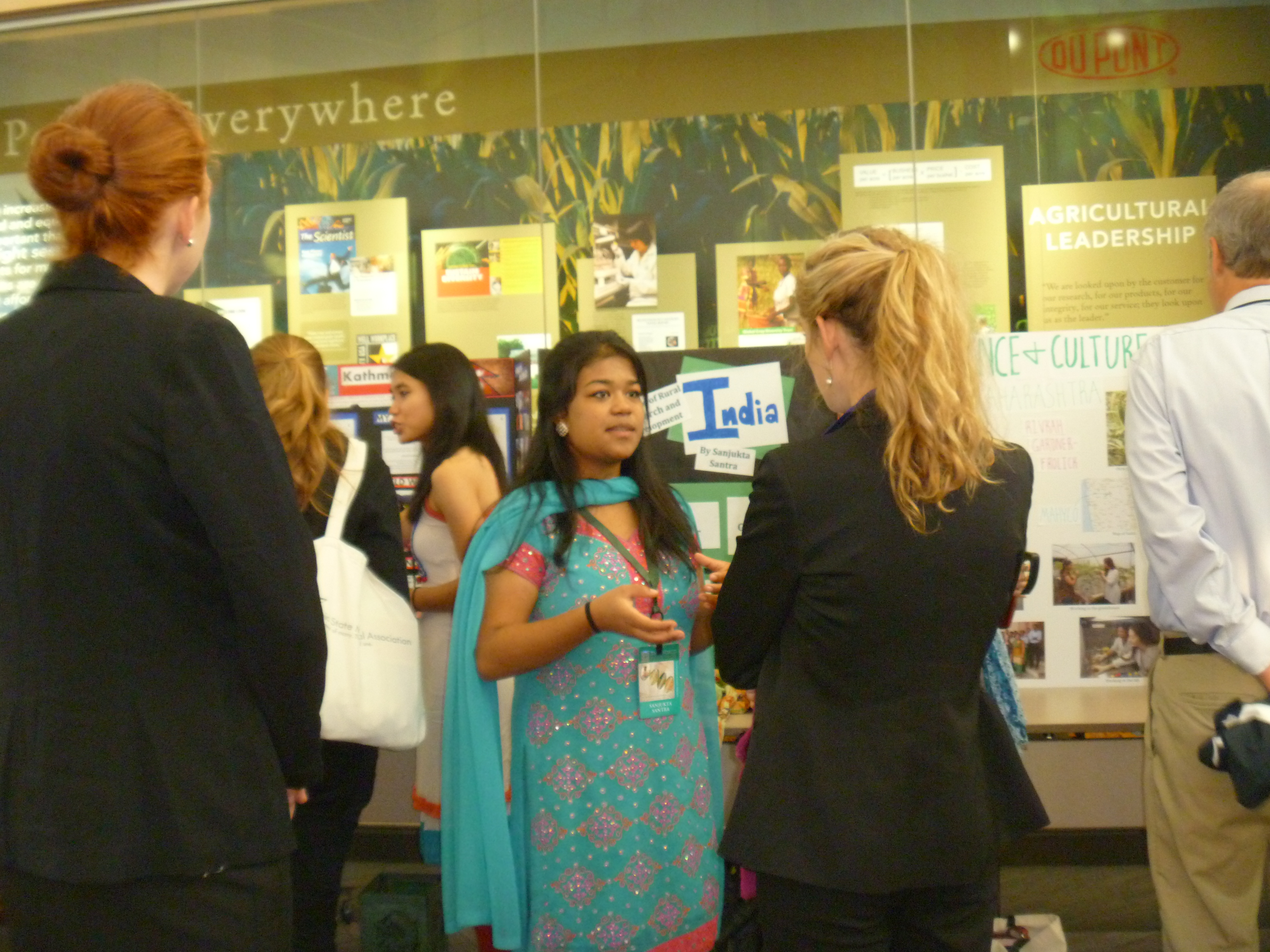
The last event of the Global Youth Institute brought students and distinguished scientists together in small groups. The students presented their papers orally (those summer revisions) and the scientists, including the new laureates and those from other years, like Phil Nelson and Gabisa Ejeta and M. S. Swaminathan (the first World Food Prize laureate of all), responded to them. The scientists asked questions, commented, praised the students and challenged them—much as the Purdue professors had done in the spring. Imagine the impact of a world class scientist listening to a high school student’s paper: This was the high point of the conference for our student, the piece that has motivated her to apply for an internship.

The event that changed lives. I don’t mean the Global Youth Institute/Borlaug Dialogue was a conversion experience—these kids already appreciate the seriousness and depth of world hunger. I don’t mean that they did an about-face on their career goals—most of them already know they want to go into agronomy or biology or engineering or such.

The change they underwent is more like a photographer putting a panoramic lens on the camera. Suddenly, the world is wider. “I saw there was poverty everywhere,” said one Borlaug Intern who saw it halfway around the world as well as here in America. “I see that technology can help,” said another, thinking perhaps of the cell phones that smallholder farmers in the developing world use to keep abreast of market value for their crops. Technology for this student is far more now than cool aps, the latest iPhone, or social networking.

At the same time, it’s as if each student has placed a close-up of herself in relief against that panorama–like a Facebook user uploads a profile photo against the banner on her page.  Each scholar stands in relief against that panoramic background, the student’s relationship to the wider world now more sharply defined. “My internship solidified what I want to do in college,” I heard one young woman say.  Because of their experiences at the Global Youth Institute, a biology major will narrow her options to plant pathology. An aspiring engineer will someday develop farm implements that can work the African soil. Someone interested in science generally will become a nutritionist.

It is in this way that lives have changed—and that the lives of those who live with hunger will change.

Norman Borlaug is still saving lives.

Visit the World Food Prize website: http://www.worldfoodprize.org/

Read the students’ papers: http://www.worldfoodprize.org/index.cfm?nodeID=69493&audienceID=1

An Education in the Russian Outdoors

Summer is here, and in the summer especially, I think again about the academic exchanges with a secondary school in Russia that I led some years ago.  I especially remember a hike I took one Sunday when my American students were all at their host families’ dachas for the day. Call this post an American teacher in an outdoor Russian classroom. I learned a lot–not just about history and biology and geography–but about relaxation, camaraderie, and low-tech, no-fuss trekking. Please, can I do it again?

My colleague Tatyana proposed that we go on a hike. “Let’s go to Izborsk,” she suggested. “We’ll have a picnic by the lake.”

Her friend Sasha, an aerobics instructor and part-time construction worker, volunteered to be our guide. Sasha hiked often with his two sons, and even though he and his family were leaving on vacation in just a few days, he welcomed the chance to take visiting Americans to the Russian countryside he knows well.

Besides, Sasha was thinking about conducting formal tours of the Izborsk region where we would hike. Here was a chance to try out the route with some visitors from afar.

The trip he had in mind would take us through conifer forests and along a glacial valley in the Izborsk region of the Russian province of Pskov. Putin had visited the fortress at Izborsk when he first was a candidate for President, and for three successive years, my students and I had also visited this historic site.The fortress was built in the 14th century and served as a defense post for the entire Pskov region. It overlooks the Valley of Snakes, a hilly, green terrain with sparkling streams and icy glacial lakes, a landscape that is much more inviting than its name would suggest.

Would we be able to do 15 kilometers in a day?

Of course! Didn’t I hike regularly in America? I most certainly didn’t want to miss this opportunity even though I hadn’t brought proper boots or moisture-wicking socks or thinsulate garb or any of the other specialized gear American hikers deem absolutely necessary for a trouble-free hike.

My friend Tatyana and my colleague Rahul were ready, too. Sasha said we would start at a point north of the fortress and walk towards it all day, stopping only for lunch. I envisioned 15 kilometers of “Davai!  Davai!” (Come on! Come on!) and Sasha at us with a whip so we’d reach Izborsk in time to catch the evening bus back to Pskov.

I was concerned about the amount of food Tatyana was packing. In my experience, packing light was important so that you didn’t wear out from the weight on your back. Tatyana put apples and strawberries, cookies and blue cheese on the kitchen counter, and then she produced a bottle of wine. She said that Sasha was bringing one, too. I was to make ham and cheese sandwiches. “Make four,” she said. “We’ll treat the others.”

No granola bars. No freeze-dried food. No attempt to minimize the weight or pack food that couldn’t be crushed. And wine on a trip like that?  We’d all be too loggy to move. But I made the sandwiches and contributed two chocolate bars to the pile and let it be.

Since neither Tatyana nor Sasha owned a car, we planned to take the bus towards Pechory, a small town on the Estonian border. We’d get off at one of the bus stops that appear, isolated and unexpected, all along the highways in Russia and then take off into the woods. It was a wet, gray morning, the day of our departure, and we waited and waited at the bus stop under Sasha’s dripping umbrella.

A taxi driver approached us and asked if we wanted to hire his services. We said we’d wait for the bus. A second taxi did the same. Four hundred rubles for 35 kilometers. That was only $3-$4 for each of us. No, we were waiting for the bus.

We stood in the drizzle for another twenty minutes until finally someone remembered the bus schedule was different on the weekends. There wouldn’t be a bus for another hour.

So that was how it was that we went by taxi to our wilderness hike.

Our driver flew down the pitted asphalt highway and eventually turned onto a sandy road. He dropped us at the edge of a pine forest in the middle of nowhere. If I’d been blindfolded and helicoptered in, I would have thought I was in the north woods of Wisconsin. Pine and spruce towered above me on all sides; lush mosses and sprawling ground cover blanketed every part of the forest floor.

We struck off into the forest on an old logging road. Sasha carried his umbrella inside a rolled-up pad that was about the size of a bedroll. I had no idea what the pad was for, but I stopped wondering when he began talking about what was around us—for example, Icelandic moss.  “It makes a good cure for pulmonary ailments,” he said, and told us he treats his own son’s asthma with it. He gave us the instructions for making a medicinal tea from the dry grey moss, and Rahul put a clump in his pack.

Sasha pointed out bottlebrush (the same ancient plant which we know in the American West as Mormon Tea), and remarked that it’s good for digestion.  A plant called Mother/Mother-in-Law whose broad leaves are cold and smooth on one side and warm and fuzzy on the other side is a coagulant and can be used to staunch bleeding. “It was used for bandages during the Great Patriotic War,” Sasha said.

Remnants of trenches and a bomb crater from that war, now thickly covered with moss, ran alongside the road we were traveling. Fighting had been heavy in the Pskov region as the Soviets tried to hold back the Germans on their march to Leningrad. Later in the day Sasha picked a piece of badly rusted barbed wire, an artifact from the war.

A mile or so into the walk, we came across a young couple, Misha and Natalia, sitting at a picnic table in front of an old farm building. They had made a summer cottage—a dacha—from an abandoned barn. One day they too were hiking in the woods and discovered this building, a two-story structure of limestone bricks on the first floor, and weathered logs on the second. They’d tracked down the owner, who said there had originally been seven buildings on this property, but the barn was all that was left of the farm. They welcomed us to go inside their house, and Rahul and I did. Downstairs, they’d created a cozy kitchen with a small table, cupboards and shelves, and a wood stove.  Colorful baskets hung from the rafters; a bicycle was stored in the corner. Upstairs, four short beds were positioned along the papered wall and there were even lace curtains at the windows. A long table in the middle served as a nightstand.

Tatyana and Sasha stayed outside and talked with the couple  while Rahul and I explored. When we rejoined them, Sasha was describing a kayaking adventure he was planning for July. Perhaps Misha would like to join? Misha had been fishing in nearby LakeMalski and showed us his catch, 4-5 fish in a net bag. They offered us tea, which we declined, but insisted we take some of the pickles Misha’s mother had made that were in a jar on the ground by the corner of the table.

The path from their house led to a wide stream, several feet deep, and a bridge that had been fashioned of skinned pine logs lashed together lengthwise. Fortunately, there was a rickety log handrail as well because the logs were slippery. We had to step sideways to avoid sliding off into the water. It was the toughest part of the trip so far, and it wasn’t so difficult that we didn’t stop to take pictures of ourselves standing on the bridge.

The trees around us began to change from conifers to deciduous varieties and soon we came to the edge of LakeMalski, and sunshine and shadow dappled the vista. An osprey lifted into the air as we drew near. My feet, already damp from the morning, were soon soaking wet from the marshy ground.

An apple tree about five feet high was growing along the path; one hundred yards farther, there was another one. Sasha speculated that they had grown from the seeds of apple cores that hikers had tossed aside. Rahul asked if they’d bear fruit, and that led to a discussion of grafting and then a demonstration, not on the apple trees, but on some other specimen of which there was an abundance.

Suddenly, at our feet was a small bird hopping along the path in front of us. A tit, we thought, who’d fallen from the nest or was making early attempts at flight. Rahul moved ahead of the bird, and it hopped forward right onto the top of his tennis shoe. We could hear the mother screaming at us from wood’s edge. The bird hopped into the grass, and we walked on, coming soon to our destined lunch spot.

Sasha immediately began a fire. As soon as it was going, he took a coffee can and a dozen small potatoes from his pack, positioned the potatoes in a pile in the fire, and put the coffee can over them. While they steamed, I explored the lake’s edge. I photographed wild iris among the tall reeds and watched white gulls swoop and dive and float on the water. When I came back to the fire, Sasha had snails and frogs to show me. The coloring on the frogs was different than North American species, but the behaviors were the same—they squirmed and jumped and mostly outmanuevered even Sasha.

The sun warmed us, a gentle breeze kept bugs away, and the sparkling blue of the lake matched the incongruous brilliant blue domes of an ancient monastery across the lake. It was a restful sight.

I collected wildflowers from the field for a bouquet for our “table” while Tatyana and Sasha and Rahul unrolled Sasha’s mysterious pad and laid out our lunch. From Sasha, steaming potatoes and fresh herbs from his dacha—parsley, green onions, and dill—served as the Russians do, as whole foods. Tatyana unpacked our fruit, blue cheese, sandwiches, and chocolate; and Rahul contributed leftover homemade pizza. On a side plate, the dill pickles from Misha and Natalia glistened in the sun, and in the center of everything were the two bottles of wine, one red and one white. I wondered how we could eat and drink it all, but we did—every bit—sitting on the ground, lingering over the wine and food, talking for at least an hour about the tourist industry in Russia and whether people would come to Russia for expeditions like this one today.

“People would pay,” I remarked, “for a day like this.”

While we ate, my shoes and socks dried. Sasha had hung the shoes on stakes rammed into the ground at the fire’s edge, and the socks were ingeniously pinned on sticks like marshmallows and roasted over the fire.

The wine, of course, made us sleepy, so before we left, I shamelessly napped while Sasha went for a swim. We left Tatyana and Rahul to pick up from the picnic. Then we doused the fire, left more firewood stacked for the next hikers, and resumed our walk toward Izborsk.

We climbed us the high glacial hill above the camp site and walked for some time along the ridge overlooking the long, narrow lake. Then we descended again and walked through fields on a rutted road that once had served now abandoned farms. The fields waved with waist high grasses, the scene interrupted by occasional clumps of wild strawberry and wild rose.

We passed through a tiny old village whose weathered wooden houses and broken barns slumped in the afternoon sun.  Few people were about, but lace curtains at windows and vegetables growing in gardens provided evidence that this cluster of buildings, surely at least 100 years old, had occupants. In fact, the probable denizens passed us a half hour later, tired people, men and women, walking toward homeward from Izborsk with their arms full.

We had taken a 20-minute break by the side of a stream just off the path. An old mill had once stood there; Tatyana washed her face in the clear water that tumbled down over the rocks in the stream and those that remained of the mill’s foundation.  Trash littered this wayside, so we built another fire and burned the candy wrappers and plastic bags. Someone had dug a pit for empty water bottles, and we threw those we found into the pit.

The fortress of Izborsk loomed on the horizon. It must have been intimidating to approaching armies, this high stone wall studded with towers and turrets with their keyhole openings. It’s imposing even today. We walked past the church overlooking the SnakeValley, past the cemetery behind it, and past the waterfalls of Izborsk that superstition says offer wealth, or health, or beauty to those who drink the waters. We walked into the fortress itself and then away from it, away from the roadside restaurant where Putin dined, away from the babushkas selling their woolen socks, woven baskets, and ceramic plates, and through the village of Izborsk.

It was as if we’d been transported to another century. A horse-drawn cart carrying villagers from one spot to another came up behind us and passed us on the lane. On one side of the cart, a shapeless old woman in a dusty dress was perched, her legs, in woolen stockings though this was June, hung over the side. A man on the other side of the cart was her mirror image. We passed a backyard chicken coop and fed leftover bread from the picnic to the rooster and his bevy of hens. The wooden houses all had gardens attached; an old woman in a scarf and heavy sweater sat on a stool outside one house, scrubbing vegetables. In another front yard, another woman, bundled up in a scarf and jacket as older Russian women keep themselves, sat straight on a bench, her feet firmly on the ground, conversing with a younger woman, not so heavily clothed. In villages throughout Russia, life goes on this way, in sharp contrast to city life where tall slim girls in form-fitting clothes stride down the sidewalks in stiletto heels and men assertively drive cars, smoke cigarettes, and talk incessantly on cell phones.

We were pleasantly tired when we boarded the bus for Pskov. Rahul summed up the experience of the day: “A picnic you have to get to,” he called it.

Sasha’s dreams of becoming an expedition guide didn’t seem far-fetched.

“Yes, people would pay,” I told him again. “People would pay for a day like we just spent. A little history, a little biology, a glimpse of life a century ago, and just enough exertion to feel good.”

A picnic you have to get to, but an experience you’d never forget.

A Song for Every Child

Two sisters, just beginning their singing career.

Three hundred secondary school students, just beginning to fulfill their dreams of an education.

The sisters live in a small town in North Dakota. The 300 live in Rwanda and Burundi, the smallest countries in Africa.

A pair of amazing teachers and a dedicated mother-daughter team marshaled the energies and the enthusiasm of students at Horizon Middle School in Bismarck, North Dakota, to bring the two sisters and the three hundred students together.

Here’s what happened in Bismarck on April 19. image Tigirlily

The two sisters—Kendra and Krista Slaubaugh—sing together under the name Tigirlily. They have a Facebook page, a YouTube following, and a burgeoning repertoire.  The Bismarck Tribune carried a feature story about the girls and their music ambitions, and that sparked an idea for middle school teacher Fran Joersz.

For six years, Fran and her colleague Peggy Hoge, both Communications teachers, have mobilized students at Horizon Middle School to raise money for Every Child is My Child, a non-profit organization that provides secondary school scholarships to children in Rwanda and Burundi.  The Horizon students have made pencil cases, jewelry, and tie-dye t-shirts—but this year they went big. They engaged Kendra and Krista in their mission and, together, staged a benefit for Every Child is My Child.

Tickets were $10 each. The Horizon Huskie Singers—the school’s show choir—opened the show, and Tigirlily performed solo renditions and musical duets for an hour and a half on the middle school stage.

Internal publicity was handled by two of the Horizon students, Halle Schereck and Taylor Pederson, who have worked on raising money for Every Child scholarships for three years now. These two 9th graders created a PowerPoint presentation about the Every Child scholars in Rwanda and Burundi and showed it to fellow students throughout the school.  The message the girls delivered to their peers was simple: You can make a difference in a child’s life by giving the gift of education.

Artist Michelle Lindblom-Eggert (http://www.mick-art.com) and her daughter, McKenzie, designed both the tickets for the concert and the posters that students hung in the school and throughout the community.  McKenzie also served as the official photographer for the event.  When McKenzie was in middle school, Michelle spearheaded the tie-dye t-shirt project, and the mother-daughter team has remained dedicated to the Every Child mission ever since.

Ticket sales to parents of the choir members were brisk—parents always want to see their children perform.  That the proceeds went for a good cause only increased the buy-in.

On the night of the performance, people flooded the school auditorium to listen first to the show choir and then to the lilting harmonies of the two sisters. When the concert was over, middle schoolers clustered excitedly around the two performers, who are only a few years older than they are, eager to pose for pictures with the duo and to take home autographed Tigirlily t-shirts. In the end, Horizon Middle School raised over $2000: enough to split with Tigirlily and still send 10 students to school for another year.

So what does it take to give the gift of education?  A brilliant idea, a few dedicated adults, the energy of youth, and music—sweet, sweet music.

To learn more about Every Child is My Child, visit these sites:

https://www.facebook.com/EveryChildisMyChild

http://www.youtube.com/watch?v=jeAW9IKHJok

Winners All

Norman Borlaug: not exactly a household name. But it should be. The father of the Green Revolution, Norman Borlaug has “saved more lives than any other person who has ever lived.” That’s not hyperbole, that quote from the Atlantic Monthly.

He was awarded the Nobel Prize in 1970 for his work in developing disease-resistant varieties of wheat, a breakthrough development that he pioneered in Mexico, and replicated in India and Pakistan, expanding the technology to rice and saving millions of lives in the process.

In 1986, he established the World Food Prize to recognize individuals in the field of agriculture whose advancements in science have had a significant impact on the elimination of world hunger.

Later still, in 1994, Norman Borlaug established the World Food Prize Youth Institute, a competition in which high school students study food security issues in countries around the world. After months of research and essay writing, students submit their essays and then present their work orally at regional competitions. The winners there attend the World Food Prize Institute in Des Moines, Iowa, where they interact with some of the most prestigious scientists in the world, learning more about solutions to world hunger and exchanging ideas with these leaders in the field.

We—my high school and my coaching colleague and I—are sending students to Iowa in October: one who ranks among the top five participants in our region and an alternate! Actually, we have a third student who has “advanced,” but she’s a senior this year and therefore can’t compete next fall.

If you read my post “Second Skin,” you know there was one boy who needed help with his citations: He’s our alternate—and he probably will attend. How gratifying is that for the two hours we spent sitting across from each other at a table, whipping those citations into shape???

This past April 4th and 5th, students from the competing schools in Indiana gathered at Purdue (with their coaches) to present their work, exchange ideas, and learn about food science at Purdue. On Thursday evening, the students presented their research findings to panels of experts—Purdue professors from various departments whose own research endeavors concern issues of world hunger. The professors had read all of the students’ research papers—carefully, as we soon discovered—and then queried the students about their research. In small groups and in front of their peers, the students defended their research and their solutions by answering the questions posed by these experts.

This was nothing like the comfortable audience of peers students face in their English or speech classes. The professors were certainly respectful—even friendly—but there was a formality to the setting that high school students rarely experience. The professors posed tough questions and pulled no punches in their questioning. In one case, a professor told a student her statistics were faulty. No gentle suggestion that she “might want to check her facts” as high school teachers sometimes gingerly write in the margins of an ill-researched paper. Nope. “Your statistics are wrong.” Flat out.

You could almost hear the students gasp.

But this is the big leagues. Facts must be right, and when they aren’t, a student needs to know.

After the oral presentations, which we discovered later weighed heavily in the selection of finalists, the students reflected on the process of writing, researching, and presenting their work and conversed with the experts who had questioned them. They gained insight into the way that scientists think, advice on how they could help people in the developing world—even what courses to take in college to combine their specific academic interests and the urge to help globally. One of our students—who wants to go into an engineering field—was told to “look for opportunities to collaborate” with other departments. The opportunities abound, a professor told her, to make a global impact through engineering—for example, in developing relatively simple agricultural tools. He explained that shovels, for example, are designed with adult males in mind–but in some countries, it is women and children who are the chief agriculturalists.

Because of my responsibilities in other schools, I could not attend the day on campus that followed on Friday, but my colleague was there with our five students. She told me that they were welcomed at breakfast by Dr. Jay Akridge, Dean of the College of Agriculture.  He applauded the research efforts of all of the participants and, more importantly, validated their selflessness in, at such a young age, wanting to make a difference in the world.  During the rest of the morning, the students were introduced to classes and majors at Purdue that would allow them to pursue their area of interest further.

At lunch in the Purdue Memorial Union, the students listened to two Purdue World Food Prize winners, Phil Nelson (2007) and Gabeisa Eijeta (2009).  Both men spoke of their research and explained that by first identifying a need, they had been able to discover or invent a solution that had made a difference for people in many poverty-stricken nations.

In the afternoon, the high school students attended sessions in agronomy, biochemistry, agriculture and biological engineering and food science.  Each of these sessions involved a hands-on experience.  For example, in a visit to the Biochemistry Department, the students loaded and ran an electrophoretic gel to identify a fictitious bacteria found in “homemade” yogurt.  In the Agronomy Department, a researcher led the students through a demonstration of some basics of soil chemistry and explained how different soil types affect product growth.

On Friday afternoon, students received written feedback on their research papers and had an opportunity to reflect again on the World Food Prize experience from start to finish. I was there for the wrap-up and was able to listen to the students articulate their take-aways from the World Food Prize experience. In general, students remarked that they had not only benefitted personally from the experience, but that they had been inspired because they had participated in a project “bigger than themselves.” Many said their eyes had been opened, their lives changed.

A week later, the results were announced. That is when we learned that several of our five students would advance. But the fact is, we have five winners. For all of these students, the prize is not the public recognition of their accomplishment, not the resume item or the activity they can list on their college applications, but the insight they have gained, the perseverance they have practiced, the skills they have mastered. Their hearts have been touched by the depth of their exposure to issues of poverty and hunger and their minds have been expanded beyond what they could have imagined when they first began their research.

Norman Borlaug intended to enter the field of forestry. In fact, he had a job lined up with the US Forest Service after graduation from college. However, tight money during the Depression delayed his start by six months. While he waited, Borlaug decided to stay on at the University of Minnesota and take some more classes. One day, quite by chance, he attended a lecture on plant pathology that changed the direction of his life. He decided not to take that job with the Forest Service and, instead, entered the Ph.D. program in plant pathology. The rest, as they say, is history.

Our students took a chance on a competition that was time-consuming and intellectually demanding, on a writing project that wasn’t easy, on an endeavor for which every reward has been intrinsic—not an easy sell for sixteen- and seventeen-year-olds.  But look what has happened. Is it possible, just possible, that in signing on for the World Food Prize competition, by studying the topic and factor that they did, they have found direction for their life work?

Every night, one in seven people in the world goes to bed hungry. It is possible that one of these amazing students will someday make a discovery that changes those odds?  Imagine. It could happen.

The Gift of Hope

Last week I wrote about Amani, a Rwandan girl who wants to become a doctor. She is on the way to fulfilling her dream because Every Child is My Child, a non-profit organization that funds secondary school scholarships for students in Rwanda and Burundi, is sending her to high school. I said in last week’s post (“Educating Every Child”) that I would write this week about what my students here in Indiana have done to raise money for Every Child so that Amani and children like her can go to secondary school.

If you haven’t read last week’s post, here’s the short version of the need: In rural Rwanda, the scene of genocide in 1994, families in poor communities struggle to educate their children. For most of the children, secondary education (grades 7-12) is out of the question because the school fees are too steep. In Burundi, the scene of a terrible civil war in 1994, the circumstances are as dire if not worse. Secondary school students in these countries need to pay tuition to attend boarding schools. They must buy uniforms, purchase books, and bring their own mattresses with them to their distant schools. A year of secondary school in Rwanda is about $300—a small amount compared to the cost of education in America. In Burundi, a year of secondary school is only $100. Every Child is My Child promises a high school education to the 6th graders in their partner schools if they study hard and pass the entrance exams—and the children are eager to learn.

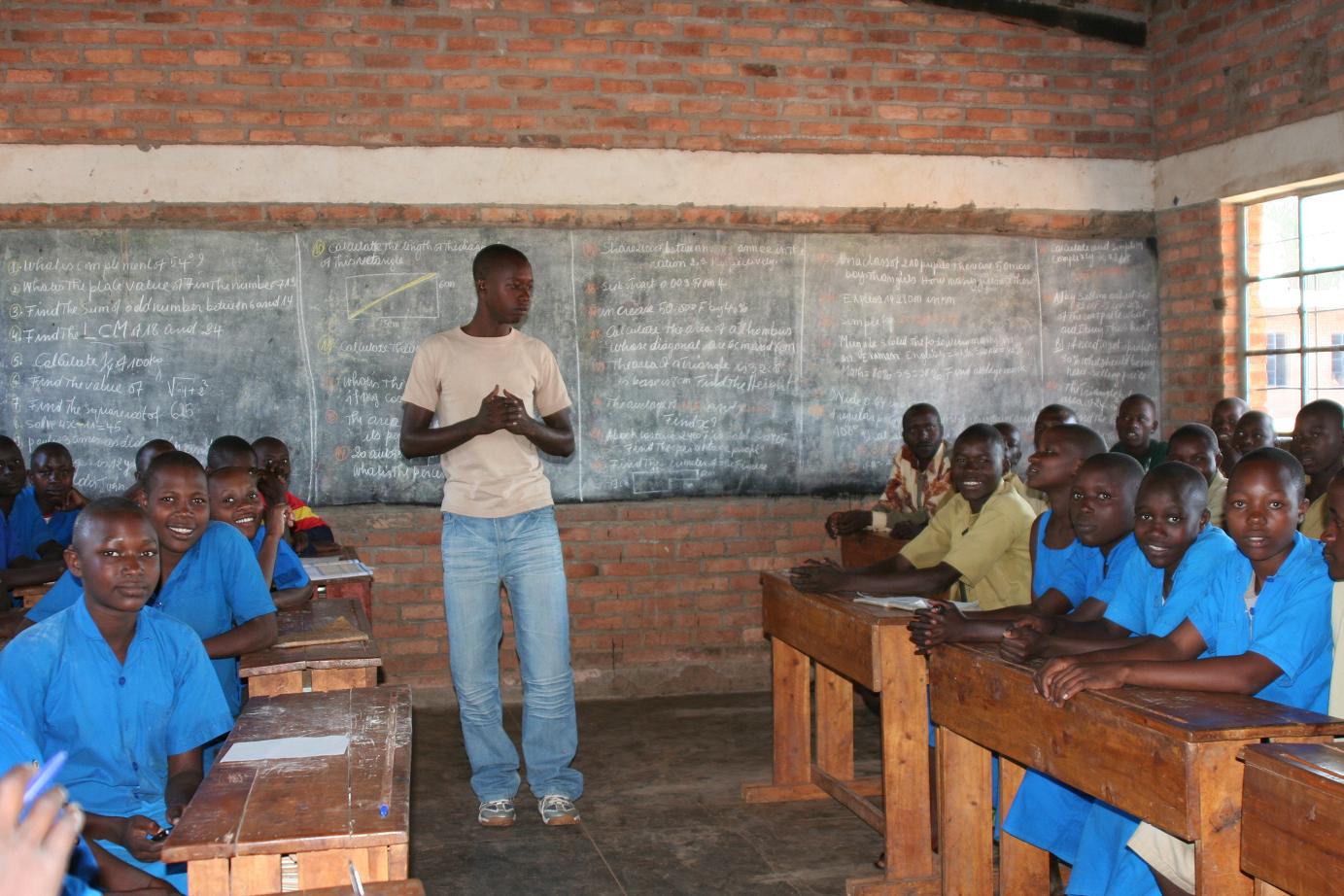
sm Ngenda schoolroomIn the elementary classrooms in Rwanda—which I have visited—there are no posters on the walls, no books, and few visual aids —just a teacher, a blackboard, copy books and pencils. The students write everything they hear from their teachers and everything they see on the board in their copy books—and they study what they have written.  Against all odds, they are on grade level with 6th graders in the United States.  And they are hungry to learn more.

Two years ago, my students made posters—alphabet art—for the walls of these primary schools. Last year they made flags.

But the most important gift my students have given to the children of Rwanda and Burundi is the gift of a high school education: Each year they have raised a substantial amount of money for scholarships for children like Amani.

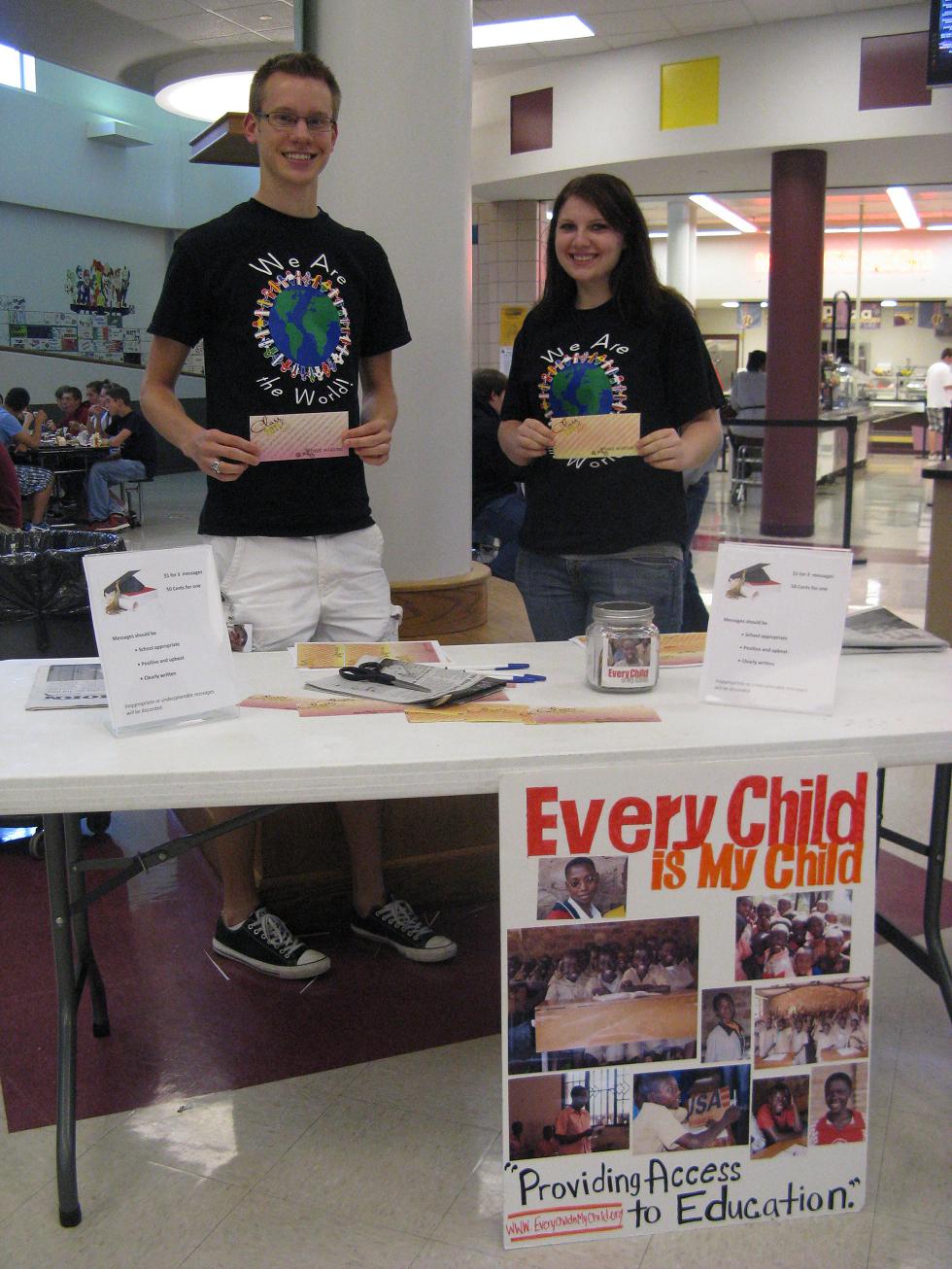
sm Senior Send-offsMy students have worked the concessions at football and basketball games. They have sold garbage bags to adults and “candygrams” (lollipops with a note attached are delivered to fellow students in their classes just before holidays) to their peers. At the end of the school year, they have served as scribes and couriers, delivering last minute “Farewell and Congratulations!” notes from underclassmen to graduating seniors. They have conducted fund drives by selling snacks in the cafeteria at lunch.

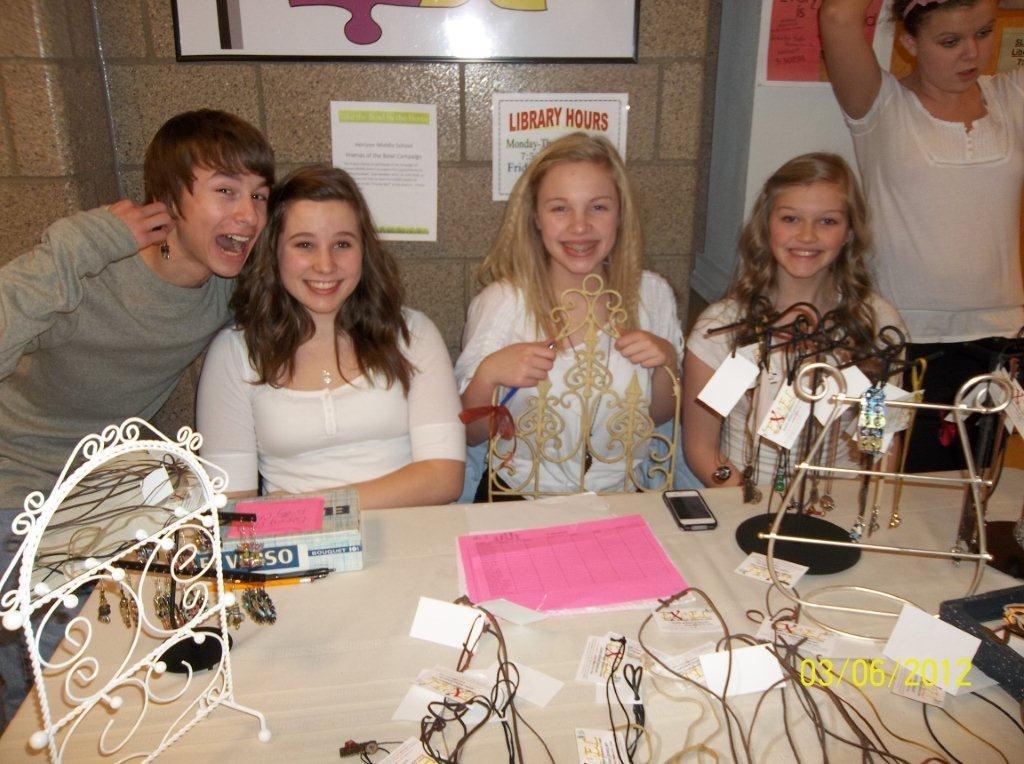
They are not alone in their devotion to the Every Child scholars. In Bismarck, 4 kids jewelryNorth Dakota, students at Horizon Middle School–with the help of two dedicated teachers and a parent volunteer–are also raising money for Every Child. For several years, these middle schoolers sold tie-dyed t-shirts  and socks to their peers and to community members. They created pencil packs out of duct tape and supplied just about everyone in their middle school with these colorful carrying cases. Now they are selling handmade jewelry–bracelets, necklaces, earrings–and sending the proceeds to Every Child.

These American teenagers are making a difference in the lives of children in Africa by helping them achieve what is taken for granted in our country: a high school education.  The money they raise is a gift of hope for a better life for the children there and a better world for all of us.

If you are a teacher and have an idea for an Every Child service project you’d like to do with your students, I’d be glad to talk particulars with you. Just contact me by responding in the comment section to this blog. Consider changing the world with us.

To learn more about Every Child is My Child, visit these sites:

https://www.facebook.com/EveryChildisMyChild

http://www.youtube.com/watch?v=jeAW9IKHJok

Educating Every Child

I’m going to depart from my usual format and include some pictures in this post. I want you to see Amani. She wants to be a doctor when she grows up.

sm AmaniHer ambition is not unusual—at least it wouldn’t be for American girl. What is unusual is that Amani is enrolled in high school in the tiny African country of Rwanda—and she’s well on the way to achieving her dream.

In Rwanda, it’s unusual for children to be in high school at all. In this tiny country in west central Africa, elementary education (grades 1-6) is mandated; in fact, 98% of the boys and 96% of the girls attend village elementary schools. But that’s where education ends for most.

The reason is money: A year of secondary school costs at least $300.

In a country where, according to the World Bank figures for 2011, the per capita GDP averages $570 a year, sending your child to secondary school—and you may have three, four, five, six children—is impossible. Amani is lucky: She attended a elementary school that partners with Every Child is My Child, an American non-profit that provides scholarships for any child in the school who passes the national exam to qualify for secondary school.

Every Child is My Child has been partnering with Nyacyonga, Amani’s village school, for five years. Children at Nyacyonga have a reason now to stay in school and study hard: Secondary school has become a possibility.

In sheer economic terms, attending secondary is meaningful because, again according to the World Bank, every additional year of school means a 10% increase in earning power. Amani is a junior, so she’s already added 50% to her potential as a wage earner. In human terms, think what an education means for her: She will have choices about the path she follows in life.

Think what Amani can do for her country.

Rwanda is not only the smallest country in Africa; it is the most densely populated. Most people in the rural areas are subsistence farmers, growing bananas and sorghum and coffee. In fact, Rwanda’s chief export is coffee, but the country is so small it can’t compete globally with Kenya, Ethiopia, Tanzania—much larger countries with far larger harvests.

Rwanda has one major tourist attraction: the endangered mountain gorillas made famous in a film about Dian Fossey’s life and work, Gorillas in the Mist.  Expensive as it is to trek into the mountainous jungle region to see the gorillas—a permit costs the equivalent of an average Rwandan’s yearly income—a limited number of tourists per day are allowed to see the gorillas (the length of a visit is a strict one hour) so that the animals don’t completely habituate to humans.

On top of that, Rwanda is still recovering from the devastating genocide of 1994 when 800,000 people were slaughtered, mostly by machete, in a mere 90 days—a story told to the world in the film Hotel Rwanda. Education is the route to development and economic independence, and ultimately, the key to peace and progress.

So Amani—her name means “Peace” in Swahili—and her fellow classmates will be the ones to lift Rwanda from poverty and bring stability to the lives of their countrymen. She and her classmates will make, in fact, a global impact because an education is a sustainable resource.

In Rwanda, secondary schools are boarding schools. Students are assigned to schools all over the country according to their interests, their test scores, and the space available, so a class of graduating 6th graders may not stay together. Amani’s is a specialized high school. The curriculum is science-based—what  we might call in this country a “magnet school.”  She travels by bus—sometimes the ride can be 10 hours—and comes home infrequently. Transportation is expensive, and it is the parents’ responsibility to pay for or make the travel arrangements, their demonstration of commitment to their children’s education. Not one parent at Nyacyonga whose child has passed the qualifying exam has turned down this opportunity for their child. The $300 a year scholarship from Every Child is for tuition, books, school supplies, a uniform, and a roll-up mattress.

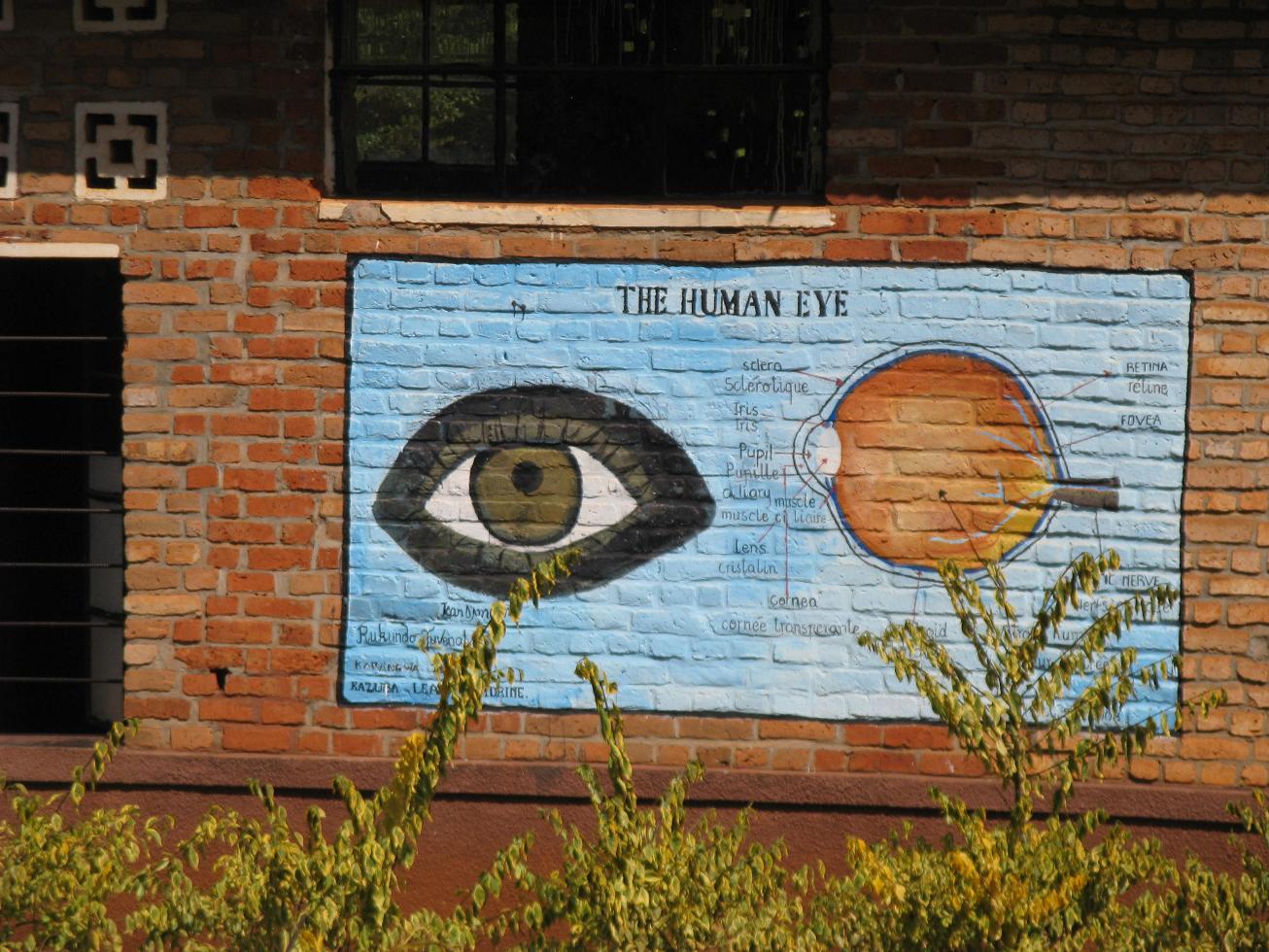
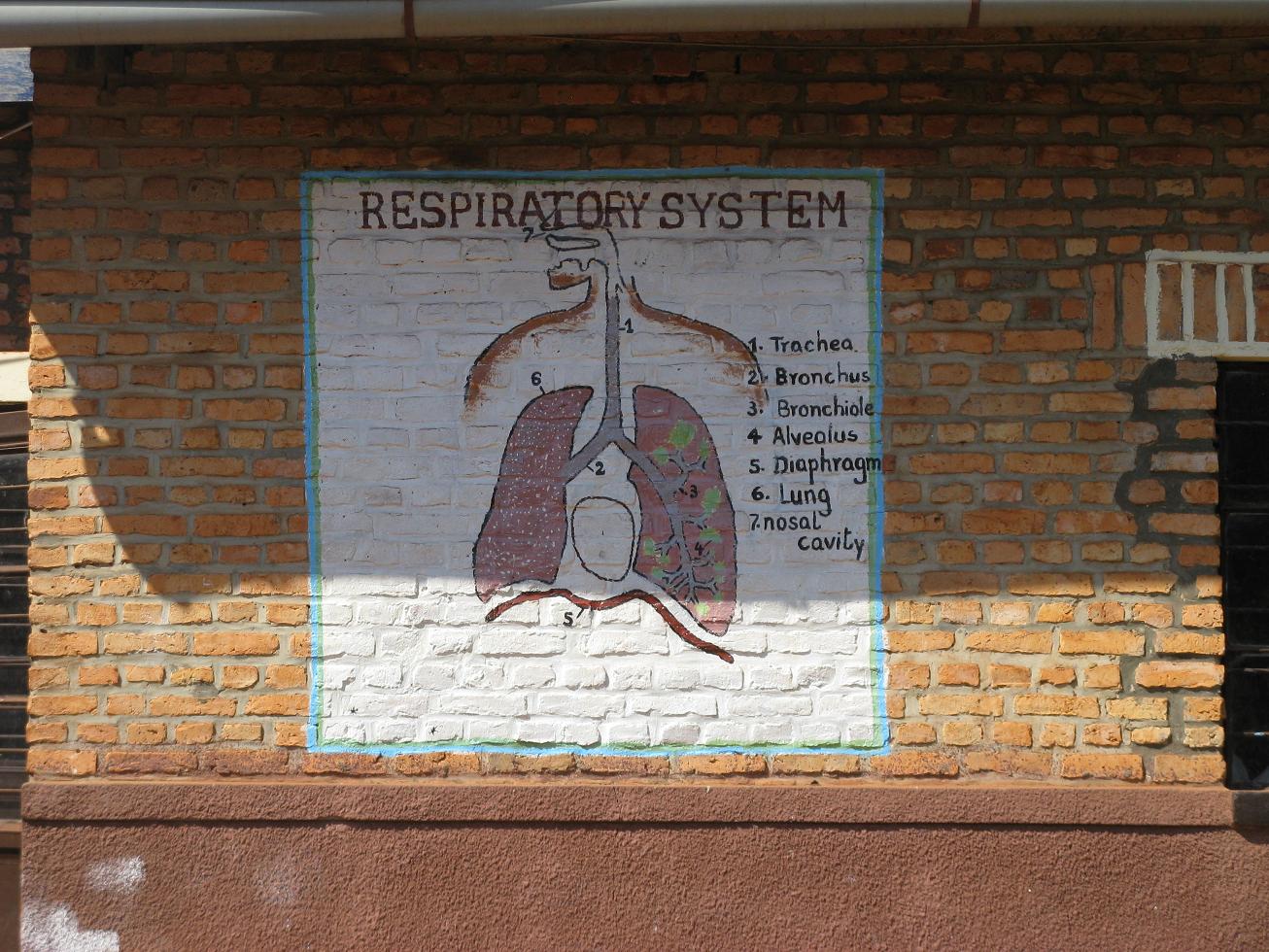
Two summers ago, I visited a secondary school with Every Child is My sm EyeChild’s founder and director (who happens to be my daughter) and some of its donors. The school I saw is in a secluded spot in northeastern Rwanda at the end of a shaded red earth road that cuts through cultivated fields. The grounds are neat, trimmed, tidy. The classroom buildings are sparsely accoutered: blackboards, desks, and only occasionally, a wall poster. The most colorful—and unique—aspect of the school is outside the classroom: Murals depicting body systems and organs have been painted on the exterior of the buildings—the eye, the respiratory system, the ear, for example.

sm Respiratory SystemWe took Amani and four other Every Child scholars from this school or from boarding schools within a few hours bus ride to lunch at a restaurant on Lake Muhazi, located not far from the school. Charming teenagers, all of them: Amani with her megawatt smile; Mary Louise, who—as is common—is the first in her family to go to secondary school; Grace, who also wants to be a doctor; and two boys, Ananies and Jean-Paul.  John-Paul was the spokesperson for the group. On the bus that morning, he’d prepared a speech which he read to us before we ate. He thanked Every Child for the opportunity to go to school, of course, and said that the students’ motto was this: “Upward Ever; Downward, Never.”

Lunch was barbecued chicken and fresh fish and orange soda. The teenagers, accustomed to beans and maize for lunch and dinner day after day after day, picked the platter clean. The soda bottles emptied quickly. “They don’t serve Fanta in the school cafeteria?” we asked, knowing full well they didn’t.

“It would be a miracle!” Amani laughed.

We asked the students about their families, their ambitions, their favorite subjects, and among other things, what they like to do in their spare time. Amani’s not so different than American kids—she likes to relax with her friends. Someone mentioned the upcoming end-of-term exams, though, and she responded, with her characteristic grin, “I guess I’ll have to reduce my relax!”

Every Child is My Child takes a unique approach to educating children in Rwanda and in Burundi, its neighbor. First of all, the scholarships are for secondary school. That’s unusual in the developing world, but clearly, the gap between elementary enrollment and 7th grade clarifies that there is where the need is—and where the greatest impact could be. The incentive for the elementary students—that is, the possibility of continuing on to secondary school—has worked.

And even if a student doesn’t pass the national exam to go on, he or she has lasted through 6th grade at least. That’s going to increase that student’s earning power and insure a degree of literacy. Likely there will be long-term impacts on early marriages and child labor expectations, on earning power and family stability. Education has the potential to break the cycle of poverty—so every year in school helps, and every child is part of the solution.

Every Child is My Child’s model is unique, too, because every child in the partner schools is offered the same opportunity. Some scholarship programs serve individual students—say, the top scholar in a school—or provide support just for girls—or just boys. These programs are important. But Every Child, by educating whole classes of students, aspires to lift entire communities. What can happen when every child in a village is literate, when every child has a high school education? In how many ways will the village itself be transformed? The country? These are big questions. The answers reside in the  future these children create for themselves and their families.

Right now, Every Child sponsors about 300 students from two elementary schools in Rwanda (Nyacyonga and Ngenda) and one in Burundi (Mageyo), an even poorer country, where the school fees for secondary grades add up to only $100 a year. The first graduates—kids who have been supported for a full six years—will receive their diplomas in 2014. There are plans to expand the Every Child model, but in the meantime, more students begin 7th grade each year, so the need to expand the base of reliable funders is also growing. This is an organization that depends 100% on volunteers—there are no salaries for anyone—and right now, the organization relies largely on individual donations.

Some American schools have helped, though–and that’s the connection to my American classroom. In my next post, I’ll describe what the International Club at my high school has done to support Every Child is My Child and what another teacher in North Dakota is doing with her middle school students. You can help, too, if you’re a teacher looking for a service project. In the meantime, you can learn more about Every Child by visiting the organization on Facebook (www.facebook.com/EveryChildisMyChild) or by viewing this YouTube video: http://www.youtube.com/watch?v=jeAW9IKHJok

And murakoze. That’s “thank you” in Kinyarwandan. Thank you for reading this blog. Thank you for caring about every child.

Second Skin

I slipped into the task like putting on a second skin.

Since the beginning of this semester, I’ve been working with a high school science teacher on a project tailor-made for co-teaching. She had gotten wind of an essay contest—the World Food Prize Essay Contest for high school students, sponsored by Purdue University, home to two World Food Prize winners. The contest is an opportunity for high school students to learn about and address issues of food insecurity around the world. What this teacher proposed was a melding of our areas of expertise—science and English—with the added fillip for both of us of the international focus.

In December, I perused the contest particulars.

The format was fundamentally a problem-solution paper. Background on the country came first. In the sample paper provided by Purdue, the winner from last year had painted a picture of Afghanistan in condensed, tightly written prose that led directly to the paper’s thesis: The central issues surrounding food insecurity in Afghanistan and some solutions that would alleviate them. Then, a lengthy and thoroughly researched discussion of those problems and solutions, and finally, a summation and restatement of the thesis. All of this, of course, documented with in-text citations and a works cited page in MLA format.

It was certainly a longer paper and a more complicated research project than any of our students would ever have undertaken—but not impossible at all. Especially when we broke the paper down for the kids and laid it out in steps for them. You notice, I am already saying “our kids.” It didn’t take me long to feel like a teacher of kids again.

Writing a research paper is one of the most difficult tasks high school students undertake. It’s a long process, and that’s hard in itself for kids with attention spans that last no longer than a Facebook post. Then, reading is involved—and with that, the pesky but fundamental comprehension skills of paraphrasing and summarizing. Then, the organizing of all that information: in the day, with index cards, each labeled with the author, title, page number, topic and subtopic, and perhaps—if I had been your teacher—marked as a paraphrase, a summary, a quote, or a basic fact.

We don’t do that anymore. Today, kids keep binders that contain printouts of the articles they’ve found, all tabbed alphabetically and highlighted for easy access to information the student intends to use in the paper. Increasingly, as they and we become more eco-conscious, the students don’t even keep binders. They create folders on their desktops. For the organized among them, this works just fine. For the others, it’s the beginning of a nightmare.

Some teachers still require outlines, a skill to be taught all by itself. I used to demand sentence outlines because the students would be forced to think their  papers through. Some of the first problems arise at this point: Just knowing the difference between a topic and its support befuddles some kids. They’ll use a quote for a main idea and a fact as a topic. But if their outlines are complete, I can read them and tell the students where the holes are. A few students will realize that with a sentence outline and well-organized index cards or binders, the paper will write itself.

For some students, actually writing the paper is the stumbling block. It means sitting in a chair for a long period of time and composing one sentence after another until the end.

But it’s not the end: Now come the in-text citations and the bibliography or works cited page. For some students, this is the trickiest part because it requires having kept track of all their resources (those index cards or the tabbed binders again) and having developed a system for keying all the quotes, statistics, examples, stories, facts, and details that they used for support to the ideas in the outline. For kids who can’t keep their lockers or their bedrooms tidy, this is a sorting and classifying task like no other!

And it’s still not the end: editing and proofreading and cross-checking the citations remain. And nowadays, even one more step: submission of the document to a plagiarism detection program like Turn It In, the advent of which was a boon to exhausted teachers, who used to have to google suspect lines or search through the students’ binders and cards to prove the student had copied. (You dare not even hint at plagiarism without the proof in hand!) Used as it’s intended, though, and done soon enough before the paper is due, the program serves as a plagiarism prevention program. I know many kids who have been saved from academic disaster by Turn It In, and I’d far rather coach a kid through the process of paraphrasing than nab him or her for plagiarism.

Are you tired just reading all this?

And you don’t have to read the papers! Or send them back for revisions and read them a second time!

Are you impressed with the sheer complexity of the task?  Me, too. I am always proud of my students when they reach the end of this task—even if their papers aren’t stellar, they’ve accomplished a complex task.  Perfection will come with maturity, experience, and the incentive of researching a topic they really care about (which they’ll do increasingly as they narrow down their academic pursuits to their life’s work).

So I knew very well what the World Peace Prize essay contestants would face as they researched a topic they knew nothing about—a country and its problems with food insecurity—and wrote the longest and most thoroughly documented paper they’d ever attempted. But I also knew that any student who elected to enter this contest would be self-motivated (no grades involved, no extra credit), willing to read, and immensely capable.

So yes, we had to help some of them select a country from a list of over 100 and choose a factor (the contest organizers presented them with a list of 19 factors that impact food security), help others select resources and evaluate those resources for credibility and authority, and talk all of them through their research—help them make sense of what they had read. But this was kind of fun for us as teachers. My colleague and I got wrapped up in the topic ourselves.

We both read the students’ early drafts and made suggestions for revisions (We were excited that we noticed and commented on the very same things) and then, at the end, I helped them with the documentation and works cited page by cross-checking their citations.

One boy did need major help with this part—and so I spent two hours yesterday teaching him how to do it, sitting beside him as he hunted out the source of each statistic and quote, each example and fact. I sat across from him while he reconstructed his works cited page and watched as he formatted the paper to meet the contest requirements. It’s not that he hadn’t been taught this process before, but I suspect such things had never mattered to him before.

But he was receptive yesterday—because suddenly, such things did matter. These papers were going out into the real world, would be read by a real audience, and since the boy cared immensely about his topic and had written a very strong paper, he really cared that he got the citations and the works cited page right.

My colleague submitted the papers yesterday after school. We think there are some among them that could be winners…but in truth, all of the students are winners. They completed this difficult task and have taken away a lifetime understanding of a serious global issue and a skill set for research that will make any paper they write from here on out, a breeze.

And I had the delicious experience of co-teaching with a colleague I admire, watching her coach the students in high-level analysis of substantial and substantive scientific information and using again myself the teaching skills I have learned over a lifetime spent in the classroom.

It was a win all around.

The Bus to Friendship

Today, a former student, one of my Russia Travelers (kids I took to Russia 10 years ago) and I met together as colleagues in the same middle school. She, working with kids; I, working with teachers. We got to talking about our trip together years ago, and I told her I was working on another essay about those weeks we spent together so very far from home. I spent many hours, during those years of the exchange, preparing the kids for those trips. We talked about cultural adjustments they’d have to make…about differences in values…about similarities in matters of the heart. My students had no idea that their teacher was learning to cross cultures, too… 

When I traveled in Russia, the loss of independence was the hardest adjustment I had to make.

As the coordinator of an exchange program, I expected to travel about on my own to the school, to the market, to the restaurants my students frequented, and to the parks where they played.  After a few days of riding the bus with Irina, the host teacher, I was ready to travel alone.

But Irina was not convinced.

The trick to riding the bus in Russia is to push your way on like everyone else. In a crowded bus, your body is not your own, and personal space is only in your mind. You have to accept intimate contact with strangers. Courtesy demands that you remain silent or at least quiet in your conversation if you are with someone else. You have to be wary of pickpockets (I was told) and conscious of older people who deserve the seats. That sometimes means hanging on to overhead bars, or in really crowded situations, allowing yourself to be supported by the individuals packed in around you. You hang onto nothing in these situations and grab for the bar when the bus stops so you won’t be swept away by those who are exiting.

The conductor, usually a matron, pushes through the crowd asking to see passes and selling tickets to those without them. She makes eye contact with each individual, gives a brief nod when you hold up your pass, and for those who don’t have a pass, she somehow accepts money and even makes change as the bus lurches along. She never forgets a face, so there’s no danger of her asking twice to see your pass or overcharging you for your ride—but she’s ever on the alert for freeloaders.

Irina could see I knew the drill, but she still wouldn’t let me ride alone. “I can’t let you do that,” was all she would say.

Then one day I needed to meet my students at an hour that was inconvenient for her; she was forced to let me go.

I received strict instructions: Bus #17 from her stop straight to Lenin Square.

Bus #17 came. I boarded a nearly empty vehicle and took a seat on the right so I’d be sure to see the stops. At first, everything was normal. Then the bus pulled into a parking lot I’d never seen before, and everyone else got off. I sat there until the conductor gestured that I, too, had to leave.

I won’t say I wasn’t anxious. I realized that even if I asked for help, people wouldn’t understand me—and I wouldn’t understand them. So for just a minute, I considered that Irina might be right.

Then I noticed that the people on my bus had moved to a spot at the front of the lot and were standing there, waiting. The conductor and the driver had gone into a building that looked like a shed.  Other buses entered the lot; the same thing happened.

It was a shift change!  Sure enough, another #17 bus came along, and I climbed on. The bus resumed the usual route, and I met with my students, as planned.

As a matter of pride, I didn’t tell Irina about this incident. Besides, I was afraid that if I revealed even a moment of anxiety, I’d never be on my own again.

By the second year of the exchange, the Russian teachers with whom I stayed had accepted the fact that I could and would ride the bus alone.

One day I met Irina for an afternoon of shopping.  At the conclusion of our time together, she put me on Bus #1 to “Kristy,” the area at the edge of town where I was living. I had been told to take Bus #4, but Irina assured me that #1 went to Kristy, too—she used to live there herself. We parted, and I rode Bus #1 down Octobrisky Street toward the bridge I knew the bus would cross on its way out of town.

Just before the bridge, the bus unexpectedly turned. I noticed the deviation immediately and, with a sinking feeling, watched the buildings go by. A few blocks later, the bus stopped at the railroad station and everyone got off.

I approached the conductor.  “Kristy?”

She replied in sentences I didn’t understand, wrote #4 on a piece of paper, and gestured toward the corner where #1 had unexpectedly turned.

My moment of panic was short-lived. I would walk to that corner, catch the right bus, and continue my journey.

Just then, a taxi pulled up and I heard a familiar voice call my name.

It was Irina. She had read a sign on the side of the bus as it pulled away that indicated the route had changed. Concerned that I would be frightened and not know what to do, she had found a taxi and pursued me to the railroad station. That is when I understood at last the depth of her concern for me. I surrendered my pride, climbed into the taxi, and we laughed together all the way to the corner.

I learned later that the name of that corner bus stop is “Friendship.”  Fitting, because that is the place where I gave up my obstinate insistence upon independence—truly an American trait—and understood the motive behind her guardianship. That was the moment real friendship began.

Russian Mother

The holiday season is just about over. I’ve ingested my weight in cookies and confections, yet when someone urges another delicacy upon me, it’s impossible to say no. It’s cultural habit to urge calories upon friends and family in December, and indulging in culinary decadence has reminded me of another time and place in my life when eating too much was more or less an expectation, one I had to help my American students understand, too. We were together in Russia, ten years ago…   

I told them to just say “No.”

Politely, but “No.”

It didn’t do any good.

Their Russian mothers continued to heap food upon my students’ plates and ask again and again, “Wouldn’t you like more?”

“Aren’t you hungry?”

“Don’t you want something to eat?”

“Kushai! Kushai!”  they implored.  In English, “Eat! Eat!”

In preparing my American students for their three-week stay in Russian homes, I had explained that the Russian mothers would associate food with well-being and the serving of it with hospitality—indeed, their own mothers had done the same when the Russian teenagers had visited us in Indiana. Still, saying “No” and stonewalling the urgent pleas of the Russian mothers was easier to imagine than do. My students struggled, and so did I, with hospitality that seemed to have no end.

In Russian homes, mothers serve the food at the table—even ladling it onto the fathers’ plates. We couldn’t help ourselves to small portions and thus strategically leave room for more. In fact, the mothers more often than not served the Americans giant portions to begin with and gave their own children the smaller portion sizes that are the rule in Russia. Perhaps they had heard that Americans’ plates are generally heaped, but probably not. The over-sized helpings were more an expression of generosity than cultural accommodation.

We tried saying “No, thank you” in Russian: Nyet, spasebo. That didn’t work. We tried “I’m full.” Ya sita.  It produced the opposite effect:

“Wouldn’t you like some more meat?”

We learned Russian slang for “I’m full. Ya ne slon. “I’m not an elephant.” That didn’t work either.

In fact, mealtime became a kind of battle of wills. The mothers, worrying and kind, urged more and more food upon the students, tempting them with packaged wafer cakes, elegant confections from the city bakery, peach juice and pineapple juice, and the incredibly smooth chocolate that is so hard to resist. The students begged, pleaded, shook their heads, held their stomachs in mock pain, and tried every Russian phrase they knew to say, politely, “Enough.”

It was the same for me, and I got nowhere, too. The teachers told me that the mothers were concerned. The kids weren’t eating. It wasn’t that they didn’t eat specific foods. No, the meat and potatoes were familiar and the desserts were delicious. The Russian “salads”—mixes of diced vegetables, fruits, nuts, meats or seafoods, all held together with mayonnaise—were tasty.  The trouble, the mothers said, was that the students weren’t eating enough.

I used such moments as opportunities to instruct my own hosts in American eating habits.  “We usually mean it when we say no,” I explained. “The kids will eat when they’re hungry. Don’t worry about them. Don’t worry about me.”

But they all did continue to worry. It became a kind of a joke, eventually, although sometimes it produced irritation. I began to dread meals. My waistline was thickening and I was usually still full from the previous repast—and yet, out of politeness I couldn’t completely resist, and out of gluttony I couldn’t pass up the desserts at all.

“Irina,” I said to my good friend, the teacher I stayed with the first time I brought a group of students to Russia, “you’ve been to my home in America. You know I don’t eat such big dinners. I don’t usually eat seconds.”

She nodded.

“In fact,” I said, “How did you get enough to eat at my house? I didn’t keep asking you if you wanted more.”

“I knew you’d ask only once,” she said knowingly. “I knew to take seconds the first time they were offered.”

I just shook my head.

Two summers later, Irina, her daughter Anna, and her daughter’s friend, Olga, met me at “Lavitsa,” a restaurant  that specializes in the delicate pastel cakes and mouth-watering chocolate tortes created at the city bakery. Displayed in splendor in a glass case at the entrance, the cakes tantalize customers who enter intending just a cup of tea. I’d “saved up” for this occasion and was in a dither choosing.

“I remember you like the one called cappuccino,” Irina said.

“Yes, that’s right, I do. Let’s order that. And how about Anna and Olga?”

“Oh, nothing for us,” they replied.

I arched an eyebrow. Skinny teenage girls. They should eat something, I thought.

When the waitress brought our cakes with the requisite teaspoons for eating dessert, my slice was as big as the Ritz. By comparison, Irina’s was small. And Anna and Olga had nothing.

I took the situation in hand.

Dve lozhki, I said to the waitress. She brought me two more spoons. I gave them to Anna and Olga and pushed my plate in their direction.

“No, no,” they said in chorus. “No, thank you.”

And then I heard myself say it.

“Kushai, kushai.”

My tone was urgent.

I jiggled the plate again and nudged it another inch across the table. “Kushai! Kushai!”  I repeated.

Irina looked at me and shook her head. I had become a Russian mother.

Small World After All

After we’ve read To Kill a Mockingbird

After we’ve read Great Expectations

After we’ve read When We Get There and The Secret Life of Bees and Cold Sassy Tree or any of a number of other stories about coming of age in America, I ask my students: Is growing up the same in other countries and cultures?  In other cultures, is there a specific age at which you are declared to be an adult? Is there an event, like a Quinceanera, to signify the passage from childhood to adulthood?  Does it take a “confrontation experience”—like Jem’s encounter with the truth about the justice system—to push  you into adulthood? Does reaching majority in other cultures bring entitlements—a driver’s license, the right to vote, responsibility for your debts?  Or is the growing up process a gradual one, a transition that occurs naturally over time and is unmarked by ritual, decree, or event?

What’s it like to come of age in other lands?

This is International Education week—just the right time to describe one of my favorite assignments—and one my students have always liked as well.  I call the assignment “International Fair.”

The students’ first task is to select a book, fiction or non-fiction, about growing up in another country or about someone from an ethnic or cultural minority coming of age in this country. In my classroom,  I have a shelf of books about young people in other countries—or immigrants and refugees in this country—and many more books are in our school library. Our media specialist helps me out by pulling the books ahead of time so kids can find them quickly and peruse them easily until they find one they like.

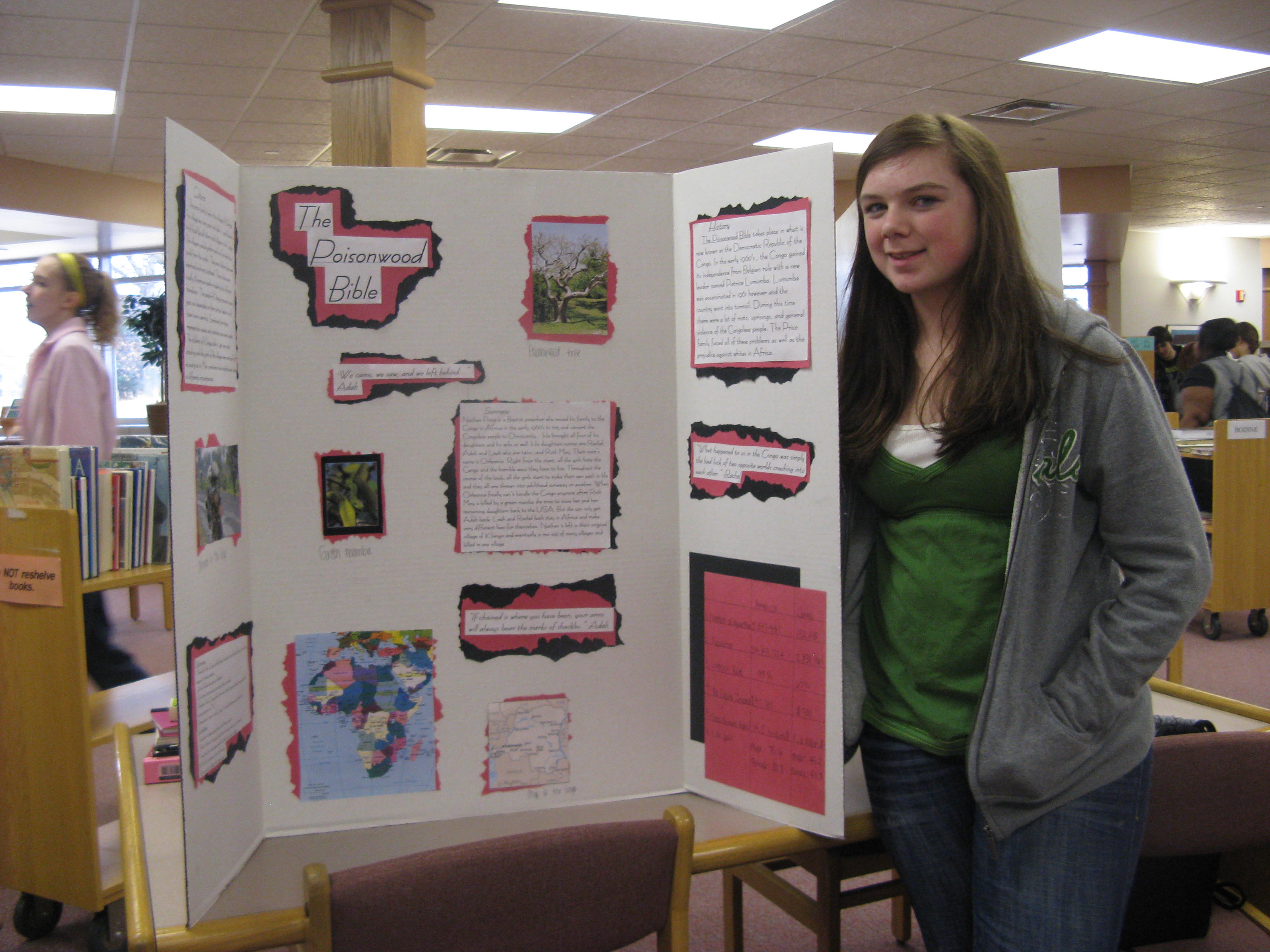
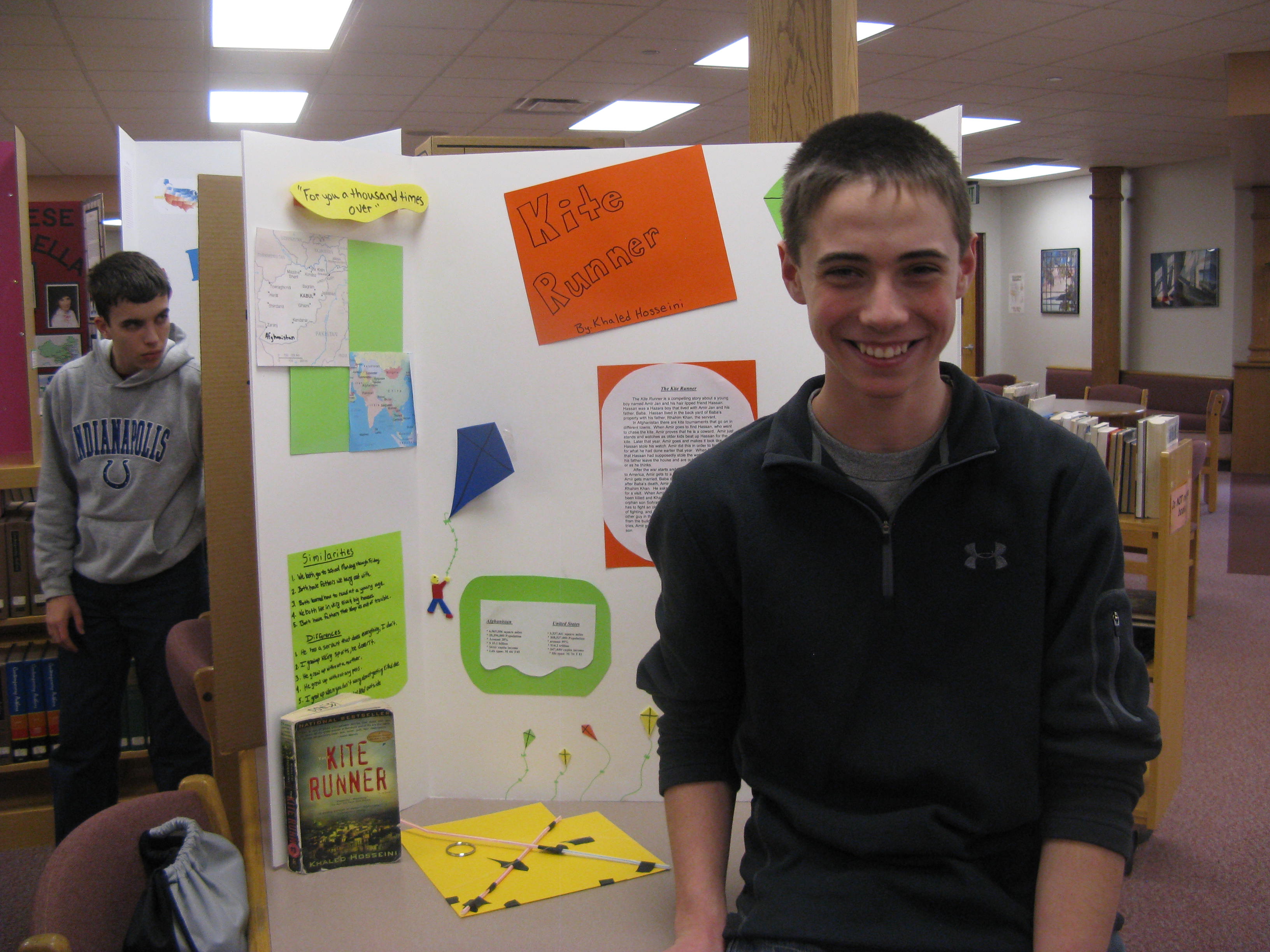
Next, each student creates a stand-alone, 3-sided poster—the kind that is used for science fair projects. The goal is to create a poster that makes the story as appealing as possible, but at the same time conveys something of the history and culture of the country portrayed in the book.

The poster must include

1.       Author’s name and title

2.       A summary of the book (about 300 words)

3.       Two maps—one of the country where the story takes place with the city or region highlighted and one of the continent in which the country is located.

4.       A paragraph about the history of the country during the time period of the book (again, about 300 words)

5.       A paragraph about pertinent religious or cultural characteristics of the particular cultural group described in the book OR a description of the relevant cultural characteristics of the country overall if the main character is not from an ethnic minority (not to exceed 300 words)

6.       A bulleted list of at least 5 differences and at least 5 similarities between a teenager growing up in Indiana and the character in the book.

7.       A comparison table showing the following pieces of information about the country or region compared to the United States:

  •  Number of square miles
  • Population
  • Literacy rate
  • Gross domestic product
  • Per capita income
  • Average life span (m & f)

But there can be more: Students sometimes include photographs, symbols, clothing,  3-DIMG_2782 objects or pictures of objects, or decorations that capture the feel of the country. They may include important sayings or proverbs from the culture, quotes from the book, other pertinent maps, or even their own assessment of the book or recommendations for other books with a similar theme.

The most successful posters are eye-catching and colorful, but even a student with little talent in art can create an appealing poster with some help from a computer and just the most basic understanding of design. I give the students these simple directions: Type your paragraphs, keep the design uncomplicated, use construction paper to frame the typed paragraphs, and be consistent with the fonts and point size.

IMG_2787On the day the posters are due, we set them up in the library and students give book talks about the work they’ve read.  I want them not only to summarize the story, but to connect the dots between the story they have read and the demographics, historical facts, and other statistical information they have gleaned.  I ask them to expand upon the similarities and differences that they have noted between themselves and the characters in the book.  Sometimes—for extra credit—they’ll offer their classmates “international fare”—regional food that they’ve prepared themselves (Parents have to sign a form indicating that their child actually prepared the food. I am not interested in giving Mom or Dad extra credit.)

Invariably, the students’ lists of similarities and differences are the most interesting part ofIMG_2793 the presentation. Depending upon what they’ve read, the students notice differences in family relationships, in family size, in the size of American homes versus homes in other countries. They’ll see disparities in possessions, in schooling, in opportunities. They’ll see differences in wealth, in medical care, in the availability of food; differences in transportation, occupations, and expectations. Some are surprised, even shocked by what they learn because some of these stories are violent and horrifying. Some are just plain sad. Resilience is a common theme. But for the most part, students also discover similarities between themselves and the person they are reading about, and those commonalities allow them to identify with the characters.

The individuals in the stories my students read have families that, like their own, love them, occasionally smother them, sometimes annoy them, always are important to them. They encounter teenagers from far away who also have dreams and aspirations; characters who respond to injustice and inequity just as they do; young men and women who are disappointed, delighted, rewarded or punished, teased or tolerated, loved or hated. They find kindred spirits in people from other countries—and learn that stereotypes are just that and outward appearances can be deceiving.  In short, they learn that what makes us human—our emotional responses to the people and events in our lives—is common to all of us, no matter where we grow up.

IMG_2796In the past, the posters have remained in the library for a month or so—long enough for other students to see them and perhaps be enticed to read one of the books for themselves. But even if their classmates don’t choose to check out a book, the posters attract attention and alert other students to a world larger than the one they know.  As for my students, reading a book about someone from another country helps them learn an opposite and important truth: The world is actually much smaller than they might have supposed.

In case you’d like to try this for yourself, here are the books on my shelf. You’ll need to check the reading levels and match the book with the particular student. Some of these are adult books, suitable for advanced readers; others are for middle schoolers.  If you know of a title I haven’t listed, please add to my list by commenting below. I’m always on the lookout for another good book.

FICTION     
Title  Author Country
Roots  and Wings Many  Ly Cambodian-American
Spud John  Vander Ruit South Africa
Power  of One Bryce Courtenay South Africa
A  Thousand Splendid Suns Khalid  Hosseini Afghanistan
The   Kite Runner Khalid  Hosseini Afghanistan
Bless   Me, Ultima Rudolfo  A. Anaya Hispanic/New   Mexico
China Boy Guss  Lee Chinese-American
In   the Time of the Butterflies Julia  Alverez Dominican Republic
Yo! Julia  Alverez Dominican Republic
How  the Garcia Girls Lost Their Accents Julia  Alverez Dominican Republic/ America
In  the Name of Salome Julia  Alverez Dominican Republic
The  Namesake Jhumpa  Lamiri Indian-American
The  Poisonwood Bible Barbara  Kingsolver Congo
The  Syringa Tree Pamela  Gien South Africa
The  Invisible Thread Yoshiko  Uchida Japanese-American
When  My Name was Keoko Linda  Sue Park Korea
The  Joy Luck Club Amy  Tan China   & Chinese/American
Habibi Naomi   hihab Nye Israel/Palestine
Snow  Falling on Cedars David  Guterman Japanese-American
Farewell  to Manzanar Jeane  Houston Japanese-American
Zoli Colum  McCann Romani   in Eastern Europe
Swimming  in the Monsoon Sea Shyam  Selvadurai Sri Lanka
NON-FICTION
                          
Stealing  Buddha’s Dinner Bich  Minh Nguyen Vietnamese-American
The House at Sugar Beach Helene  Cooper Liberia
First They Killed My Father Loung  Ung Cambodia
They  Took My Father Mayme  Sevander USSR
The Lost Boys of the Sudan Mark Bixler Sudan/Kenya/Ethiopia
There is No Me without You Melissa  Fay Greene Ethiopia
They Poured Fire on Us from the Sky Deng, Deng, and Ajax Sudan/Kenya/Ethiopia
When I Was Puerto Rican Esmeralda  Santiago Puerto   Rican-American
Leaving Mother Lake Yang   Namu China (Moso culture)
The Endless Steppe Esther  Hautzig USSR
Growing Up in Moscow Kathy  Young USSR
The Diary of a Young Girl Anne Frank Nazi-occupied   Holland
The Children of Willesden Lane Mona Golabek England during WWII (Jewish refugees: kindertransport)
All But My Life Gerda   Weismann Klein Nazi   Germany
The Bite of the Mango Mariatu   Kamara Sierra Leone
A Long Way Gone Ishmael   Beah Sierra Leone
The Kids from Nowhere George   Guthridge Eskimos in Alaska
Lipstick Jihad Azadeh Moareni Iran
The Price of Stones Twesigye Kaguri Uganda
A Beginner’s Guide to Acting English Shappi Khorsandi Iran/England