International Flavor

Last night was the 10th annual International Dinner at my high school. It’s a carry-in. The food is prepared by the students, and all of it is fare from the cuisines of countries other than the United States. This year’s spread featured beignets, potato latkes, pico de gallo with tortilla chips, borscht, rice and bean and zucchini casseroles, fajitas, German chocolate cake, and cookies and sweets from around the world.

The foreign exchange students proudly offered food from their home countries. This year the most exotic dish was Giorgi from Georgia’s khachapuri – dough stuffed with cheese and “fried” in the skillet in olive oil—a sort of stuffed crepe. He’d never made the dish before. Apparently, it was quite a feat. Two Chinese cooks on YouTube, speaking Chinese, provided a demo, and his host mother, my colleague, gave him a hand once they found the recipe in English.

After the dinner, there’s entertainment—sometimes a talent show, sometimes performances by World Languages students, sometimes games or simulations teachers have set up. This year, the French teacher—who plays the fiddle and the guitar—led the crowd in French and French-Canadian songs and taught the students a folk dance that involved a broom and dashing in pairs down an alley of other students lined up to take their turns doing the same thing.

These dinners began ten years ago as a social activity connected with the exchange program I sponsored then with a secondary school in Russia. Each year, 9 American students welcomed 9 Russian students into their homes and into our school. In June, we switched—I took the Americans to Russia. But in the fall, the Russians were with us. In those days, the American host families came to the International Dinner, too, and the Russian students provided the entertainment after the meal.

When the exchanges ended, the dinners continued. In fact, it was while the exchanges were active that my colleague (Giorgi’s host mother) and I initiated the International Club, an extra-curricular service and learning organization that is now the largest club in the school.

My colleague taught Spanish then, and she was the mother duckling around whom our slim number of Hispanic students flocked. During the years of the exchange, she and I took the Russian students, their American “brothers” and “sisters,” Spanish Club students, and Hispanic students on field trips to Chicago. Other students in the school became curious about and then interested in all our “doings.” The spirit of appreciation for other countries and cultures was growing in our school, and when the exchanges ended, we wanted that spirit to continue.

To do that, we founded the International Club. The first year, the membership was small—mostly the few kids who had been with me to Russia and a few others from my colleague’s Spanish classes—but today, the membership crowds 100.

The International Club, we decided, would have three purposes: Service, Learning, and Fun. Since then, the students have
• Made greeting cards for Russian students in Beslan following the terrorist attack there
• Contributed money and person power to clean-up efforts in Louisiana after Hurricane Katrina
• Electrified a school for the deaf in Isiolo, Kenya
• Raised the money for playground equipment for an elementary school in India
Furnished a school library in El Salvador with books and computers
Paid the secondary school fees for 6 years for a girl in Rwanda
• Raised money to send 10 secondary students to school in Burundi
• Made flags and alphabet posters for primary schools in Rwanda
• Collected toys for an orphanage in Haiti that was destroyed by the earthquake
• And this year, they are raising money for an elementary school in Cameroon

Fun we have had; learning we have done. But most of all, the students’ horizons have expanded and their interest in global affairs has increased. More and more of them are eager to travel to other countries during Spring Break; more and more of them tell me they plan to study abroad while they are in college. Friendships with international students have been forged and sustained. Best of all, most important of all, appreciation of other countries and understanding of people from afar has had the contagion effect I had hoped for when I first took kids to Russia.

My thought then had been this: If my students could get to know and genuinely like just one other person from somewhere else, if they could come to understand that we are more alike than different from those from afar, then that attitude would generalize to people everywhere. My students would accept differences; they would embrace diversity. They would not fear “the other.” The kids I took to Russia did more than “genuinely like” their sisters and brothers from Russia; they fell in love with their Russian families. The same thing happened to the Russian students—they grew to love their American families.

And such has been the experience of so many other students during these past 10 years. American students who have hosted exchange students have gone to European countries to see them again and meet their families. This year for the first time, one of our boys has gone on a year-long study abroad program. He’s in Germany, living with the family of the boy who lived with him last year in Indiana.

So, watching the students last night—Sylvie from Kenya dancing down the gauntlet with her friend from rural Indiana; Victor, whose family is from China, dancing with Lili, whose family is from Iran—I marveled and rejoiced at what has happened in 10 short years. Organizations like the International Club are usually personality-driven. They don’t have national charters, like Future Farmers of America, or an established purpose, like the Student Council. They aren’t recognized high school entities like the National Forensic League. They usually die when the sponsor withdraws.

But our International Club—unique in Indiana as far as I know—continues to thrive. In part, that’s because of the committed efforts of my colleague and two other teachers, who are now the sponsors, but it’s also because the Club itself has become institutionalized. It is a recognized entity in our school community. The activities are fun, the service projects are meaningful; the learning is measureable. Look how many were there last night!

And I was there, too—savoring international flavors and celebrating amazing friendships that extend beyond national borders.

How sweet it is.
A Travel Journal Worth Keeping

School’s out, the grade book is closed, and the room has been cleared for summer maintenance. For many students, attention has turned to summer travel. Some will be going on exchanges, others traveling with their families. Here’s the handout I share with students who are going abroad for the first time.

Of course they’ll take pictures and send them back home—theirs is, after all, the world of the iPhone and Facebook—but some things can’t be captured in photographs. I encourage my students to record the sights and sounds of other countries and the experiences they have as they travel in words as well as photographic images. And then, of course, they’ll have lots to write about when they return to the classroom and need story starters for their essays.

First of all, I tell them, there is no single way to keep a travel journal (except that you have to write in it or you won’t have one.) Your journal can be an old-fashioned diary—one that summarizes each day from dawn to dusk. This type of journal is sometimes called a chronicle because it details, in the order of what happened, everything about the day: what you did, who you saw, what you experienced, where you went, what you ate, or just some of this. Or, your journal can be topical (you write on just certain subjects and don’t necessarily record every last thing you did). It can be thematic (you write about ideas and how you see them play out in events and people you encounter). It can be a sketchbook. That’s right: You draw your way through the day—or in this case, the trip. It can be a scrapbook of odds and ends you collect as you go and paste right into the pages alongside your thoughts, observations, summaries, and sketches. In other words, the journal is yours—your business, your record, your expression of yourself, your portrait in words (mostly) of what you see hear, smell, taste, touch, sense, experience, and understand on your journey.

A journal can be a diary with a lock and key, a spiral notebook, a fancy blank book (lined or unlined pages) from someplace like Barnes and Noble, a sketchbook (unlined pages), or even a 3-ring binder! It can be any size that’s convenient for you. But here are my preferences for journal-keeping (based on years of keeping them):

• A spiral binding so the book will open flat—makes it easier to write on the left hand pages.
• An elastic band that slips around the front and back to hold anything loose you’ve slipped inside (of course, this can be accomplished with a big, fat rubber band, too).
• Lined pages—but, if you’re likely to want to sketch, you might prefer unlined pages. In that case, take a sheet of blank paper and draw heavy lines on it–thick ones, dark enough to show through the blank page. Slip the lined piece of paper under a blank page and presto: lined pages!
• Not so big you can’t slip it in your purse or backpack. Not so small you can’t write very much.
• A glue stick (slip it in your purse or pocket)
• Pockets (make these with index cards and scotch tape) on the inside of the front and back covers. You will use the pockets to keep stuff too big to paste into your journal.

Getting Started:

It may help to get started to imagine an audience. It might be your parents, with whom you will share your book when you get back. It might be a friend. It might be an imaginary friend. It might even be just you yourself that you’re writing to. But most people have an audience in mind—maybe subconsciously—when they sit down to write. If a “known” audience will help you, consciously pick someone to think about when you write. That way, you’ll “speak” directly to that person, in a natural voice, and you’ll think of the details that person would need to know to understand. This is very much like writing a letter. (Some very powerful diaries have been composed as letters. Remember Anne Frank’s diary to “Dear Kitty”?) Other people, however, prefer to just “free-write.” Do what suits you.

Naturally, you are going to apply everything you have ever learned about descriptive writing from every English teacher you’ve ever had. You know: appeal to the senses, think in metaphors, relish similes and other figures of speech, write about one thing by comparing it to another, choose vivid words, use action verbs, include details, details, details—etc., etc., etc. Besides all that, which is VERY IMPORTANT and ABSOLUTELY BASIC, here are some practical suggestions for things to notice and write about :

What to Write About:

Jokes you are told—what someone thinks is funny tells you a lot about their world.

Conversations—just a few lines that are provocative or thoughtful will begin a journal entry in an interesting way and capture the flavor of what you learned. Just by itself, with no elaboration, conversation is interesting to read. For example, I had this conversation with two girls who were translating for me when I was in Russia in 1998. (Both girls were named Anya.) Their summary of the teacher’s omniscience stays with me because I recorded the conversation.

In Russian schools, students sit two to a desk—a “seatmate” it is called.
I said to Anya 1 and Anya 2 that I was impressed they didn’t poke each other, they said, “Oh, we poke.” And then I did see one boy whack his diligent seatmate with a ruler.
“Seatmates are an advantage,” Anya 1 said. “If I don’t understand something, my seatmate can help me.”
“What’s to prevent cheating during an exam?” I asked.
“The discipline, “ they answered. “The teacher knows.”

Lists. Make a list of items in a room, books on a shelf, ingredients in a cupboard, CDs or videos in a rack, things on the table, foods in the market, music on the radio, vendors on the street, merchandise in a shop, breads in the bakery, people on the train, foods at a party. The list will capture the flavor without much further description.

Draw a floor plan of your host’s apartment if you are staying with a family. Label the rooms and explain who sleeps where. Later, if you are able to take pictures of the apartment, it will help your family and friends at home to visualize it.

Recipes for foods you liked. Ask your host mother to show you how to make a favorite bread or dessert. She will be pleased, and you will have an authentic recipe to share.

Journal Entry Starters:

Three things I should have brought…
Three things I didn’t need to bring…
Three things I didn’t expect…
Three things I’ll never forget…

Things I love about Russia (or any country)…
Things I miss about the USA…
Things that made me sad…
Things that made me glad…

Keep a record of the weather
Keep a record of the number of times you hear a certain word or slang expression
Keep a record of the dogs you see, or cats, or kinds of cars, or popular songs
Keep a record of the American products you see for sale

A surprise
A disappointment
A moment of gratification
A moment of annoyance
A wish
A hope
A dream

Take a walk down the street. Who else is on the street? How many and what kinds of cars pass you? How many animals do you see? What buildings do you pass? How are they different from buildings in America? What is beneath your feet? Straight ahead? What do you smell? What do you see on the horizon? What’s the prettiest thing you see? The ugliest? What feeling do you get, walking down the street?

Go shopping. Describe the procedure. What if you didn’t have a friend to help you? What would be the dangers for you? What would perplex you? Frustrate you? Confuse you? What are the advantages of buying items the way it is done in this country? Disadvantages? Compare and contrast with shopping protocols in America.

Watch TV. IT doesn’t matter whether you understand the words. Record the types of shows, the length of each one, the commercials (if there are any), the pictures that are shown. Who is the audience for each of the shows? How is TV in this country different from American TV? How many channels are there? How many American shows did you see? What were they? How many shows imported from other countries? How much news do you hear about the USA? How much about other countries? Compare international news abroad with international news in the USA.

Describe a dinner/breakfast. What did you eat? How was the table set? What were you served? Were you expected to eat everything on your plate? Did you like it? If you didn’t, how did you balance politeness with preference? What was dessert? How long did dinner last? Did the whole family talk? Did everyone clear the table? Who did the dishes? Did you offer to help? Were you expected to help? What was the response to your offer to help?

Describe traveling by public transportation. How long did it take to go from one place to another? How much did it cost? What was the procedure? How did it differ from taking a city bus at home? If you traveled to school, how did the trip compare with your experiences on the big yellow school bus here at home?

And of course, write about what you did every day.

Happy travels! Don’t forget to come home and tell us all about it!

Teach Me How

Once, in Rwanda, I was working with the English teachers in a secondary school in Kigali on the rules for punctuating compound sentences. I had handouts, visual aids, and even a graphic that illustrated a fairly clever way to remember the rules. But, I had run out of practice sentences. We were in the school library at the time—a room with very few books but many long tables and benches to accommodate the 50-60 students in a class. As I pondered how to produce more practice sentences quickly—without the aid of a blackboard—I glanced at the shelves and saw, to my surprise, a familiar text—Writer’s Choice—a book I had used in my own high school in Indiana some years before. In fact, a whole class set—two class sets—were neatly arranged on the shelves. I got up from my seat at the table and retrieved a copy for myself and one for each teacher.

The texts had been sent from a school in Florida to this school in Kigali as a charitable donation. A gracious one, indeed—but the books had never been used. They’d been on the shelves since they had arrived. The English Department Chair shrugged when I asked her why.

I didn’t belabor the point. I just turned to the index and searched for the page numbers that corresponded with compound sentences. We all turned to the appropriate page, and I resumed my lesson.

When I was finished, the teachers began asking questions. Did this book teach capital letters? Did it teach spelling? What about other comma rules? Could I show them how I found the sentences I had been looking for? It dawned on me, suddenly, why these books had not been used. These teachers weren’t accustomed to using textbooks in the first place, but more importantly, the books themselves were baffling. They didn’t understand how our thick and elaborate American textbooks are laid out: sequenced chapters with the rules and their exceptions, each rule followed by several dizzying sets of practice sentences and quiz sets; elaborate but confusing color-coding; distracting sidebars; and suggested links to related lessons located half an inch farther into the text. They didn’t know what an index was.

Once I showed them how to use the book, the teachers were absorbed, turning the pages avidly, asking each other questions, discovering with delight the explanations for rules they themselves weren’t sure of. It wasn’t long before the English Department Chair turned to me and said, “I see now that these books are very useful.”

An impromptu lesson in how to use a textbook was more critical—and probably more lasting—than the fancy lesson I’d prepared on compound sentences.

That experience with the Rwandan teachers sticks with me because it reinforced something I’ve known for a long time but sometimes lose sight of: Process is as important as product. Mastery of process yields confidence, an attitude that is, for a young learner, far more important than content knowledge. It is confidence that enables a student to shoot for the stars. Students reach high when they are comfortable with what they’re doing, comfortable with the process. Actually, don’t we all?

It’s intellectually interesting to identify content we want our students to learn; it’s fun to develop the blueprint for a culminating project. But it’s easy for us to overlook the importance of teaching processes. How to use a database. How to run the grammar checker. How to summarize. How to use Turn It In (an online plagiarism prevention site). How to give a speech. How to make a poster aesthetically pleasing. How to write a business letter. How to set up a Works Cited page.

Sometimes the process we need to teach is a basic one. For example, part of the Unsung Heroes project (which I wrote about a few weeks ago) is learning how to write a handwritten letter. My students write thank you notes to their heroes for the time spent interviewing them and invitations to the celebration we hold when the book is published. I insist they do this on stationery, in ink, by hand. Every year I have to teach my students how to address an envelope. I used to have to show them how to find an address in the phone book. Now it’s how to find an address online. But now they know—and they won’t shy away from handwritten notes in the future. In fact, they think they’re pretty cool.

Other times, though, the process is complex. For example, English teachers are charged with teaching research skills so students can produce what used to be called “the term paper.” What we are teaching our students is a very lengthy process: choosing a topic, finding resources, reading and understanding those resources, evaluating them, writing an annotated bibliography, formulating a thesis, combing the readings for evidence to support the thesis, and then writing the paper itself–clearly, coherently, correctly—even elegantly. And finally, that miserable Works Cited page—how to do that systematically so the bibliographical entries match the internal documentation. It’s an enormous process, and at my school, we lead the students through it at least once each year. Their papers often reveal that they don’t quite understand their topic. They may treat it superficially or focus on something trivial. But really, these fledgling scholars are to be congratulated at the end: they’ve gained experience with a difficult and lengthy process that will be second nature to them when they get to college—where the content will really matter.

Sometimes we forget how important it is to teach the “how-to” part. We have a way, in our eagerness to share our own excitement about a topic or an idea, to presume in our students skills they don’t have, just as the people who sent the textbooks to Rwanda presumed the teachers there would know how to use them. We sometimes assume familiarity, make assignments our kids don’t know how to approach, or confuse them with complexity. In our enthusiasm, we don’t break a process down—or we skip teaching it altogether—and leave our students puzzled rather than confident. I’ve done it myself too many times—but I’m learning. Teaching well is a process, too.

Night in Rwanda

2009.04.15 Honors 9 Pattern of Genocide 016I have taught Holocaust literature—Night, The Diary of Anne Frank, The Children of Willesden Lane—for many years. But I cannot teach these books in the way I usually teach literary works of art. Granted, these books are not fiction, so I am spared having to chart the plot line. I know there are motifs and images and definitely themes—but my point has never been, in teaching any of these accounts, to reveal the writer’s technique. Putting such a text under the microscope of literary analysis would distance the students from the story, and I want them to hold close the visceral response they all have when they read, say, Night. Discussing Wiesel’s imagery as if he had sat down deliberately to craft a work of art instead of to tell his horrifying story to an unconscious world would be—to my mind—a sacrilege. As story, his journey through hell penetrates our unconsciousness and sears our souls. Ironically, what I could do would destroy its impact, and that I cannot do.

But the Holocaust must be taught. Genocide must be admitted and discussed. Here is what I do instead.

Most students, when they first learn about the Holocaust, do not immediately see the connection between the tragic events of WWII and their own lives in the 21st century. They think that genocide is a distant horror. But we, the adults, the teachers in the room, know about Darfur, where genocide is so fresh. We know about Cambodia, Bosnia, Rwanda, and other places that in recent history have served as the stage for mass murder.

I have been to Rwanda. My first trip there, in 2006, was undertaken specifically to study the genocide of 1994. I wanted to understand the causes and the chronology of the Rwandan genocide to see how it compared with the unfolding of the Holocaust. I learned very quickly that genocide doesn’t just happen. In fact, it follows a pattern, one that I have taught to my students ever since. (I am indebted to Gregory Stanton at Genocide Watch for his work in revealing this pattern, though I simplify it somewhat for 9th graders.)

Genocide always begins with prejudice. A power group, for a variety of reasons, marginalizes, discriminates against, isolates, and ultimately demonizes a minority. The climax is the killing, followed by a strange denouement, denial.

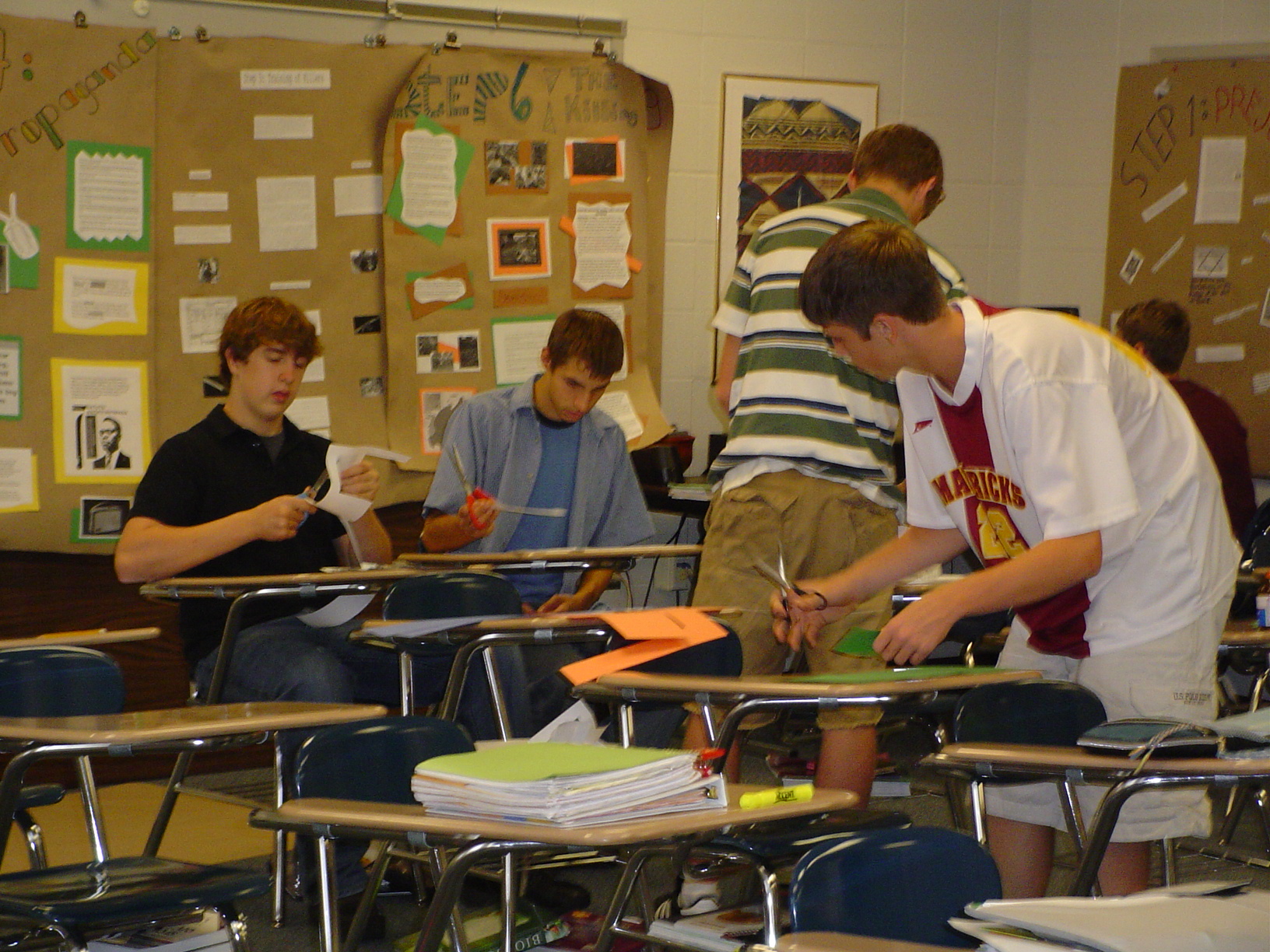
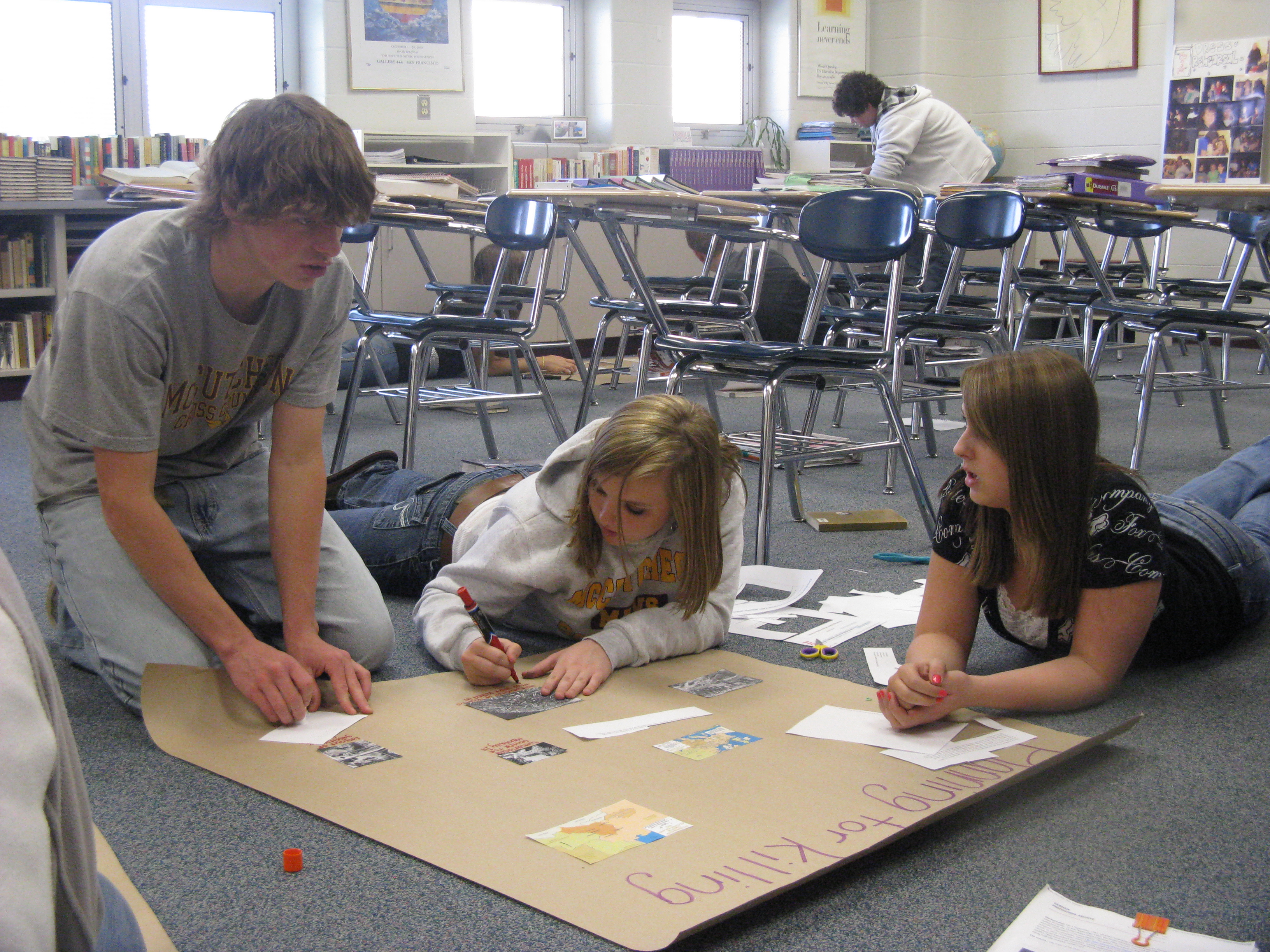
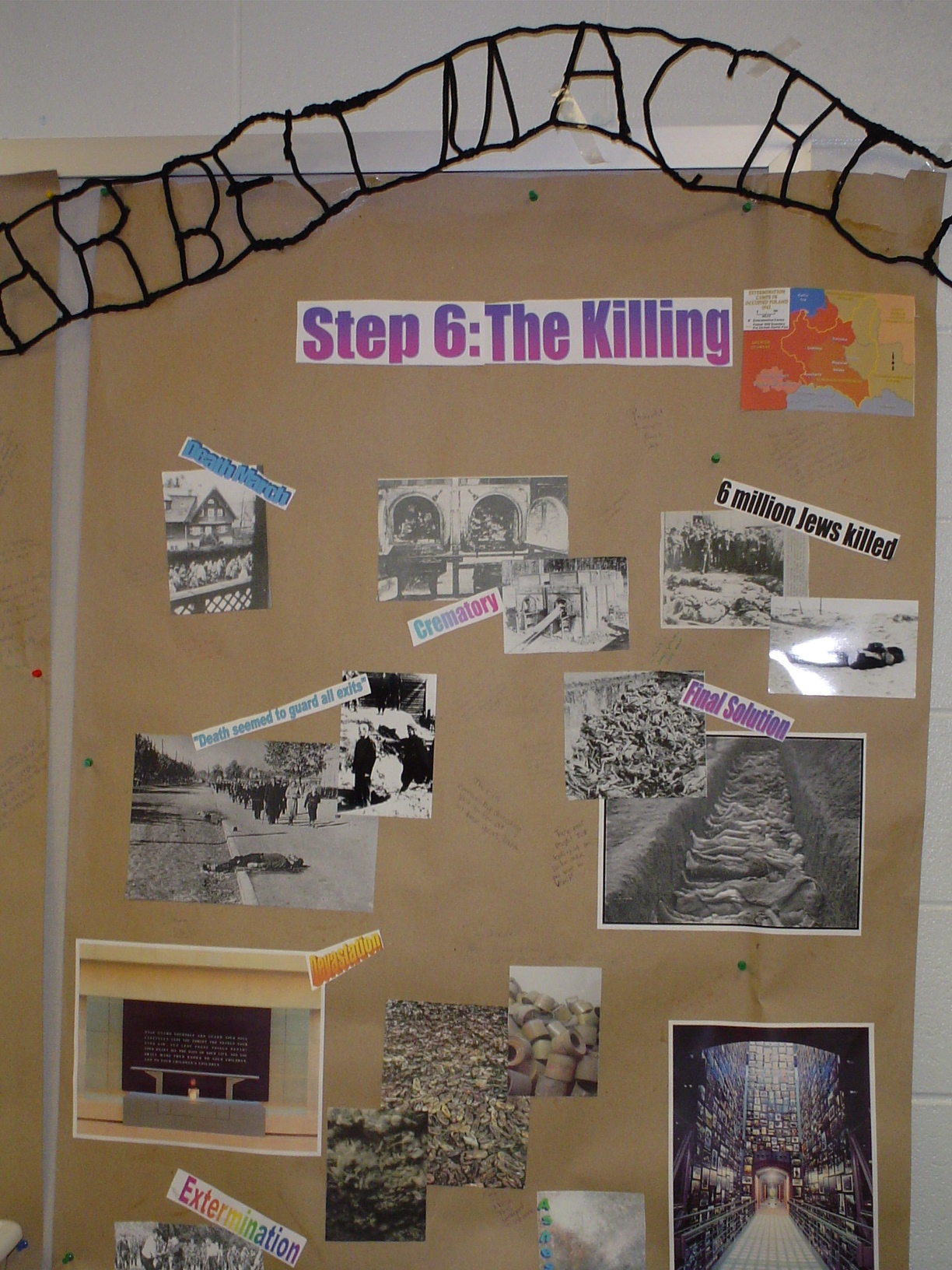
My students read Night first. They read it without a lot of preface, and they are full of questions during the three short days it takes them to finish the book. By the end, they want to know more, and it is then that I send them on a research mission. The students work collaboratively to construct poster essays that will reveal the pattern of genocide. They draw straws to form groups, and I give each group a title for the poster—the name of a stage in the pattern—and a few keywords to get them started. For the next several days, my room resembles an art studio—construction paper, scissors, rubber cement, watercolors, and magic markers dominate the landscape. Kids cluster around the tables, lie on the floor. They labor over their posters, placing pictures precisely and writing captions that capture the essence of the photographs they’ve downloaded. They know that what they are researching and presenting in their posters is too important to treat superficially, and their posters powerfully illustrate the progress from prejudice to mass murder. Pattern of Genocide 002 2009.04.15 Honors 9 Pattern of Genocide 020 Pattern of Genocide 004

We put the posters on the board and discuss the order in which they should be hung: Prejudice, Legal Discrimination, Separation and Isolation, Preparation for Killing, and Extermination—and the one that could be hung anywhere and everywhere along the continuum: Propaganda.

Then, after a brief introduction, I instruct them to repeat the research—this time researching Rwanda. They create, again, poster essays that depict the progress of the genocide there—from the identity cards issued by the Belgians when Rwanda was still a colony to the hate radio broadcasts that mobilized the Interahamwe.

Pattern of Genocide 012They hang the posters side-by-side on the whiteboards in my classroom: the Holocaust and the Rwandan genocide. I am not interested in discussions of scale—it’s not that kind of comparison. I am interested in the pattern.

By studying the Holocaust and the Rwandan genocide side-by-side, my students come to see that neither was an aberration of history. By studying the pattern, they realize that genocide has its roots in attitudes that show up in day-to-day interactions, the kinds of discriminatory behaviors they themselves encounter not just in the evening news, but in the lunchroom, on the playground, in the halls, in gym class. Sometimes we call it bullying.

My students come face-to-face with the pernicious effects of prejudice in their study of these two genocides, and they understand the importance of speaking out against ethnic jokes in the lunchroom, bullying in the halls, discriminatory laws in their state and country, and unfolding events in places like Sudan. They understand the moral imperative to be inclusive rather than exclusive, to accept rather than reject.

My students see that they can work to prevent genocide by voicing opposition to the prejudice they encounter and by engaging in activities that promote peace and understanding—both locally and globally. Sometimes it is as simple as writing letters to their Congressional representatives, to the Secretary-General of the United Nations, to the President. We live in a democracy where it is our right and our duty to let our voices be heard, to be “upstanders” for justice, not voiceless bystanders in the face of evil—and this responsibility becomes real for them.

This past week, at the United States Holocaust Memorial Museum, Elie Wiesel and President Obama spoke about genocide prevention. In fact, on the very day my students and I were having a discussion about what they could do personally to combat the forces of prejudice and discrimination, these two men were discussing what the nation could do. I watched the video that night at home: My students had said many of the very same things these compelling leaders had said. I showed the video the very next day.

Genocide survivors tell their stories—in books, films, and essays—not to create works of art that will make them famous, but with the hope that the lessons of their nightmares will not be forgotten, that people of conscience will work to stop incipient genocides before they occur and to speak out against ongoing tragedies. Teaching our children what they can do to combat evil in the world is work that teachers can do, must do.

Pattern of Genocide 010

Hunger

Do not eliminate hunger in this world. Do not. Hunger motivates.

I am not talking, of course, about literal food. I am talking about that burning in the brain that propels a person forward in the relentless pursuit of whatever he or she wants to achieve. That kind of hunger—or drive, if you will—is indispensible in the quest for knowledge.

For several years some years ago, I took students from my high school, McCutcheon, to Russia. We spent time in a Russian secondary school, even though it was June, because national exams were given across the country at the end of that summer month. We entered the school by mounting crumbling cement steps. Inside, cracked and curling linoleum covered the floor of the lobby; classrooms were equipped with cheap laminate desks, pitted window-sized blackboards, and old rags that served as erasers. The Pskov Humanitarian Lyceum, a top academic school in the region, was characteristic of Soviet-style school construction, and the accoutrements in the classrooms were common across the country. The Russian teenagers who hosted my students on those academic exchanges ten years ago were my students’ age but a year ahead of them in school. They spoke English, which they had been studying since they were seven, fluently; we struggled with the Cyrillic alphabet and elementary phrases like “Good morning” and “Good-bye.” They knew more about American history than we did, and the American students knew no Russian history at all. The Russian students were well acquainted with many American artists, musicians, and writers, but we had never even heard of Pushkin, their beloved, legendary poet.

What did these Russian students want? A better lifestyle than what they were living in Russia then. They had heard about the American standard of living, read about the material possessions that made us seem rich and that made our lives comfortable, and had seen it all for themselves when they finally came to America—and they hungered for it. They knew that education was what they needed to win a place at Russian universities, to complete a course of study and graduate, and to find the kind of work that would being them closer to our kind of comfort and prosperity.

I brought their teachers erasers for the blackboards, and for the students I brought pencils and pens with McCutcheon logos. I could not bring them new and shining schools. I did not need to.

Situated in Isiolo, Kenya, the last outpost before the long stretch of Sahara desert to the north, the Isiolo School for the Deaf is an aggregation of board shacks without windows, set in the middle of an open field: not on a foundation, not on a platform, but on bare ground that becomes mud in the rainy season. Cracks between the boards admit some light to the inside. When I was there, I saw children sitting tall in straight back chairs at wooden desks scarred from years of hard use, children from eight to fourteen, raising their hands excitedly, rapidly finger spelling answers in the air, signing the words they knew. At lunchtime, the students sat on the grass in a set-aside area under a roof to protect themselves, in rain or shine, from sudden downpours and the searing African sun. Their lunch, cooked in a vat, was rice and sometimes beans. There was no electricity at night, only a lucky few had mosquito nets, and the only clothes the children owned, they were wearing. No books, no paper, no pens, but exuberance and pride marked the children’s demeanor.

What were they without? Language. These children were born deaf or had lost their hearing at an early age. They were the lucky ones, deaf children whose parents had brought them from homes all over Kenya to attend this boarding school, to learn some language, to learn some method of communication. Language would bring them some measure of civility in the life of isolation that stretched ahead of them like the long, dry desert to the north.

I brought them alphabet banners for the classroom and a “Spill and Spell” game with hands etched into the sides of the dice to illustrate a, b, c in the manual alphabet. You would think I had brought the moon. Later, students at McCutcheon raised the money to electrify the school. Now the students could sign to each other in the night; they could continue to learn even after the sun went down.

In rural Rwanda, the scene of genocide not so many years ago, families in poor communities struggle to educate their children. For most children, secondary education is out of the question because the school fees are too steep. Secondary school students need to pay tuition to attend boarding schools. They must buy uniforms, purchase books, and sometimes carry mattresses with them to schools in remote locations. But in a few primary schools, an American organization, Every Child is My Child, has promised the elementary students a high school education if they study hard and pass the entrance exams—and they are driven to learn. Their classrooms are brick, not board, but there are no posters on the walls, no books, and few visual aids —just a teacher, a blackboard, copy books and pencils. The students write everything they hear from their teachers and everything they see on the board in their copy books—and they study what they have written. Against all odds, they are on grade level with students in the United States. And they are hungry to learn more. Hands wave in the air, answers fly in French and English and Kinyarwandan , and shy smiles cross the children’s faces when their responses are correct.

What do these students want? An education. I brought paper rulers and protractors—disposable learning aids gathered up after standardized tests—and National Geographic maps of Africa. I could not begin to equip their classrooms, and I could not feed their hunger. Only they could do that.

The hunger of all these children, the burning desire to learn that all of them have felt, has been essential to their achievement. Their desire comes from within—not from buildings equipped with the latest technology, not from the resources of their governments, not even from great teachers, but from within themselves.

We eat because we are hungry; we achieve success for the same reason. We have to do more than just want whatever we dream for ourselves. We have to burn to have it and then put our heads down and drill through the dark to attain it. “Wanting something is not enough. You must hunger for it. Your motivation must be absolutely compelling in order to overcome the obstacles that will invariably come your way,” said Les Brown, an American businessman and motivational speaker. He may have been talking about material success—I have no idea—but his point applies. Drive—the motivating force that makes a person, or a team, or even a country “go the distance”—is a hunger that is fed from within.

Spring is the Best Season

Once, at a conference for American teachers and teachers from the Newly Independent States of the former Soviet Union, I met a teacher from Kazakhstan whose students had won a national recognition for their performance in competitive debate. This, in a formerly Soviet state—a country that had once upon a time brooked no controversy, tolerated no dissent. She gave a presentation about her strategies to mystified Kazakh colleagues whose shy, meek students would not disagree with them on the smallest of matters. How, they wondered, could Kazakh students, raised to be voiceless and compliant, come to debate their peers so skillfully as to win a national debate contest?

“That’s just it,” the teacher explained. “We began with the smallest of matters.”

The first topic of debate the teacher had put before her students was this: Spring is the best season.

“Spring is the best season,” the teacher declared. “Raise your hands if you agree with me.” Every hand went up.

“Raise your hands if you disagree.” No one raised a hand.

“No one disagrees?” she asked. “There is nothing about spring that you don’t like?” She waited. Finally, one tentative hand lifted.

“Well,” a little girl offered hesitantly, “in the spring, there is mud.”

And that is how this wise teacher began: small.

Students “debated” whether a particular food tasted good, whether a book was worth reading, whether a clothing style was attractive. In increments, she led the students to genuinely controversial topics and deeper, more incisive arguments until finally, they were debating serious topics in formal forensic style. She had had to warm the students to controversy, show them that nothing was to be feared from disagreement, and then teach them the skills of debate: researching and analyzing an argument, evaluating evidence, developing a claim, formulating effective support, using concession to advantage.

American teachers today are tasked with preparing students for a new kind of standardized test. Students will be asked to read and respond in writing to a variety of documents they will be given on unannounced topics in science, social studies, the arts—really, any area. On the new tests of students’ proficiency in the English Language Arts—coming in 2014-2015—students will need to read documents on the spot, formulate a claim, gather evidence from the readings to support their position, and use all their skills of analysis and evaluation to write a cogent, coherent essay defending their position. (At least this is what we are hearing now will be the format of the new assessments.)

What this means for instruction in the language arts classroom is a much more intense focus on reading and writing, with particular emphasis on argument.

Let’s leave politics aside. Ditto opinions about whether this is a valid way to assess a student’s progress or whether scores on these tests should be used to determine a teacher’s effectiveness. For now, too, set aside questions about the logistics of evaluating these writing-intensive tests and reporting the results in a timely fashion.

The immediate question is this: Are these skills students should have?

We live in a contentious society. Prominent people use public platforms to spout unsubstantiated opinions. Politicians twist the meaning of other people’s remarks, make snide insinuations, and sometimes tell blatant lies. Even ordinary people become irate without cause and seek redress for their grievances before they even try compromise or consider reconciliation. Would it be good to train our students to question claims, spot flaws in logic, evaluate evidence, counter arguments and expose specious claims? It would. If future citizens cannot read with understanding, write clearly and coherently to varied audiences, talk back to statistics, question authority, speak truth to power, and argue responsibly, where will our democracy be? To my mind, the new agenda is not an issue. It may even have evolved as a solution to the temper of our times.

But are we teaching these skills now in our classrooms? Can we do it?

Getting there will be easier than it was for the Kazakh teachers because our students don’t have to be led to argument. They love to debate and don’t back away from controversy. They’ve been raised in the land of free speech and exercise that freedom without trepidation. What my students need help with is what this new curriculum mandates: reading, writing, and thinking clearly. The new Common Core standards, subscribed to by forty-six states, present an interdisciplinary, grade-by-grade outline of the skills our students need to be “college and career ready” (new education-speak for “prepared for the future”) and the ones our country needs them to have to remain in its right mind.

We can do this—and we will. One step at a time. One grade at a time. One skill at a time. Start small, start young. Spring is the best season.