It’s Not About the Lure

ELECTROFishing

  • Aquarium net
  • Transparent plastic containers
  • Plastic buckets
  • Golf balls
  • Magnifying glass
  • Ice cube tray
  • Parametric software
  • 3-D printers

and

  • Students in Honors 9 Biology, AP Biology, and Principles of Engineering

Put them all together and what do you get?

Fishing lures!

Except, it wasn’t about the lures.
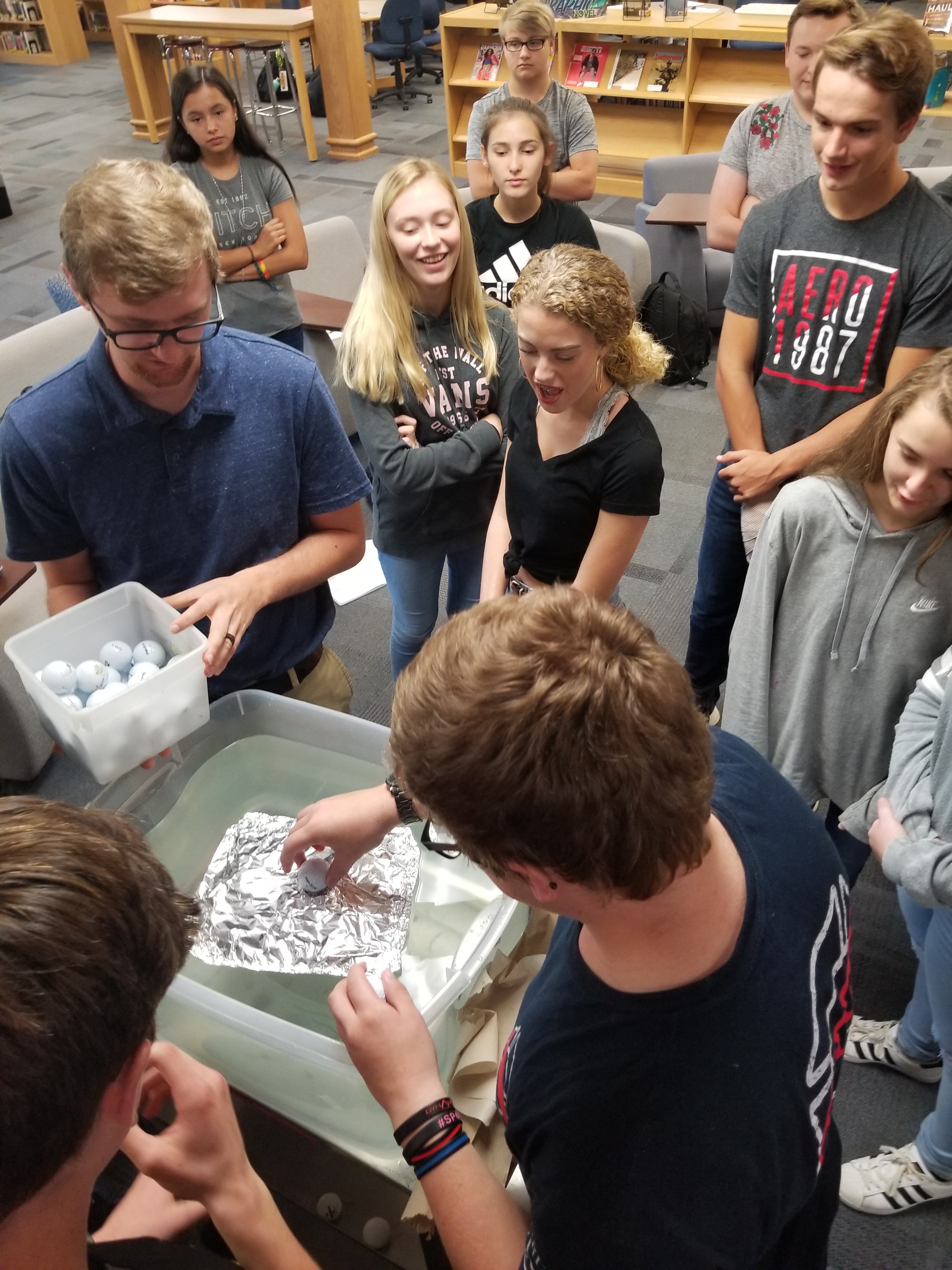
Teacher Zach McKeever supervises as students float golf balls in tin foil boats to understand buoyancy

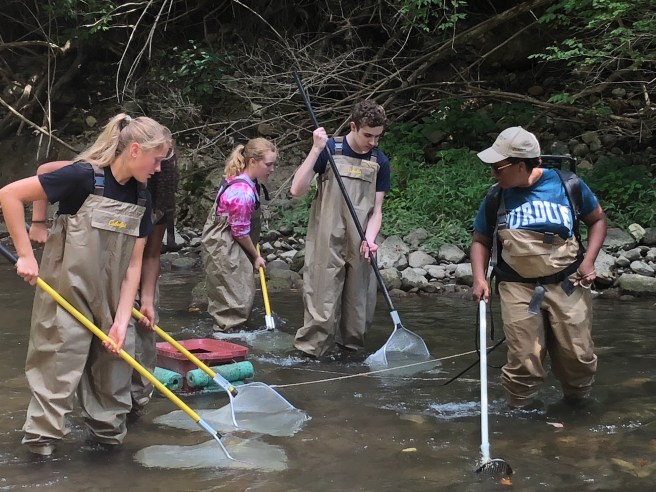
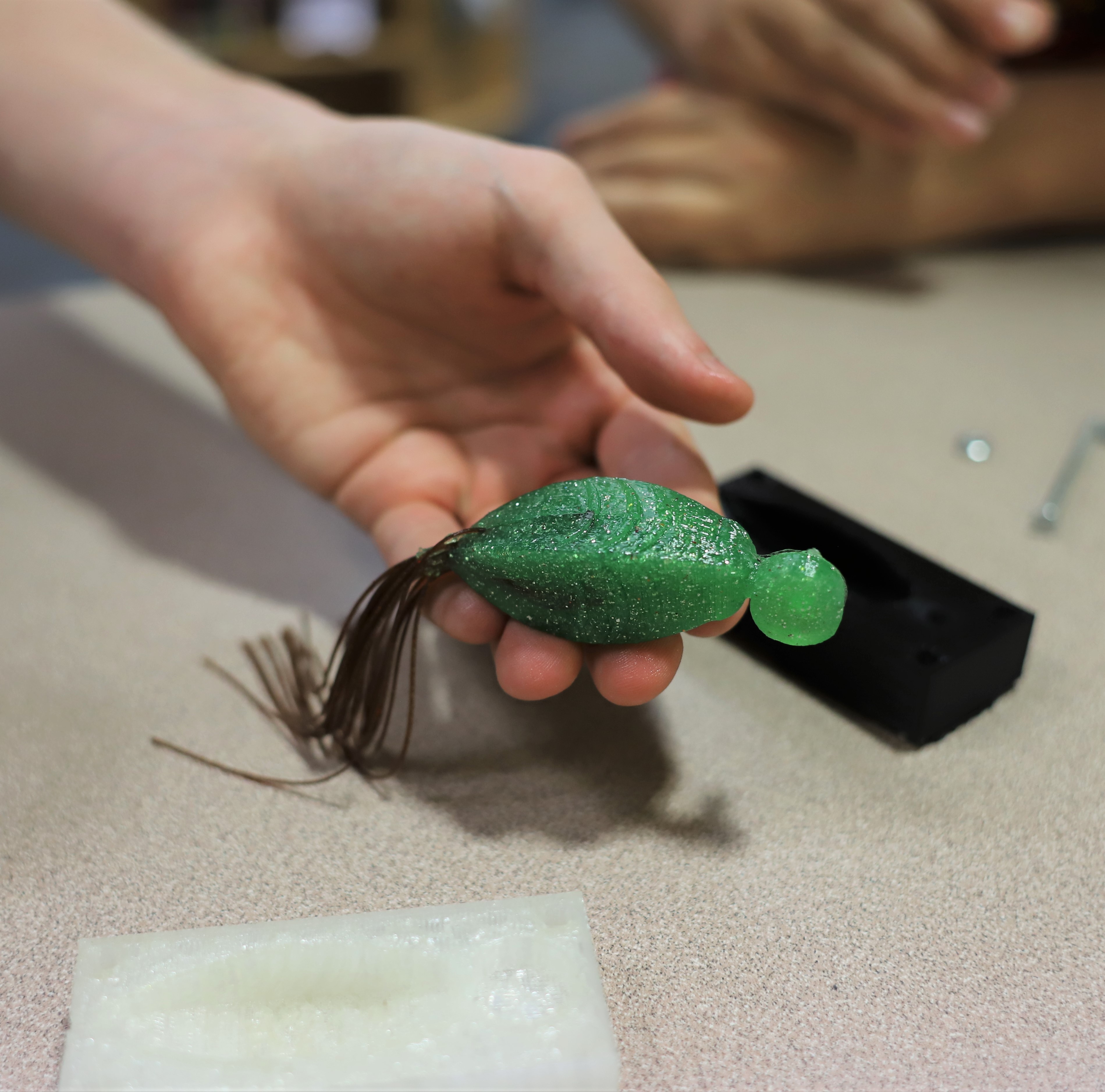
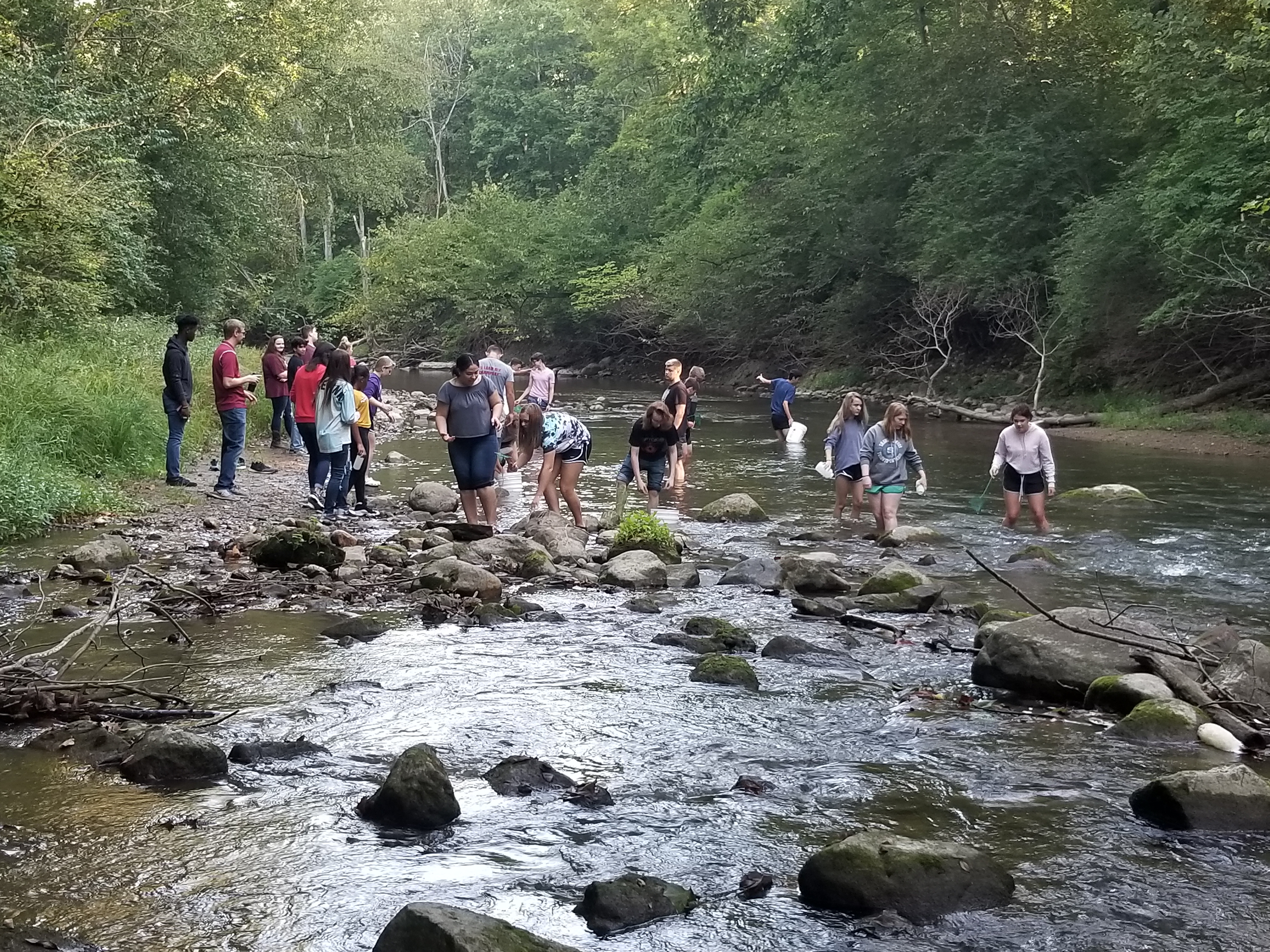
Teams of students from these three classes at McCutcheon High School joined forces to learn about the fish that swim in Wea Creek, the insects that attract them, and the design process engineers use to create any new product. The standards addressed by this bioengineering module pulled from biology, physics, math, technology literacy, and environmental systems. The students spent time at the creek in waders, capturing and identifying fish through electrofishing techniques guest instructors from Purdue University showed them. They identified aquatic insects–also caught in the creek that runs behind our school–and preserved them in transparent containers to learn about biomimicry. Using a decision matrix to guide their design choices, the student teams created fishing lures that looked and moved like the insects they’d observed. They floated golf balls in tin foil “boats” and used their math skills to determine the buoyancy of their designs. Ultimately, the students used Inventor, a parametric modeling software program, to visualize a prototype. The most promising prototypes were printed using a 3-D printer.

20180911_121840When they weren’t outdoors, the teams met together in the Media Center where large round tables and lots of space facilitated consultation and collaboration. The four teachers, whose schedules had been specifically arranged to accommodate this project-based learning endeavor, floated among the groups. The large space also improved the efficiency of the project. “It was much easier to walk between tables to answer a question than to send an email from one classroom to another,” commented engineering teacher Zach McKeever.

Finally, each team made a PowerPoint presentation of their experience, including a reflection on their performance in terms of communication, creativity, collaboration, critical thinking, and computational thinking. An expert angler was present for some of the final presentations and inspected the lures close-up. The students listened intently to his critiques.  One group was surprised when he told them, “You could market this if you’d make just this one little change.” 

And then, on a warmish October Saturday, they tried out their lures. Total catch: a few nibbles.

20181006_093239

But that’s all right. It wasn’t about the lure.

In their wrap-up discussion, students (predictably) commented that they liked going outside and enjoyed the fishing expedition at the end. They wished they’d spent more time at the creek! They appreciated the hands-on learning and real-world application of their learning. They enjoyed the guest lecturers from Purdue who opened their eyes not only to a new way of fishing, but to the presence of specific species of fish as an indication of water cleanliness, to the connection between bioindicators and our own drinking water, and to watershed ecosystems in general.
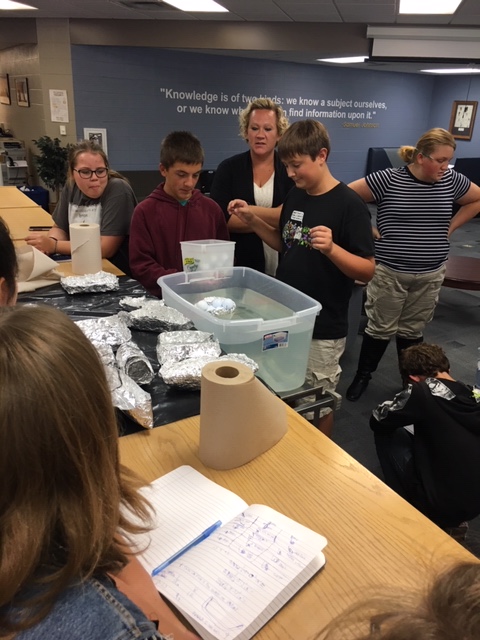
Students test their hypotheses about the number of golf balls their vessels will hold as teacher Amanda Cox looks on

Some students did say they prefer a more traditional approach to learning: They wanted textbook learning first, then the application. However, the majority of students said they liked putting the pieces together even though they experienced some anxiety at first when they weren’t sure what was going to happen, how they would get from the assignment “Create a Lure” to the final product without the familiar front-loaded vocabulary lessons, textbook assignments, and the quizzes and tests that usually accompany traditional classroom instruction.

Other students had suggestions for their teachers for improving the unit’s design. The project had been set up to differentiate for experience (Honors 9 Bio and AP Bio) and course credit (Engineering vs. Biology). The AP Bio students, for instance, experienced the electrofishing and were responsible for conveying that information to the rest of their team. The engineering students used Inventor–and explained it to the others. The Honors 9 students did the insect study and relayed what they learned to the rest of their team. That structure led to some problems of communication, so the students suggested ways to ensure better communication and more accountability for each team member. 

Many students commented at length on the communication and collaboration skills they had needed to develop in order to be successful. Some teams reported, quite frankly, that they hadn’t started out working together well–but they overcame those obstacles because they had to. That admission–and the ultimate resolution of the problem–brought smiles to the faces of the teachers because, of course, learning to work together as a team was one of their goals. 
The principles of design apply across the board and collaborative problem-solving among individuals with different areas of expertise and different perspectives will always be the case. For example, Mr. McKeever explained, civil engineers may be commissioned to create a dam. That will certainly disrupt the ecology of a river, so the goal will be to design a structure that minimizes impact but still does the job of holding back the water. Chemical engineers may develop vaccines and the packing materials for those medications. They’ll need to take the impact of chemical emissions, waste, and the product itself into account as they develop the product.

“The biggest takeaway for me,” Mr. McKeever continued, “was the relevancy. The biology part helped the students create lures for a specific fish in a specific environment, making the whole project much more authentic. Without the biology component, the assignment would have been ‘Design a lure you think will catch a fish’.”  Not nearly so relevant and not nearly as challenging. 

For students who have never experienced project-based learning, the first venture into this way of learning can be intimidating.  But in the end, biology teacher Abi Bymaster asserts, “This project forced students to feel uncomfortable, to ‘not know the answer,’ and they couldn’t just look the answers up on Google. However, it is because of this discomfort that they learn; this is what I love about PBL.”

“Learning ‘this way’ made the learning real,” many biology students said in summary. They liked the independence, the taking charge of their own learning, the creativity expected and allowed. The students clearly saw that while the biomimicry and the buoyancy achieved by the unique anatomy of fish were concepts important to understanding predator/prey relationships, understanding the whole ecological system–and the ability to generalize that to other systems–was the greater lesson. 
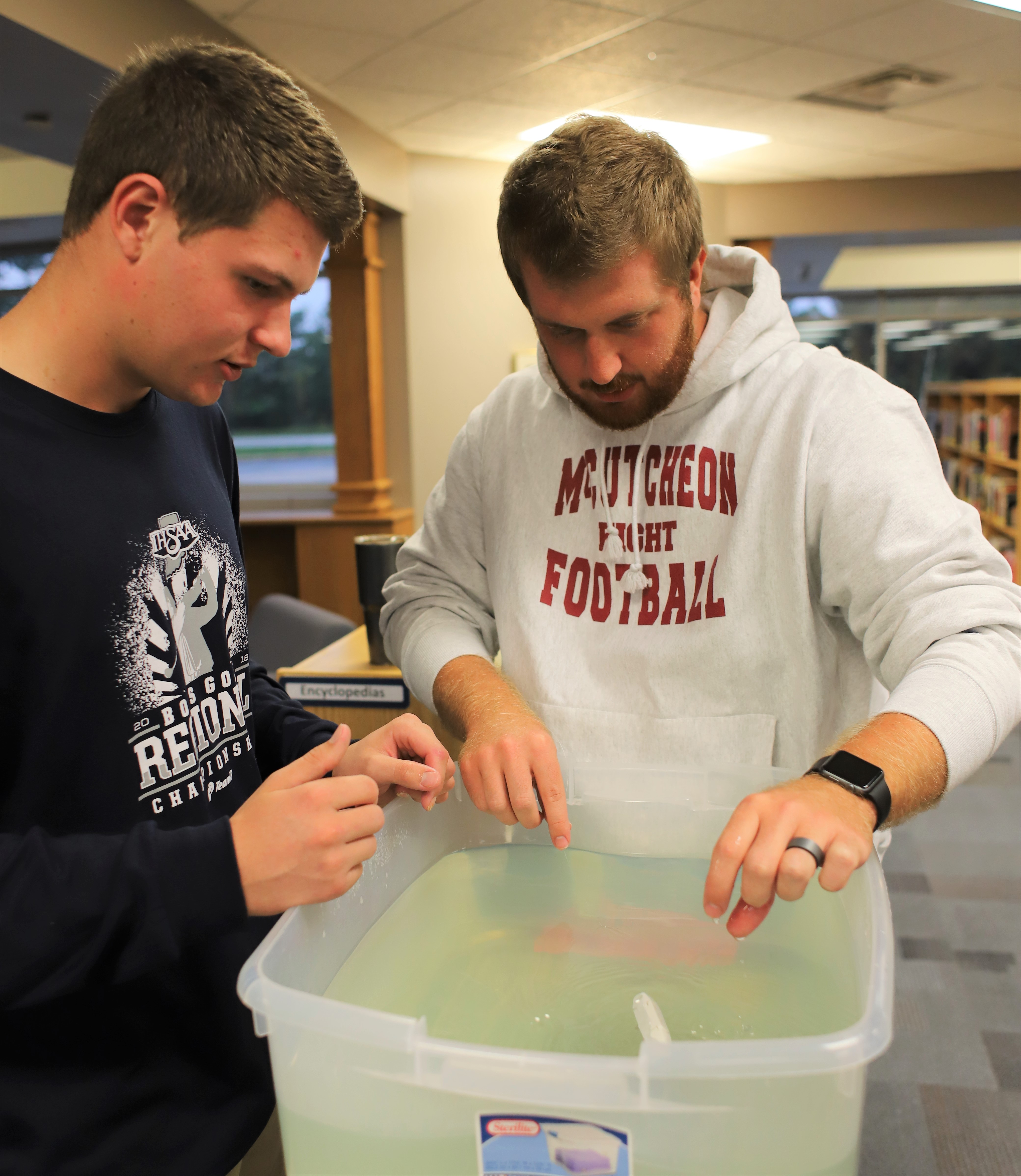
Teacher Mike McKee watches as his student tries out a lure

No one misunderstood the real learning goals of this endeavor. It wasn’t about the fishing lures. It was about the interdisciplinary nature of learning and the teamwork needed to pull a project together, hallmarks of project-based learning: authentic experiences that reflect real-life problem-solving and decision-making.

This project-based learning experience has a formal name: Designing Bugs and Innovative Technology (D-Bait). It is one unit in the TRAILS curriculum designed by Jeffrey Holland, Todd R. Kelley, Euisuk Sung, and Nathaniel W. Cool at Purdue University and supported with funding from a National Science Foundation grant. The project was new this year to two of the four collaborating McCutcheon teachers, all of whom were trained during previous summers. All four of the high school teachers are looking forward to doing the project again next year–and implementing lesson design modifications suggested by their students, the bioengineers.


The Unsung Heroes Project

DSC_0070

So many young people today are without real heroes. Their knowledge of individuals who have made a difference in the world usually extends only as far as celebrities and sports stars, perhaps to someone in politics. Worthy as some of these people may be, students are generally unaware of the range of actions that can be considered heroic and, even more importantly, of the people in their own community who have made a difference by standing up for, rescuing, or serving another person, cause, idea, or the community itself.

The last three years that I was in the classroom, my 9th grade Honors English students and I undertook a project that expanded their understanding of what it means to be a hero.  This was the Unsung Hero Project, inspired and supported by the Lowell Milken Center in Fort Scott, Kansas. I’ve blogged about this project before (Great Expectations: The Unsung Hero Project and Unsung Heroes, Reprise), but I’ve never outlined exactly what my students did. Recently I was asked to do that, so I’m sharing my description here along with some pictures of students at work on the project.

This classroom undertaking is an example of project-based learning. Through their work on this project, students developed skills in research, collaboration, writing, and the use of technology.  And, as important (if not more so) than anything else they learned, they were inspired by real live heroes in our own community.

Semester One

Students received intensive writing instruction the first semester, especially regarding formal writing conventions and organization of ideas. I spent time on sentence combining techniques (compound, complex, compound-complex sentences, introductory modifiers, appositives) before as well as during the time the students wrote their essays (February and March), and I hit topics such as pronoun antecedents pretty hard. Other grammatical topics I covered on an “as needed” basis. I also “unpacked” the skills required for a research paper, teaching basic bibliography skills, outlining, and internet search techniques in the first semester in preparation for the more complex research the students conducted during the second.

Collaboration is a vital component of this project, so I employed a variety of strategies for developing collaborative skills from the very beginning of the year. My goal was for students to be comfortable working together so that when they began the Unsung Heroes project in the second semester, they could work together efficiently, productively, and equitably.

The first step in the project itself was to define, through class discussion, what exactly we meant by the word “hero.”  Here’s what the students came up with one year: A hero is a person who, with no expectation or recognition or reward, has made a difference by standing up for, rescuing, or serving another person, cause, idea, or the community itself.  Definition Lessons 035

We had a few models, too: Atticus Finch served as the fictional model for a community hero (we read To Kill a Mockingbird in the fall) and the non-fiction model was Irena Sendler. The Courageous Heart of Irena Sendler is available on DVD from Hallmark; the book Life in a Jar is available through Amazon. Other models were individuals profiled in the Christian Science Monitor’s series “People Making a Difference” (available online at the Monitor website). We read a number of these essays and practiced defining a hero by breaking down the stories and aligning them with the students’ definition.

Semester Two

Students formed groups of three, self-selecting their partners, and established an account on google.docs, an online tool for writing collaboratively, simultaneously, in real time (a new technology tool eight years ago when I first began this work!).

Then students selected a hero/heroine from a list I provided for them of people in our community who had been in some way heroic. Some of the individuals came to my/our attention because they had received a very small local award for their efforts. Some were suggested by friends in the community, the faculty at my school, and (by the second and third year) various individuals who had read the first volumes of the book. Once the students selected a cause/person, I contacted that individual, soliciting their involvement. No one ever turned us down, by the way, and I would have been surprised if they had.

The next step was the research paper, probably the most complex instructional piece. The students worked collaboratively to research the cause their hero had championed. Thus, when they met the hero and interviewed him/her, they were already “experts” on the topic. The hero didn’t have to start from scratch to educate the students. The research paper included an outline, an annotated bibliography, internal documentation, and a Works Cited page in MLA format.

Most students established email contact with their hero right away and were able to ask him/her for advice and recommendations for resources as they researched the topic. The heroes were usually glad to steer the students to appropriate resources and helped them narrow their topic appropriately.

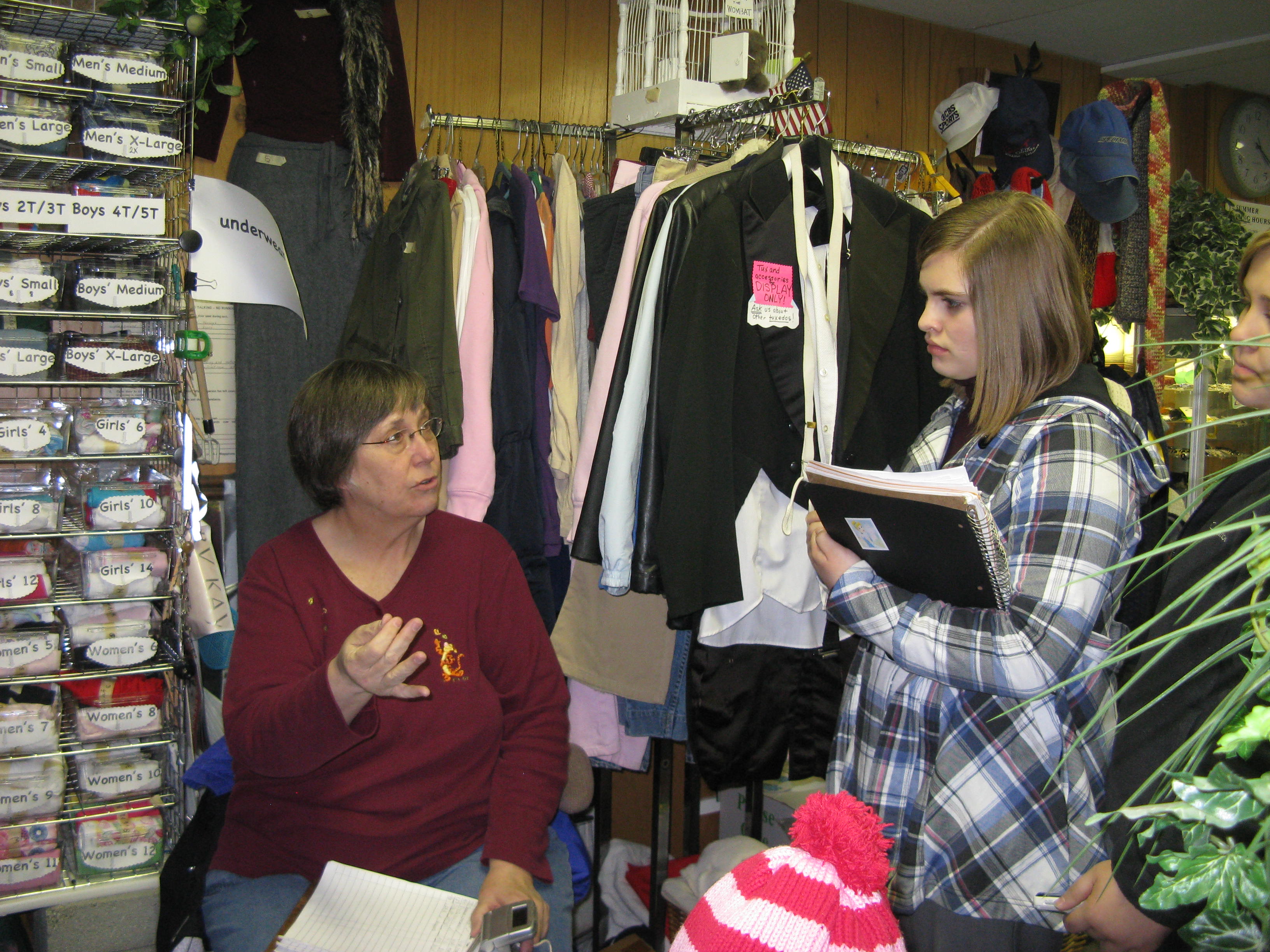
Unsung Heroes II 024Once the research paper was underway, the students set up an interview with their hero. We tried to conduct all the interviews on the same day in the school library, but of course, not everyone was available on the day we selected, and in some cases, it was inconvenient for the hero to come to school at all. I sometimes drove groups of students to on-site locations and arranged for their parents to pick them up. To be honest, when the hero was associated with a facility—such as the Boys and Girls Club and a second-hand store for impoverished families—it is helpful for the students to see the facility.

Students set up the interview by phone or by email. Although I coached them in the art of interviewing, I stayed out of the interviews myself (aside from taking photographs). Afterward, the students typed up their notes in narrative form or in Question/Answer format—and then they started in on the essay. Their essays went through several revisions. Early versions were read by their peers and by me, and these revisions dealt with structure, the balance between narration and  quoted material, and the weaving of information from their research with what they had learned from their hero. Line editing came last, and both the students and I did this at various times.

P1010472One of my concerns as a teacher of writing was that “voice” would be lost in a collaborative project, and to a certain extent, it was. However, what usually happened is that one of the students emerged as the primary writer, so meshing styles and voices wasn’t as severe a problem as I had originally anticipated. They also each wrote a reflection. I was light-handed with these—I didn’t want to extinguish their individual voices—and by this time, the students were expert at line editing. People who have read the book who are not from this community and don’t know the heroes have told me that the reflections are the most interesting part of each book. That doesn’t surprise me—there students wrote from their hearts.

Students submitted their work to me as a Word document, and I did take over as the master technician on setting up the pages. Eventually, the document turned into a pdf file. The students selected the font and the layout, and they designed the front and back covers as well.

The books could have been published using an online company, but the submission deadlines for these companies did not work with the school calendar very well, so I elected to work with a local printing service. Frankly, I am glad I did. We were able to receive a galley, make final corrections, and still meet our publication deadline. Besides, the printer I worked with had a lot of good advice for us and accommodated our schedule well. He even attended our celebration at the end because he had had a hand in this production, too.

Unsung Heroes in Our Community was developed with the support of the Lowell Milken Center for Unsung Heroes (LMC) in Fort Scott, Kansas, whose mission is to “galvanize a movement to teach respect and understanding among all people regardless of race, religion or creed.” The spirit of the Center is embodied in the Hebrew expression, tikkun olam, which means “to repair the world.” The LMC accomplishes its mission of teaching respect and understanding by supporting education projects that feature Unsung Heroes—people who, like Irena Sendler, have acted to repair the world. The project was funded by grants from the Kiwanis Foundation and the Public Schools Foundation of Tippecanoe County.

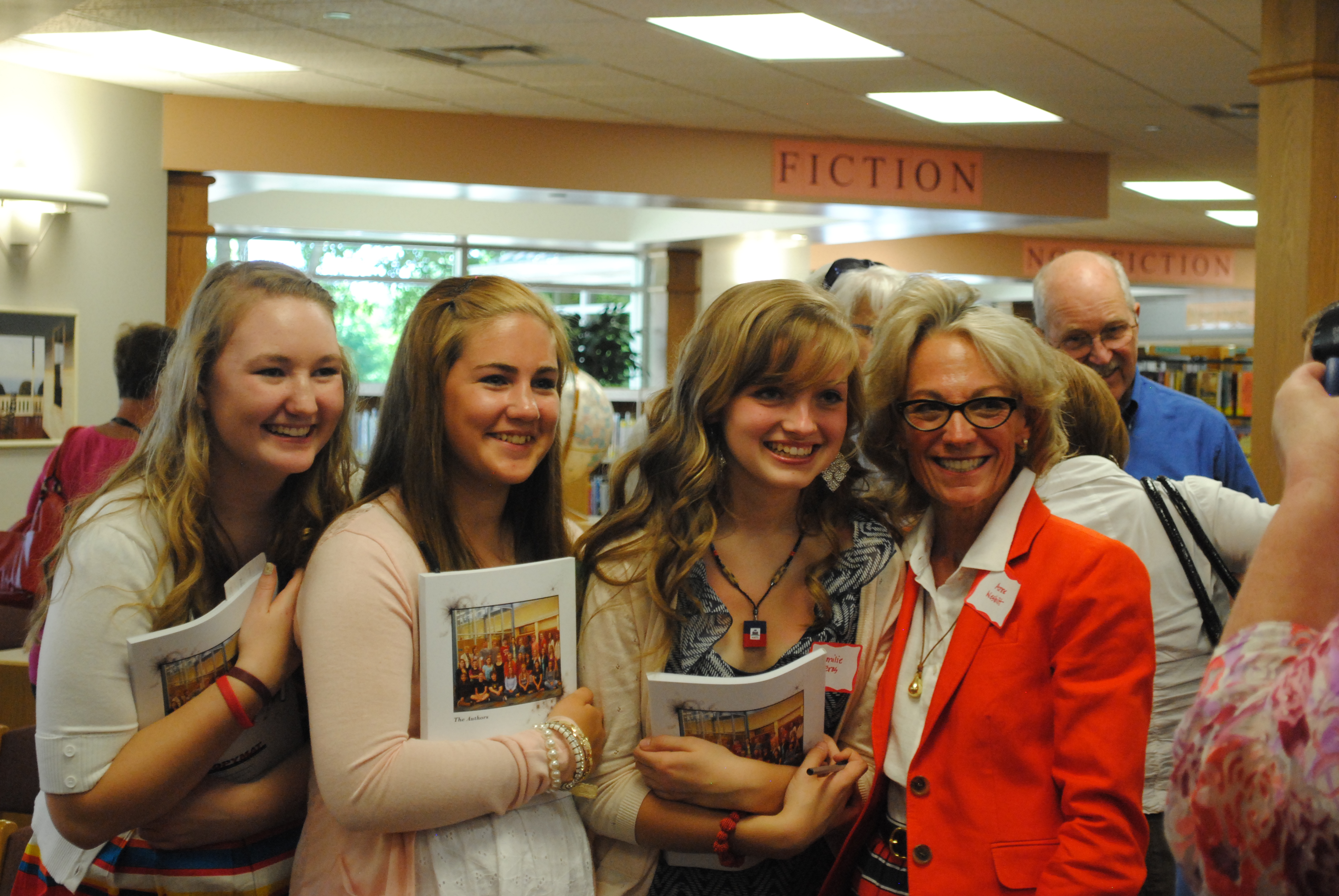
Unsung Heroes in Our Community was an extensive project, and one that made me—still makes me—very proud. At the end of each year, we held a celebration to which all the heroes were invited as well as the principal and the school district administrators, the students’ parents, the press, and our donors. DSC_0002

At the celebration, the students introduced their heroes, a few students spoke to the audience about the process and what they had learned, and often the heroes made little speeches themselves. All this was followed by a mass book signing. The heroes were even more enthusiastic than the students about collecting signatures! DSC_0113

The book is now in our local public libraries, our local historical society, and in the collection at the Indiana State Historical Society in Indianapolis. Last year, two students were cited in the newspaper by our local historian for information they discovered about the Underground Railroad in our town. Volume I of Unsung Heroes in Our Community was enthusiastically reviewed on the radio last summer  and the book was also featured on local television. Some of our heroes, in fact, later became subjects for a local TV program, “Heroes Among Us.” DSC_0140

This project is well worth the time, energy, and effort it takes to orchestrate. Project-based learning is meaningful to students because it is “real” (as one of the students told me). At the same time, a project like this directly addresses state academic standards and district curriculum expectations. For the teacher, bringing a project such as this to fruition necessitates a thorough understanding of the standards and curriculum, of course, but beyond that, it is a matter of organization and planning and, above all, faith in the students. Their gain in research and composition skills, in comfort with technology, and in the ability to work collaboratively is extraordinary.

DSC_0010The book made an impact on the students beyond the skills they gained and the recognition they garnered. Their definition of a hero expanded from the vision of a super-powered individual in a cape and Spandex to someone who serves others. My students were inspired by the person whose life and work they researched. Someday, when they themselves confront an injustice, meet with a challenge, or perceive a community need (as they undoubtedly will), I am confident that they will recall the courage, selflessness, and determination of these local heroes to “repair the world.” I believe that from these individuals’ examples, my students will draw the strength to act heroically themselves.