Becoming Hemingway–or at least Improving Your Prose

P1000007A new app for writers emerged last week: the Hemingway app.

Hemingway, of course, was famous for his spare writing style: straightforward language, short sentences, action verbs, and not so many adjectives. A simple style, some say.

I have to say, the app is fun, and running a few of my own paragraphs through the program verified that doing so is a quick way to detect overuse of adverbs, instances of passive voice, and any long, confusing sentences that would be better broken apart. These are writing problems that result in convoluted sentences.

Theoretically, if you eliminate those three problems in your writing, you’ll approach Hemingway’s plain, terse style. Although there’s more to being Hemingway than that, it would be instructive and possibly amusing for students studying The Old Man and the Sea or A Farewell or Arms or any of Papa’s short stories to put their own prose through the Hemingway app’s paces.

But if your students use Word—or if you do yourself—here’s a way to use Word’s grammar checker to challenge students to improve their prose—and address more issues than the three mentioned above.

When the grammar/spell check finishes, Word reports the writer’s “stats.” Many of these counts (e.g., number of words, number of words in a sentence, number of sentences in a paragraph, number of characters in a word) can be used instructionally. For instance, you can challenge students to write longer sentences—so that average sentence length increases–or to use words with more than one syllable so that the average number of characters in a word increases.

There’s also a way to use those stats to help a student lift the entire level of the paragraph or essay he has written. The next to the last score that Word reports is the Flesch-Kincaid Readability score, a measure of the reading level of the text. You do have to caution students about this score. The Flesch-Kincaid score is the reading level of their writing, so a Flesch-Kincaid score of 4.5 means that a fourth grader in the middle of the year could read and understand what has been written, not that the student is writing “like a 4th grader.” (You also have to caution them not to take the score too seriously.)

The Flesch-Kincaid Reading Ease score is a variation on this theme. A slightly different score, the Reading Ease number indicates just how comfortably the text can be read. The higher the number, the easier the text supposedly is. Secondary students shouldn’t aim for 90, though, because then their writing would be suitable for small children. The easy reading range for 13-15-year-olds is 60-70, according to Flesch-Kincaid.

To begin, you’ll need to enable the readability statistics reporting function on Word’s grammar checker.
File > Options > Proofing
• Check the box that says “Show Readability Statistics.”
• Just below that box, a drop-down menu says ” Grammar.” Change that to “Grammar and Style.” (The grammar checker will be much more useful overall if “Grammar and Style” is the default.)
• Click “OK.”

If you have emphasized some specific writing strategies in your instruction—like sentence combining or the use of transition words—you can challenge your students to apply those strategies to their own writing. These instructional strategies are, in my experience, the most effective ones for elevating the reading level of a piece of writing using Word’s grammar checker:
• Combining sentences with coordinating conjunctions (i.e, creating compound sentences)
• Combining sentences using semi-colons
• Using colons correctly
• Combining sentences with subordinating conjunctions (i.e., creating complex sentences)
• Adding transition words and phrases
• Adding adjectives and otherwise elaborating
• Using words of more than one syllable

What follows is a series of paragraph revisions. The original paragraph was one I fabricated, but you could use a real student’s work to demonstrate this revision method for your students—or try this out with something you’ve written. The number at the end of each paragraph revision is the Flesch-Kincaid readability score for that rendition):

My name is Jose Carter. I am in 7th grade. I like to play football. I like to play basketball. I do not like baseball, though. It is too slow for me. I also like fast cars. I have three sisters. They can be real pains sometimes but sometimes they are a lot of fun. We have a good time during Christmas vacation. We live in a house on a big hill so we slide on the hill a lot. We also have a pond on our property. We go ice-skating whenever the pond is frozen. 2.1

My name is Jose Carter. I am in 7th grade. I like to play football and basketball, but I do not like baseball. It is too slow. As you can imagine, I also like fast cars. I have three sisters who can be real pains sometimes, but sometimes they are a lot of fun. For example, we have a good time during Christmas vacation. Since we live in a house on a big hill, we go sledding whenever there is enough snow. We also have a pond on our property, so we go ice-skating whenever the pond is frozen. 3.2

Hello! I am Jose Carter, a 7th grader at Any Middle School where I am on the football and basketball teams. I do not play baseball, though, because it is a slow sport, and I like speed. As you can imagine, I also like fast cars. Maybe that is why I enjoy sledding down the big hill on our property during Christmas vacation so much. When there is snow, my three sisters (who can be real pains sometimes) and I enjoy this activity very much. We also like ice-skating, which we also do whenever the pond on our property is frozen. 4.3

Let me introduce myself: I am Jose Carter, also known as “Speedy.” I am a 7th grader at Any Middle School and a proud member of the football and basketball teams. I have considered playing on the baseball team, too, but I really do not enjoy that sport because it is so slow-moving. You can probably tell from reading this that I like speed, and thus, as you can imagine, I also like fast cars. Maybe that is why I enjoy sledding down the big hill on our property during Christmas vacation so much. When there is enough snow, my three sisters and I, through repetitive runs down that hill, are able to create a thrillingly slick track. We also enjoy ice-skating on the pond on our property; once again, we carefully groom the ice so that it remains slick and we can travel fast across the frozen surface. 5.2

Using the grammar checker to improve writing can go beyond just checking for spelling errors, comma usage, capital letters, and subject-verb agreement problems. Some students will rise to the challenge of using it to revise their sentences, and they’ll make multiple revisions. But even reluctant revisionists will see improvement in their writing with just one or two attempts.

The grammar checker won’t cure everything—no more than the Hemingway app will turn our students into Hemingway—but such programs have the appeal of games, and a lot of kids like that.

Give it a shot yourself.
FFA: Not What You Might Think

It was a familiar scene for a former speech coach: Yellow school buses and white vans stacked up in the school parking lot and a bevy of adults clutching clipboards and coffee cups gathered in the Media Center awaiting final instructions from the teacher in charge. In the halls, students clustered in tight little groups or stood nervously to the side, rehearsing one last time the speech they would deliver as soon as the judges received their scoring packets and were released to classrooms. In those rooms, chairs had been pushed back, masking tape had been laid on the floor to delineate the “stage,” and the doors all had signs that were not there the day before: the event to take place in that room, the time of the event, the contestants.

Very familiar. Except that this was not a National Forensic League speech competition. It was the Future Farmers of America (FFA) District Contest yesterday at my high school.

I was assigned to judge “Freshman Prepared Public Speaking”—an event for the youngest FFA members, an initiation into the more difficult “Prepared Public Speaking” competition for older chapter members. These 9th graders—14-year-olds—each chose a topic in agriculture and prepared a 3-5 minute speech on the subject. They had to submit their papers, accompanied by a complete and correct bibliography, ahead of time. We judges had read the speeches before the contestants even entered the room—and, in fact, one of the scoring categories addressed the students’ written language: organization, coherence, logic, language, sentence structure, and whether the writer accomplished the purpose.

For the most part, they had memorized their speeches, although note cards are allowed. The topics were serious ones: The loss of farm land to developers and the implications of that for feeding our rapidly expanding global population; water conservation and the various ways we can effect that; the advantages and disadvantages of biofuels. No fluff here. Students were scored on the accuracy of their information, the evidence they provided and its suitability for the occasion. And that bibliography? Forty points!

The students had been coached in presentation skills. Every one of them strode confidently into the room, shook hands with each of the five judges, and made eye contact, smiling big. Someone who hadn’t learned this first rule of commanding the stage would have been a sore thumb, but every one of these kids was genuine in their friendliness. Their demeanor was refreshing, not staged, and they exuded wholesomeness.

I wanted to claim each of them as my own.

At the end, each student stood to answer questions from the judges. Naturally, they had to maintain their poise throughout the ordeal—and I imagine, to them, it was that. They had no idea what we might ask, but for the most part they had done their homework and could elaborate on their topic—or had the good sense to admit they didn’t know when the question was something that came (I’m sure they thought) from left field. One of the contestants, remarking on the importance of agriculture, observed that kids in general don’t know where their food comes from.

Another judge, an elementary school teacher, concurred with her. “Yes,” he said, “Ask elementary students where hamburger comes from and most will say, ‘The store.’”

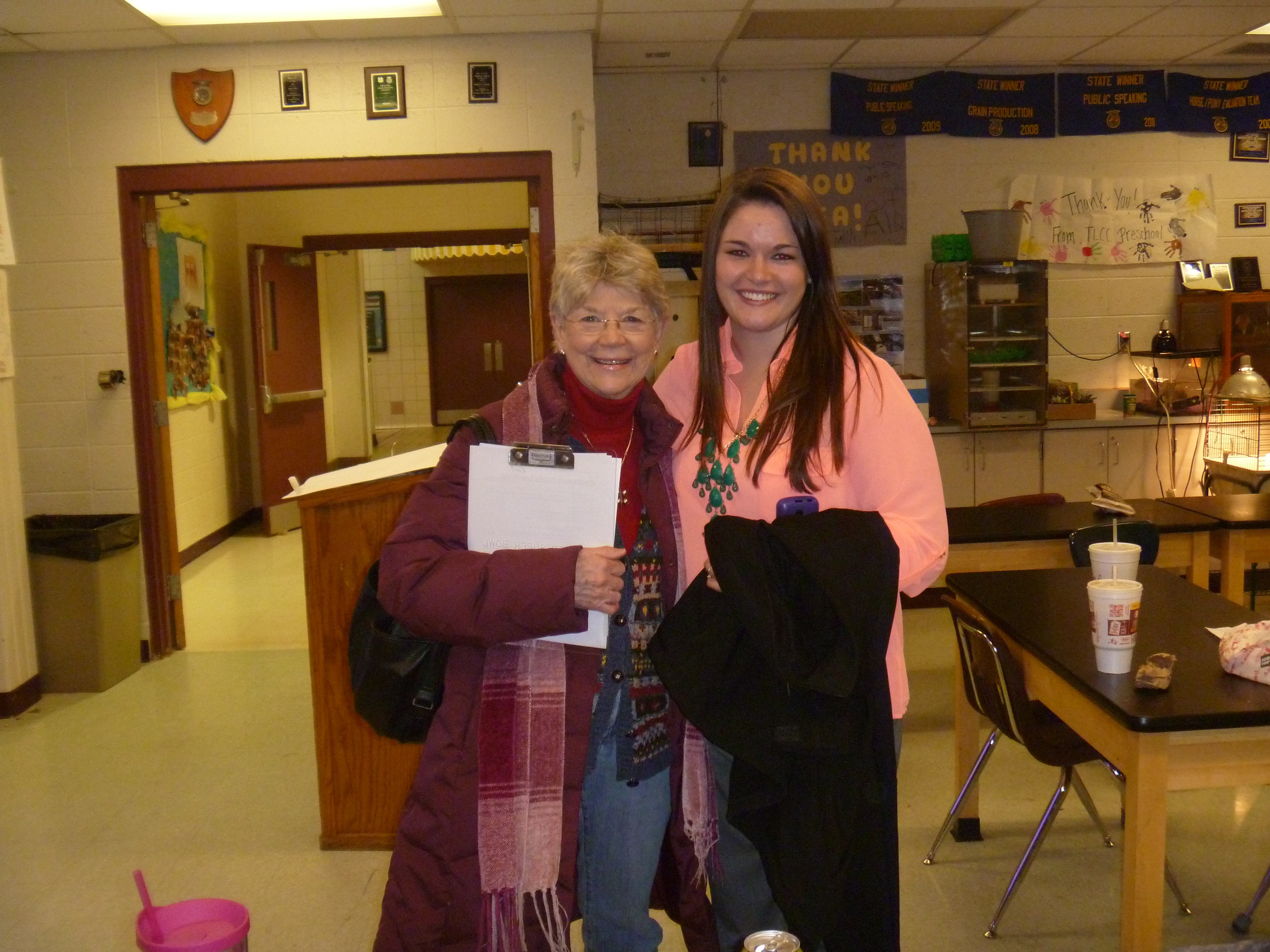
P1040331That won’t happen when the student whom I can claim as my own is in charge of her classroom. In an exquisite turn-around, one of the judges I was with was once a student of mine, and now she helped me understand the procedures of my judging assignment. Three years ago, I coached Layne, who was in my American Lit class, in “Prepared Public Speaking” for this same FFA contest.

Layne not only won the district, but she went on to win the state competition and capture bronze at Nationals. Her speech was a heavily researched, intensely rehearsed argument defending the livestock industry against agencies and organizations who brand their practices inhumane. Her compelling explanations and well-chosen evidence convinced not just me, but audience after audience. Layne spoke not just in competition, but also, to rehearse her speech in advance of nationals, to many audiences of adults in business or in organizations connected to agriculture. She met people from all over the state—including a senator who offered to help her with resources—and the networking she did is still bearing fruit.

This past summer Layne was crowned Miss Tippecanoe County at the county fair—another big deal in our state and another competition that is not at all what it sounds like. Asked at that competition what her proudest accomplishment was, Layne replied that it was her experience with the Prepared Public Speaking event in FFA.

Layne is in college now, studying to be an elementary school teacher. Naturally, I wanted to know how FFA had prepared her for college. “Well,” Layne answered, “I’m the one people bring their papers to.”

The answer didn’t surprise me because the contest today was all about literacy skills—not just in the event I judged and the one I had coached Layne for, but in all the others, too: Agricultural Sales Demonstration, Essay, Exhibit, Extemporaneous Speaking, Job Interview, Natural Resources Demonstration—to name just a few.

She knows how to gather evidence for an argument, how to organize a presentation, how to write clearly and convincingly, and how to do that beastly Works Cited page—whether in MLA or APA format. “I did just fine on my first college paper,” she continued.” I already had those skills.”

Of course, the English Department gets credit here, too, but FFA gave Layne the opportunity to apply the skills she learned in English and speech in a real-world setting with authentic audiences. I wonder if everyone realizes the extent to which FFA supports the literacy skills that are taught in English and articulated in the College and Career Ready standards that every state (Common Core states and otherwise) must adhere to? We’re working the same ground, we English teachers and FFA.

And, I might add, FFA is an example of the kind of interdisciplinary learning that our students need. FFA members apply basic math skills all the time, in practical situations they deal with every day and in theoretical ones they’re handed in classes in ag business and ag econ. FFA topics are wedded to science (look no farther than the girl who spoke about water—she cited research at Purdue into drought-resistant plants and mentioned the aquifers in the West) and to history (She tied her speech to the water shortage during the Depression, too).  If we’re going to feed 9 billion people by the year 2050, technology will play a vital role as well. In fact, it is the interdisciplinary thinking and the committed work ethic of kids like those I saw yesterday at the FFA district contest that will make it happen.

The saying is clichéd now—a staple of promotional t-shirts and commemorative swag—but it was new to me yesterday: “FFA: Not just Cows, Plows, and Sows.”

Indeed.

From Paragraph to Essay

ry=400For some students, producing a paragraph of writing is a struggle—for the student and the teacher. The mere mention of essay writing so overwhelms these students that they won’t even start. For teachers, essay writing inevitably means hours of work at night and on the weekends. And if the writing isn’t particularly engaging, that work can be drudgery.

One way to get those pens moving or fingers typing is what one of my favorite writers, Anne Lamott, calls the “bird-by-bird” strategy.  I call it the “Piecemeal Method.” The students write the essay one paragraph at a time, and the teacher responds to it in the same way. It’s easy on both parties.

On Monday, after a prewriting warm-up, I have the students write the first paragraph, the introduction. And believe me, when I say “warm-up,” I mean both their warming up to the idea of writing as much as I mean any prewriting strategy I might use (like making lists, webbing, outlining, etc.).

I give each student a folder for their pre-writing ideas and then collect the folders along with the introductions. Many times, students who are challenged to write essays are the same ones who stuff loose papers into their notebooks, tuck English work into science texts, or lose their work in the recesses of their lockers. I solve that problem by keeping the folders in the room.

That night, I read the introductions, making whatever corrections or suggestions for revision I think are necessary on the papers. I hand the introductions back on Tuesday along with the folders.

Then I have the students write the first support paragraph. I collect the lot, read them that night and make my marks, and return them all the next day.

On Wednesday,  the students write the second support paragraph. Once again, I collect their work, and before I even go home from school, I go through those paragraphs, making my corrections. It’s relatively easy to read a stack of paragraphs, I have found, whereas reading a whole stack of essays is daunting. Teachers aren’t any different from students!

I repeat the process on Thursday for the last paragraph of support, and on Friday, the students write their conclusions. On the following Monday, when I hand back the conclusions and the folders, students will have an entire essay.

Now they can rewrite their essays, in ink or at the computer, making the corrections and revisions I suggested along the way. If they’re homework-averse individuals (and most are these days!), I can set aside class time for this final draft.

Of course, I could go farther before they make their last revisions.  I could present a mini-lesson on transitions and ask the students to use words like first, second, third (for beginners) or later, while, since, occasionally, moreover, consequently and so forth (for more experienced writers) between paragraphs. I could teach them how to use Word’s grammar checker if they don’t already know. I could work on identifying weak or clichéd words and expressions and replacing the limp language with strong action verbs, vivid adjectives, and specific nouns. I could do a review on semi-colons, for example, and ask them to find a couple of places in their essays where they could use a semicolon instead of a comma and a coordinating conjunction. I can’t—and shouldn’t—do it all. “All” will overwhelm the students, and they’re bored with the topic by this time anyway. I choose what seems most important for them to learn or do–and that can vary from year to year and from class to class. And, if the needs aren’t universal, I can differentiate by focusing on the different challenges of individuals or groups of kids.

The grading rubric I construct is simple. I might score for organization, length, grammar and punctuation, sentence structure. The kids usually do well, now that they’ve had a chance to revise. I’ve already marked the paper for surface error, made suggestions for elaboration, crossed out redundancies, suggested places where they could combine sentences, and facilitated improvement in any number of other ways.

As long as they’ve written a paragraph a day, the chances are good that most of the papers will meet my standard for organization and length. The same with grammar and punctuation. It’s likely that the most egregious mechanical errors have been eliminated, thanks to the pre-assessment suggestions I made and the grammar checker the students utilized at the end. Sentence structure may be a place some students will fall short, but overall, they won’t do badly.

This is a “feel good” approach to writing an essay, and it works with middle-schoolers who are just learning the structure of a five-paragraph theme and seniors who are still dragging their heels about writing anything. It isn’t going to elicit charming, eloquent, or fluid writing, but it will produce serviceable prose. Students will score better than average for a change and feel good about their ability to produce a lengthy piece of writing.

And I’ve graded it all in less time than usual (or it will feel like less time!) and ended up with better results. A win-win for everyone!

What is Russia?

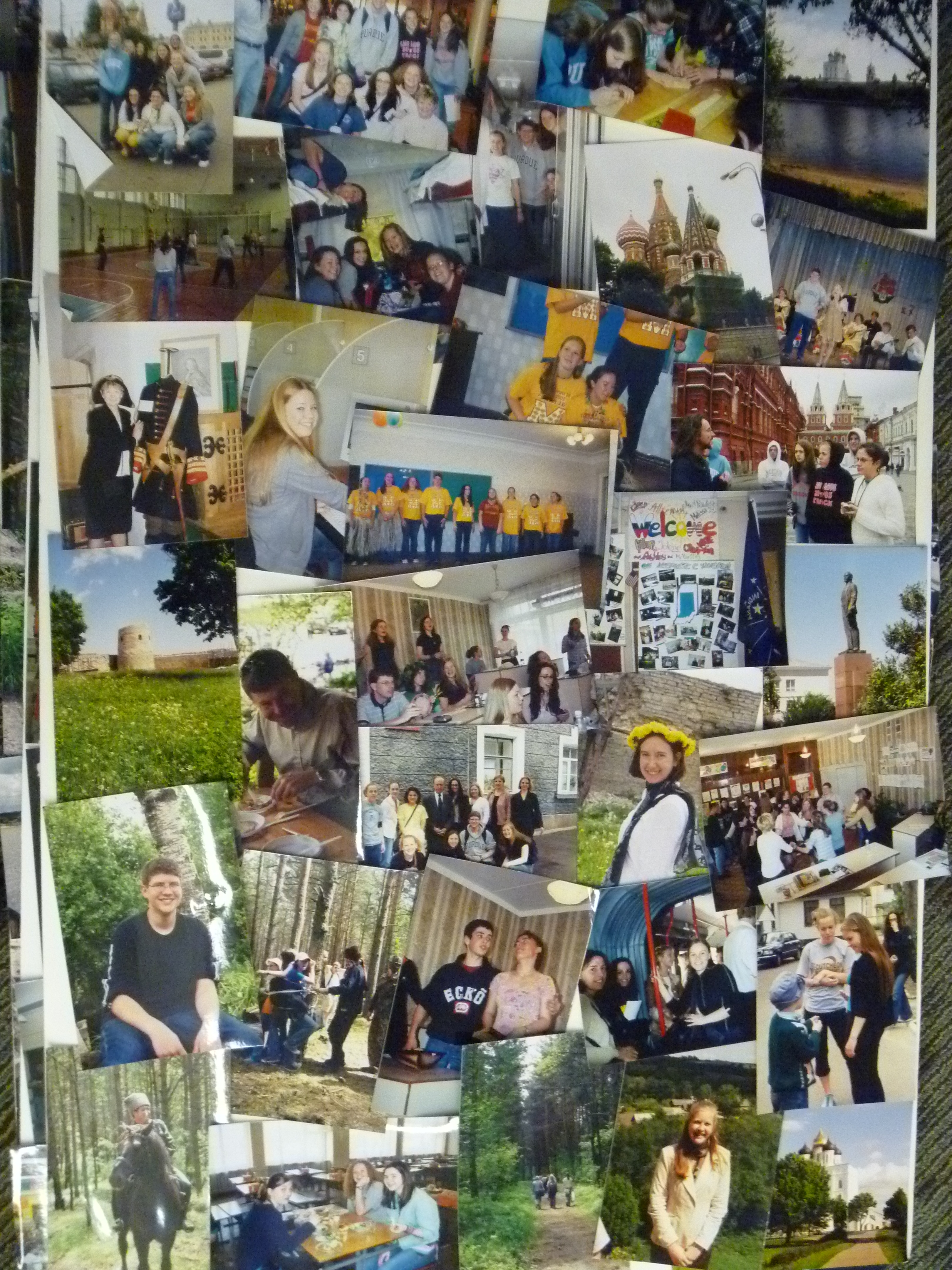
The Sochi Olympics have me thinking about the summers when I took students to Russia on an exchange program. The kids–in their twenties now–are thinking about those days, too. I know because they’ve been reconnecting on Facebook and emailing me. We are all acquainted with the unfinished public buildings, the difficulties of getting around, the stray dogs, and the other objects of humor so glibly reported on in the press. We know very well the dark side of Russian history. But more deeply than any of that, we know that what we took away from our experiences ten years ago would last all our lives. See what that was:

“What is Russia? Provide a brief definition.”

It sounded like an exam question. Alina, one of the Russian students, asked it at the end of our three-week exchange with students at the Pskov Humanitarian Lyceum. No one took it for a quiz at all; nevertheless, the American students reflected before they replied.  What came to my mind as I waited for their responses was Churchill’s remark: “A riddle wrapped in a mystery inside an enigma.”

But the students weren’t hampered by such long-ago images as they articulated their impressions. Anna and Hillary responded first and simultaneously.

“History,” they said.

Indeed, we had experienced the history of Russia throughout P1000702our visit. The Pskov town fortress dates back to the 11th century; that year, in fact, Pskov was celebrating its 1100th birthday. Pskov was its own principality until 1510 when it surrendered its ancient veche, or assembly, and came under the control of Moscow. We visited Pechory, a monastery on the Estonian border where Ivan the Terrible decapitated the Father Superior, Cornelius, whom he supposed to be a traitor, and watched his head roll down the cobblestone walk. The Empress Elizabeth abandoned her carriage on a visit to Pechory—it’s still on display along that same steep walk. And in the caves of Pechory, Orthodox monks hid from the Nazis during the Great Patriotic War. We hiked at Izborsk, a nearby fortress that dates back to 1232. Here we waded in a stream whose waters, according to local legend, promise health or wealth or beauty, your choice to wish for.

“Is it only me, or is Russia beautiful?” Kate wrote in our group journal in praise of Izborsk.

We spent an afternoon at Peterhof, the summer palace of Peter the Great. We strolled—and stopped to stare incredulously at Peter’s four magnificent water cascades, each more elaborate than the next, and at the palaces of Marly, Monplaisir, Hermitage, and the Grand Palace itself. We watched children play on the trick stones that Peter designed for children. Little ones, sometimes holding their parents’ hands, ran back and forth in the fountains, pretending to avoid the spots that triggered hidden sprays, hoping to be doused, shrieking excitedly when they were. Some of the students posed in the fountains—under umbrellas. We dipped our hands in the Gulf of Finland and heard from our guide about Peter’s war on the Swedes that culminated in victory in 1709. We could see St. Petersburg, the city Peter built to be his new capital, in the distance across the water.

Later, we toured St. Petersburg itself and had a look at the Russia I, II, III Posters 014famous statue of Peter the Great, the Bronze Horseman. The custom in Russia is for brides and grooms to lay flowers at the bases of historical monuments. While we were there, two couples laid flowers at Peter’s feet. We saw the incredible Church of the Stained Blood, built by Tsar AlexanderIII to honor his father, AlexanderII, who had been assassinated in that very place in 1881.  We walked around St.Isaac’s Cathedral, where the city’s treasures were hidden from the Nazis—we could see the attackers’ bullet holes in the monolithic columns. We were glad to learn the Nazis had never penetrated the building.

Of course we stopped at the WinterPalace, now the famous HermitageMuseum. The grandeur and size of the Hermitage amazed us. Our guide said that it would take eight hours a day for eight years to see everything. We had two hours. At the Hermitage, we split into pairs, each couple making a beeline for the period or style of art that they found most appealing. Some visited the Impressionists; others took in the Flemish painting. Two pairs went to the Egyptian exhibit. Nikita, one of the Russian students, translated the exhibit signs for us when our skills in deciphering Cyrillic failed. We saw clay vessels, fragments of cloth, an actual mummy, and a sarcophagus opened to display the case within the case.

“Look!” exclaimed Ashley. “It’s just like a matryoshka doll, only vertical!”

Nikita smiled.

“Russia is ornate,” said Allie. “Even the railings have detail.”

She was referring to the railings our tour guide had pointed out along one of the bridges in St. Petersburg, but the imperial architecture, the interiors of the monasteries, the carvings in walls along the city streets, the gates between buildings, even the doors to business establishments are ornate. When we saw the Armory collection in Moscow, we understood “ornate” even better. Robes, wedding dresses, vessels of all kinds, chargers for serving food, plates, chalices, crosses and Bible covers, even the Tsars’ carriages have been preserved through the centuries.

“Preservation,” Ashley added. “It’s not just one person or small group; everyone values the past and is keeping it alive.”

In Pushkin Hills, we saw the ongoing excavation of a church that had burned to the ground after the Soviets took power, and we observed the restoration of a monastery, now a convent for Orthodox nuns, at Elizarovo. In fact, the students had helped with both projects. Under the direction of a well-known archeologist, they’d removed the first layer of turf in a small area at the church site. At Elizarovo, they’d painted window frames, hoed in the monastery’s garden, and washed some of the double-hung cloirestory windows that were caked with whitewash and dust from rebuilding efforts. St.Basil’s in Moscow was partially covered with scaffolding, as were churches in Pskov. In St. Petersburg, spruced up in celebration of its 300th anniversary, we saw, through a window into a less public side of the Hermitage, a stash of renovation materials and a faded green wall that had yet to be repainted to match the façade.

“Russia is culture.” Melissa turned in her seat to explain her impression. “It’s the national dress and the folk songs and dances.”

On the first full day in Russia the students had been invited to School #26, a magnet school for the arts, to attend a performance by a folk music ensemble, a group of select high school students. The students played traditional instruments— wooden spoons, the balalaika, the tambourine—and invited our young men to join the Russian girls who were singing on stage in traditional costumes. Back at the Pskov Humanitarian Lyceum, the music and dance teachers taught the Americans some Russian folk songs and dances. Later still, the Americans and their Russian friends learned more folklore at the regional museum where they attended a Russian tea party, the table dominated by an enormous samovar, and participated in songs and dances that were led by a member of a local folk music troupe who was dressed in a colorful sarafan.

“Children,” was my answer. I’d noticed, of course, that most adults in Russian towns wore dark colors—a defense against dust and the expense of dry cleaning—but in contrast, all of a sudden I’d see a child who looked like a bright yellow chick or a big blue gumdrop holding onto her mother or grandmother’s hand. And the hats! All the small children wore wonderful hats—blue velour with yellow stripes, pink or beige straw hats with decorative satin rose petals, denim hats with daisies embroidered on the brims—and I longed for a telephoto lens to snap their pictures unaware.

Then Clinton offered this definition: “It’s hospitality,” he said. “Anything I needed or wanted was provided for me.” When we first arrived in Pskov, spilling giddily off the train and into the arms of the Russian families whom we’d so eagerly looked forward to seeing, some of the parents apologized because their apartment buildings were currently without hot water. Our students took the announcement of cold showers in stride, but their Russian mothers heated water for them daily, and two of the parents, who worked at a local hotel, made arrangements for the “unfortunate” ones to shower there occasionally!

The mothers opened their cupboards and refrigerators to the American students, cooking special Russia dinners for them and searching out foods that would suit American palates. “Eat, eat,” they constantly urged, and while we could never satisfy their need to fill us full, we ate heartily and learned to love certain foods especially. Everyone loved blini, served with sour cream, jam, honey, or just plain butter.  Some students liked the borscht and most liked a Georgian specialty, cheburek, which the students ate regularly at a café on Oktvabrskii Street. Russian pizza and the incredibly beautiful pastries were “hits,” and everyone loved the chocolate, too. Almost everyone developed a fondness for tea and the rituals surrounding it, and it wasn’t unusual to find an American student ordering tea at lunch or in mid-afternoon. The most popular food item of all, however, was the incomparable Russian ice cream. Again and again we visited the booth by the bus stop where a “scoop ice cream” vendor presented an ever-changing selection of flavors.

The Russian families—the parents and the students—extended themselves in every way, in many cases giving up bedrooms so the American students could have a room of their own. The families helped us with telephone calls, with the Internet café, with changing money. They bought bus passes for us in advance of our visit and showed us how to ride like Russians (jump on quickly, show the pass later) lest we be left curbside, waiting in a non-existent line to board. They took us shopping in town and over and over again to “the market.”

Russia? “It’s my second home,” pronounced Karen, and she wasn’t thinking just of the hospitality that had been extended to all of us by our families or of occasions like a trip we’d taken to Sacha’s family’s dacha. As had happened for the Russian students in the United States, all of the Russian parents brought the American students “into the family,” and soon the adjective Russian disappeared when our students referred to them.

Karen meant, too, what we all had come to understand: that the relationships we’d formed and the friends we had made defined our Russian experience more significantly than anything material, anything historical, or anything cultural ever could. During our three weeks, there had been official welcomes from the school principal, from teachers who had prepared special lessons for us, from the Chairman of the city Duma and from the Vice-Mayor of Pskov. There had been formal interactions with the professors and students at the Pskov Pedagogical Institute. All of them were important, but none made as indelible an impression as did the commonplace, often spontaneous, social activities that transpired between the brothers and sisters, between the Americans and their host families.

Allie and Anna cooked a spaghetti dinner together for their host families, and Karen and Melissa made spiced chicken for theirs. Yulia and Karen, whose birthdays are at the end of May, had a birthday party and invited the others. Irina’s mother, who works at a hospital, took Jolene along one day—an impromptu “Take Your Daughter to Work Day.” A large group, accompanied by the teachers and Sasha’s father, went to a disco one night. The students danced together and found no differences in style that they couldn’t absorb. Even the music, half in English and half in Russian, bridged the potential divide.

Our Farewell Party at Alina’s family dacha lasted from late afternoon until the teenagers’ curfew at 11:00. The back yard was a sea of purple lupine, gathered from an adjacent field and stashed in buckets everywhere. Plastic chairs and café tables with umbrellas, rented from town by the parents, were sprinkled about the yard. Volleyball, croquet, and even a karaoke machine provided entertainment, and the fare was the ever-popular shashlik.

When the games were over and the meal was done, when we’d finished with gifts and speeches, lead teacher “Mrs. Irina” introduced the culminating activity. She distributed a handful of colored embroidery thread to each student and teacher and invited the recipients to separate the strands and tie the strings around the wrists of the people to whom they’d like to say a specific “thank-you.” Of course, the tears started as each student and all of the teachers approached each other and the parents to privately convey their thanks.

In the end, each person’s wrist was encircled with a wide, colorful band made of the individual strands. “What is Russia?” Alina’s unintentional quiz question had helped us focus our thoughts about our visit to Russia. Ashley remarked at the end of the discussion that Russia is like the Hermitage. “You could never see it all,” she said.

We agreed with her, but still, we realized we would come home from our three-week visit with fresh, joyful, and positive impressions of the country. There is no mystery, puzzle, or enigma in this. Our idea of Russia, outlined by the history and culture we were shown, has been colored brightly and deeply by the friendships and love that our exchange created. And, like the thick bands upon our wrists, woven of single strands of gratitude, so the idea we have of Russia is all of these impressions together, impressions for which we are grateful still to our many Russian friends.

Learning about World Hunger: Five Big Benefits

This post began as a letter to parents explaining the benefits of  participation in the intense and demanding World Food Prize essay contest.  From my point of view as a teacher, there are five big benefits. In about a thousand words, here is what this competition teaches our kids. 

Dear Parents, P1040079

The World Food Prize/Global Youth Institute competition is underway! We thought you would like to more about the program and why we are so committed to it and so excited that your student has elected to participate.

To begin with, food insecurity—sometimes called, more simply, hunger—is a problem around the world—including right here in Indiana. Did you know that 1 in 6 Hoosiers don’t know where their next meal is coming from? That means that nearly 17% of the population of our state is food insecure.  Right here in our county, the statistic for children is even higher: 20.1%.

The problem is even worse than that in developing countries.

It isn’t that we don’t have enough food in the world—in fact, we do. But a host of factors contribute to the problem of hunger. For example, distribution is an issue in a country like Afghanistan. The US can send technical assistance to farmers in Afghanistan to help them become more efficient and increase their yield—but roads to take their produce to market are poor or non-existent. Food is wasted and people in the cities go hungry.

The problem could be war. In South Sudan and Syria, organizations like the United Nations World Food Programme and Oxfam International deliver food aid—but ongoing violence often prevents the food from reaching refugee camps.

The problem could be land ownership. In many parts of India, women can’t own land—and research shows that when women have a stake in ownership, problems with food insecurity decrease.

The problem could be disease or drought. Here in Indiana, at Purdue University, agronomists like Gebesa Ejeta, who was awarded the World Food Prize for developing a drought-resistant variety of sorghum that thrives in Ethiopia, work to increase yields from challenged soils in countries around the world. Agricultural research can solve some of the problems that cause food insecurity, but the solutions don’t happen overnight.

P1040127 Last year, when we attended the World Food Prize Conference in Des Moines, Iowa, students had a chance to hear world-class scientists from Monsanto talk about their research. The students visited the headquarters of DuPont Pioneer and learned about the work Pioneer is doing here in the United States as well as around the world.

Participation in the World Food Prize competition is eye-opening for students. Bottom line: They learn a lot. In fact, they become incredibly well-informed about agriculture, the food crisis in a particular country, and specific solutions to the crisis.

They develop skills—especially in writing and speaking—that will serve them well in the years ahead. The WFP competition is the most rigorous writing project they will ever do in high school—and it positions these students well for the rigors of college writing. The same goes for speaking: Our kids have the opportunity to present their work orally to a panel of Purdue professors. Talk about developing confidence and poise and learning to think on your feet!  And all of this comes packaged in one-on-one coaching by the two of us: a science teacher and an English teacher.

They learn to think critically. The solutions to world hunger aren’t simple. The factors that contribute to food insecurity are complex and interrelated. Students learn to examine a problem through more than one lens and select solutions that are likely to have the most impact on the country they have chosen to study. Learning to discern a solution to a complex problem is a life skill.

They develop passion and compassion–for this topic, for world affairs, for helping people in need. They never look at the world the same way again. In fact, their passion may turn into a career, into a lifetime of work in agriculture, science, public service, international relations, engineering, governmental affairs, foods and nutrition, and a host of other related fields. Talk about opportunity!

Three of our 2013 participants spoke to the School Board last fall about their experience with the World Food Prize/Global Youth Institute essay and their presentations at Purdue and in Des Moines. The students explained what their research was about and described the impact of the program upon them. Here are the points they made when school board members asked them what they’d learned:

  1. The enormity of the problem of food insecurity
  2. The complexity of the problems in the countries they studied
  3. The complexity of the solutions
  4. The compassion of the people working in the field to solve the problems
  5. The passion of the people involved in the solutions—scientists, aid workers, civil engineers
  6. The growth they experienced academically because of their participation (writing and speaking skills, specifically)
  7. A broadened awareness of the problems in food security
  8. An appreciation they hadn’t had before for agriculture
  9. And the understanding that their everyday concerns are miniscule compared to the survival needs of the people in the countries they studied.

They didn’t use all of those words—#9, for example, came out as “I’m worried about a paper and these people are starving!” They used words such as “amazed” and “humbled.”

Afterwards, one boy wrote a downright touching email, saying he would be “forever thankful” for this whole experience. He spoke in his note about the skills he had developed and his certainty that they would follow him into college and on into his professional life. This same boy spoke at the school board meeting of the broadened vision he had gained. He had been attracted to the WFP project by his political interests, which he still has, but his takeaway was that there aren’t black and white solutions—“You have to look at the people where they are and understand their situations.” In essence, you have to appreciate the on-the-ground realities.

If you have questions about the World Food Prize itself or about the Global Youth Institute, please visit the website at Purdue or the World Food Prize website itself:

https://ag.purdue.edu/wfp/Pages/default.aspx

http://www.worldfoodprize.org/

Or ask us! We would be happy to talk to you and answer any specific questions you may have.

Once again, we are so excited—and thrilled that your son or daughter has signed on to participate in the World Food Prize/Global Youth Institute competition. They will be winners just for participating!

The Coaches

Anything but Random

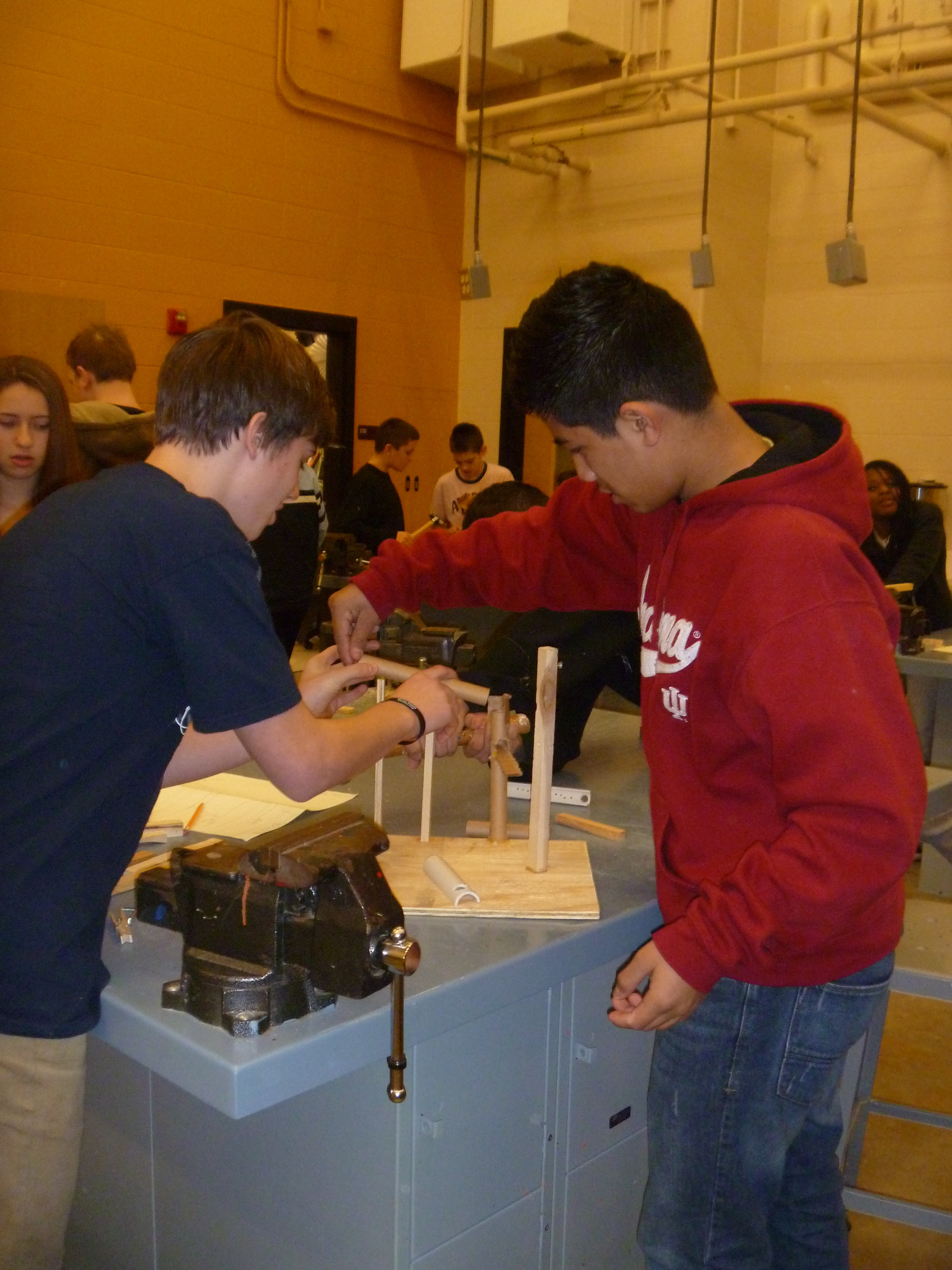
P1040221It was a system he’d devised for grouping students that led me into my colleague’s 8th grade Industrial Technology class:

He knows, given a choice, that students will sit with their friends. So on the first day of school, when his 8th graders come into the lab setting where they will sit four to a table, he lets them do that. What he further observes is that those self-selected groups tend to be homogeneous—most everyone is a member of some social group: the brains, the preps, the slackers, etc. Kids (and adults, it must be said) are usually friends with the people who are most like they are.

But for many of the projects in IT—Project-Lead-the-Way’s Gateway to Engineering course—a heterogeneously grouped team works better. So, to get the kids into such groups without their realizing they’ve been strategically placed, this savvy teacher puts a coffee cup on each table. In each cup are pieces of paper numbered 1,2,3,4. Everyone draws a number. Basically, all the ones become a group, all the twos, all the threes, etc. If the group needs to be smaller, it can be subdivided, but divided or not, what happens is that every group includes someone from each of the social groups—and the kids think they’ve been drawing numbers randomly. No hard feelings for a student who might not have been picked. No subtle labeling by the teacher when he or she divides the kids up.

Leave it to an IT teacher to work out the mechanics of social engineering.

I stayed on that day to watch these teams at work on their Rube Goldberg projects. You remember who Rube Goldberg was: an inventor, an engineer, and a Pulitzer Prize-winning editorial cartoonist who drew elaborate machines to perform simple tasks. His name has become an adjective in the English language to designate any complex solution to a simple problem.

In sixth grade, these students had learned about the six simple machines:

  • incline plane
  • wedge
  • screw
  • lever (3 classes, depending upon where the fulcrum is located relative to the load)
  • wheel and axle
  • pulley

Now their task was to design a system that would use all six machines at least once to transfer energy from a given point on a 12” x 12” plywood base in a minimum of 3 seconds. A longer time is better—this is Rube Goldberg after all! Ultimately, all the complex machines would attach in a line. Students would have to devise the transitional steps between any two.

By the time I got there, toward the end of the semester, kids had already done the reading for this unit. They’d already learned the vocabulary (Try words like these and tell me they aren’t Tier 3 language: force, friction, gravity, mechanical advantage, open loop system, kinetic energy, potential energy, prototype, torque, velocity, work. Not to mention the names of the six simple machines themselves.)

The students had already been to the computers to find five common examples of each of the six simple machines: things like ramps to load or offload heavy equipment, door stops, circular slides on playgrounds, teeter-totters, wheelbarrows, shovels, rolling pins, and window shades. The research component of this project teaches kids to open their eyes to the world around them—and the amazing display of human invention that is all around us.

P1040229They’d already drawn their plans, and those were spread out on the tables as the kids gathered materials and assembled their machines. The supplies came from random materials my colleague had salvaged, scrounged, selected, and squirreled away just for this project: odd pieces of lumber, random pieces of metal, old bits of hardware, spools, caps, plastic parts of unknown origin, cardboard and whatnot. To an outside observer, the junk pile looked like trash—but it was treasure to these aspiring inventors.

They were keeping track of their “costs” as well. While no purchased parts are allowed for these projects, the students keep a running list of the costs they incur for the materials they consume, for the use of tools, even for the teacher’s “consulting time.” At the end, cost figures into the overall evaluation of their finished product.

I watched kids consult, make adjustments, compare the product to the plan, test their device. Painstakingly. Thoughtfully. Respectfully.

P1040230And when the bell rang, I looked around: All the tables were clear, the projects had been stowed until the next day, quiet had descended. Actually, the quiet was more the cessation of the power saws than the kids voices—because their voices had been  collaborative in tone; their words, purposeful.  Everyone had been contributing to the group effort; no one was a lone ranger.

There was nothing random about this class at all.

Leave it to an IT teacher to make complexity, simple: To teach kids upper level thinking skills, problem-solution strategies, skills of collaboration, math applications, and a whole lot of vocabulary, comprehension, and discipline-specific writing.

I was blown away.

Break It Down: Scaffolding Style

All right.  The kids “got it.” They saw that Capote has a distinct writing style and that his style has something to do with lists and parenthetical remarks and sensory detail.  Is that all they’re expected to know? That the author—any author—has a style?  Or do I want more?

Of course I want more.

I want my students to recognize what style is and be able to articulate the stylistic elements in any author’s work.  I want them to distinguish one author’s style from another’s and describe the differences using the appropriate language.  What I want is analysis: a higher level thinking skill. Not so easy as simply recognizing the author has a style or that there are differences in writers’ styles.

It’s a skill that has to be taught—and in the beginning, students will benefit from some “scaffolding.”

So, once they’re “hooked” (See my blog post “A Matter of Style”), I provide my students with a checklist prepared by teachers at a school in Seattle, Washington—the Lakeside School—called Checklist: Elements of Literary Style. Yes, I thieved it. (I prefer to say “borrowed.”  After all, when people put items on the Internet, it’s an invitation for others to use them, not unlike the teacher down the hall pulling something from her file cabinet and saying, “Try this!”) I noticed, when I searched online again for the checklist, for this blog, that another teacher has borrowed it, too. Like me, she gives credit where credit is due.  Frankly, it would be hard to improve upon this checklist, so thank you, English teachers at the Lakeside School!

Pause now to go to this site:

http://teachers.lakesideschool.org/us/english/ErikChristensen/WRITING%20STRATEGIES/LiteraryStyles.htm

I also provide the students with a handout (below) that can be simplified by including fewer categories, depending upon the age and stage of the students or the characteristics of the particular author whose style they are analyzing, or by combining two categories (like #3 and #4):

Element of Style Example or explanation
1. Sentence structure
2. Pace
3. Diction
4. Vocabulary
5. Figures of speech
6. Use of Dialogue
7. Point of View
8. Character development
9. Tone
10. Word Color/Sound
11. Paragraph/Chapter Structure
12. Time Sequence
13. Allusions
14.  Experimentation
15.   Metafictional techniques

The students’ task—independently, in pairs, or in small groups, depending again upon all the variables of instructional planning and strategy—is  to examine the designated writer’s work—and find examples in the text of each of the elements on the checklist—if they apply.

For example, students will note that the sentences in “A Christmas Memory” are long (#1), full of lists and adjectives and subordinate clauses. The pace (#2) is slow, with much description—sensory images like the stove, the tipsy dancing in the kitchen, the tinfoil stars ornamenting the trees—and emphasis on the setting (the South—pecans, pine trees; and the Depression—FDR was the President, it cost a dime to attend a movie).  His diction (#3) is expansive—he’s long-winded and that contributes to the affectionate feeling he has for Sook and his lingering description of these Christmas memories. His vocabulary (#4) includes some unusual and/or multisyllabic words—for example, inaugurated, dilapidated, mingle, sacrilegious, skinflint, prosaic—but these alternate with simple words that describe images and scenes that are easy to understand and with figures of speech (#5) such as like a drunkard’s legs, blaze of her heart, turned our purse inside out that are easy to visualize. There is not much dialogue (#6), but lines such as “It’s fruitcake weather!” move the story along and signal significance.

And so on.

More sophisticated students might write for Truman Capote that his portrait of Sook (#8) is almost a caricature of an eccentric and solitary older woman, perhaps a simple-minded one, but by inserting his own parenthetical comments (#15), he not only softens our judgment but endears her to us.

The checklist provides a scaffold for students when they attempt to describe style.  It’s  a difficult literary concept—more difficult by far than outlining the plot or figuring out point of view or even determining theme—so the checklist and companion worksheet break the task up into manageable pieces.

Done often enough, the exercise will help students develop their understanding of what style is and, with practice, come to identify its characteristics with the same automaticity with which they identify the stages in plot development or analyze character.

Furthermore, the language of the checklist plus the examples they find in the text will provide the students with the support they need when their teacher—could that be me?—asks them to write a formal analysis of an author’s style.

Whatever the skill you want students to learn, break it down, break it apart. Make the goal attainable.

A Matter of Style

The blog post I wrote about “A Christmas Memory” got so many “hits” this season that I thought people might be interested in the follow-up; that is, what we did after the kids realized that Harper Lee had modeled Dill in To Kill a Mockingbird on her real life friend, Truman Capote. I wrote to a friend of mine about that day in class—the first time I taught this lesson—and printed out my email because I never wanted to forget it. So here is the rest of the story, all about a lesson in style, taken from a dispatch fifteen years ago.

“Dill?”

There was a kind of silence and others began to say things like, “Yeah, that’s true.” Very quietly at first, as there wasn’t yet a lot of confidence for this idea.

I waited a minute for them all to make the connection and then said, “You’re right. Harper Lee and the author of this story grew up together. Dill is Buddy.” The girl who had ventured her idea was stunned—and very quiet herself. The idea had to sink in with all of them—and my girl had to believe she could have been so intuitive. And then we began to talk about the real lives of authors.

When I told them about Capote’s In Cold Blood, several wanted to read it. I happened to have a copy in the classroom, so the boy who was at the top of the class jumped up and took it from me. He said he would read it over Christmas Break and then exchange it with another boy in the class. I told them that Harper Lee had accompanied Capote on his trip to Oklahoma and had served as his secretary during the research phase of the book. The boy turned to the beginning of the book—sure enough, there was an inscription: “To Harper Lee.” I could feel the chills running through the class.

So, my assignment that night was to come to class the next day having identified two specific passages in “A Christmas Memory” that they particularly liked. My plan then was to launch a discussion of style—without telling them that that was what we were talking about.

They were excited when they came into the room, eager to talk about “their” passages. We identified the cataloguing, or listing technique; appeals to the senses; metaphors and similes; artful creation of symbols; parenthetical remarks; “special effects,” like typography and non-words; abundant use of detail. One boy said, “My favorite sentence in the whole story is the one where he talks about (and he directed us to the page and column) “the buggy wheels wobbling like a drunkard’s legs.”

Now I don’t know about you, but when a 9th grade boy, a big, hulking athlete, says something about “his favorite sentence,” chills run through me.

Then another boy mentioned the parentheses. He said, “These parenthetical remarks seem like they are made to protect Miss Sook.” He went through them. Sure enough, in the list of things she’d done, for example, was “Take snuff,” but the parenthetical remark was “Secretly.” She had done a number of other things that would have made her seem strange—except that in parentheses, Capote would say “You just try it,” or “I did, too,” or “Just once”—something that mitigated the extreme and made her seem quaint, not weird.

The boy who had taken In Cold Blood piped up: “That’s the same thing he does here! He uses the parentheses the same way. And he lists things. Here, let me read.”  And the boy read us quite a long passage which, since the others didn’t have the text, didn’t impress them quite as much as it did the boy who was reading—except that they all were impressed by the dawning realization, the discovery they made for themselves, that writers have identifiable styles.

An education professor had been in my classroom observing me a few months before this. He had told me then that mine was a “constructivist classroom.”  He had seen me doing something similar to this discussion about style in a class called Novels that I was teaching with seniors and also in a discussion about the Odyssey with these same 9th graders. I like to lead kids to make discoveries on their own, but until then, I hadn’t had a name for this approach.

Having a name is so legitimizing—I had thought, up until then, that I was doing something unidentifiable and vaguely unorthodox as no one had ever taught me any of this. My method of instruction, this line of inquiry, hadn’t come packaged with operating instructions.  I just like kids to discuss what we are reading and have them do the thinking—it always means more that way.

So, I found there’s a name for it. Well, well. That’s kind of like discovering authors have identifiable styles, isn’t it?

How to Use an Instructional Coach

Athletes—including the very best—use coaches regularly to improve their performance. Surgeons bring coaches into the operating room to observe them as they work and make suggestions for perfecting their technique. Social service agencies employ coaches to help caseworkers develop communication skills, especially with difficult clientele. In  schools, coaches serve a variety of purposes.

Sometimes we are called literacy coaches. In that case, we work with teachers to develop instructional strategies vis-a-vis reading and writing in all the disciplines. Sometimes we are called curriculum coaches, and then the focus is on the district’s learning goals and standardized assessments of those goals.  We might be called technology coaches—where the emphasis is on the obvious. Or, we are called instructional coaches—and then it’s all about what happens in the classroom. The truth is, most of us do some of all of this. The name doesn’t matter. We know what we do, and what we can do.

But often, the classroom teacher isn’t certain what our role is or could be. Coaching is still relatively new and teachers aren’t used to built-in support systems.

The last time most of us had any help in the classroom was during our student teaching experience. For  some, that may not have been a productive experience. Whether the student teacher is cut loose and expected to sink or swim or guided skillfully in an orchestrated co-teaching environment—or experiences something in between—the fact is, the status of a student teacher is just that: student. Novice, beginner, apprentice, neophyte. The relationship is unbalanced: The cooperating teacher is the old pro, and the student teacher is the greenhorn. The one tells the other what to do.

The relationship between a teacher and an instructional coach is much different. The coach is a colleague and a peer. The teacher is a professional and an equal. It’s the teacher’s classroom, not the coach’s, and the coach is invited to interact. By the teacher.

Oh, sure, sometimes the principal has expectations that his or her staff will use the coach, and sometimes the principal is even more directive than that, but in the end, the teacher invites the coach into the room and into the relationship.

But what can a teacher ask a coach to do?

To answer that question, I thought about how I would have used me at various times during my career.

In the beginning, I sure could have used help organizing my classroom. It took me a long time to develop systems for collecting papers, storing them, returning them. I needed a template for putting assignments on the board and a system for conveying missed information and assigning make-up work to kids who were absent. I even needed help with room arrangements. I didn’t have the backlog of experience that would have told me how to break up cliques without making kids mad and how to move a student’s seat without giving him (or her) an audience.

At the start of my career, I could have used a coach to help me put a lesson together.  I’d have an idea of what I wanted to communicate, but I didn’t have a repertoire of activities to draw upon. I could have used someone simply to help me plan a lesson, a week of instruction, a whole unit. To help me see the flow of instruction over a semester’s time. To set goals. To develop activities to communicate those goals. To plan tests to measure how well the students had learned. Really. None of that came easily in the beginning.

I could have benefitted from having a coach watch me teach and make suggestions about pacing, about questioning techniques, about checking for understanding. It’s true that I figured things out on my own—eventually—but a good coach could have kick-started that process and made me a better teacher, faster.

Shoot. I could have used a coach’s help in planning and delivering lessons right up to the end of my time in the classroom. Not because I was bad, but because I wanted to be better.

As time went along and I grew more comfortable with planning and delivery, I could have used an extra set of eyes—not on me, but on the kids. Someone to watch social interactions–in some cases, to identify the primary troublemaker. I remember the frustration of knowing a group of kids was cutting up when my back was turned—but turning in time to see only the last participant, not the instigator. I could have used an extra set of ears: Someone to listen for the under-the-breath remark that would tell me a student didn’t understand but wouldn’t ask a question. So many times I could have used an extra set of hands. Whenever I put kids in groups, whenever I wanted to conference with students individually, whenever I set up learning stations, another teacher in the room would have been a boon.

And I could have used a shoulder to cry on. The relationship with a coach is a confidential one. We listen. We don’t take sides. If we can, we offer suggestions.

I would have loved, loved, loved to co-teach with a coach. Once, I had a paraprofessional in my classroom who was more like a co-teacher than an aide for one of my students. We dialogued about content with the kids as our audience—delivered a relaxed, two-person lecture, really. Other times, she’d ask a question that would prompt me to clarify a point. Once we even planned a tag-team presentation. Now that I’ve been a coach and had the opportunity to co-teach with colleagues, I know I would do it myself whenever I could. Sure, it takes planning—you have to meet and discuss the objectives, plan the activities and decide who’s going to do what, figure out how to assess what the students have learned—but you have to do that anyway. It’s more productive with a colleague because two heads on a topic are usually better than one—brainstorming and piggybacking on each other’s ideas usually yields rich discussion in the classroom. The same is true with lesson planning.

Co-teaching would have built my confidence when I was a novice, but I would have thrived on it as a veteran.

I could have used someone to help me make sense of standardized test data. Someone to research topics for me. Someone to look for alternative titles for theme-based units.

In short, a coach’s job is to make a teacher’s job easier. Whether that is doing research, co-teaching a lesson, refining a strategy, figuring out technology, solving a problem, or working with kids, coaches are there to help.

We don’t have all the answers—but we do have the time to find answers to yours. We’re not outside experts, not even consultants. We’re teachers—just like you—but teachers without our own classrooms. Invite us into yours.

Remembering JFK

I wrote this piece about JFK eleven years ago when I was teaching 12th grade English. I was modeling for my students, furnishing an example for the essays they would write about a significant moment in their lives. On the 50th anniversary of Kennedy’s death (2013), I offered it as a reflection on the extent and depth of the impact Kennedy had on so many young people of my generation, on me. Looking back all these many years later, I can’t imagine a better way to have spent my life or a better way to have served my country. Because that is what teachers do: We serve. Through our instruction, our example, and our own perseverance, we shape the country—even the world—for years to come. 

It is true what they say about historic moments: You remember where you were, what you were doing. I was standing on the steps of Harrison Hall—the science building—at DePauw University in Greencastle, Indiana, the morning that John F. Kennedy was shot. Someone told me the bare facts when I came out of the building after my zoology class. I hurried back to my living unit and crowded around the TV set with my friends, hanging on every word that came out of Parkland Hospital and the Dallas Police Station, every scrap of information from Walter Cronkite. No one spoke.

I had seen Kennedy in person just two years before. He was coming to Iowa on a campaign trip in September and would take part in a motorcade through downtown Davenport.  My government teacher had dismissed class for the afternoon so that we seniors could be part of the crowd that would line the streets that day, so that we could see for ourselves the handsome young senator from Massachusetts who had so fired our imaginations. Those of us who drove to school took those who didn’t in our cars. We sped downtown, found parking places, and raced on foot to the levee. We must have scoped this all out ahead of time—or our teacher had—for we knew right where to stand. Maybe the parade route was in the newspaper.

Just so you know—and so you understand how a single teacher could dismiss school for the afternoon—I attended high school in Davenport, Iowa, a town across the Mississippi River from my home in Illinois. I was a day student at a school for girls, grades K-12. When I enrolled in the 8th grade, there were eight students in my class. By the time I graduated, we were a class of seventeen, considered big in comparison to other classes. Mr. Hostetter, our government teacher and the teacher of every history class I took in high school (American, Ancient, British, and World as well as Government in my senior year), was also the Dean of Students and sometimes even the bus driver. However, by the time Kennedy came to town, I was driving myself to school.

We were kids in gray uniforms—maybe that was how we managed to hold our positions at the front of the crowd. People shouted and squealed and elbowed their way forward, jockeying for a clear view. Most were adults, but we recognized kids from the public high schools, too. We waited impatiently for the car to come, probably for an hour or so, all that time staking our territory against the urgency of other admirers and the aggressiveness of those who just wanted a look at the audacious young Democrat whose Catholic background made him a novelty in this overwhelmingly Protestant, Republican community.

He was handsome indeed. Intense eyes, a shock of loose, casual hair that swept back off his face in a fresh and unconstructed way—so different from the bald President Eisenhower and his dark, slicked-back Vice-President, Nixon. Kennedy smiled at us directly; we saw white, even teeth and a shine in those eyes. His arm stretched out across the window ledge of the convertible. I reached for it…and he took it.

I think.

Maybe it was my friend Pam whose hand he shook. Isn’t that funny? The high point of the story and I can’t remember if it was she or I who actually touched his hand. Probably it was she or I wouldn’t have this doubt about which of us it was. Certainly she had as much claim to the shock of it as I did. Both of our fathers were Republican businessmen—and her father was ardently involved in Republican politics as well. Our parents thought our infatuation with Kennedy was just that: a crush that would pass. My father said I was a “tide-bucker,” not a Democrat at all.

But it wasn’t about political parties. I was inspired by Kennedy. He touched a nerve in me with his sympathy for the poor and oppressed. I knew I wanted to make a difference in people’s lives, not just enjoy my own. So when Kennedy said in his inaugural address in that January of my senior year, “Ask not what your country can do for you, ask what you can do for your country,” I knew he was speaking directly to me, directly to my generation, to all the kids who had lined the streets in the cities along the campaign trail. He called upon us in that speech to participate in a struggle against “the common enemies of man: tyranny, poverty, disease, and war itself… Can we forge against these enemies,” he asked, “a grand and global alliance…that can assure a more fruitful life for all mankind?  Will you join in that historic effort?”

Yes, I vowed. I will.

After college, I joined VISTA,  the domestic Peace Corps (now called Americorps) and after that, I became a teacher. I didn’t serve in inner-city schools—my family and I have never lived in big cities. I didn’t become a union organizer, though I do, proudly, belong to the union. I didn’t burst onto the national scene and transform education policy, either.

But I did love my students in all their splendid diversity. I tried to teach perseverance so that they would be successful. I tried to instill a love of learning. In a variety of ways, curricular and extra-curricular, I exposed my students to a wider world than they had yet known in hopes that they would learn to appreciate others and live caring lives.

Looking back all these many years, I can’t imagine a better way to have spent my life or a better way to have served my country. Because that is what teachers do: We serve. Through our instruction, our example, and our own perseverance, we shape the country—even the world—for years to come.

Kennedy reached out his hand, and I took it.

All of my life since, I have tried to pass on that handshake.