Forty Chances

If we’re lucky, writes Howard Buffett, we have about forty chances in our working lives to “get it right.”

Howard Buffett is the son of Warren Buffett—not as well known as his father, but a man who is also making his mark upon the world. For Buffett the son—and for his son, too—the “work” is primarily  agriculture and the arena is the world. Buffett’s foundation funds projects related to food and water security, conflict resolution in developing countries, and a few other projects of special interest such as cheetah and mountain gorilla conservation. For Howard, getting it right means using the 26.5 million dollars his father gave to him for philanthropic purposes wisely, strategically, and effectively.

Fundamentally, Howard G. Buffett is a farmer—he lives and farms in Decatur, Illinois. He’s an accomplished photographer, too, so 40 Chances is illustrated with photographs he’s taken all over the world. He’s also the author of Fragile: The Human Condition, a collection of photographs of and essays about vulnerable places he’s been in the world—130 countries—and the people he’s seen there. Published in 2009 by National Geographic, the book is immense, beautiful, and eye-opening. So Howard Buffett’s commitment to issues of food insecurity is long-standing and substantial: He’s not a celebrity flirting with a cause.

The title—and the concept—of 40 Chances originated from a spiel Buffett heard at the farm implement company in Decatur. The owner was showcasing a new line of John Deere equipment; the pitch was that the company realized their clients had about forty opportunities to perfect their business before their working time was up. The company wanted to supply the farmers with the best possible equipment and advise them on how to use it to advantage.  The idea of “forty chances” stuck with Buffett and brought not only his farming but his philanthropic efforts into sharp focus.

The stories in the book (forty of them) are about the problems he’s witnessed in specific countries, other problems that are more general, and the specific solutions that have worked in those countries—and some that haven’t and why. From these experiences, Buffett has evolved his ethic of funding.  He’s careful about the projects he funds and the people he invests in, and he’s learned to pay attention to these principles:

  1. What we think we know doesn’t automatically transfer to other parts of the world. You have to pay attention to the local geography, customs, and culture.
  2. Policy matters. You can’t get the right results if you don’t have the right policies.
  3. Dream big—but be realistic. Set reachable goals.
  4. Believe in people. Find amazing people and fund them to do the work they propose.

I took the wording of those principles straight from Buffett himself. I heard him speak at the Borlaug Dialogue in Des Moines, Iowa, in October 2013.  The book provides amplification of these guiding principles and sets forth a few others.

Buffet writes in his book about ineffective practices—such as funding projects that aren’t sustainable—and he goes into detail about some that are just plain wrong-headed—like  monetization. That’s the practice, authorized by the 1985 Food Security Act, of NGOs or recipient countries reselling a percentage of direct food aid to generate cash for other development projects. Sending our food surpluses to food insecure countries for monetization drives the prices down for locally produced food and creates a marketing problem for farmers in the country that the food was supposed to help. Food that is monetized may even end up on the plates of tourists rather than in the stomachs of food insecure individuals.

In emergencies—such as natural disasters—or in situations where procuring food locally is cost-prohibitive—situations, for example, where transportation costs make local purchases uneconomical—direct food aid is critical. However, sending direct food aid often removes the incentive for local solutions to long-standing problems of food insecurity. In many cases, Buffett favors direct cash aid in the first place; he believes the US should at least reexamine its policies about the mix of cash and food we send to food insecure countries.

More of Buffett’s basic beliefs:  Good governance in developing countries is critical to success in solving issues of food insecurity.  Land ownership motivates good stewardship—so he’s in favor of land rights for farmers and reform of land laws in countries where women especially are marginalized. He stresses the importance of the value chain—everything from farm to market has to work or the project may fail. Farmers might harvest an improved crop due to technical assistance, but if the roads are so bad they can’t get their crop to market, what has been gained?

Howard Buffett will make some American farmers uneasy. He favors no-till methods and doesn’t believe in subsidies the way they currently work. He’s not opposed to genetically-modified seed. He practices what he calls “conservation farming,” but that doesn’t mean organic farming.  He doesn’t think organic farming can be practiced on a large enough scale to feed the world.

And that’s his mission: To feed the world.

Right now, according to the organization “Feeding America,” one-sixth of the people in the USA—50 million Americans—are “food insecure.”  That means they don’t  know for sure where the next meal is coming from.  According to the United Nations, that number worldwide is 870 million people.  It’s no surprise then that the United Nations Food and Agriculture Organization projection for 2050 is grim:  Food production will have to increase worldwide by 70 percent to feed us all.

Whether you agree with all of Buffett’s views, you have to give the man credit. He is the recipient of many awards—for example, he’s been named a United Nations Goodwill Ambassador Against Hunger; he was the recipient of the World Ecology Award and the Triumph of Agriculture Exposition Agri Award. ColumbiaUniversity honored him with the Global Leadership Award. And that’s just the beginning of the kudos and accolades. He’s doing about as much as anyone can in his crusade against hunger, in his effort to feed the world. Money well spent, a life well lived, forty chances not gone to waste.

I started out, as I sat down to write this, to apply the “forty chances” concept to us as teachers. It does apply, of course. Forty years is about the span of our working lives, too, and most of us are still perfecting our art, polishing our skills, trying “to get it right,” right up to the very last day.

But I couldn’t stop writing about the book. 40 Chances, now on the New York Times non-fiction best-seller list. It is an unusual book to have fallen into my hands. I am usually reading literary classics or recent fiction, even literary non-fiction, but not a book about agriculture.  However, my interest in international issues is deep—especially international education efforts.  I heard Buffett speak at the World Food Prize Conference I attended in October, the conference also known as the Borlaug Dialogue. And the obvious struck me: If children are food insecure, if they’re hungry literally, their hunger for learning can’t be fed.

So I’m impressed with what I’ve read and I am recommending 40 Chances to you.  Let us hope that Howard Buffett continues to use his remaining chances wisely and that he has many more. As for us, the same: We have forty chances. Let’s use them well.

Changed Lives: The World Food Prize

It isn’t often that you come away from an event knowing with certainty that lives have been changed. 

P1040080

But in October, that’s exactly how I felt. One hundred and forty-six students from 27 states and 7 foreign countries assembled in downtown Des Moines, Iowa, for the Global Youth Institute, held in conjunction with the presentation of this year’s World Food Prize.

If you have followed my blog for long, you may remember that I wrote about the World Food Prize last spring. (See “Second Skin” and “Winners All.”) A colleague at my high school, a biology teacher whom I admire, had learned about the World Food Prize essay competition, a contest on the subject of world hunger. Students would choose a country somewhere in the world,  do research, and then write about issues of food insecurity in that country. My colleague asked me to help her coach the students who signed on to the challenge. The final  papers—as many as 10 pages long, single-spaced, thoroughly documented in MLA format—were written with no promise of any extrinsic reward and turned out to be far more complex than any the students had written before—even in AP classes.

At the end of  March, the five students we coached presented their papers before a panel of Purdue University professors, all of them connected in some way to agriculture and food science. One of our students—Caroline—had written about India and the issue of land law reform. If women owned land, she argued, agricultural improvements and increased food supplies would not only decrease hunger and malnutrition but would contribute to the elevation of women’s status and thus to a decrease in gender-based violence.

All of our students wrote papers like this—one was about hydroponic produce in the Gaza Strip, another was about water sanitation in Cambodia—but Caroline’s essay and  her subsequent oral defense of her work qualified her to attend the national conference—the 2013 Borlaug Dialogue—in Des Moines. Over the summer, she revised her paper, resubmitted it, and then waited for the event in October—the event that changed lives.

This was a full scale conference—called the Borlaug Dialogue in honor of the Nobel Peace Prize recipient in 1970, food scientist and humanitarian Norman Borlaug, “the man who saved more lives than anyone else on earth.” Working as a young scientist in Mexico in the 1940s, Borlaug developed a disease-resistant strain of wheat that made Mexico less dependent upon imported grain. His work was the beginning of the Green Revolution in India and Pakistan in the 1950s. His contribution to peace in the world—by increasing the world’s food supply and saving millions, perhaps a billion, from starvation—is unparalleled.

The conference, held in Des Moines, Iowa, was attended by food scientists, statesmen, NGO leaders, academicians, and agribusiness men and women. Attendees listened to thought-provoking speakers and panel presentations, ate delicious, eco-friendly, catered meals that concluded with keynote addresses or round table discussions, and viewed posters explaining work being done to fight hunger around the world by various NGOs.

The students took in most of this, but the Global Youth Institute, their conference, ran in tandem with the Borlaug Dialogue, and students followed its schedule, too: a farm tour, an opportunity to package food for Outreach International, a Hunger Dinner organized on Friday night by Oxfam. The climax was on Saturday morning when the students again presented their papers, this time to distinguished scientists who were attending the conference—scientists like previous World Food Prize honorees Dr. Philip Nelson (2007) and Dr. Gabisa Ejeta (2009) from Purdue University.

  • So what changed lives? Was it Howard Buffett, an international philanthropist (and son of Warren Buffett) whose interest is in agriculture? Buffet told the audience that we all have about 40 chances in our lives to do something for the world. We don’t get unlimited opportunities—40 years is about the span of our working lives. We have that many chances to “get it right,” whatever our goal. His is feeding the world.
  • Was it the President of Iceland, a learned and engaging speaker who told the students that the melting of polar ice will have a greater effect on their lives than anything else?  In a talk entitled “Ice, Energy, and Food,” he explained the geothermal aspects of the polar melt and outlined the subsequent effects on countries around the world.
  • Was it Tony Blair, explaining we need to pay attention to the priorities of the people in developing countries and to listen to them: They just might know more than we do.

P1040108Or perhaps it was at the Hunger Banquet.  Teachers and students drew cards as they entered the room and were sent, depending upon the color of their cards, to one side or the other or to a spot on the floor. On the right, tables had been set for an elegant multi-course meal—15% of the participants landed there. Another 25% were sent to chairs along the wall. That group, those who are barely “making it” in the world, got a dinner of rice and lentils, served on paper plates. The rest of the participants ended up on the floor. They represented the 60% of the world that is food insecure. Their dinner was rice only, served directly into their hands from great bowls placed on the floor.

People reacted in myriad ways. Some on the floor accepted their fate, some begged and even stole food, others bartered. Some of the 15% shared willingly or even tried to give their food away. Some people served as intermediaries between the rich and the poor.

The students voiced their reactions and their takeaways after the dinner. One student, an articulate young woman who had been a Borlaug Intern in India the previous summer (an opportunity yet ahead for this year’s crop of students) said to the group at the end of the dinner, “If we are going to help in the world, I believe it has to start with empathy.”

Maybe it was the World Food Prize winners themselves who changed the lives of the young people in the room. All of the laureates this year are microbiologists who have relentlessly conducted basic scientific research that has, after years of study, yielded advances in the genetically modified seeds. They spoke at lunch about their lives in science: about the curiosity that sparked their quest, about the discipline and persistence that science requires, about the mostly friendly competition among their labs, about the electricity—and the satisfaction—they felt when their experiments worked and new knowledge was born.  Any budding scientist in the audience had to have been inspired.

Or perhaps it was the same three scientists giving the students some advice at the end of the conference—passing on some life lessons:

  • Dr. Robert T. Fraley: Pretend that 37 years from now you are 56 years old and toward the end of you career. What will you be thinking about? It believe it will be your friends and colleagues and the few lasting contributions you will have made in the world—those moments that will come from deep inside you. Nothing else will matter.
  • Dr. Mary-Dell Chilton: Do what you want to do. Follow your love. That is the place where you will succeed.
  • Dr. Marc Von Montagu: Whatever discipline you go into, question the knowledge. Take a scientific approach.

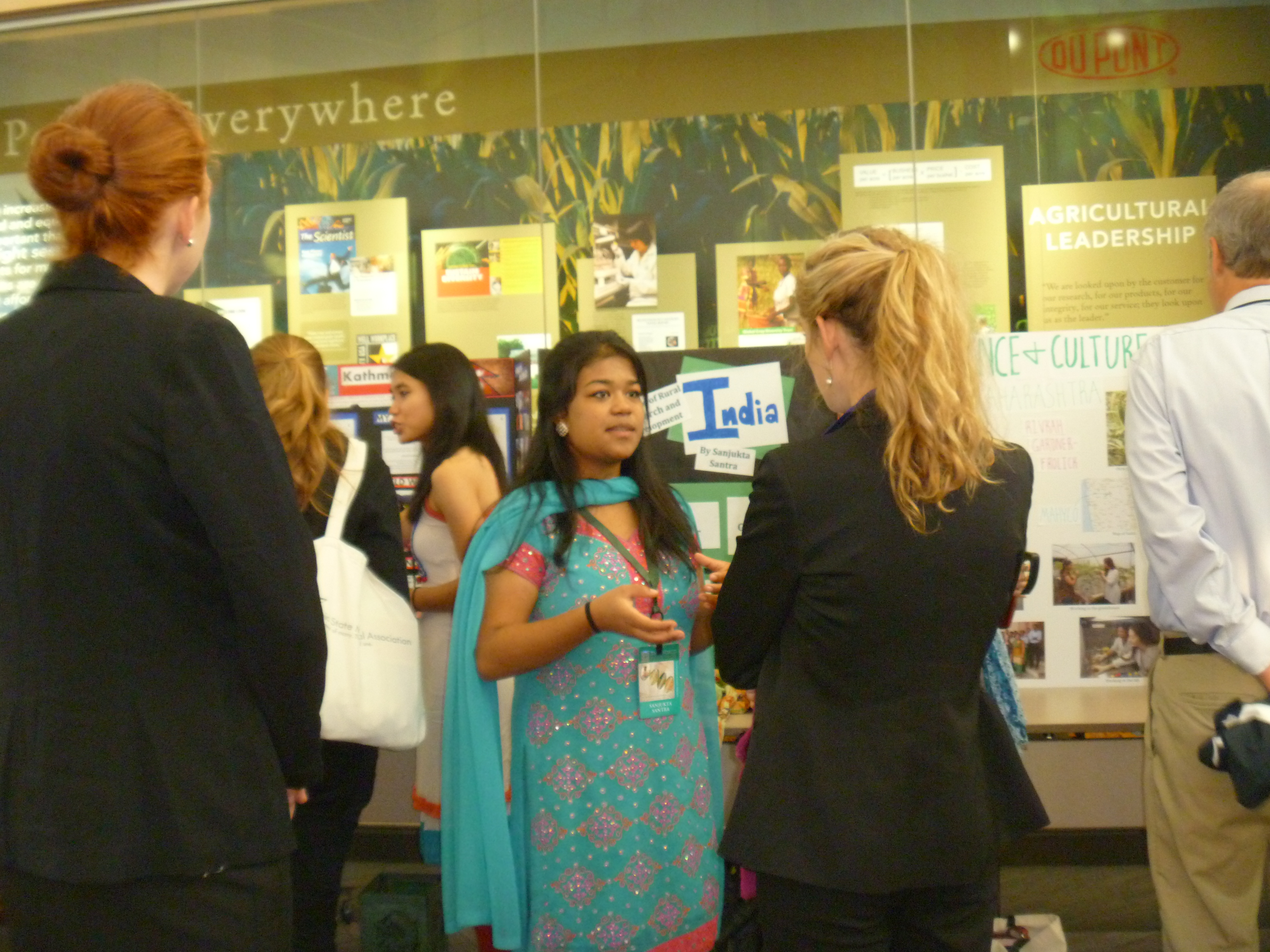
Maybe it was the posters and presentations by Borlaug Interns—students from the previous year who had applied for and won the twenty coveted summer opportunities to conduct research on site in countries all over the world. That, by the way, is the prize for the students who attended the Global Youth Institute. P1040132Their work is distinguished enough that they’ve earned the right to apply for an overseas internship—while they’re still in high school. The students I heard presenting their papers and discussing the impact of their experiences abroad are all committed to the further pursuit of answers to the problem of hunger.

The last event of the Global Youth Institute brought students and distinguished scientists together in small groups. The students presented their papers orally (those summer revisions) and the scientists, including the new laureates and those from other years, like Phil Nelson and Gabisa Ejeta and M. S. Swaminathan (the first World Food Prize laureate of all), responded to them. The scientists asked questions, commented, praised the students and challenged them—much as the Purdue professors had done in the spring. Imagine the impact of a world class scientist listening to a high school student’s paper: This was the high point of the conference for our student, the piece that has motivated her to apply for an internship.

The event that changed lives. I don’t mean the Global Youth Institute/Borlaug Dialogue was a conversion experience—these kids already appreciate the seriousness and depth of world hunger. I don’t mean that they did an about-face on their career goals—most of them already know they want to go into agronomy or biology or engineering or such.

The change they underwent is more like a photographer putting a panoramic lens on the camera. Suddenly, the world is wider. “I saw there was poverty everywhere,” said one Borlaug Intern who saw it halfway around the world as well as here in America. “I see that technology can help,” said another, thinking perhaps of the cell phones that smallholder farmers in the developing world use to keep abreast of market value for their crops. Technology for this student is far more now than cool aps, the latest iPhone, or social networking.

At the same time, it’s as if each student has placed a close-up of herself in relief against that panorama–like a Facebook user uploads a profile photo against the banner on her page.  Each scholar stands in relief against that panoramic background, the student’s relationship to the wider world now more sharply defined. “My internship solidified what I want to do in college,” I heard one young woman say.  Because of their experiences at the Global Youth Institute, a biology major will narrow her options to plant pathology. An aspiring engineer will someday develop farm implements that can work the African soil. Someone interested in science generally will become a nutritionist.

It is in this way that lives have changed—and that the lives of those who live with hunger will change.

Norman Borlaug is still saving lives.

Visit the World Food Prize website: http://www.worldfoodprize.org/

Read the students’ papers: http://www.worldfoodprize.org/index.cfm?nodeID=69493&audienceID=1

Why No I

Since they’ve been in middle school, the kids I’ve taught have complained about having to follow the rules of rhetorical writing— particularly the rule about not using the first person.

Of course, they “know” why. Their English teachers all along have adhered to the formal writing conventions (abbreviated by us as FWC and used as shorthand on their essays to point out such slips as the use of contractions, or the appearance of digits instead of words for numbers under 100, and yes, ironically, for the use of abbreviations). “I” isn’t appropriate, we tell them, because this is formal writing. (And yes, they get plenty of chances to write narratives and stories and other sorts of essays where a more casual tone is perfectly appropriate.)

Like they would understand what we meant. I used to make an analogy with dress: You wouldn’t wear a sundress to a funeral or a leotard to the prom, I’d say. But times have changed, and I’ve seen worse at both venues. So the old analogies no longer hold. In my later years in the classroom, I had to find a new way to make the point that the more distance between the writer and the audience, the weightier the writing occasion, the more formal the style. Your college professor—or the reader of a scientific article—isn’t your best buddy, I’d say. Don’t call him by his first name and don’t inject yourself into the conversation.

In talking over the content and the intent of the Academic English 12 course we have always called (rightly or wrongly) College Composition, my colleague in the English Department at my former high school revealed that her students were making the same complaints mine always had: Why can’t we use “I”?  These students aren’t middle schoolers. They’re, in fact, old enough (some would say, beyond old enough) to think seriously about levels of diction. I described the lesson I had developed towards the end of my time in the classroom to address this topic, and she invited me to try it out with her students.

I was so excited to be back at the front of the room that I showed up 24 hours early.

We had planned the lesson together. She’d locate a copy of the children’s story The Three Little Pigs and read it aloud to the students. The lesson depended upon their all recalling the plot line.

I started the class by reminding the students of the various conventions they observe in life:

  • Going up the staircase: Up on the right, down on the left
  • Setting the table: Glasses are placed on the right, above the knife
  • Driving: Passing on the right on the road (in the USA)
  • Airline boarding: By zone—unless it’s Southwest and then it’s by number
  • Attire: Hats off inside–except on Spirit Days

When I asked why we have conventions, one boy’s hand shot up: “To make things go smoother!” So right. So that everyone knows what to do. So that everyone is on the same wave length. Various kinds of writing follow certain conventions, too, I reminded them, and they remembered: FWC.

My colleague stepped in then and read The Three Little Pigs aloud, just as a teacher would in elementary school. In this particular version, the first two pigs were eaten—a violent rendition, the kids exclaimed—but reading it aloud was critical, and the pigs demise made for humor later on.

Then we divided the class into six groups and handed each group a card. We did do a little staging, as teachers often do to be sure a lesson goes well. One student we knew to have a particularly droll sense of humor we placed in the Facebook group—we knew he would write in that style without inhibition.  Another we put in the Twitter group because he knew its conventions. Finally, we placed a particular girl—one I’d had in 9th grade—in the “scholarly” group because we knew she’d take the assignment seriously. We wanted the kids to enjoy the activity, but we also wanted them to take the lesson where we were headed.

The directions to the six groups all involved summarizing the story of The Three Little Pigs:

  • Retell the story as a plot summary for a formal writing assignment (for say, Academic English 12).
  • Retell the story as an email to Grandma from an elementary student.
  • Retell the story as a student in the hallway would tell it to prep another student who hadn’t read the assignment before class.
  • Retell the story as a series of text messages between the pigs and the wolf. Be sure to write as if these were real text messages.
  • Retell the story as it would unfold on Facebook, starting with a status update by one of the pigs…be sure to write the way people write on Facebook!
  • Retell the story as a “Tweet”: no more than 140 characters.

The students composed their answers on their computers and sent them electronically to their teacher, who compiled them and projected the collection onto the ENO board. One student from each group read the group’s submission aloud. The class had no trouble identifying the style of each rendition. I was especially impressed when one boy said of the conversation in the hallway, “That sounds like a speech, not a written account.”

Here’s what they wrote, just as they wrote it:

1. Plot summary for the English teacher:

2 Slices of Bacon and Wolf Stew

In the Story “The Three Little pigs” there are three young pigs trying to build themselves each their own home. The first little pig buys straw to build his humble abode. However, a hungry wolf comes along and blows his house in. That poor little pig did not survive. The second pig buys twigs to construct his home out of. Sadly, that same wolf finds him as well, and the second pig does not make it either. The third pig uses his intelligence and buys bricks to design a sturdy home for himself. When the wolf comes he is unable to blow in his house. The wolf then attempts to climb down the chimney into the house. However the little pig using his clever wits out smarts the wolf by placing a pot of boiling water in the chimney. The third little pigs goes on to live happily ever after.

N.B.: The class suggested that a revision opportunity should be offered to this group.

2. Letter to Grandma:

Deer GramGram,

How are you doing? Third grade is going good. Mrs. Ruiz red The 3 Little Pigs today. I did not like the story. There were 3 bruther pigs. The first bruther made a hous. His hous was made out of straw. Then there was a wolf. The wolf wanted to get in the hous but the pig said no. The wolf blew his straw hous down and ate the pig. I was sad. : (. Then the second bruther made a hous. He made his hous out of sticks. The wolf wanted to come inside but the pig said no. So the wolf blew the hous over and ate the other bruther. I was really really sad GramGram : (. Then there was 1 mor bruther. He made his hous out of briks. His hous was really realy strong. The wolf wanted in but the pig said no. The wolf tried blowing it over and going thru the roof but the pig catched the wolf and he died. I was really really happy!!!!i cant really blame the wolf tho i like bacon two.

Love,

Your favorite grand dauter

3. Cramming in the hallway:

Ok so there was 3 pigs. They left their mom’s house because they needed to make their own lives. Then each pig build their own house out of straw, twigs, and bricks. A hungry wolf blew down the first two houses of straw and twigs then ate the pigs. When he came to the last house, the wolf couldn’t blow down the house of bricks. He went down the chimney in order to eat the last pig. He landed in a pot of boiling water and died. The last pig lived happily ever after.

4. Texts:

Conversation One:

Wolf: Hey what’s up my lil round friend?

Pig: Shut up I hate everything about you, fool.

Wolf: Ok now I’m kind of ticked off. I’m blowing your house to the ground like a little bubble. So get out.

Pig: Haha you must be trippin’ bro. I’m not gonna move.

Wolf: You are obviously oblivious to the situation at hand, my friend.

Pig: Aye bro, idk what u trying to say… u r stupid.

Wolf: (blow) Now you’re the fool.

Pig: OMG you eating me hurts so bad.

Wolf: LOL

Conversation two:

Wolf: Hey man, how’s it goin?

Pig: Wut do u want?

Wolf: Man, I’m just trying to have a conversation

Pig: Nah, I’m not about that life

Wolf: Are you about this life? (blows house down and eats pig)

Pig: Stop, man!

Wolf: LOL

Conversation three:

Wolf: Aye pork chop, let me in dat house

Pig: I ain’t eva goin, not by the hurrrr on my chiny chiny chin

Wolf: nu uh, ill blow dat young house down (tries to blow house down)

Pig: I told you I aint eva goin.  Man I’m too nice.

Wolf: Commin in hot! (goes down chimney)

Pig: You a gonna. (traps wolf in pot

5. Facebook

Pig 1: “OMG, h8 my mom soooooooooooooooooooooooooooo much right now. I cant believe she thinks she can tell me what to do. Like if you love jesus ❤ #worst #life #ever #hashtag”

It’s the Word: “Aww bb whats wrong :C”

Pig 2:  “Mom totes just dumped us on the streets, like wtf”

Merchant: “Hey, I can offer some stuff for you guys to build your own houses. Sound good?”

Wolf: “dont bother with these pigs, they are too wimpy to build there own houses. XP”

Pig 1: “thats not what ur mom said last night. #BURN”

Wolf: “Its go time! Lets fight!”

Pig 2: “Well take u on any time”

Pig 3: “I’ll take 300 tons of brick for my house, please.”

Wolf: “LOL JUST ATE UR BROS. UR NEXT #Bacon #porkchopped”

Pig 3: “Dude…….come at me bro.”

Pig 3: “Talk about a sick burn.”

6. Twitter:

Three little pigs are down to one and the big bad wolf is cooking in the pot #yolo #sad #funny #nomnomnom @3lilpigs @BIGbadWOLF

When the laughter subsided, it didn’t take but a minute for the students to draw the conclusions we hoped for.

“So what’s the point?” I asked. “What made the difference?  I can think of at least three things.”

“The audience!” several shouted out immediately.

“The tone!” said another, meaning the tone of the medium itself. I agreed with her: Facebook has a certain tone, and you wouldn’t take that tone with your grandmother or your English teacher.

And finally, with a little pantomiming—my two hands moving farther apart as I ticked through the list from Twitter to the English teacher summary—psychological distance. They got it. Your teacher is an authority—and the grader, they reminded me—and you better not presume to be her buddy.

I rode high on that lesson for a week. And so did my colleague. She reported—a week later—that the kids really had understood the message.

We’re going to do it again next semester, reversing roles this time.

I can’t wait. I’ll probably show up 24 hours early once again.

License to Sew

Middle School FACS (Family and Consumer Sciences) isn’t the cooking and sewing of yesterday. In fact, many FACS teachers don’t teach sewing at all P1040022these days.  It’s not in the state standards as a stand-alone skill.  Fashion design, care of resources, reading instruction manuals: These are covered in the standards, but not teaching of sewing per se.  Fortunately, the middle schools in my district still have sewing machines, local standards still allow for teaching kids how to operate them, and the teachers understand that the justification for omitting sewing from the state standards—“No one sews anymore”—is not entirely true.  In my part of the world, 4-H is still a big deal and fabric stores still exist. In the larger world, the world beyond the borders of my county, the fashion industry is HUGE—and people who enter into that world need to know how garments are constructed if they’re going to design them.  Learning to sew is a career skill for some kids—no less important than learning to draw, play a musical instrument, or use basic computer programs like Excel and Word.

So it was a thrill yesterday to watch a sewing lesson—and one that was about as perfect as any lesson could be.

The kids came into the room, put their binders and paraphernalia on the desks in the classroom portion of the FACS room, and proceeded without delay or loud chatter to their assigned sewing tables.  Their teacher took attendance by simply asking the tables to report out the names of the missing kids.  Two kids were gone; she recorded their names later. Then she began the class with three very simple, short directives.  First, a correction to a privilege she’d accorded the students earlier in the year (one sentence, very clear, about music and iPods). Then, a review of the parts of the sewing machine (The students pointed appropriately as the teacher called out the names of the parts: presser foot, bobbin winder, feed dogs, and so forth).  Finally, the day’s agenda (Steps 8-11 on the License to Sew).

Have you ever tried to explain a complex task to an 8th grader? Try thirty at a time on a potentially dangerous, motorized machine.  Can’t you just see the apprehension in a novice teacher’s eyes? The constant hands in the air? The ever-rising level of talk as the students  wait for the teacher to run around the room to each one individually identifying parts, showing each one how to load the bobbin, confirming that the machine is correctly threaded? The horsing around that middle school students are so very capable of? None of that happened in this FACS room.

Here’s how this teacher did it: She issued those students a “License to Sew.”

P1040025If you look closely at that “license,”  you’ll see genius at work.  To start with, the students taught themselves the parts of the machine and how to thread it (including bobbin winding) by reading the instruction manual.  Anyone with a question first asked a fellow student at the same sewing table.  On the blackboard, the place of last resort, was the teacher’s HELP list.  The teacher answered the questions of the kids who had put their names on that list. What that meant was that she wasn’t frantically trying to answer thirty questions, all exactly the same, many about trivial matters, or running around reassuring the anxious ones and restraining the ones with the potential to cause harm.  She was helping kids who genuinely needed her expertise.  For all the rest, self-reliance and a little help from a friend did the trick. Incidently, that’s an important goal of the FACS standards: helping kids learn to act responsibly and productively.  Kids moved ahead at their own pace, and a quiz later on—taken individually, when the student was ready, in a one-on-one minute with the teacher—confirmed knowledge of the parts of the machine and the necessary application skills.  The next step was practice sewing on paper templates. I missed that scene, but I saw the templates, commonly used in introductory sewing lessons to give the students practice without wasting resources–in this case, precious fabric.

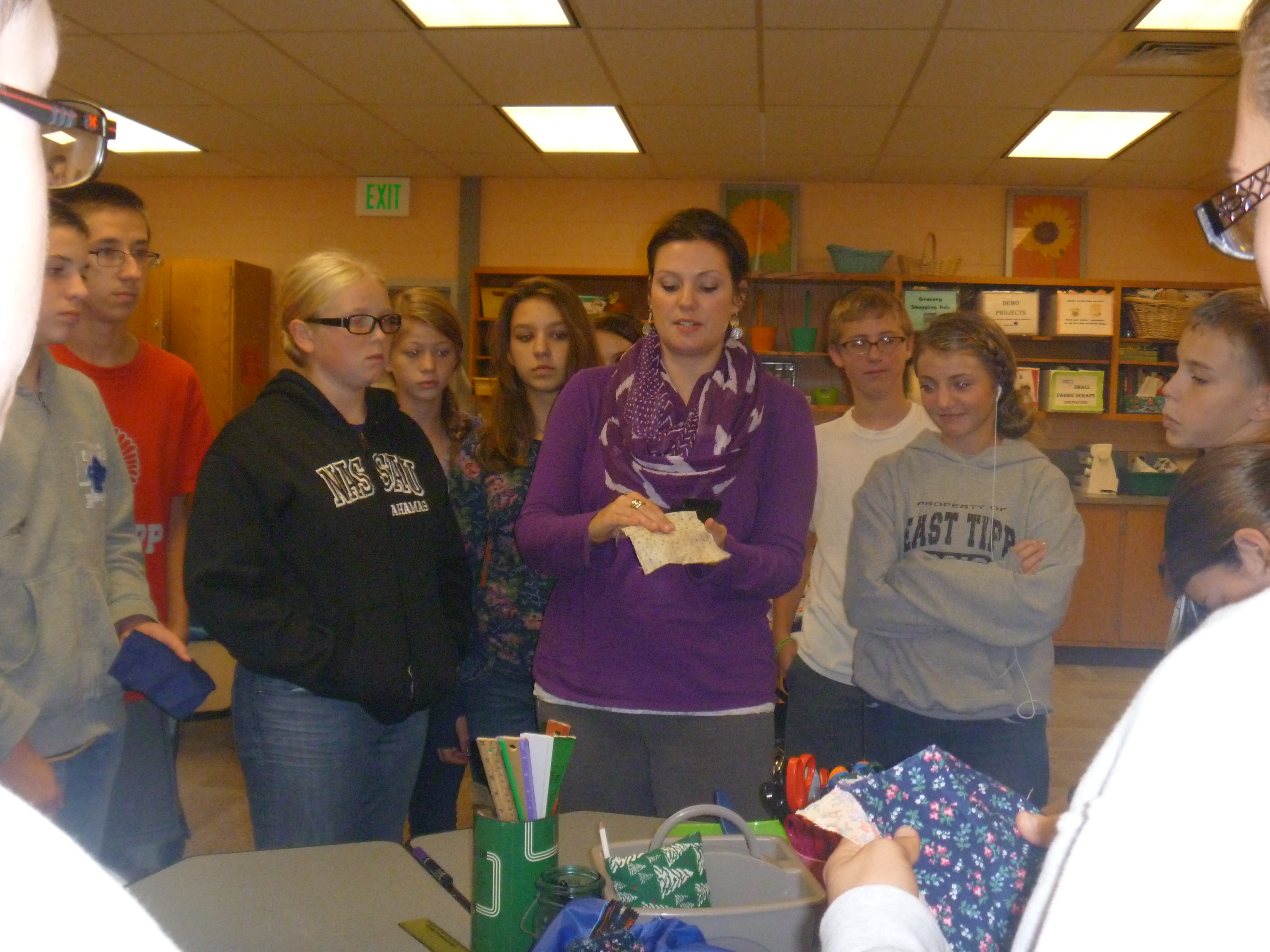
When I was in that FACS class yesterday, about a third of the way into the P1040019hour, when everyone had been issued their “license to sew,” the teacher conducted a quick demo.  The kids—orderly, quiet, attentive— clustered around her as she showed them the next steps in their first project, a pincushion.  She showed them how to pin two pieces of fabric together (“Right sides kissing!”), leave a hole, turn the item inside out and stuff it, starting with the corners. Then she released the students to the machines.

At one point, a student I was standing near asked me for help. Her bobbin thread was hopelessly tangled, but I didn’t know the machine, and besides, the rule was, ask a friend first.  So I suggested that and reiterated that if she P1040015didn’t understand, she should write her name on the HELP list. Another student overheard my response and stepped right up: “I can help you with that,” she said. Exit me.

Imagine some of the other things that could have been going on in this classroom:  At a table covered with fabric scraps (from which the students were to choose two pieces for the pincushion), no one was tussling over the fabric, pushing or shoving others, or throwing fabric wildly about. The scene was orderly—and  the teacher wasn’t standing nearby controlling this situation, either.  She was seated at another table where kids who finished could line up with their license and their project in hand. She P1040024measured their seams and checked off the steps on the license. All over the room, kids were working at their own pace, and everyone was engaged.

When the end of class grew near, the rest of this teacher’s clearly articulated and rehearsed expectations played out: Without reminders or fuss, the kids stowed their possessions, picked up the room and put all the equipment back where it belonged. They disposed of the fabric bits that had fallen to the floor and pushed their chairs in. Exit them.

A spectacular class: Specific skills were learned, character traits like self-reliance and independence were honored and nurtured, and the instruction the teacher provided and the procedures she had instituted allowed for students to progress at their own rate and take responsibility for their learning.  I’ve seen art teachers and music teachers and technology teachers do this same thing.  In any project-based learning scenario in any subject area, the procedures must be clear and the pacing has to be orchestrated to accommodate different kids progressing at different rates. The class must operate (forgive the pun) like a well-oiled machine.

This one did.

The Right Fit

One night this past week I awoke at 2 A.M. thinking about the Parts of Speech Notebook I produced when I was in the 7th grade. Sounds like a school kid’s nightmare. But it wasn’t—then or now. In fact, for me, it was quite the opposite.

The Parts of Speech Notebook was, naturally, eight pages long. Mine was bound in a green presentation folder with brass fasteners. Each page was labeled at the top—Noun, Pronoun, Verb, etc.—and illustrated with words and pictures cut from magazines and glued down with white library paste. Mine was messy and aesthetically unpleasing, I am sure (I was not a neat child), but no matter. The task served its purpose: Suddenly, unexpectedly, sitting cross-legged on my bedroom floor, sticky with paste and covered with the colorful confetti that cut-up magazines generate, I got it. Parts of speech, I mean.

What I remember is that electrifying moment of revelation when all the bits of information (not the paper) coalesced and the whole thing made sense. And then came the worry that my grasp on the topic would slip. Did I really understand? Could I rely on this new knowledge? Would the clarity continue? I remember reciting the definitions over and over again in my head. Yes! The mystery had evaporated!

Next day, I sprinted up the stairs to the second floor of my junior high school, raced through the classroom door with my finished notebook, and nearly knocked over my teacher, Mrs. Moeller, a rather stern individual who was, I thought, as old as Methuselah’s wife, demanding that she affirm my brilliance—and more importantly—share the excitement of my epiphany. I remember that she did.

Once I had the building blocks, the rest of it came easy—sentence patterns, clauses, phrases, verbals. I caught on quickly to diagramming—we did that in my day—and eventually I became an English teacher.

But this is not a story about a 7th grade assignment sparking my career—heaven knows, I had been on the path to becoming a teacher since I’d learned to read. Nor is it a story about how a single teacher sparked my love of English—no, I already loved English when I entered Mrs. Moeller’s class. Rather, it’s a story about a galvanizing moment in my education and how it happened and what I hope for, for every child in every classroom: Revelations that last.

I have been thinking a lot lately about differentiation, the term we use in the education world to describe the purposeful design of instruction to meet the varied needs of our diverse clientele. That is, the need to provide instruction that will help all kids have “notebook moments.”

No doubt some of the kids in my class understood the parts of speech just by reading about them in the textbook and identifying them in sentences. Some had luck with the “drill and kill” workbook that accompanied the text. For some, diagramming—that elaborate and either cherished or despised graphic organizer—did it. And for others, like me, it was the notebook. Today we’d label all that cutting and pasting a “hands-on” learning experience, designed for kids who are kinesthetic learners—the ones who can’t sit still, the ones who need to touch things and move them about, the ones who like to learn by doing.

I can’t begin to know if Mrs. Moeller was ahead of her time in realizing that not all children learn the same way. Did she know instinctively that children have learning preferences, ways of comprehending information that are as complex and various as children themselves?  Maybe she required the notebooks because she was tired of grading papers or maybe just because she thought they’d be “fun.” I rather doubt it was the latter, remembering Mrs. Moeller, but whatever her motivation or pedagogical reason, the notebook was the right fit for me.

As teachers, we’ve been schooled for a long time in the need to structure tasks that appeal to visual learners, auditory learners, and kinesthetic learners, but differentiating our instruction is so much more than that. These days we think about grouping strategies, about whether a child understands things that are laid out logically and sequentially or understands them in non-linear ways, about attention spans, about creativity and conformity, about reflective learners versus action-oriented kids. We think about multiple intelligences and ask ourselves if a student is analytical or verbal or musical or artistic. We even think about the learning environment we create in our classrooms and the impact our seating arrangement might have on our students. Round tables encourage collaboration, but not every child wants to work in groups. Rows represent order and calm—but they can stifle learning for very social students.

The task of the teacher is to know every child’s learning profile well—and then to capture each student at the point of readiness and offer content that challenges but is not too much of a stretch to be defeating. Of course, we have to interest students in the first place in the topic we are studying or the skill that we are teaching. An uninterested student won’t learn much and won’t carry the lesson beyond the classroom walls or past the perfunctory quiz on Friday.

Knowing the students, structuring the lesson and designing activities that appeal to all these variations is no mean feat. Sometimes we “mix it up” serially—something for the visual learner one day, something for the kinesthetic one the next. Other times we provide a number of activities simultaneously—through learning menus or learning stations—sometimes we group kids and sometimes we have them work alone. Computer programs offer variety—though they’re no silver bullet for learning—and so do games and art activities.

But it’s not just mixing it up for “fun,” and it’s not just mixing it up for variety. Differentiating instruction is about intentionally designing learning activities to offer all the kids in the class the chance to experience those “notebook moments.”

If Mrs. Moeller had only had us do workbook pages, I might never have learned the parts of speech. Oh, that’s not true. I would have learned them, but painfully, slowly, and without that wonderful moment of sudden clarity when everything fell into place. If she’d only done diagramming, three-quarters of the class would have been permanently lost in space and rolling their eyes to this day. But she didn’t. And even though the Parts of Speech Notebook sounds today like a pretty conventional assignment, it wasn’t conventional then and it wasn’t conventional for me. For me, it was the avenue to understanding.

Mrs. Moeller, you weren’t old at all. You were wise. More likely related to Solomon than Methuselah.

What’s in a Name?

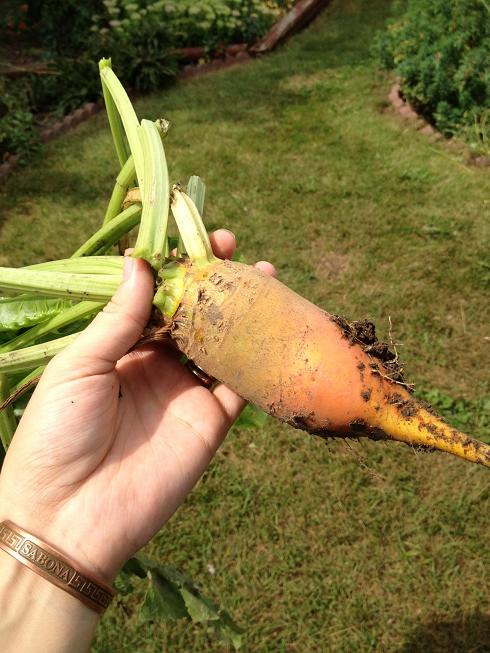
mangel-wurzels2The other day at lunch I asked a colleague who farms if she had ever raised mangel-wurzels. She started laughing, “No,” she said, “but what a name.”

What prompted the question is that a former student had sent me a few photographs of the mangel-wurzels in her garden. They’re ready to harvest, and back in the spring when she told me she’d included these ungainly root vegetables—beets, not turnips, usually fed to animals—I asked her to send pictures.

Mangel-wurzels—unforgettable in the silliness of their name–feature in the song Old Major teaches to the animals in Orwell’s classic allegory of the Russian Revolution and the subsequent years under Stalin, Animal Farm.

This story about overworked and underfed farm animals, who are inspired by Old Major’s words and brought to the point of delirium by the promise of a limitless bounty of “wheat and barley, oats and hay/Clover, beans, and mangel-wurzels” that will be theirs when Mr. Jones (“Tyrant Man”) is overthrown, is satirical. Many students need help recognizing that, even though Orwell writes that “it was a stirring tune, something between ‘Clementine’ and ‘La Cucaracha.’”

For the most part, middle schoolers, 9th graders, even Honors 9th graders haven’t been schooled in satire yet, but the mention of mangel-wurzels tips them off–especially after the whole class sings the song together from beginning to end. That’s what I used to do when I was teaching Animal Farm. Students were startled when I began a sprightly rendition of “Beasts of England,” belting it out to the tune of “Clementine.” I invited them to join in. Right away a few did, but most hesitated. I didn’t waver (even though I felt self-conscious, too) and eventually the others joined in for the sheer fun of it. In a good year, the singing became quite spirited—especially after the giggling started: which was when we got to the word mangel-wurzels.

That inspired and absurd song—its sprightly tempo, the mangel-wurzels, the “rings from our noses,” the “golden future time”—all of it—helps students recognize other points of satire in the first chapter. For example:

  • Mr. Jones, unsteady on his feet, drunk, tottering up to bed to his snoring wife
  • Old Major, a boar with a vision—and a pedigree (He was exhibited under the name Willingdon Beauty)
  • The various animals with their human traits
  • The cat voting on both sides of question “Are rats comrades?”
  • Old Major mentioning that when he was ”a little pig,” his mother used to sing to him
  • The animals readily learning the words to “Beasts of England” and singing the song five times straight before they awaken Mr. Jones

In the next chapter, after the Rebellion, the animals take Mr. Jones’ hams out of the farmhouse to give them a proper burial, and Molly, the white mare, prances and preens in front of a mirror, admiring her hair ribbons.

It’s just silly. And that’s the way that satire starts.

But Animal Farm doesn’t stay silly for long. Satire is not the same thing as parody. Because of those human characteristics—particularly those of Clover, the motherly cart-horse and Boxer, the long-suffering, devoted and steady work horse—the students identify with the animals and become invested in their struggle to make a success of the farm. But when Napoleon squirrels away the milk and apples and later when he tells the assembly that Snowball is a traitor, the students see his duplicity and share the animals’ befuddlement. When the sheep are murdered, the animals are horrified—and so are the students. When Boxer is taken to the knacker’s, the students are outraged—and hurt. They feel the betrayal, too—just as Orwell intended.

What’s in a name? Orwell choosing an absurdedly named root vegetable to represent the hope and promise of rebellion—the utopia of Old Major’s vision—is an early clue that Animal Farm is satire. Looking back from the end of the book, it’s also Orwell’s final word on the subject. In his view, the ideal is impossible. It is the nature of power to corrupt; eventually, the new leaders will morph into the old, again there will be masters and slaves.

Mankind can achieve and sustain egalitarian self-rule?

Nonsense!

Poppycock!

Mangel-wurzels!

An Education in the Russian Outdoors

Summer is here, and in the summer especially, I think again about the academic exchanges with a secondary school in Russia that I led some years ago.  I especially remember a hike I took one Sunday when my American students were all at their host families’ dachas for the day. Call this post an American teacher in an outdoor Russian classroom. I learned a lot–not just about history and biology and geography–but about relaxation, camaraderie, and low-tech, no-fuss trekking. Please, can I do it again?

My colleague Tatyana proposed that we go on a hike. “Let’s go to Izborsk,” she suggested. “We’ll have a picnic by the lake.”

Her friend Sasha, an aerobics instructor and part-time construction worker, volunteered to be our guide. Sasha hiked often with his two sons, and even though he and his family were leaving on vacation in just a few days, he welcomed the chance to take visiting Americans to the Russian countryside he knows well.

Besides, Sasha was thinking about conducting formal tours of the Izborsk region where we would hike. Here was a chance to try out the route with some visitors from afar.

The trip he had in mind would take us through conifer forests and along a glacial valley in the Izborsk region of the Russian province of Pskov. Putin had visited the fortress at Izborsk when he first was a candidate for President, and for three successive years, my students and I had also visited this historic site.The fortress was built in the 14th century and served as a defense post for the entire Pskov region. It overlooks the Valley of Snakes, a hilly, green terrain with sparkling streams and icy glacial lakes, a landscape that is much more inviting than its name would suggest.

Would we be able to do 15 kilometers in a day?

Of course! Didn’t I hike regularly in America? I most certainly didn’t want to miss this opportunity even though I hadn’t brought proper boots or moisture-wicking socks or thinsulate garb or any of the other specialized gear American hikers deem absolutely necessary for a trouble-free hike.

My friend Tatyana and my colleague Rahul were ready, too. Sasha said we would start at a point north of the fortress and walk towards it all day, stopping only for lunch. I envisioned 15 kilometers of “Davai!  Davai!” (Come on! Come on!) and Sasha at us with a whip so we’d reach Izborsk in time to catch the evening bus back to Pskov.

I was concerned about the amount of food Tatyana was packing. In my experience, packing light was important so that you didn’t wear out from the weight on your back. Tatyana put apples and strawberries, cookies and blue cheese on the kitchen counter, and then she produced a bottle of wine. She said that Sasha was bringing one, too. I was to make ham and cheese sandwiches. “Make four,” she said. “We’ll treat the others.”

No granola bars. No freeze-dried food. No attempt to minimize the weight or pack food that couldn’t be crushed. And wine on a trip like that?  We’d all be too loggy to move. But I made the sandwiches and contributed two chocolate bars to the pile and let it be.

Since neither Tatyana nor Sasha owned a car, we planned to take the bus towards Pechory, a small town on the Estonian border. We’d get off at one of the bus stops that appear, isolated and unexpected, all along the highways in Russia and then take off into the woods. It was a wet, gray morning, the day of our departure, and we waited and waited at the bus stop under Sasha’s dripping umbrella.

A taxi driver approached us and asked if we wanted to hire his services. We said we’d wait for the bus. A second taxi did the same. Four hundred rubles for 35 kilometers. That was only $3-$4 for each of us. No, we were waiting for the bus.

We stood in the drizzle for another twenty minutes until finally someone remembered the bus schedule was different on the weekends. There wouldn’t be a bus for another hour.

So that was how it was that we went by taxi to our wilderness hike.

Our driver flew down the pitted asphalt highway and eventually turned onto a sandy road. He dropped us at the edge of a pine forest in the middle of nowhere. If I’d been blindfolded and helicoptered in, I would have thought I was in the north woods of Wisconsin. Pine and spruce towered above me on all sides; lush mosses and sprawling ground cover blanketed every part of the forest floor.

We struck off into the forest on an old logging road. Sasha carried his umbrella inside a rolled-up pad that was about the size of a bedroll. I had no idea what the pad was for, but I stopped wondering when he began talking about what was around us—for example, Icelandic moss.  “It makes a good cure for pulmonary ailments,” he said, and told us he treats his own son’s asthma with it. He gave us the instructions for making a medicinal tea from the dry grey moss, and Rahul put a clump in his pack.

Sasha pointed out bottlebrush (the same ancient plant which we know in the American West as Mormon Tea), and remarked that it’s good for digestion.  A plant called Mother/Mother-in-Law whose broad leaves are cold and smooth on one side and warm and fuzzy on the other side is a coagulant and can be used to staunch bleeding. “It was used for bandages during the Great Patriotic War,” Sasha said.

Remnants of trenches and a bomb crater from that war, now thickly covered with moss, ran alongside the road we were traveling. Fighting had been heavy in the Pskov region as the Soviets tried to hold back the Germans on their march to Leningrad. Later in the day Sasha picked a piece of badly rusted barbed wire, an artifact from the war.

A mile or so into the walk, we came across a young couple, Misha and Natalia, sitting at a picnic table in front of an old farm building. They had made a summer cottage—a dacha—from an abandoned barn. One day they too were hiking in the woods and discovered this building, a two-story structure of limestone bricks on the first floor, and weathered logs on the second. They’d tracked down the owner, who said there had originally been seven buildings on this property, but the barn was all that was left of the farm. They welcomed us to go inside their house, and Rahul and I did. Downstairs, they’d created a cozy kitchen with a small table, cupboards and shelves, and a wood stove.  Colorful baskets hung from the rafters; a bicycle was stored in the corner. Upstairs, four short beds were positioned along the papered wall and there were even lace curtains at the windows. A long table in the middle served as a nightstand.

Tatyana and Sasha stayed outside and talked with the couple  while Rahul and I explored. When we rejoined them, Sasha was describing a kayaking adventure he was planning for July. Perhaps Misha would like to join? Misha had been fishing in nearby LakeMalski and showed us his catch, 4-5 fish in a net bag. They offered us tea, which we declined, but insisted we take some of the pickles Misha’s mother had made that were in a jar on the ground by the corner of the table.

The path from their house led to a wide stream, several feet deep, and a bridge that had been fashioned of skinned pine logs lashed together lengthwise. Fortunately, there was a rickety log handrail as well because the logs were slippery. We had to step sideways to avoid sliding off into the water. It was the toughest part of the trip so far, and it wasn’t so difficult that we didn’t stop to take pictures of ourselves standing on the bridge.

The trees around us began to change from conifers to deciduous varieties and soon we came to the edge of LakeMalski, and sunshine and shadow dappled the vista. An osprey lifted into the air as we drew near. My feet, already damp from the morning, were soon soaking wet from the marshy ground.

An apple tree about five feet high was growing along the path; one hundred yards farther, there was another one. Sasha speculated that they had grown from the seeds of apple cores that hikers had tossed aside. Rahul asked if they’d bear fruit, and that led to a discussion of grafting and then a demonstration, not on the apple trees, but on some other specimen of which there was an abundance.

Suddenly, at our feet was a small bird hopping along the path in front of us. A tit, we thought, who’d fallen from the nest or was making early attempts at flight. Rahul moved ahead of the bird, and it hopped forward right onto the top of his tennis shoe. We could hear the mother screaming at us from wood’s edge. The bird hopped into the grass, and we walked on, coming soon to our destined lunch spot.

Sasha immediately began a fire. As soon as it was going, he took a coffee can and a dozen small potatoes from his pack, positioned the potatoes in a pile in the fire, and put the coffee can over them. While they steamed, I explored the lake’s edge. I photographed wild iris among the tall reeds and watched white gulls swoop and dive and float on the water. When I came back to the fire, Sasha had snails and frogs to show me. The coloring on the frogs was different than North American species, but the behaviors were the same—they squirmed and jumped and mostly outmanuevered even Sasha.

The sun warmed us, a gentle breeze kept bugs away, and the sparkling blue of the lake matched the incongruous brilliant blue domes of an ancient monastery across the lake. It was a restful sight.

I collected wildflowers from the field for a bouquet for our “table” while Tatyana and Sasha and Rahul unrolled Sasha’s mysterious pad and laid out our lunch. From Sasha, steaming potatoes and fresh herbs from his dacha—parsley, green onions, and dill—served as the Russians do, as whole foods. Tatyana unpacked our fruit, blue cheese, sandwiches, and chocolate; and Rahul contributed leftover homemade pizza. On a side plate, the dill pickles from Misha and Natalia glistened in the sun, and in the center of everything were the two bottles of wine, one red and one white. I wondered how we could eat and drink it all, but we did—every bit—sitting on the ground, lingering over the wine and food, talking for at least an hour about the tourist industry in Russia and whether people would come to Russia for expeditions like this one today.

“People would pay,” I remarked, “for a day like this.”

While we ate, my shoes and socks dried. Sasha had hung the shoes on stakes rammed into the ground at the fire’s edge, and the socks were ingeniously pinned on sticks like marshmallows and roasted over the fire.

The wine, of course, made us sleepy, so before we left, I shamelessly napped while Sasha went for a swim. We left Tatyana and Rahul to pick up from the picnic. Then we doused the fire, left more firewood stacked for the next hikers, and resumed our walk toward Izborsk.

We climbed us the high glacial hill above the camp site and walked for some time along the ridge overlooking the long, narrow lake. Then we descended again and walked through fields on a rutted road that once had served now abandoned farms. The fields waved with waist high grasses, the scene interrupted by occasional clumps of wild strawberry and wild rose.

We passed through a tiny old village whose weathered wooden houses and broken barns slumped in the afternoon sun.  Few people were about, but lace curtains at windows and vegetables growing in gardens provided evidence that this cluster of buildings, surely at least 100 years old, had occupants. In fact, the probable denizens passed us a half hour later, tired people, men and women, walking toward homeward from Izborsk with their arms full.

We had taken a 20-minute break by the side of a stream just off the path. An old mill had once stood there; Tatyana washed her face in the clear water that tumbled down over the rocks in the stream and those that remained of the mill’s foundation.  Trash littered this wayside, so we built another fire and burned the candy wrappers and plastic bags. Someone had dug a pit for empty water bottles, and we threw those we found into the pit.

The fortress of Izborsk loomed on the horizon. It must have been intimidating to approaching armies, this high stone wall studded with towers and turrets with their keyhole openings. It’s imposing even today. We walked past the church overlooking the SnakeValley, past the cemetery behind it, and past the waterfalls of Izborsk that superstition says offer wealth, or health, or beauty to those who drink the waters. We walked into the fortress itself and then away from it, away from the roadside restaurant where Putin dined, away from the babushkas selling their woolen socks, woven baskets, and ceramic plates, and through the village of Izborsk.

It was as if we’d been transported to another century. A horse-drawn cart carrying villagers from one spot to another came up behind us and passed us on the lane. On one side of the cart, a shapeless old woman in a dusty dress was perched, her legs, in woolen stockings though this was June, hung over the side. A man on the other side of the cart was her mirror image. We passed a backyard chicken coop and fed leftover bread from the picnic to the rooster and his bevy of hens. The wooden houses all had gardens attached; an old woman in a scarf and heavy sweater sat on a stool outside one house, scrubbing vegetables. In another front yard, another woman, bundled up in a scarf and jacket as older Russian women keep themselves, sat straight on a bench, her feet firmly on the ground, conversing with a younger woman, not so heavily clothed. In villages throughout Russia, life goes on this way, in sharp contrast to city life where tall slim girls in form-fitting clothes stride down the sidewalks in stiletto heels and men assertively drive cars, smoke cigarettes, and talk incessantly on cell phones.

We were pleasantly tired when we boarded the bus for Pskov. Rahul summed up the experience of the day: “A picnic you have to get to,” he called it.

Sasha’s dreams of becoming an expedition guide didn’t seem far-fetched.

“Yes, people would pay,” I told him again. “People would pay for a day like we just spent. A little history, a little biology, a glimpse of life a century ago, and just enough exertion to feel good.”

A picnic you have to get to, but an experience you’d never forget.

A Six-Box Year

The principal at the middle school where I spent yesterday morning brought donuts for his 35 teachers to mark the approaching end to the school year.

The size of the donut array took me by surprise. Apparently, the teacher standing beside me was surprised, too.

“It’s a six-box day!” she exclaimed.

A celebration!

For teachers, the end of the year brings celebration, but it brings emotional overload, too.

There are the usual worries over final exams, the routine but nonetheless draining dismantling of classrooms, the extra stress of tying up myriad loose ends, and lots of anxiety about the first year of the new evaluation system we’ve all been through.

There’s the excitement of culminating projects—the videos, the newscasts, the high-spirited presentations in front of the class–and celebrations, like the ice cream sundae fest that I just witnessed in the school library for the kids who read 20 books in a semester.  Awards ceremonies,  talent shows,  and field days, even—in one school I visit—a field trip after school is over!

There’s saying goodbye to students whom teachers have come to love—or even just learned to tolerate—and that brings another emotional reality.  In a way, teachers are preparing for the grief they’ll feel when school is over, even if they’ve never thought of the inevitable letdown as being a kind of loss.

Many of them pause in this busy time, though, to ask me how this year has gone, whether I have enjoyed my work as an instructional coach, whether I miss the kids.

Did I feel productive? Of course.

Was the work satisfying? Yes.

Did I miss the kids? Certainly.

Especially in the beginning and particularly when I was at “my own” high school and would see the kids I’d had in class just the year before.

In August and September, a lot of shrieking and embracing went on when we’d run into each other in the halls. For them, it was like I’d come back from the dead. They hadn’t expected to see me again, so when they did, the remembrance of all we’d shared would take them by surprise. I’d fly high on those days–but I would bring myself down to earth pretty quickly by remembering that were I at the front of the classroom still, all those displays of affection would not be happening.

And increasingly, as the days went by, my delights rested on the victories of the teachers whose professional lives I touched even lightly as well as those I coached intensely.

A first year industrial tech teacher who felt awkward at the beginning of the year is moving with confidence in her classroom today. The other day she even videotaped the class while they tested the strength and durability of bridges made with cardboard, styrofoam, tongue depressors, and fiberglass. The students were in teams, eager, excited and energized by the competition.

A social studies teacher who’s been struggling all year to marry a set of academic standards that honor recall of a thousand facts with the Common Core emphasis on big ideas and essential concepts has found a path forward.

A special education teacher whose students wrote whole sentences, not fragments; pages, not paragraphs beamed ear-to-ear with them as she returned their papers and complimented them on what they’ve done well.

A world language teacher whose dialogue journals are proof positive that students have increased their vocabulary and their ability to write in Spanish directed her students to look back at their entries from the beginning of the year. What they saw is what they hadn’t realized: their skills had crept up on them.

An English teacher with whom I co-taught a strategy for reading poetry reported that when her students encountered the poem on the standardized state test, they used the new blocking ruler to read the poem line-by-line and reported it was easy!

A science teacher discovered a penchant for etymology–for telling stories about word origins—to help his students learn vocabulary. He plans to spend the summer preparing more lessons about word origins to help his students learn the roots and prefixes that are the building blocks of scientific terminology.

A 7th grade math teacher, after my work in her school on vocabulary acquisition now directs her kids to look at words in a whole new way—quartiles, she told me, for example, made sense to her kids when they made the connection with quarts and quarters and quarterly.

A chemistry teacher developed a modification of the Frayer model—a strategy for teaching vocabulary—and told me her students’ vocabulary scores went up!

Collaborative successes—like the World Food Prize endeavor—have brought utter exhilaration, and I’ve drawn satisfaction from departments that have begun work on curriculum articulation, K-12. Vertical teams have formed in middle schools and horizontal ones in high school disciplines. I’ve had a hand in those endeavors and that’s been cool, too.

How do I measure success at the end of the year? Is it in the number of professional development presentations I made to whole faculties? Is it in the number of team meetings I facilitated? Or the number of individual conferences and observations I conducted? Is it in professional development conferences I attended and learned from myself or the quantity of professional books I read? Is it in the curriculum documents that teams of teachers produced? The web site I created?

The numbers don’t lie; the documents that have been produced, the charts and calendars I’ve kept, the book reviews I’ve written, the photographs I’ve taken are all concrete evidence of productivity. They’re pleasing to look at—but it’s the cumulative impact of teachers’ victories, whether large or small, that makes me smile, that brings me satisfaction and delight.

Tomorrow is the last day of school in my district. I’ll be at “my” high school tomorrow, and I’ll be giving a lot of high-fives, I know. But it’s their current teachers the students will be hugging hard.

I’ll miss that.

I’ll be proud of the kids, for sure, but it’s their teachers’ joy I’ll feel tomorrow.

Anybody asks me now how I’ve liked my job as an instructional coach and I’ll have to say, “It’s been a six-box year!”

A Song for Every Child

Two sisters, just beginning their singing career.

Three hundred secondary school students, just beginning to fulfill their dreams of an education.

The sisters live in a small town in North Dakota. The 300 live in Rwanda and Burundi, the smallest countries in Africa.

A pair of amazing teachers and a dedicated mother-daughter team marshaled the energies and the enthusiasm of students at Horizon Middle School in Bismarck, North Dakota, to bring the two sisters and the three hundred students together.

Here’s what happened in Bismarck on April 19. image Tigirlily

The two sisters—Kendra and Krista Slaubaugh—sing together under the name Tigirlily. They have a Facebook page, a YouTube following, and a burgeoning repertoire.  The Bismarck Tribune carried a feature story about the girls and their music ambitions, and that sparked an idea for middle school teacher Fran Joersz.

For six years, Fran and her colleague Peggy Hoge, both Communications teachers, have mobilized students at Horizon Middle School to raise money for Every Child is My Child, a non-profit organization that provides secondary school scholarships to children in Rwanda and Burundi.  The Horizon students have made pencil cases, jewelry, and tie-dye t-shirts—but this year they went big. They engaged Kendra and Krista in their mission and, together, staged a benefit for Every Child is My Child.

Tickets were $10 each. The Horizon Huskie Singers—the school’s show choir—opened the show, and Tigirlily performed solo renditions and musical duets for an hour and a half on the middle school stage.

Internal publicity was handled by two of the Horizon students, Halle Schereck and Taylor Pederson, who have worked on raising money for Every Child scholarships for three years now. These two 9th graders created a PowerPoint presentation about the Every Child scholars in Rwanda and Burundi and showed it to fellow students throughout the school.  The message the girls delivered to their peers was simple: You can make a difference in a child’s life by giving the gift of education.

Artist Michelle Lindblom-Eggert (http://www.mick-art.com) and her daughter, McKenzie, designed both the tickets for the concert and the posters that students hung in the school and throughout the community.  McKenzie also served as the official photographer for the event.  When McKenzie was in middle school, Michelle spearheaded the tie-dye t-shirt project, and the mother-daughter team has remained dedicated to the Every Child mission ever since.

Ticket sales to parents of the choir members were brisk—parents always want to see their children perform.  That the proceeds went for a good cause only increased the buy-in.

On the night of the performance, people flooded the school auditorium to listen first to the show choir and then to the lilting harmonies of the two sisters. When the concert was over, middle schoolers clustered excitedly around the two performers, who are only a few years older than they are, eager to pose for pictures with the duo and to take home autographed Tigirlily t-shirts. In the end, Horizon Middle School raised over $2000: enough to split with Tigirlily and still send 10 students to school for another year.

So what does it take to give the gift of education?  A brilliant idea, a few dedicated adults, the energy of youth, and music—sweet, sweet music.

To learn more about Every Child is My Child, visit these sites:

https://www.facebook.com/EveryChildisMyChild

http://www.youtube.com/watch?v=jeAW9IKHJok

Winners All

Norman Borlaug: not exactly a household name. But it should be. The father of the Green Revolution, Norman Borlaug has “saved more lives than any other person who has ever lived.” That’s not hyperbole, that quote from the Atlantic Monthly.

He was awarded the Nobel Prize in 1970 for his work in developing disease-resistant varieties of wheat, a breakthrough development that he pioneered in Mexico, and replicated in India and Pakistan, expanding the technology to rice and saving millions of lives in the process.

In 1986, he established the World Food Prize to recognize individuals in the field of agriculture whose advancements in science have had a significant impact on the elimination of world hunger.

Later still, in 1994, Norman Borlaug established the World Food Prize Youth Institute, a competition in which high school students study food security issues in countries around the world. After months of research and essay writing, students submit their essays and then present their work orally at regional competitions. The winners there attend the World Food Prize Institute in Des Moines, Iowa, where they interact with some of the most prestigious scientists in the world, learning more about solutions to world hunger and exchanging ideas with these leaders in the field.

We—my high school and my coaching colleague and I—are sending students to Iowa in October: one who ranks among the top five participants in our region and an alternate! Actually, we have a third student who has “advanced,” but she’s a senior this year and therefore can’t compete next fall.

If you read my post “Second Skin,” you know there was one boy who needed help with his citations: He’s our alternate—and he probably will attend. How gratifying is that for the two hours we spent sitting across from each other at a table, whipping those citations into shape???

This past April 4th and 5th, students from the competing schools in Indiana gathered at Purdue (with their coaches) to present their work, exchange ideas, and learn about food science at Purdue. On Thursday evening, the students presented their research findings to panels of experts—Purdue professors from various departments whose own research endeavors concern issues of world hunger. The professors had read all of the students’ research papers—carefully, as we soon discovered—and then queried the students about their research. In small groups and in front of their peers, the students defended their research and their solutions by answering the questions posed by these experts.

This was nothing like the comfortable audience of peers students face in their English or speech classes. The professors were certainly respectful—even friendly—but there was a formality to the setting that high school students rarely experience. The professors posed tough questions and pulled no punches in their questioning. In one case, a professor told a student her statistics were faulty. No gentle suggestion that she “might want to check her facts” as high school teachers sometimes gingerly write in the margins of an ill-researched paper. Nope. “Your statistics are wrong.” Flat out.

You could almost hear the students gasp.

But this is the big leagues. Facts must be right, and when they aren’t, a student needs to know.

After the oral presentations, which we discovered later weighed heavily in the selection of finalists, the students reflected on the process of writing, researching, and presenting their work and conversed with the experts who had questioned them. They gained insight into the way that scientists think, advice on how they could help people in the developing world—even what courses to take in college to combine their specific academic interests and the urge to help globally. One of our students—who wants to go into an engineering field—was told to “look for opportunities to collaborate” with other departments. The opportunities abound, a professor told her, to make a global impact through engineering—for example, in developing relatively simple agricultural tools. He explained that shovels, for example, are designed with adult males in mind–but in some countries, it is women and children who are the chief agriculturalists.

Because of my responsibilities in other schools, I could not attend the day on campus that followed on Friday, but my colleague was there with our five students. She told me that they were welcomed at breakfast by Dr. Jay Akridge, Dean of the College of Agriculture.  He applauded the research efforts of all of the participants and, more importantly, validated their selflessness in, at such a young age, wanting to make a difference in the world.  During the rest of the morning, the students were introduced to classes and majors at Purdue that would allow them to pursue their area of interest further.

At lunch in the Purdue Memorial Union, the students listened to two Purdue World Food Prize winners, Phil Nelson (2007) and Gabeisa Eijeta (2009).  Both men spoke of their research and explained that by first identifying a need, they had been able to discover or invent a solution that had made a difference for people in many poverty-stricken nations.

In the afternoon, the high school students attended sessions in agronomy, biochemistry, agriculture and biological engineering and food science.  Each of these sessions involved a hands-on experience.  For example, in a visit to the Biochemistry Department, the students loaded and ran an electrophoretic gel to identify a fictitious bacteria found in “homemade” yogurt.  In the Agronomy Department, a researcher led the students through a demonstration of some basics of soil chemistry and explained how different soil types affect product growth.

On Friday afternoon, students received written feedback on their research papers and had an opportunity to reflect again on the World Food Prize experience from start to finish. I was there for the wrap-up and was able to listen to the students articulate their take-aways from the World Food Prize experience. In general, students remarked that they had not only benefitted personally from the experience, but that they had been inspired because they had participated in a project “bigger than themselves.” Many said their eyes had been opened, their lives changed.

A week later, the results were announced. That is when we learned that several of our five students would advance. But the fact is, we have five winners. For all of these students, the prize is not the public recognition of their accomplishment, not the resume item or the activity they can list on their college applications, but the insight they have gained, the perseverance they have practiced, the skills they have mastered. Their hearts have been touched by the depth of their exposure to issues of poverty and hunger and their minds have been expanded beyond what they could have imagined when they first began their research.

Norman Borlaug intended to enter the field of forestry. In fact, he had a job lined up with the US Forest Service after graduation from college. However, tight money during the Depression delayed his start by six months. While he waited, Borlaug decided to stay on at the University of Minnesota and take some more classes. One day, quite by chance, he attended a lecture on plant pathology that changed the direction of his life. He decided not to take that job with the Forest Service and, instead, entered the Ph.D. program in plant pathology. The rest, as they say, is history.

Our students took a chance on a competition that was time-consuming and intellectually demanding, on a writing project that wasn’t easy, on an endeavor for which every reward has been intrinsic—not an easy sell for sixteen- and seventeen-year-olds.  But look what has happened. Is it possible, just possible, that in signing on for the World Food Prize competition, by studying the topic and factor that they did, they have found direction for their life work?

Every night, one in seven people in the world goes to bed hungry. It is possible that one of these amazing students will someday make a discovery that changes those odds?  Imagine. It could happen.