Candy in My Mouth

April is National Poetry Month, so it was a perfect time for my colleague (a middle school English Language Arts teacher) and I to plan and present a lesson on how to read a poem. I’d been talking about one of my favorite methods for unraveling meaning in poetry, and she invited me to demonstrate for her 6th graders.

Offer me a chance to teach?  It’s like giving me candy.

I selected three poems, two from the textbook, and a charming one I remembered from a  long time ago, Eve Merriam’s lovely invitation to enjoy poetry, “How to Eat a Poem”:

Don’t be polite.
Bite in.
Pick it up with your fingers and lick the juice that
may run down your chin.
It is ready and ripe now, whenever you are.

You do not need a knife or fork or spoon
or plate or napkin or tablecloth.

For there is no core
or stem
or rind
or pit
or seed
or skin
to throw away.

I have always loved this sweet, delicious comparison between a poem and a piece of fruit—especially juicy fruits, like peaches and pears and watermelon, where the deliciousness runs like a river, all down your front. The poem seemed like a great hook.

The second poem I chose was from the text: Gary Soto’s “Ode to Family Photographs.” Soto’s poem is a list of images—descriptions of bad family photos—images gone awry because the photographer was no good with a camera.

This is the pond, and these are my feet. 
This is the rooster, and this is more of my feet. 

Mama was never good at pictures.

This is a statue of a famous general who lost an arm, 
And this is me with my head cut off. 

This is a trash can chained to a gate, 
This is my father with his eyes half-closed. 

This is a photograph of my sister 
And a giraffe looking over her shoulder. 

This is our car’s front bumper. 
This is a bird with a pretzel in its beak. 
This is my brother Pedro standing on one leg on a rock, 
With a smear of chocolate on his face. 

Mama sneezed when she looked
Behind the camera: the snapshots are blurry,
The angles dizzy as a spin on a merry-go-round.

But we had fun when Mama picked up the camera. 
How can I tell? 
Each of us is laughing hard. 
Can you see? I have candy in my mouth.

I expected opportunities to talk about the individual pictures; to notice the two switches to italics (not italics, here) whenever the narrator stops to explain about Mama; to look at the possible meanings of that last line, candy in my mouth; to examine the writer’s tone—nostalgic about those family moments, kind—even amused—in his assessment of Mama.

The third poem was Emily Dickinson’s 4-line nugget, “Fame is a Bee,” all about the allure of fame, its glamour, its backlash, its transitory nature. Perfect for kids in thrall to performers on American Idol.

Fame is a bee.
It has a song–
It has a sting–
Ah, too, it has a wing.

As I planned it, we’d do the Merriam poem first, then the Dickinson one, and end with Soto. I’d lead the students to learn and use the words ode, stanza, image, voice, metaphor, and tone. The objective—beyond making the terms a part of their working vocabulary—was to show them a method they could use on their own to figure out the meaning of a poem. What I wanted above all was to excite the students about poetry. I planned to leave them at the end with a little present—a personal poetry reader for each child—a bright yellow card decorated with a fruit sticker and the words, “Bite in!” A reminder of Merriam’s poem; a reminder of our class period together.

My sequencing of the lesson would have been good—it would have worked—but when I met with my colleague to fine tune the lesson, “good” turned into “outstanding.” That’s the beauty of instructional coaching—two heads are better than one. I knew the strategy and I picked the poems, but she had the genius to put it all together in a way that would capture the kids.

When we started talking about the lesson, we knew we’d need a hook. My colleague had just the idea. She loves games. In fact, her classroom is decorated with boxes of games, game boards, game pieces. And she had a wonderful one she had grabbed at a garage sale: Awkward Family Photographs, a collection of perfectly awful family pictures. Her idea was to have a handful of cards on each table when the kids came in. We’d let them look at the photos for a few minutes, talk about why they were funny or scary or stupid, and then launch into the Soto poem. P1020407

So that’s what we did on the appointed day. She set up the hook and after a few minutes of laughing together at the pictures, I read the Soto poem aloud. The kids followed along.

“I don’t get it,” Daniel said flat out at the end. We loved that. It was the perfect entrée to the slow reveal.

I moved to the interactive whiteboard, the centerpiece of the strategy. The “screen block” tool would cover the poem and I would expose one line at a time, asking questions of the students to show them how the poet constructed meaning, line by line by line.

And the technology failed. It had worked in the morning before class. What had happened?  No time to twist our hands, throw them up in despair. Gamely, we went on, directing the students to look at each line of the poem in turn until we reached the end.

Of course, because of the Awkward Family Photographs, the kids caught on to the images immediately. That meant a lot of fun conversation about what was happening when Mama snapped the picture—what she intended to capture with her camera and what she actually got. Favorite line? This is me with my head cut off.

“How could he take a picture of himself with his head cut off?”

“But remember the line, Mama was never good at pictures?

“What new piece of information did you get there?”

“Oh! Mama’s taking the pictures!

We lingered on the stanzas about Mama. “How does he feel about his mama?” I asked at the end of the second one. “What’s his tone when he talks about her?”

“He isn’t mad at her!”

“He thinks she’s funny. He says, Each of us is laughing hard.”

One girl said, “It’s kind of like when people say, ‘You gotta love her!’ when they mean a person drives them crazy but they love her anyway.”

And what’s this last line: I have candy in my mouth?

Silence.

Think metaphor, kids.  Poets and words…children and candy.  All sweet.

“The experiences were sweet and he’s writing about them.”

“Uh-huh. We call that ‘nostalgia,’ when you look back on something and remember it so fondly.”

“He enjoyed those times.”

“Maybe it’s just candy in my mouth.”

“Either way.”

We looked at “Fame is a Bee” next.   The poem seems so obvious that I was surprised the kids were puzzled when I read it through. But they remembered the word metaphor, could tell me it was a comparison, so I called on them to brainstorm the pros and cons of fame.

“Money!”

“Limosines!”

“Mansions!”

“Paparazzi!”

“No privacy!”

“Stuff on the Internet.”

“And what if you don’t make it on American Idol?”

“People forget you.”

And then we started brainstorming the attributes of a bee: the buzz, the sting, the pollination—good for the flowers—honey…and…

“I got it!” Clayton shouted out before we even finished. And line by line, he explained the connection. He was popping up and down in his seat he was so excited.

Alyssa, the thinker: “But you know, wings can carry you anywhere. The wing doesn’t have to mean ‘forgotten.’ It could mean carrying you to another place…”

I love an independent thinker.

Finally, “How to Eat a Poem.”

An implied metaphor, we said, when they saw there was no “one thing is another” as a metaphor lays it out.

One boy was sure the juice was from a cheeseburger, but the unraveling strategy worked like it should when someone else pointed out ripe. “Cheeseburgers aren’t ripe.”

“And ready when you are! It’s always there, just waiting for you.”

“It’s definitely not a cheeseburger. Cheeseburgers don’t have pits or seeds or stems!”

“But the poem isn’t like a fruit because there’s nothing to throw away.”

Not a word or a punctuation mark or a break in the page to spare. Yep, they got it.

My colleague and I had a ball. I did the lesson myself the first time through, but with the next class, she was asking the kids questions, too. The third time around, even more so. The technology never did work. No matter. She did the next two presentations solo (I was somewhere else in the building), but for the last period (she has six classes and 170 kids!), by which time I had returned, we decided to function as a tag team. By then we had expanded the lesson so much that we only got through two of the poems! That was okay. She would do the third the next day. The students would be reading more poetry, using their texts and the poetry readers I’d made for them. P1030329

“I wish we could always be two heads on a lesson,” she said. “What’s our district thinking, not hiring two teachers per room?”

What are they thinking, indeed?  That’s what coaching is all about.

It was sweet all day.
The Gift of Hope

Last week I wrote about Amani, a Rwandan girl who wants to become a doctor. She is on the way to fulfilling her dream because Every Child is My Child, a non-profit organization that funds secondary school scholarships for students in Rwanda and Burundi, is sending her to high school. I said in last week’s post (“Educating Every Child”) that I would write this week about what my students here in Indiana have done to raise money for Every Child so that Amani and children like her can go to secondary school.

If you haven’t read last week’s post, here’s the short version of the need: In rural Rwanda, the scene of genocide in 1994, families in poor communities struggle to educate their children. For most of the children, secondary education (grades 7-12) is out of the question because the school fees are too steep. In Burundi, the scene of a terrible civil war in 1994, the circumstances are as dire if not worse. Secondary school students in these countries need to pay tuition to attend boarding schools. They must buy uniforms, purchase books, and bring their own mattresses with them to their distant schools. A year of secondary school in Rwanda is about $300—a small amount compared to the cost of education in America. In Burundi, a year of secondary school is only $100. Every Child is My Child promises a high school education to the 6th graders in their partner schools if they study hard and pass the entrance exams—and the children are eager to learn.

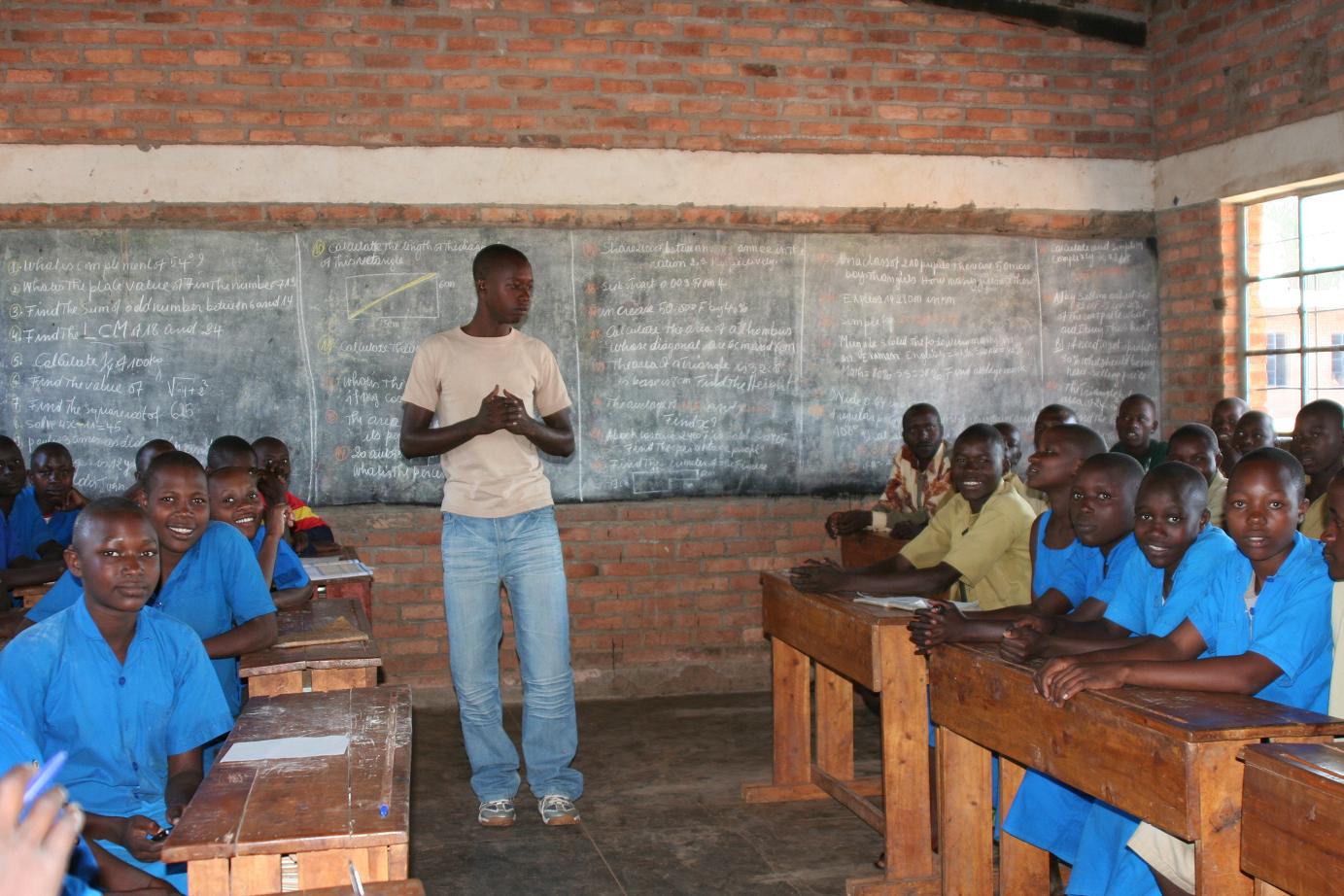
sm Ngenda schoolroomIn the elementary classrooms in Rwanda—which I have visited—there are no posters on the walls, no books, and few visual aids —just a teacher, a blackboard, copy books and pencils. The students write everything they hear from their teachers and everything they see on the board in their copy books—and they study what they have written.  Against all odds, they are on grade level with 6th graders in the United States.  And they are hungry to learn more.

Two years ago, my students made posters—alphabet art—for the walls of these primary schools. Last year they made flags.

But the most important gift my students have given to the children of Rwanda and Burundi is the gift of a high school education: Each year they have raised a substantial amount of money for scholarships for children like Amani.

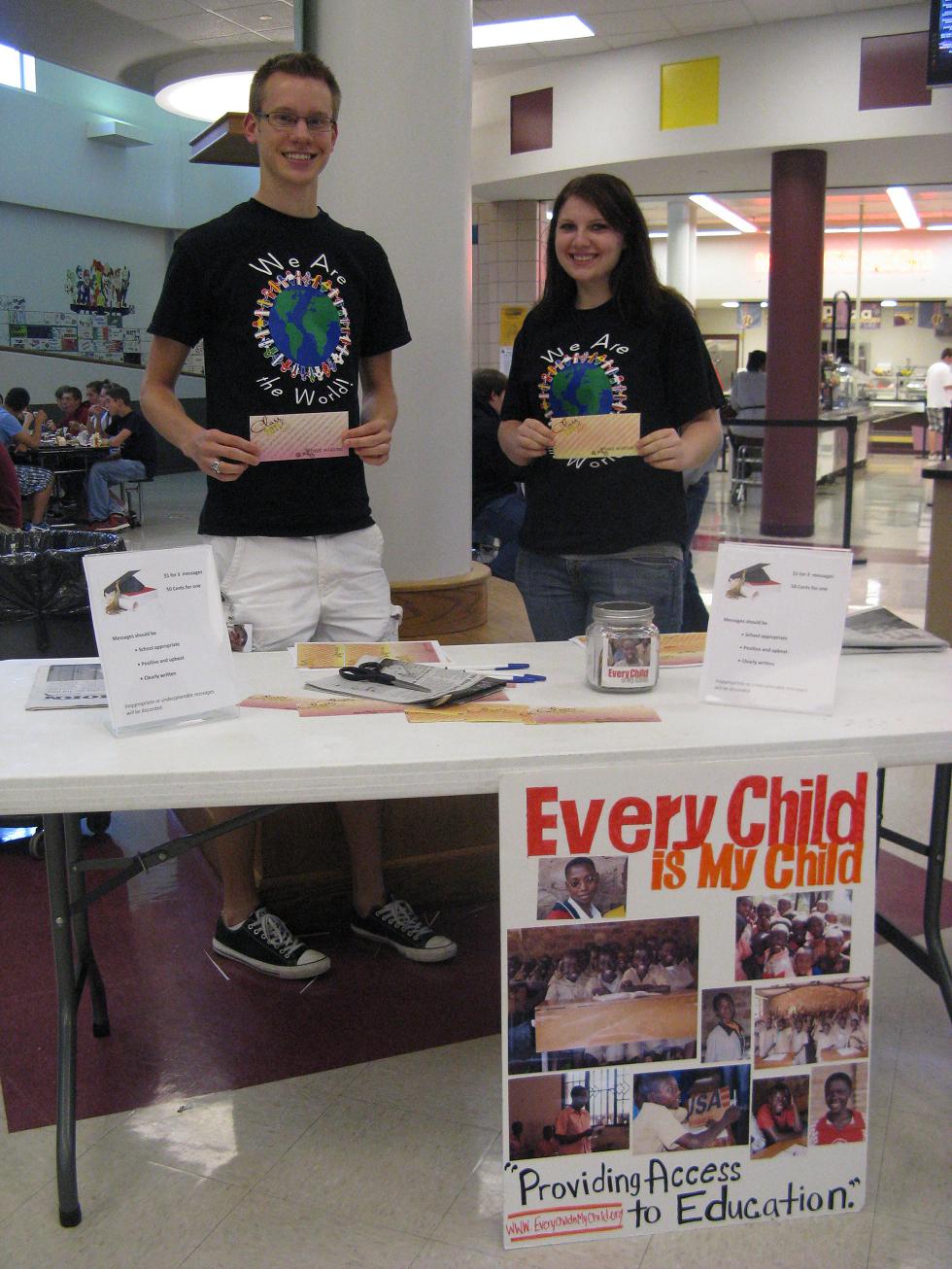
sm Senior Send-offsMy students have worked the concessions at football and basketball games. They have sold garbage bags to adults and “candygrams” (lollipops with a note attached are delivered to fellow students in their classes just before holidays) to their peers. At the end of the school year, they have served as scribes and couriers, delivering last minute “Farewell and Congratulations!” notes from underclassmen to graduating seniors. They have conducted fund drives by selling snacks in the cafeteria at lunch.

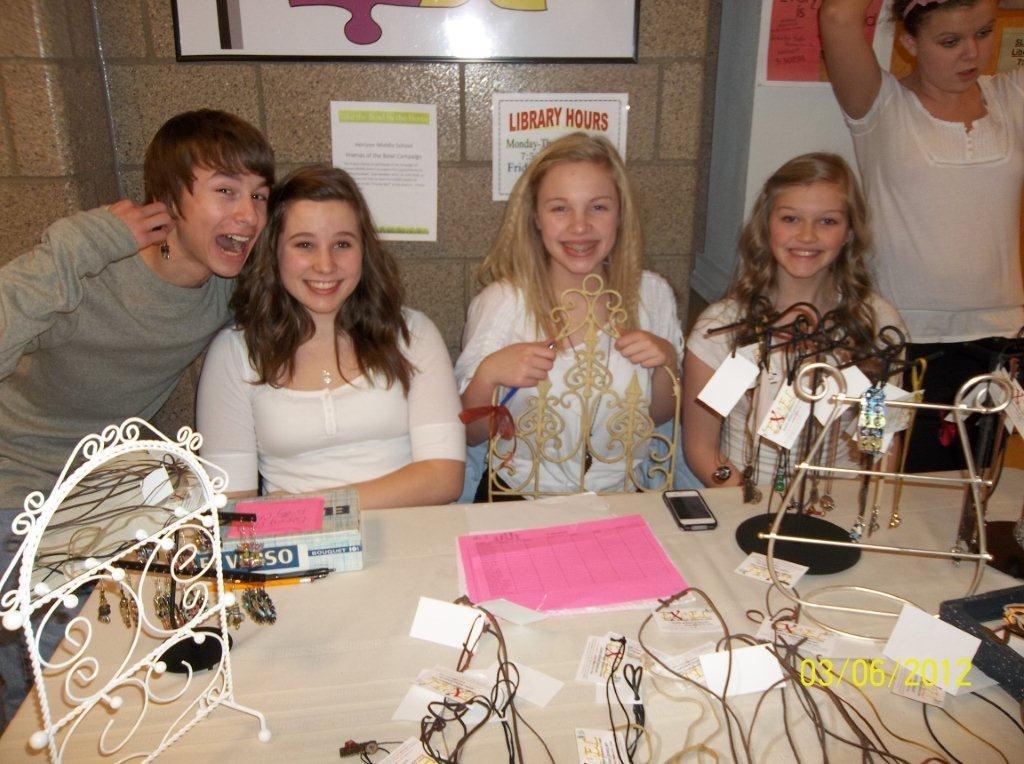
They are not alone in their devotion to the Every Child scholars. In Bismarck, 4 kids jewelryNorth Dakota, students at Horizon Middle School–with the help of two dedicated teachers and a parent volunteer–are also raising money for Every Child. For several years, these middle schoolers sold tie-dyed t-shirts  and socks to their peers and to community members. They created pencil packs out of duct tape and supplied just about everyone in their middle school with these colorful carrying cases. Now they are selling handmade jewelry–bracelets, necklaces, earrings–and sending the proceeds to Every Child.

These American teenagers are making a difference in the lives of children in Africa by helping them achieve what is taken for granted in our country: a high school education.  The money they raise is a gift of hope for a better life for the children there and a better world for all of us.

If you are a teacher and have an idea for an Every Child service project you’d like to do with your students, I’d be glad to talk particulars with you. Just contact me by responding in the comment section to this blog. Consider changing the world with us.

To learn more about Every Child is My Child, visit these sites:

https://www.facebook.com/EveryChildisMyChild

http://www.youtube.com/watch?v=jeAW9IKHJok

Educating Every Child

I’m going to depart from my usual format and include some pictures in this post. I want you to see Amani. She wants to be a doctor when she grows up.

sm AmaniHer ambition is not unusual—at least it wouldn’t be for American girl. What is unusual is that Amani is enrolled in high school in the tiny African country of Rwanda—and she’s well on the way to achieving her dream.

In Rwanda, it’s unusual for children to be in high school at all. In this tiny country in west central Africa, elementary education (grades 1-6) is mandated; in fact, 98% of the boys and 96% of the girls attend village elementary schools. But that’s where education ends for most.

The reason is money: A year of secondary school costs at least $300.

In a country where, according to the World Bank figures for 2011, the per capita GDP averages $570 a year, sending your child to secondary school—and you may have three, four, five, six children—is impossible. Amani is lucky: She attended a elementary school that partners with Every Child is My Child, an American non-profit that provides scholarships for any child in the school who passes the national exam to qualify for secondary school.

Every Child is My Child has been partnering with Nyacyonga, Amani’s village school, for five years. Children at Nyacyonga have a reason now to stay in school and study hard: Secondary school has become a possibility.

In sheer economic terms, attending secondary is meaningful because, again according to the World Bank, every additional year of school means a 10% increase in earning power. Amani is a junior, so she’s already added 50% to her potential as a wage earner. In human terms, think what an education means for her: She will have choices about the path she follows in life.

Think what Amani can do for her country.

Rwanda is not only the smallest country in Africa; it is the most densely populated. Most people in the rural areas are subsistence farmers, growing bananas and sorghum and coffee. In fact, Rwanda’s chief export is coffee, but the country is so small it can’t compete globally with Kenya, Ethiopia, Tanzania—much larger countries with far larger harvests.

Rwanda has one major tourist attraction: the endangered mountain gorillas made famous in a film about Dian Fossey’s life and work, Gorillas in the Mist.  Expensive as it is to trek into the mountainous jungle region to see the gorillas—a permit costs the equivalent of an average Rwandan’s yearly income—a limited number of tourists per day are allowed to see the gorillas (the length of a visit is a strict one hour) so that the animals don’t completely habituate to humans.

On top of that, Rwanda is still recovering from the devastating genocide of 1994 when 800,000 people were slaughtered, mostly by machete, in a mere 90 days—a story told to the world in the film Hotel Rwanda. Education is the route to development and economic independence, and ultimately, the key to peace and progress.

So Amani—her name means “Peace” in Swahili—and her fellow classmates will be the ones to lift Rwanda from poverty and bring stability to the lives of their countrymen. She and her classmates will make, in fact, a global impact because an education is a sustainable resource.

In Rwanda, secondary schools are boarding schools. Students are assigned to schools all over the country according to their interests, their test scores, and the space available, so a class of graduating 6th graders may not stay together. Amani’s is a specialized high school. The curriculum is science-based—what  we might call in this country a “magnet school.”  She travels by bus—sometimes the ride can be 10 hours—and comes home infrequently. Transportation is expensive, and it is the parents’ responsibility to pay for or make the travel arrangements, their demonstration of commitment to their children’s education. Not one parent at Nyacyonga whose child has passed the qualifying exam has turned down this opportunity for their child. The $300 a year scholarship from Every Child is for tuition, books, school supplies, a uniform, and a roll-up mattress.

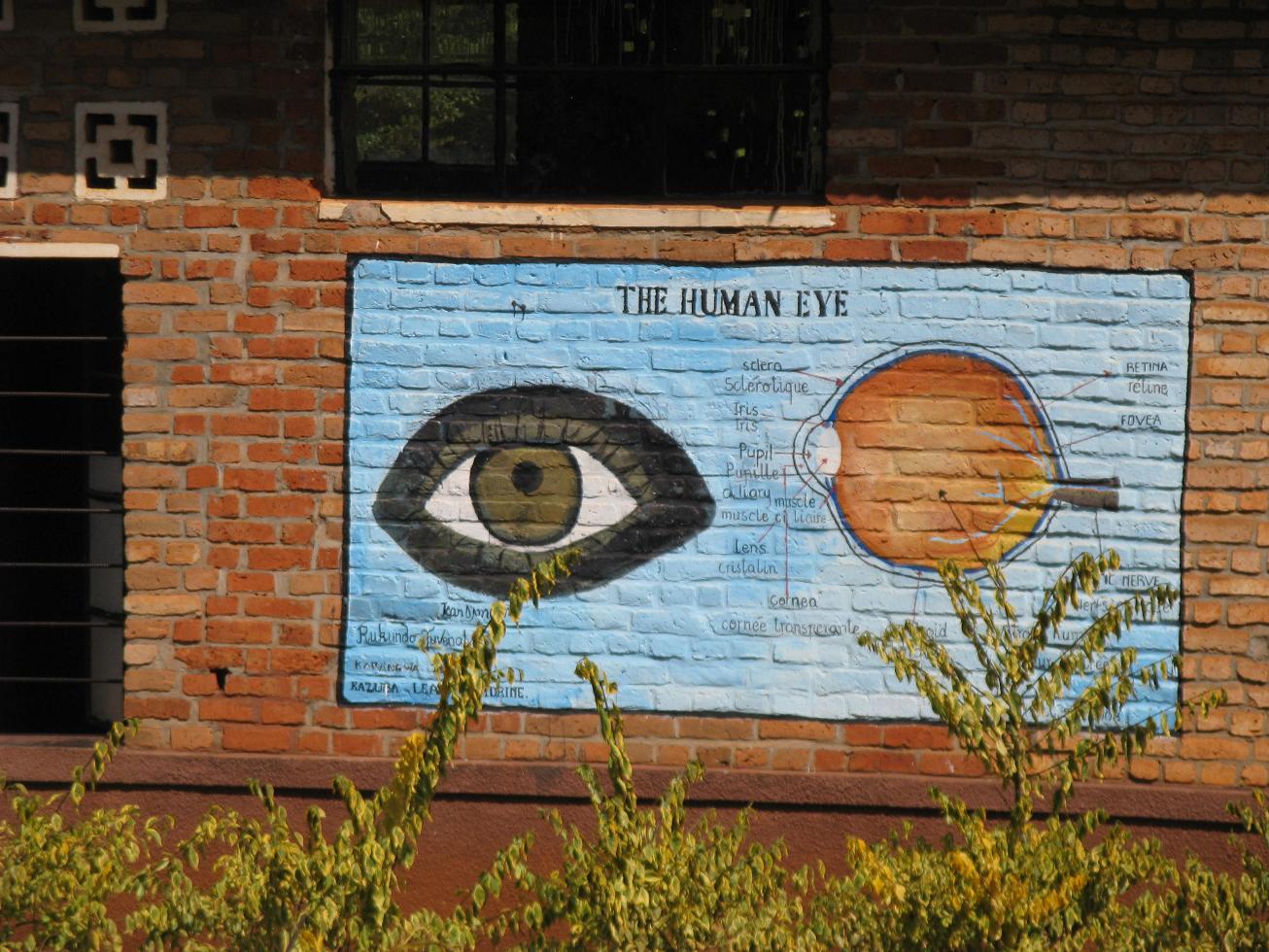
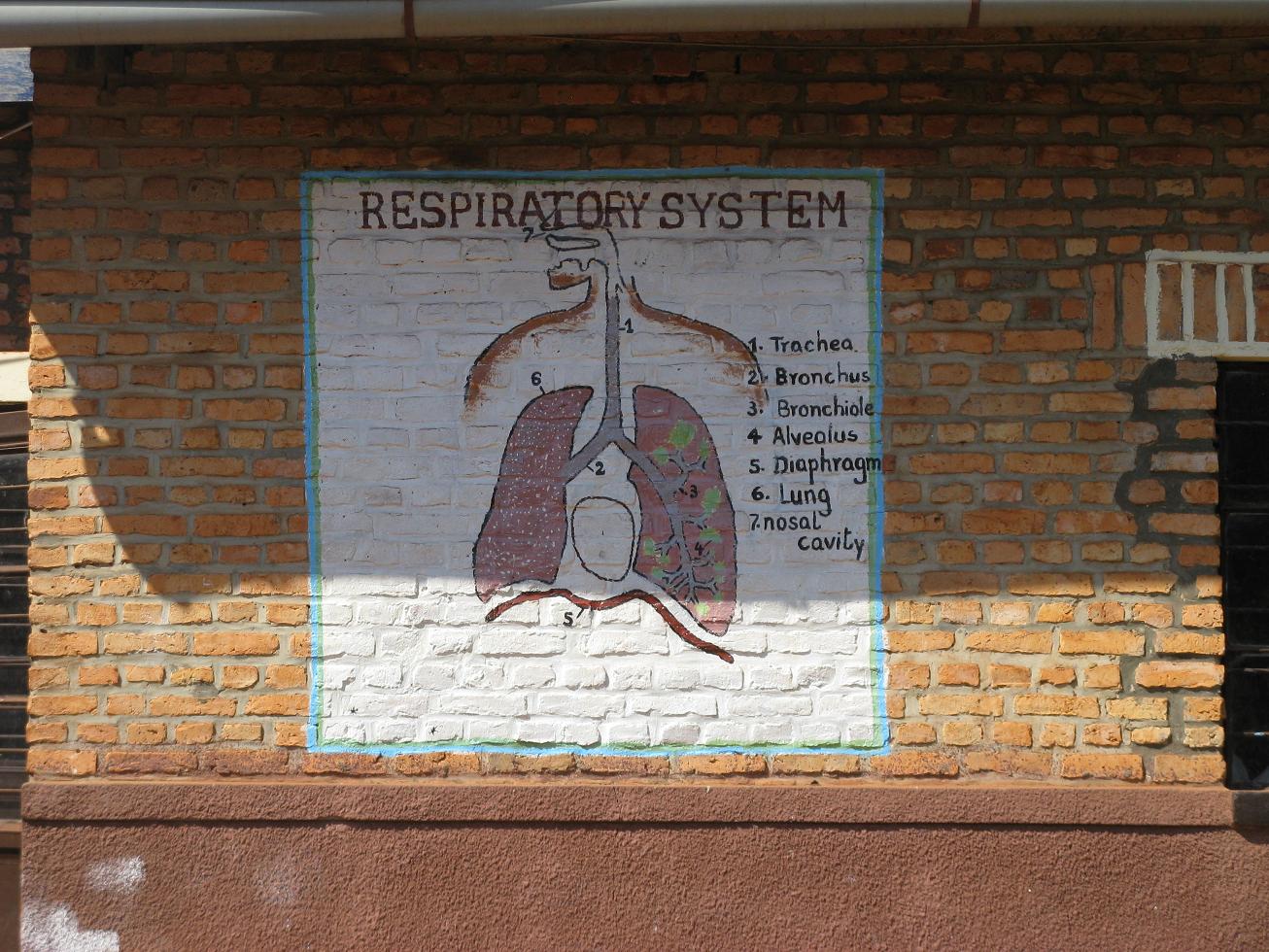
Two summers ago, I visited a secondary school with Every Child is My sm EyeChild’s founder and director (who happens to be my daughter) and some of its donors. The school I saw is in a secluded spot in northeastern Rwanda at the end of a shaded red earth road that cuts through cultivated fields. The grounds are neat, trimmed, tidy. The classroom buildings are sparsely accoutered: blackboards, desks, and only occasionally, a wall poster. The most colorful—and unique—aspect of the school is outside the classroom: Murals depicting body systems and organs have been painted on the exterior of the buildings—the eye, the respiratory system, the ear, for example.

sm Respiratory SystemWe took Amani and four other Every Child scholars from this school or from boarding schools within a few hours bus ride to lunch at a restaurant on Lake Muhazi, located not far from the school. Charming teenagers, all of them: Amani with her megawatt smile; Mary Louise, who—as is common—is the first in her family to go to secondary school; Grace, who also wants to be a doctor; and two boys, Ananies and Jean-Paul.  John-Paul was the spokesperson for the group. On the bus that morning, he’d prepared a speech which he read to us before we ate. He thanked Every Child for the opportunity to go to school, of course, and said that the students’ motto was this: “Upward Ever; Downward, Never.”

Lunch was barbecued chicken and fresh fish and orange soda. The teenagers, accustomed to beans and maize for lunch and dinner day after day after day, picked the platter clean. The soda bottles emptied quickly. “They don’t serve Fanta in the school cafeteria?” we asked, knowing full well they didn’t.

“It would be a miracle!” Amani laughed.

We asked the students about their families, their ambitions, their favorite subjects, and among other things, what they like to do in their spare time. Amani’s not so different than American kids—she likes to relax with her friends. Someone mentioned the upcoming end-of-term exams, though, and she responded, with her characteristic grin, “I guess I’ll have to reduce my relax!”

Every Child is My Child takes a unique approach to educating children in Rwanda and in Burundi, its neighbor. First of all, the scholarships are for secondary school. That’s unusual in the developing world, but clearly, the gap between elementary enrollment and 7th grade clarifies that there is where the need is—and where the greatest impact could be. The incentive for the elementary students—that is, the possibility of continuing on to secondary school—has worked.

And even if a student doesn’t pass the national exam to go on, he or she has lasted through 6th grade at least. That’s going to increase that student’s earning power and insure a degree of literacy. Likely there will be long-term impacts on early marriages and child labor expectations, on earning power and family stability. Education has the potential to break the cycle of poverty—so every year in school helps, and every child is part of the solution.

Every Child is My Child’s model is unique, too, because every child in the partner schools is offered the same opportunity. Some scholarship programs serve individual students—say, the top scholar in a school—or provide support just for girls—or just boys. These programs are important. But Every Child, by educating whole classes of students, aspires to lift entire communities. What can happen when every child in a village is literate, when every child has a high school education? In how many ways will the village itself be transformed? The country? These are big questions. The answers reside in the  future these children create for themselves and their families.

Right now, Every Child sponsors about 300 students from two elementary schools in Rwanda (Nyacyonga and Ngenda) and one in Burundi (Mageyo), an even poorer country, where the school fees for secondary grades add up to only $100 a year. The first graduates—kids who have been supported for a full six years—will receive their diplomas in 2014. There are plans to expand the Every Child model, but in the meantime, more students begin 7th grade each year, so the need to expand the base of reliable funders is also growing. This is an organization that depends 100% on volunteers—there are no salaries for anyone—and right now, the organization relies largely on individual donations.

Some American schools have helped, though–and that’s the connection to my American classroom. In my next post, I’ll describe what the International Club at my high school has done to support Every Child is My Child and what another teacher in North Dakota is doing with her middle school students. You can help, too, if you’re a teacher looking for a service project. In the meantime, you can learn more about Every Child by visiting the organization on Facebook (www.facebook.com/EveryChildisMyChild) or by viewing this YouTube video: http://www.youtube.com/watch?v=jeAW9IKHJok

And murakoze. That’s “thank you” in Kinyarwandan. Thank you for reading this blog. Thank you for caring about every child.

Second Skin

I slipped into the task like putting on a second skin.

Since the beginning of this semester, I’ve been working with a high school science teacher on a project tailor-made for co-teaching. She had gotten wind of an essay contest—the World Food Prize Essay Contest for high school students, sponsored by Purdue University, home to two World Food Prize winners. The contest is an opportunity for high school students to learn about and address issues of food insecurity around the world. What this teacher proposed was a melding of our areas of expertise—science and English—with the added fillip for both of us of the international focus.

In December, I perused the contest particulars.

The format was fundamentally a problem-solution paper. Background on the country came first. In the sample paper provided by Purdue, the winner from last year had painted a picture of Afghanistan in condensed, tightly written prose that led directly to the paper’s thesis: The central issues surrounding food insecurity in Afghanistan and some solutions that would alleviate them. Then, a lengthy and thoroughly researched discussion of those problems and solutions, and finally, a summation and restatement of the thesis. All of this, of course, documented with in-text citations and a works cited page in MLA format.

It was certainly a longer paper and a more complicated research project than any of our students would ever have undertaken—but not impossible at all. Especially when we broke the paper down for the kids and laid it out in steps for them. You notice, I am already saying “our kids.” It didn’t take me long to feel like a teacher of kids again.

Writing a research paper is one of the most difficult tasks high school students undertake. It’s a long process, and that’s hard in itself for kids with attention spans that last no longer than a Facebook post. Then, reading is involved—and with that, the pesky but fundamental comprehension skills of paraphrasing and summarizing. Then, the organizing of all that information: in the day, with index cards, each labeled with the author, title, page number, topic and subtopic, and perhaps—if I had been your teacher—marked as a paraphrase, a summary, a quote, or a basic fact.

We don’t do that anymore. Today, kids keep binders that contain printouts of the articles they’ve found, all tabbed alphabetically and highlighted for easy access to information the student intends to use in the paper. Increasingly, as they and we become more eco-conscious, the students don’t even keep binders. They create folders on their desktops. For the organized among them, this works just fine. For the others, it’s the beginning of a nightmare.

Some teachers still require outlines, a skill to be taught all by itself. I used to demand sentence outlines because the students would be forced to think their  papers through. Some of the first problems arise at this point: Just knowing the difference between a topic and its support befuddles some kids. They’ll use a quote for a main idea and a fact as a topic. But if their outlines are complete, I can read them and tell the students where the holes are. A few students will realize that with a sentence outline and well-organized index cards or binders, the paper will write itself.

For some students, actually writing the paper is the stumbling block. It means sitting in a chair for a long period of time and composing one sentence after another until the end.

But it’s not the end: Now come the in-text citations and the bibliography or works cited page. For some students, this is the trickiest part because it requires having kept track of all their resources (those index cards or the tabbed binders again) and having developed a system for keying all the quotes, statistics, examples, stories, facts, and details that they used for support to the ideas in the outline. For kids who can’t keep their lockers or their bedrooms tidy, this is a sorting and classifying task like no other!

And it’s still not the end: editing and proofreading and cross-checking the citations remain. And nowadays, even one more step: submission of the document to a plagiarism detection program like Turn It In, the advent of which was a boon to exhausted teachers, who used to have to google suspect lines or search through the students’ binders and cards to prove the student had copied. (You dare not even hint at plagiarism without the proof in hand!) Used as it’s intended, though, and done soon enough before the paper is due, the program serves as a plagiarism prevention program. I know many kids who have been saved from academic disaster by Turn It In, and I’d far rather coach a kid through the process of paraphrasing than nab him or her for plagiarism.

Are you tired just reading all this?

And you don’t have to read the papers! Or send them back for revisions and read them a second time!

Are you impressed with the sheer complexity of the task?  Me, too. I am always proud of my students when they reach the end of this task—even if their papers aren’t stellar, they’ve accomplished a complex task.  Perfection will come with maturity, experience, and the incentive of researching a topic they really care about (which they’ll do increasingly as they narrow down their academic pursuits to their life’s work).

So I knew very well what the World Peace Prize essay contestants would face as they researched a topic they knew nothing about—a country and its problems with food insecurity—and wrote the longest and most thoroughly documented paper they’d ever attempted. But I also knew that any student who elected to enter this contest would be self-motivated (no grades involved, no extra credit), willing to read, and immensely capable.

So yes, we had to help some of them select a country from a list of over 100 and choose a factor (the contest organizers presented them with a list of 19 factors that impact food security), help others select resources and evaluate those resources for credibility and authority, and talk all of them through their research—help them make sense of what they had read. But this was kind of fun for us as teachers. My colleague and I got wrapped up in the topic ourselves.

We both read the students’ early drafts and made suggestions for revisions (We were excited that we noticed and commented on the very same things) and then, at the end, I helped them with the documentation and works cited page by cross-checking their citations.

One boy did need major help with this part—and so I spent two hours yesterday teaching him how to do it, sitting beside him as he hunted out the source of each statistic and quote, each example and fact. I sat across from him while he reconstructed his works cited page and watched as he formatted the paper to meet the contest requirements. It’s not that he hadn’t been taught this process before, but I suspect such things had never mattered to him before.

But he was receptive yesterday—because suddenly, such things did matter. These papers were going out into the real world, would be read by a real audience, and since the boy cared immensely about his topic and had written a very strong paper, he really cared that he got the citations and the works cited page right.

My colleague submitted the papers yesterday after school. We think there are some among them that could be winners…but in truth, all of the students are winners. They completed this difficult task and have taken away a lifetime understanding of a serious global issue and a skill set for research that will make any paper they write from here on out, a breeze.

And I had the delicious experience of co-teaching with a colleague I admire, watching her coach the students in high-level analysis of substantial and substantive scientific information and using again myself the teaching skills I have learned over a lifetime spent in the classroom.

It was a win all around.

Two-hour Delays

For as long as big yellow school buses have transported children to school, snow days have been the students’ not-so-secret joy, their guiltless revenge on a system they can’t control: Nature is more powerful than the principal; snow keeps the teacher at bay. What kids don’t realize—at least when they’re little—is that snow days delight their teachers, too—even when it means extending classes an extra day in May.

But here in Indiana, snow days have been rare in recent years, so now we experience a not-so-secret tingle when weather that warrants at least a two-hour delay is in the forecast. A two-hour delay brings

  • An extra hour of sleep
  • An extra cup of coffee
  • Another load of laundry done
  • Bonus time for grading
  • Snuggling with our children
  • Juggling daycare
  • Remaining hopeful, even after the delay is called, that it could turn into a snow day
  • Driving to school in daylight instead of piloting through the dark
  • Dithering about whether to leave for school or stay at home
  • Treacherous driving either way
  • A parking place close to the door (if you’ve made the former choice)
  • Working in the quiet of the classroom until the students start to arrive—you could find yourself humming along with the air ducts as they fill with warm air
  • And sometimes, arriving at school at the usual hour just to discover you missed the call on the  two-hour delay

And once school does start:

  • Driving stories from excited kids who were behind the wheel on snow and ice  for the very first time
  • Adjustments to everything—the bell schedule, the cancelled Homeroom period or special appointments you might have had during your prep hour
  • Disorientation—because the bells are different
  • Speed teaching—only half an hour with each class
  • A growling stomach because lunch is at a different time
  • Feeling, at the end of the day, like you’ve run a gauntlet—because the number of human contacts, decisions to be made, problems to be solved, details to attend to don’t decrease—they just come at you faster.

But still, a two-hour delay is a break in routine, a small triumph over time. And  BONUS: no having to make it up!

A New Frame

Recently, my husband and I took a piece of art to our favorite framer. The print had been hanging on the same wall for so long it was part of the background, something we didn’t even see anymore. A remodeling project had caused us to rethink the way we had displayed many of the objects in our house, and that is how we came to reconsider the way this particular print was framed.

When the framer took the piece apart, we realized that it had originally been framed when we were 22 years old, newly married, and not knowledgeable enough to know that a fine art print should be mounted on an acid free board and hinged at the top so it would appear to float. We hadn’t known enough to tell that framer of so many years ago not to tape the print on all four sides to a piece of ordinary cardboard.

“I haven’t seen something like this in a long, long time,” our framer remarked as he removed the old metal frame and lifted the mat.  We could clearly see the adhesive that pinned the print to the board.  On top of that, the mat itself was not acid free, and it had left a burn line all around the print itself.

Fortunately, the piece could be restored and appropriately reframed.

As I listened to the framer talk about methods for framing art and thought about our own need to reconsider the way we were displaying this particular piece, I was put in mind of the remodeling project going on in education.

Some of the things we do as teachers spring from habits and approaches we developed when we were novices. It’s a complex thing, teaching, and in the beginning, when something works, we are so pleased and relieved that we keep on with the practice until it becomes so much a part of what we do, we don’t even know we are doing it. In other cases, we continue a practice because it appears to do what it is supposed to do. It’s hard to make yourself change when you think what you are doing works.

But with the introduction of the Common Core State Standards, teachers will have to undo the habits of years.

For example, for years English teachers have relied on textbook companies to lay out a scope and sequence they can follow with confidence —solacing themselves for capitulating to a company by remembering that the textbook companies are advised by practitioners and scholars.  If we use the anthology conscientiously, many teachers reason, by the end of the year we will have exposed our students to the most important writers and their most accessible or well-known stories and poems.  And, if we progress at a brisk pace from August to May, we will have “covered the curriculum.”

However, a wide but thin acquaintance with great writers does not result in students who are enthralled with literature.  This approach doesn’t whet their appetites for more. It does not give them a deep understanding of any of the writers they’ve read, and it doesn’t particularly develop their critical reading skills.  What it does do is produce students who can play Jeopardy.

The Common Core State Standards present us with an opportunity to “reframe” our English courses.  They ask us to read deeply, rather than broadly, and connect texts and text types to each other and to other disciplines. They ask us to do close reading in our literature classes and approach informational text with a focus on the content, not on prior experiences that may not even be relevant to the topic. The Common Core standards ask us to have our students write more often and use evidence from the text to build an argument.

It isn’t really that we are teaching content and skills we’ve never taught before. The picture is still the same. But it’s framed differently.

Some content will be taught earlier than it used to be—various grammatical concepts, for example, are supposed to be introduced earlier than they often are now. By high school, teachers should be able to conduct conversations about style and discussions of writing technique that are predicated upon students knowing the vocabulary and structure of English grammar. As it is now, we repeat basic grammatical concepts year after year, and by 10th grade, some students still don’t know what we’re talking about. Is it just remotely possible that this is because we repeat ourselves so much (parts of speech in grade after grade, for example) that kids realize they really don’t have to dig in and learn the material?

Some modes of rhetoric will be emphasized—like argumentative writing—and others—such as narrative writing—will be called for less often.  But shouldn’t our students know how to set up and defend  an argument? Shouldn’t they know how to spot specious claims? Detect holes in arguments? Shouldn’t they know how to use quotes and statistics and examples—and how not to misuse them? And narrative still has a place, make no mistake. Narrative writing is still specified in the Common Core. It’s the emphasis that has shifted.

Students will be doing research with more frequency than usual. But that doesn’t mean a series of full-blown research papers four times each year—rather, the skills involved in research can be teased out, presented sequentially, and the ante upped gradually.  Teachers can challenge students to learn a variety of presentation modes—including those in the multi-faceted world of technological presentation. Students can develop their expertise with technology skills just as much as they can develop skill with  traditional print forms of reporting information.

The books we ask the students to read are supposed to reflect higher lexile levels—but really, it isn’t just the lexile level. There are other measures of complexity than that, so many of the texts we use now, we’ll still be using when we teach the Common Core. And if our texts are more difficult, no one is arguing to throw the kids a book and let them flounder. Instead, we’re asked to support the students with appropriate instruction—scaffolding, it’s called.

Novels we typically teach will no longer be stand-alone units of instruction. As teachers, we’ll look for and connect the books to poems that reflect the same themes, to essays that address a shared topic, to informational texts that elucidate ideas pertinent to the story. Assembling readings that are related by topic or theme and creating instructional tasks that ask kids to think deeply about a subject is actually fun and refreshing for the teacher. Why not start with a book we already teach—an age-appropriate and complexity-appropriate one—and collect other texts (poems, essays, magazine articles) that complement it and lead students on to an exploration of the common theme? What would be new? Maybe some of the readings, but not the anchor text. Not the need to build vocabulary,  develop comprehension, or teach writing and research skills to go along with the readings.

With the Common Core, we’ll make interdisciplinary connections, and even, in the best of circumstances, teach collaboratively with our colleagues. As it is now, the curriculum often overlaps from discipline to discipline and creates redundancies that dull our students’ appetite for learning. I am thinking of a unit I created once that began with the excerpt in our American lit text from William Bradford’s “Of Plimoth Plantation.” It was a unit that called for students to envision what they would do in a new world. (That was its name: Starting Out in a New World: What Would You Do?)  I presented  the students with information they didn’t already know about the Mayflower and a list of resources the intrepid souls on that boat had (and didn’t have). The activities of the unit took the students deep into Bradford’s text and other primary sources from the Puritan time period, texts which were available on the internet and in print in my room.

The enthusiasm that I expected for the task wasn’t there. Why not?

My students had studied the Pilgrims in elementary classrooms every year of their lives and then considered the Puritans again in 8th grade American history and then again in 11th grade American History—and here I came with yet another “unit” on this topic from the country’s far, far past.  What might have happened if the American history teacher and I had collaborated? Might we together have generated some excitement among our students instead of both of us hearing questions like “Hey! We’re doing this in history (or English)? Why do we have to study it here?”

The Common Core was introduced several years ago, yet I am still hearing resistance—and in some cases, foot-dragging–in the hope that it will all just go away.  I hope it doesn’t.

The Common Core Standards do not ask us, really, to throw out our old art. Instead, they ask us to reframe what we’ve always had hanging on our walls.

This could be fun. It’s all in one’s frame of mind.

By the way, you should see the print my husband and I had reframed. It seems like a whole new piece, but really, it isn’t. The frame is new, and so we look at the piece afresh—but suddenly, it has come to life again: strong, vibrant, exciting our imaginations.  I see no reason why reframing for the Common Core shouldn’t have the same impact.

Chocolate Scramble

191

I don’t ordinarily distribute candy to students as an incentive, but when I am introducing Animal Farm to 9th graders, I need to acquaint them with the concepts of communism and capitalism.

To do this, I engage them in a simulation activity I learned from an amazing social studies teacher. In this simulation, Hershey’s kisses equal money. But I don’t tell the students that until later. I just come in one day and start inexplicably throwing chocolate around.

If the principal came into my room for a 10-minute walk-though just as I was throwing the Hershey’s kisses up into the air and saying “Go for it,” he might well wonder what I was up to. In light of the scramble that ensues—kids bolting from their chairs, dropping to the floor, reaching, stretching, even covering the chocolate pieces with their bodies—I could just hope that he knows me well enough to believe there’s method in my madness.

Capitalism, I could tell him, and maybe he’d see that kids diving under tables and greedily scooping up kisses by the armful resembles the drive to amass a fortune. Maybe he’d see the girl with the big heart slip a few pieces of chocolate to someone who has none and recognize the philanthropic impulse. Maybe he’d see the kids who are seated at the back of the room or trapped behind furniture and realize they represent the disadvantaged in our society. “Not fair!” he’d hear a few kids cry—and see them sit there, mad.

If he came in later, when I was redistributing the chocolate evenly, would he see the gratitude of those who had nothing, suddenly having something?  Or would he see the complaisance of those who hadn’t been willing to scramble, smiling smugly when they got some chocolate anyway?  Would he see the frustration of the ones who put had effort into the game, no longer having so much?  “Not fair!” he’d hear them cry. Or would he think I was just offering up candy that day and making sure—in good teacher fashion—that it was shared equally, that everyone got the same amount?

He might come in later when a discussion about these two economic systems was underway. Would he wonder why the kids weren’t naming the systems? I wouldn’t stop to explain that I hadn’t yet labeled them: If I had, the students’ discussion would be informed by what they already knew or had heard somewhere. In this simulation, the scrambling represents the American system, capitalism: The students might not be able—or willing—to point out its flaws. The other system is one they’ve already, by age 14, come to regard negatively. They might not be able—or willing—to discuss communism without bias.

But this way, with chocolate as the symbol and no names named, the students conclude that neither system is perfect.

And then I name them, the systems (and reveal the learning objective for the day, hidden from the kids until now so as not to spoil the discovery aspect of this lesson): Students will understand and discuss the advantages and disadvantages of two economic systems—capitalism and communism.

Looking at the activity as a vocabulary exercise, what better way to make meanings permanent than with a physical activity? For learning words, the research tells us that kinesthetic connections create the strongest memory bonds of all.

Or, if I think about it as a strategy for stimulating higher level thinking, the discussion is really a comparison/contrast exercise—We know that one of the best ways to understand one thing is to juxtapose it with another and examine the points of similarity and difference. So it’s analytical.

And as a stategy to build familiarity prior to reading a text, which is what an English teacher also needs to do, the simulation works perfectly. Suddenly the excesses of Mr. Jones of Manor Farm are made real, and the intent of the rebellious animals—to share equally in the work and the profits of the farm—are understandable.

But of course, what begins idealistically in Orwell’s classic deteriorates rapidly. The introduction of Napoleon and Snowball turns Animal Farm into another thing altogether.

“Not fair!’ the students cry when the milk and apples are reserved for the pigs. “Not fair!” when the pigs begin sleeping in beds. “Not fair!” when confessions are forced and animals executed. More than “Not fair!” when Boxer is sent to the knacker’s. Kids sometimes cry tears, not just foul, when they realize, with the betrayal of Boxer, the depth of Napoleon’s deceit. At the end of the book, when the pigs are walking on their hind legs and carrying whips in their hooves, when the other animals see Napoleon and Pilkington playing poker and raising toasts to each other, the pigs and the men around the poker table indistinguishable from each other, the destruction of Animal Farm is complete.

And now, a third term—totalitarianism—presented visually with the image of Napoleon, drunk with power and playing cards with Pilkington. The stage is set for another analysis task: tracing what happened at Animal Farm, step-by-step, in order to see exactly how the animals were deceived. And then for another: drawing the allegorical connection between what happens on Animal Farm and the Russian Revolution.

What goes on in a classroom is so much more complex than what meets the eye. Throwing chocolate around, indeed!

It’s ideas that teachers send flying through the air—and lessons like “Chocolate Scramble” that land them in students’ minds.

PS: That amazing social studies teacher? My daughter. Thanks, Elizabeth. This simulation worked for me for years–and when I left the classroom, I passed it along to my colleagues. Isn’t that what teachers do? Share the wealth?

The Text, The Students, and Me

“Mrs. Powley! How do you know all this stuff?”

I sometimes heard that question when I was the teacher at the front of the room, leading my students through Great Expectations, Huckleberry Finn, To Kill a Mockingbird, The Great Gatsby…and a library of other literary staples in the English Language Arts canon.

Such a remark was gratifying to hear because what it really meant was that the students had been awed by the text.

“I’ll never be able to read a book like that,” they would say.

“Yes, you will,” I’d answer. “It takes practice.”

And I had to be honest: “Do you think all this comes to me the very first time I read a book?”

I reread the text, I told them, every single time I taught it.  And every single time, I picked up on more subtleties, developed more insight, made more connections within the story and to the world outside my classroom.

“That’s what I’m trying to teach you,” I’d say. “How to read.”

Lately, I’ve been reading a lot about an instructional strategy called “close reading.”  It’s the opposite of reading to get the gist of a piece; that is, reading to summarize.  The Common Core Standards document sets out as its aim that students should be able to “deeply” analyze a piece of “rich text”—it doesn’t matter whether fiction or non-fiction—in order to understand how an author has constructed meaning.

A close reading of text is a rereading of a small slice of a story (or something that is short to begin with, like a poem or an essay)—perhaps rereading it many times. Then, through careful inspection of words, sentences, paragraphs, and the way they work as parts and together as a whole, the teacher leads the students to discern the author’s meaning.  Students are guided to provide “textual evidence” that the author’s meaning is what it is. They can’t  guess, based only their prior knowledge and a cursory look at the words on the page, what the author intends.  This means, practically, that a Cliff Note’s acquaintanceship with the text won’t cut it.

The more I have read, these past few months, about “close reading,” the more familiar it has seemed to me. That’s because, in the very best of my literature lessons, that is what I had been working at for years.

Reading about this “new” instructional strategy has set me to thinking about my long journey through pedagogy and practice, about all the strategies and instructional supports I’ve used throughout the years as I’ve tried to help students make meaning of words on a page.

When I began teaching, the hardest thing for me was to get a good class discussion going.  I didn’t seem to ask the kinds of questions that led to scintillating discussions of life, death, and everything important in between, the kinds of discussions star teachers reported having, discussions where the classroom rhetoric soared and kids came away with life-changing notions about the universe and their place in it.

My questions were the standard ones—and don’t get me wrong, they weren’t unimportant—about the plot of a story, the characters in it, the symbols, point of view, setting, and how they all contributed to the themes of whatever book we were reading.  I’d plod along, chapter by chapter, and it seemed to me the conversation was stiff.  I wasn’t sure where discussions might go, what kids might say, so I pretty much stuck to the script.  Still, kids read the books and told me they enjoyed them.  (Some didn’t, I’m sure.)

I thought maybe the stiffness came from the way I was approaching the stories, so for a while I depended upon the textbook to set the pace. Sometimes, I found, those questions were fine, but sometimes I thought they required the kids to make fantastic leaps of insight.  Other times I thought they didn’t emphasize what was really important.

Like a lot of novice teachers, I used to think the textbook company was the authority on curriculum and instruction. I guess I imagined the editors sitting around having deep conversations about theories of writing instruction and seminal works of literature and the evolution of the novel as an art form.  Presumably, those fervent conversations ended with the editors scurrying to their office cubicles, like monks burning with the faith, to annotate a text and develop the accompanying questions.

Eventually, thank goodness, I realized that the editors were concerned with real things—like wooing customers and cutting production costs—and that the actual writing of the text and the materials to go with it were contracted to consultants.  Thus, the questions in the textbook were only as good as the consultant who wrote them.  And that consultant was a human being—just like me.  With that bit of enlightenment, I felt justified in choosing not to use the questions at the end or to use only some of them.

I tried various “frames” for asking questions. One that teachers use frequently to develop comprehension skills sorts questions into a three-tiered hierarchy. The first questions are “right there” in the text—a student has only to skim and scan for the answer; the second ones require making inferences—the student finds two (or more) bits of information and puts them together in her head. The third tier questions require the student to make a connection to something else she has learned in English class or in another class or even to something she knows from life experience.  Not bad, this frame, but it didn’t always serve my purpose.

There are 4-level frames and other 3-level frames, too, but none of them were fail safe structures. Besides, I’m an English teacher, and what I really wanted—increasingly so as the years went by—was for kids to see how the metaphorical language worked, how the word choice mattered, how images supported meaning, how rhetorical devices helped the writer accomplish his or her purpose.  I was interested in how the author made meaning, in the craft of writing.

I grew to dislike the 4-pound literary anthology that, for the most part, gave students snippets of text (the last one devoted exactly one page to Moby-Dick), the easiest or shortest story an author had written, and poems that were perhaps the most accessible to students but not necessarily the richest.  Today, a typical anthology is accompanied by an even heavier teacher’s edition, the pages so packed on the sides and along the bottom with suggestions for teaching that the literary text in question is condensed to 8-point type.  I could barely read it.

And that doesn’t include the ancillary materials supplied by the publisher—supplementary vocabulary instruction, grammar exercises, practice tests, overhead transparencies, writing prompts, and daily oral language items (DOL, as we say in the business)—that escalate the cost of these anthologies. So much help for the teacher is provided that I found it paralyzing.  Too many choices.

I yearned for it to be just the text, the students, and me.

And that is how I came to “close reading,” even though I had never heard the term.  I stopped plodding through the anthology, stopped trying to create artificial discussions, stopped trying to cover everything.  From a chunk of text that I believed was pivotal in terms of the story or central to developing the themes of a book or key to understanding the author’s style, I’d ask questions that demanded a close look at word choice, at sentence structure, at metaphorical language, at rhetorical devices. Slowly, sometimes dramatically, big ideas would emerge. Then kids would say, “I get it!” or “Wow!” or “Oh, my gosh.” They’d grasp the beauty of what the author had accomplished and appreciate—really appreciate—how she had accomplished it.  Sometimes we made connections from there—to their own worlds or to other things we’d talked about or they’d learned elsewhere—but these connections stemmed from real knowledge of the text, not from idle remarks, snatched from thin air.

Of course, “close reading” is not all that I did in the classroom.  And I wish I could say this kind of epiphany happened every day and every time I taught a poem, an essay, a story, or a passage from a book.  It didn’t.  But when it did, it came about from something deep inside the text, the students, and me. And it came often enough that I know this “close reading” strategy isn’t just another instructional fad.

Besides, the best teachers I know do the very same thing.  They bring their students face-to-face with the words in the text. We don’t all follow the same procedures or choose to emphasize the same thing, but we get the same results: Kids learn to read, really read.

The Bus to Friendship

Today, a former student, one of my Russia Travelers (kids I took to Russia 10 years ago) and I met together as colleagues in the same middle school. She, working with kids; I, working with teachers. We got to talking about our trip together years ago, and I told her I was working on another essay about those weeks we spent together so very far from home. I spent many hours, during those years of the exchange, preparing the kids for those trips. We talked about cultural adjustments they’d have to make…about differences in values…about similarities in matters of the heart. My students had no idea that their teacher was learning to cross cultures, too… 

When I traveled in Russia, the loss of independence was the hardest adjustment I had to make.

As the coordinator of an exchange program, I expected to travel about on my own to the school, to the market, to the restaurants my students frequented, and to the parks where they played.  After a few days of riding the bus with Irina, the host teacher, I was ready to travel alone.

But Irina was not convinced.

The trick to riding the bus in Russia is to push your way on like everyone else. In a crowded bus, your body is not your own, and personal space is only in your mind. You have to accept intimate contact with strangers. Courtesy demands that you remain silent or at least quiet in your conversation if you are with someone else. You have to be wary of pickpockets (I was told) and conscious of older people who deserve the seats. That sometimes means hanging on to overhead bars, or in really crowded situations, allowing yourself to be supported by the individuals packed in around you. You hang onto nothing in these situations and grab for the bar when the bus stops so you won’t be swept away by those who are exiting.

The conductor, usually a matron, pushes through the crowd asking to see passes and selling tickets to those without them. She makes eye contact with each individual, gives a brief nod when you hold up your pass, and for those who don’t have a pass, she somehow accepts money and even makes change as the bus lurches along. She never forgets a face, so there’s no danger of her asking twice to see your pass or overcharging you for your ride—but she’s ever on the alert for freeloaders.

Irina could see I knew the drill, but she still wouldn’t let me ride alone. “I can’t let you do that,” was all she would say.

Then one day I needed to meet my students at an hour that was inconvenient for her; she was forced to let me go.

I received strict instructions: Bus #17 from her stop straight to Lenin Square.

Bus #17 came. I boarded a nearly empty vehicle and took a seat on the right so I’d be sure to see the stops. At first, everything was normal. Then the bus pulled into a parking lot I’d never seen before, and everyone else got off. I sat there until the conductor gestured that I, too, had to leave.

I won’t say I wasn’t anxious. I realized that even if I asked for help, people wouldn’t understand me—and I wouldn’t understand them. So for just a minute, I considered that Irina might be right.

Then I noticed that the people on my bus had moved to a spot at the front of the lot and were standing there, waiting. The conductor and the driver had gone into a building that looked like a shed.  Other buses entered the lot; the same thing happened.

It was a shift change!  Sure enough, another #17 bus came along, and I climbed on. The bus resumed the usual route, and I met with my students, as planned.

As a matter of pride, I didn’t tell Irina about this incident. Besides, I was afraid that if I revealed even a moment of anxiety, I’d never be on my own again.

By the second year of the exchange, the Russian teachers with whom I stayed had accepted the fact that I could and would ride the bus alone.

One day I met Irina for an afternoon of shopping.  At the conclusion of our time together, she put me on Bus #1 to “Kristy,” the area at the edge of town where I was living. I had been told to take Bus #4, but Irina assured me that #1 went to Kristy, too—she used to live there herself. We parted, and I rode Bus #1 down Octobrisky Street toward the bridge I knew the bus would cross on its way out of town.

Just before the bridge, the bus unexpectedly turned. I noticed the deviation immediately and, with a sinking feeling, watched the buildings go by. A few blocks later, the bus stopped at the railroad station and everyone got off.

I approached the conductor.  “Kristy?”

She replied in sentences I didn’t understand, wrote #4 on a piece of paper, and gestured toward the corner where #1 had unexpectedly turned.

My moment of panic was short-lived. I would walk to that corner, catch the right bus, and continue my journey.

Just then, a taxi pulled up and I heard a familiar voice call my name.

It was Irina. She had read a sign on the side of the bus as it pulled away that indicated the route had changed. Concerned that I would be frightened and not know what to do, she had found a taxi and pursued me to the railroad station. That is when I understood at last the depth of her concern for me. I surrendered my pride, climbed into the taxi, and we laughed together all the way to the corner.

I learned later that the name of that corner bus stop is “Friendship.”  Fitting, because that is the place where I gave up my obstinate insistence upon independence—truly an American trait—and understood the motive behind her guardianship. That was the moment real friendship began.

How Children Succeed

I saw her in the high school library on a Tuesday afternoon at the end of the day. She was bent over her books, head in hands, her long black hair a kind of curtain around the pages that were open on the table.

“How are you doing?” I asked, interrupting her study. “It’s so good to see you!”

She lifted her head, brushed back her hair. “Mrs. Powley!”  Then she smiled and answered the question. “I’m fine—but kind of stressed now, to be honest. My classes…” Her voice trailed off.

“What are you taking?”

“Pre-cal, College Comp. Chemistry, Government. You know.”

Yes, I do know.  Kids are sometimes surprised that senior year is stressful. So many of them confuse arriving at senior year with finishing senior year and have the mistaken notion that the last year of high school will be a slide. A lot of them give up when the pressure becomes intense.

But not her.

“I thought you were going to have early dismissal this year,” I said. “What are you doing here?”

“I do. But I only work three afternoons a week—40 hours, but only 3 afternoons.”

“Forty hours?”

“I work all day Saturday and Sunday.”  Her parents own one of the small Hispanic grocery stores in the area. I got the sense—last year when she was in my American lit class and from this conversation in October—that her family is working hard to make a go of it. “If I go home,” she continued, “I get distracted. If I stay here, I get my work done. I’ve got to.”

She wants to go to college. She’s not a A student.

I’ve just finished reading, for the second time, Paul Tough’s riveting new book, How Children Succeed. It confirms everything I’ve known for years—from experience and by  instinct—about why some kids are successful and why some aren’t. It isn’t about IQ; it isn’t about money and family resources. It’s about character.

It’s about having the discipline to make yourself study when you’d rather be playing video games or texting or driving around town with your friends on a fine spring night. It’s about persistence—about seeing a teacher after school to get something explained, about giving up a lunch period to visit the math lab, or revising that paper when the assignment to do so is optional. It’s about memorizing the formulas and going over the study notes. It’s about setting a goal and moving toward it, step by step by step.

Character counts.

A few years ago, Paul Tough wrote Whatever It Takes, a book about the Harlem Children’s Zone in NYC. It was while he was researching that book that he became interested in issues of success and failure. Research shows, he found, that character is a better predictor of success in college than GPA scores. In his book, Tough identifies a handful of character strengths that can be taught in school if they haven’t been cultivated at home.

Most of Tough’s book is focused on the children of poverty. He summarizes a number of studies conducted by psychologists, neuroscientists, and even an economist that point to character strengths such as determination, resilience, conscientiousness, self-control, and what Tough calls “grit” as being the reasons some kids, against all odds, succeed. But where does it comes from, this thing we call “character”?

To begin with, children who are nurtured when they are young are more likely to develop these character strengths than the children who are not. Why?

There is a physiological explanation. The conditions of poverty, under which twenty to twenty-five percent of our children live—conditions of family dysfunction like violence, anxiety, abandonment, alcoholism, abuse, frequent relocations—cause stress for kids. The stress of living in poverty causes changes in kids’ cognitive functioning—and that means these kids can’t sit still, can’t pay attention, can’t control their emotions. They do poorly in school. “When you’re overwhelmed by uncontrollable impulses and distracted by negative feelings,” writes Tough, “it’s hard to learn the alphabet.”

The preventative—and the antidote—is a strong, nurturing relationship with an adult. Ideally, in childhood, with a mother—but not necessarily a birth mother. Tough makes the point that it is the rearing mother that has the impact, so a child raised by grandparents, by an adoptive family, by another relative who gives the child the love and guidance and support she or he needs can become a young person with these crucial character strengths. The role of the mother—whoever she or he is—is to soothe, guide, counsel, and support the child in learning to deal with adversity. She’s the teacher, if you will, of a home school course in stress management.

That might lead you to think that it is only the children of poverty who lose out on early character training, not the children of privilege. But Tough points out, in observations based upon the reflections of teachers and principals as well as research he cites, that parents who rush in to rescue their children whenever they are in a tight spot—those we call “helicopter parents”–are just as likely to be disabling their children as the neglectful parent living in poverty. Increasingly, even at the college level, teachers know the kind of parent I mean: those who contest every poor score their child receives or seek accommodations no other student will have. (Surely there is a retest? Surely the extenuating circumstances I am telling you about excuse the fact that he didn’t pay attention in class, didn’t come in for help, didn’t study? Surely he can do a make-up because his outside commitments—sports or 4H or whatever—had him just too busy for your test?)  Or, parents whose relationships with their children are “distant,” but whose expectations are nonetheless high—sometimes impossibly high.

By never allowing their children to learn how to manage a disappointment or a setback, these parents, too, are handicapping their children. If a child is never allowed to fail, he or she will lack resilience—the ability to bounce back after a defeat. My grandmother used to say: Whatever doesn’t kill you makes you stronger. She had a point.

But it won’t work to throw up our hands in despair and write off such children. We can’t just chalk up their failures to “lack of parental support” or “helicopter” parenting and be done with the matter. Tough goes on to say that the character traits he enumerates and explains in his book can be taught in school. Using examples of whole-school programs, classroom initiatives, and extra-curricular clubs (such as a chess club in an impoverished school community that has led to amazing accomplishments for some middle school students), Tough shows how teachers and principals can make a difference, can instill those character traits even in students who have lost out at home. Furthermore, character can be shaped, the examples show—even as late as during the teenage years. It’s not ideal, it’s not easy, it’s not the same—but it can happen.

What it takes is a mentor, a teacher, who believes in that student, teaches that student well, expects the best—and gets the best. Remember that Tough specified a strong, nurturing relationship with an adult, a specification that has implications for turning these kids around even as late as high school. It could be a pastor, a 4H leader, a surrogate mother—but because kids go to school, it is often a teacher. Every good teacher I know has had at least one student like this, often many more: a student in whom the teacher invested an amazing amount of time and energy and effort, one they know they reached, one they know they turned around, one who will forever be changed.


Back to my girl in the library: I remembered how, last year in late May, when she came in after school to make up a quiz, she stayed after that and asked me for help with vocabulary. She wanted to learn more roots. I gave her one of my books and a huge list of Greek and Latin roots and their derivatives.

Who knows where her determination, her discipline comes from? I think she must have the kind of continuing parental support that breeds success. Consider the work ethic of her family. She herself works 40 hours. It seems too much for a 17-year old. But in this case, she’s the lucky one.

So in the library that day last October, I told her not to worry. “Keep on like this and you will be fine. Determination and self-discipline are what make for success in college. You’ve got what it takes.”

And she does.