Russian Mother

The holiday season is just about over. I’ve ingested my weight in cookies and confections, yet when someone urges another delicacy upon me, it’s impossible to say no. It’s cultural habit to urge calories upon friends and family in December, and indulging in culinary decadence has reminded me of another time and place in my life when eating too much was more or less an expectation, one I had to help my American students understand, too. We were together in Russia, ten years ago…   

I told them to just say “No.”

Politely, but “No.”

It didn’t do any good.

Their Russian mothers continued to heap food upon my students’ plates and ask again and again, “Wouldn’t you like more?”

“Aren’t you hungry?”

“Don’t you want something to eat?”

“Kushai! Kushai!”  they implored.  In English, “Eat! Eat!”

In preparing my American students for their three-week stay in Russian homes, I had explained that the Russian mothers would associate food with well-being and the serving of it with hospitality—indeed, their own mothers had done the same when the Russian teenagers had visited us in Indiana. Still, saying “No” and stonewalling the urgent pleas of the Russian mothers was easier to imagine than do. My students struggled, and so did I, with hospitality that seemed to have no end.

In Russian homes, mothers serve the food at the table—even ladling it onto the fathers’ plates. We couldn’t help ourselves to small portions and thus strategically leave room for more. In fact, the mothers more often than not served the Americans giant portions to begin with and gave their own children the smaller portion sizes that are the rule in Russia. Perhaps they had heard that Americans’ plates are generally heaped, but probably not. The over-sized helpings were more an expression of generosity than cultural accommodation.

We tried saying “No, thank you” in Russian: Nyet, spasebo. That didn’t work. We tried “I’m full.” Ya sita.  It produced the opposite effect:

“Wouldn’t you like some more meat?”

We learned Russian slang for “I’m full. Ya ne slon. “I’m not an elephant.” That didn’t work either.

In fact, mealtime became a kind of battle of wills. The mothers, worrying and kind, urged more and more food upon the students, tempting them with packaged wafer cakes, elegant confections from the city bakery, peach juice and pineapple juice, and the incredibly smooth chocolate that is so hard to resist. The students begged, pleaded, shook their heads, held their stomachs in mock pain, and tried every Russian phrase they knew to say, politely, “Enough.”

It was the same for me, and I got nowhere, too. The teachers told me that the mothers were concerned. The kids weren’t eating. It wasn’t that they didn’t eat specific foods. No, the meat and potatoes were familiar and the desserts were delicious. The Russian “salads”—mixes of diced vegetables, fruits, nuts, meats or seafoods, all held together with mayonnaise—were tasty.  The trouble, the mothers said, was that the students weren’t eating enough.

I used such moments as opportunities to instruct my own hosts in American eating habits.  “We usually mean it when we say no,” I explained. “The kids will eat when they’re hungry. Don’t worry about them. Don’t worry about me.”

But they all did continue to worry. It became a kind of a joke, eventually, although sometimes it produced irritation. I began to dread meals. My waistline was thickening and I was usually still full from the previous repast—and yet, out of politeness I couldn’t completely resist, and out of gluttony I couldn’t pass up the desserts at all.

“Irina,” I said to my good friend, the teacher I stayed with the first time I brought a group of students to Russia, “you’ve been to my home in America. You know I don’t eat such big dinners. I don’t usually eat seconds.”

She nodded.

“In fact,” I said, “How did you get enough to eat at my house? I didn’t keep asking you if you wanted more.”

“I knew you’d ask only once,” she said knowingly. “I knew to take seconds the first time they were offered.”

I just shook my head.

Two summers later, Irina, her daughter Anna, and her daughter’s friend, Olga, met me at “Lavitsa,” a restaurant  that specializes in the delicate pastel cakes and mouth-watering chocolate tortes created at the city bakery. Displayed in splendor in a glass case at the entrance, the cakes tantalize customers who enter intending just a cup of tea. I’d “saved up” for this occasion and was in a dither choosing.

“I remember you like the one called cappuccino,” Irina said.

“Yes, that’s right, I do. Let’s order that. And how about Anna and Olga?”

“Oh, nothing for us,” they replied.

I arched an eyebrow. Skinny teenage girls. They should eat something, I thought.

When the waitress brought our cakes with the requisite teaspoons for eating dessert, my slice was as big as the Ritz. By comparison, Irina’s was small. And Anna and Olga had nothing.

I took the situation in hand.

Dve lozhki, I said to the waitress. She brought me two more spoons. I gave them to Anna and Olga and pushed my plate in their direction.

“No, no,” they said in chorus. “No, thank you.”

And then I heard myself say it.

“Kushai, kushai.”

My tone was urgent.

I jiggled the plate again and nudged it another inch across the table. “Kushai! Kushai!”  I repeated.

Irina looked at me and shook her head. I had become a Russian mother.

A Christmas Memory

IMG_0531In years when I was not running behind by December, when I hadn’t lingered too long on To Kill a Mockingbird or Great Expectations or any other of the books my freshmen read, back when so many days weren’t set aside for standardized tests and final exams and AR assessments, back when I had control of the calendar, I liked to set aside the last several instructional days of the semester for Christmas literature. Sometimes we read A Christmas Carol, sometimes Dylan Thomas’ “A Child’s Christmas in Wales,” sometimes Truman Capote’s “A Christmas Memory.” My favorite, of course, was the latter—for two reasons. First, because the story lends itself to the students writing their own memoirs about Christmas—always a delight to read—and then, because I loved watching my students come slowly to the realization that the little boy narrator of “A Christmas Memory” and Dill Harris in To Kill a Mockingbird were one and the same person.
That was, of course, when such knowledge was still a revelation. Today, because of the Internet mostly, kids already know. This upset me at first. A perfectly wonderful epiphany: smashed. But I got over it. (The real Buddy as the model for Dill isn’t the only literary surprise the Internet has ruined. These days the kids know before they read the Odyssey or their first Shakespearean play that Homer wasn’t one person and Shakespeare may not have been Shakespeare.)

But back when Buddy/Dill was still a surprise, we’d read the story together—parts of it, at least, aloud.  Knowing where the story goes, I’d have trouble when the kites begin their ascent to the sky, when Queenie buries her bone, when Buddy’s best friend, Sook, says, “I could leave the world with today in my eyes.”  It was worse than that, actually.  I’d get choked up at the very beginning—when Sook first says: “Oh my! It’s fruitcake weather!”

The story is so rich:

  • In figurative language: “a pillow as wet as a widow’s handkerchief,” “the blaze of her heart,” and the stove “like a lighted pumpkin.”
  • In catalogues, or lists: the uses of the dilapidated baby carriage, the ways Sook and Buddy make money, the recipients of the fruitcakes, the contents of the trunk in the attic, the Christmas presents from the others, and most especially, the things Sook “has never done and the things she has done, does do.”
  • In sensory imagery: the ingredients in the fruitcakes, Haha Jones’ scar, the ornaments for the tree, Miss Sook dropping the kettle on the kitchen floor to awaken the sleeping relatives, Miss Sook herself in her gray sweater and Lincoln-like face.
  • The trip to cut the Christmas tree is a Christmas message all by itself, capped by Miss Sook’s response to the lazy mill-owner’s wife who tries to buy the tree, who tells the soulmates that they can always get another one. No, replies Miss Sook, “There’s never two of anything.”

It was easy after that to direct my students to their own best memories, to remembrances of grandparents, of favorite gifts, of pets who’d long since left them, to ritual and tradition, to ornaments they hang on the tree with delight year after year after year, to  Christmas confections, to sights and sounds and tastes that, unbeknownst to them, had been laid down already—at 13, 14—in layers of sweetness that will forever define Christmas in their hearts. They loved writing their own memoirs—evoking images, searching for similes, reaching for symbols like the kites that would carry their stories into light air. One year, a girl named Sarah wrote and wrote and wrote. Her lists were exquisite; her images, poignant beyond what was imaginable for her age. “She’s a writer,” her friends all said.  “You should have seen her in middle school.” Indeed.

But my favorite part of the lesson came after we had talked about style, after we had talked about Sook, after we had understood the message. I would ask the students to think about the boy, about Buddy. Until now, the focus had been on Sook—her superstitions, her quirkiness, her simplicity; on Haha Jones’ sudden philanthropy; on the relatives’ insensitivity; on the humor in Queenie’s sampling the leftover whiskey.

I asked my students to think about Buddy. “Is there anyone you’ve met this semester that Buddy reminds you of?” I’d ask them. A few literal ones would scan the list of kids they’d met that semester, their first in the high school. A few caught on to the fact that I was talking  about literary characters, who, to me and to them, too, were as real as any flesh and bone teenagers in the building.

The room is quiet. The students scan their memories, open their notebooks, reflect, try to remember the characters we’ve met.

I wait.

A hand at last. A voice, so quiet. Becca ventures an answer: “Dill?”

The room stays quiet. They take it in. Then, an almost audible, collective gasp.

Yes.

She’s got it.

Oh, that is so cool.

A Christmas memory.

Unsung Heroes, Reprise

Last week I received an unexpected email from the director of the West Lafayette Public Library, Nick Schenkel.  In a book talk on our local NPR station, he had reviewed the collection of essays my 9th grade Honors English class had written and published last spring; he was writing to invite me to listen. Unsung Heroes in Our Community, Volume III was the culmination of a year of carefully planned instruction on my part and intense research, personal interviews, and many, many revisions on the part of the students.  In late May, we celebrated the publication of the book with a festive reception for the heroes in our high school media center.

When you write anything, you wonder if it will find an audience and what that audience will think. Accordingly, I went right to the WBAA website to find and listen to the review. As my browser searched out the recording, I speculated about the content of the 10-minute spot. What would be the focus? Would it be on the work of the heroes or the work of the students?  Which of the stories would Nick retell? Who among my students would be featured? What would the overall appraisal be?

I listened intently.

First, I was gratified that each hero was mentioned—certainly, a few were highlighted—but every person was represented. The students had worked in groups of three to research their topic and interview the hero they were honoring; thus, all of them were recognized for their work. Then I was excited: I wanted to listen to the review again, this time with my students—now 10th graders—and watch their reaction to Nick’s comments and his praise (Yes!)  for their work. Their current teacher graciously let me steal some of her time with them to do so. Sitting in a classroom again with these remarkable kids and listening to what the librarian said took us all right back to last spring when we had worked together so intensely for so long.

Nick opens his review by explaining that Unsung Heroes “spotlights local residents with big hearts and big imaginations.”  The students nodded, stole looks at one another, smiled at me. The librarian goes on to say that each essay exemplifies “Hoosier can-do”—and I thought about how the students’ work itself illustrates the same thing. When we first began the project, the very idea of writing a book had seemed preposterous to them—but the students had persevered, completed the task, and now were hearing genuine, unsolicited praise for a book that Nick calls an “uplift for our spirits.” Like a detective, Nick had read the text, discerned the evolution of the final product, and in his review, he illuminates not only the content of Unsung Heroes, but the process by which it was accomplished.

In the published book, each essay is followed by the students’ personal reflections on the process.  In her reflection, Alesia repeats the definition of a hero that the class had generated: Motivated by his or her values, beliefs, or compassion for others, a hero is a person who, with no expectation of recognition or reward, when confronted by a disaster, an injustice, or a need, inspires and helps others—at the risk of losing something valuable.  Nick zeroes in on that definition in his review, pronouncing it “as good as any I have read.”  We basked in the glow of those seven words, knowing that developing that definition had been our very first step. It had taken the students two instructional days to list all the attributes of a hero they could think of and then capture the essence of those qualities in short, precise phrases. We worked at the ENO board to put all of their ideas into one (long) grammatical sentence—not an easy feat.  Can you imagine having debates about prepositional phrases and commas  and dashes with 9th graders? Well, we had them. Two days—100 minutes—to write a definition might seem extravagant, but 28 kids had to agree on every word. Just as importantly, having a clear definition was critical to the success of the project. It guided the students in selecting the heroes in the first place and later on in composing the text.

Nick mentioned the research the students did—a long and arduous process in which they investigated their hero’s cause and then wrote a traditional term paper complete with an annotated bibliography and a works cited page. Then came the interviews—when the students met their heroes face-to-face—and the follow-up: emails, phone calls, and second and third meetings in some cases. And then the drafts of the essays—and the seemingly endless revisions.

Oh yes. The revisions. I read and responded to the students’ first efforts, reading for structure and coherence. Then I read again—still for structure and coherence. The students read each other’s work—for clarity and  detail. Revisions followed and the students read again—their own and each other’s essays. Sentence structure, word choice, transitions: they checked on these.  Finally, finally, there was the line editing—the grammar that had to be checked, the questions about punctuation that had to answered, the intricacies of prepositional phrases and adjective clause placements that had to be determined. Revision went on—it seemed to them—forever.

One transition was particularly pesky. The students who were writing an essay about the chairperson of our local community health clinic needed to profile the  clinic’s founder, a different person, first, and then transition into the discussion of the chairperson’s work. The first time I listened to Nick’s review, I nearly jumped out of my seat at his mention of that particular segue. He says it was effected “effortlessly.”  When the kids heard that, they grinned broadly.  The fact is, I must have sent that piece back half a dozen times because the transition was choppy; ultimately, the students got it right. That it seemed so smooth to Nick made all the red ink, the returns, the frustration, and the perseverance so worth it. The power of revision: illustrated for us right there on the radio. Could a teacher ask for more?

At one point Nick explains to the radio audience that these essays were written by teams of students “in the best tradition of committee writing.”  The team approach had posed a design problem for me as a teacher. Voice is so important in writing, and I had been afraid that voice would be lost if the students worked collaboratively. Indeed, as McKaylee wrote later, in her reflection on the process, “One of the most challenging aspects of the Unsung Heroes project was to allow the paper to smoothly flow, camouflaging the fact that it was written by three authors instead of one.”  When I hit upon the idea of including each student’s personal reflection in the book, the problem of voice was resolved—and the book is the better for the reflections. Though their heroes have inspired them and made permanent imprints on their lives, in the end, Nick is right:  The reflections are often the most “compelling and thought-filled” pieces in the book.  When he read a portion of  Kory’s reflection, captured a line that Sherrie wrote, repeated Eric’s lovely tribute to the special education teacher in our own building, these three blushed, slid down in their seats, felt the hot pride of authorship that comes when a story has hit home.

“What do you think?” I asked at the end of the broadcast. “How does it feel to listen to the review?”

“It gives me goose bumps,” said Megan, who was sitting next to me. This wasn’t hyperbole. There were little bumps all over her arms.

It gave me goose bumps, too.

Thank you, Nick. Thank you for affirming me as a teacher, my students as writers, and the heroes’ stories as inspiration for us all.

Small World After All

After we’ve read To Kill a Mockingbird

After we’ve read Great Expectations

After we’ve read When We Get There and The Secret Life of Bees and Cold Sassy Tree or any of a number of other stories about coming of age in America, I ask my students: Is growing up the same in other countries and cultures?  In other cultures, is there a specific age at which you are declared to be an adult? Is there an event, like a Quinceanera, to signify the passage from childhood to adulthood?  Does it take a “confrontation experience”—like Jem’s encounter with the truth about the justice system—to push  you into adulthood? Does reaching majority in other cultures bring entitlements—a driver’s license, the right to vote, responsibility for your debts?  Or is the growing up process a gradual one, a transition that occurs naturally over time and is unmarked by ritual, decree, or event?

What’s it like to come of age in other lands?

This is International Education week—just the right time to describe one of my favorite assignments—and one my students have always liked as well.  I call the assignment “International Fair.”

The students’ first task is to select a book, fiction or non-fiction, about growing up in another country or about someone from an ethnic or cultural minority coming of age in this country. In my classroom,  I have a shelf of books about young people in other countries—or immigrants and refugees in this country—and many more books are in our school library. Our media specialist helps me out by pulling the books ahead of time so kids can find them quickly and peruse them easily until they find one they like.

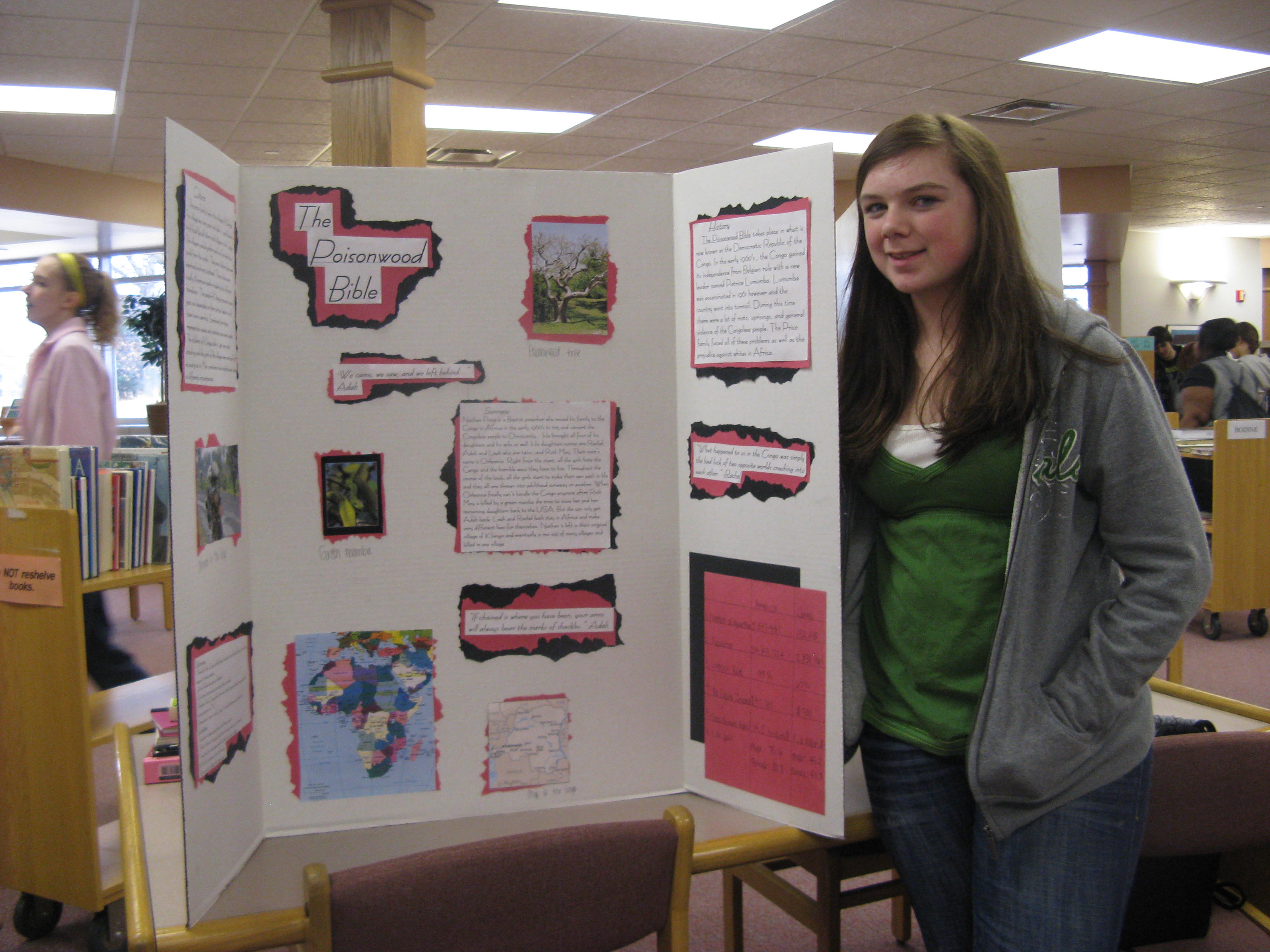
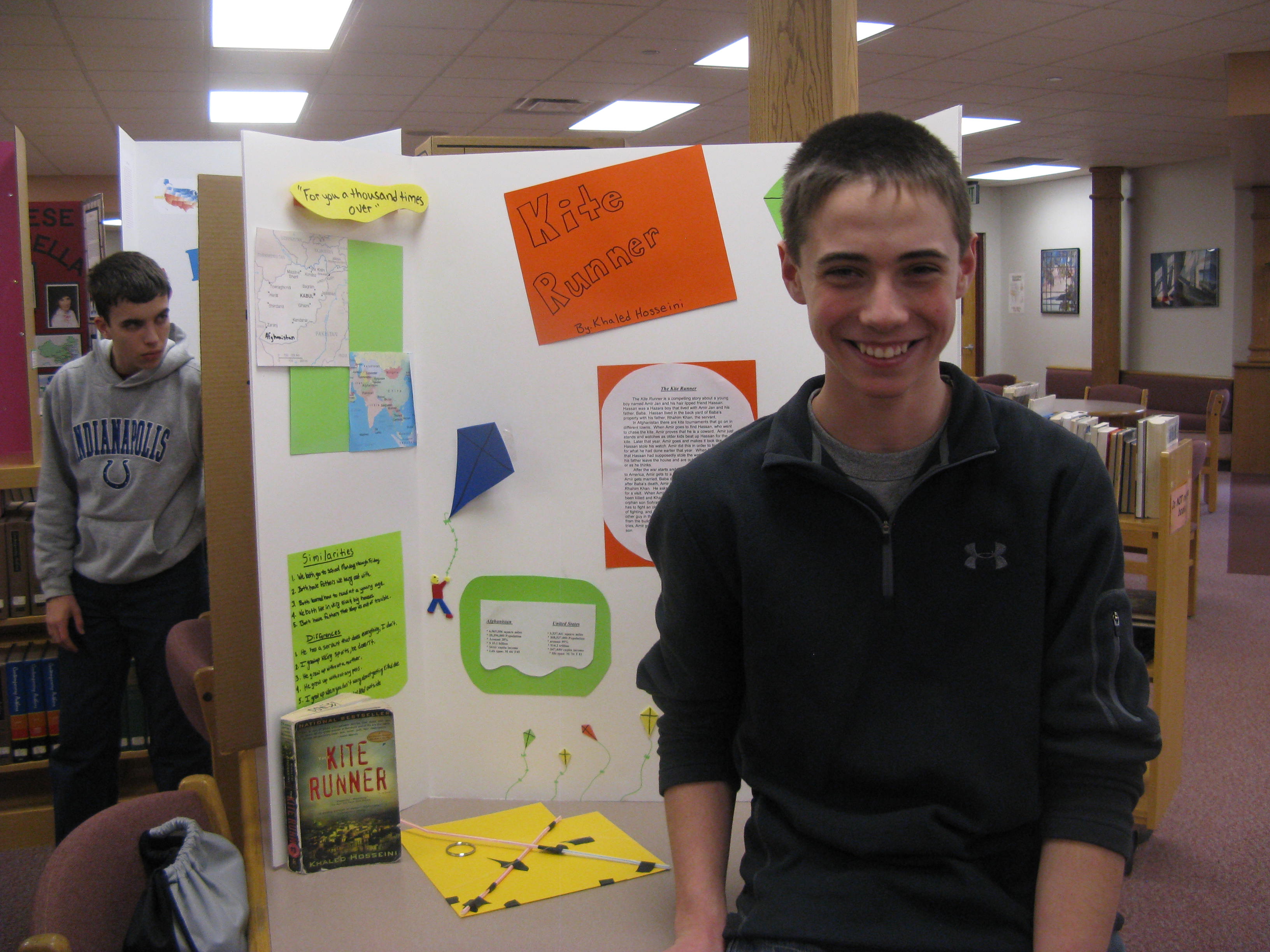
Next, each student creates a stand-alone, 3-sided poster—the kind that is used for science fair projects. The goal is to create a poster that makes the story as appealing as possible, but at the same time conveys something of the history and culture of the country portrayed in the book.

The poster must include

1.       Author’s name and title

2.       A summary of the book (about 300 words)

3.       Two maps—one of the country where the story takes place with the city or region highlighted and one of the continent in which the country is located.

4.       A paragraph about the history of the country during the time period of the book (again, about 300 words)

5.       A paragraph about pertinent religious or cultural characteristics of the particular cultural group described in the book OR a description of the relevant cultural characteristics of the country overall if the main character is not from an ethnic minority (not to exceed 300 words)

6.       A bulleted list of at least 5 differences and at least 5 similarities between a teenager growing up in Indiana and the character in the book.

7.       A comparison table showing the following pieces of information about the country or region compared to the United States:

  •  Number of square miles
  • Population
  • Literacy rate
  • Gross domestic product
  • Per capita income
  • Average life span (m & f)

But there can be more: Students sometimes include photographs, symbols, clothing,  3-DIMG_2782 objects or pictures of objects, or decorations that capture the feel of the country. They may include important sayings or proverbs from the culture, quotes from the book, other pertinent maps, or even their own assessment of the book or recommendations for other books with a similar theme.

The most successful posters are eye-catching and colorful, but even a student with little talent in art can create an appealing poster with some help from a computer and just the most basic understanding of design. I give the students these simple directions: Type your paragraphs, keep the design uncomplicated, use construction paper to frame the typed paragraphs, and be consistent with the fonts and point size.

IMG_2787On the day the posters are due, we set them up in the library and students give book talks about the work they’ve read.  I want them not only to summarize the story, but to connect the dots between the story they have read and the demographics, historical facts, and other statistical information they have gleaned.  I ask them to expand upon the similarities and differences that they have noted between themselves and the characters in the book.  Sometimes—for extra credit—they’ll offer their classmates “international fare”—regional food that they’ve prepared themselves (Parents have to sign a form indicating that their child actually prepared the food. I am not interested in giving Mom or Dad extra credit.)

Invariably, the students’ lists of similarities and differences are the most interesting part ofIMG_2793 the presentation. Depending upon what they’ve read, the students notice differences in family relationships, in family size, in the size of American homes versus homes in other countries. They’ll see disparities in possessions, in schooling, in opportunities. They’ll see differences in wealth, in medical care, in the availability of food; differences in transportation, occupations, and expectations. Some are surprised, even shocked by what they learn because some of these stories are violent and horrifying. Some are just plain sad. Resilience is a common theme. But for the most part, students also discover similarities between themselves and the person they are reading about, and those commonalities allow them to identify with the characters.

The individuals in the stories my students read have families that, like their own, love them, occasionally smother them, sometimes annoy them, always are important to them. They encounter teenagers from far away who also have dreams and aspirations; characters who respond to injustice and inequity just as they do; young men and women who are disappointed, delighted, rewarded or punished, teased or tolerated, loved or hated. They find kindred spirits in people from other countries—and learn that stereotypes are just that and outward appearances can be deceiving.  In short, they learn that what makes us human—our emotional responses to the people and events in our lives—is common to all of us, no matter where we grow up.

IMG_2796In the past, the posters have remained in the library for a month or so—long enough for other students to see them and perhaps be enticed to read one of the books for themselves. But even if their classmates don’t choose to check out a book, the posters attract attention and alert other students to a world larger than the one they know.  As for my students, reading a book about someone from another country helps them learn an opposite and important truth: The world is actually much smaller than they might have supposed.

In case you’d like to try this for yourself, here are the books on my shelf. You’ll need to check the reading levels and match the book with the particular student. Some of these are adult books, suitable for advanced readers; others are for middle schoolers.  If you know of a title I haven’t listed, please add to my list by commenting below. I’m always on the lookout for another good book.

FICTION     
Title  Author Country
Roots  and Wings Many  Ly Cambodian-American
Spud John  Vander Ruit South Africa
Power  of One Bryce Courtenay South Africa
A  Thousand Splendid Suns Khalid  Hosseini Afghanistan
The   Kite Runner Khalid  Hosseini Afghanistan
Bless   Me, Ultima Rudolfo  A. Anaya Hispanic/New   Mexico
China Boy Guss  Lee Chinese-American
In   the Time of the Butterflies Julia  Alverez Dominican Republic
Yo! Julia  Alverez Dominican Republic
How  the Garcia Girls Lost Their Accents Julia  Alverez Dominican Republic/ America
In  the Name of Salome Julia  Alverez Dominican Republic
The  Namesake Jhumpa  Lamiri Indian-American
The  Poisonwood Bible Barbara  Kingsolver Congo
The  Syringa Tree Pamela  Gien South Africa
The  Invisible Thread Yoshiko  Uchida Japanese-American
When  My Name was Keoko Linda  Sue Park Korea
The  Joy Luck Club Amy  Tan China   & Chinese/American
Habibi Naomi   hihab Nye Israel/Palestine
Snow  Falling on Cedars David  Guterman Japanese-American
Farewell  to Manzanar Jeane  Houston Japanese-American
Zoli Colum  McCann Romani   in Eastern Europe
Swimming  in the Monsoon Sea Shyam  Selvadurai Sri Lanka
NON-FICTION
                          
Stealing  Buddha’s Dinner Bich  Minh Nguyen Vietnamese-American
The House at Sugar Beach Helene  Cooper Liberia
First They Killed My Father Loung  Ung Cambodia
They  Took My Father Mayme  Sevander USSR
The Lost Boys of the Sudan Mark Bixler Sudan/Kenya/Ethiopia
There is No Me without You Melissa  Fay Greene Ethiopia
They Poured Fire on Us from the Sky Deng, Deng, and Ajax Sudan/Kenya/Ethiopia
When I Was Puerto Rican Esmeralda  Santiago Puerto   Rican-American
Leaving Mother Lake Yang   Namu China (Moso culture)
The Endless Steppe Esther  Hautzig USSR
Growing Up in Moscow Kathy  Young USSR
The Diary of a Young Girl Anne Frank Nazi-occupied   Holland
The Children of Willesden Lane Mona Golabek England during WWII (Jewish refugees: kindertransport)
All But My Life Gerda   Weismann Klein Nazi   Germany
The Bite of the Mango Mariatu   Kamara Sierra Leone
A Long Way Gone Ishmael   Beah Sierra Leone
The Kids from Nowhere George   Guthridge Eskimos in Alaska
Lipstick Jihad Azadeh Moareni Iran
The Price of Stones Twesigye Kaguri Uganda
A Beginner’s Guide to Acting English Shappi Khorsandi Iran/England

International Flavor

Last night was the 10th annual International Dinner at my high school. It’s a carry-in. The food is prepared by the students, and all of it is fare from the cuisines of countries other than the United States. This year’s spread featured beignets, potato latkes, pico de gallo with tortilla chips, borscht, rice and bean and zucchini casseroles, fajitas, German chocolate cake, and cookies and sweets from around the world.

The foreign exchange students proudly offered food from their home countries. This year the most exotic dish was Giorgi from Georgia’s khachapuri – dough stuffed with cheese and “fried” in the skillet in olive oil—a sort of stuffed crepe. He’d never made the dish before. Apparently, it was quite a feat. Two Chinese cooks on YouTube, speaking Chinese, provided a demo, and his host mother, my colleague, gave him a hand once they found the recipe in English.

After the dinner, there’s entertainment—sometimes a talent show, sometimes performances by World Languages students, sometimes games or simulations teachers have set up. This year, the French teacher—who plays the fiddle and the guitar—led the crowd in French and French-Canadian songs and taught the students a folk dance that involved a broom and dashing in pairs down an alley of other students lined up to take their turns doing the same thing.

These dinners began ten years ago as a social activity connected with the exchange program I sponsored then with a secondary school in Russia. Each year, 9 American students welcomed 9 Russian students into their homes and into our school. In June, we switched—I took the Americans to Russia. But in the fall, the Russians were with us. In those days, the American host families came to the International Dinner, too, and the Russian students provided the entertainment after the meal.

When the exchanges ended, the dinners continued. In fact, it was while the exchanges were active that my colleague (Giorgi’s host mother) and I initiated the International Club, an extra-curricular service and learning organization that is now the largest club in the school.

My colleague taught Spanish then, and she was the mother duckling around whom our slim number of Hispanic students flocked. During the years of the exchange, she and I took the Russian students, their American “brothers” and “sisters,” Spanish Club students, and Hispanic students on field trips to Chicago. Other students in the school became curious about and then interested in all our “doings.” The spirit of appreciation for other countries and cultures was growing in our school, and when the exchanges ended, we wanted that spirit to continue.

To do that, we founded the International Club. The first year, the membership was small—mostly the few kids who had been with me to Russia and a few others from my colleague’s Spanish classes—but today, the membership crowds 100.

The International Club, we decided, would have three purposes: Service, Learning, and Fun. Since then, the students have
• Made greeting cards for Russian students in Beslan following the terrorist attack there
• Contributed money and person power to clean-up efforts in Louisiana after Hurricane Katrina
• Electrified a school for the deaf in Isiolo, Kenya
• Raised the money for playground equipment for an elementary school in India
Furnished a school library in El Salvador with books and computers
Paid the secondary school fees for 6 years for a girl in Rwanda
• Raised money to send 10 secondary students to school in Burundi
• Made flags and alphabet posters for primary schools in Rwanda
• Collected toys for an orphanage in Haiti that was destroyed by the earthquake
• And this year, they are raising money for an elementary school in Cameroon

Fun we have had; learning we have done. But most of all, the students’ horizons have expanded and their interest in global affairs has increased. More and more of them are eager to travel to other countries during Spring Break; more and more of them tell me they plan to study abroad while they are in college. Friendships with international students have been forged and sustained. Best of all, most important of all, appreciation of other countries and understanding of people from afar has had the contagion effect I had hoped for when I first took kids to Russia.

My thought then had been this: If my students could get to know and genuinely like just one other person from somewhere else, if they could come to understand that we are more alike than different from those from afar, then that attitude would generalize to people everywhere. My students would accept differences; they would embrace diversity. They would not fear “the other.” The kids I took to Russia did more than “genuinely like” their sisters and brothers from Russia; they fell in love with their Russian families. The same thing happened to the Russian students—they grew to love their American families.

And such has been the experience of so many other students during these past 10 years. American students who have hosted exchange students have gone to European countries to see them again and meet their families. This year for the first time, one of our boys has gone on a year-long study abroad program. He’s in Germany, living with the family of the boy who lived with him last year in Indiana.

So, watching the students last night—Sylvie from Kenya dancing down the gauntlet with her friend from rural Indiana; Victor, whose family is from China, dancing with Lili, whose family is from Iran—I marveled and rejoiced at what has happened in 10 short years. Organizations like the International Club are usually personality-driven. They don’t have national charters, like Future Farmers of America, or an established purpose, like the Student Council. They aren’t recognized high school entities like the National Forensic League. They usually die when the sponsor withdraws.

But our International Club—unique in Indiana as far as I know—continues to thrive. In part, that’s because of the committed efforts of my colleague and two other teachers, who are now the sponsors, but it’s also because the Club itself has become institutionalized. It is a recognized entity in our school community. The activities are fun, the service projects are meaningful; the learning is measureable. Look how many were there last night!

And I was there, too—savoring international flavors and celebrating amazing friendships that extend beyond national borders.

How sweet it is.

Questioning the Quality

In Mark Twain’s classic Huckleberry Finn, Huck, the son of an abusive, alcoholic father, stumbles upon the Grangerfords, a family of some wealth. Huck calls them “the quality,” and at first he is awed by the Grangerfords—by their possessions, by their manners, even by the sentimental poetry of their dead daughter Emmaline. The Grangerfords, for all their “gentility,” have sustained a feud with their neighbors, the Shepherdsons, for countless years. When Huck’s new friend, Buck Grangerford, is killed in a shootout with the Shepherdsons, Huck realizes that the Grangerfords’ fortune and finery are quality only on the surface; underneath, these people are vengeful and brutal murderers. Their wealth disguises the poverty of their souls. Through the use of irony, Twain reveals the important truth that the family you are born into is not the determiner of character. True aristocracy is not about class, but character.

Harper Lee comes from the same tradition.

Here’s another selection from To Kill a Mockingbird, a passage from Chapter 13, shortly after Aunt Alexandra has come to Maycomb, unbidden, to keep an eye on Scout and Jem while the Tom Robinson trial is underway. In my 9th grade class, we’ve been talking about Harper Lee’s technique in revealing Atticus’s character, and this passage presents him in contrast with his sister, whose notions of Southern aristocracy run counter to Atticus’s fundamental belief in the equality of all people. Alexandra has asked Atticus to talk to the children about their background, but in this scene, Harper Lee lets the reader know how Atticus really feels about his sister’s notions of class superiority.

“How do you know,” I ask the students when I begin reading this passage aloud, “that Atticus is uncomfortable in this conversation? That the children are uncomfortable? As I read, pay attention to the details that tell you.”

Before bedtime I was in Jem’s room trying to borrow a book when Atticus knocked and entered. He sat on the edge of Jem’s bed, looked at us soberly, then he grinned.

Here I’d interrupt myself and ask, “What does this word soberly mean? We’ve already learned that Atticus doesn’t drink.”

It’s important to ask a question about a word like soberly. Many students have only heard the word in the context of drinking alcohol. Such a misinterpretation could seriously affect the way they read the rest of the passage.

Someone supplies the meaning—seriously—and I go on.

“Er—h’rm,” he said. He was beginning to preface some things he said with a throaty noise, and I thought he must at last be getting old, but he looked the same. “I don’t know how to say this,” he began.

Well, just say it,” said Jem. “Have we done something?”

Our father was actually fidgeting. “No, I just want to explain to you that—your Aunt Alexandra asked me—son, you know you’re a Finch, don’t you?”

“That’s what I’ve been told.” Jem looked out of the corners of his eyes. His voice rose uncontrollably. “Atticus, what’s the matter?”

Atticus crossed his knees and folded his arms. “I’m trying to tell you the facts of life.”

Jem’s disgust deepened. “I know all that stuff,” he said.

Atticus suddenly became serious. In his lawyer’s voice, without a shade of inflection, he said, “Your aunt has asked me to try and impress upon you and Jean Louise that you are not from run-of-the-mill people, that you are the product of several generations gentle breeding—“ Atticus paused, watching me locate an elusive redbug on my leg.

About here I stop again and ask the students to explain what “gentle breeding” means. It’s the central idea of the passage, so the meaning must be clear. The two words aren’t hard ones, but combined, they convey an entirely different idea than either word alone. Breeding, the students have little trouble with. But juxtaposed with gentle? Eventually someone hits on refined, or a similar word. But that produces puzzlement—until they remember Aunt Alexandra’s obsession with social status.

“It means you come from a high class!”

“It means you’re better than everyone else.”

“It’s snobby.”

“Gentle breeding,” he continued, when I had found and scratched it, “and that you should try to live up to your name—“ Atticus persevered in spite of us: “She asked me to tell you you must try to behave like the little lady and gentleman that you are. She wants to talk to you about the family and what it’s meant to Maycomb County through the years, so you’ll have some idea of who you are, so you might be moved to behave accordingly,” he concluded at a gallop.

Stunned, Jem and I looked at each other, then at Atticus, whose collar seemed to worry him. We did not speak to him.

Again, just in case, I stop to ask what collar seemed to worry him means. Some students have trouble with idioms, so this is a good chance to make the expression clear.

“He was doing like this,” someone volunteers. “You know, running his finger under it like this.” The student demonstrates. “But really, it means he’s uncomfortable.”

“Oh, yeah. That’s why he was talking so fast.”

“He was fidgeting, it says.”

“And that throaty noise. He’s coughing to clear his throat.”

“He’s nervous!”

Presently I picked up a comb from Jem’s dresser and ran its teeth along the edge.

“Stop that noise,” Atticus said.

His curtness stung me. The comb was midway in its journey, and I banged it down. For no reason, I felt myself beginning to cry, but I could not stop. This was not my father. My father never thought these thoughts. My father never spoke so. Aunt Alexandra had put him up to this, somehow. Through my tears I saw Jem standing in a similar pool of isolation, his head cocked to one side.

“One more detail that tells you Atticus is uncomfortable?”

“His tone! Scout says His curtness stung me.”

“What details tell us the children are uncomfortable?

“Scout says This was not my father.”

“Before that?”

“The comb. She isn’t thinking about what she’s doing. She’s thinking about what he’s saying and runs it down the dresser edge.”

“Before that?”

“She won’t look at him. She’s picking at a bug on her leg.”

“So she’s uncomfortable. Is Jem?”

“Yes, he’s looking out of the corners of his eyes at Atticus. Like he’s suspicious.”

“And Scout says he’s in a similar pool of isolation. That means she feels alone and he does, too. They feel like Atticus has left them. This isn’t the real Atticus.”

“What can you conclude about Atticus’s point of view? How does he really feel about being ‘a Finch’?”

“He doesn’t believe all that.”

And indeed, a few paragraphs later, Atticus tells the children to “forget it.”

Finally, a question to stretch the students’ understanding: “How do you think Harper Lee, the author, feels about this issue of background? Is she on Aunt Alexandra’s side or Atticus’s?”

“Well, she’s arranged the details so we think Aunt Alexandra’s point of view is wrong.”

“She’s presented the scene through Scout’s eyes.”

“Yes, that’s right. But is there something else—something in the text we haven’t focused on in this way?”

Sometimes I give the students a hint: It’s a bit of irony.

Then another if they haven’t hit upon it: “Gentle breeding—“

“Oh! All the while Atticus is talking about ‘background,’ Scout is picking at a bug. Then she scratches it.”

“She’s the opposite of refined!”

“And then the author writes gentle breeding again!”

Very sly.

“So what does Harper Lee think?”

“All that class stuff is a lot of hooey.”

Kids can spot prevarication and deception in a heartbeat, so they have no trouble grasping the tenor of this passage and little difficulty seeing that the passage underscores, in the end, the integrity of the hero. What they need help with is understanding the craft of fiction and explaining how the author made her point and revealed her attitude. How any author makes a point. That is done with questions, questions whose answers are grounded in the text. Asking them is the teacher’s job. Answering them, the students’.

Yep. “The quality”: A lot of hooey.

In the tradition of Huckleberry Finn.

Always the Kids

The final bell had rung, the halls had emptied, and a small 6th grade boy struggled with a Trapper Keeper, three heavy textbooks, and his trombone case. One or the other kept falling out of his arms.

“Can I help you with some of that?” I asked.

“Yes, please,” he answered.

“Are you trying to make the bus?”

“No, my mom is waiting for me. “

So we made our way together down the long hall, chatting about school, his homework, his family’s plans to celebrate his grandmother’s birthday that evening.

He was open and trusting because even though I was a stranger, I was obviously a teacher.

I delivered him with a smile to his mother.

It was a small encounter, but a significant one for me. When I turned away, I felt that I was part of the staff, a teacher of children again.

In another school, a teacher came to me and asked if I could help an 8th grade girl in her study hall find a library book. “She’s read all the Wimpy books, but she says she doesn’t like to read. I know it’s not in your job description, but could you help her? I’m not an English teacher.”

Of course I would try. The student and I went to the library. I had never seen a Wimpy book, but quickly learned that the series features engaging graphics and fairly large text in a font that replicates a child’s printing. The Wimpy books are humorous stories about a middle school boy whose struggles are the same as the ones the kids who read these books experience.

“What kind of stories do you like?” I asked. And she responded in the way I expected.

“About real kids. I don’t like made-up stuff.”

So no Harry Potter (She didn’t even like the Harry Potter movies), no vampires, no princesses, no science fiction. The school’s library had graphic novels—but only classics like Robin Hood and King Arthur.

“Can you tell me why you don’t like to read?”

She was unusually aware. “It’s the way the print is on the page,” she said. “It’s all blocky and together.”

Sure enough. Every book she rejected had conventional print. In every book she liked, the spacing between the lines was wide and the right margin was not justified.

We found several books that met her requirements. She picked one, and I took her back to study hall. On the way, she told me she is supposed to get glasses.

In my own high school, where just a few months ago I was the one at the front of the room, I had a chance to co-teach with a colleague. It was an AP history class, and we were working with the students on writing thesis statements, the first step in learning to write the elaborated but precisely constructed essays that will be required for students to earn a high score on the tests they’ll take in the spring. We had planned the lesson well, and my colleague is a star, so instruction unfolded like a ballet: perfectly choreographed, graceful and smooth in its delivery.

And yet, my very favorite moment came when a student who had grasped the concept of a thesis and the way each part of the statement previews a point that will be developed in the body of the essay, raised her hand and asked, “But what if you don’t know the information?”

My colleague and I chuckled.

“That is what all this means. You will have to do the job of learning.”

And we, the job of teaching.

In my new role as an instructional coach, I have met with teachers in secondary schools throughout my district. I’ve talked with them individually, in small groups, at whole faculty meetings. I have met outstanding educators and seen some spectacular teaching. I have been warmly welcomed, my calendar is full, and I feel valued and productive. I love supporting other teachers. I love my new job.

But there is something I have to get used to.

I wrote in August about my “phantom limb”—my impulse to plan lessons, develop units, create curriculum. Now that school has started, I’ve discovered another missing limb—and it’s the kids. Interacting with them makes me feel like a teacher. So I’ll grab every chance I get to co-teach, to find library books, to carry trombone cases.

I am a teacher.

I always will be.

What’s the Point?

Last year, I began experimenting with learning objectives. I wrote them on the whiteboard every day all semester long. (I first blogged about this topic last February in a post entitled The Last First Day of School.)

The experiment started because my district began requiring teachers to post their learning objectives every day. The objectives, it was explained, should be clear, concise statements, written in kid-friendly language, of the learning goal for any given day in each class.

I wrote objectives all the way to the end of the year. In fact, I even took photographs of my whiteboards so I could use the examples when I was working (this year) as an instructional coach. I wrote some dreadful learning objectives and some good ones, some long ones and some short, most of them for the one day and a few that extended for several days.

Here is what I learned:

1. It isn’t as easy as it sounds.

For example, distinguishing between the activity and the learning objective sometimes tests one’s own understanding of the lesson. Consider a few simple objectives first:

Using examples from Huckleberry Finn, students will identify and explain three kinds of irony. Specific. Concrete. It’s easy to write because it’s at the recall/comprehension level on Bloom’s Taxonomy. What did we do in class? Students already had the definitions of three kinds of irony. I gave them a sheet full of examples and they had to match a type of irony with an example. The tricky part was explaining to me why an example was a certain kind of irony. Comprehension.

Or this one even: Students will understand how a sentence outline sequences information and clarifies the relationships between and among ideas in the outline. [Kid-friendly language, by the way, would have that reading this way: Students will understand how sentence outlines work.] I started by showing the students a topic outline that one of them had submitted to me for feedback. I had no idea what the student was going to say about any of the topics in the outline and no clue how one idea related to another. So, to show them how a sentence outline would have communicated the student’s ideas more clearly, I xeroxed and then cut a sentence outline into strips of paper, gave each table a set of strips, and asked the students to reassemble the outline by following the internal logic of the sentences. This one is also at the comprehension level of Bloom’s Taxonomy.

But what about something more abstract, something at the analysis level? What if the assignment is to read, say, Chapter 11 in To Kill a Mockingbird? If I write Students will read Chapter 11 of To Kill a Mockingbird, then what I am writing is the assignment. If I write, Students will discuss Chapter 11 of To Kill a Mockingbird, then I am describing the day’s activity. I need to write something like this: Students will understand how Atticus’ definition of courage is the standard he will have to live up to. Or, if that is too explicit and gives away the discussion, Students will identify the key idea in Chapter 11 and be able to explain how it sets up a standard for behavior. Or whatever you or I, the teacher, want to emphasize. In other words, I have to think through the discussion and figure out what I want the students to take away from it.

I started to think of the learning objective as a purpose statement, or the point of the activity, and that made articulating the objective easier. It also took me longer then because it required more thought on my part.

2. The activity is the means to an end, not the end in itself.

Well, most of the time. In truth, sometimes the activity itself is the point. Write a bibliography. Park a car. Practice the music for the school concert. Dribble a basketball. In all of these activities, perfecting one’s performance is the goal. The student learns by doing: application level on Bloom’s. The clue to these is the “how to.” When you start writing The student will learn how to…, you know you’ve got a performance. The student will learn to dribble a basketball. Purpose and activity.

3. Sometimes, students shouldn’t see the objective ahead of time.

Science teachers especially have taught me that you don’t always want the objective up on the board at the beginning of the class period. In inquiry learning, they tell me, students figure things out for themselves. I, with my biases about constructivist learning, certainly appreciate that! Given our mandate about posting objectives, what can the teacher do in cases like these? My advice has been to write the objective on the board, but cover it up—or put it at the end of the PowerPoint presentation on the lesson—or write it in the plan book. Somehow, have it there so that the principal can find it if he (or she) comes in. Have it there so that, at the end, the students can check their perception of what the day’s learning was all about. As one teacher suggested to me, put it under the pull-down map. Just remember to pull the map up at the end of the lesson.

4. The learning objective is really there for the kids.

We make the mistake of assuming that kids get the point of a lesson. We know why we have them do whatever we have them do. We know what they should take away from the day’s activity. But do they? We can’t be sure even if we tell them. But stating the purpose in writing goes a long way toward assuring that understanding. Of course, the objective has to be written in letters large enough for students to read from across the room, and it does need to be written in kid-friendly language. The teacher also has to make the connection to the objective: Point it out, refer to it, match it to subsequent quiz questions. We know we have to alert students to assignments that are written on the board. Objectives are no different.

I am still learning about learning objectives, but so far, here’s my response to the multiple choice question I posed in February:

So on with the experiment. Stay tuned. I’ll let you know if A) I can keep it up, B) the principal finds it helpful, C) the kids benefit from the explicit statement of the goal, D) it continues to be a challenge to me to focus my thoughts and articulate them, E) all of the above.

The answer is E.

Going for Gold

• The bell rings before you reach the lesson’s close.
• A befuddled question from a student translates into a moment of clarity for you: The student doesn’t understand. You’ll have to back up and start over.
• Kids aren’t listening, so you interrupt the lesson to redirect them. But then other kids lose the thread because your intervention is far more interesting than the lesson.
• Your explanation is unclear. You’ve even confused yourself.
• Three boys are spending more time fooling around than completing the task at hand. You shouldn’t have put them in a group together. But too late now. The lesson is underway and there isn’t much you can do.
• The technology fails–the ENO board won’t work right, perhaps, or a bulb blows on the overhead–and your lesson depends on the technology. You spend 10 minutes trying to get it to work. It never does. Worse than that, you lose your cool.
• Eye rolling and snickering from teenage girls: it’s unnerving and makes your knees jump. You can’t shake them off, and you can’t concentrate on your lesson, either.
• The activity you planned is too complex–the kids are not moving into and through it smoothly.
• A parent calls to register a complaint that seems to come out of left field. How could you have anticipated that?

Plenty of things can go wrong every single period of every teaching day. A teacher is a human being interacting with thirty other human beings every period. That can mean 150 kids—sometimes even more—in the course of a day. There’s a text to be understood, a concept to be explained, or a skill to be taught—and an array of technological supports that can fail at any time. When any one of the infinite number of variables goes wrong, any teacher is troubled.

I have experienced every one of the scenarios sketched in the text above.

Imagine if all them (or even just several) happened on the same day. A novice teacher could easily be thrown: her confidence shaken; her resolve, dissolved. Even one such incident can haunt a beginner, and one hour that goes badly can color the whole week. You can feel like a failure within a very short time.

I remember spending one whole weekend, when I was a beginning teacher, obsessing over something that happened on a Friday afternoon and second-guessing my response to it. I had had a “horrible week,” I declared to my husband, but in reality, I’d had one bad incident on Friday. By Monday, whatever had happened had been completely forgotten by the students, and I felt silly for letting it ruin my weekend.

This fixation on failure happened to me more than once. I’d let one or two “disasters” during a week dominate my assessment of myself as a teacher. The optimism and confidence I’d started the year out with were soon gone, and I really was in danger of failure. What was I going to do? I wanted to be a teacher. I wanted to make a difference in the lives of children—and not a negative difference, either. After a lot of fretting and frustration, I hit upon a strategy for dealing with disaster: I created a mental calendar to set the record straight.

It was like this: I taught six classes a day, five days a week, so (I told myself) there were thirty chances for success. Each week began with—in my mind—a blank white page gridded like a calendar: five squares across, six squares down, one for every period I taught. If a period went well–nothing spectacular, but nothing awful, either—the square remained white. If a class went badly, I colored the square black. But if the class went well, I made the square yellow, a cheerful color, one most people associate with happiness.

The object, of course, was to achieve a solid yellow page. In the beginning, I was gratified if there were no black spots on the grid. A page that was still white by the end of the week was a huge relief, and on the few intermittent yellows, I rode high. Gradually, my grids started looking like a case of measles—my yellow squares were sprinkled throughout the week. A whole day that was solid yellow was cause for rejoicing; a week of yellow–which took a long time to achieve—provoked a celebration equivalent to the Fourth of July. As time went along, the black days disappeared and the yellow ones dominated. Occasionally, one of those dreaded black marks did occur, but because of the grid, I could put that period into perspective. It was one period in a matrix of thirty opportunities. Not the whole picture, not a portrait of failure. My confidence increased, square by square, and with the confidence, guess what? More and more yellow squares began to appear.

Naturally, as the years passed by, I raised my standards, expected more of myself. Yellow became the new norm. I started going for gold. My explanations became clearer and were illustrated with examples kids could understand. I learned how to structure groups and keep students on task. Through trial and error and a lot of deliberate action, classroom management moved from nightmare to second nature. I learned about learning styles, adjusted my instruction for students at various levels, developed better questioning techniques and pacing strategies. And so on.

I got to gold. One square at a time.

I tell this story now to beginning teachers and others who are temporarily off their stride. Be gentle with yourself. Don’t let one bad day spoil the weekend. Don’t let one bad hour define you. You’ll get to yellow. One square at a time. And then you’ll go for gold.

A Grammar Lesson

From To Kill a Mockingbird by Harper Lee:

Daylight…in my mind, the night faded. It was daytime and the neighborhood was busy. Miss Stephanie Crawford crossed the street to tell the latest to Miss Rachel. Miss Maudie bent over her azaleas. It was summertime, and two children scampered down the sidewalk toward a man approaching in the distance. The man waved, and the children raced each other to him.

It was still summertime, and the children came closer. A boy trudged down the sidewalk dragging a fishing pole behind him. A man stood waiting with his hands on his hips. Summertime, and his children played in the front yard with their friend, enacting a strange little drama of their own invention.

It was fall, and his children fought on the sidewalk in front of Mrs. Dubose’s. The boy helped his sister to her feet, and they made their way home. Fall, and his children trotted to and fro around the corner, the day’s woes and triumphs on their faces. They stopped at an oak tree, delighted, puzzled, apprehensive.

Winter, and his children shivered at the front gate, silhouetted against a blazing house. Winter, and a man walked into the street, dropped his glasses, and shot a dog.

Summer, and he watched his children’s heart break. Autumn again, and Boo’s children needed him.

Once they understand that Boo killed Bob Ewell, another issue looms for the students. We haven’t talked about Boo’s motive for stabbing Bob, and by now they realize this: Every action has a motive. Of course the students know Boo cares about the children. He leaves gifts for them in a live oak tree (until his brother Nathan cements up the hole): a broken pocket watch, a spelling medal, soap dolls, chewing gum, and other artifacts of a young boy’s life. But how deep is this caring? What is its nature?

The answer is in the paragraph above, which appears at the very end of the book when Scout is standing on the Radley porch. I read this section slowly, carefully—sometimes two times before anyone notices the author’s sleight of pen.

Finally, this comes, sometimes tentatively, sometimes in an explosion of understanding:

“’Boo’s children needed him.’ He thinks of Jem and Scout as his children!”

“He left presents for them in the tree.”

“The pocket watch! Fathers give their sons their watches.”

“He put a blanket around Scout at the fire!”

“But the text says ‘A man walked into the street, fired a gun’: That’s Atticus.”

“This is confusing.”

I ask them then to think about what the author has done and to find the exact place in the text where she does it.

“She says ‘his children’ and we think Atticus.”

“But she means Boo. We assumed Atticus…”

“Because all the details are about him!”

“Because he’s their father!”

“Because we know the rule!”

We’ve been talking about pronouns for some time. I’ve pounded the rule into their heads, and they can recite it from memory: Every pronoun has an antecedent with which it must agree in case, number, and gender. Antecedent comes from Latin: ante (before) and cedere (to go). The term makes perfect sense: The antecedent comes before the pronoun.

“The true antecedent comes after the noun here!’

I can almost hear low whistles.

Slick.

They like it.

And they understand the depth of Boo’s feeling. He cares for Scout and Jem as a parent does—and parents would do anything to protect their children. Even put themselves at risk to come to their children’s rescue.

So in a way, this lesson, just like the last one, is about the danger of making assumptions—and this blog entry is a plug for grammar instruction.

Sure, the students could “get it”—could understand they’d been misled—without knowing the rule. I could have said that the author just flipped the men’s names to create an effect. But the trick is more subtle than that. Atticus’ name is never used. Understanding the technicalities of Harper Lee’s maneuver reveals to the students—maybe for the first time—that author’s craft their work. Understanding precisely what occurred in the text tells the students that writers are deliberate.

I’m not saying no teacher will ever have to visit pronoun antecedents again with these students. No, it takes repeated interactions with any concept to make the point indelibly. But being able to use the language of grammar to explain the author’s technique gives students a sense of authority, of control over language.

We want students to do close analysis of text—meanings of words, arrangement of details, syntactical analysis. Grammar helps us do this.

All by itself, though, grammar instruction can be pretty dull for a whole lot of kids. Granted, there are some who take to it. (Believe it or not, one year I met after-school with a group of grammar devotees who called themselves “The Diagramming Club.”) But for most young students, we need to hang our grammar lessons on some kind of hook.

Harper Lee’s is a classy one.