Teach Me How

Once, in Rwanda, I was working with the English teachers in a secondary school in Kigali on the rules for punctuating compound sentences. I had handouts, visual aids, and even a graphic that illustrated a fairly clever way to remember the rules. But, I had run out of practice sentences. We were in the school library at the time—a room with very few books but many long tables and benches to accommodate the 50-60 students in a class. As I pondered how to produce more practice sentences quickly—without the aid of a blackboard—I glanced at the shelves and saw, to my surprise, a familiar text—Writer’s Choice—a book I had used in my own high school in Indiana some years before. In fact, a whole class set—two class sets—were neatly arranged on the shelves. I got up from my seat at the table and retrieved a copy for myself and one for each teacher.

The texts had been sent from a school in Florida to this school in Kigali as a charitable donation. A gracious one, indeed—but the books had never been used. They’d been on the shelves since they had arrived. The English Department Chair shrugged when I asked her why.

I didn’t belabor the point. I just turned to the index and searched for the page numbers that corresponded with compound sentences. We all turned to the appropriate page, and I resumed my lesson.

When I was finished, the teachers began asking questions. Did this book teach capital letters? Did it teach spelling? What about other comma rules? Could I show them how I found the sentences I had been looking for? It dawned on me, suddenly, why these books had not been used. These teachers weren’t accustomed to using textbooks in the first place, but more importantly, the books themselves were baffling. They didn’t understand how our thick and elaborate American textbooks are laid out: sequenced chapters with the rules and their exceptions, each rule followed by several dizzying sets of practice sentences and quiz sets; elaborate but confusing color-coding; distracting sidebars; and suggested links to related lessons located half an inch farther into the text. They didn’t know what an index was.

Once I showed them how to use the book, the teachers were absorbed, turning the pages avidly, asking each other questions, discovering with delight the explanations for rules they themselves weren’t sure of. It wasn’t long before the English Department Chair turned to me and said, “I see now that these books are very useful.”

An impromptu lesson in how to use a textbook was more critical—and probably more lasting—than the fancy lesson I’d prepared on compound sentences.

That experience with the Rwandan teachers sticks with me because it reinforced something I’ve known for a long time but sometimes lose sight of: Process is as important as product. Mastery of process yields confidence, an attitude that is, for a young learner, far more important than content knowledge. It is confidence that enables a student to shoot for the stars. Students reach high when they are comfortable with what they’re doing, comfortable with the process. Actually, don’t we all?

It’s intellectually interesting to identify content we want our students to learn; it’s fun to develop the blueprint for a culminating project. But it’s easy for us to overlook the importance of teaching processes. How to use a database. How to run the grammar checker. How to summarize. How to use Turn It In (an online plagiarism prevention site). How to give a speech. How to make a poster aesthetically pleasing. How to write a business letter. How to set up a Works Cited page.

Sometimes the process we need to teach is a basic one. For example, part of the Unsung Heroes project (which I wrote about a few weeks ago) is learning how to write a handwritten letter. My students write thank you notes to their heroes for the time spent interviewing them and invitations to the celebration we hold when the book is published. I insist they do this on stationery, in ink, by hand. Every year I have to teach my students how to address an envelope. I used to have to show them how to find an address in the phone book. Now it’s how to find an address online. But now they know—and they won’t shy away from handwritten notes in the future. In fact, they think they’re pretty cool.

Other times, though, the process is complex. For example, English teachers are charged with teaching research skills so students can produce what used to be called “the term paper.” What we are teaching our students is a very lengthy process: choosing a topic, finding resources, reading and understanding those resources, evaluating them, writing an annotated bibliography, formulating a thesis, combing the readings for evidence to support the thesis, and then writing the paper itself–clearly, coherently, correctly—even elegantly. And finally, that miserable Works Cited page—how to do that systematically so the bibliographical entries match the internal documentation. It’s an enormous process, and at my school, we lead the students through it at least once each year. Their papers often reveal that they don’t quite understand their topic. They may treat it superficially or focus on something trivial. But really, these fledgling scholars are to be congratulated at the end: they’ve gained experience with a difficult and lengthy process that will be second nature to them when they get to college—where the content will really matter.

Sometimes we forget how important it is to teach the “how-to” part. We have a way, in our eagerness to share our own excitement about a topic or an idea, to presume in our students skills they don’t have, just as the people who sent the textbooks to Rwanda presumed the teachers there would know how to use them. We sometimes assume familiarity, make assignments our kids don’t know how to approach, or confuse them with complexity. In our enthusiasm, we don’t break a process down—or we skip teaching it altogether—and leave our students puzzled rather than confident. I’ve done it myself too many times—but I’m learning. Teaching well is a process, too.
Night in Rwanda

2009.04.15 Honors 9 Pattern of Genocide 016I have taught Holocaust literature—Night, The Diary of Anne Frank, The Children of Willesden Lane—for many years. But I cannot teach these books in the way I usually teach literary works of art. Granted, these books are not fiction, so I am spared having to chart the plot line. I know there are motifs and images and definitely themes—but my point has never been, in teaching any of these accounts, to reveal the writer’s technique. Putting such a text under the microscope of literary analysis would distance the students from the story, and I want them to hold close the visceral response they all have when they read, say, Night. Discussing Wiesel’s imagery as if he had sat down deliberately to craft a work of art instead of to tell his horrifying story to an unconscious world would be—to my mind—a sacrilege. As story, his journey through hell penetrates our unconsciousness and sears our souls. Ironically, what I could do would destroy its impact, and that I cannot do.

But the Holocaust must be taught. Genocide must be admitted and discussed. Here is what I do instead.

Most students, when they first learn about the Holocaust, do not immediately see the connection between the tragic events of WWII and their own lives in the 21st century. They think that genocide is a distant horror. But we, the adults, the teachers in the room, know about Darfur, where genocide is so fresh. We know about Cambodia, Bosnia, Rwanda, and other places that in recent history have served as the stage for mass murder.

I have been to Rwanda. My first trip there, in 2006, was undertaken specifically to study the genocide of 1994. I wanted to understand the causes and the chronology of the Rwandan genocide to see how it compared with the unfolding of the Holocaust. I learned very quickly that genocide doesn’t just happen. In fact, it follows a pattern, one that I have taught to my students ever since. (I am indebted to Gregory Stanton at Genocide Watch for his work in revealing this pattern, though I simplify it somewhat for 9th graders.)

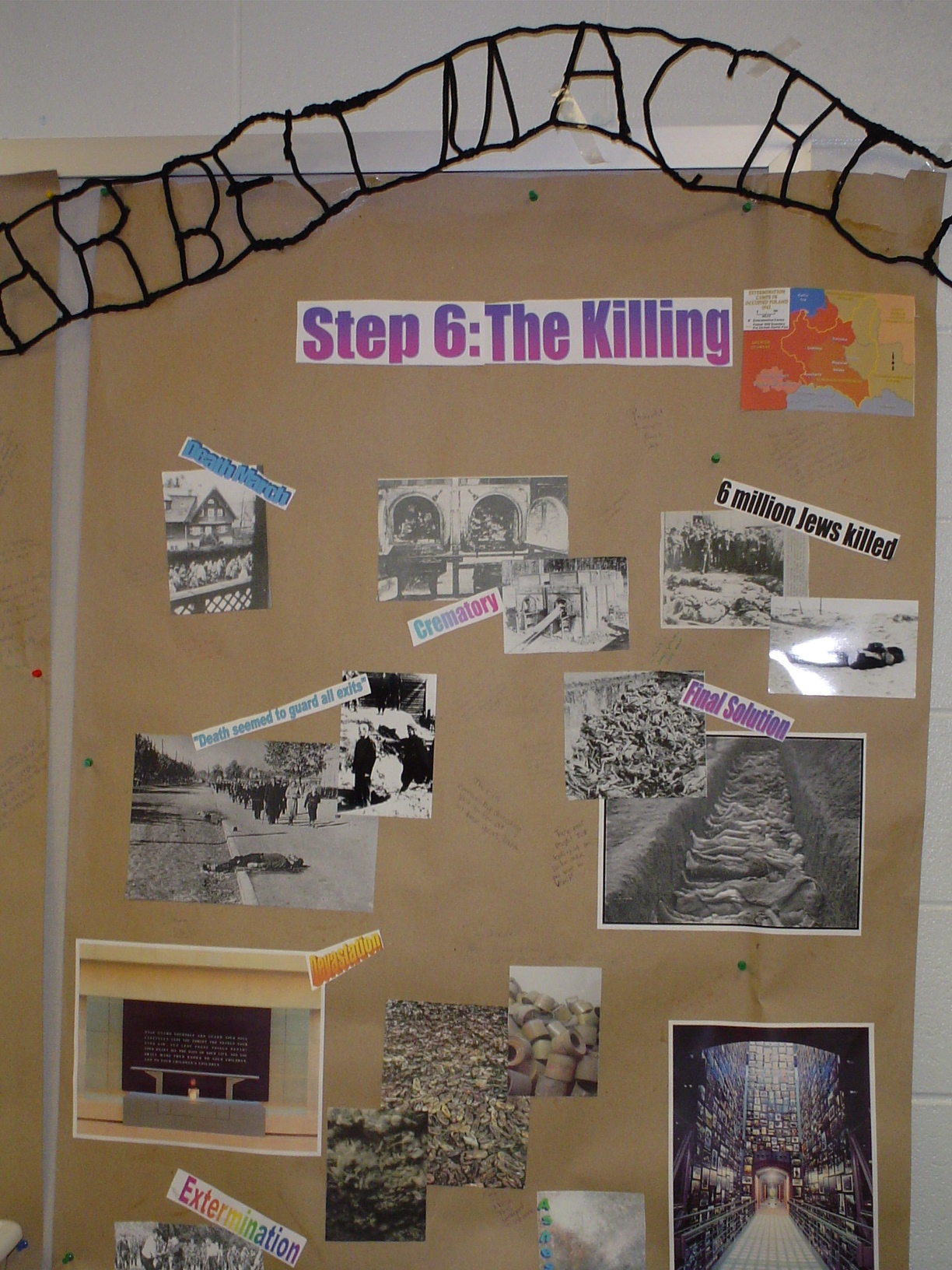
Genocide always begins with prejudice. A power group, for a variety of reasons, marginalizes, discriminates against, isolates, and ultimately demonizes a minority. The climax is the killing, followed by a strange denouement, denial.

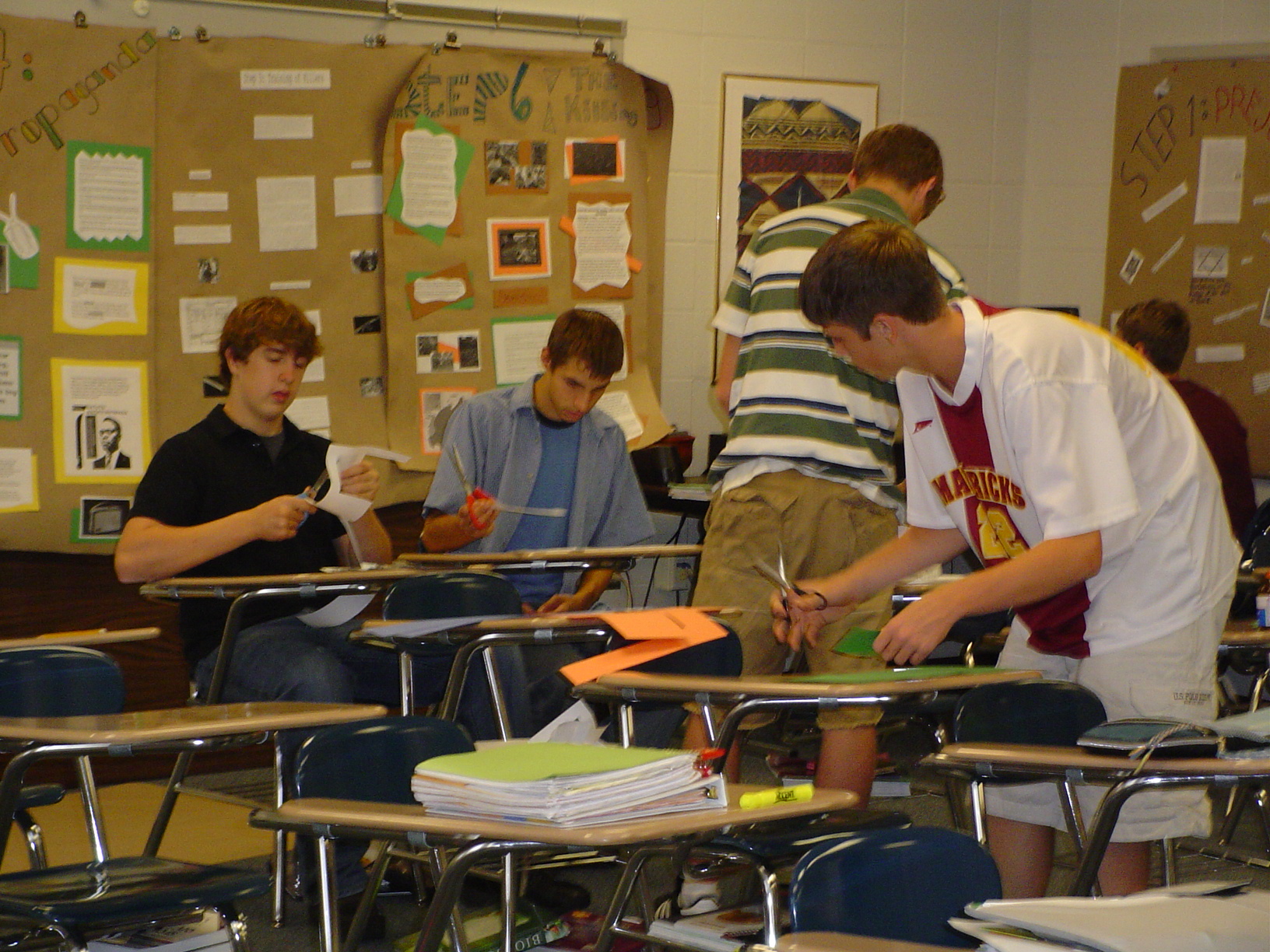
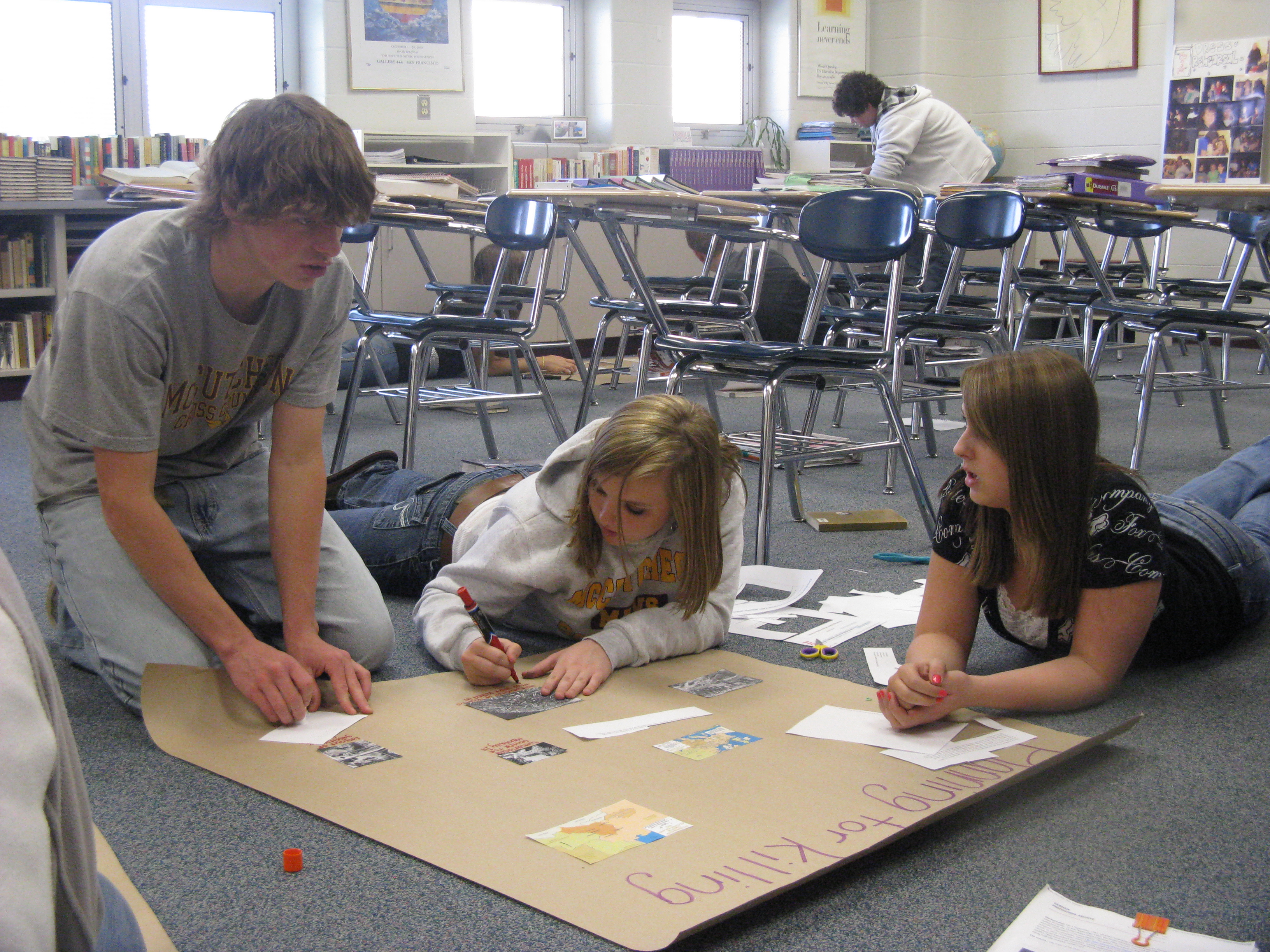
My students read Night first. They read it without a lot of preface, and they are full of questions during the three short days it takes them to finish the book. By the end, they want to know more, and it is then that I send them on a research mission. The students work collaboratively to construct poster essays that will reveal the pattern of genocide. They draw straws to form groups, and I give each group a title for the poster—the name of a stage in the pattern—and a few keywords to get them started. For the next several days, my room resembles an art studio—construction paper, scissors, rubber cement, watercolors, and magic markers dominate the landscape. Kids cluster around the tables, lie on the floor. They labor over their posters, placing pictures precisely and writing captions that capture the essence of the photographs they’ve downloaded. They know that what they are researching and presenting in their posters is too important to treat superficially, and their posters powerfully illustrate the progress from prejudice to mass murder. Pattern of Genocide 002 2009.04.15 Honors 9 Pattern of Genocide 020 Pattern of Genocide 004

We put the posters on the board and discuss the order in which they should be hung: Prejudice, Legal Discrimination, Separation and Isolation, Preparation for Killing, and Extermination—and the one that could be hung anywhere and everywhere along the continuum: Propaganda.

Then, after a brief introduction, I instruct them to repeat the research—this time researching Rwanda. They create, again, poster essays that depict the progress of the genocide there—from the identity cards issued by the Belgians when Rwanda was still a colony to the hate radio broadcasts that mobilized the Interahamwe.

Pattern of Genocide 012They hang the posters side-by-side on the whiteboards in my classroom: the Holocaust and the Rwandan genocide. I am not interested in discussions of scale—it’s not that kind of comparison. I am interested in the pattern.

By studying the Holocaust and the Rwandan genocide side-by-side, my students come to see that neither was an aberration of history. By studying the pattern, they realize that genocide has its roots in attitudes that show up in day-to-day interactions, the kinds of discriminatory behaviors they themselves encounter not just in the evening news, but in the lunchroom, on the playground, in the halls, in gym class. Sometimes we call it bullying.

My students come face-to-face with the pernicious effects of prejudice in their study of these two genocides, and they understand the importance of speaking out against ethnic jokes in the lunchroom, bullying in the halls, discriminatory laws in their state and country, and unfolding events in places like Sudan. They understand the moral imperative to be inclusive rather than exclusive, to accept rather than reject.

My students see that they can work to prevent genocide by voicing opposition to the prejudice they encounter and by engaging in activities that promote peace and understanding—both locally and globally. Sometimes it is as simple as writing letters to their Congressional representatives, to the Secretary-General of the United Nations, to the President. We live in a democracy where it is our right and our duty to let our voices be heard, to be “upstanders” for justice, not voiceless bystanders in the face of evil—and this responsibility becomes real for them.

This past week, at the United States Holocaust Memorial Museum, Elie Wiesel and President Obama spoke about genocide prevention. In fact, on the very day my students and I were having a discussion about what they could do personally to combat the forces of prejudice and discrimination, these two men were discussing what the nation could do. I watched the video that night at home: My students had said many of the very same things these compelling leaders had said. I showed the video the very next day.

Genocide survivors tell their stories—in books, films, and essays—not to create works of art that will make them famous, but with the hope that the lessons of their nightmares will not be forgotten, that people of conscience will work to stop incipient genocides before they occur and to speak out against ongoing tragedies. Teaching our children what they can do to combat evil in the world is work that teachers can do, must do.

Pattern of Genocide 010

Pinterest, Sort of

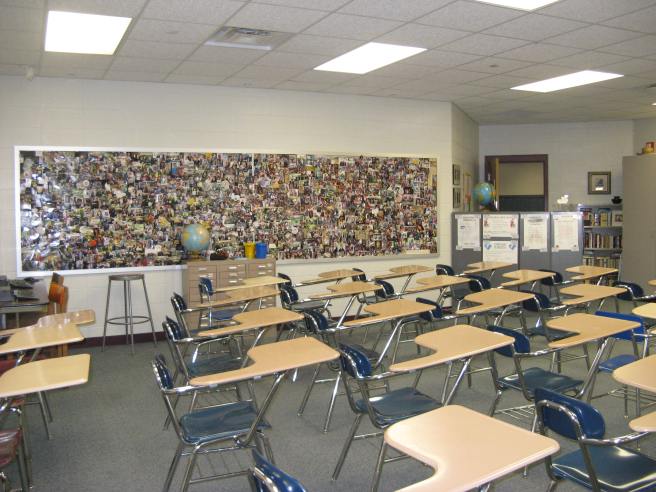
Years ago, students began giving me pictures of themselves. They would slip them into their graduation announcements, leave them on my desk, or simply hand them to me. I tacked the first few on the bulletin board. The result? More pictures came my way. The board began to fill. Eventually, all the bulletin boards in my classroom were covered with pictures of kids—except for one section behind some bookcases.

• Eric, who read Shane in the 11th grade–the first book he’d ever read cover to cover.

• And Twila, the first person in her family to attend college…oh, how she loved to read.

• Kelly, who rarely spoke in class, but had enormous writing talent. One day when she was absent, I read her story aloud.
“Who wrote that?” asked Brandon. He always spoke his mind.
“Kelly.”
“She ought to speak up more,” he said.
I agreed. “Someday she will,” I said. She wanted to be a minister.

• Masooda, a refugee from Afghanistan: She spoke no English at all when she first came to my class. We started with pictures she would cut from magazines. By the end of the year, she knew enough English to give a speech to her incredulous classmates about Afghanistan and her escape to America.

I used to joke with my students that when the bulletin boards were full, I’d retire. Since I was much too young for that, I simply moved the bookcase. Then I myself moved—to a new classroom where even more capacious bulletin boards filled one entire wall. I kept adding pictures.

IMG_3252

• The Russia Travelers: 27 American kids and 27 Russian ones—all of them participants in the academic exchanges that opened our eyes and forever changed all of our lives.

• Allie, who was my student aide for three years and knew me so well she practically ran my classroom the year I had to take a short leave.

• Another Brandon, this one the boy who took up my challenge and spent one whole night bringing his Turn It In score down from 26% to zero. “Mrs. Powley! How’s it going?” he’d shout out exuberantly every day when he came into class.

• Maggie, sliding into home base in a picture clipped from the newspaper. She loved to hear me read out loud.

A year and a half ago, I switched classrooms for the last time. There is very little bulletin board space in my new room—just yards and yards of whiteboard. So the pictures—which it took two teachers and four kids several hours to untack and place in a gigantic box—are already packed to go home with me when I leave the classroom at the end of this year to become a full-time Instructional Coach.

I’ve nurtured these students. I’ve challenged them; I’ve believed in them and helped them grow. I’ll never forget them, but I’m glad to have the pictures.

Funny how something so little, given and taken so casually—a senior picture, a snapshot from a field trip, a photo that was in the newspaper—can be so weighted with meaning.

I haven’t had trouble culling my files. I’ve been happy to pass my books along to my colleagues. Maps, posters, decorations: I’m glad they have new homes. But the photographs? They’re coming with me.

B-I-G

She came to me in her junior year—rough and brash and scared. She wasn’t a reader; she wasn’t a writer. She wasn’t a student at all. But somewhere she’d gotten the idea that the only way out of the harsh life she had known was through education. Her family certainly didn’t think school mattered.

Once she had asked her mother how to spell “enormous.”

Her mother answered, “B-I-G. That’s good enough.”

9th and 10th grade General English had been unchallenging, and she didn’t think she was going to get the education she craved in the 11th grade class to which she had been assigned. It promised to be another slow-paced section where no one did the homework and the books were never opened. So she signed herself up for a tougher class in hopes that someone would teach her something. Her mother told her she’d fail, her guidance counselor thought the same, and she herself had no idea how demanding the next level up would be.

She did fail the first test. Tears welled up in her eyes. The reading had been difficult and the essays, impossible.

That test was a crucible. She nearly gave up. But I talked her into sticking it out, and I worked with her. I taught her how to use the footnotes and the sidebars in the text to improve her understanding. I showed her how to figure out the meanings of words from their context and worked with her on writing coherent sentences. She labored over the assignments, and, because of all the effort she was putting forth, I had to resist the temptation to give her higher marks than her performance merited. Her grades remained borderline for some time, but slowly, step-by-step, she gained ground. She learned to read Hawthorne, Emerson, and Thoreau. Her scores improved. Gradually, she learned to write an essay.

At the end of the year, she asked if she could keep the textbook.

For her senior year, she chose another difficult English class and continued her steady growth with another teacher who responded to her drive to learn. She went to college on a combination of loans, work-study, and grants, and she became a teacher herself, giving to her students what she says we gave to her: challenge—and the coaching she needed to meet that challenge.

The credit for her accomplishments goes to her, not to me or my colleague. But I know that setting those high expectations—and then helping her to meet them—through after-school tutoring and after-class explanations, through attentive responses to her questions, through suggestions for further reading so she could catch up with her peers—were essential to her success. She had the motivation. She needed teachers who would not limit her rise, but would support her reach for what was possible.

When a track coach trains a high jumper, he lifts the bar in increments, raising it just enough each time to make the jump a challenge—but not so much that he defeats the jumper at the get-go. So it should be in the classroom. Styling ourselves as “impossibly hard” in an effort to challenge our students to grow—or the reverse, settling for “good enough”—are neither one going to help our students reach their potential. Instead, we need to operate like a track coach: Make our students comfortable so they are willing to take a run at the goal, teach the fundamentals, and then gradually increase the level of difficulty. And of course, celebrate when they clear the bar!

Great Expectations: The Unsung Hero Project

I wish I’d had a tape recorder last Friday. My students were huddled in their writing groups looking at feedback from their peers—penciled remarks and notations from the other students in the class—on fourth and fifth drafts of essays each group had written. They’d traded their essays with each other, passing them around the room round robin style. In just two weeks, their work goes to press.

The manuscripts the students were looking at so intently this past Friday are the culmination of three intense months of research, interviews, and writing that they have done about individuals in our community who have met their definition of a hero. The students’ essays will be published in a book that we hope will be acquisitioned (as the previous two volumes have been) by the public libraries in our town and by the historical societies here and in our state capitol, Indianapolis.

The writing these students have been doing is for a real audience, a real purpose—and the impact of authenticity on their work has been nothing short of phenomenal. Their growth as writers has been off the charts.

Here are the sorts of things they were saying as they bent over their manuscripts, excitedly deciphering their friends’ comments and evaluating the merits of the various proofreading notations:

• They say we need to move this phrase so what it modifies is clear. They’re right.
• They think this should be a comma, but I don’t. I think it should be a semi-colon.
• Look! This is the subordinate clause rule Mrs. Powley just taught us!
• I don’t understand this comment. Emily! This is your handwriting. What do you mean here?
• Three people said “proper” water doesn’t sound right. What word should we use? We mean you can’t drink the water. Is there a word for that?
• What do we do to make this fragment into a sentence? Oh look! It connects to the noun at the end of the sentence before it. Oh! It’s an adjective clause!
• Look at this. We’ve started three paragraphs in a row the same way. We need to switch it up.

Ninth graders. Urgently resolving their own grammatical errors, punctuation mistakes, stylistic quandaries, and word choice confusions. How did this come about?

The story starts several years ago, in 2009, when I was a Fellow at the Lowell Milken Center in Ft. Scott, Kansas. I spent time there that summer planning the project that my 9th grade students have worked on now for three successive years: Unsung Heroes in Our Community. The mission of the Lowell Milken Center is to promote, through education, respect and understanding for all people. The spirit of the Center is embodied in the Hebrew expression tikkun olam, which means “to repair the world.” To accomplish its mission, the Center supports project-based learning endeavors that feature unsung heroes—people who have acted to repair the world.

The idea that drove the design of Unsung Heroes in Our Community is a reality that has bothered me for a long time: Too many young people today are without positive role models. They are without real heroes. Their knowledge of individuals in the world who have made a difference extends to celebrities and sports stars, occasionally to someone in politics. Worthy as some of these people may be, students are generally unaware of the range of actions that can be considered heroic and even more importantly, of the people in their own community who have gone out of their way to help others.

This year’s collection of student essays is the third one that profiles people in our town who have stepped forward to “repair the world.” My hope when I began this project three years ago was that these people would inspire my students, and my hopes have been fulfilled. Indeed, the “heroes” have become role models and mentors for them.

Here are a few of the comments the student made in their reflections on this project:

• We learned so much about suffering going on in the world—and not very far from us, either. [These students were writing about a couple who volunteer on the Pine Ridge Indian Reservation in South Dakota.] But we also learned that there are those that care and are willing to step up to the plate and do something about it— and they live right in our own community.

• This project has inspired me to become involved in community affairs and volunteer for organizations such as Riggs [a community health care center].

• Another thing I have learned through this project is the true definition of a hero. A hero is not just someone wearing spandex and flying high in the air with his cape trailing behind him, but someone who has a passion to help others and makes a difference without expecting any reward.

• In getting to know my hero, I have learned that, no matter what struggles life may give me, I should keep moving forward and never look at the challenges as some type of disability or setback but as a chance to prove myself and my own strength.

• With each new revision, I was inspired to make something truly great. In a sense, to make something that would do justice to what Mrs. Yates [the writer’s hero] does. I wanted to make her proud.

So, on Friday, listening to my students’ conversations, answering their questions, cheering when they figured out how to solve a writing problem by themselves, I was as happy as I’ve ever been as a teacher. My students have internalized the formal English lessons they’ve learned, they’ve successfully accomplished an enormous and meaningful task, and each of them feels the pride of achievement. They’ve learned immeasurable amounts about their community and the amazing people who live here—people who, not surprisingly, went out of their way to help 9th graders with a school project.

Most importantly, from my point of view, my students now know real heroes. In the future, when these 9th graders confront an injustice, meet with a challenge, or perceive a community need (as they undoubtedly will), I don’t just hope they will recall the courage, selflessness, and determination of their “heroes” and model their responses after them, I believe they will.

And finally, because the work they did—the research, the writing, the revision—was all for an authentic purpose, intended for a public audience, they took their writing task seriously. They really cared about the outcome: about telling their heroes’ stories accurately and well, about crafting sentences and paragraphs that are clear, coherent, correct, and even eloquent.

What could make an English teacher happier?

Pencilhead

Some years ago, the guidance counselor appeared at my classroom door with a senior boy in tow. We were already three weeks into the first quarter, and my Basic English class of eighteen kids was a cohesive and productive unit. I would have preferred it to remain that way.

She pulled me to the side. “There is no place for him,” she said. “His schedule’s been changed and he needs English. Will you take him?”

Everything I had heard about him was true. He wouldn’t do his homework. He tried to sidetrack discussions with impertinent remarks. His body language said, “You can’t make me!” and on Friday afternoons he jingled the coins in his pockets and spread the money he had collected for “partying” out on his desk for the class—and me—to see.

I started with the money.

“Put that away,” I said.

To his own surprise, I think, he cleared his desk. Slowly—it took all semester—he began to settle down, to speak pleasantly, to read his assignments. He started to take tests seriously, too, although he’d protest the unfairness of each one, just in case he failed.

His contribution to discussion was less and less often an outburst, but even in December, he still didn’t raise his hand.

At the semester, he needed a new class. The one I would teach next was a step up in difficulty, and there would be thirty students. He asked what it would be like.

“There will be more reading,” I said, “and you’ll have to raise your hand. You won’t be the center of attention.”

He considered this. “Okay,” he said, “but you’ll never make me a ‘pencilhead’.”

“Pencilhead,” of course, was a derogatory term for a smart kid.

And that’s when he gave himself away. That’s when he told me he wanted to learn.

“Pencilhead” didn’t become a scholar overnight, but he did earn a B in the class. His mother said in June that he’d read more books that year than in all of his years of school combined. I will never forget the day he pulled his chair into another group’s reading circle so he could hear a second discussion of the book his group had just talked about.

After he graduated, he joined the military. He served overseas, and once he wrote me that he was taking an English course—“Introduction to Writing.”

Eventually, he returned to the community, gained employment, and went on for post-secondary training. For a few years, he occasionally came to school to see me. Once he brought McDonald’s for lunch. He always gave me a hug. He had become a success, and he told me I’d taught him that he could accomplish anything he set his mind to.

In truth, his success had more to do with him than me. He’d decided to grow up that year in my classroom.

But we teachers remember students like “Pencilhead” long after they have left school, and their stories become our personal folklore. We recall such stories to nourish and reward ourselves for the work we have done, the risks we have taken, the tears we have shed.

Most of us go into education hoping to make a difference in someone’s life.

“Pencilhead” stories tell us we have.

Note: “Pencilhead” was first published by Red Sky Books in 2001 in Pass-Fail, a collection of stories about teaching edited by Kurt Kleidon and Rose A.O. Kleidon.

Go to the Parent Conference

This one is for parents: Why you should do this, even if all is well.
P1000130

Face it: When Parent Conference Night rolls around, we’re all tired. I’m tired from a long day in the classroom; you’re tired from your day of work, too. Frantically eating dinner, remaining dressed up, and driving to the school (perhaps for the second or third time that day) may seem like a lot of effort for a minimal return.

But parents should always attend conferences—even if the teacher says they don’t need to. Here’s why:

For the teacher, you are more than a visible presence that night, more than a momentary reminder that your child’s progress in school matters to you. When you show up at conference time, I have you in the back of my mind all the rest of the year. By meeting you, I get a rounded picture of your child and develop a clear sense of obligation to you as a family. It isn’t that I don’t pay attention to the kids whose parents don’t come to conference. I do. In fact, the most frequent lament about conferences that I voice—and the one I hear the most often from other teachers—is that the parents who most need to come, don’t.

It isn’t that I cater to your child, either—because I don’t.

Here’s the secret not a lot of parents realize: Attendance at a parent conference—or an open house—is not a perfunctory exercise. Parents and teachers form relationships because of these interactions, and the parents who do attend conferences become a sort of litmus test for the ideas we invent, for the questions we have, for the quandaries we’re in. What would Sally’s parents or Joe’s parents think of this idea? This method? This idea for a field trip? This expectation? Could they be a resource? Would they chaperone? Is what I am expecting, reasonable?

Knowing you broadens my perspective. Your responses factor into my decision-making.

And just as I develop a rounded picture of your child when I meet you, you have a better picture of me when you come to the conference: not just what I look like (though that helps when you’re reading an email from me or speaking to me on the phone), but my demeanor, the intensity in my voice, my facial expression when I talk about your child. All of those little clues inform your response to me—and that could be important at some point during our year together.

Bottom line: when you come to the conference, you open up that line of communication between us. There’s a problem I should know about? Something’s come up? It’s easier to call me or email when you know who I am—and it’s easier for me to approach you if we’ve already met.

When you come to the conference, you learn the details behind the grade on the report card. Not just the standardized test scores, though you’ll learn those, too, and you’ll have an opportunity to have them explained. But you’ll also find out what you may not know: that your child is a good listener or a respectful group leader or needs help with understanding figurative language or doesn’t take notes or doesn’t take advantage of extra help or checks out more books from the library than anyone else in the class or went out of his way to help someone else. When you come to the conference, you’ll find out I know a lot about your child and I care about him, too.

Go to the parent conference so your child has concrete evidence that you care, so he or she knows that you will always go to the parent conference, good or bad. If you only go when there is a problem, that will communicate the wrong message. After the conference, let your child know how proud of him you are and how much you appreciate his teacher and the chance to meet with her. Make him think parent conferences are cool because parents and teachers get to talk together about the one person who is at the center of the universe: him. Make your child proud that you attend the conferences. As he grows older, there will be plenty of kids whose parents don’t, and you will want your child to think your attendance is cool, not dumb.

By going to the parent conference, you’re reaching out across the generations. Children watch everything their parents do. Because you went to school to meet their teachers, they will show up at their children’s conferences. It’s all about modeling.

It’s also a chance—and here’s a shameless plug for all the hard-working teachers I know—for a parent to thank the teacher for all he or she does–teachers need pats on the back, too, so a thank you is a boost, and a positive conference is just as important as a problem one, even if it does take up a few minutes when we’re all tired and ready to go home.

And let me add this before I move away from the subject: For the most part, I really enjoy parent conferences. When I open my classroom door and parents drop in, I feel like I am inviting them into my home. In some ways, I am. I spend more awake hours per week at school than at my home, and I do “clean house” for my visitors: I wipe down the tables, clean the boards, tidy up for the occasion. I stop short of cookies and tea (although that might not have been a bad idea for sweetening a couple of the conferences I’ve had in my career).

Many of the parents I see are like family. I’ve taught all of their children—or more than one of their children—and I’ve even taught some of them. Sometimes they’ll stick their heads in the door and wave at me even though I no longer have their children in my classes. If I’m not in conference with someone, they’ll come in to chat, bring me up to date on the kids who are now in college, or grad school, or having babies, or farming, or working in Indianapolis, or traveling somewhere in the world. That means a lot. I’ve invested time, energy, and yes, love in their children, and I really do want to know what is happening in their lives and how they’ve fared in the wider world.

So go to the conference–all the way through high school. Even if all you do is stick your head in the door and wave.

Hunger

Do not eliminate hunger in this world. Do not. Hunger motivates.

I am not talking, of course, about literal food. I am talking about that burning in the brain that propels a person forward in the relentless pursuit of whatever he or she wants to achieve. That kind of hunger—or drive, if you will—is indispensible in the quest for knowledge.

For several years some years ago, I took students from my high school, McCutcheon, to Russia. We spent time in a Russian secondary school, even though it was June, because national exams were given across the country at the end of that summer month. We entered the school by mounting crumbling cement steps. Inside, cracked and curling linoleum covered the floor of the lobby; classrooms were equipped with cheap laminate desks, pitted window-sized blackboards, and old rags that served as erasers. The Pskov Humanitarian Lyceum, a top academic school in the region, was characteristic of Soviet-style school construction, and the accoutrements in the classrooms were common across the country. The Russian teenagers who hosted my students on those academic exchanges ten years ago were my students’ age but a year ahead of them in school. They spoke English, which they had been studying since they were seven, fluently; we struggled with the Cyrillic alphabet and elementary phrases like “Good morning” and “Good-bye.” They knew more about American history than we did, and the American students knew no Russian history at all. The Russian students were well acquainted with many American artists, musicians, and writers, but we had never even heard of Pushkin, their beloved, legendary poet.

What did these Russian students want? A better lifestyle than what they were living in Russia then. They had heard about the American standard of living, read about the material possessions that made us seem rich and that made our lives comfortable, and had seen it all for themselves when they finally came to America—and they hungered for it. They knew that education was what they needed to win a place at Russian universities, to complete a course of study and graduate, and to find the kind of work that would being them closer to our kind of comfort and prosperity.

I brought their teachers erasers for the blackboards, and for the students I brought pencils and pens with McCutcheon logos. I could not bring them new and shining schools. I did not need to.

Situated in Isiolo, Kenya, the last outpost before the long stretch of Sahara desert to the north, the Isiolo School for the Deaf is an aggregation of board shacks without windows, set in the middle of an open field: not on a foundation, not on a platform, but on bare ground that becomes mud in the rainy season. Cracks between the boards admit some light to the inside. When I was there, I saw children sitting tall in straight back chairs at wooden desks scarred from years of hard use, children from eight to fourteen, raising their hands excitedly, rapidly finger spelling answers in the air, signing the words they knew. At lunchtime, the students sat on the grass in a set-aside area under a roof to protect themselves, in rain or shine, from sudden downpours and the searing African sun. Their lunch, cooked in a vat, was rice and sometimes beans. There was no electricity at night, only a lucky few had mosquito nets, and the only clothes the children owned, they were wearing. No books, no paper, no pens, but exuberance and pride marked the children’s demeanor.

What were they without? Language. These children were born deaf or had lost their hearing at an early age. They were the lucky ones, deaf children whose parents had brought them from homes all over Kenya to attend this boarding school, to learn some language, to learn some method of communication. Language would bring them some measure of civility in the life of isolation that stretched ahead of them like the long, dry desert to the north.

I brought them alphabet banners for the classroom and a “Spill and Spell” game with hands etched into the sides of the dice to illustrate a, b, c in the manual alphabet. You would think I had brought the moon. Later, students at McCutcheon raised the money to electrify the school. Now the students could sign to each other in the night; they could continue to learn even after the sun went down.

In rural Rwanda, the scene of genocide not so many years ago, families in poor communities struggle to educate their children. For most children, secondary education is out of the question because the school fees are too steep. Secondary school students need to pay tuition to attend boarding schools. They must buy uniforms, purchase books, and sometimes carry mattresses with them to schools in remote locations. But in a few primary schools, an American organization, Every Child is My Child, has promised the elementary students a high school education if they study hard and pass the entrance exams—and they are driven to learn. Their classrooms are brick, not board, but there are no posters on the walls, no books, and few visual aids —just a teacher, a blackboard, copy books and pencils. The students write everything they hear from their teachers and everything they see on the board in their copy books—and they study what they have written. Against all odds, they are on grade level with students in the United States. And they are hungry to learn more. Hands wave in the air, answers fly in French and English and Kinyarwandan , and shy smiles cross the children’s faces when their responses are correct.

What do these students want? An education. I brought paper rulers and protractors—disposable learning aids gathered up after standardized tests—and National Geographic maps of Africa. I could not begin to equip their classrooms, and I could not feed their hunger. Only they could do that.

The hunger of all these children, the burning desire to learn that all of them have felt, has been essential to their achievement. Their desire comes from within—not from buildings equipped with the latest technology, not from the resources of their governments, not even from great teachers, but from within themselves.

We eat because we are hungry; we achieve success for the same reason. We have to do more than just want whatever we dream for ourselves. We have to burn to have it and then put our heads down and drill through the dark to attain it. “Wanting something is not enough. You must hunger for it. Your motivation must be absolutely compelling in order to overcome the obstacles that will invariably come your way,” said Les Brown, an American businessman and motivational speaker. He may have been talking about material success—I have no idea—but his point applies. Drive—the motivating force that makes a person, or a team, or even a country “go the distance”—is a hunger that is fed from within.

Spring is the Best Season

Once, at a conference for American teachers and teachers from the Newly Independent States of the former Soviet Union, I met a teacher from Kazakhstan whose students had won a national recognition for their performance in competitive debate. This, in a formerly Soviet state—a country that had once upon a time brooked no controversy, tolerated no dissent. She gave a presentation about her strategies to mystified Kazakh colleagues whose shy, meek students would not disagree with them on the smallest of matters. How, they wondered, could Kazakh students, raised to be voiceless and compliant, come to debate their peers so skillfully as to win a national debate contest?

“That’s just it,” the teacher explained. “We began with the smallest of matters.”

The first topic of debate the teacher had put before her students was this: Spring is the best season.

“Spring is the best season,” the teacher declared. “Raise your hands if you agree with me.” Every hand went up.

“Raise your hands if you disagree.” No one raised a hand.

“No one disagrees?” she asked. “There is nothing about spring that you don’t like?” She waited. Finally, one tentative hand lifted.

“Well,” a little girl offered hesitantly, “in the spring, there is mud.”

And that is how this wise teacher began: small.

Students “debated” whether a particular food tasted good, whether a book was worth reading, whether a clothing style was attractive. In increments, she led the students to genuinely controversial topics and deeper, more incisive arguments until finally, they were debating serious topics in formal forensic style. She had had to warm the students to controversy, show them that nothing was to be feared from disagreement, and then teach them the skills of debate: researching and analyzing an argument, evaluating evidence, developing a claim, formulating effective support, using concession to advantage.

American teachers today are tasked with preparing students for a new kind of standardized test. Students will be asked to read and respond in writing to a variety of documents they will be given on unannounced topics in science, social studies, the arts—really, any area. On the new tests of students’ proficiency in the English Language Arts—coming in 2014-2015—students will need to read documents on the spot, formulate a claim, gather evidence from the readings to support their position, and use all their skills of analysis and evaluation to write a cogent, coherent essay defending their position. (At least this is what we are hearing now will be the format of the new assessments.)

What this means for instruction in the language arts classroom is a much more intense focus on reading and writing, with particular emphasis on argument.

Let’s leave politics aside. Ditto opinions about whether this is a valid way to assess a student’s progress or whether scores on these tests should be used to determine a teacher’s effectiveness. For now, too, set aside questions about the logistics of evaluating these writing-intensive tests and reporting the results in a timely fashion.

The immediate question is this: Are these skills students should have?

We live in a contentious society. Prominent people use public platforms to spout unsubstantiated opinions. Politicians twist the meaning of other people’s remarks, make snide insinuations, and sometimes tell blatant lies. Even ordinary people become irate without cause and seek redress for their grievances before they even try compromise or consider reconciliation. Would it be good to train our students to question claims, spot flaws in logic, evaluate evidence, counter arguments and expose specious claims? It would. If future citizens cannot read with understanding, write clearly and coherently to varied audiences, talk back to statistics, question authority, speak truth to power, and argue responsibly, where will our democracy be? To my mind, the new agenda is not an issue. It may even have evolved as a solution to the temper of our times.

But are we teaching these skills now in our classrooms? Can we do it?

Getting there will be easier than it was for the Kazakh teachers because our students don’t have to be led to argument. They love to debate and don’t back away from controversy. They’ve been raised in the land of free speech and exercise that freedom without trepidation. What my students need help with is what this new curriculum mandates: reading, writing, and thinking clearly. The new Common Core standards, subscribed to by forty-six states, present an interdisciplinary, grade-by-grade outline of the skills our students need to be “college and career ready” (new education-speak for “prepared for the future”) and the ones our country needs them to have to remain in its right mind.

We can do this—and we will. One step at a time. One grade at a time. One skill at a time. Start small, start young. Spring is the best season.

Discipline Lessons II

It’s been years since I sent a student from my classroom to the office. This realization came upon me today when I witnessed an altercation between a frustrated teacher and a huffy young man. When I was first teaching, I was afraid to send anyone to the office; I thought such a move would signal my incompetence. It might have, but principals form impressions of their teachers through all kinds of informal observations. They don’t need direct evidence like a string of miscreants in their office to get the picture—although a run of kids like that can’t help but influence them.

No, it’s the other students’ opinions a teacher needs to worry about. Sending someone to the office, if it occurs repeatedly, signals to students that you can’t handle the class. That gives them the upper hand. But sometimes, turning a ruffian over to the authorities is a good idea.

My first teaching position was English 7 and English 8 in a small junior high school in Wisconsin. I was newly married and so young looking that every year I was there, the company that took our school pictures mixed mine in with the students’. I lived about two blocks from the school and walked to and from every day.

My assignment began in January; I was the replacement for a veteran of twenty-five years who left for medical reasons. She was to undergo open-heart surgery and doubted she could return to work afterward. The English department in this school was small—only four teachers—and every one of us was a rookie. That fall, in a gesture of collegiality, the veteran teacher had swapped all of her ace students for the “bad boys” that the new teachers were contending with, so when I came in January, I inherited them all.

They followed me home from school, interrupted during class, threw things, dropped their books on the floor so they thudded loudly, and generally made me feel—and look—inadequate. I caught one boy, who supposedly couldn’t read, avidly studying something he had hidden behind his English book. He was clearly enthralled by whatever was there; I suspected it was not the text. What I removed from his grasp was a dime novel called Nympho Nurse.

I wanted to shrivel up and die right then and there. I am not sure what I actually did, but I know I didn’t have the presence of mind to turn the tables on my young “reader”—to make him the one who was embarrassed. Lacking such finesse, I probably should have sent him to the office so the others could see that I wasn’t putting up with such stuff. But I didn’t.

Instead, my husband chased after the boys who were trailing me home and scared them out of their minds when he caught up with them. That ended the nonsense from those boys; a colleague, a brawny math teacher, silenced the rest when he backed another boy up against a locker one day and read him the riot act. So I was rescued. But I knew I’d have to learn how to control boys like this on my own. I wouldn’t always have the luxury of strongmen on my side and in proximity.

I taught in Wisconsin for another four years, and during that time I took advice from more experienced teachers and put into play techniques I picked up on my own. I discovered that real control came from the expectations I set and from the work of the classroom, not from rules and regulations. I slowly gained the confidence I needed and grew into the authority I wanted.

After a hiatus of several years as a stay-at-home mom, I began a second teaching career in a junior high school in rural Indiana. I remembered my earlier encounters with adolescent boys and hoped being older would ease my reentry into the world of schooling. I hoped I wouldn’t have to send anyone to the office.

I needn’t have worried. The principal at my new school was so physically intimidating that few students ever even risked a trip to his office. He helped me establish myself not because he handled the discipline problems, but because his mere presence in the hallways set a tone that discouraged them.

Mr. Christopher had a linebacker’s build. He stood at the entrance to the school every morning, arms crossed tightly over his chest, scrutinizing every student as each one climbed down from the school bus and entered the building. He always faced straight ahead—if he wanted to inspect you further, his eyes followed you, but his head stayed put: like the Mona Lisa. To be honest, it was kind of scary, even for teachers. It seemed like Mr. Christopher could see into your soul.

The fact is, Mr. Christopher is a kind man with a wry sense of humor. He understood kids well, and usually, a conversation with him had a marvelously reforming effect on those who did end up in his office. He believed, rightly, that kids need structure. If right and wrong are clear, if expectations are spelled out, a child will be supported as a seedling is by a stake in the ground. Under those conditions, a child will stand a good chance of growing tall and strong.

I sent a student to Mr. Christopher exactly once. It was a 9th grade speech class in the early 1980s, and I was videotaping commercials the students had written. (An historical aside here: In those days, kids weren’t allowed to touch the expensive, new A-V equipment. Today, I would gladly turn the filming over to them!) Anyway, the boy whose turn it was to have his commercial recorded held up his “prop”—a book—and began his pitch. The book was entitled The Yellow River by I. P. Daily.

Click.

I stopped the tape, snapped the lens shut, and emerged from behind the camera. Though I said nothing, my “look” was enough. The boy left the room, headed straight down the hall to Mr. Christopher.

It makes me laugh to think about this now. Today, kids who are sent to the office usually aren’t so intimated, and what they are sent for is far, far removed from The Yellow River. However, that was the worst offense in those four years at Southwestern. I must have learned my discipline lessons well—or maybe—no, most certainly—Mr. Christopher was the stake in the ground supporting me. I established a reputation, and after that, I was much less frequently tested.

Young teachers struggling with discipline need to know that with time and experience, things do get better. But that day comes faster if there’s a Mr. Christopher beside them while they grow into the job.