Break It Down: Scaffolding Style

All right.  The kids “got it.” They saw that Capote has a distinct writing style and that his style has something to do with lists and parenthetical remarks and sensory detail.  Is that all they’re expected to know? That the author—any author—has a style?  Or do I want more?

Of course I want more.

I want my students to recognize what style is and be able to articulate the stylistic elements in any author’s work.  I want them to distinguish one author’s style from another’s and describe the differences using the appropriate language.  What I want is analysis: a higher level thinking skill. Not so easy as simply recognizing the author has a style or that there are differences in writers’ styles.

It’s a skill that has to be taught—and in the beginning, students will benefit from some “scaffolding.”

So, once they’re “hooked” (See my blog post “A Matter of Style”), I provide my students with a checklist prepared by teachers at a school in Seattle, Washington—the Lakeside School—called Checklist: Elements of Literary Style. Yes, I thieved it. (I prefer to say “borrowed.”  After all, when people put items on the Internet, it’s an invitation for others to use them, not unlike the teacher down the hall pulling something from her file cabinet and saying, “Try this!”) I noticed, when I searched online again for the checklist, for this blog, that another teacher has borrowed it, too. Like me, she gives credit where credit is due.  Frankly, it would be hard to improve upon this checklist, so thank you, English teachers at the Lakeside School!

Pause now to go to this site:

http://teachers.lakesideschool.org/us/english/ErikChristensen/WRITING%20STRATEGIES/LiteraryStyles.htm

I also provide the students with a handout (below) that can be simplified by including fewer categories, depending upon the age and stage of the students or the characteristics of the particular author whose style they are analyzing, or by combining two categories (like #3 and #4):

Element of Style Example or explanation
1. Sentence structure
2. Pace
3. Diction
4. Vocabulary
5. Figures of speech
6. Use of Dialogue
7. Point of View
8. Character development
9. Tone
10. Word Color/Sound
11. Paragraph/Chapter Structure
12. Time Sequence
13. Allusions
14.  Experimentation
15.   Metafictional techniques

The students’ task—independently, in pairs, or in small groups, depending again upon all the variables of instructional planning and strategy—is  to examine the designated writer’s work—and find examples in the text of each of the elements on the checklist—if they apply.

For example, students will note that the sentences in “A Christmas Memory” are long (#1), full of lists and adjectives and subordinate clauses. The pace (#2) is slow, with much description—sensory images like the stove, the tipsy dancing in the kitchen, the tinfoil stars ornamenting the trees—and emphasis on the setting (the South—pecans, pine trees; and the Depression—FDR was the President, it cost a dime to attend a movie).  His diction (#3) is expansive—he’s long-winded and that contributes to the affectionate feeling he has for Sook and his lingering description of these Christmas memories. His vocabulary (#4) includes some unusual and/or multisyllabic words—for example, inaugurated, dilapidated, mingle, sacrilegious, skinflint, prosaic—but these alternate with simple words that describe images and scenes that are easy to understand and with figures of speech (#5) such as like a drunkard’s legs, blaze of her heart, turned our purse inside out that are easy to visualize. There is not much dialogue (#6), but lines such as “It’s fruitcake weather!” move the story along and signal significance.

And so on.

More sophisticated students might write for Truman Capote that his portrait of Sook (#8) is almost a caricature of an eccentric and solitary older woman, perhaps a simple-minded one, but by inserting his own parenthetical comments (#15), he not only softens our judgment but endears her to us.

The checklist provides a scaffold for students when they attempt to describe style.  It’s  a difficult literary concept—more difficult by far than outlining the plot or figuring out point of view or even determining theme—so the checklist and companion worksheet break the task up into manageable pieces.

Done often enough, the exercise will help students develop their understanding of what style is and, with practice, come to identify its characteristics with the same automaticity with which they identify the stages in plot development or analyze character.

Furthermore, the language of the checklist plus the examples they find in the text will provide the students with the support they need when their teacher—could that be me?—asks them to write a formal analysis of an author’s style.

Whatever the skill you want students to learn, break it down, break it apart. Make the goal attainable.


A Matter of Style

The blog post I wrote about “A Christmas Memory” got so many “hits” this season that I thought people might be interested in the follow-up; that is, what we did after the kids realized that Harper Lee had modeled Dill in To Kill a Mockingbird on her real life friend, Truman Capote. I wrote to a friend of mine about that day in class—the first time I taught this lesson—and printed out my email because I never wanted to forget it. So here is the rest of the story, all about a lesson in style, taken from a dispatch fifteen years ago.

“Dill?”

There was a kind of silence and others began to say things like, “Yeah, that’s true.” Very quietly at first, as there wasn’t yet a lot of confidence for this idea.

I waited a minute for them all to make the connection and then said, “You’re right. Harper Lee and the author of this story grew up together. Dill is Buddy.” The girl who had ventured her idea was stunned—and very quiet herself. The idea had to sink in with all of them—and my girl had to believe she could have been so intuitive. And then we began to talk about the real lives of authors.

When I told them about Capote’s In Cold Blood, several wanted to read it. I happened to have a copy in the classroom, so the boy who was at the top of the class jumped up and took it from me. He said he would read it over Christmas Break and then exchange it with another boy in the class. I told them that Harper Lee had accompanied Capote on his trip to Oklahoma and had served as his secretary during the research phase of the book. The boy turned to the beginning of the book—sure enough, there was an inscription: “To Harper Lee.” I could feel the chills running through the class.

So, my assignment that night was to come to class the next day having identified two specific passages in “A Christmas Memory” that they particularly liked. My plan then was to launch a discussion of style—without telling them that that was what we were talking about.

They were excited when they came into the room, eager to talk about “their” passages. We identified the cataloguing, or listing technique; appeals to the senses; metaphors and similes; artful creation of symbols; parenthetical remarks; “special effects,” like typography and non-words; abundant use of detail. One boy said, “My favorite sentence in the whole story is the one where he talks about (and he directed us to the page and column) “the buggy wheels wobbling like a drunkard’s legs.”

Now I don’t know about you, but when a 9th grade boy, a big, hulking athlete, says something about “his favorite sentence,” chills run through me.

Then another boy mentioned the parentheses. He said, “These parenthetical remarks seem like they are made to protect Miss Sook.” He went through them. Sure enough, in the list of things she’d done, for example, was “Take snuff,” but the parenthetical remark was “Secretly.” She had done a number of other things that would have made her seem strange—except that in parentheses, Capote would say “You just try it,” or “I did, too,” or “Just once”—something that mitigated the extreme and made her seem quaint, not weird.

The boy who had taken In Cold Blood piped up: “That’s the same thing he does here! He uses the parentheses the same way. And he lists things. Here, let me read.”  And the boy read us quite a long passage which, since the others didn’t have the text, didn’t impress them quite as much as it did the boy who was reading—except that they all were impressed by the dawning realization, the discovery they made for themselves, that writers have identifiable styles.

An education professor had been in my classroom observing me a few months before this. He had told me then that mine was a “constructivist classroom.”  He had seen me doing something similar to this discussion about style in a class called Novels that I was teaching with seniors and also in a discussion about the Odyssey with these same 9th graders. I like to lead kids to make discoveries on their own, but until then, I hadn’t had a name for this approach.

Having a name is so legitimizing—I had thought, up until then, that I was doing something unidentifiable and vaguely unorthodox as no one had ever taught me any of this. My method of instruction, this line of inquiry, hadn’t come packaged with operating instructions.  I just like kids to discuss what we are reading and have them do the thinking—it always means more that way.

So, I found there’s a name for it. Well, well. That’s kind of like discovering authors have identifiable styles, isn’t it?

What’s in a Name?

mangel-wurzels2The other day at lunch I asked a colleague who farms if she had ever raised mangel-wurzels. She started laughing, “No,” she said, “but what a name.”

What prompted the question is that a former student had sent me a few photographs of the mangel-wurzels in her garden. They’re ready to harvest, and back in the spring when she told me she’d included these ungainly root vegetables—beets, not turnips, usually fed to animals—I asked her to send pictures.

Mangel-wurzels—unforgettable in the silliness of their name–feature in the song Old Major teaches to the animals in Orwell’s classic allegory of the Russian Revolution and the subsequent years under Stalin, Animal Farm.

This story about overworked and underfed farm animals, who are inspired by Old Major’s words and brought to the point of delirium by the promise of a limitless bounty of “wheat and barley, oats and hay/Clover, beans, and mangel-wurzels” that will be theirs when Mr. Jones (“Tyrant Man”) is overthrown, is satirical. Many students need help recognizing that, even though Orwell writes that “it was a stirring tune, something between ‘Clementine’ and ‘La Cucaracha.’”

For the most part, middle schoolers, 9th graders, even Honors 9th graders haven’t been schooled in satire yet, but the mention of mangel-wurzels tips them off–especially after the whole class sings the song together from beginning to end. That’s what I used to do when I was teaching Animal Farm. Students were startled when I began a sprightly rendition of “Beasts of England,” belting it out to the tune of “Clementine.” I invited them to join in. Right away a few did, but most hesitated. I didn’t waver (even though I felt self-conscious, too) and eventually the others joined in for the sheer fun of it. In a good year, the singing became quite spirited—especially after the giggling started: which was when we got to the word mangel-wurzels.

That inspired and absurd song—its sprightly tempo, the mangel-wurzels, the “rings from our noses,” the “golden future time”—all of it—helps students recognize other points of satire in the first chapter. For example:

  • Mr. Jones, unsteady on his feet, drunk, tottering up to bed to his snoring wife
  • Old Major, a boar with a vision—and a pedigree (He was exhibited under the name Willingdon Beauty)
  • The various animals with their human traits
  • The cat voting on both sides of question “Are rats comrades?”
  • Old Major mentioning that when he was ”a little pig,” his mother used to sing to him
  • The animals readily learning the words to “Beasts of England” and singing the song five times straight before they awaken Mr. Jones

In the next chapter, after the Rebellion, the animals take Mr. Jones’ hams out of the farmhouse to give them a proper burial, and Molly, the white mare, prances and preens in front of a mirror, admiring her hair ribbons.

It’s just silly. And that’s the way that satire starts.

But Animal Farm doesn’t stay silly for long. Satire is not the same thing as parody. Because of those human characteristics—particularly those of Clover, the motherly cart-horse and Boxer, the long-suffering, devoted and steady work horse—the students identify with the animals and become invested in their struggle to make a success of the farm. But when Napoleon squirrels away the milk and apples and later when he tells the assembly that Snowball is a traitor, the students see his duplicity and share the animals’ befuddlement. When the sheep are murdered, the animals are horrified—and so are the students. When Boxer is taken to the knacker’s, the students are outraged—and hurt. They feel the betrayal, too—just as Orwell intended.

What’s in a name? Orwell choosing an absurdedly named root vegetable to represent the hope and promise of rebellion—the utopia of Old Major’s vision—is an early clue that Animal Farm is satire. Looking back from the end of the book, it’s also Orwell’s final word on the subject. In his view, the ideal is impossible. It is the nature of power to corrupt; eventually, the new leaders will morph into the old, again there will be masters and slaves.

Mankind can achieve and sustain egalitarian self-rule?

Nonsense!

Poppycock!

Mangel-wurzels!

A New Frame

Recently, my husband and I took a piece of art to our favorite framer. The print had been hanging on the same wall for so long it was part of the background, something we didn’t even see anymore. A remodeling project had caused us to rethink the way we had displayed many of the objects in our house, and that is how we came to reconsider the way this particular print was framed.

When the framer took the piece apart, we realized that it had originally been framed when we were 22 years old, newly married, and not knowledgeable enough to know that a fine art print should be mounted on an acid free board and hinged at the top so it would appear to float. We hadn’t known enough to tell that framer of so many years ago not to tape the print on all four sides to a piece of ordinary cardboard.

“I haven’t seen something like this in a long, long time,” our framer remarked as he removed the old metal frame and lifted the mat.  We could clearly see the adhesive that pinned the print to the board.  On top of that, the mat itself was not acid free, and it had left a burn line all around the print itself.

Fortunately, the piece could be restored and appropriately reframed.

As I listened to the framer talk about methods for framing art and thought about our own need to reconsider the way we were displaying this particular piece, I was put in mind of the remodeling project going on in education.

Some of the things we do as teachers spring from habits and approaches we developed when we were novices. It’s a complex thing, teaching, and in the beginning, when something works, we are so pleased and relieved that we keep on with the practice until it becomes so much a part of what we do, we don’t even know we are doing it. In other cases, we continue a practice because it appears to do what it is supposed to do. It’s hard to make yourself change when you think what you are doing works.

But with the introduction of the Common Core State Standards, teachers will have to undo the habits of years.

For example, for years English teachers have relied on textbook companies to lay out a scope and sequence they can follow with confidence —solacing themselves for capitulating to a company by remembering that the textbook companies are advised by practitioners and scholars.  If we use the anthology conscientiously, many teachers reason, by the end of the year we will have exposed our students to the most important writers and their most accessible or well-known stories and poems.  And, if we progress at a brisk pace from August to May, we will have “covered the curriculum.”

However, a wide but thin acquaintance with great writers does not result in students who are enthralled with literature.  This approach doesn’t whet their appetites for more. It does not give them a deep understanding of any of the writers they’ve read, and it doesn’t particularly develop their critical reading skills.  What it does do is produce students who can play Jeopardy.

The Common Core State Standards present us with an opportunity to “reframe” our English courses.  They ask us to read deeply, rather than broadly, and connect texts and text types to each other and to other disciplines. They ask us to do close reading in our literature classes and approach informational text with a focus on the content, not on prior experiences that may not even be relevant to the topic. The Common Core standards ask us to have our students write more often and use evidence from the text to build an argument.

It isn’t really that we are teaching content and skills we’ve never taught before. The picture is still the same. But it’s framed differently.

Some content will be taught earlier than it used to be—various grammatical concepts, for example, are supposed to be introduced earlier than they often are now. By high school, teachers should be able to conduct conversations about style and discussions of writing technique that are predicated upon students knowing the vocabulary and structure of English grammar. As it is now, we repeat basic grammatical concepts year after year, and by 10th grade, some students still don’t know what we’re talking about. Is it just remotely possible that this is because we repeat ourselves so much (parts of speech in grade after grade, for example) that kids realize they really don’t have to dig in and learn the material?

Some modes of rhetoric will be emphasized—like argumentative writing—and others—such as narrative writing—will be called for less often.  But shouldn’t our students know how to set up and defend  an argument? Shouldn’t they know how to spot specious claims? Detect holes in arguments? Shouldn’t they know how to use quotes and statistics and examples—and how not to misuse them? And narrative still has a place, make no mistake. Narrative writing is still specified in the Common Core. It’s the emphasis that has shifted.

Students will be doing research with more frequency than usual. But that doesn’t mean a series of full-blown research papers four times each year—rather, the skills involved in research can be teased out, presented sequentially, and the ante upped gradually.  Teachers can challenge students to learn a variety of presentation modes—including those in the multi-faceted world of technological presentation. Students can develop their expertise with technology skills just as much as they can develop skill with  traditional print forms of reporting information.

The books we ask the students to read are supposed to reflect higher lexile levels—but really, it isn’t just the lexile level. There are other measures of complexity than that, so many of the texts we use now, we’ll still be using when we teach the Common Core. And if our texts are more difficult, no one is arguing to throw the kids a book and let them flounder. Instead, we’re asked to support the students with appropriate instruction—scaffolding, it’s called.

Novels we typically teach will no longer be stand-alone units of instruction. As teachers, we’ll look for and connect the books to poems that reflect the same themes, to essays that address a shared topic, to informational texts that elucidate ideas pertinent to the story. Assembling readings that are related by topic or theme and creating instructional tasks that ask kids to think deeply about a subject is actually fun and refreshing for the teacher. Why not start with a book we already teach—an age-appropriate and complexity-appropriate one—and collect other texts (poems, essays, magazine articles) that complement it and lead students on to an exploration of the common theme? What would be new? Maybe some of the readings, but not the anchor text. Not the need to build vocabulary,  develop comprehension, or teach writing and research skills to go along with the readings.

With the Common Core, we’ll make interdisciplinary connections, and even, in the best of circumstances, teach collaboratively with our colleagues. As it is now, the curriculum often overlaps from discipline to discipline and creates redundancies that dull our students’ appetite for learning. I am thinking of a unit I created once that began with the excerpt in our American lit text from William Bradford’s “Of Plimoth Plantation.” It was a unit that called for students to envision what they would do in a new world. (That was its name: Starting Out in a New World: What Would You Do?)  I presented  the students with information they didn’t already know about the Mayflower and a list of resources the intrepid souls on that boat had (and didn’t have). The activities of the unit took the students deep into Bradford’s text and other primary sources from the Puritan time period, texts which were available on the internet and in print in my room.

The enthusiasm that I expected for the task wasn’t there. Why not?

My students had studied the Pilgrims in elementary classrooms every year of their lives and then considered the Puritans again in 8th grade American history and then again in 11th grade American History—and here I came with yet another “unit” on this topic from the country’s far, far past.  What might have happened if the American history teacher and I had collaborated? Might we together have generated some excitement among our students instead of both of us hearing questions like “Hey! We’re doing this in history (or English)? Why do we have to study it here?”

The Common Core was introduced several years ago, yet I am still hearing resistance—and in some cases, foot-dragging–in the hope that it will all just go away.  I hope it doesn’t.

The Common Core Standards do not ask us, really, to throw out our old art. Instead, they ask us to reframe what we’ve always had hanging on our walls.

This could be fun. It’s all in one’s frame of mind.

By the way, you should see the print my husband and I had reframed. It seems like a whole new piece, but really, it isn’t. The frame is new, and so we look at the piece afresh—but suddenly, it has come to life again: strong, vibrant, exciting our imaginations.  I see no reason why reframing for the Common Core shouldn’t have the same impact.

Chocolate Scramble

191

I don’t ordinarily distribute candy to students as an incentive, but when I am introducing Animal Farm to 9th graders, I need to acquaint them with the concepts of communism and capitalism.

To do this, I engage them in a simulation activity I learned from an amazing social studies teacher. In this simulation, Hershey’s kisses equal money. But I don’t tell the students that until later. I just come in one day and start inexplicably throwing chocolate around.

If the principal came into my room for a 10-minute walk-though just as I was throwing the Hershey’s kisses up into the air and saying “Go for it,” he might well wonder what I was up to. In light of the scramble that ensues—kids bolting from their chairs, dropping to the floor, reaching, stretching, even covering the chocolate pieces with their bodies—I could just hope that he knows me well enough to believe there’s method in my madness.

Capitalism, I could tell him, and maybe he’d see that kids diving under tables and greedily scooping up kisses by the armful resembles the drive to amass a fortune. Maybe he’d see the girl with the big heart slip a few pieces of chocolate to someone who has none and recognize the philanthropic impulse. Maybe he’d see the kids who are seated at the back of the room or trapped behind furniture and realize they represent the disadvantaged in our society. “Not fair!” he’d hear a few kids cry—and see them sit there, mad.

If he came in later, when I was redistributing the chocolate evenly, would he see the gratitude of those who had nothing, suddenly having something?  Or would he see the complaisance of those who hadn’t been willing to scramble, smiling smugly when they got some chocolate anyway?  Would he see the frustration of the ones who put had effort into the game, no longer having so much?  “Not fair!” he’d hear them cry. Or would he think I was just offering up candy that day and making sure—in good teacher fashion—that it was shared equally, that everyone got the same amount?

He might come in later when a discussion about these two economic systems was underway. Would he wonder why the kids weren’t naming the systems? I wouldn’t stop to explain that I hadn’t yet labeled them: If I had, the students’ discussion would be informed by what they already knew or had heard somewhere. In this simulation, the scrambling represents the American system, capitalism: The students might not be able—or willing—to point out its flaws. The other system is one they’ve already, by age 14, come to regard negatively. They might not be able—or willing—to discuss communism without bias.

But this way, with chocolate as the symbol and no names named, the students conclude that neither system is perfect.

And then I name them, the systems (and reveal the learning objective for the day, hidden from the kids until now so as not to spoil the discovery aspect of this lesson): Students will understand and discuss the advantages and disadvantages of two economic systems—capitalism and communism.

Looking at the activity as a vocabulary exercise, what better way to make meanings permanent than with a physical activity? For learning words, the research tells us that kinesthetic connections create the strongest memory bonds of all.

Or, if I think about it as a strategy for stimulating higher level thinking, the discussion is really a comparison/contrast exercise—We know that one of the best ways to understand one thing is to juxtapose it with another and examine the points of similarity and difference. So it’s analytical.

And as a stategy to build familiarity prior to reading a text, which is what an English teacher also needs to do, the simulation works perfectly. Suddenly the excesses of Mr. Jones of Manor Farm are made real, and the intent of the rebellious animals—to share equally in the work and the profits of the farm—are understandable.

But of course, what begins idealistically in Orwell’s classic deteriorates rapidly. The introduction of Napoleon and Snowball turns Animal Farm into another thing altogether.

“Not fair!’ the students cry when the milk and apples are reserved for the pigs. “Not fair!” when the pigs begin sleeping in beds. “Not fair!” when confessions are forced and animals executed. More than “Not fair!” when Boxer is sent to the knacker’s. Kids sometimes cry tears, not just foul, when they realize, with the betrayal of Boxer, the depth of Napoleon’s deceit. At the end of the book, when the pigs are walking on their hind legs and carrying whips in their hooves, when the other animals see Napoleon and Pilkington playing poker and raising toasts to each other, the pigs and the men around the poker table indistinguishable from each other, the destruction of Animal Farm is complete.

And now, a third term—totalitarianism—presented visually with the image of Napoleon, drunk with power and playing cards with Pilkington. The stage is set for another analysis task: tracing what happened at Animal Farm, step-by-step, in order to see exactly how the animals were deceived. And then for another: drawing the allegorical connection between what happens on Animal Farm and the Russian Revolution.

What goes on in a classroom is so much more complex than what meets the eye. Throwing chocolate around, indeed!

It’s ideas that teachers send flying through the air—and lessons like “Chocolate Scramble” that land them in students’ minds.

PS: That amazing social studies teacher? My daughter. Thanks, Elizabeth. This simulation worked for me for years–and when I left the classroom, I passed it along to my colleagues. Isn’t that what teachers do? Share the wealth?

The Text, The Students, and Me

“Mrs. Powley! How do you know all this stuff?”

I sometimes heard that question when I was the teacher at the front of the room, leading my students through Great Expectations, Huckleberry Finn, To Kill a Mockingbird, The Great Gatsby…and a library of other literary staples in the English Language Arts canon.

Such a remark was gratifying to hear because what it really meant was that the students had been awed by the text.

“I’ll never be able to read a book like that,” they would say.

“Yes, you will,” I’d answer. “It takes practice.”

And I had to be honest: “Do you think all this comes to me the very first time I read a book?”

I reread the text, I told them, every single time I taught it.  And every single time, I picked up on more subtleties, developed more insight, made more connections within the story and to the world outside my classroom.

“That’s what I’m trying to teach you,” I’d say. “How to read.”

Lately, I’ve been reading a lot about an instructional strategy called “close reading.”  It’s the opposite of reading to get the gist of a piece; that is, reading to summarize.  The Common Core Standards document sets out as its aim that students should be able to “deeply” analyze a piece of “rich text”—it doesn’t matter whether fiction or non-fiction—in order to understand how an author has constructed meaning.

A close reading of text is a rereading of a small slice of a story (or something that is short to begin with, like a poem or an essay)—perhaps rereading it many times. Then, through careful inspection of words, sentences, paragraphs, and the way they work as parts and together as a whole, the teacher leads the students to discern the author’s meaning.  Students are guided to provide “textual evidence” that the author’s meaning is what it is. They can’t  guess, based only their prior knowledge and a cursory look at the words on the page, what the author intends.  This means, practically, that a Cliff Note’s acquaintanceship with the text won’t cut it.

The more I have read, these past few months, about “close reading,” the more familiar it has seemed to me. That’s because, in the very best of my literature lessons, that is what I had been working at for years.

Reading about this “new” instructional strategy has set me to thinking about my long journey through pedagogy and practice, about all the strategies and instructional supports I’ve used throughout the years as I’ve tried to help students make meaning of words on a page.

When I began teaching, the hardest thing for me was to get a good class discussion going.  I didn’t seem to ask the kinds of questions that led to scintillating discussions of life, death, and everything important in between, the kinds of discussions star teachers reported having, discussions where the classroom rhetoric soared and kids came away with life-changing notions about the universe and their place in it.

My questions were the standard ones—and don’t get me wrong, they weren’t unimportant—about the plot of a story, the characters in it, the symbols, point of view, setting, and how they all contributed to the themes of whatever book we were reading.  I’d plod along, chapter by chapter, and it seemed to me the conversation was stiff.  I wasn’t sure where discussions might go, what kids might say, so I pretty much stuck to the script.  Still, kids read the books and told me they enjoyed them.  (Some didn’t, I’m sure.)

I thought maybe the stiffness came from the way I was approaching the stories, so for a while I depended upon the textbook to set the pace. Sometimes, I found, those questions were fine, but sometimes I thought they required the kids to make fantastic leaps of insight.  Other times I thought they didn’t emphasize what was really important.

Like a lot of novice teachers, I used to think the textbook company was the authority on curriculum and instruction. I guess I imagined the editors sitting around having deep conversations about theories of writing instruction and seminal works of literature and the evolution of the novel as an art form.  Presumably, those fervent conversations ended with the editors scurrying to their office cubicles, like monks burning with the faith, to annotate a text and develop the accompanying questions.

Eventually, thank goodness, I realized that the editors were concerned with real things—like wooing customers and cutting production costs—and that the actual writing of the text and the materials to go with it were contracted to consultants.  Thus, the questions in the textbook were only as good as the consultant who wrote them.  And that consultant was a human being—just like me.  With that bit of enlightenment, I felt justified in choosing not to use the questions at the end or to use only some of them.

I tried various “frames” for asking questions. One that teachers use frequently to develop comprehension skills sorts questions into a three-tiered hierarchy. The first questions are “right there” in the text—a student has only to skim and scan for the answer; the second ones require making inferences—the student finds two (or more) bits of information and puts them together in her head. The third tier questions require the student to make a connection to something else she has learned in English class or in another class or even to something she knows from life experience.  Not bad, this frame, but it didn’t always serve my purpose.

There are 4-level frames and other 3-level frames, too, but none of them were fail safe structures. Besides, I’m an English teacher, and what I really wanted—increasingly so as the years went by—was for kids to see how the metaphorical language worked, how the word choice mattered, how images supported meaning, how rhetorical devices helped the writer accomplish his or her purpose.  I was interested in how the author made meaning, in the craft of writing.

I grew to dislike the 4-pound literary anthology that, for the most part, gave students snippets of text (the last one devoted exactly one page to Moby-Dick), the easiest or shortest story an author had written, and poems that were perhaps the most accessible to students but not necessarily the richest.  Today, a typical anthology is accompanied by an even heavier teacher’s edition, the pages so packed on the sides and along the bottom with suggestions for teaching that the literary text in question is condensed to 8-point type.  I could barely read it.

And that doesn’t include the ancillary materials supplied by the publisher—supplementary vocabulary instruction, grammar exercises, practice tests, overhead transparencies, writing prompts, and daily oral language items (DOL, as we say in the business)—that escalate the cost of these anthologies. So much help for the teacher is provided that I found it paralyzing.  Too many choices.

I yearned for it to be just the text, the students, and me.

And that is how I came to “close reading,” even though I had never heard the term.  I stopped plodding through the anthology, stopped trying to create artificial discussions, stopped trying to cover everything.  From a chunk of text that I believed was pivotal in terms of the story or central to developing the themes of a book or key to understanding the author’s style, I’d ask questions that demanded a close look at word choice, at sentence structure, at metaphorical language, at rhetorical devices. Slowly, sometimes dramatically, big ideas would emerge. Then kids would say, “I get it!” or “Wow!” or “Oh, my gosh.” They’d grasp the beauty of what the author had accomplished and appreciate—really appreciate—how she had accomplished it.  Sometimes we made connections from there—to their own worlds or to other things we’d talked about or they’d learned elsewhere—but these connections stemmed from real knowledge of the text, not from idle remarks, snatched from thin air.

Of course, “close reading” is not all that I did in the classroom.  And I wish I could say this kind of epiphany happened every day and every time I taught a poem, an essay, a story, or a passage from a book.  It didn’t.  But when it did, it came about from something deep inside the text, the students, and me. And it came often enough that I know this “close reading” strategy isn’t just another instructional fad.

Besides, the best teachers I know do the very same thing.  They bring their students face-to-face with the words in the text. We don’t all follow the same procedures or choose to emphasize the same thing, but we get the same results: Kids learn to read, really read.

A Christmas Memory

IMG_0531In years when I was not running behind by December, when I hadn’t lingered too long on To Kill a Mockingbird or Great Expectations or any other of the books my freshmen read, back when so many days weren’t set aside for standardized tests and final exams and AR assessments, back when I had control of the calendar, I liked to set aside the last several instructional days of the semester for Christmas literature. Sometimes we read A Christmas Carol, sometimes Dylan Thomas’ “A Child’s Christmas in Wales,” sometimes Truman Capote’s “A Christmas Memory.” My favorite, of course, was the latter—for two reasons. First, because the story lends itself to the students writing their own memoirs about Christmas—always a delight to read—and then, because I loved watching my students come slowly to the realization that the little boy narrator of “A Christmas Memory” and Dill Harris in To Kill a Mockingbird were one and the same person.
That was, of course, when such knowledge was still a revelation. Today, because of the Internet mostly, kids already know. This upset me at first. A perfectly wonderful epiphany: smashed. But I got over it. (The real Buddy as the model for Dill isn’t the only literary surprise the Internet has ruined. These days the kids know before they read the Odyssey or their first Shakespearean play that Homer wasn’t one person and Shakespeare may not have been Shakespeare.)

But back when Buddy/Dill was still a surprise, we’d read the story together—parts of it, at least, aloud.  Knowing where the story goes, I’d have trouble when the kites begin their ascent to the sky, when Queenie buries her bone, when Buddy’s best friend, Sook, says, “I could leave the world with today in my eyes.”  It was worse than that, actually.  I’d get choked up at the very beginning—when Sook first says: “Oh my! It’s fruitcake weather!”

The story is so rich:

  • In figurative language: “a pillow as wet as a widow’s handkerchief,” “the blaze of her heart,” and the stove “like a lighted pumpkin.”
  • In catalogues, or lists: the uses of the dilapidated baby carriage, the ways Sook and Buddy make money, the recipients of the fruitcakes, the contents of the trunk in the attic, the Christmas presents from the others, and most especially, the things Sook “has never done and the things she has done, does do.”
  • In sensory imagery: the ingredients in the fruitcakes, Haha Jones’ scar, the ornaments for the tree, Miss Sook dropping the kettle on the kitchen floor to awaken the sleeping relatives, Miss Sook herself in her gray sweater and Lincoln-like face.
  • The trip to cut the Christmas tree is a Christmas message all by itself, capped by Miss Sook’s response to the lazy mill-owner’s wife who tries to buy the tree, who tells the soulmates that they can always get another one. No, replies Miss Sook, “There’s never two of anything.”

It was easy after that to direct my students to their own best memories, to remembrances of grandparents, of favorite gifts, of pets who’d long since left them, to ritual and tradition, to ornaments they hang on the tree with delight year after year after year, to  Christmas confections, to sights and sounds and tastes that, unbeknownst to them, had been laid down already—at 13, 14—in layers of sweetness that will forever define Christmas in their hearts. They loved writing their own memoirs—evoking images, searching for similes, reaching for symbols like the kites that would carry their stories into light air. One year, a girl named Sarah wrote and wrote and wrote. Her lists were exquisite; her images, poignant beyond what was imaginable for her age. “She’s a writer,” her friends all said.  “You should have seen her in middle school.” Indeed.

But my favorite part of the lesson came after we had talked about style, after we had talked about Sook, after we had understood the message. I would ask the students to think about the boy, about Buddy. Until now, the focus had been on Sook—her superstitions, her quirkiness, her simplicity; on Haha Jones’ sudden philanthropy; on the relatives’ insensitivity; on the humor in Queenie’s sampling the leftover whiskey.

I asked my students to think about Buddy. “Is there anyone you’ve met this semester that Buddy reminds you of?” I’d ask them. A few literal ones would scan the list of kids they’d met that semester, their first in the high school. A few caught on to the fact that I was talking  about literary characters, who, to me and to them, too, were as real as any flesh and bone teenagers in the building.

The room is quiet. The students scan their memories, open their notebooks, reflect, try to remember the characters we’ve met.

I wait.

A hand at last. A voice, so quiet. Becca ventures an answer: “Dill?”

The room stays quiet. They take it in. Then, an almost audible, collective gasp.

Yes.

She’s got it.

Oh, that is so cool.

A Christmas memory.

Small World After All

After we’ve read To Kill a Mockingbird

After we’ve read Great Expectations

After we’ve read When We Get There and The Secret Life of Bees and Cold Sassy Tree or any of a number of other stories about coming of age in America, I ask my students: Is growing up the same in other countries and cultures?  In other cultures, is there a specific age at which you are declared to be an adult? Is there an event, like a Quinceanera, to signify the passage from childhood to adulthood?  Does it take a “confrontation experience”—like Jem’s encounter with the truth about the justice system—to push  you into adulthood? Does reaching majority in other cultures bring entitlements—a driver’s license, the right to vote, responsibility for your debts?  Or is the growing up process a gradual one, a transition that occurs naturally over time and is unmarked by ritual, decree, or event?

What’s it like to come of age in other lands?

This is International Education week—just the right time to describe one of my favorite assignments—and one my students have always liked as well.  I call the assignment “International Fair.”

The students’ first task is to select a book, fiction or non-fiction, about growing up in another country or about someone from an ethnic or cultural minority coming of age in this country. In my classroom,  I have a shelf of books about young people in other countries—or immigrants and refugees in this country—and many more books are in our school library. Our media specialist helps me out by pulling the books ahead of time so kids can find them quickly and peruse them easily until they find one they like.

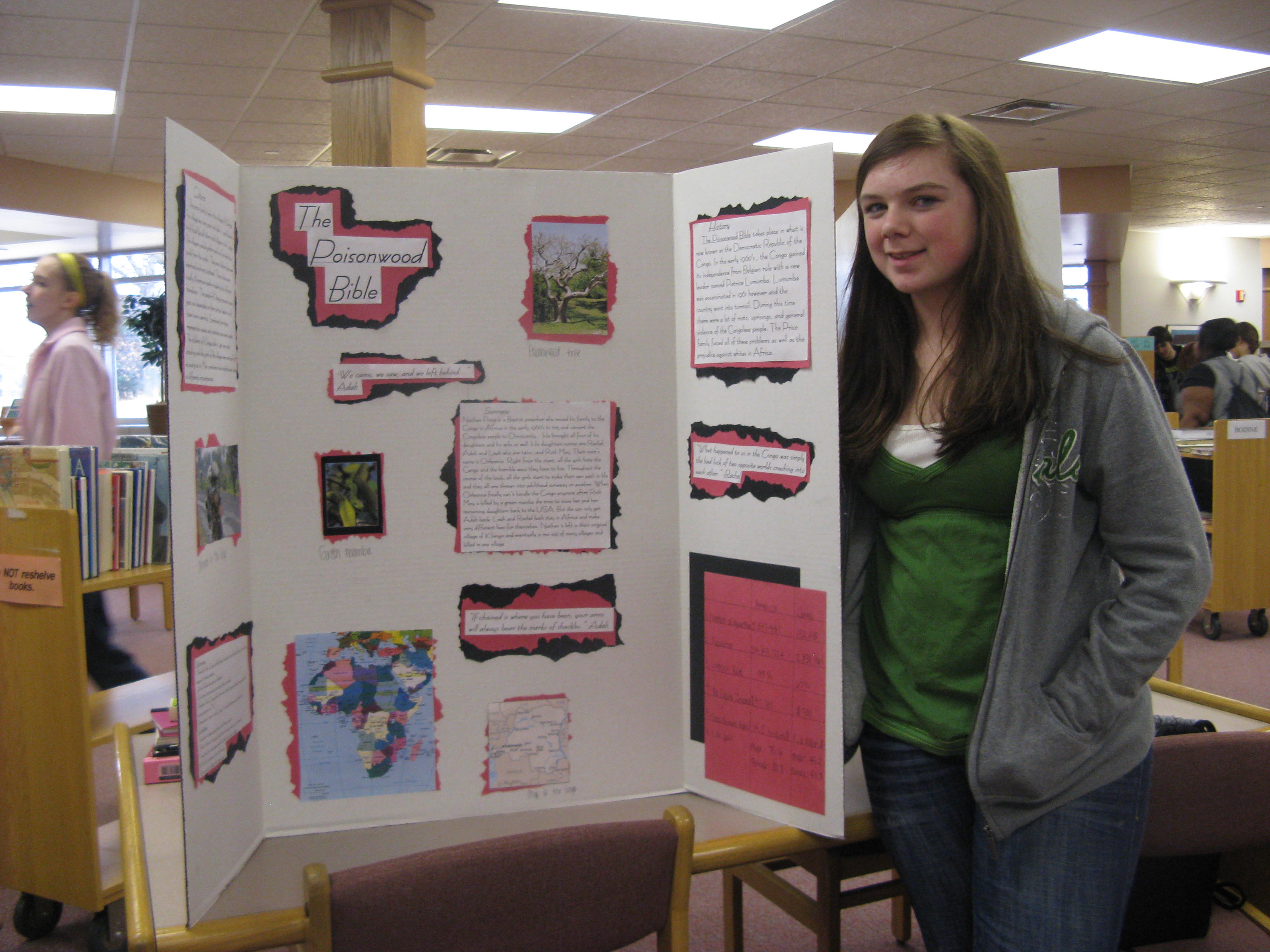
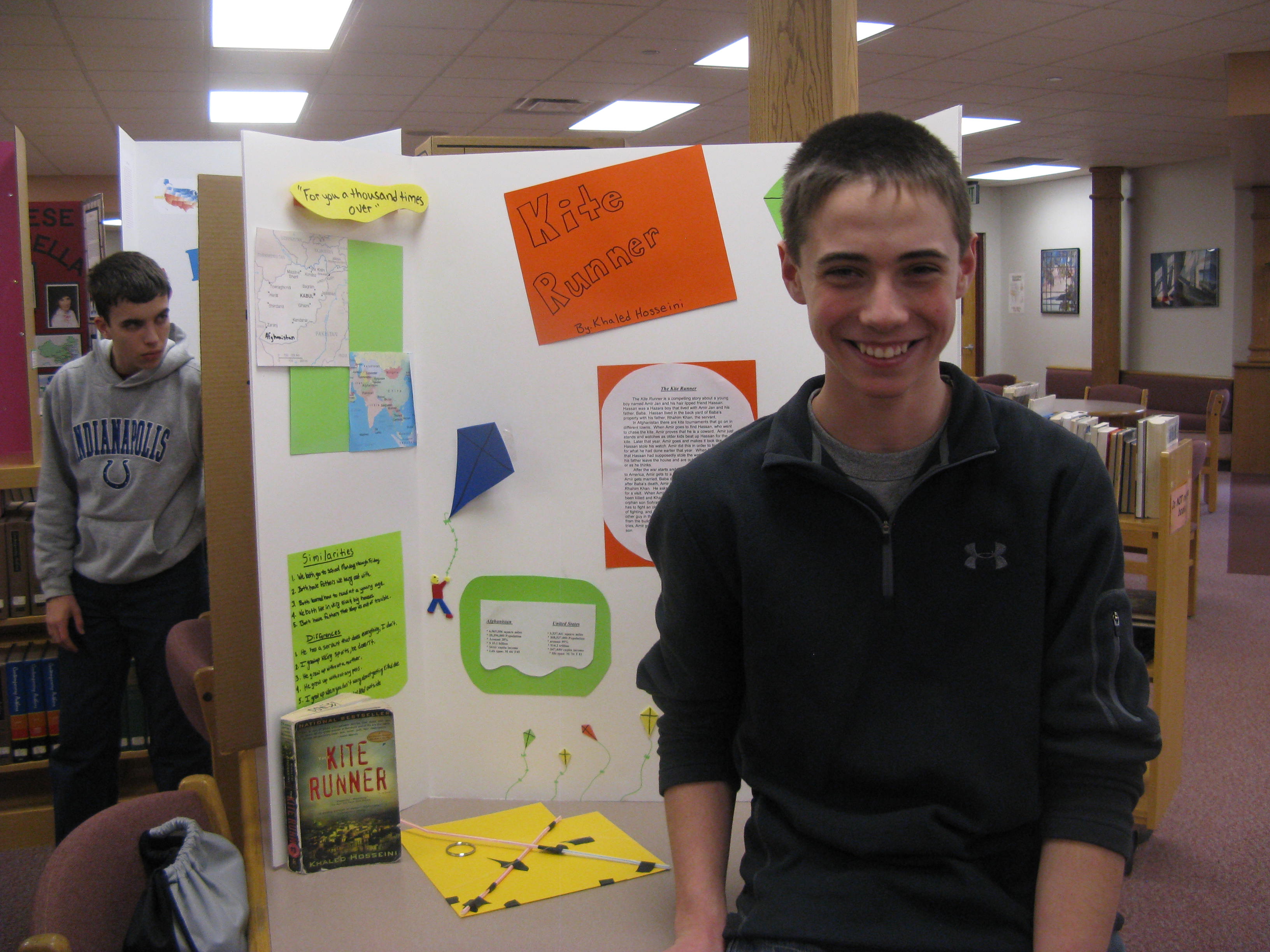
Next, each student creates a stand-alone, 3-sided poster—the kind that is used for science fair projects. The goal is to create a poster that makes the story as appealing as possible, but at the same time conveys something of the history and culture of the country portrayed in the book.

The poster must include

1.       Author’s name and title

2.       A summary of the book (about 300 words)

3.       Two maps—one of the country where the story takes place with the city or region highlighted and one of the continent in which the country is located.

4.       A paragraph about the history of the country during the time period of the book (again, about 300 words)

5.       A paragraph about pertinent religious or cultural characteristics of the particular cultural group described in the book OR a description of the relevant cultural characteristics of the country overall if the main character is not from an ethnic minority (not to exceed 300 words)

6.       A bulleted list of at least 5 differences and at least 5 similarities between a teenager growing up in Indiana and the character in the book.

7.       A comparison table showing the following pieces of information about the country or region compared to the United States:

  •  Number of square miles
  • Population
  • Literacy rate
  • Gross domestic product
  • Per capita income
  • Average life span (m & f)

But there can be more: Students sometimes include photographs, symbols, clothing,  3-DIMG_2782 objects or pictures of objects, or decorations that capture the feel of the country. They may include important sayings or proverbs from the culture, quotes from the book, other pertinent maps, or even their own assessment of the book or recommendations for other books with a similar theme.

The most successful posters are eye-catching and colorful, but even a student with little talent in art can create an appealing poster with some help from a computer and just the most basic understanding of design. I give the students these simple directions: Type your paragraphs, keep the design uncomplicated, use construction paper to frame the typed paragraphs, and be consistent with the fonts and point size.

IMG_2787On the day the posters are due, we set them up in the library and students give book talks about the work they’ve read.  I want them not only to summarize the story, but to connect the dots between the story they have read and the demographics, historical facts, and other statistical information they have gleaned.  I ask them to expand upon the similarities and differences that they have noted between themselves and the characters in the book.  Sometimes—for extra credit—they’ll offer their classmates “international fare”—regional food that they’ve prepared themselves (Parents have to sign a form indicating that their child actually prepared the food. I am not interested in giving Mom or Dad extra credit.)

Invariably, the students’ lists of similarities and differences are the most interesting part ofIMG_2793 the presentation. Depending upon what they’ve read, the students notice differences in family relationships, in family size, in the size of American homes versus homes in other countries. They’ll see disparities in possessions, in schooling, in opportunities. They’ll see differences in wealth, in medical care, in the availability of food; differences in transportation, occupations, and expectations. Some are surprised, even shocked by what they learn because some of these stories are violent and horrifying. Some are just plain sad. Resilience is a common theme. But for the most part, students also discover similarities between themselves and the person they are reading about, and those commonalities allow them to identify with the characters.

The individuals in the stories my students read have families that, like their own, love them, occasionally smother them, sometimes annoy them, always are important to them. They encounter teenagers from far away who also have dreams and aspirations; characters who respond to injustice and inequity just as they do; young men and women who are disappointed, delighted, rewarded or punished, teased or tolerated, loved or hated. They find kindred spirits in people from other countries—and learn that stereotypes are just that and outward appearances can be deceiving.  In short, they learn that what makes us human—our emotional responses to the people and events in our lives—is common to all of us, no matter where we grow up.

IMG_2796In the past, the posters have remained in the library for a month or so—long enough for other students to see them and perhaps be enticed to read one of the books for themselves. But even if their classmates don’t choose to check out a book, the posters attract attention and alert other students to a world larger than the one they know.  As for my students, reading a book about someone from another country helps them learn an opposite and important truth: The world is actually much smaller than they might have supposed.

In case you’d like to try this for yourself, here are the books on my shelf. You’ll need to check the reading levels and match the book with the particular student. Some of these are adult books, suitable for advanced readers; others are for middle schoolers.  If you know of a title I haven’t listed, please add to my list by commenting below. I’m always on the lookout for another good book.

FICTION     
Title  Author Country
Roots  and Wings Many  Ly Cambodian-American
Spud John  Vander Ruit South Africa
Power  of One Bryce Courtenay South Africa
A  Thousand Splendid Suns Khalid  Hosseini Afghanistan
The   Kite Runner Khalid  Hosseini Afghanistan
Bless   Me, Ultima Rudolfo  A. Anaya Hispanic/New   Mexico
China Boy Guss  Lee Chinese-American
In   the Time of the Butterflies Julia  Alverez Dominican Republic
Yo! Julia  Alverez Dominican Republic
How  the Garcia Girls Lost Their Accents Julia  Alverez Dominican Republic/ America
In  the Name of Salome Julia  Alverez Dominican Republic
The  Namesake Jhumpa  Lamiri Indian-American
The  Poisonwood Bible Barbara  Kingsolver Congo
The  Syringa Tree Pamela  Gien South Africa
The  Invisible Thread Yoshiko  Uchida Japanese-American
When  My Name was Keoko Linda  Sue Park Korea
The  Joy Luck Club Amy  Tan China   & Chinese/American
Habibi Naomi   hihab Nye Israel/Palestine
Snow  Falling on Cedars David  Guterman Japanese-American
Farewell  to Manzanar Jeane  Houston Japanese-American
Zoli Colum  McCann Romani   in Eastern Europe
Swimming  in the Monsoon Sea Shyam  Selvadurai Sri Lanka
NON-FICTION
                          
Stealing  Buddha’s Dinner Bich  Minh Nguyen Vietnamese-American
The House at Sugar Beach Helene  Cooper Liberia
First They Killed My Father Loung  Ung Cambodia
They  Took My Father Mayme  Sevander USSR
The Lost Boys of the Sudan Mark Bixler Sudan/Kenya/Ethiopia
There is No Me without You Melissa  Fay Greene Ethiopia
They Poured Fire on Us from the Sky Deng, Deng, and Ajax Sudan/Kenya/Ethiopia
When I Was Puerto Rican Esmeralda  Santiago Puerto   Rican-American
Leaving Mother Lake Yang   Namu China (Moso culture)
The Endless Steppe Esther  Hautzig USSR
Growing Up in Moscow Kathy  Young USSR
The Diary of a Young Girl Anne Frank Nazi-occupied   Holland
The Children of Willesden Lane Mona Golabek England during WWII (Jewish refugees: kindertransport)
All But My Life Gerda   Weismann Klein Nazi   Germany
The Bite of the Mango Mariatu   Kamara Sierra Leone
A Long Way Gone Ishmael   Beah Sierra Leone
The Kids from Nowhere George   Guthridge Eskimos in Alaska
Lipstick Jihad Azadeh Moareni Iran
The Price of Stones Twesigye Kaguri Uganda
A Beginner’s Guide to Acting English Shappi Khorsandi Iran/England

A Grammar Lesson

From To Kill a Mockingbird by Harper Lee:

Daylight…in my mind, the night faded. It was daytime and the neighborhood was busy. Miss Stephanie Crawford crossed the street to tell the latest to Miss Rachel. Miss Maudie bent over her azaleas. It was summertime, and two children scampered down the sidewalk toward a man approaching in the distance. The man waved, and the children raced each other to him.

It was still summertime, and the children came closer. A boy trudged down the sidewalk dragging a fishing pole behind him. A man stood waiting with his hands on his hips. Summertime, and his children played in the front yard with their friend, enacting a strange little drama of their own invention.

It was fall, and his children fought on the sidewalk in front of Mrs. Dubose’s. The boy helped his sister to her feet, and they made their way home. Fall, and his children trotted to and fro around the corner, the day’s woes and triumphs on their faces. They stopped at an oak tree, delighted, puzzled, apprehensive.

Winter, and his children shivered at the front gate, silhouetted against a blazing house. Winter, and a man walked into the street, dropped his glasses, and shot a dog.

Summer, and he watched his children’s heart break. Autumn again, and Boo’s children needed him.

Once they understand that Boo killed Bob Ewell, another issue looms for the students. We haven’t talked about Boo’s motive for stabbing Bob, and by now they realize this: Every action has a motive. Of course the students know Boo cares about the children. He leaves gifts for them in a live oak tree (until his brother Nathan cements up the hole): a broken pocket watch, a spelling medal, soap dolls, chewing gum, and other artifacts of a young boy’s life. But how deep is this caring? What is its nature?

The answer is in the paragraph above, which appears at the very end of the book when Scout is standing on the Radley porch. I read this section slowly, carefully—sometimes two times before anyone notices the author’s sleight of pen.

Finally, this comes, sometimes tentatively, sometimes in an explosion of understanding:

“’Boo’s children needed him.’ He thinks of Jem and Scout as his children!”

“He left presents for them in the tree.”

“The pocket watch! Fathers give their sons their watches.”

“He put a blanket around Scout at the fire!”

“But the text says ‘A man walked into the street, fired a gun’: That’s Atticus.”

“This is confusing.”

I ask them then to think about what the author has done and to find the exact place in the text where she does it.

“She says ‘his children’ and we think Atticus.”

“But she means Boo. We assumed Atticus…”

“Because all the details are about him!”

“Because he’s their father!”

“Because we know the rule!”

We’ve been talking about pronouns for some time. I’ve pounded the rule into their heads, and they can recite it from memory: Every pronoun has an antecedent with which it must agree in case, number, and gender. Antecedent comes from Latin: ante (before) and cedere (to go). The term makes perfect sense: The antecedent comes before the pronoun.

“The true antecedent comes after the noun here!’

I can almost hear low whistles.

Slick.

They like it.

And they understand the depth of Boo’s feeling. He cares for Scout and Jem as a parent does—and parents would do anything to protect their children. Even put themselves at risk to come to their children’s rescue.

So in a way, this lesson, just like the last one, is about the danger of making assumptions—and this blog entry is a plug for grammar instruction.

Sure, the students could “get it”—could understand they’d been misled—without knowing the rule. I could have said that the author just flipped the men’s names to create an effect. But the trick is more subtle than that. Atticus’ name is never used. Understanding the technicalities of Harper Lee’s maneuver reveals to the students—maybe for the first time—that author’s craft their work. Understanding precisely what occurred in the text tells the students that writers are deliberate.

I’m not saying no teacher will ever have to visit pronoun antecedents again with these students. No, it takes repeated interactions with any concept to make the point indelibly. But being able to use the language of grammar to explain the author’s technique gives students a sense of authority, of control over language.

We want students to do close analysis of text—meanings of words, arrangement of details, syntactical analysis. Grammar helps us do this.

All by itself, though, grammar instruction can be pretty dull for a whole lot of kids. Granted, there are some who take to it. (Believe it or not, one year I met after-school with a group of grammar devotees who called themselves “The Diagramming Club.”) But for most young students, we need to hang our grammar lessons on some kind of hook.

Harper Lee’s is a classy one.

Who Killed Bob Ewell?

Students rarely understand exactly what happens at the end of To Kill a Mockingbird. I like to use their befuddlement strategically to help them put the clues together.

Heck Tate puts them together very quickly when he discovers Bob Ewell dead under the oak tree near the Radley’s house. Heck takes Ewell’s switchblade from the scene and later tells Atticus he “took it off a drunk man.” My students take that remark at face value. Bob Ewell is a drunk and Heck’s a sheriff, so the students make the assumption that Heck picked up the knife earlier in the evening on his usual rounds. They don’t imagine that a law enforcement officer would tamper with the evidence to perpetrate a cover-up. But making those two assumptions is how even Atticus is temporarily misled.

Heck’s motive, of course, is to protect Boo, the children’s reclusive, awkward, ghost-like neighbor. Ultimately, Boo—if he killed Bob Ewell—would be acquitted of the murder charge he’d face, but in the interim, he’d be subjected to a trial and then to a storm of appreciation from the town folk.

I could just tell the students what happened, but that is never my preferred style. Instead, I have them act out the ending of the book because, through role-playing, they discern the answer for themselves. The process of discovery is not only fun, it’s a chance at the beginning of the year for the students to delve deep into a text and to have an analytical discussion without the formality of hands in the air.

I take volunteers for the various roles and urge the students to reread the text carefully so they can act the story out just as it happens. Even so, the next day, when I hold up two plastic knives labeled “switchblade” and “kitchen knife” and say that the actors who need the knives should take them, they all look at one another mystified. Usually the student playing Heck, thinking I’m just supplying props to make the scene more realistic, takes the switchblade. That leaves the kitchen knife for Bob Ewell—another error.

The troupe of actors retreats to the hallway to block out their performance. Meanwhile, I tell the rest of the students: “They’re going to make a mistake. It’s your job to figure out what they got wrong—so follow along in the text.”

While the group in the hall is blocking the scene—and having their own discussion about those two knives—the other students and I move all the desks to the back of the room. We clear a large space at the front of the room and sit on the floor more or less like a theater audience or in chairs that are informally arranged in front of the “stage.”

The actors enter, books in hand, Scout yelling “Cecil Jacobs is a big wet he-en!”

Jem puts his hand on her head, steering her along, and Bob Ewell enters, stalking the two children as they make their way across the classroom to the corner designated as the Finch home. The students read the lines aloud and carry out the actions indicated. I read the narration.

Boo hears the children, comes out of his house, pulls Bob away from Jem, and then…

Sometimes the actors show Boo stabbing Bob with the kitchen knife. Sometimes they show Bob falling on his knife. Sometimes there’s a radical deviation from the text and the troupe tries to show that Jem killed Bob. After all, that’s what Atticus first thinks. Depending upon what the students have decided to do with the switchblade, more difficulty can arise when Heck Tate comes along to examine the body. In any case, the students’ first error is usually at the tree, and the second one occurs when Heck examines the body.

In many years of doing this, only once did a group nail the ending on the first try.

It takes a series of mental leaps to realize that
• Bob had a switchblade.
• Boo had a kitchen knife.
• Boo stabbed Bob with the kitchen knife.
• Bob then had both knives—a switchblade in his hand and a kitchen knife “up under his ribs”
• Heck relieved Bob of the switchblade.
• No one will question Bob “falling on his knife.”
• Heck Tate reasons that justice is ultimately served because Boo would be acquitted in a trial and the man responsible for Tom Robison’s conviction is now dead.

By now, the actors have stopped acting and are huddled up on the floor with the audience. I am off to the side or somewhere in the mix, asking pertinent questions. But the students are talking to each other, looking back at the text, and arguing constructively over what took place. They lead each other through the sequence of events and untangle the circumstances that lead Heck Tate to his declaration. They support their claims with textual evidence and counter each other’s errors the same way. It’s awesome to watch.

In the end, we have an animated conversation about Heck Tate’s preemptive decision to “let the dead bury the dead this time.” He tells Atticus— emphatically—“I’m the sheriff of Maycomb County and Bob Ewell fell on his knife,” leaving Atticus with no questions, no choice, and no responsibility for not pursuing justice, in this case to the point of injustice.

There’s more than one hero in Maycomb County, the students conclude.

This lesson, of course, is an example of the constructivist approach to reading comprehension. Through close examination of the text, the students discern for themselves the author’s meaning. They’re collaborating to put the puzzle pieces together, and they’re actively involved in the process. With or without the name—constructivist approach—this is a powerful way to engage kids, build skills of textual analysis, and have a lot of fun the same time.

And the answer is Boo. The kids just proved it.