Figure It Out: A Reading Comprehension Lesson

I’m a big fan of structuring lessons so that students can figure things out on their own. In the education world, what I am talking about is sometimes called the constructivist approach, sometimes called inquiry-based learning, sometimes called—well, whatever the name, lessons learned this way usually stick—and in the act of discovery, students are empowered as learners.

Here’s an example of what I mean: a reading comprehension lesson involving allusions—in this case, in the context of one of my favorite books, To Kill a Mockingbird. The goal is to show students how allusions enrich the meaning of a text—how to spot them, how to decode them, how to make meaning of what is frequently an analogy.

For example, take this dialogue between Scout and Jem, in Chapter 2:

“Don’t worry, Scout, “ Jem confronted me. “Our teacher says Miss Caroline’s introducing a new way of teaching. She learned about it in college. It’ll be in all the grades soon. You don’t have to learn much out of books that way.—it’s like if you wanta learn about cows, you go milk one, see?”

“Yeah Jem, but I don’t wanta study cows, I—”

“Sure you do. You hafta know about cows, they’re a big part of life in Maycomb County.”

I contented myself with asking Jem if he’d lost his mind.

“I’m just trying to tell you the new way they’re teachin’ the first grade, stubborn. It’s the Dewey Decimal System.”

Students might be vaguely puzzled by “Dewey Decimal System,” but they could just as easily pass right over the reference. If they do, though, they miss the humor in Jem’s misnomer. That’s the way allusions work, I explain to them. They aren’t necessary to understanding the plot, but knowing that Jem is confusing a library cataloguing system with the education reformer John Dewey is funny. Furthermore, in this short passage, we get a glimpse of Jem as an occasionally annoying big brother who isn’t as smart as he thinks he is. Since this is a sibling type many students know first-hand, this depiction of Jem rings true and helps some students to directly and immediately identify with Scout.

That’s the concept. To get started with the lesson, I print and cut into slim strips a list of other allusions from To Kill a Mockingbird, put the strips in a hat, and pass the hat around the room. Students “draw” a strip, and I tell them that the first part of their assignment is to figure out the literal meaning of the words on the strip. (The same strategy could be used with any text that is heavily allusive. I’ve used it with Shauna Seliy’s coming-of-age story, When We Get There, and with Charles Dickens’ Great Expectations, for example.)

This part of the assignment used to be more difficult than it is now. Years ago, before Google, before Wikipedia, before the website To Kill a Mockingbird: The Student Survival Guide (www.lausd.k12.ca.us/Belmont_HS/tkm/), I’d take my students to the library so they could look through books and print encyclopedias to find the answers. Some of the allusions weren’t so easily identifiable, so I’d allow them to ask other people for help—other people but me, that is. My lips were sealed—except to suggest books they might check or to provide hints that would send them in a fruitful direction. After they knew what they had—sometimes a parent would, understandably, just tell them—they’d have to find at least two print sources that explained the allusion and then summarize the meaning and document their sources.

I still ask my students to do this, but thanks to electronic searches, it’s the easy part of the assignment now.

The next step is finding the allusion in context. They’re spread throughout the novel, so while I distribute the strips early on, it will be late in the story before the task is completed by everyone. Once the students come upon their allusions, they write a paragraph explaining the allusion’s purpose in the text. This can be challenging for young readers; nevertheless, they often make amazing connections and articulate insights that astonish me.

Some allusions, such as “Maycomb County had just been told it had nothing to fear but fear itself [my italics],” help the reader establish the time period of the story. So do items like “linotype machine,” or “flivver,” or “Ladies Law.” Other allusions establish place: “Jitney Jungle” and “Bellingrath Gardens,” for example, make explicit that this story takes place in the South. These allusions authenticate what the author has already told us: the setting is Maycomb County, Alabama. Some “place” allusions supply deeper background information as well: “Stonewall Jackson ran the Creeks up the creek” is a reference to the intersection of Alabama history, Native American history, and Finch family history.

There are some tougher ones, though, like “Lord Melbourne,” a British parliamentarian who loved the ladies. When Uncle Jack tells Scout about Lord Melbourne in response to her asking him what a “whore-lady” is, he reveals his discomfort in discussing adult topics with children. His circumlocution, of course, contrasts with Atticus’ straightforward responses to his children. Thus, the allusion to Lord Melbourne (which is obscure for most readers, not just 9th graders) helps to build the character of both men. A student could have read the paragraph, been temporarily confused, but ultimately not concerned, because the allusion does not advance the plot. And yet, “getting” the reference to Lord Melbourne deepens the reader’s understanding.

So does this one, another reference made by Uncle Jack: When he and Atticus are discussing the upcoming trial of Tom Robinson—whom Atticus has been appointed to defend—Uncle Jack remarks, “’Let this cup pass from you,’ eh?‘” Untangling that one means linking the Biblical reference to Christ’s prayer in the Garden of Gethsemane—O my Father, if it be possible, let this cup pass from me: nevertheless not as I will, but as you will (Matthew 26:39)—to Atticus’ wish that he didn’t have to step into the role of defense attorney in what he knows will be a losing battle. He knows as well that defending Tom Robinson will stir up the town: His children may be the targets of people’s vitriol, and he could lose them in a backlash. Nevertheless, in the same conversation with Uncle Jack, Atticus is clear. He says that he couldn’t ask his children to obey him if he didn’t defend Tom. He will comply with the court order. A student could, of course, explicitly make the Christ symbol connection—but, more likely for a 9th grader, the student who understands the allusion will see the analogy between Christ’s situation and Atticus’ and understand that the comparison supports the picture of Atticus that has building throughout the story: He will do what he must. He will do the right thing.

But the task of building meaning isn’t over. It isn’t enough, to my mind, for a student to know only his or her own allusion. Sometimes, depending upon curriculum needs, I’ve had students report out on their allusion while the others take notes, but this process takes more time than I often have. Recently, I’ve accomplished my purpose much more expediently by posting the students’ work on the walls of the classroom.

Each paper has three parts: the paragraph from the text where the allusion appears, the explanation of the allusion, and then the paragraph about its purpose or how it enriches the meaning. The students circulate around the room, pen and paper in hand, and take notes on what their peers have written. This takes about one class period. I keep silent, read over the students’ shoulders, check the written work to be sure the students have explained their allusions clearly and correctly. Misunderstandings are infrequent, I find. If something isn’t quite right, it’s usually easy enough to question the student on the side, and he or she will see the confusion and make the adjustment on the spot.

By the end of the hour, each student has compiled a list of allusions and their meanings. In essence, they have taught each other some pretty sophisticated vocabulary and deepened each other’s understanding of the text. They’ve also learned a valuable reading skill: how to identify and figure out an allusion. A short matching quiz the next day confirms that the “vocabulary” has been learned (Most kids score 100%), but more importantly, the students come away understanding what an allusion is and how one works in a text.

Imagine how tedious this would have been if I had stopped in our reading to explain every one of these connections. I would have grown tired of the sound of my voice—and the kids would have yawned. Openly.

Instead, they figured it all out on their own, taught each other, and know they can do the same thing independently with the next book they read. That’s empowerment.

This Enormous Business

For thirty-one years, my school year began with the opening sentence from Harper Lee’s matchless story of courage, compassion, and coming-of-age, To Kill a Mockingbird. It was nothing short of privilege to introduce 9th graders to Jem and Scout, their father Atticus, and their playmate Dill; to rural Alabama in the 1930s; to racism and injustice in the days of Jim Crow; and to the idea that in coming face-to-face with an unvarnished and painful reality, one comes of age.

Sometimes that moment of truth is called a “confrontation experience.”

When the trial is over and Tom Robinson is found guilty, Jem is confused and upset. He cries first, then broods, questioning Atticus intently as he puzzles through the injustice of the verdict. Miss Maudie, the children’s insightful neighbor from across the street, bakes a cake the next morning, but alters her custom of preparing three small cakes—one each for Jem and Scout and Dill—and makes only two. Jem’s portion is to come from the big cake. In this way, she signals her understanding that Jem has grown up: He has emerged from the experience of the trial, changed. Many students—as Jem himself does—miss the significance of that culinary symbolism.

So just after my students have read Chapter 22, the chapter with the cake paragraph that begins “It was Jem’s turn to cry,” I introduce this poem by Gwendolyn Brooks. I project it on the ENO board and read it aloud once, all the way through.

One Wants A Teller In A Time Like This

One wants a teller in a time like this

One’s not a man, one’s not a woman grown
To bear enormous business all alone.

One cannot walk this winding street with pride
Straight-shouldered, tranquil-eyed,
Knowing one knows for sure the way back home.
One wonders if one has a home.

One is not certain if or why or how.
One wants a Teller now:

Put on your rubbers and you won’t catch a cold
Here’s hell, there’s heaven. Go to Sunday School
Be patient, time brings all good things–(and cool
Strong balm to calm the burning at the brain?)

Behold,
Love’s true, and triumphs; and God’s actual.

Occasionally, a student will “get” the poem immediately, but the majority of my 9th graders are mystified. Why am I introducing this poem? What does it have to do with the story? Focused on the verdict itself—which they are eager to talk about even though they had predicted it—they don’t think of the impact of the decision on the children.

“Who in the story do you think this poem could be about?” I ask.

“Atticus,” someone always guesses. “He lost the trial.”

So. They got the gist of the poem. It’s about someone who is depressed.

“But Atticus knew he would lose—and he thinks they’ve taken a step forward because the jury deliberated for two hours,” someone else corrects.

“Tom? He lost and now he’s going to prison.”

“Boo.” Another guess.

“Miss Maudie.” A wilder guess.

Funny—if they’d examine their own reactions—shock, outrage, grief—when the verdict is announced, they’d see immediately that the poem points to Jem.

But Jem is not the “hero” of the story—or even an important protagonist like Tom Robinson or Boo. We’ve talked as a class about the symbolism of the mad dog and related rabies to the mental disease of prejudice. We’ve focused on character development and identified Atticus as the hero. We’ve examined Atticus’ definition of courage in the Mrs. Dubose chapter. But, besides noting that the children are catalysts for action and establishing that Jean Louise (the adult Scout) is a reflective narrator, we haven’t talked much yet about Jem and Scout. So far, they haven’t been a thematic focus.

I suggest that we take the poem apart, line by line. From this moment on, I am largely silent. I simply cover the poem and proceed to expose one line at a time. With its lovely “reveal” function, the ENO board helps me with this technique, but I used to do the same thing with an overhead projector. Baring even that, I could write the poem on the board, one line at a time. The strategy captures my students. They are good detectives, and they eagerly put their skills of observation to work.

First, the title: enigmatic, evocative, puzzling. Why the capitalized ‘One’? And then, it turns out, the title is the first line. The first line stands alone, the students notice. Why?

Then the phrase, “One’s not a man, not a woman grown.”

“So it’s not about Atticus.”

“But what is ‘this enormous business’?”

“It doesn’t say.”

“Whoever he is, he’s walking a crooked path.”

“He’s lost.”

“Unsure.”

“Confused.”

“He—or she—can’t find his home, maybe doesn’t have one.”

“Is this about a homeless person?”

“No, I think it’s about safety. Home is safety.”

“It’s about certainty. This person is uncertain.”

“Something terrible has happened.”

“Look at those words–‘if or when or how.’ Those are question words. This person’s questions are unanswered.”

“But why is ‘Teller’ capitalized in the next line?”

“He wants someone to answer his questions. To tell him the answers. A Teller.”

By this time, several students realize it is Jem’s reaction to the verdict that I am focusing on. I can barely contain them from blurting out their epiphany, and epiphany it is: They squirm in their seats; their arms pump up and down; their faces convey urgency. Others catch on. The class knows.

But what is this last stanza? Look: The font changes. And how are all those things connected?

“‘Rubbers’ are boots,” someone says. “What do they have to do with Sunday School?”

“’Heaven and hell’.” That’s Sunday School.”

“They’re opposites. Like black and white, or right and wrong.”

“Oh I get it! The new font is the Teller talking!”

“Yes! The Teller is telling the person what to do.”

“What to think.”

“How to behave.”

“That’s what he wants. A Teller.”

“Yes. A Teller makes things simple.”

But then the font changes back.

“What’s ‘balm’?”

“Like lip balm. A salve.”

“Oh! It’s ‘One’ again—questioning the Teller. It’s ‘One’ not finding an answer.”

“Not accepting an answer.”

“And the Teller speaks again, telling him everything is okay.”

“Except he doesn’t believe it. Whatever has happened is so bad, he even questions God.”

“Wow.”

And then, silence.

When we resume talking, students are quick to say—and confident now in saying—that “One” is anyone, so the poem can apply universally. “This enormous business” is unspecified for the same reason—and that means the poem can apply to many situations.

Too many of my students have already experienced tragedy, grief, and despair in their own lives. They make the jump to divorce, separation, untimely death, to betrayal by a friend, to abandonment by an adult—to myriad experiences that could force a person to confront an unpleasant truth—and come of age.

And then they know how Jem felt.

Silence again.

Quite often, someone in the class offers a final idea.

“You know, this may be about growing up, but even adults feel this way sometimes. My mom did when my dad left.”

How right that observation is. There is no time limit on innocence, no age limit on hope.

“So it could be about Atticus. He could have felt that way and then resolved his feeling by thinking the two-hour delay in the verdict was a step forward.”

It could be, indeed. Enormous business can level us all, even a hero.

I love teaching this lesson and the technique of “unveiling” a poem. As students pick out the clues, they build meaning and expand their understanding beyond the text. They see the relevance to the story we are reading, but they can apply the meaning of the poem to their own lives as well. They think deeply about an idea—in this case, the transformative effect of a confrontation experience.

What else is wonderful is that they figure the poem out for themselves.

I don’t tell them anything.

Thys Boke is Myne

Thys Boke is Myne Prince Henry: An inscription in a copy of Cicero, belonging to Henry VIII when he was a boy.*

What is it that makes us write our names in our books, amass collections of books, enthusiastically lend our books to friends (but keep a record so we can call them back)? When we do cull our collections and take stacks to used book dealers, why do we cross out our names or obliterate them with labels? If someone has inscribed a book for us—a gift—we hesitate to let it go, and if we have books passed down from our parents, our grandparents, their parents before them, well, these simply cannot be discarded.

Maybe I shouldn’t be using first person plural here. Maybe the problem is unique to me. But I don’t think so. I’ve seen too many crossed out names in books I’ve picked up in second hand stores.

Whatever else Henry VIII the adult was, he read widely as a child and even became a writer himself. I like to think that the impulse to write his name in his Latin book—to assert his ownership—was not just proprietary in the way he acquired weapons and wives, but that it sprang from the same impulse I respond to when I write my name in a book. When I say I own a book, it is not just the physical entity that I mean belongs to me. I am saying that the contents have become a part of me, have shaped my identity, and have influenced my thought. When someone I don’t know well looks at my personal library—whether at school or at home—I feel just a little bit invaded, like that person has a window into my mind, has gotten a glimpse of my soul.

Understanding this explains why, at a used book sale, I buy copies of books I already own—it’s as if I’m retrieving a lost part of myself. Thys boke is myne! Not the library’s, not Earl Avenue Books’, not Buy the Book’s. Myne!

For some years now, I’ve been collecting the books I read as a preschooler or during early elementary school years, repossessing myself, so to speak. I know these books not by title, but by their images. I’ve instantly recognized Me, Too (a fluffy yellow duck) and The Little Small Red Hen, both found resting unceremoniously in antique dealers’ cubbies. I have no trouble recognizing the Dick and Jane readers, primers peopled by those ever-ebullient, always co-operative, never unpleasant—but sadly, monosyllabic—children, Dick and Jane, and their little sister, Sally, whom I loved best because she had my name. And their pets: Spot and Puff.

On summer afternoons in upper elementary school, my best friend Anne and I were allowed to go downtown to the public library where, once we had exhausted the children’s collection, which was located in the basement, we moved to the junior high shelves, also in the basement. There, I discovered books that came in series: Little House on the Prairie, Anne of Green Gables, and the Betsy-Tacy books. Betsy Ray, growing up in a small town in Minnesota around the turn of the century, wanted to be a writer. So did I. I stuck with Betsy well into junior high. At one point during those years, two friends and I playacted the three best friends of the series, and I wrote to the author, Maud Hart Lovelace, to tell her of this marvelous fact: We fit her characters to a tee. She graciously replied, in her own hand, on a card that featured an illustration of Betsy, taken from one of the books. I still have that card, and as an adult, from used book dealers online, I bought the Betsy books I’d lost over the years. Pristine copies are collector’s items now, but I kind of like my worn library copies because the public library is where I first found Betsy.

Later, my friend Anne and I wheedled our way into the adult stacks, located upstairs. Attitudes about reading were different in the day. Librarians, I am sure, had a proprietary interest in the books themselves, and they seemed to disapprove of children getting “above” themselves, reading stories that were too old for them or books with words they surely wouldn’t know. I can remember having to tell a librarian once what a book was about in order to satisfy her need to be certain of my reading ability. Once we got upstairs and into the dark, towering stacks, Anne wanted to start with the A’s and read every book all the way to Z, but we got waylaid and then stuck in the H’s, captured by another series, this one by Grace Livingston Hill. But I went on to discover Carl Sandburg and McKinley Cantor and Sinclair Lewis, and I read many, many British classics that I took from those stacks.

In 8th grade, I traveled by train from my home in Illinois to my cousins’ home in Seattle. I brought a big book with me: Gone with the Wind. It was the first really thick book I’d read, and when I closed the cover on the last page, I remember feeling that I’d crossed some kind of threshold. I read two more fat books that summer: The Silver Chalice (I loved to swirl the name “Joseph of Arimathea” around in my mouth) and Not as a Stranger (considered risqué—even more evidence that I’d crossed some threshold). The poetry of Emily Dickinson—and Dorothy Parker’s acerbic verse—I remember from summer reading. Jane Eyre was a summer book sometime in high school, and so was Betty Smith’s A Tree Grows in Brooklyn (a recent choice of the book club I belong to!). The summer after my junior year, I gave my heart to Henry David Thoreau, whose Walden I still read and sometimes have been lucky enough to teach, and senior summer it was Huxley and Orwell who captured my imagination with Brave New World and 1984.

What does all this reminiscing about summer reading have to do with my American classroom? My teachers—and my parents, of course—encouraged me to read, both by example and by mandate. My first grade teacher taught me to read, and all of my teachers helped me to love books. Many of those teachers presented me with a summer reading list, knowing full well that it is in the long, languid days of summer that children and teenagers have the time and disposition to sink into books, abandon obligation, and let the characters and ideas therein become a part of themselves. When I left my classroom almost a month ago, I gave away my paperback books, the ones that had been housed in my classroom on a revolving display case, a hand-me-down from the school library. All year I’d been recommending the books on that rack; in the end, I offered them free to my students. They snapped them up. One boy needed a shopping bag.

I hope this is a summer of books for them. I hope they will love them, write their names in them, and make the contents their own. And I hope they will remember me, the giver. I did not erase or sully my name. I left it on the first page: Sarah Powley. Thys boke was myne.

And now, I am settling down with my own reading list, a mix of history and science and literature and books on instructional coaching. I’ll be back in the fall, rejuvenated, reeducated, and ready to take on my new responsibilities and resume this blog. Happy summer everyone! Happy reading!

*The Folger Shakespeare Library’s exhibit of people and their books, displayed during the winter of 2002-2003, took its name from Henry’s assertion of ownership.

Danger Zone

IMG_3253


Here are the most calamitous events of my career:

• I broke my wrist one day when I fell from the ceiling (I was hanging a mobile and stepped into air).
• A student driver tried to pass me on a county road when I was making a left turn (My car was totaled, but neither of us was hurt).
• A student who rushed to the front of the class to ask to use the bathroom threw up on me before she could get the words out (The dress washed).
• Two winters ago, a student crunched my car (a different one) while it was parked in the school lot (Actually, he took out two cars when his truck spun on ice).

But until the other day, I’d never been flattened.

I have a tendency to dart, and I darted out of my classroom at the same time a boy exited the room next door. His head was down; he was reading a note. We collided, and there I was, flat on my back like an overturned bug. The boy was stricken; I was certainly surprised.

“Are you okay?” he asked.

“Sure,” I said, “but you can help me up.”

I was restored to dignity and “over it” within a few minutes. It took a little longer for the boy. After all, he’d just leveled a teacher, and an—uh—older one at that.

Maybe teachers should get hazard pay.

Here are some other dangers I’ve exposed myself to in my long life in an American classroom.

Twain and Faulkner and E. B. White and Harper Lee and Charles Dickens and Homer and George Orwell and many, many more literary luminaries: I have the time to reread their work every single year—to admire anew a turn of phrase, to marvel once more at an apt comparison, to suck in my breath at the sheer beauty of their prose. It was nothing short of privilege to open To Kill a Mockingbird this year (for the thirty-first time) and read aloud to my class, “When he was nearly thirteen, my brother Jem got his arm badly broken at the elbow.” In November, I went to London with Pip, and in February, I followed Odysseus around the world. Come spring, it was time to visit Manor Farm again and watch the pigs turn into Mr. Jones. I wonder, now that I will be out of the classroom, if I ever again will read, “Sing in me, O muse…” I hope I will make time to do this, for these stories and the people in them are a huge part of me. I know whole chapters nearly by heart. I’ve kept company with my favorite writers all day long for many years, and now I’m spoiled for bestseller fiction. I can’t stand TV. That makes me a poor conversationalist and puts me out of touch with popular culture.

Here’s another danger I have faced: No one tells me how to structure those fifty minutes between the bells. No one tells me how to teach or how to manage my classroom. I decide from a range of choices what we will read and when we will read it. I decide how I will make the stories come alive or what I will to do to help the students improve their writing. I set the goals and I craft the lessons. I make the connections from book to book, and I design the projects, the writing assignments, the presentations. I make up the tests. My creativity as a teacher is limited only by my imagination and my stamina. Even when resources are in short supply, I usually can find ways to finance what I want to do. Granted, there are standards and a local curriculum that I am obliged to follow, but how can I quibble with those? The standards provide guidance, and I helped to write the curriculum. Such independence is exhilarating—but it also poses a risk. Since I decide just about everything that happens in my room, what happens if I fail? What if I become a bug on her back, flailing, limbs in the air?

I’m in constant danger, too, of my heart being broken. It’s love, of course, that does that, and love is the only way to describe my feelings for the students I am with each year, sometimes for longer than a year. These are kids I have seen when they are happy, seen when they are down, seen when they are taxed to their limit, and seen at play. We have developed a relationship, each one of them and I, based on shared experience and my knowledge of what they often reveal when we read those books together. I am privy to their ideas when they raise their hands to speak. I read their thoughts in the essays they write for me. It’s a lopsided relationship, of course. More like parent-child than friend-to-friend. I nag them, cajole them, and tell them what to do. Sometimes they make poor decisions, let me down, act badly. Sometimes I’d like to throttle them. Sometimes terrible things happen in their lives, and then my heart aches for them. My attachment to the kids I teach sounds odd to people who haven’t taught. But years later, when I see my students all grown up, when I encounter them in a store or at a theater or meet them on the street, I discover that they feel attached to me, too. Sometimes, even years later, they come back to say thank you: for pushing them, for demanding they do their best, for putting up with their resistance, for caring about them, for teaching them something.

Dangerous stuff, this other: Privilege. Independence. Joy. They are intoxicating. But they come with risk attached: Isolation. Failure. Hurt.

In the end, since I gave my heart to teaching, I have spent a good deal of my life in a box—inside the four walls of a classroom. But I have traveled far in a world I created myself, a world peopled by the most amazing characters—fictional and real—whose lives have enriched, beyond measure, my own.

There ought to be a police barrier—a yellow ribbon—around the perimeter of every school: Danger Zone.

I’ve never been sorry I crossed that line. Even when I’ve been flattened.

Night in Rwanda

2009.04.15 Honors 9 Pattern of Genocide 016I have taught Holocaust literature—Night, The Diary of Anne Frank, The Children of Willesden Lane—for many years. But I cannot teach these books in the way I usually teach literary works of art. Granted, these books are not fiction, so I am spared having to chart the plot line. I know there are motifs and images and definitely themes—but my point has never been, in teaching any of these accounts, to reveal the writer’s technique. Putting such a text under the microscope of literary analysis would distance the students from the story, and I want them to hold close the visceral response they all have when they read, say, Night. Discussing Wiesel’s imagery as if he had sat down deliberately to craft a work of art instead of to tell his horrifying story to an unconscious world would be—to my mind—a sacrilege. As story, his journey through hell penetrates our unconsciousness and sears our souls. Ironically, what I could do would destroy its impact, and that I cannot do.

But the Holocaust must be taught. Genocide must be admitted and discussed. Here is what I do instead.

Most students, when they first learn about the Holocaust, do not immediately see the connection between the tragic events of WWII and their own lives in the 21st century. They think that genocide is a distant horror. But we, the adults, the teachers in the room, know about Darfur, where genocide is so fresh. We know about Cambodia, Bosnia, Rwanda, and other places that in recent history have served as the stage for mass murder.

I have been to Rwanda. My first trip there, in 2006, was undertaken specifically to study the genocide of 1994. I wanted to understand the causes and the chronology of the Rwandan genocide to see how it compared with the unfolding of the Holocaust. I learned very quickly that genocide doesn’t just happen. In fact, it follows a pattern, one that I have taught to my students ever since. (I am indebted to Gregory Stanton at Genocide Watch for his work in revealing this pattern, though I simplify it somewhat for 9th graders.)

Genocide always begins with prejudice. A power group, for a variety of reasons, marginalizes, discriminates against, isolates, and ultimately demonizes a minority. The climax is the killing, followed by a strange denouement, denial.

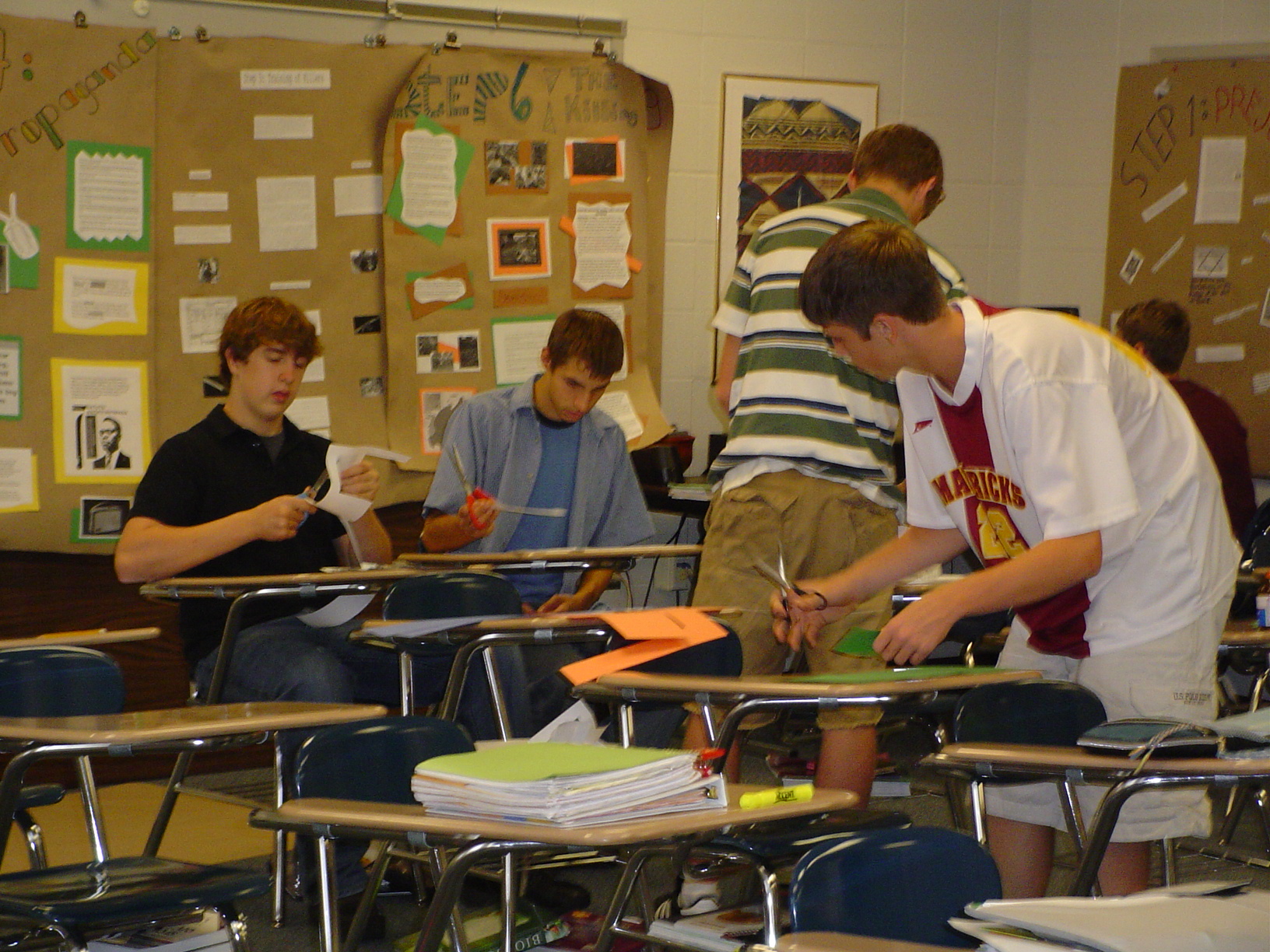
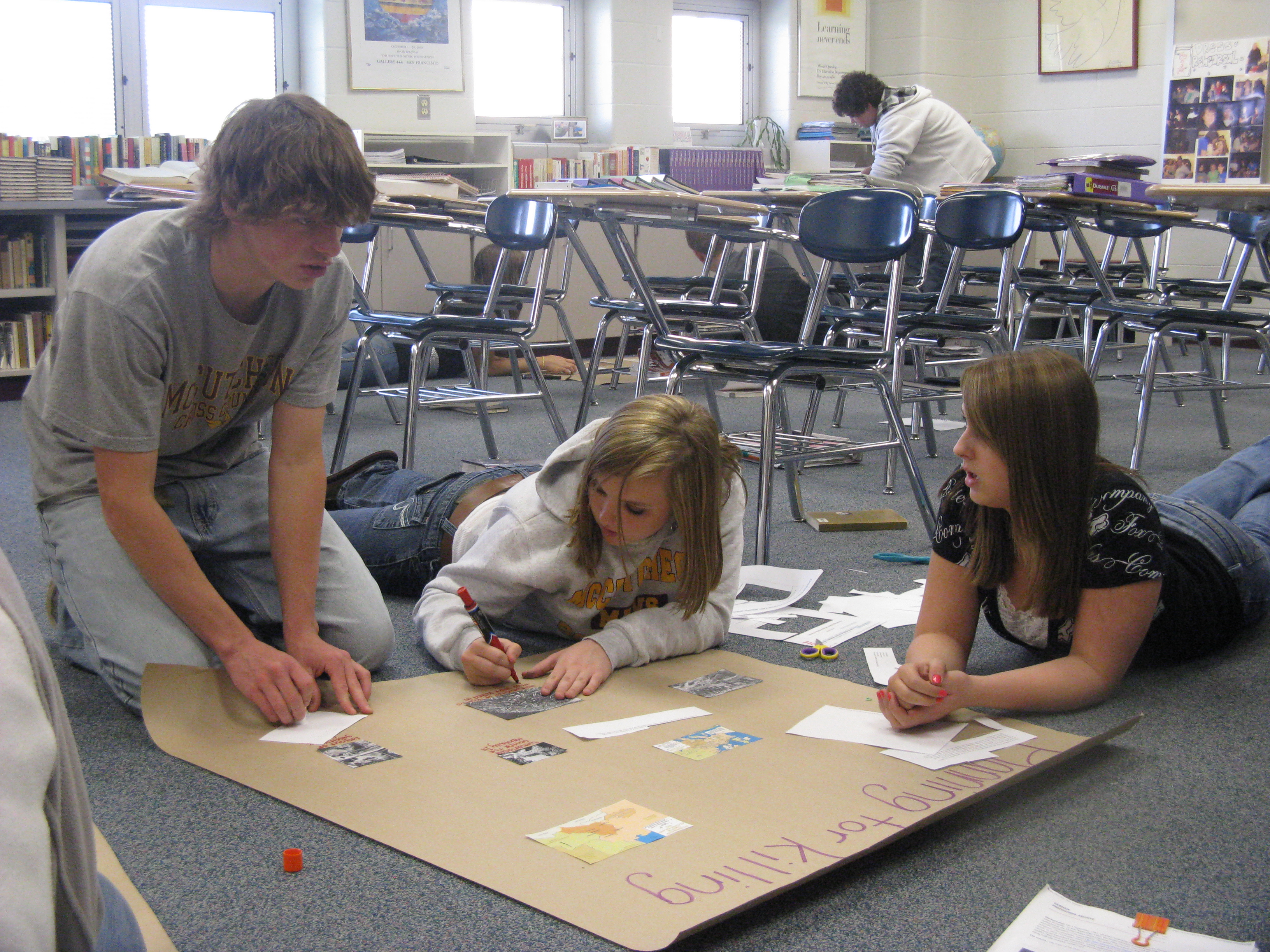
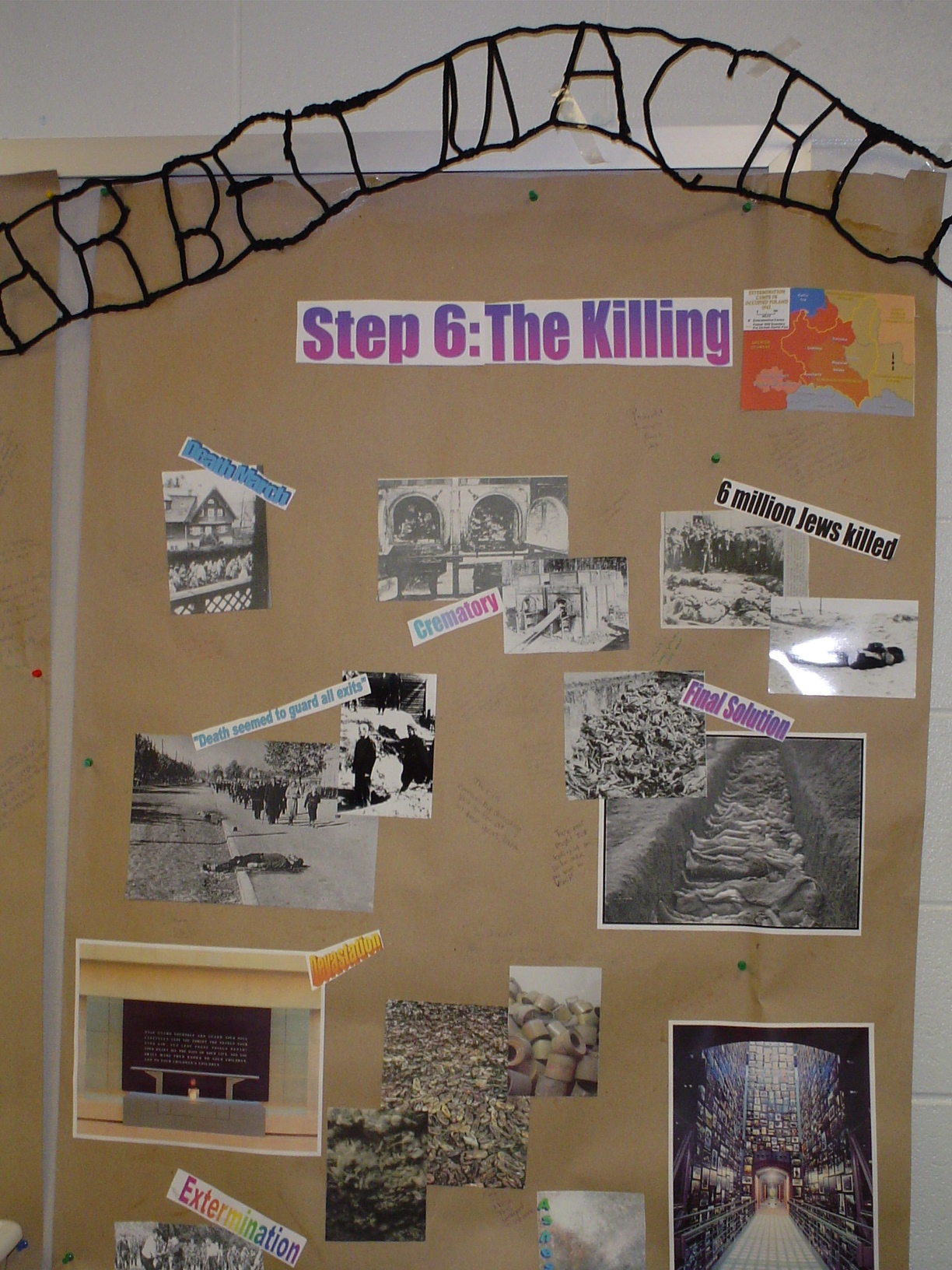
My students read Night first. They read it without a lot of preface, and they are full of questions during the three short days it takes them to finish the book. By the end, they want to know more, and it is then that I send them on a research mission. The students work collaboratively to construct poster essays that will reveal the pattern of genocide. They draw straws to form groups, and I give each group a title for the poster—the name of a stage in the pattern—and a few keywords to get them started. For the next several days, my room resembles an art studio—construction paper, scissors, rubber cement, watercolors, and magic markers dominate the landscape. Kids cluster around the tables, lie on the floor. They labor over their posters, placing pictures precisely and writing captions that capture the essence of the photographs they’ve downloaded. They know that what they are researching and presenting in their posters is too important to treat superficially, and their posters powerfully illustrate the progress from prejudice to mass murder. Pattern of Genocide 002 2009.04.15 Honors 9 Pattern of Genocide 020 Pattern of Genocide 004

We put the posters on the board and discuss the order in which they should be hung: Prejudice, Legal Discrimination, Separation and Isolation, Preparation for Killing, and Extermination—and the one that could be hung anywhere and everywhere along the continuum: Propaganda.

Then, after a brief introduction, I instruct them to repeat the research—this time researching Rwanda. They create, again, poster essays that depict the progress of the genocide there—from the identity cards issued by the Belgians when Rwanda was still a colony to the hate radio broadcasts that mobilized the Interahamwe.

Pattern of Genocide 012They hang the posters side-by-side on the whiteboards in my classroom: the Holocaust and the Rwandan genocide. I am not interested in discussions of scale—it’s not that kind of comparison. I am interested in the pattern.

By studying the Holocaust and the Rwandan genocide side-by-side, my students come to see that neither was an aberration of history. By studying the pattern, they realize that genocide has its roots in attitudes that show up in day-to-day interactions, the kinds of discriminatory behaviors they themselves encounter not just in the evening news, but in the lunchroom, on the playground, in the halls, in gym class. Sometimes we call it bullying.

My students come face-to-face with the pernicious effects of prejudice in their study of these two genocides, and they understand the importance of speaking out against ethnic jokes in the lunchroom, bullying in the halls, discriminatory laws in their state and country, and unfolding events in places like Sudan. They understand the moral imperative to be inclusive rather than exclusive, to accept rather than reject.

My students see that they can work to prevent genocide by voicing opposition to the prejudice they encounter and by engaging in activities that promote peace and understanding—both locally and globally. Sometimes it is as simple as writing letters to their Congressional representatives, to the Secretary-General of the United Nations, to the President. We live in a democracy where it is our right and our duty to let our voices be heard, to be “upstanders” for justice, not voiceless bystanders in the face of evil—and this responsibility becomes real for them.

This past week, at the United States Holocaust Memorial Museum, Elie Wiesel and President Obama spoke about genocide prevention. In fact, on the very day my students and I were having a discussion about what they could do personally to combat the forces of prejudice and discrimination, these two men were discussing what the nation could do. I watched the video that night at home: My students had said many of the very same things these compelling leaders had said. I showed the video the very next day.

Genocide survivors tell their stories—in books, films, and essays—not to create works of art that will make them famous, but with the hope that the lessons of their nightmares will not be forgotten, that people of conscience will work to stop incipient genocides before they occur and to speak out against ongoing tragedies. Teaching our children what they can do to combat evil in the world is work that teachers can do, must do.

Pattern of Genocide 010