Going for Gold

• The bell rings before you reach the lesson’s close.
• A befuddled question from a student translates into a moment of clarity for you: The student doesn’t understand. You’ll have to back up and start over.
• Kids aren’t listening, so you interrupt the lesson to redirect them. But then other kids lose the thread because your intervention is far more interesting than the lesson.
• Your explanation is unclear. You’ve even confused yourself.
• Three boys are spending more time fooling around than completing the task at hand. You shouldn’t have put them in a group together. But too late now. The lesson is underway and there isn’t much you can do.
• The technology fails–the ENO board won’t work right, perhaps, or a bulb blows on the overhead–and your lesson depends on the technology. You spend 10 minutes trying to get it to work. It never does. Worse than that, you lose your cool.
• Eye rolling and snickering from teenage girls: it’s unnerving and makes your knees jump. You can’t shake them off, and you can’t concentrate on your lesson, either.
• The activity you planned is too complex–the kids are not moving into and through it smoothly.
• A parent calls to register a complaint that seems to come out of left field. How could you have anticipated that?

Plenty of things can go wrong every single period of every teaching day. A teacher is a human being interacting with thirty other human beings every period. That can mean 150 kids—sometimes even more—in the course of a day. There’s a text to be understood, a concept to be explained, or a skill to be taught—and an array of technological supports that can fail at any time. When any one of the infinite number of variables goes wrong, any teacher is troubled.

I have experienced every one of the scenarios sketched in the text above.

Imagine if all them (or even just several) happened on the same day. A novice teacher could easily be thrown: her confidence shaken; her resolve, dissolved. Even one such incident can haunt a beginner, and one hour that goes badly can color the whole week. You can feel like a failure within a very short time.

I remember spending one whole weekend, when I was a beginning teacher, obsessing over something that happened on a Friday afternoon and second-guessing my response to it. I had had a “horrible week,” I declared to my husband, but in reality, I’d had one bad incident on Friday. By Monday, whatever had happened had been completely forgotten by the students, and I felt silly for letting it ruin my weekend.

This fixation on failure happened to me more than once. I’d let one or two “disasters” during a week dominate my assessment of myself as a teacher. The optimism and confidence I’d started the year out with were soon gone, and I really was in danger of failure. What was I going to do? I wanted to be a teacher. I wanted to make a difference in the lives of children—and not a negative difference, either. After a lot of fretting and frustration, I hit upon a strategy for dealing with disaster: I created a mental calendar to set the record straight.

It was like this: I taught six classes a day, five days a week, so (I told myself) there were thirty chances for success. Each week began with—in my mind—a blank white page gridded like a calendar: five squares across, six squares down, one for every period I taught. If a period went well–nothing spectacular, but nothing awful, either—the square remained white. If a class went badly, I colored the square black. But if the class went well, I made the square yellow, a cheerful color, one most people associate with happiness.

The object, of course, was to achieve a solid yellow page. In the beginning, I was gratified if there were no black spots on the grid. A page that was still white by the end of the week was a huge relief, and on the few intermittent yellows, I rode high. Gradually, my grids started looking like a case of measles—my yellow squares were sprinkled throughout the week. A whole day that was solid yellow was cause for rejoicing; a week of yellow–which took a long time to achieve—provoked a celebration equivalent to the Fourth of July. As time went along, the black days disappeared and the yellow ones dominated. Occasionally, one of those dreaded black marks did occur, but because of the grid, I could put that period into perspective. It was one period in a matrix of thirty opportunities. Not the whole picture, not a portrait of failure. My confidence increased, square by square, and with the confidence, guess what? More and more yellow squares began to appear.

Naturally, as the years passed by, I raised my standards, expected more of myself. Yellow became the new norm. I started going for gold. My explanations became clearer and were illustrated with examples kids could understand. I learned how to structure groups and keep students on task. Through trial and error and a lot of deliberate action, classroom management moved from nightmare to second nature. I learned about learning styles, adjusted my instruction for students at various levels, developed better questioning techniques and pacing strategies. And so on.

I got to gold. One square at a time.

I tell this story now to beginning teachers and others who are temporarily off their stride. Be gentle with yourself. Don’t let one bad day spoil the weekend. Don’t let one bad hour define you. You’ll get to yellow. One square at a time. And then you’ll go for gold.

Phantom Limb

In August every year, teachers—just like kids—get  excited about the opening of school. They go into their classrooms in the sweltering heat to arrange the furniture, decorate the walls, organize seating charts and other materials, and most of all, to plan their units of instruction. It’s not unlike preparing for the arrival of a newborn. You get the classroom ready and then start imagining all the wonderful  adventures in learning that you’re going to experience with your students, most of whom are still, at this point, abstract.

I am not immune to the exhilaration of August either.  Last year, when I accepted my new position as a full-time instructional coach for my district, I joked with colleagues that this was “voluntary amputation.”  I said that because I knew that I would miss being in the classroom, even though I was—and am—excited about this new opportunity.  I thought I was being funny, talking about dismemberment, but my quip was more on target than I realized.

I have a phantom limb.

During the Civil War–and probably before that–amputees began reporting that they could feel sensations in their missing arms or legs. Today the phenomenon is well known.  No one knows for sure what causes the phantom limb sensation—some neuroscientists think the feelings are evidence of the brain reorganizing itself—but the illusion of feeling in a severed body part is real and widely experienced.

A few days ago, a colleague recommended a link to a great site for art, history, and science visuals to me and all my colleagues in the English Department on our Facebook group site. My mind started spinning, and soon I had a long list in my head of ways to use these images.

Then, while we were driving home from vacation last week, I read an apt and amusing editorial in the New York Times out loud to my husband: Auto Crrect Ths. The article was about the author’s  frustration with “auto correct” and his ruminations on the trend toward loss of spelling skills. I thought it would make a good starting place for a discussion in my College Composition class about the importance—or unimportance—of competence in spelling.  I couldn’t resist the urge: I emailed the article to my colleagues.

Then I received a notification from an online educational products company hawking ready-to-purchase units organized around primary documents, the use of which is a huge component of the new Common Core State Standards that everyone is scrambling to understand and implement. The units looked pretty good—perusing them gave me ideas for organizing my own instructional units.

These and other starting places for new units of instruction (or enhancements for existing ones) get me pretty excited.  But each time I feel my heart racing and my cheeks turning pink from the thrill of anticipated academic adventure, the phantom limb phenomenon brings me up short. I remember that I won’t be in the classroom this year.

Still, just as the severed limbs seem more real to amputees than their intact ones, teaching my 9th graders, my American Lit classes, and my seniors in College Comp seems more real to me than what I’ll be doing next.  To be honest, I don’t know what to expect.  That’s why, as I begin in my new position, I’m going to resume this blog by describing some of my past experiences as a teacher and sharing some instructional strategies that have worked for me.  And, since my new job is all about passing along  experiences and strategies, this is fitting.

I know I will be adding to an already huge store of creative teaching strategies for To Kill a Mockingbird, but I’m going to start with some lessons from this modern classic, a book taught almost everywhere in the country. However, while the lessons are in the context of TKM (as English teachers often abbreviate it), the strategies are widely applicable. I hope they are helpful to someone.

You see? The excitement about learning, and the urge to construct units and share resources, ideas, and lesson plans doesn’t go away even when someone leaves the classroom.

You don’t believe me?  The colleague who sent the link to the visuals?  She retired last year, too. Guess we both have a phantom limb.

Pomp and Circumstance

05-21-09-mccutcheon-end-of-year-and-graduation-033In an American high school like mine, which is not so different from most, students come in all shapes and sizes with backgrounds so varied you are surprised they were raised in the same country, let alone the same community. They range widely in their abilities, their interests, their experiences, and their aspirations. Some have parental support so intense we call their mothers and fathers “helicopter parents”; others have no support at all. Some are from robust, supportive, intact families; others have survived dysfunction that boggles the mind—alcoholism, drug abuse, child abuse, divorce, and abandonment. Some are rich; others, dirt poor. They may speak perfect English, bad English, or no English at all. They may have traveled the world or seen only the corners of Tippecanoe County. They are the sons and daughters of bankers, business owners, teachers, farmers, industrial workers, lawyers, tradesmen and women, city engineers and school janitors. They live in trailers, apartments, bungalows, farm houses, and mansions on the prairie. Some even live in cars.
Black and white, Hispanic and Asian, a few Native Americans. They are from here—from three different middle schools—and from everywhere, individuals (over the years) from as far away as Libya, Afghanistan, France, Russia, Bulgaria, China, Ukraine, Iraq, Peru, Brazil, Belgium, and many more countries around the globe. They are Christian, Muslim, and Jew; straight and gay; rich and poor, tall and short; fat and thin; handsome and plain.

For some, it has been a straight line from those first “lost in the halls” days as freshmen to academic distinction and class leadership.

For others, it has been a struggle to reach the stage.

Some have moved nearly anonymously from first year to last; others are personalities, standouts whom everyone knows.

But we weave them together as a class so that by the end of their time with us, when they graduate, they are whole cloth, dressed alike in their red and gold graduation robes, momentarily still on the stage in front of us. We are their admiring parents, extended family, friends of all ages, and their teachers, whose investment in their success is deeper than they’ll ever know.

Most will continue their education—here at Purdue or other at other Indiana colleges, some in vocational schools, a few at colleges out-of-state. Some will enter the military; some, the workforce. But for just this minute, there they all are, a tableau on the stage, a pleasing assembly whose accomplishments make us proud.

The Pledge of Allegiance. The introductions of the School Board of Trustees and the school administrators. A speech from the Teacher of the Year. This year it is an English Department colleague who speaks. His topic, an important one in this time of economic uncertainty and overemphasis on testing, is this: “What is an education for?” Not, he argues, to get jobs, but rather, to know what it is to be human.

The Faculty Scholarship, always a surprise announcement at graduation, is awarded each year to a student or students whose work ethic, demeanor, and personal integrity represent the values we as a faculty share. My colleague announces the recipients, and the two, blushing and excited, but even so, poised, come down from their seats in the bleachers to receive giant foam board replicas of checks—and the real ones, too—in front of everyone here in Elliott Hall, Purdue’s immense (and packed) auditorium.

Five valedictory addresses this year: One makes me and the teachers around me tear up. Juan was born in Mexico. From the very beginning of his education in America, he has been one of those “straight line” kids. In his speech, he thanks his parents, in English and in Spanish, for bringing him to this country and giving him the opportunity they hadn’t had. He has worked hard, he says, to make his parents proud.

Who wouldn’t cry?

Then, the Awarding of the Diplomas. One by one, the students’ names are called and each makes the walk, stopping halfway to shake the principal’s hand and receive his or her diploma—a blank, actually. After the ceremony, teachers will perform one last service: We’ll congregate with the students in a room under the auditorium and give them the actual document. Withholding the diplomas this way prevents hijinks on stage and guarantees that all outstanding fees are paid before the diploma itself is handed over. What we see is stagecraft, and for the most part, the students play their part as instructed. But, like a slip peeking out below the hem of a dress, a student’s individuality is glimpsed in the pace of his walk, the manner of extending her hand, a furtive or full-on smile at the audience, the reaction when air horns and whistles and shouts of “Woot! Woot!” erupt in the audience. A couple of cut-ups dance their way across the stage. Roaring applause affirms the accomplishments of the young man in the wheelchair and the special students who are accompanied in their walk.

When the last Z has crossed the stage, we look at the whole again, not just at the individual making the journey, and see that the group has reassembled without our realizing it. They are a tableau again—but just for a few more minutes while the principal speaks to the audience directly, acknowledging the personality of this class as a whole—go-getters, step-up-to-the-plate kids. Then, the magic words, directed to the students themselves: “You may move your tassels to the left.”

The tableau breaks. The spell is broken. A hat sails through the air, though tossing hats has been forbidden.

Graduation this year is a spectacular finish—for the graduates, of course, who leave the stage smiling broadly and then gather outside with their families and friends for photographs, handshakes, hugs, and happy tears—but for me, too. For all of us who have invested ourselves, day after day, week after week, month after month, in these kids. They are our legacy and they make all of us proud.

Farewell for the Teacher

Removing posters from the walls, stashing books behind cupboard doors, sweeping clear the desk: This is a ritual for the teacher at the end of the school year. But it is not the only one. June brings graduation, and for many students at my high school in rural Indiana, that means a party. These “open houses” are almost all the same: a card basket, a buffet, a sheet cake, and prettily decorated tables set up in the garage or on the back deck. Prominent in all this is another table, sometimes called (even by the kids), “the shrine.” This one is laden with the evidence of a life in school: trophies, awards, scrapbooks, old term papers, and glossy photographs of the graduate in every grade. In some cases, DVDs of graduation, held just that day or the day before, play in the background.

The setting is ordinary only to someone who has attended too many of these parties to count—like me, their teacher. But the fact is, I look forward to these celebrations. Graduation is a marker event for me, too, and the parties are an opportunity to honor my students, for whom graduation is, after all, the biggest achievement of their short lives. I love my students, and at graduation, I have my own emotions to deal with: joy, relief, sometimes regret, and always, when the graduates walk across the stage and out of my daily life, a profound sense of loss.

So every year at this time, I drive the back roads, routes that I ordinarily don’t traverse, to attend one open house after another. Farmers come up behind me in their pick-ups, exasperated, I am sure, because my driving is erratic. I slow down and speed up unpredictably as I scan the mailboxes for names and numbers like 7342 S 750 W, addresses that reflect the rural grid instead of platted city streets. Usually someone has tied balloons to the mailbox or planted a sign: “Jessica’s Open House!” or “Katie’s Party!” or “Brad’s Graduation Bash!”

I attend these parties every year even though no one quite knows what to do with me once I’m in the door. I’m not family, yet my influence has been more profound in some cases than even a close relative’s. I’m not a buddy, but sometimes my opinion has been more crucial than a friend’s. They are not my children, but their importance in my life is incalculable.

The graduates greet me at the end of the driveway or on the porch with open arms and lively voices: “Oh! You came! Thank you!” We hug exuberantly. I remember something funny from class and talk to them about their plans for next year. I usually don’t eat, not because the food isn’t tempting, but because quite often, the students forget to offer me anything. Though they are happy to see me, my presence throws them off stride. I am out of my usual context.

Sometimes they will say, “Oh, you have to go to so many parties you must already have eaten!” and in this way keep me from the potato salad, the pulled pork, the coleslaw, and the cake. I make it a point then to view their collection of memorabilia and to compliment their parents on their son’s or daughter’s accomplishments. Sometimes I chat with other guests, but most often, I leave after only a few minutes. I am at loose ends here. Used to directing the scene, suddenly I am part of the background.

When I leave, there being nothing else to say, nothing more to do, I close the door gently behind me. In this way, I move from the present into the past for this group of graduates, and they for me.

Attending these parties is the equivalent of crossing the stage. I am free now to turn my attention to the summer and to whatever is on the horizon, to rest up for next year. But I drive away slowly. I feel like my classroom looks: stripped of posters, empty of books, barren. I’ll miss these kids.

Danger Zone

IMG_3253


Here are the most calamitous events of my career:

• I broke my wrist one day when I fell from the ceiling (I was hanging a mobile and stepped into air).
• A student driver tried to pass me on a county road when I was making a left turn (My car was totaled, but neither of us was hurt).
• A student who rushed to the front of the class to ask to use the bathroom threw up on me before she could get the words out (The dress washed).
• Two winters ago, a student crunched my car (a different one) while it was parked in the school lot (Actually, he took out two cars when his truck spun on ice).

But until the other day, I’d never been flattened.

I have a tendency to dart, and I darted out of my classroom at the same time a boy exited the room next door. His head was down; he was reading a note. We collided, and there I was, flat on my back like an overturned bug. The boy was stricken; I was certainly surprised.

“Are you okay?” he asked.

“Sure,” I said, “but you can help me up.”

I was restored to dignity and “over it” within a few minutes. It took a little longer for the boy. After all, he’d just leveled a teacher, and an—uh—older one at that.

Maybe teachers should get hazard pay.

Here are some other dangers I’ve exposed myself to in my long life in an American classroom.

Twain and Faulkner and E. B. White and Harper Lee and Charles Dickens and Homer and George Orwell and many, many more literary luminaries: I have the time to reread their work every single year—to admire anew a turn of phrase, to marvel once more at an apt comparison, to suck in my breath at the sheer beauty of their prose. It was nothing short of privilege to open To Kill a Mockingbird this year (for the thirty-first time) and read aloud to my class, “When he was nearly thirteen, my brother Jem got his arm badly broken at the elbow.” In November, I went to London with Pip, and in February, I followed Odysseus around the world. Come spring, it was time to visit Manor Farm again and watch the pigs turn into Mr. Jones. I wonder, now that I will be out of the classroom, if I ever again will read, “Sing in me, O muse…” I hope I will make time to do this, for these stories and the people in them are a huge part of me. I know whole chapters nearly by heart. I’ve kept company with my favorite writers all day long for many years, and now I’m spoiled for bestseller fiction. I can’t stand TV. That makes me a poor conversationalist and puts me out of touch with popular culture.

Here’s another danger I have faced: No one tells me how to structure those fifty minutes between the bells. No one tells me how to teach or how to manage my classroom. I decide from a range of choices what we will read and when we will read it. I decide how I will make the stories come alive or what I will to do to help the students improve their writing. I set the goals and I craft the lessons. I make the connections from book to book, and I design the projects, the writing assignments, the presentations. I make up the tests. My creativity as a teacher is limited only by my imagination and my stamina. Even when resources are in short supply, I usually can find ways to finance what I want to do. Granted, there are standards and a local curriculum that I am obliged to follow, but how can I quibble with those? The standards provide guidance, and I helped to write the curriculum. Such independence is exhilarating—but it also poses a risk. Since I decide just about everything that happens in my room, what happens if I fail? What if I become a bug on her back, flailing, limbs in the air?

I’m in constant danger, too, of my heart being broken. It’s love, of course, that does that, and love is the only way to describe my feelings for the students I am with each year, sometimes for longer than a year. These are kids I have seen when they are happy, seen when they are down, seen when they are taxed to their limit, and seen at play. We have developed a relationship, each one of them and I, based on shared experience and my knowledge of what they often reveal when we read those books together. I am privy to their ideas when they raise their hands to speak. I read their thoughts in the essays they write for me. It’s a lopsided relationship, of course. More like parent-child than friend-to-friend. I nag them, cajole them, and tell them what to do. Sometimes they make poor decisions, let me down, act badly. Sometimes I’d like to throttle them. Sometimes terrible things happen in their lives, and then my heart aches for them. My attachment to the kids I teach sounds odd to people who haven’t taught. But years later, when I see my students all grown up, when I encounter them in a store or at a theater or meet them on the street, I discover that they feel attached to me, too. Sometimes, even years later, they come back to say thank you: for pushing them, for demanding they do their best, for putting up with their resistance, for caring about them, for teaching them something.

Dangerous stuff, this other: Privilege. Independence. Joy. They are intoxicating. But they come with risk attached: Isolation. Failure. Hurt.

In the end, since I gave my heart to teaching, I have spent a good deal of my life in a box—inside the four walls of a classroom. But I have traveled far in a world I created myself, a world peopled by the most amazing characters—fictional and real—whose lives have enriched, beyond measure, my own.

There ought to be a police barrier—a yellow ribbon—around the perimeter of every school: Danger Zone.

I’ve never been sorry I crossed that line. Even when I’ve been flattened.

Pinterest, Sort of

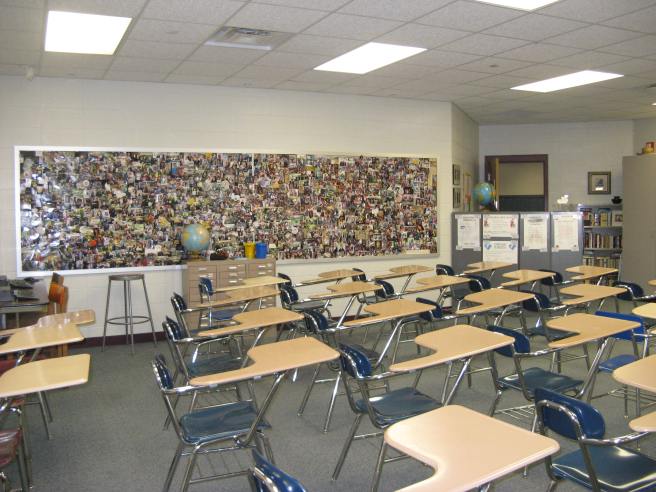
Years ago, students began giving me pictures of themselves. They would slip them into their graduation announcements, leave them on my desk, or simply hand them to me. I tacked the first few on the bulletin board. The result? More pictures came my way. The board began to fill. Eventually, all the bulletin boards in my classroom were covered with pictures of kids—except for one section behind some bookcases.

• Eric, who read Shane in the 11th grade–the first book he’d ever read cover to cover.

• And Twila, the first person in her family to attend college…oh, how she loved to read.

• Kelly, who rarely spoke in class, but had enormous writing talent. One day when she was absent, I read her story aloud.
“Who wrote that?” asked Brandon. He always spoke his mind.
“Kelly.”
“She ought to speak up more,” he said.
I agreed. “Someday she will,” I said. She wanted to be a minister.

• Masooda, a refugee from Afghanistan: She spoke no English at all when she first came to my class. We started with pictures she would cut from magazines. By the end of the year, she knew enough English to give a speech to her incredulous classmates about Afghanistan and her escape to America.

I used to joke with my students that when the bulletin boards were full, I’d retire. Since I was much too young for that, I simply moved the bookcase. Then I myself moved—to a new classroom where even more capacious bulletin boards filled one entire wall. I kept adding pictures.

IMG_3252

• The Russia Travelers: 27 American kids and 27 Russian ones—all of them participants in the academic exchanges that opened our eyes and forever changed all of our lives.

• Allie, who was my student aide for three years and knew me so well she practically ran my classroom the year I had to take a short leave.

• Another Brandon, this one the boy who took up my challenge and spent one whole night bringing his Turn It In score down from 26% to zero. “Mrs. Powley! How’s it going?” he’d shout out exuberantly every day when he came into class.

• Maggie, sliding into home base in a picture clipped from the newspaper. She loved to hear me read out loud.

A year and a half ago, I switched classrooms for the last time. There is very little bulletin board space in my new room—just yards and yards of whiteboard. So the pictures—which it took two teachers and four kids several hours to untack and place in a gigantic box—are already packed to go home with me when I leave the classroom at the end of this year to become a full-time Instructional Coach.

I’ve nurtured these students. I’ve challenged them; I’ve believed in them and helped them grow. I’ll never forget them, but I’m glad to have the pictures.

Funny how something so little, given and taken so casually—a senior picture, a snapshot from a field trip, a photo that was in the newspaper—can be so weighted with meaning.

I haven’t had trouble culling my files. I’ve been happy to pass my books along to my colleagues. Maps, posters, decorations: I’m glad they have new homes. But the photographs? They’re coming with me.

Discipline Lessons II

It’s been years since I sent a student from my classroom to the office. This realization came upon me today when I witnessed an altercation between a frustrated teacher and a huffy young man. When I was first teaching, I was afraid to send anyone to the office; I thought such a move would signal my incompetence. It might have, but principals form impressions of their teachers through all kinds of informal observations. They don’t need direct evidence like a string of miscreants in their office to get the picture—although a run of kids like that can’t help but influence them.

No, it’s the other students’ opinions a teacher needs to worry about. Sending someone to the office, if it occurs repeatedly, signals to students that you can’t handle the class. That gives them the upper hand. But sometimes, turning a ruffian over to the authorities is a good idea.

My first teaching position was English 7 and English 8 in a small junior high school in Wisconsin. I was newly married and so young looking that every year I was there, the company that took our school pictures mixed mine in with the students’. I lived about two blocks from the school and walked to and from every day.

My assignment began in January; I was the replacement for a veteran of twenty-five years who left for medical reasons. She was to undergo open-heart surgery and doubted she could return to work afterward. The English department in this school was small—only four teachers—and every one of us was a rookie. That fall, in a gesture of collegiality, the veteran teacher had swapped all of her ace students for the “bad boys” that the new teachers were contending with, so when I came in January, I inherited them all.

They followed me home from school, interrupted during class, threw things, dropped their books on the floor so they thudded loudly, and generally made me feel—and look—inadequate. I caught one boy, who supposedly couldn’t read, avidly studying something he had hidden behind his English book. He was clearly enthralled by whatever was there; I suspected it was not the text. What I removed from his grasp was a dime novel called Nympho Nurse.

I wanted to shrivel up and die right then and there. I am not sure what I actually did, but I know I didn’t have the presence of mind to turn the tables on my young “reader”—to make him the one who was embarrassed. Lacking such finesse, I probably should have sent him to the office so the others could see that I wasn’t putting up with such stuff. But I didn’t.

Instead, my husband chased after the boys who were trailing me home and scared them out of their minds when he caught up with them. That ended the nonsense from those boys; a colleague, a brawny math teacher, silenced the rest when he backed another boy up against a locker one day and read him the riot act. So I was rescued. But I knew I’d have to learn how to control boys like this on my own. I wouldn’t always have the luxury of strongmen on my side and in proximity.

I taught in Wisconsin for another four years, and during that time I took advice from more experienced teachers and put into play techniques I picked up on my own. I discovered that real control came from the expectations I set and from the work of the classroom, not from rules and regulations. I slowly gained the confidence I needed and grew into the authority I wanted.

After a hiatus of several years as a stay-at-home mom, I began a second teaching career in a junior high school in rural Indiana. I remembered my earlier encounters with adolescent boys and hoped being older would ease my reentry into the world of schooling. I hoped I wouldn’t have to send anyone to the office.

I needn’t have worried. The principal at my new school was so physically intimidating that few students ever even risked a trip to his office. He helped me establish myself not because he handled the discipline problems, but because his mere presence in the hallways set a tone that discouraged them.

Mr. Christopher had a linebacker’s build. He stood at the entrance to the school every morning, arms crossed tightly over his chest, scrutinizing every student as each one climbed down from the school bus and entered the building. He always faced straight ahead—if he wanted to inspect you further, his eyes followed you, but his head stayed put: like the Mona Lisa. To be honest, it was kind of scary, even for teachers. It seemed like Mr. Christopher could see into your soul.

The fact is, Mr. Christopher is a kind man with a wry sense of humor. He understood kids well, and usually, a conversation with him had a marvelously reforming effect on those who did end up in his office. He believed, rightly, that kids need structure. If right and wrong are clear, if expectations are spelled out, a child will be supported as a seedling is by a stake in the ground. Under those conditions, a child will stand a good chance of growing tall and strong.

I sent a student to Mr. Christopher exactly once. It was a 9th grade speech class in the early 1980s, and I was videotaping commercials the students had written. (An historical aside here: In those days, kids weren’t allowed to touch the expensive, new A-V equipment. Today, I would gladly turn the filming over to them!) Anyway, the boy whose turn it was to have his commercial recorded held up his “prop”—a book—and began his pitch. The book was entitled The Yellow River by I. P. Daily.

Click.

I stopped the tape, snapped the lens shut, and emerged from behind the camera. Though I said nothing, my “look” was enough. The boy left the room, headed straight down the hall to Mr. Christopher.

It makes me laugh to think about this now. Today, kids who are sent to the office usually aren’t so intimated, and what they are sent for is far, far removed from The Yellow River. However, that was the worst offense in those four years at Southwestern. I must have learned my discipline lessons well—or maybe—no, most certainly—Mr. Christopher was the stake in the ground supporting me. I established a reputation, and after that, I was much less frequently tested.

Young teachers struggling with discipline need to know that with time and experience, things do get better. But that day comes faster if there’s a Mr. Christopher beside them while they grow into the job.

Discipline Lessons I

Many years ago, when I was living in Connecticut, an educational psychology professor at Yale, who was conducting some of the early teacher effectiveness studies, hired me to observe and evaluate teachers in a New Haven public high school, one that had been the scene of violence the previous spring. I was in all kinds of classrooms, watched all manner of teachers, and learned very quickly that effectiveness isn’t the exclusive property of any particular teaching style (though some approaches have more potential for deadliness than others).

Tasked with observing the interaction between classroom control and teacher effectiveness, I saw that students in the classrooms of effective teachers—whether they were traditional lecturers or innovative strategists—were deeply engaged in the learning process. Sometimes it was the sheer complexity or elegance of the content that kept the students’ attention, sometimes it was the specific techniques the teacher employed, and sometimes it was simply the teacher’s charisma.

But the effective teachers had control, even when the students were running the show, as in the case of one young English teacher whose students were conducting a mock trial, a culminating project for a novel they had read. She sat on the sidelines, but she was following the action intently, completely focused on the proceedings and on her students’ interactions.

In every case, it seemed to me, the teachers’ control came from a clear set of objectives, high performance expectations, and personal confidence, not from a rigid set of rules and imposed penalties.

Years later, when I was required by my school district to write up my classroom policies and procedures—all the rules and the corresponding penalties—I complied with the request but told the students, orally and in writing, that the whole thing really boiled down to two concepts: Do Your Best and Respect Other People.

Of course, achieving effectiveness isn’t as simple as that sounds.

It starts with confidence.

My student teacher this past spring stood in front of her first class—9th grade—looking, frankly, terrified. The students, mostly boys, none of them “bad,” but all of them squirrely, wouldn’t sit still, talked when she talked, fidgeted with their papers and pens and books (if they’d brought them to class), dropped books on the floor, looked out the window—in short, did everything but sit tall in their seats and pay attention to the teacher. For her part, my student teacher wasn’t signaling that she ought to be paid attention to. Her voice was high, and when she spoke, she tripped along at record speed. She moved all over the place while she spoke to the students, and she constantly looked at me for reassurance or help. Her directions were vague and alarmist: “Don’t do that!” Exactly what the students shouldn’t do wasn’t clear.

In truth, she reminded me of myself in my very first teaching position.

Over the years I learned some tricks—the hard way—and was happy to pass them on to her. Things like:

• Lower your voice; don’t raise it. Students will have to be quiet to hear.
• Stand still when you talk to them—they’ll have only one place to look.
• Make your directions explicit: “Keep your hands on top of your desk and your feet on the floor under it.”
• Deal with disruptions immediately and in private. Most students who disrupt are really seeking attention. If you reprimand them in front of others, they have the audience they seek and will use it to cast you as the villain. Bend down and tell the student quietly what you expect. Even something as simple as changing a student’s seat can and should be done privately.
• Don’t engage in public debates about the purpose of a correction or the rightness or wrongness of one. It is what it is. Turn to the topic at hand. A student who wants to argue can certainly talk to you—after class.
• Don’t be afraid to call parents if a student has been disruptive. The failure isn’t yours: It’s the student’s. Most parents will be your allies, but they can’t help you out if they don’t know what’s going on. So what if the lesson wasn’t as good as it should have been? So what if your directions weren’t clear? Those aren’t reasons to tolerate disrespectful behavior. Parents won’t ask about the fine points of your instruction. They’ll ask what Johnny or Sally needs to do. Tell them.

Simple things like this, I learned by trial and error. Every one of these scenarios has happened to me—and it was discouraging at the beginning of my career to have to learn what to do, one agonizing crisis at a time. But every time I successfully handled a situation, my confidence increased. Eventually, I wasn’t afraid of my own shadow and wore my authority comfortably.

But it was a bumpy road to that confidence, so my sympathies were with my student teacher. Luckily, she was a quick learner and soon had the classroom under her control. She grew in confidence daily, and before long, she was ready to concentrate on other components of effective teaching. For her, too, discipline became as “simple” as Do Your Best and Respect Other People.

Why We Teach

From time to time, a piece of office humor entitled “You know you’re a teacher if…” circulates on the Internet. The ensuing list of indicators would make anyone wonder why on earth a person would become a teacher. For example, these highlights of the profession:

• no social life from August to June
• high susceptibility to chicken pox, colds, sore throats, and flu
• a compulsion to put grades on grocery lists, telephone messages, and junk mail

Funny…but it’s not the real story. The reason why teachers enter the profession and why they stay on is, quite simply, the kids.

• It’s the young woman whose resume landed her a full-time job–the resume you gave up your lunch period to help her compose.
• It’s the math students you’ve driven to Saturday competitions and the art students you’ve entered in contests so they can test their strengths and hone their skills.
• It’s the “struggler” who didn’t like to read, the one you stayed after school to help, who finally confessed when he finished a novel, “This is the first book I’ve ever read cover to cover.”
• It’s the girl who said, “I didn’t have any friends until I joined your club!”
• It’s the student whose lines you listened to over and over until you could recite them yourself–but the play was a success and the student was a star.
• It’s the ones you’ve stayed up all night for to chaperone at the after-prom.
• It’s the ones you’ve monitored early in the morning on “study table”–it kept them eligible for sports and it kept them in school.
• It’s the ones for whom you’ve written college recommendations and hugged when they told you the good news: “I’ve been accepted!”
• It’s the ones you’ve helped in the library when they “couldn’t find anything.”
• It’s the boy who said, “You made me work. You taught me how to study–and now I’m going to college!”
• It’s the child you agonized about on the weekends and lost sleep over at night because no one at home seemed to care.
• It’s the ones who’ve come back from to say, “You really did know what skills I’d need in sixth grade…or ninth grade…or college.”
• It’s the children for whom you’ve been a stand-in parent on Family Nights.
• It’s the ones you’ve helped with computer problems–students who weren’t even in your classes.
• It’s the ones for whom you’ve paid the field trip charge.
• It’s the ones to whom you’ve given lunch money.
• And it’s the light in their eyes and the lift in their voices when they learn how to read, or convert fractions, or understand covalence, or give a speech, or shoot a basket, or play the clarinet, or fix a car’s transmission…

Ask any educator–as I did. Stories like these are the sustaining force in our professional lives, the compensation for those skipped lunches, sleepless nights, and endless piles of paperwork.

It’s the kids. They’re the reason why we teach.

The Last “First Day of School”

Some people would say I am nuts. First off, I was too caught up in the mechanics of the first day of school of the second semester—taking the roll, issuing books, assigning seats, previewing the semester, and explaining the rules (Two: “Do your Best” and “Respect Other People”) and what they mean and why they are important—to think about how this was the last “first day of school” I’ll ever experience. (Next year, I’ll be a full-time Instructional Coach.) Then, for the students who had been in my class first semester, I was busy going over the final exam and introducing the work of the week: revising an essay they had turned in at the end of last quarter. I hardly had time to catch my breath between the classes.

I’m on a new schedule, too, so my body was adjusting not only to bells again after the long, languid hours of Christmas vacation, where what I was doing could flow from one hour into the next, but to standing on my feet from 7:30 until 11:08 without a break. I had an hour and a half then to respond to email, eat my lunch, check the front office for incoming mail, and get ready for the last push, my final class from 12:40 to 1:35. And then I was done. Done! I’ve never had a last hour “prep” in my entire teaching career (37 and ½ years). I think I’m going to like this…but time will tell if I will be able to stand the standing.

So here’s the “nuts” part. I spent the last hour of the day writing purpose sentences on the whiteboard. For each class, in kid-friendly language, a statement of what we are learning tomorrow. Kids ought to know what the focus each day is upon and what’s so important about it. So say the current education gurus and the administrators in my District Office.

I absolutely agree. (Unless, of course, you’re doing an activity where stating the point ahead of time would kill the learning activity—but that’s a subject for another day.)

In these 37 ½ years, I’ve written lesson plans that I’ve submitted in advance to the principal and lesson plans that I’ve kept for myself. I’ve kept a daily assignment list on the board so kids could see what was coming up. I’ve issued calendars (Thanks, Publisher) for entire semesters on the first day (I did that today, in fact, in two out of three of my classes). Sometimes—especially in later years—I’ve kept personal curriculum maps on my desk, flow charts of what I’d done and what I need to do, and sometimes I’ve just run by the seat of my pants. I mean, I have been doing this for so long that I’ve memorized my own speeches and know by instinct what comes next and what’s after that and what the ultimate destination is. I’ve even managed to use this last (non-) method and keep more or less on schedule. I don’t think my students have suffered; I think that at any given moment they know what we are learning and why we are learning it. I often start class by saying “My goal for today—or for this week—is…” I think they know.

But of course, I don’t know.

I assume it.

But today I wrote purpose statements on the whiteboard during that last period of the day when I was, for the first time ever, “done” at 1:35. I’m experimenting. In response to the mandate for a better evaluation system for teachers, our district is initiating walk-through observations by administrators. My question was this: How will the principal know what I am trying to accomplish? The answer: It should be written on the board, plainly, in kid-friendly language, not just for the administrator, but for the students—so they will know for sure what the learning target (new jargon word in education) is for the day.

So I did it.

Doing so forced me not just to focus my thoughts, but to articulate them.

On the second day of school, I’m giving the students in my senior composition class the multiple choice part of the final exam. Purpose: to assess prior knowledge for each student. Why? So I know what I need to emphasize in my instruction and so that, at the end of the semester, they can see their growth for themselves—at least in this area. It’s a writing class, so the skill set they’ll acquire extends far beyond multiple choice answers to questions about grammar, usage, and mechanics. The purpose sentence for the next day was easy, though: “To determine what you already know and what you need to learn,” I wrote (kid-friendly language).

For the next class, there are really four learning targets: 1) Kids will collaboratively (a whole lot of skills to be taught there!), 2) write a clear, concise, coherent, and correct summary (Deconstruct that if you will!) of three pages in the textbook. (That’s the content part.) 3) They’ll access two separate but complementary sets of instructions on the internet (What? Read and follow directions? What am I thinking?) and 4) submit their responses to me using the Dropbox on our district’s electronic system (new process for some). I put the whole thing on the board. I mean, I want them to understand that there can be multiple goals for any one assignment or activity.

And the third class? This is my freshman Honors class, the students who will be writing essays for inclusion in a book they’ll publish by May. They wrote comparison/contrast essays at the end of last semester. Now I want them to improve upon those essays. Some had weak introductions; others fell down in the conclusion. Some need to reorder their supports, some omitted a thesis or wrote a weak one, some need more support for their supports, some need less plot summary and more selective detail. We’ll have a lesson on introductions first, using as models some of their own paragraphs (I’ve already picked out the ones that I’ll ask the kids to project onto the ENO Board for others to see.) Then we’ll work on conclusions. That’s probably the day after next. Everyone can benefit from seeing exemplary models, but I’ll devote half the period to working with students individually to improve what’s specific to their particular papers.

I wasn’t sure what to write for this class. There’s so much going on. In the end I wrote “Revise comparison/contrast essays to include a strong introduction (and I listed the components of that) and work in class on individual areas for improvement.”

My purpose statements took up half my board space! (I print big.)

So who experiments with teaching strategies on the last first day of school? Me. Because I believe that teaching well is a work in progress. No one is so good she can’t be better. No one does everything right and everything perfectly 100% of the time. We all have room to grow. And if we didn’t, whew! It would be an easy job and our kids would be achieving at levels unparalleled in the world. And we know that neither of those things is true.

So on with the experiment. Stay tuned. I’ll let you know if A) I can keep it up, B) the principal finds it helpful, C) the kids benefit from the explicit statement of the goal, D) it continues to be a challenge to me to focus my thoughts and articulate them, E) all of the above.