All Charged Up

I come from a time when girls were not encouraged to take science classes.  I struggled with math in high school, so when my teachers said I didn’t need to take chemistry or physics–the implication being I’d struggle there, too, and besides, why did a girl need chemistry or physics?–I just smiled and considered myself lucky. Big mistake. I should have been more assertive–I should have known I would be missing out. 

My good friend and colleague Cheryl McLean invited me into her class last week to observe a demonstration lesson in AP Physics I. As I watched, my own high school experience came rushing back. I realized what I had missed a long time ago, and I’m grateful now, after all these years, for the invitation to learn, right along with this class of–get this!–twenty-one girls (and one boy).  

Here’s an account of that class:

While students settled into their seats and readied their laptops, notebooks, and pencils, Mrs. McLean briskly conducted the business of the day:  due dates announced for future assignments, current papers collected, attendance taken. Then she directed the students to gather in front of the demonstration counter for an introduction to the fundamentals of electric charge.

McLean pie pans 2For the first demonstration, she used an electroscope and a charging rod. She brought a negatively charged rod close to the electroscope and the two metal “leaves” inside pushed as far away from each other as they could; a positively charged rod brought them together.  The principles: attraction and repulsion.

Ben Franklin, she told the students, coined the terms positive and negative charge.  In that way, she tapped into our collective memory of his legendary experiment with lightning.  Franklin, even I knew, wanted to establish that lightning carries electricity.  Indeed he proved that.  The negative charge from a lightning bolt struck his kite and traveled down a wet silk thread to a key at the end of the thread.  When Franklin touched the key, he received a shock.  Classic electrodynamics.

For the next demonstrations, Mrs. McLean used the van de Graaf generator, a piece of scientific equipment that looks like a giant silver lollipop.  The van de Graaf generator produces a charge by dragging a rotating belt over copper cones.  The surface of the metal “lollipop” becomes charged.
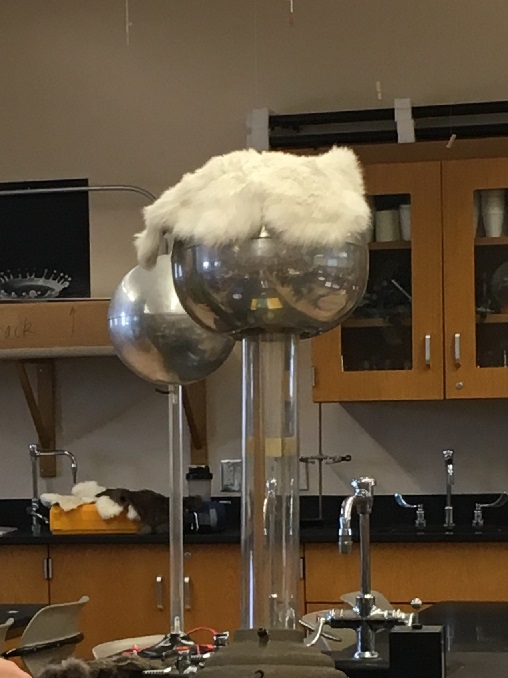
McLean peltMrs. McLean brushed the surface of a rabbit pelt with a comb. When she perched the pelt  on top of the device, the individual hairs stood on end.

Then came the “pie pan demo.” One-by-one, chicken pot pie pans, a minute ago nested in a stack on top of the van de Graaf generator, launched into the air, seemingly on their own.  Students had already observed the generator’s ability to charge an object.  Now they saw that a collection of charge can produce an electric force that exceeds the gravitational force acting on a single pie pan.  Thus, the charged pie pans achieved lift off and sailed into the air.

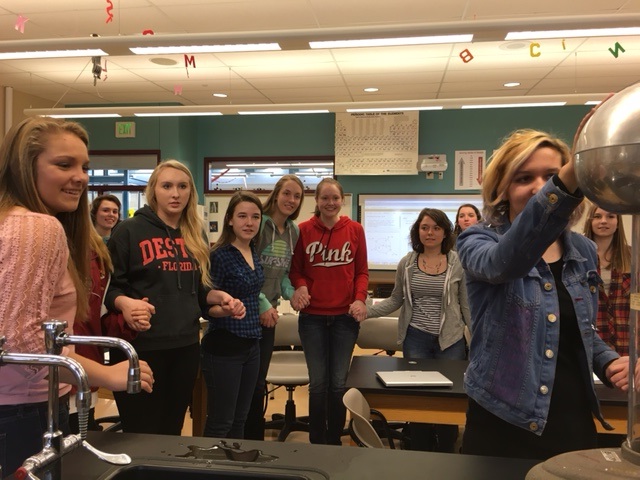
Finally, Mrs. McLean showed the students how a charge “travels.” A student touched the van de Graaf generator, received the charge, and then touched a small pool of water on the counter.  The resulting electric shock traveled, wrist to wrist, along a line of students who were holding hands. The last student was touching the counter, too—and the charge grounded.
McLean tarveling shock

AP Physics has the reputation of being a difficult class:  Tough topics, high level math.  To explain the phenomena that the students study, Mrs. McLean starts this unit, and others like it, with a demonstration of the principles the students will later explain mathematically.  “It’s not enough to do the math that explains the phenomena.  It’s important for students to know through experience what actually happens,” says Mrs. McLean.

Later in the class period, when the students were working the equations that explained the phenomena, I did get lost.  It had just been too long.

A week later, I went back to AP Physics I to ask the students if and how the demonstrations had helped them when they started doing the math.

“They helped me visualize the movement of the electrons and the protons to make positive and negative charges,” said one student.

“It was more interesting with the demonstrations,” added another. “We paid more attention.”

The final word came from a third: “And it was more fun!

Indeed it was.

I have also observed high school chemistry classes in my capacity as an instructional coach.  (You don’t need to know the content to recognize good teaching or to help someone adjust their instruction to be more effective.)  I know now that I could have understood chemistry.  I could have understood physics.  After all, I did take the full four years of math, which ended then with trigonometry and solid geometry.  The recommendation that I not take those science courses in high school is really a reflection of the time period in which I grew up.  No malice was intended.  My teachers were simply short-sighted–and I didn’t believe in myself enough to question their recommendation.

I could mourn my loss. I could get angry at having been cheated out of an education in science.  But really, I’m more grateful than I am sad or mad. Grateful to my colleagues who have invited me into their classrooms to help them, but who, probably unknowingly, have helped me as much.  In the past several years of coaching, I’ve learned quite a lot–in science, in math, and in every other subject, too. In a way, I’m getting to repeat high school. And it’s a privilege, not a penalty.  In fact, I’m all charged up about it.  Still.  After all these years.
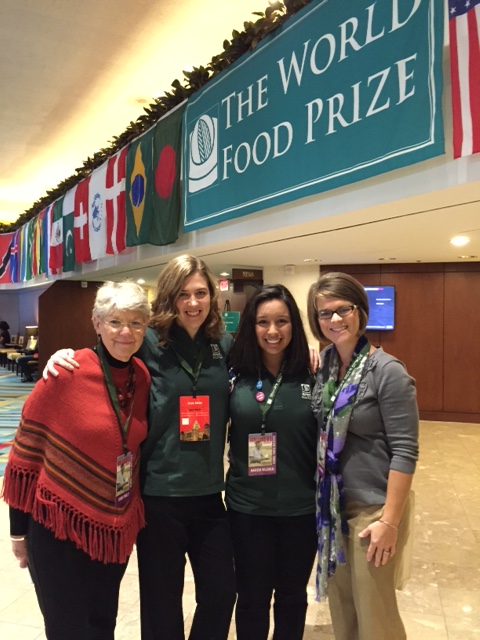
 

Hunger Fighters

Get out of your comfort zone and try to understand people’s lives that are different than yours.   –Sir Fazle Hasan Abed, recipient of the 2015 World Food Prize

4 of us.jpeg
Rachel researched water sanitation and access in the DRC; Marisa’s paper was about water sanitation in India.

The World Food Prize honors scientists and humanitarians around the world who have made a significant contribution to the fight against hunger. It was established by Norman Borlaug, who is sometimes called “The man who saved 1 billion lives” for his work in developing a drought-resistant variety of wheat that, over time, saved those estimated one billion lives. Scientists such as Purdue’s Dr. Gebisa Ejeta (2009) and Dr. Philip Nelson (2007) have been recognized for their work in fighting hunger as have humanitarian leaders of the caliber of this year’s winner, Sir Fazle Hasan Abed, the visionary from Bangladesh who founded BRAC, the world’s largest NGO.

In 1970, Borlaug received the Nobel Peace Prize. In 1986, he conceived the idea of the World Food Prize to honor individuals who had made significant contributions to ending world hunger.  Later still, in 1994, he established the World Food Prize Global Youth Institute, a competition in which high school students study food security issues in countries around the world. After months of research and essay writing, students submit their essays and then present their work orally at regional competitions. The winners there attend the World Food Prize/Global Youth Institute in Des Moines, Iowa, where they interact with some of the most prestigious scientists in the world, learning more about solutions to world hunger and exchanging ideas with these leaders in the field.

Indiana students talk with WFP Laureate Gabisa Ejeta.
Indiana students talk with WFP Laureate Gebisa Ejeta.

I’ve just returned from the World Food Prize/Global Youth Institute proceedings in Des Moines. My colleague and I have three years of sponsoring students under our belts; we’ve sent students on to Iowa every year—and every year we’ve come away from this amazing conference recommitted to the cause. I’ve written about the World Food Prize essay contest before (See https://sarahpowley.wordpress.com/2013/05/03/winners-all/ and https://sarahpowley.wordpress.com/2013/11/08/changed-lives-the-world-food-prize/), but I can’t help writing again about the incredible opportunities this program extends to students and the profound impact it has upon their lives.

As a former English teacher, of course I value the writing and thinking skills that such a challenging paper demands. Gathering information and evaluating it for its recency, credibility, and specificity; sorting and organizing it all into a coherent problem/solution format; and then writing the paper in tight but fluid prose is no mean feat.

To be in the presence of great scientists—at the regional competition and again at the Institute—is awe-inspiring. Most students have no idea what a professional conference looks like, let alone even know that professionals in any field gather regularly to present papers, engage in dialogue, participate in panel discussions about timely topics, and hammer out approaches to common problems. Watching leading scientists, small holder farmers, representatives from NGOs, and agribusiness growers present information about (for example) aquaculture, conservation agriculture, and the nutritional impact of sweet potatoes in Africa is mind-expanding. Who would think such topics would captivate high school students whose background is not necessarily agriculture? But the students were not just snagged; they were hooked by the passion of the speakers and the complexity of the world of agriculture. They recognized the importance of something they’d always taken for granted—food—and the urgency of the challenge to feed 9 billion by 2050.

The culminating event for the high school students is a presentation at the end of the Institute to a panel of scientists and agriculture experts (even the laureates themselves, including this year’s winner) who read the students’ papers and interact with them.

One of our students, Rachel, in introducing herself prior to presenting her paper on water sanitation and access in the Democratic Republic of Congo, declared, her tone earnest and her demeanor sincere, “I didn’t think this experience would affect me the way it did. Food is the key to everything. I didn’t really realize that before I wrote my paper.”

rachel.jpeg
Rachel and two other students discussing their presentations.

I had watched Rachel intently throughout the conference. Because she has always been a little bit shy, I wondered if she would feel overwhelmed by the experience in Iowa. But the reverse happened. It was like watching a flower unfold in Disney’s Fantasia. She sat at lunch and dinner with students, teachers, and professionals from all over the world, gaining confidence every time she initiated a conversation or answered a question. Her public speaking skills soared: Her own presentation was animated, thoughtful, and nuanced by very natural vocal and facial expressions. One of the experts evaluating her performance told he was “touched” by her comments about the impact of the experience on her thinking.

But the benefits don’t end there, with students developing an English teacher’s skill set.

The impact on career choices, college majors, even the choice of a particular college is significant.  Rachel said she had come into the program certain she wanted to pursue criminology but was now considering a career in public relations or international relations.  Another student, one I don’t know personally said, “This program made me consider college majors I’d never thought of. It made me aware of issues I’d never heard of.”

Students who attend the Institute in Des Moines—the top essayists—become eligible to apply for 2-month summer internships to do real science themselves. Last year, 23 students were awarded Borlaug-Ruan Internships to pursue science in locations around the world. They worked with top scientists in all areas of agriculture, agronomy, and food science. Each of the students returned to Iowa this past week to give a poster presentation of their research.

This slideshow requires JavaScript.

Students who attend the Institute in Des Moines are also eligible to apply for Carver-Wallace internships here in the United States.  So far, 110 students have been Carver-Wallace Fellows; among them, one of our own students. Caroline, who competed two years ago, interned at the USDA facility on the Purdue campus the summer after high school; her experience there morphed into a job with the USDA while she attended college at Purdue.

The mission of the Global Youth Institute is to inspire students to answer the call to fight hunger in the world—as scientists, humanitarian aid workers, journalists, business leaders, growers, teachers, and manufacturers (among other occupations).

“Even if you become, say, a banker,” Sir Fazle Husan Abed elaborated in his luncheon address, “you’ll be a better banker for that. Doing for others leads to a satisfying life. If that is not your occupation, make it your preoccupation.”

In the next 40 years, according to a senior officer from DuPont who spoke in Des Moines, we will need to provide more food than we have produced in the last 10,000 years. The world needs young people to make fighting hunger their life’s work. Reaching out to them—when they’re on the brink of life decisions—is what the World Food Prize/Global Youth Institute does well.

Some, of course, won’t go into agriculture or nutrition or science. But no matter their career path, they’ll never forget the message they’ve learned, the skills they’ve gained, or the opportunities afforded them because of their participation in the Global Youth Institute. They’ll never take food for granted again.

Under Discussion: Literature Circles

P1010150Literature Circles are old hat now. English teachers everywhere–from the elementary grades through high school—use this strategy to group students by interest or by reading level. Harvey Daniels, who popularized the concept and brilliantly refined it, has published at least five books on the topic. How-to websites abound, and Pinterest is a rich resource for the props that go with establishing literature circles: the “role sheets,” question cards, sentence starters, anchor charts, choice boards, discussion guides, and rubrics.

I came to literature circles quite by accident sometime in the early 90s—before Harvey Daniels and before roles for participants in the circle had been devised. I am sure I was not alone in figuring out for myself what to do when faced with a wildly disparate group of students. All these years later, I’m still a believer in literature circles—and I encourage the use of Harvey Daniels’ role sheets (plus some of my own devising) although I’ve learned that some educators think the role sheets are limiting.

But that year, whichever year it was, I was still fairly new to teaching high school English. The course, called “Trails West,” featured books about the American West.  My class was hugely mixed in readiness and in student interests.  A few students, whom I’d had in Honors 9 English, consumed books like cookies and cake; others read poorly, infrequently, and under protest. The course was nine weeks long and the curriculum specified that the students would read three books within that time frame.

Essentially, I decided to teach thematically and, for the first unit, selected three books on aP1010623 single topic: The Western Hero (aka, the Epic Hero). The books I chose (from what was available in the bookroom) were The Virginian, the classic by Owen Wister that established the cowboy as an epic hero; True Grit, in which a young girl sets out with a grizzled old lawman to avenge her father’s murder; and Shane, a book about as close to the epic pattern as anyone could imagine. The second “unit” was about the pioneer experience; the third, the Native American experience.

Every three weeks, students chose the book they wanted to read (Miraculously, I thought, no one tried to “read down” and a few challenged themselves to “read up”). Initially, they met in groups of four or five to lay out a plan for the number of pages they’d read before the three meetings I had pre-established for them to convene and discuss the book. I supplied the questions for these meetings—the same ones for each group since the themes were the same—and in between meetings, the students read, kept a list of self-selected vocabulary words, did a mini-research project, and took direct instruction from me on topics related to the book or on other relevant English class topics.

I made bookmarks for everyone, with spaces for page numbers, so they could establish daily reading goals. They divided the number of pages in their book by the number of days to completion. Some kids didn’t need that—they could hardly put down a book they liked—but the reluctant readers enjoyed checking off the little boxes on their bookmarks that indicated they’d accomplished their 10 or 15 pages for the day. They might stop mid-chapter rather than read one more page, a mind-set I admit drove me crazy, but the bookmark served as a kind of time clock for them. When they’d completed their number of pages, they could congratulate themselves, check off a day on their bookmark, and close the book. The strategy worked. One boy, a junior, told me at the end of the year that Shane was the first book he’d read cover to cover in his entire schooling experience.

I’ve seen literature circles work when all the students are reading the same book and in Lucy, Henry, Taylorsituations like mine where students chose a text, based on their interests or their reading levels. I’ve seen literature circles work in subjects other than English and with articles rather than whole books. The online Encyclopedia Britannica presents leveled versions of its topics, and NEWSELA, a free online leveled reading site, (www.newsela.com) sends daily articles relevant to science, sports, history, the arts, current events—all kinds of subject areas—each article written at as many as four to five grade levels. The site also offers complete text sets on topics of interest to teachers of every discipline.

However you choose to implement literature circles, at the heart of the strategy is the discussion: Kids talk about what they have read. The questions the students ask and answer  go way beyond study guides and recall and comprehension recitation. Nowadays, I’d have them take turns making up their own questions, trading around the responsibility for being the discussion leader. Another person’s role is usually to summarize the pages under consideration so that everyone in the group has the facts right, but eventually, questions about the author’s purpose, concerns  about the motivation and credibility of characters, and conversations about style emerge.

Lit circles are more like adult book club conversations than teacher-directed Q and A. They’re effective at drawing students in because the conversations are genuine and everyone gets a chance to say what they think. They work as a vehicle, too, for developing fluency in academic conversation and for inculcating the manners that are necessary for civil discourse (Hence, the sentence starters and conversation rules you see on Pinterest).

I had good luck with lit circles with Honors students and struggling readers alike. In fact, my favorite memory from those Trails West days is of Pencilhead (see my blog post:       https://sarahpowley.wordpress.com/2012/04/01/pencilhead/), at that  time a reluctant reader and would-be class comedian, pulling his chair up to another group deep into discussion of the same book his group had already discussed: He wanted to hear more.

Literature Circles get kids to read more. Literature circles get them to talking more. What could be better?

_________

This post presumes you know all about Literature Circles. Perhaps you are just getting started or even still thinking about the idea. If so, here are some starter websites:

http://www.educationworld.com/a_curr/curr259.shtml A straightforward explanation of Literature Circles—what they are, how they work, why they work.

http://www.lauracandler.com/strategies/litcirclemodels.php Teaching suggestions including variations on the basic model of roles, role sheets, information on working with multi-leveled books.

http://www.litcircles.org/Overview/overview.html This site provides an overview of Literature Circles—structure, benefits, outcomes over time—in chart form.

Under Discussion: Fishbowl

Keelsing 1In my last post, I wrote about getting the students to contribute to teacher-led discussions. But sometimes, the best way to get them talking is to structure the conversation. A structured conversation, in fact, can engage students in a lesson in ways that a teacher-led discussion cannot.

The other day, I watched a master 7th grade science teacher, Miss Kimberly Keesling, lead her class through a Fishbowl debate. Her objective was a universal lesson in critical thinking: Beware of loaded words and emotional responses. Ask questions. Do your own thinking.

She drew upon a well-known hoax from the 1990s in which scientific “evidence” was deliberately used to mislead the public.

Miss Keesling distributed facts sheets to the students—papers she’d prepared listing the pros and cons of banning a mysterious substance, dihydrogen monoxide—DMHO for short. The strikes against DMHO in the realm of health alone are pretty severe. It’s

  • Colorless, odorless, tasteless
  • Accidental inhalation can be deadly
  • May cause severe burns
  • Prolonged exposure to its solid form causes severe tissue damage
  • For those who have become dependent, DHMO withdrawal means certain death
  • Has been found in excised tumors of terminal cancer patients, but is not believed to be carcinogenic

Environmental issues are also serious:

  • Is also known as hydroxic acid, and is the major component of acid rain
  • Contributes to the “greenhouse effect”
  • Is found in almost every stream, lake, and reservoir in America
  • Has caused millions of dollars of property damage in the Midwest recently
  • Contributes to the erosion of our natural landscape
  • Accelerates corrosion and rusting of many metals
  • May cause electrical failures and decreased effectiveness of automobile brakes

On the other hand, DMHO is used

  • As an industrial solvent and coolant
  • To generate power
  • In the production of Styrofoam
  • As a fire retardant
  • In the distribution of pesticides
  • As an additive in certain “junk-foods” and other food products

Miss Keesling gave the students five minutes to ask questions, study the fact sheets, and write out talking points on one side or the other. Then she took the pulse of the class. Those in favor of banning DMHO went to one side of the room; those against banning it, to the other. The Undecideds sat in the middle. She explained to the students that they were going to have a debate about DMHO, so they had to use facts.Keesling 2

It took only a few minutes then to explain the rules of Fishbowl:

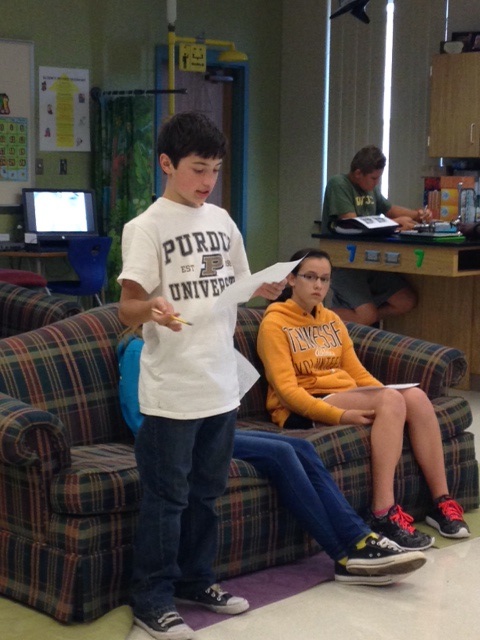
  1. Three people—volunteers, one from each group—would be at the front of the room, seated on a comfortable couch. (Usually, Fishbowl is done with two concentric circles—an inner circle and an outer circle—but the rules are malleable.) Using their notes and the fact sheets, the students would take turns presenting their point of view about DMHO.
  2. When a speaker finished, if another student wanted to support that point of view, he’d tap the speaker on the shoulder and the first speaker would sit down. In that way, only three people at a time were seated on the couch.
  3. The speakers stood up to present their arguments.

Middle schoolers love to talk, love to debate, and these students did so brilliantly. Their arguments for and against banning the mysterious substance were cogent and fact-filled. Some students were direct and succinct; others became quite animated. Within 15 minutes, just about everyone in the room had spoken. I heard impassioned and powerful statements and effective transitions such as these:

  • Although it is used to generate power…
  • It’s a risk: But life is about risk.
  • Bottom line: It kills people.

Sophisticated stuff for 7th graders. At the end, my colleague asked how many of the students had switched sides because of the arguments they heard. Some had.

Then she made the Big Reveal: DHMO is water. She broke the scientific words down into their roots and prefixes: di (2); hydrogen; mono (1); oxide. A few students caught on, clapped their hands to their foreheads: H20.

Why, she asked the students, had they come down on the side they had? All the claims and counterclaims are true—but they had been duped. Who had even asked what DMHO was before they began?  No one. What had swayed them? They had heard the facts, stacked on one side or the other as they were—all of them true, all of them convincing—and formed an opinion, often a very strong one. Why?

What followed were insightful responses that boiled down to this: The use of strong, emotional words such as kill, severe tissue damage, withdrawal, “greenhouse effect,” found in tumors… It was easy to be led to a conclusion.

And that was her point. Scientists have to investigate dispassionately. Scientists have to examine the facts. Scientists have to ask questions. They can’t be swayed by emotional language.

And it’s not just scientists. These students were quick to point out that television, politicians, advertising—they’re all guilty of using emotional language to influence their audiences. Everyone needs to be vigilant. Everyone needs to think before they jump to a conclusion about something they know nothing about.

The Fishbowl strategy proved to be superior to recitation and far better than teacher questioning for a lesson like this. Because it was experiential, because kids were out of their seats moving and talking, because they took ownership of the lesson, they were engaged in the activity and Miss Keesling was able to make her point.

Granted, this particular lesson was a set-up. But the kids were good-natured about it. They understood the message and understood the value of it being learned in this way. In fact, the lesson will stick far longer than a paragraph in a textbook or a lecture by the teacher. But the method—a Fishbowl debate—was the perfect vehicle in a powerful lesson orchestrated by this experienced science teacher. Point made.

Fishbowl works for straightforward discussions about all kinds of topics. It’s especially useful if students are invested in a topic and eager to contribute, but even shy students will express their opinion when they can choose when to tap someone on the shoulder, decide for themselves when to take an inner circle seat.

Want to know more? Here are three websites explaining Fishbowl, offering other ways of structuring a Fishbowl conversation.

https://www.facinghistory.org/for-educators/educator-resources/teaching-strategy/fishbowl  (Facing History and Ourselves) A straightforward explanation of how to set up a fishbowl discussion.

http://www.learner.org/workshops/tml/workshop3/teaching2.html (Annenberg Learner) A lengthier description with alternative ways of structuring the discussion.

http://www.edchange.org/multicultural/activities/fishbowl.html (Multicultural Pavilion) Another good explanation of the set-up for Fishbowl.

Under Discussion: Getting Them to Talk

FullSizeRender (1)A teacher asked me the other day, “How do you get them to talk?”

I had just seen the same kids who wouldn’t raise their hands and answer her questions about the bell work they had just completed come into the room talking like crazy at the start of the hour. I’d seen them turn in their seats and continue to talk to each other—until class started. They did have voices.

But of course, the questions about the bell work were posed by the teacher, the topic was academic, and too much was riding on raising their hands.

  • Some didn’t know the answer and didn’t want to look “dumb.”
  • Some had the answer but didn’t want to be branded as “smart.”
  • Some had an idea—but didn’t want to risk being wrong.
  • Some knew the answer but just weren’t saying. Lots of reasons why.
  • Some were shy and not yet comfortable in the class. It is still the start of the year.

I remember learning to break icy silences like this, so here is what I told the teacher. It’s what I learned over the years about getting the kids to talk.

To start with, some conditions promote participation and, eventually, real discussion, better than others.

The seating arrangements: When desks are in rows, the student answering the question speaks to one person only—the teacher.  If recitation—simple Q and A—is what you expect, rows are okay; but if the goal is dialogue among the students, sitting in rows discourages that.

Even setting up the room so that two banks of desks face each other or are at least on a diagonal—a herringbone design—can help. Now they’re not talking to the backs of heads.

Circles, of course, are wonderful, but a circle is difficult if there are many students, big desks, and a small room.  Plus, there’s all that space gone to waste in the middle.

For years, I arranged my room in a U—two of them, to be precise. One had 19 chairs and inside that U was another, with 11 chairs. (I taught the students how to quickly rearrange the desks in rows for tests. For that matter, I taught them, too, how to rearrange the desks into pods for group work.) The U shape allowed the students to see the faces of a good many of their peers, so when we moved beyond recitation to real discussion, they were more likely to address each other, not me. Which is what I wanted.

My dream-come-true happened in my last years in the classroom when my room had 6 tables that broke apart into single desks. The students had swivel chairs. (Yes, I had to stop a few “spinners” from distracting others—and making me dizzy just watching them!—but that was quickly and easily halted.) The tables were perfect for group work and because they broke apart, the students could easily set them up for tests—and put them back again when a test was over.

The teacher’s position: Sometimes you want to be the “sage on the stage,” standing above the students and posing questions to a seated audience. In that case, rows are traditional and can work. But for discussion, a subtle change in your position makes a big change in audience response. Try sitting among the students in an empty student desk. Or, if the conversation you are looking for is to be strictly among the kids, sit off to the side. If you sit down—not at your desk, but in a student desk—you’ve changed the climate dramatically.

When my desks were in that U-shaped configuration, I sat in a student desk at the top of the U—in the gap between the two ends.  I could see everyone, direct traffic, keep track of who was participating and who wasn’t, and even write things down (which is much harder to do when you’re standing).

Wait time: This is an old piece of advice, but still so important. You have to give the students a few seconds to think before they speak. Not only will they provide better answers—more reflective, more detailed—but you’ve signaled that you value reflection first and open mouth second. Every prospective teacher learns about “wait time” in preparation for teaching, but that wait time is easier said than done. As a culture, we are uncomfortable with pauses, distressed by silence. That partly explains the vocalized pauses teachers of speech and debate struggle to eliminate—those ums and ahs that unconsciously creep into our speech.

In his book, Teach Like a Champion, Doug Lemov suggests what he calls “Narrated Wait Time.” That is, when the room is silent and you are waiting for an answer, throw out a comment that will help the students monitor the time (“I’m waiting for 10 more seconds before I call on someone”) or even guide them down the right path (“Think of a character in another book we’ve read who has had this same kind of problem”). Then wait a few more seconds.

Related to this is another strategy: Let them take a minute to write down an answer so they feel prepared. Sometimes when students don’t respond it’s because they’re tongue-tied. Having a prepared response builds confidence.

Your questions:

Avoid yes/no questions. What else is left to say after the answer is given?

Be explicit about what you are looking for.

Explain the similarities between these two characters. (If you just say “How are these two characters alike?” the answers will be short. Requiring students to explain provokes a more detailed response.)

Why do Russians think Stalingrad, not D-Day, was the turning point in WWII? Explain their point of view. (This is a complex question. It requires students not only to know what happened at Stalingrad as well as on D-Day, but to compare and contrast the two events and step outside the comfort zone of the conventional American point of view.)

What evidence do we have that climate change is happening? (Notice that asking for evidence avoids nebulous and unsupported answers that begin with “I feel that…” or “I think that…”, demanding, instead, that students present pertinent facts, not unsubstantiated opinions.

Here’s a source for great questions: www.edutopia.org/blog/rethinking-whole-class-discussion-todd-finley

Your responses:

Just as you will expect the students to be courteous to each other, you need to be careful about your responses to them. “Can you tell me a little more about that” sounds better than “Is that all?”  “You’re on the right track. Can anyone else add to that?” is nicer, too.  You don’t want to accept wrong answers, but you have to be supportive of attempts—otherwise, students will shut down. Whoever volunteers to be humiliated?

Teach them how to respond: Consider posting sentence stems as reminders when you’re first getting started.

  • I agree with James, but I want to add this…
  • I don’t agree, James, because…
  • That’s an interesting (unusual/thoughtful/surprising/etc.) way to look at the situation, but here’s my take:
  • I’d like to add to what Sally said.
  • I didn’t understand it that way. What I got out of it was…

An excellent list of sentence stems—that teachers can use as well as students—appears on Te@chThought: http://www.teachthought.com/learning/sentence-stems-higher-level-conversation-classroom/

Collaboration helps:

Think/Pair/Share is another confidence-building strategy for discussion. You may have used this for reinforcing concepts, but it can also be used for developing ideas. Two people seated next to each other turn in their seats and for a brief amount of time, discuss the question and come up with an answer. Keep the time short—very short—or the talk will deteriorate into social conversation. And, be explicit about how they share—especially important if the students have never done this before. Model the exchange of ideas for them so they have the language of collaboration.

Group Share is essentially the same thing, but three or four people work together to come up with an answer. Usually the question is more complex, the time allotted is longer, and the discussion afterward is extended. Again, keep to a strict time limit, model the process, and instruct the students to choose a spokesperson who will deliver the consensus response. After each group has reported out, a fuller discussion starts spontaneously because the groups don’t always agree.

If all else fails, try this:

I’m by and large not a believer in extra credit, but many teachers, for good reasons, are. Many people award participation points—or expect students to earn them. Also for good reasons.

One year I came up with this strategy for a class who wouldn’t talk. We were reading Field of Dreams (This was before it became a movie). I took a great big sheet of white construction paper, used a water glass as a template, and drew around the glass to make circles on the paper. Using my amazing artistic skills, I turned each circle into a baseball, wrote the students’ names on the baseballs, and laminated the sheets.

When they entered the room, I’d hand them their baseballs. (The leftover baseballs told me who was absent: Presto! Attendance taken!) Then, as I explained on the first day, my expectation was that everyone would speak at least once a period. They had to raise their hands, I called on them, and as they spoke, I collected their cards.

This strategy really worked for me. I did get them talking because that extra point (In the beginning, I did count their contributions as extra credit) was a huge motivator. After a while, I dropped the extra credit, moved to participation points, and eventually got rid of all points—but by then we were done with the book, too. But, the students had opened up. The ice was broken and they were no longer so hesitant to speak.

This strategy is similar to the one elementary teachers frequently use: calling on a student whose name is on a Popsicle stick or drawing a name from a fishbowl. The difference is, with the baseball, the student has the choice of when to speak—a powerful bit of control for someone in high school.

Of course it wasn’t a perfect strategy. A student could use his card right away and then sit back and relax. A student who wanted to contribute more than once still could, but only when the others had all had a chance. But the baseball card strategy wasn’t a permanent solution anyway. It was a device to, so to speak, get the ball rolling.

How to get them to talk: The question is under discussion, and I’d be interested to know how you do it.