On Track to the End

You could tell it was the end of the 3rd quarter just from the daily announcements:

Tickets for the spring musical, awards from the art show, final competitions for dance team and Super Bowl.  Athletic awards banquets, FFA Dinners, state championships for speech and robotics and then the biggest finale of all: the March Madness of Indiana basketball.

And then we were released for Spring Break.  A week to go somewhere far away from school or to sleep in, catch up, and get ready for the last push: 4th quarter, the culmination of the academic year.

But more often than we like to admit, when we get back from Spring Break, a lot of us will come face-to-face with the equivalent in teaching of running out of money before you run out of month.

There’s way too much left to “cover” before the last bell rings in May.

If you find yourself in this predicament, here are five simple steps to solve the problem of too much curriculum and too few days.  And some advice for how to prevent this from happening next year.

1.  Make a list of the curriculum topics you have yet to cover.

2.  Decide which ones are “Imperative” and which ones merely “Important.” Use the chart below for your list.  Then ask yourself the questions in Step 3. They  will help you sort the Imperatives from the Importants.

Start with a list of the topics.

Topic Imperative Important

3.  Ask yourself some questions about those topics to help you sort them into one of the two columns to the right.

  • Is the topic a skill you need to teach?

Skills trump content most of the time. Skills, the students have to have; chunks of content are often dispensable. For example, in American Literature, the textbooks contain selections from a pantheon of great writers. Will the students survive if they don’t read something by Willa Cather? By John Steinbeck? By Truman Capote?  Those authors are favorites of mine, and of course they’re Important, but in the big scheme of things, students won’t be scarred for life if they miss reading “A Wagner Matinee” or Of Mice and Men or “Miriam.”  Capote isn’t an Imperative.

But research skills? Those are important for academic success in any class, and it’s the English teacher’s job to teach them.  So don’t cut out the research project.  Look instead for ways to streamline it.

Think about the skills in your discipline that the students have to have, that the teacher next year is depending upon their having learned.  Put your time and effort into those topics.

  • Is it a piece of sequential learning that you can’t skip?

In math and world languages and other linear-sequential subjects, you simply can’t skip some things. There are processes and constructions kids have to know in order to progress to the next level.  These are Imperatives.  What can you do to compact the instruction so that you’re spending less time on each topic before moving on to the next?

Can you do the homework in class so that you see the mistakes the students are making as they make them—and offer correctives right then and there?

Can you put kids in cooperative groups and have them help each other?

Can you cut down the number of examples or possibly stop elaborating so much?

  • Is it an activity, rather than a topic, that you could dispense with or truncate?

 An easy one to rethink is a film.  Do you have to show it?  Eliminating a movie can save a couple of days at least.  Can’t cut it out entirely? What about showing excerpts only? What about an after-school showing with popcorn and soft drinks?

Is it a culminating project that involves teaching a process as much as the content?  For example, a debate on an issue the students have been studying.  Without some instruction in process, a full-on debate can deteriorate into a shouting match.  What about conducting a Socratic Seminar or a Pinwheel discussion—something easier to model that doesn’t take up so much time—but still gets various points of view out there.

95An independent research activity can be a huge time suck.  What about putting the kids in groups and conducting the inquiry as a team?  They can jigsaw their discoveries and divide up the presentation work as well.  By working together, they get the advantage of collaborative learning—often more productive anyway than learning alone—and you can likely save a day or so of time online and/or in the library.

Teamwork saves time generally and it allows you to capitalize on the students’ natural disposition to chatter. Set up your expectations so that they stay on task.  Consider using a rubric for daily effort to reinforce your expectation that the students stay focused.  They can fill it out themselves—most kids are honest—and you’ve got override privileges if they misjudge themselves.

  • How can you use a process you have to teach as a vehicle for teaching content? In other words, can you create a twofer?

I remember one year when I was teaching Animal Farm, as I did every year in 9th grade. I was short on time that year and needed to take students through the research process and give them enough background in Russian history that they would be able to see the novel as allegory.  I ended up dividing 300 years of Russian history into six time periods and/or areas of interest.  Students worked independently on a research question of their own, but they were organized in groups, each group addressing one of the six interest areas/time periods.  As they researched their own sub-topics, they had a cohort of friends who were working on sub-topics from the same time period.  The students worked collaboratively even though each one submitted his or her own paper.  In the end, each group made a 5-6 minute presentation to the class on their period in Russian history.  In this way, the class took a whirlwind tour of Russia—from Peter the Great to the launch of Sputnik. The students helped each other understand their period in Russian history, but also work through the processes at play in research and reporting.  As I said, a twofer.

4. Open up a blank calendar (or dig out a 2016 calendar you stashed in a drawer somewhere) and literally block out the days. Don’t forget that Finals Week is lost for teaching new material, and be sure to save a couple of days for review.  Pare each topic or unit down to its essentials and fill in the days.  You may find you have only a few days to teach something that usually requires two weeks.  When that happens, you’ll whittle the content down to the necessities by necessity.  You’ll be amazed at how quickly what is really imperative will surface—and the rest, the important but not the imperative—will just fall away.

5. Stick to your game plan. Don’t allow yourself to deviate from it or you’ll have to go through this process again.  Day by day, one day at a time, you’ll get to the end of the year.  You’ll find actually that it’s a sprint—after Spring Break, everything goes fast—but if you follow your plan, you’ll stay on the track to the end.

This falling behind has happened to all of us, even veterans who’ve been at teaching for a long time.  In fact, it commonly happens to veterans because the longer we teach, the more in-depth we go about our favorite topics and pretty soon, we’re way off track.  For a new teacher, the problem more likely arises because it just takes longer to teach things than you had supposed it would.  Plus, there were more interruptions than you had expected or planned for.  Either way, for both the veteran and the novice, the problem is one of pacing.

So add this to your resolutions for next year: Map out the year (easier to do when you’ve been through it once) and stick to your objectives.

And take this tip seriously: When planning units for next year, add an extra day to each unit you map out.  Then you have a day for re-teaching or for interruptions or for something unexpected or just because you’ve fallen behind.  We never have enough days, so if you do end up with a day left over, you can just add it to the next unit!  You’ll be glad you can.

Under Discussion: Reciprocal Teaching

Here’s a problem that teachers have to deal with all too often: Kids come to class not having read the assigned text, or chapter, or article.  What to do to move forward?

The solution for some has been to do an end run around such assignments by having the students read the piece in class instead. That takes a lot of instructional time and leads to strategies like Round Robin Reading (RRR) and its cousins, Popcorn Reading and Combat Reading.

RRR is not a comprehension strategy; it’s a management tool.  Kids keep quiet and listen because they might be called on next.  Worrying that they might get called on next means they’re not paying attention to what is currently being read. If the teacher is obvious about who’ll read next, the students know when their turns are coming and are rehearsing while someone else is laboring away at her chunk of the text.

RRR is not a valid fluency strategy, either: With no chance to rehearse what they’re reading, poor oral readers won’t do well—and on top of that, they’re modeling poor reading for others.  And, there’s the embarrassment factor. I can remember from my own schools days that some kids hated reading aloud because they anticipated stumbling, and the good readers hated it when the poor ones read for just that reason.

But after all these years, teachers still use RRR.  It’s primarily a management strategy.  Kids are quiet, occupied, and the assignment gets read.

So okay.  You still have to lick the didn’t-read-the-assignment-before-class problem.  What could you do instead?

How about trying this strategy: Reciprocal Teaching.

Like literature circles, Reciprocal Teaching (RT) depends on students assuming specific roles: Summarizer, Clarifier, Questioner, and Predictor. In their groups of four, students read the text—or chunk of text—in class and then discuss what they’ve read with each other.  Each student has a reading purpose. The Summarizer knows he’ll have to recap what happened in the story or outline the main points if the piece is non-fiction.  The Clarifier will keep an eye out for words or phrases that might be confusing. The Questioner asks like a teacher, probing the text not just with recall questions (especially if the students are secondary level) but with “What ifs?” and “I wonders…” and other idea extenders.  The Predictors make an educated guess about what comes next—they’re like “the weatherman” one student told me.

Naturally, the teacher needs to be sure the students understand the demands of the four roles.  With older students, that may only require a simple explanation.  At any age, it may require modeling or even a dry run or two.  As with any new skill, the students have to be trained or their conversations won’t be productive.

Reciprocal Teaching can be used with fiction, but it was originally designed for use with non-fiction: a chapter in a textbook, a newspaper article, an argumentative essay, a short informative piece. As they take turns leading the discussion, students practice summary skills, learn to think beyond the text, help each other discern meaning from context, and importantly, grapple with text structure.  This last is a significant challenge. Kids know the story arc well by the time they reach middle school.  Being the weatherman for a fictional piece isn’t hard because middle school students know how foreshadowing works, and they’ve had enough experience with stories to imagine plot turns and story endings that aren’t pat.  But they’ve had less experience with the structures of non-fiction.  Reciprocal Teaching gives them practice at discerning how a non-fiction piece is laid out—to learn about order of importance, problem/solution, cause/effect, comparison/contrast, chronological order, and other methods of organization–to predict what comes next in an informative or argumentative piece.

Website sources such as those listed at the end of this article spell out the details of structuring a Reciprocal Teaching lesson.  Bookmarks with question stems and note-taking sheets are provided on many websites.

Recently I’ve seen Reciprocal Teaching in action.  In fact, I modeled the strategy in a 6th grade classroom, which is where the “weatherman” quip originated.  The students were quick to catch on and excited to implement the strategy.  All the groups were reading the same book: Julie of the Wolves. The students loved talking through that day’s chapter with each other. Days later, after several rounds using the Reciprocal Teaching process as it has traditionally been practiced, the 6th graders suggested a new spin. Let the summarizers all talk together and choose the best summary, the clarifiers work through a variety of confusions to share with the class, the questioners ask questions of each other and then pose the best to the class, and the predictors to consider a variety of options and present their consensus to the class.  Another variation you might try is having each group of four make up a quiz over the assigned section and exchange quizzes with another group. You, the teacher, are the final judge of the quality of the questions: Students get all the points you’ll assign if their questions are thoughtful and carefully written.

Reciprocal Teaching 1Or, each group can read a different piece.  I also recently presented Reciprocal Teaching as a comprehension strategy and an alternative to RRR to a group of high school teachers.  After the workshop, one 10th grade teacher selected articles from internet and newspaper sources that all related to the concept of ambition. Each piece explored the topic from a different perspective. His students read the articles in small groups and then reported the gist of each to the rest of the class. All this was in preparation for a unit on ambition with Macbeth as the anchor text. His students staked out corners in the classroom, spots in the hallway, and tables in the cafeteria to hold their discussions.  I listened in and was reminded not of wooden Q-A sessions where the teacher decides what ideas to privilege and what details are important, but of adult book club conversations.

Another colleague, a high school health teacher, had been using RRR for years.  Once he learned about the advantages of Reciprocal Teaching, he deliberately reorganized his classroom, moving the desks from conventional rows into clusters of fours. His students—who definitely hadn’t been reading their assignments—had taken to the strategy immediately.  They’d developed independence as readers rather quickly.  The teacher found that he was able to circulate among the clusters and keep an ear on their discussions—a much better management strategy, he found, than casting an eye on the students from the front.

One of my colleagues, a high school music teacher and band director, used Reciprocal Teaching as a strategy for students to review for the final exam.  The students enjoyed the process and the conversations about the musical language he wanted them to understand and use on the final went beyond simply recalling definitions.  Watch this video to see what Dan Peo did.  Be warned: the process was noisy.  https://drive.google.com/a/tsc.k12.in.us/file/d/0B1xPdu7aOTwqVlFHWmo1bHcyZTA/view?usp=sharing

Reciprocal Teaching is, at its heart, far more than a strategy to manage the classroom, but if that’s the starting place, that’s okay.  Once teachers see how well Reciprocal Teaching works and how much students like the process of learning from each other, they choose RT.  It’s an effective way to build comprehension skills and teach text structures.  Instructional time is put to good use—and the assignments all get read.


http://eclass.uoa.gr/modules/document/file.php/PHS122/%CE%91%CF%81%CE%B8%CF%81%CE%B1/Reciprocal%20teaching.pdf

This is the original research reported by Annemarie Palinscar and Ann L. Brown (1984) in Cognition and Instruction. The authors developed the strategy, Reciprocal Teaching, and in this paper describe its effectiveness in improving comprehension skills among seventh graders.

http://www.readingrockets.org/strategies/reciprocal_teaching

This explanation for elementary school teachers has clear directions and a video of a teacher modeling the process for a group of students. Downloadable bookmarks and a worksheet are provided.

http://www.readingquest.org/strat/rt.html

Another clear set of directions from a web site for social studies teachers. This site explains that the order in which the group members “present” is not fixed.  The teacher should prescribe the order that makes sense.

Harper Lee’s Enormous Gift

For thirty-one years, my school year began with the opening sentence from Harper Lee’s matchless story of courage, compassion, and coming-of-age, To Kill a Mockingbird. It was nothing short of privilege to introduce 9th graders to Jem and Scout, their father Atticus, and their playmate Dill; to rural Alabama in the 1930s; to racism and injustice in the days of Jim Crow; and to the idea that in coming face-to-face with an unvarnished and painful reality, one comes of age.

Sometimes that moment of truth is called a “confrontation experience.”

When the trial is over and Tom Robinson is found guilty, Jem is confused and upset. He cries first, then broods, questioning Atticus intently as he puzzles through the injustice of the verdict. Miss Maudie, the children’s insightful neighbor from across the street, bakes a cake the next morning, but alters her custom of preparing three small cakes—one each for Jem and Scout and Dill—and makes only two. Jem’s portion is to come from the big cake. In this way, she signals her understanding that Jem has grown up: He has emerged from the experience of the trial, changed. Many students—as Jem himself does—miss the significance of that culinary symbolism.

So just after my students have read Chapter 22, the chapter with the cake paragraph that begins “It was Jem’s turn to cry,” I introduce this poem by Gwendolyn Brooks. I project it on the ENO board and read it aloud once, all the way through.

One Wants A Teller In A Time Like This

One wants a teller in a time like this

One’s not a man, one’s not a woman grown
To bear enormous business all alone.

One cannot walk this winding street with pride
Straight-shouldered, tranquil-eyed,
Knowing one knows for sure the way back home.
One wonders if one has a home.

One is not certain if or why or how.
One wants a Teller now:

Put on your rubbers and you won’t catch a cold
Here’s hell, there’s heaven. Go to Sunday School
Be patient, time brings all good things–(and cool
Strong balm to calm the burning at the brain?)

Behold,
Love’s true, and triumphs; and God’s actual.

Occasionally, a student will “get” the poem immediately, but the majority of my 9th graders are mystified. Why am I introducing this poem? What does it have to do with the story? Focused on the verdict itself—which they are eager to talk about even though they had predicted it—they don’t think of the impact of the decision on the children.

“Who in the story do you think this poem could be about?” I ask.

“Atticus,” someone always guesses. “He lost the trial.”

So. They got the gist of the poem. It’s about someone who is depressed.

“But Atticus knew he would lose—and he thinks they’ve taken a step forward because the jury deliberated for two hours,” someone else corrects.

“Tom? He lost and now he’s going to prison.”

“Boo.” Another guess.

“Miss Maudie.” A wilder guess.

Funny—if they’d examine their own reactions—shock, outrage, grief—when the verdict is announced, they’d see immediately that the poem points to Jem.

But Jem is not the “hero” of the story—or even an important protagonist like Tom Robinson or Boo. We’ve talked as a class about the symbolism of the mad dog and related rabies to the mental disease of prejudice. We’ve focused on character development and identified Atticus as the hero. We’ve examined Atticus’ definition of courage in the Mrs. Dubose chapter. But, besides noting that the children are catalysts for action and establishing that Jean Louise (the adult Scout) is a reflective narrator, we haven’t talked much yet about Jem and Scout. So far, they haven’t been a thematic focus.

I suggest that we take the poem apart, line by line. From this moment on, I am largely silent. I simply cover the poem and proceed to expose one line at a time. With its lovely “reveal” function, the ENO board helps me with this technique, but I used to do the same thing with an overhead projector. Baring even that, I could write the poem on the board, one line at a time. The strategy captures my students. They are good detectives, and they eagerly put their skills of observation to work.

First, the title: enigmatic, evocative, puzzling. Why the capitalized ‘One’? And then, it turns out, the title is the first line. The first line stands alone, the students notice. Why?

Then the phrase, “One’s not a man, not a woman grown.”

“So it’s not about Atticus.”

“But what is ‘this enormous business’?”

“It doesn’t say.”

“Whoever he is, he’s walking a crooked path.”

“He’s lost.”

“Unsure.”

“Confused.”

“He—or she—can’t find his home, maybe doesn’t have one.”

“Is this about a homeless person?”

“No, I think it’s about safety. Home is safety.”

“It’s about certainty. This person is uncertain.”

“Something terrible has happened.”

“Look at those words–‘if or when or how.’ Those are question words. This person’s questions are unanswered.”

“But why is ‘Teller’ capitalized in the next line?”

“He wants someone to answer his questions. To tell him the answers. A Teller.”

By this time, several students realize it is Jem’s reaction to the verdict that I am focusing on. I can barely contain them from blurting out their epiphany, and epiphany it is: They squirm in their seats; their arms pump up and down; their faces convey urgency. Others catch on. The class knows.

But what is this last stanza? Look: The font changes. And how are all those things connected?

“‘Rubbers’ are boots,” someone says. “What do they have to do with Sunday School?”

“’Heaven and hell’.” That’s Sunday School.”

“They’re opposites. Like black and white, or right and wrong.”

“Oh I get it! The new font is the Teller talking!”

“Yes! The Teller is telling the person what to do.”

“What to think.”

“How to behave.”

“That’s what he wants. A Teller.”

“Yes. A Teller makes things simple.”

But then the font changes back.

“What’s ‘balm’?”

“Like lip balm. A salve.”

“Oh! It’s ‘One’ again—questioning the Teller. It’s ‘One’ not finding an answer.”

“Not accepting an answer.”

“And the Teller speaks again, telling him everything is okay.”

“Except he doesn’t believe it. Whatever has happened is so bad, he even questions God.”

“Wow.”

And then, silence.

When we resume talking, students are quick to say—and confident now in saying—that “One” is anyone, so the poem can apply universally. “This enormous business” is unspecified for the same reason—and that means the poem can apply to many situations.

Too many of my students have already experienced tragedy, grief, and despair in their own lives. They make the jump to divorce, separation, untimely death, to betrayal by a friend, to abandonment by an adult—to myriad experiences that could force a person to confront an unpleasant truth—and come of age.

And then they know how Jem felt.

Silence again.

Quite often, someone in the class offers a final idea.

“You know, this may be about growing up, but even adults feel this way sometimes. My mom did when my dad left.”

How right that observation is. There is no time limit on innocence, no age limit on hope.

“So it could be about Atticus. He could have felt that way and then resolved his feeling by thinking the two-hour delay in the verdict was a step forward.”

It could be, indeed. Enormous business can level us all, even a hero.

I love teaching this lesson and the technique of “unveiling” a poem. As students pick out the clues, they build meaning and expand their understanding beyond the text. They see the relevance to the story we are reading, but they can apply the meaning of the poem to their own lives as well. They think deeply about an idea—in this case, the transformative effect of a confrontation experience.

What else is wonderful is that they figure the poem out for themselves.

I don’t tell them anything.

Back to Basics–or, Why We Still Teach the Five Paragraph Theme

P1010159When I was still in elementary school, my mother signed me up for piano lessons. My teacher introduced me to the piano by pointing out middle C and then demonstrating scales—as piano students for generations have been introduced to the keyboard. I didn’t have a natural talent for music or a particular desire to play the piano, and I mostly remember epic battles with my mother about practicing. I didn’t want to.  She insisted. I resisted.  She won.
I learned the basics and played The Happy Farmer at my first recital. The struggle over practicing continued, but eventually, I learned enough to play Für Elise at another recital. My mother clapped for me, but I think the piano lessons stopped not long after that performance.

I was a fledgling piano student no different than the majority of students in my classes have been fledgling writers. They began telling stories and formulating their ideas as long ago as kindergarten where they learned that all stories have a beginning, a middle, and an end. Having been taught in the early grades to write one paragraph, they next learned to write three: an introductory paragraph, a body paragraph, and a concluding paragraph. By middle school, that 3-paragraph theme expanded analogously to the 5-paragraph theme.

Yes, you can have more than 5 paragraphs, we more than occasionally have to tell high school students. And you can have fewer. Eventually, sometime during high school (depending upon their readiness or level of achievement), students come to see that no matter how many body paragraphs there are (Look at a high school research paper—there might be as many as 30!), there’s always a beginning, a middle, and an end.

The 5-paragraph theme, thus, is a scaffold to help kids recognize the basic structure of a composition. And that’s the very reason why, over the years, some people have denigrated the 5-paragraph theme and its conventions: It’s a formula, akin to paint-by-number.

(Similarly, it isn’t until late in high school that students learn that the thesis statement isn’t always the last sentence in the first paragraph—it might be the first, or buried in the middle of the introduction, or not expressed until the very end of the piece, or even not expressed at all, just implied.)

I agree that the 5-paragraph theme is a formula—one that’s often too rigidly demanded.  But, most kids need something formulaic when they first begin to write. Think of any skill we teach.  We start with the time-honored way of doing whatever it is—swinging a golf club, pitching a ball, drawing a figure, or playing the piano: Time-honored because for most of the population, that method works. It works with writing, too. Most kids leave school able to write satisfactory—at least, serviceable—prose.

When we get the basics right, we can move on and branch out and take risks and, for some few, demonstrate artistry.  But no matter what, there’s still and always a beginning, a middle, and an end.

Actually, my mother’s applause at that recital was probably born of relief. I lost my way in the middle of Für Elise. I simply blanked on what came next.  But no way was I going to quit in front of all those people. I improvised (unaware that nearly everyone else in the room had played Für Elise at some point in their lives and knew immediately what I was doing). Finally, by running the measures I did remember up the scale (and adding a few little flourishes of my own along the way), I restarted my memory and played the piece out to a satisfactory end.

Like most of our students, who never become authors, I never became a pianist—but I do still understand how the piano is played.


Hunger Fighters

Get out of your comfort zone and try to understand people’s lives that are different than yours.   –Sir Fazle Hasan Abed, recipient of the 2015 World Food Prize

4 of us.jpeg
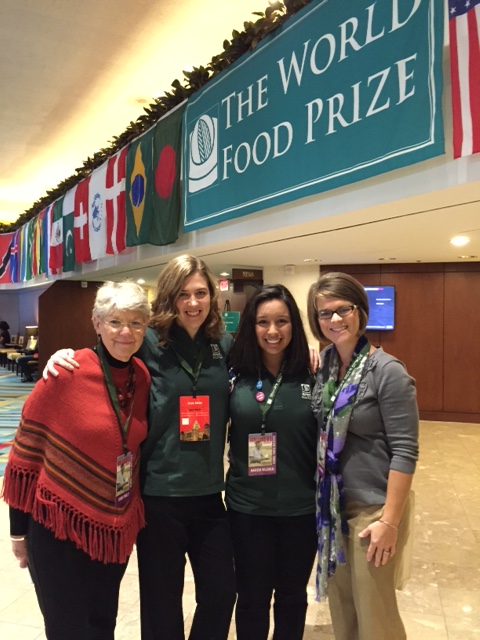
Rachel researched water sanitation and access in the DRC; Marisa’s paper was about water sanitation in India.

The World Food Prize honors scientists and humanitarians around the world who have made a significant contribution to the fight against hunger. It was established by Norman Borlaug, who is sometimes called “The man who saved 1 billion lives” for his work in developing a drought-resistant variety of wheat that, over time, saved those estimated one billion lives. Scientists such as Purdue’s Dr. Gebisa Ejeta (2009) and Dr. Philip Nelson (2007) have been recognized for their work in fighting hunger as have humanitarian leaders of the caliber of this year’s winner, Sir Fazle Hasan Abed, the visionary from Bangladesh who founded BRAC, the world’s largest NGO.

In 1970, Borlaug received the Nobel Peace Prize. In 1986, he conceived the idea of the World Food Prize to honor individuals who had made significant contributions to ending world hunger.  Later still, in 1994, he established the World Food Prize Global Youth Institute, a competition in which high school students study food security issues in countries around the world. After months of research and essay writing, students submit their essays and then present their work orally at regional competitions. The winners there attend the World Food Prize/Global Youth Institute in Des Moines, Iowa, where they interact with some of the most prestigious scientists in the world, learning more about solutions to world hunger and exchanging ideas with these leaders in the field.

Indiana students talk with WFP Laureate Gabisa Ejeta.
Indiana students talk with WFP Laureate Gebisa Ejeta.

I’ve just returned from the World Food Prize/Global Youth Institute proceedings in Des Moines. My colleague and I have three years of sponsoring students under our belts; we’ve sent students on to Iowa every year—and every year we’ve come away from this amazing conference recommitted to the cause. I’ve written about the World Food Prize essay contest before (See https://sarahpowley.wordpress.com/2013/05/03/winners-all/ and https://sarahpowley.wordpress.com/2013/11/08/changed-lives-the-world-food-prize/), but I can’t help writing again about the incredible opportunities this program extends to students and the profound impact it has upon their lives.

As a former English teacher, of course I value the writing and thinking skills that such a challenging paper demands. Gathering information and evaluating it for its recency, credibility, and specificity; sorting and organizing it all into a coherent problem/solution format; and then writing the paper in tight but fluid prose is no mean feat.

To be in the presence of great scientists—at the regional competition and again at the Institute—is awe-inspiring. Most students have no idea what a professional conference looks like, let alone even know that professionals in any field gather regularly to present papers, engage in dialogue, participate in panel discussions about timely topics, and hammer out approaches to common problems. Watching leading scientists, small holder farmers, representatives from NGOs, and agribusiness growers present information about (for example) aquaculture, conservation agriculture, and the nutritional impact of sweet potatoes in Africa is mind-expanding. Who would think such topics would captivate high school students whose background is not necessarily agriculture? But the students were not just snagged; they were hooked by the passion of the speakers and the complexity of the world of agriculture. They recognized the importance of something they’d always taken for granted—food—and the urgency of the challenge to feed 9 billion by 2050.

The culminating event for the high school students is a presentation at the end of the Institute to a panel of scientists and agriculture experts (even the laureates themselves, including this year’s winner) who read the students’ papers and interact with them.

One of our students, Rachel, in introducing herself prior to presenting her paper on water sanitation and access in the Democratic Republic of Congo, declared, her tone earnest and her demeanor sincere, “I didn’t think this experience would affect me the way it did. Food is the key to everything. I didn’t really realize that before I wrote my paper.”

rachel.jpeg
Rachel and two other students discussing their presentations.

I had watched Rachel intently throughout the conference. Because she has always been a little bit shy, I wondered if she would feel overwhelmed by the experience in Iowa. But the reverse happened. It was like watching a flower unfold in Disney’s Fantasia. She sat at lunch and dinner with students, teachers, and professionals from all over the world, gaining confidence every time she initiated a conversation or answered a question. Her public speaking skills soared: Her own presentation was animated, thoughtful, and nuanced by very natural vocal and facial expressions. One of the experts evaluating her performance told he was “touched” by her comments about the impact of the experience on her thinking.

But the benefits don’t end there, with students developing an English teacher’s skill set.

The impact on career choices, college majors, even the choice of a particular college is significant.  Rachel said she had come into the program certain she wanted to pursue criminology but was now considering a career in public relations or international relations.  Another student, one I don’t know personally said, “This program made me consider college majors I’d never thought of. It made me aware of issues I’d never heard of.”

Students who attend the Institute in Des Moines—the top essayists—become eligible to apply for 2-month summer internships to do real science themselves. Last year, 23 students were awarded Borlaug-Ruan Internships to pursue science in locations around the world. They worked with top scientists in all areas of agriculture, agronomy, and food science. Each of the students returned to Iowa this past week to give a poster presentation of their research.

This slideshow requires JavaScript.

Students who attend the Institute in Des Moines are also eligible to apply for Carver-Wallace internships here in the United States.  So far, 110 students have been Carver-Wallace Fellows; among them, one of our own students. Caroline, who competed two years ago, interned at the USDA facility on the Purdue campus the summer after high school; her experience there morphed into a job with the USDA while she attended college at Purdue.

The mission of the Global Youth Institute is to inspire students to answer the call to fight hunger in the world—as scientists, humanitarian aid workers, journalists, business leaders, growers, teachers, and manufacturers (among other occupations).

“Even if you become, say, a banker,” Sir Fazle Husan Abed elaborated in his luncheon address, “you’ll be a better banker for that. Doing for others leads to a satisfying life. If that is not your occupation, make it your preoccupation.”

In the next 40 years, according to a senior officer from DuPont who spoke in Des Moines, we will need to provide more food than we have produced in the last 10,000 years. The world needs young people to make fighting hunger their life’s work. Reaching out to them—when they’re on the brink of life decisions—is what the World Food Prize/Global Youth Institute does well.

Some, of course, won’t go into agriculture or nutrition or science. But no matter their career path, they’ll never forget the message they’ve learned, the skills they’ve gained, or the opportunities afforded them because of their participation in the Global Youth Institute. They’ll never take food for granted again.

Under Discussion: Literature Circles

P1010150Literature Circles are old hat now. English teachers everywhere–from the elementary grades through high school—use this strategy to group students by interest or by reading level. Harvey Daniels, who popularized the concept and brilliantly refined it, has published at least five books on the topic. How-to websites abound, and Pinterest is a rich resource for the props that go with establishing literature circles: the “role sheets,” question cards, sentence starters, anchor charts, choice boards, discussion guides, and rubrics.

I came to literature circles quite by accident sometime in the early 90s—before Harvey Daniels and before roles for participants in the circle had been devised. I am sure I was not alone in figuring out for myself what to do when faced with a wildly disparate group of students. All these years later, I’m still a believer in literature circles—and I encourage the use of Harvey Daniels’ role sheets (plus some of my own devising) although I’ve learned that some educators think the role sheets are limiting.

But that year, whichever year it was, I was still fairly new to teaching high school English. The course, called “Trails West,” featured books about the American West.  My class was hugely mixed in readiness and in student interests.  A few students, whom I’d had in Honors 9 English, consumed books like cookies and cake; others read poorly, infrequently, and under protest. The course was nine weeks long and the curriculum specified that the students would read three books within that time frame.

Essentially, I decided to teach thematically and, for the first unit, selected three books on aP1010623 single topic: The Western Hero (aka, the Epic Hero). The books I chose (from what was available in the bookroom) were The Virginian, the classic by Owen Wister that established the cowboy as an epic hero; True Grit, in which a young girl sets out with a grizzled old lawman to avenge her father’s murder; and Shane, a book about as close to the epic pattern as anyone could imagine. The second “unit” was about the pioneer experience; the third, the Native American experience.

Every three weeks, students chose the book they wanted to read (Miraculously, I thought, no one tried to “read down” and a few challenged themselves to “read up”). Initially, they met in groups of four or five to lay out a plan for the number of pages they’d read before the three meetings I had pre-established for them to convene and discuss the book. I supplied the questions for these meetings—the same ones for each group since the themes were the same—and in between meetings, the students read, kept a list of self-selected vocabulary words, did a mini-research project, and took direct instruction from me on topics related to the book or on other relevant English class topics.

I made bookmarks for everyone, with spaces for page numbers, so they could establish daily reading goals. They divided the number of pages in their book by the number of days to completion. Some kids didn’t need that—they could hardly put down a book they liked—but the reluctant readers enjoyed checking off the little boxes on their bookmarks that indicated they’d accomplished their 10 or 15 pages for the day. They might stop mid-chapter rather than read one more page, a mind-set I admit drove me crazy, but the bookmark served as a kind of time clock for them. When they’d completed their number of pages, they could congratulate themselves, check off a day on their bookmark, and close the book. The strategy worked. One boy, a junior, told me at the end of the year that Shane was the first book he’d read cover to cover in his entire schooling experience.

I’ve seen literature circles work when all the students are reading the same book and in Lucy, Henry, Taylorsituations like mine where students chose a text, based on their interests or their reading levels. I’ve seen literature circles work in subjects other than English and with articles rather than whole books. The online Encyclopedia Britannica presents leveled versions of its topics, and NEWSELA, a free online leveled reading site, (www.newsela.com) sends daily articles relevant to science, sports, history, the arts, current events—all kinds of subject areas—each article written at as many as four to five grade levels. The site also offers complete text sets on topics of interest to teachers of every discipline.

However you choose to implement literature circles, at the heart of the strategy is the discussion: Kids talk about what they have read. The questions the students ask and answer  go way beyond study guides and recall and comprehension recitation. Nowadays, I’d have them take turns making up their own questions, trading around the responsibility for being the discussion leader. Another person’s role is usually to summarize the pages under consideration so that everyone in the group has the facts right, but eventually, questions about the author’s purpose, concerns  about the motivation and credibility of characters, and conversations about style emerge.

Lit circles are more like adult book club conversations than teacher-directed Q and A. They’re effective at drawing students in because the conversations are genuine and everyone gets a chance to say what they think. They work as a vehicle, too, for developing fluency in academic conversation and for inculcating the manners that are necessary for civil discourse (Hence, the sentence starters and conversation rules you see on Pinterest).

I had good luck with lit circles with Honors students and struggling readers alike. In fact, my favorite memory from those Trails West days is of Pencilhead (see my blog post:       https://sarahpowley.wordpress.com/2012/04/01/pencilhead/), at that  time a reluctant reader and would-be class comedian, pulling his chair up to another group deep into discussion of the same book his group had already discussed: He wanted to hear more.

Literature Circles get kids to read more. Literature circles get them to talking more. What could be better?

_________

This post presumes you know all about Literature Circles. Perhaps you are just getting started or even still thinking about the idea. If so, here are some starter websites:

http://www.educationworld.com/a_curr/curr259.shtml A straightforward explanation of Literature Circles—what they are, how they work, why they work.

http://www.lauracandler.com/strategies/litcirclemodels.php Teaching suggestions including variations on the basic model of roles, role sheets, information on working with multi-leveled books.

http://www.litcircles.org/Overview/overview.html This site provides an overview of Literature Circles—structure, benefits, outcomes over time—in chart form.

Under Discussion: Fishbowl

Keelsing 1In my last post, I wrote about getting the students to contribute to teacher-led discussions. But sometimes, the best way to get them talking is to structure the conversation. A structured conversation, in fact, can engage students in a lesson in ways that a teacher-led discussion cannot.

The other day, I watched a master 7th grade science teacher, Miss Kimberly Keesling, lead her class through a Fishbowl debate. Her objective was a universal lesson in critical thinking: Beware of loaded words and emotional responses. Ask questions. Do your own thinking.

She drew upon a well-known hoax from the 1990s in which scientific “evidence” was deliberately used to mislead the public.

Miss Keesling distributed facts sheets to the students—papers she’d prepared listing the pros and cons of banning a mysterious substance, dihydrogen monoxide—DMHO for short. The strikes against DMHO in the realm of health alone are pretty severe. It’s

  • Colorless, odorless, tasteless
  • Accidental inhalation can be deadly
  • May cause severe burns
  • Prolonged exposure to its solid form causes severe tissue damage
  • For those who have become dependent, DHMO withdrawal means certain death
  • Has been found in excised tumors of terminal cancer patients, but is not believed to be carcinogenic

Environmental issues are also serious:

  • Is also known as hydroxic acid, and is the major component of acid rain
  • Contributes to the “greenhouse effect”
  • Is found in almost every stream, lake, and reservoir in America
  • Has caused millions of dollars of property damage in the Midwest recently
  • Contributes to the erosion of our natural landscape
  • Accelerates corrosion and rusting of many metals
  • May cause electrical failures and decreased effectiveness of automobile brakes

On the other hand, DMHO is used

  • As an industrial solvent and coolant
  • To generate power
  • In the production of Styrofoam
  • As a fire retardant
  • In the distribution of pesticides
  • As an additive in certain “junk-foods” and other food products

Miss Keesling gave the students five minutes to ask questions, study the fact sheets, and write out talking points on one side or the other. Then she took the pulse of the class. Those in favor of banning DMHO went to one side of the room; those against banning it, to the other. The Undecideds sat in the middle. She explained to the students that they were going to have a debate about DMHO, so they had to use facts.Keesling 2

It took only a few minutes then to explain the rules of Fishbowl:

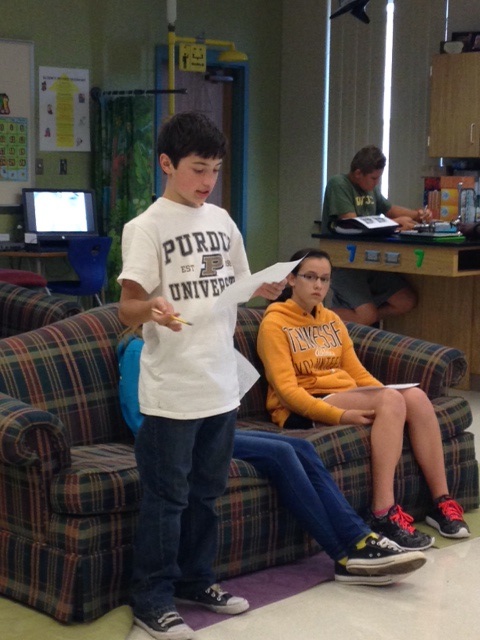
  1. Three people—volunteers, one from each group—would be at the front of the room, seated on a comfortable couch. (Usually, Fishbowl is done with two concentric circles—an inner circle and an outer circle—but the rules are malleable.) Using their notes and the fact sheets, the students would take turns presenting their point of view about DMHO.
  2. When a speaker finished, if another student wanted to support that point of view, he’d tap the speaker on the shoulder and the first speaker would sit down. In that way, only three people at a time were seated on the couch.
  3. The speakers stood up to present their arguments.

Middle schoolers love to talk, love to debate, and these students did so brilliantly. Their arguments for and against banning the mysterious substance were cogent and fact-filled. Some students were direct and succinct; others became quite animated. Within 15 minutes, just about everyone in the room had spoken. I heard impassioned and powerful statements and effective transitions such as these:

  • Although it is used to generate power…
  • It’s a risk: But life is about risk.
  • Bottom line: It kills people.

Sophisticated stuff for 7th graders. At the end, my colleague asked how many of the students had switched sides because of the arguments they heard. Some had.

Then she made the Big Reveal: DHMO is water. She broke the scientific words down into their roots and prefixes: di (2); hydrogen; mono (1); oxide. A few students caught on, clapped their hands to their foreheads: H20.

Why, she asked the students, had they come down on the side they had? All the claims and counterclaims are true—but they had been duped. Who had even asked what DMHO was before they began?  No one. What had swayed them? They had heard the facts, stacked on one side or the other as they were—all of them true, all of them convincing—and formed an opinion, often a very strong one. Why?

What followed were insightful responses that boiled down to this: The use of strong, emotional words such as kill, severe tissue damage, withdrawal, “greenhouse effect,” found in tumors… It was easy to be led to a conclusion.

And that was her point. Scientists have to investigate dispassionately. Scientists have to examine the facts. Scientists have to ask questions. They can’t be swayed by emotional language.

And it’s not just scientists. These students were quick to point out that television, politicians, advertising—they’re all guilty of using emotional language to influence their audiences. Everyone needs to be vigilant. Everyone needs to think before they jump to a conclusion about something they know nothing about.

The Fishbowl strategy proved to be superior to recitation and far better than teacher questioning for a lesson like this. Because it was experiential, because kids were out of their seats moving and talking, because they took ownership of the lesson, they were engaged in the activity and Miss Keesling was able to make her point.

Granted, this particular lesson was a set-up. But the kids were good-natured about it. They understood the message and understood the value of it being learned in this way. In fact, the lesson will stick far longer than a paragraph in a textbook or a lecture by the teacher. But the method—a Fishbowl debate—was the perfect vehicle in a powerful lesson orchestrated by this experienced science teacher. Point made.

Fishbowl works for straightforward discussions about all kinds of topics. It’s especially useful if students are invested in a topic and eager to contribute, but even shy students will express their opinion when they can choose when to tap someone on the shoulder, decide for themselves when to take an inner circle seat.

Want to know more? Here are three websites explaining Fishbowl, offering other ways of structuring a Fishbowl conversation.

https://www.facinghistory.org/for-educators/educator-resources/teaching-strategy/fishbowl  (Facing History and Ourselves) A straightforward explanation of how to set up a fishbowl discussion.

http://www.learner.org/workshops/tml/workshop3/teaching2.html (Annenberg Learner) A lengthier description with alternative ways of structuring the discussion.

http://www.edchange.org/multicultural/activities/fishbowl.html (Multicultural Pavilion) Another good explanation of the set-up for Fishbowl.

Under Discussion: Getting Them to Talk

FullSizeRender (1)A teacher asked me the other day, “How do you get them to talk?”

I had just seen the same kids who wouldn’t raise their hands and answer her questions about the bell work they had just completed come into the room talking like crazy at the start of the hour. I’d seen them turn in their seats and continue to talk to each other—until class started. They did have voices.

But of course, the questions about the bell work were posed by the teacher, the topic was academic, and too much was riding on raising their hands.

  • Some didn’t know the answer and didn’t want to look “dumb.”
  • Some had the answer but didn’t want to be branded as “smart.”
  • Some had an idea—but didn’t want to risk being wrong.
  • Some knew the answer but just weren’t saying. Lots of reasons why.
  • Some were shy and not yet comfortable in the class. It is still the start of the year.

I remember learning to break icy silences like this, so here is what I told the teacher. It’s what I learned over the years about getting the kids to talk.

To start with, some conditions promote participation and, eventually, real discussion, better than others.

The seating arrangements: When desks are in rows, the student answering the question speaks to one person only—the teacher.  If recitation—simple Q and A—is what you expect, rows are okay; but if the goal is dialogue among the students, sitting in rows discourages that.

Even setting up the room so that two banks of desks face each other or are at least on a diagonal—a herringbone design—can help. Now they’re not talking to the backs of heads.

Circles, of course, are wonderful, but a circle is difficult if there are many students, big desks, and a small room.  Plus, there’s all that space gone to waste in the middle.

For years, I arranged my room in a U—two of them, to be precise. One had 19 chairs and inside that U was another, with 11 chairs. (I taught the students how to quickly rearrange the desks in rows for tests. For that matter, I taught them, too, how to rearrange the desks into pods for group work.) The U shape allowed the students to see the faces of a good many of their peers, so when we moved beyond recitation to real discussion, they were more likely to address each other, not me. Which is what I wanted.

My dream-come-true happened in my last years in the classroom when my room had 6 tables that broke apart into single desks. The students had swivel chairs. (Yes, I had to stop a few “spinners” from distracting others—and making me dizzy just watching them!—but that was quickly and easily halted.) The tables were perfect for group work and because they broke apart, the students could easily set them up for tests—and put them back again when a test was over.

The teacher’s position: Sometimes you want to be the “sage on the stage,” standing above the students and posing questions to a seated audience. In that case, rows are traditional and can work. But for discussion, a subtle change in your position makes a big change in audience response. Try sitting among the students in an empty student desk. Or, if the conversation you are looking for is to be strictly among the kids, sit off to the side. If you sit down—not at your desk, but in a student desk—you’ve changed the climate dramatically.

When my desks were in that U-shaped configuration, I sat in a student desk at the top of the U—in the gap between the two ends.  I could see everyone, direct traffic, keep track of who was participating and who wasn’t, and even write things down (which is much harder to do when you’re standing).

Wait time: This is an old piece of advice, but still so important. You have to give the students a few seconds to think before they speak. Not only will they provide better answers—more reflective, more detailed—but you’ve signaled that you value reflection first and open mouth second. Every prospective teacher learns about “wait time” in preparation for teaching, but that wait time is easier said than done. As a culture, we are uncomfortable with pauses, distressed by silence. That partly explains the vocalized pauses teachers of speech and debate struggle to eliminate—those ums and ahs that unconsciously creep into our speech.

In his book, Teach Like a Champion, Doug Lemov suggests what he calls “Narrated Wait Time.” That is, when the room is silent and you are waiting for an answer, throw out a comment that will help the students monitor the time (“I’m waiting for 10 more seconds before I call on someone”) or even guide them down the right path (“Think of a character in another book we’ve read who has had this same kind of problem”). Then wait a few more seconds.

Related to this is another strategy: Let them take a minute to write down an answer so they feel prepared. Sometimes when students don’t respond it’s because they’re tongue-tied. Having a prepared response builds confidence.

Your questions:

Avoid yes/no questions. What else is left to say after the answer is given?

Be explicit about what you are looking for.

Explain the similarities between these two characters. (If you just say “How are these two characters alike?” the answers will be short. Requiring students to explain provokes a more detailed response.)

Why do Russians think Stalingrad, not D-Day, was the turning point in WWII? Explain their point of view. (This is a complex question. It requires students not only to know what happened at Stalingrad as well as on D-Day, but to compare and contrast the two events and step outside the comfort zone of the conventional American point of view.)

What evidence do we have that climate change is happening? (Notice that asking for evidence avoids nebulous and unsupported answers that begin with “I feel that…” or “I think that…”, demanding, instead, that students present pertinent facts, not unsubstantiated opinions.

Here’s a source for great questions: www.edutopia.org/blog/rethinking-whole-class-discussion-todd-finley

Your responses:

Just as you will expect the students to be courteous to each other, you need to be careful about your responses to them. “Can you tell me a little more about that” sounds better than “Is that all?”  “You’re on the right track. Can anyone else add to that?” is nicer, too.  You don’t want to accept wrong answers, but you have to be supportive of attempts—otherwise, students will shut down. Whoever volunteers to be humiliated?

Teach them how to respond: Consider posting sentence stems as reminders when you’re first getting started.

  • I agree with James, but I want to add this…
  • I don’t agree, James, because…
  • That’s an interesting (unusual/thoughtful/surprising/etc.) way to look at the situation, but here’s my take:
  • I’d like to add to what Sally said.
  • I didn’t understand it that way. What I got out of it was…

An excellent list of sentence stems—that teachers can use as well as students—appears on Te@chThought: http://www.teachthought.com/learning/sentence-stems-higher-level-conversation-classroom/

Collaboration helps:

Think/Pair/Share is another confidence-building strategy for discussion. You may have used this for reinforcing concepts, but it can also be used for developing ideas. Two people seated next to each other turn in their seats and for a brief amount of time, discuss the question and come up with an answer. Keep the time short—very short—or the talk will deteriorate into social conversation. And, be explicit about how they share—especially important if the students have never done this before. Model the exchange of ideas for them so they have the language of collaboration.

Group Share is essentially the same thing, but three or four people work together to come up with an answer. Usually the question is more complex, the time allotted is longer, and the discussion afterward is extended. Again, keep to a strict time limit, model the process, and instruct the students to choose a spokesperson who will deliver the consensus response. After each group has reported out, a fuller discussion starts spontaneously because the groups don’t always agree.

If all else fails, try this:

I’m by and large not a believer in extra credit, but many teachers, for good reasons, are. Many people award participation points—or expect students to earn them. Also for good reasons.

One year I came up with this strategy for a class who wouldn’t talk. We were reading Field of Dreams (This was before it became a movie). I took a great big sheet of white construction paper, used a water glass as a template, and drew around the glass to make circles on the paper. Using my amazing artistic skills, I turned each circle into a baseball, wrote the students’ names on the baseballs, and laminated the sheets.

When they entered the room, I’d hand them their baseballs. (The leftover baseballs told me who was absent: Presto! Attendance taken!) Then, as I explained on the first day, my expectation was that everyone would speak at least once a period. They had to raise their hands, I called on them, and as they spoke, I collected their cards.

This strategy really worked for me. I did get them talking because that extra point (In the beginning, I did count their contributions as extra credit) was a huge motivator. After a while, I dropped the extra credit, moved to participation points, and eventually got rid of all points—but by then we were done with the book, too. But, the students had opened up. The ice was broken and they were no longer so hesitant to speak.

This strategy is similar to the one elementary teachers frequently use: calling on a student whose name is on a Popsicle stick or drawing a name from a fishbowl. The difference is, with the baseball, the student has the choice of when to speak—a powerful bit of control for someone in high school.

Of course it wasn’t a perfect strategy. A student could use his card right away and then sit back and relax. A student who wanted to contribute more than once still could, but only when the others had all had a chance. But the baseball card strategy wasn’t a permanent solution anyway. It was a device to, so to speak, get the ball rolling.

How to get them to talk: The question is under discussion, and I’d be interested to know how you do it.

Taming the Beast: ELLS and the Five-Paragraph Theme

P1040079The question came from an English teacher at the conclusion of an after-school workshop I’d conducted at one of the high schools I serve: Why do my ELL students have trouble writing essays in English (besides having a limited vocabulary)?

One of our students from Mexico, who had just spoken to my colleagues about the ways in which teachers can help English Language Learners navigate the culture of an American high school, unlock the English language, and facilitate learning the content of their classes, attempted to describe the difference between writing an essay in school in Mexico and writing an essay in English class here in America. “Well,” she said, “we have more like summary.” Considering her current limitations in English, she did pretty well, but had she known the term “five-paragraph theme,” she might have been more precise.

The question rang a bell with me, though, and I remembered a session I’d attended in 2004 at the National Council of Teachers of English (NCTE) conference in San Francisco where the message from the speaker was this: The written discourse pattern in Mexican Spanish is different from English. We need to explicitly teach our ELLs the organizational pattern of written English.

A few days after my workshop was over, I went on an internet search to find the scholarly work behind that 2004 statement, and aided by our high school librarian, whose help was indispensable, uncovered the research that informed it. I’d tucked the information away 11 years ago because, unlike the states on the edges of our country, my district in rural Indiana had a tiny ELL population in 2004 and no program at all for these students. I myself had no ELL students at that time. I had attended the ELL  sessions at NCTE because I wanted to help my district establish such a program.

What I learned from reading the research was this: Patterns of language and the expectations for written discourse differ from country to country. That seems obvious, of course, and broadly speaking, we know it intuitively because of any cross-cultural experiences we may have had and academically because of the linguistics classes we took in college.

However, what I wanted to know were the practicalities: the precise differences between written discourse in English and written discourse as learned in school in Mexico—or, even deeper, in the pattern of social discourse generally in Mexico. The author of the article is explicit about those differences but cautions that the study is limited to Mexican Spanish and studies in secondary schools in Mexico. Puerto Rican Spanish, for example, shares some characteristics with Mexican Spanish language patterns but is not entirely the same. Furthermore, the characteristics of written Spanish demonstrated by Hispanic students born, raised, and schooled here in the States are not the same. The research article addresses the discourse patterns of secondary students in Mexico. But that’s entirely relevant to my colleagues: In my district, few of our ELL students are from anywhere else but Mexico, and many of them come to us as high-schoolers or middle schoolers. Thus, the findings reported by the researcher are pertinent to my district and my colleagues.

 So here’s what I learned. (If I spoke Spanish myself, perhaps I’d have known all this, but I don’t, so the specifics were revelatory.) In written Mexican Spanish, the vocabulary tends to be “fancy” and “flowery”; the tone, “formal.” Sentences are generally longer than English sentences, often characterized by what English teachers would mark as run-ons—that is, two sentences joined by a comma (i.e., comma splices). The long sentences these students produce in English may seem like a jumble of compound-complex constructions, the word order may seem unusual to an English teacher, and the ideas, repetitious. That’s because an acceptable sentence pattern in written Mexican Spanish is to state an idea, follow it with a comma, and then repeat the idea using synonyms. There may be frequent or lengthy deliberate digressions, following which, the writer brings the reader back to the main topic. English teachers would mark such a digression as “off-topic.” It doesn’t adhere to the organizational pattern we teach in most American schools—introduction, three supports, and a conclusion (in short, the five-paragraph theme), pictured here in my favorite, definitely irreverent, graphic by Boynton. I call it “The Beast.”

Boynton's Beast
Boynton’s Beast

Such an essay would be unusual in written Spanish in Mexico because the writer’s mission is more likely explanation than an evidence-based essay in which the writer enumerates his points. In essays in secondary schools in Mexico, according to the research, students rarely use enumeration (e.g., 1, 2, 3; first, second, third; at first, then, finally) as an organizational strategy. In short, what constitutes a logical essay is different in Mexican Spanish than it is in English.

On top of all that, English speakers tend to be blunt and to the point. We are linear in our presentation of information.  Spanish-speakers, not so much. In fact, following a straight-line way of organizing information can be interpreted by Spanish speakers as rude. So, a Spanish-speaking student writing in English could be struggling not to offend—especially difficult if you have a limited vocabulary and little understanding that the five-paragraph theme approach is the preferable style in English. Furthermore, the researcher pointed out, direct and unelaborated prose in Spanish can be dull; such a writer can even sound childish. Having internalized that, Spanish-speaking students from Mexico could be struggling not to be boring or sound juvenile. They might not realize that their English teachers would applaud brevity and welcome direct statements.

For English teachers, the message is straightforward: It is extremely important to explicitly teach the structure of English composition to our ELL students: i.e, the five-paragraph theme format–or, if they are younger, the five-sentence paragraph. Scaffolds for this format abound, and providing a simple worksheet for organizing information might be more powerful than one might think in terms of supporting ELL students.

Of course, English teachers have been offering graphic organizers and outlines for this kind of writing for as long as I’ve been in the classroom and probably for years before that. It’s nothing new. What we may not know, especially if we don’t speak Spanish, have never been to Mexico, or haven’t thought about it, is how important it is to be explicit. To compare and contrast the written discourse conventions of English and Mexican Spanish for our ELLs, to be clear about our expectations, and to analyze their written work, looking (if they are from Mexico) for these particular differences and pointing them out. Not because the five paragraph theme is better or that it is always the best way to express ideas, but because the ability of ELLs to communicate in the format that is widely taught and widely expected in this country is paramount for their success.

Our ELLs may not be from Mexico. We may not know the precise variations from English that their language conventions dictate. Nevertheless, just as we know that there are cultural differences from country to country, we need to recognize that differences exist in discourse patterns, too. We need to remember that it takes a long time to unlearn a pattern you’ve been taught from an early age. If a student doesn’t “get it,” even after several tries, the problem is not a deficiency. The problem is unlearning what’s been second nature. Writing reveals patterns of thought; those don’t change overnight.

So, no matter how you feel about the five-paragraph theme (and English teachers either love it or hate it–in both cases, for good reasons), it’s a scaffold for writing that will help non-native English speakers understand the way written discourse is structured in English. Like all scaffolds, it can gradually be removed, but for beginners and for ELLs with low English proficiency, it can be the support that enables success.

Help your students tame the “Beast.” Here are some links to useful graphics and outlines that you can use to scaffold the five-paragraph theme:

https://goo.gl/mNiYK3  (Many graphics)

https://goo.gl/2MQN47 (Many worksheets and outlines)

Read the original research:

Montano-Harmon, M. 1991. Discourse Features of Written Mexican Spanish: Current Research in Contrastive Rhetoric and Its Implications. Fullerton, CA: California State University.

http://www.cervantesvirtual.com/obra-visor/hispania–14/html/p0000013.htm

Beyond the Pages

A few days ago, a young teacher (once upon a time,  a student at my high school) approached me after a workshop I’d conducted. “Tell me,” he said, “that I really did meet Gwendolyn Brooks when I was in high school. Her poetry has made such an impact on me.  She’s the opposite of me: black/white; female/male. She was old; I was young. But, I really connected with her. ‘We real cool’…She gets it. She really gets it.”

He was about to introduce her poetry to his 7th graders, so I dug through my personal “archives”—fat 3-ring binders with memos, schedules, programs evaluations, contracts, and photographs that I’ve kept all these years—and found a poster, a program, and a newspaper article from 1994 to help him recall the events of that day. The search took me back, too—refreshed my own memory of what was, for seven years, an extraordinary interdisciplinary, literary arts program in my high school. We called it Beyond the Pages.

 Some snapshots from those days:

  • Gwendolyn Brooks carried books in her deep, omnipresent satchel. In the middle of an intense conversation with a teenage writer, this Pulitzer Prize-winning poet reached into her bag, withdrew a volume of her poetry, and gave it to the student.
  • W. P. Kinsella, author of Shoeless Joe, carried a photograph of the real Moonlight Graham in his wallet. While he was talking with students in my class, he casually removed the wallet from his pocket and passed the picture around the room.
  • Retired Chicago Tribune editor, John T. McCutcheon, Jr., carried words and images from history-making news events in his memory. He described the atmosphere in the pressroom during the Watergate era to a hushed audience of high school journalists and their teachers.

Beyond the Pages brought students face-to-face with authors whose work they had studied. In the library, in classrooms, in the halls, and even in the cafeteria, writers with international reputations talked casually with McCutcheon students, carrying them beyond the pages of their textbooks to interactions with the authors themselves.

The goal was simple: to spark students’ interest in reading.  National statistics showed then—20 years ago—that the percentage of students who read for pleasure every day dropped by half between elementary school and high school–from 45% in Grade 4 to 24% in Grade 12.  Beyond the Pages was a commitment to reversing this trend.

IMG_1755The program began with a dream.  The English curriculum already included W. P. Kinsella’s Shoeless Joe when I met the author at a writing workshop in (of course) Iowa.  After listening to Kinsella discuss his book, I approached him: “If we asked you, would you come?” He told me to contact his agent.

I did.

Dream became reality when the principal endorsed the idea and the English Department signed on to plan the visit.  The success of that first event spurred the decision to continue the program on an annual basis. Eventually, Beyond the Pages branched out beyond the English Department, becoming interdisciplinary and theme-related.  Not only did teachers in other departments incorporate the writer’s work into their lessons, but faculty from many different departments served on the steering committee.  Students were represented on the committee, too, and they helped with promotional activities, art work, and myriad details.

The authors were guests at the school for one to three days.  While they were with us, they participated in a variety of small group interactions and addressed the students in all-school convocations.  The format changed from year to year; activities were tailored to the writer and to the connection between his or her work and the curriculum. Delightful spontaneous events also transpired.

  • Before Kinsella visited, my students studied his work and developed a list of interview questions. When he arrived, the television production class filmed an hour long interview in the school’s TV studio. I still have the tape.
  • In 1996, seven local writers—in a warm-up to Esmeralda Santiago’s visit—discussed their careers in small seminars.
  • In 1997, actress Annie Corley (a graduate of the high school) conducted mock-auditions in the school’s sound studio using real television scripts from episodes of Friends.
  • Scott Russell Sanders’ visit occurred when one English class was writing term papers on Indiana authors. He graciously made time for the young woman writing about him to conduct an impromptu interview.
  • W. P. Kinsella took a break from filming his interview to meet the special needs students whose classroom was next to the TV studio. The students were studying careers at the time, so Kinsella talked to them about the writing life.
  • And Gwendolyn Brooks gave her home address to several earnest young writers and encouraged them to send her their poems.

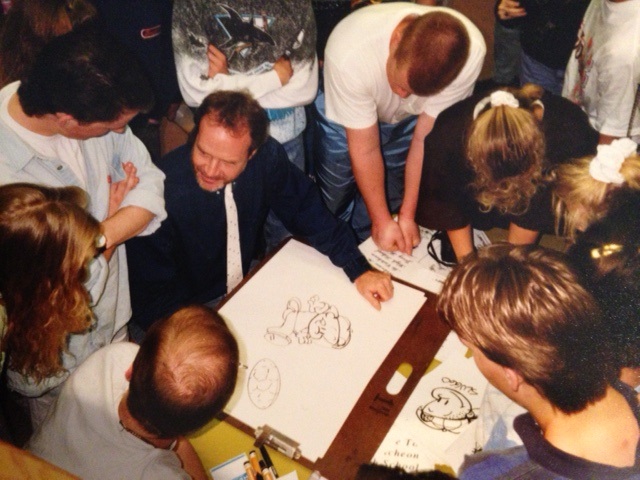
Jerry ScottThe program served 1100 high school students and 70 staff members, and each year the literary celebration expanded to include students and teachers from elementary schools within the district.  In 1993, for example, cartoonist Jerry Scott taught an auditorium full of 4th, 5th, and 6th graders how to draw the cartoon character NANCY.

Fundamental to the program’s success:

Teachers and students were given the opportunity to lead and the responsibility for the success of the program.

Teachers contracted with the artists, conducted the fund-raising efforts, organized the events, handled the publicity, planned the dinners, wrote the grants for funding, arranged transportation and accommodations for the authors, and conducted evaluations.  The Advanced Home Economics students prepared a luncheon for the guest author.  Students served on the steering committee, designed and printed the posters and programs, produced artistic displays, ushered, ran errands, and more.  The preparation for Gwendolyn Brooks’ visit took seven months of planning, 350 combined teacher hours of preparation, and the active involvement of scores of students—but it was done in a spirit of community. It felt like love, not labor.Brooks signing autographs

Beyond the Pages was grounded in the curriculum.

  • Every English class studied Gwendolyn Brooks’ poetry in preparation for her appearance, and students clamored for more. When she read aloud at an all-school convocation, students listened spellbound.  For the first time ever, some students told us, they felt the power of poetry.
  • When Jerry Scott brought his cartoon characters to life on an overhead projector and told students he was the “shortest short story writer in the world,” creative writing students had already written their own short stories and tried their hand at cartooning.
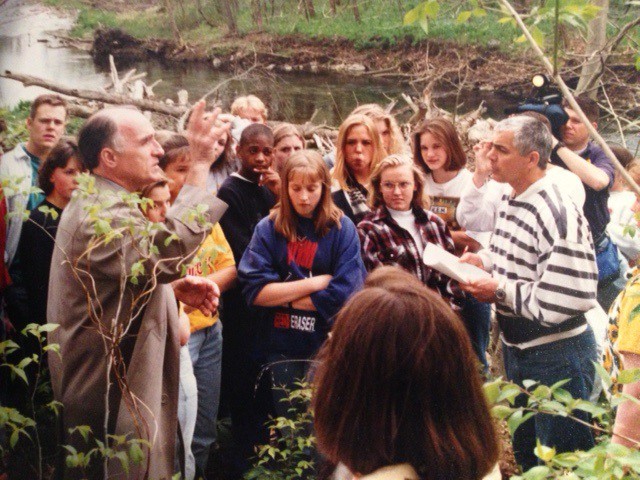
  • Before Scott Sanders visited McCutcheon in 1995, students in geography classes had created murals to illustrate his book Wilderness Plots. The murals were hung in the auditorium and became a focal point during Sanders’ special session with these students. In their biology and agriculture classes, students had begun creating a prairie on school property and identifying botanical species on an adjacent woodlot.  When the author arrived, the students took him on a tour of their “outdoor lab” and discussed the projects planned for the future.Sanders
  • In 1995, two other authors whose writing focuses on the geography and history of early Indiana appeared at the school in the spring to climax a year-long interdisciplinary study of “The Wilderness Experience.” Author James Alexander Thom, who had written about the Shawnee chief Tecumseh in Panther in the Sky, shared Native American stories with American history students.  Dark Rain Thom, a Shawnee clan mother, assembled her collection of Native American artifacts in the school library and provided a narrated tour of her exhibit.

The program caught the imagination of the community.

The boldness of the project–inviting best-selling authors to a public school–captured the attention of the local media.  Newspaper, television, and radio coverage helped to spread the word beyond the school.  The program was even in the sports pages.  In 1992, Kinsella opened the baseball season at McCutcheon by pitching the first ball on the school’s own “field of dreams.”

Most years, members of the public were invited to attend an evening reading or a performance at the high school.  Attendance grew from 200 in 1992 to over 750 in 1994, the year that Gwendolyn Brooks spoke.  Beyond the Pages became a community event.  

We believed that these encounters with professional writers would be motivational for Santiagostudents. Indeed, English teachers saw an uptick in students’ understanding of how a writer works and an increase in their appreciation for books.  We provided students with rare opportunities to see professional writers at work and to ask questions about craft as well as biography.  One student wrote afterwards about Kinsella, “He taught me that writing takes a lot of preparation and time.”  Another student remarked that “it helps students write better if they understand how a professional does it.”

And individual students—like the young teacher who started me on this journey through my archives—were inspired and even changed by their interactions with the authors.

I’d be interested to learn about programs today in other schools in other places. Are author visitations still happening?  Who has come to your school? How was your program organized? What was the impact? Please respond in the comment box if you have memories from Beyond the Pages or stories to share about your own school’s program. I’m hoping events like this still go on.