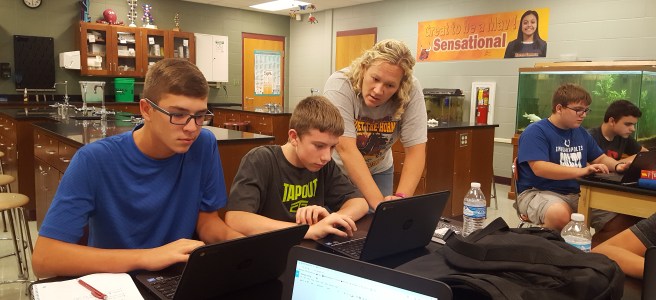
Writing Like a Scientist

The first year, we just put a toe in the water: We addressed the use of the passive voice.

The next year, we took on pronouns.

This year, my colleague and I dove in head first: We tackled passive voice, pronoun usage, scientific description, conciseness, the particular vocabulary of science, and (of course) citations and internal documentation. The goal: improved Science Fair projects–and ones that read like science writing.

An instructional coach for secondary teachers, I was thrilled three years ago when Mrs. Amanda Cox approached me about her goal for the year: incorporating the Indiana Academic Standards for Literacy into her Honors biology classes. Mrs. Cox took the standards to heart.  “I want my students to write like scientists,” she told me, “but they don’t know how–and I’m not sure I know how to teach them. I’m not an English teacher.”

She’s not alone. The literacy standards–which apply across the curriculum–challenge many content area teachers.  Writing instruction begins in grade school, but the skills that are emphasized are the ones in the English teacher’s toolbox: introductions that capture the reader’s attention, strong action verbs, colorful vocabulary choices, rhetorical questions, apt quotations.

English teachers don’t focus on the language of science. We want variety in sentence length and structure to sustain interest in the content, and we aim for metaphor, simile, and other figures of speech for the same reason. The passive voice gives us the heebie-jeebies.

If you’re a content area teacher, it is easy enough to require writing, but requiring something means teaching it–or knowing for sure that it has been taught–and then grading it. Where is the professional development in reading and writing for content area teachers?  It came, delightfully and productively for my colleague and me, in the form of co-teaching.

We began with the passive voice, one of the most distinctive features of science writing–and a requirement for the Science Fair project.  In science, it’s the discovery that is important; the role of the specific scientist is downplayed. So, in a  traditional write-up of a scientific investigation, the scientist is missing from his or her report. Instead of saying “I discovered X,” a researcher would write, “X was discovered.” Mrs. Cox’s 9th grade students had never even heard of passive voice.

A grammar lesson was necessary, and I was happy to prepare and deliver it. An English teacher by training, I was in my element. Even more fun, I was in front of students again. I had a chance to refresh my classroom skills.

With practice, Mrs. Cox’s students learned to write sentences in the passive voice. Their lab reports began to sound a little more scientific. But a quantitative payoff wasn’t there. The average grade on the Science Fair projects that year was the same as the year before: 76%.

So the next year we tackled pronoun usage. Again, in science writing, pronouns are scarce. When one is used, its antecedent is unmistakable.  So another grammar lesson was in order: What’s a pronoun? What’s an antecedent? Why do they have to agree? And what’s agreement anyway?

Every English teacher in the country knows how pesky pronouns can be and how tough it is for kids to master them. Drill and kill doesn’t much work as a strategy for learning. A teacher can spray red ink on a paper like Roundup on weeds and still the pronoun errors sprout again in the next paper.

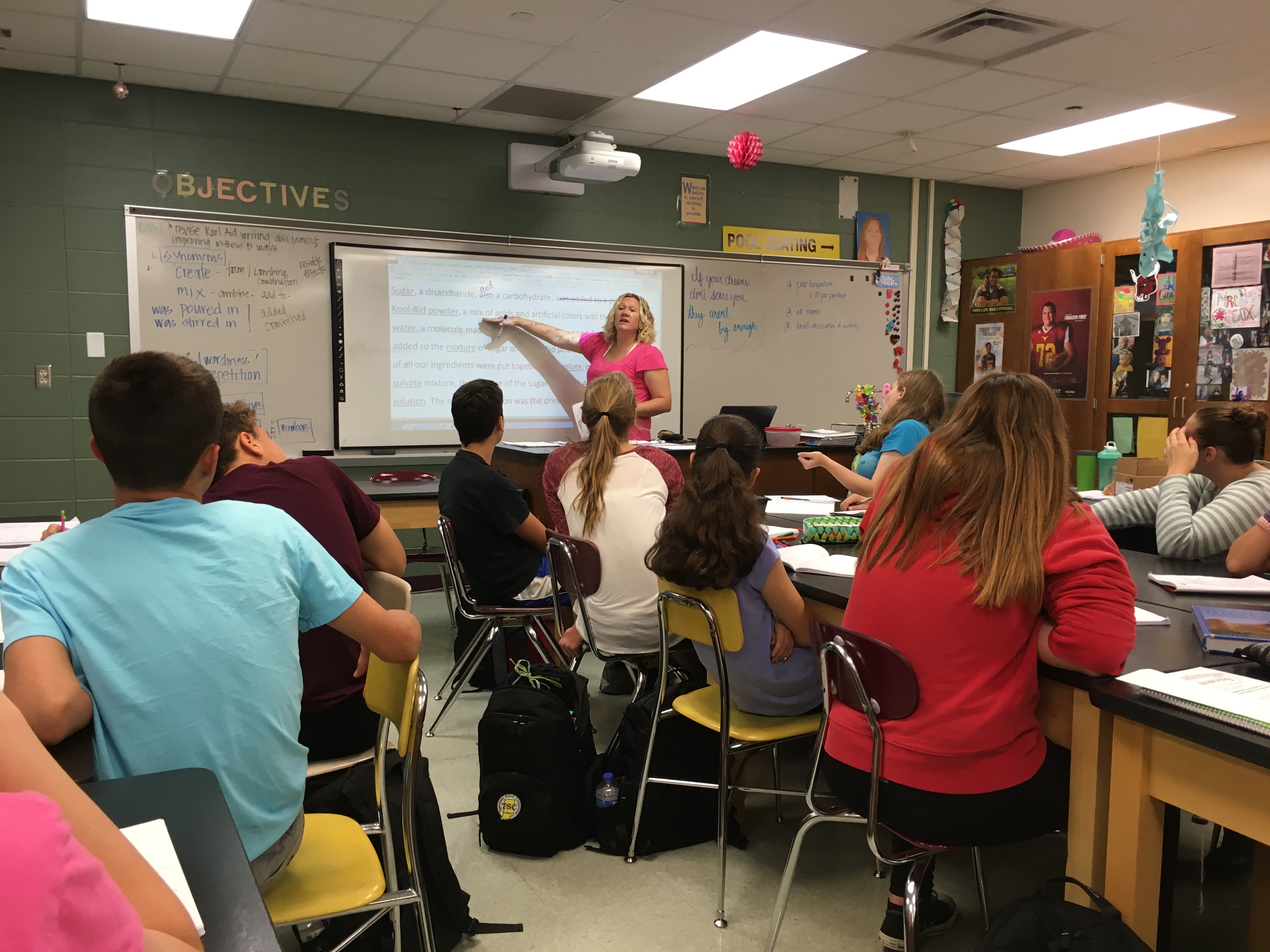
Mrs. Cox and I decided on an old-fashioned revision method: We projected sentences onto the whiteboard that we had drawn from the students’ own lab reports and, working together as a class, corrected them. That process worked well.  In correcting the pronoun errors, of course, we uncovered other problems and eliminated those, too: problems of conciseness and specificity, problems of vocabulary and redundancy.
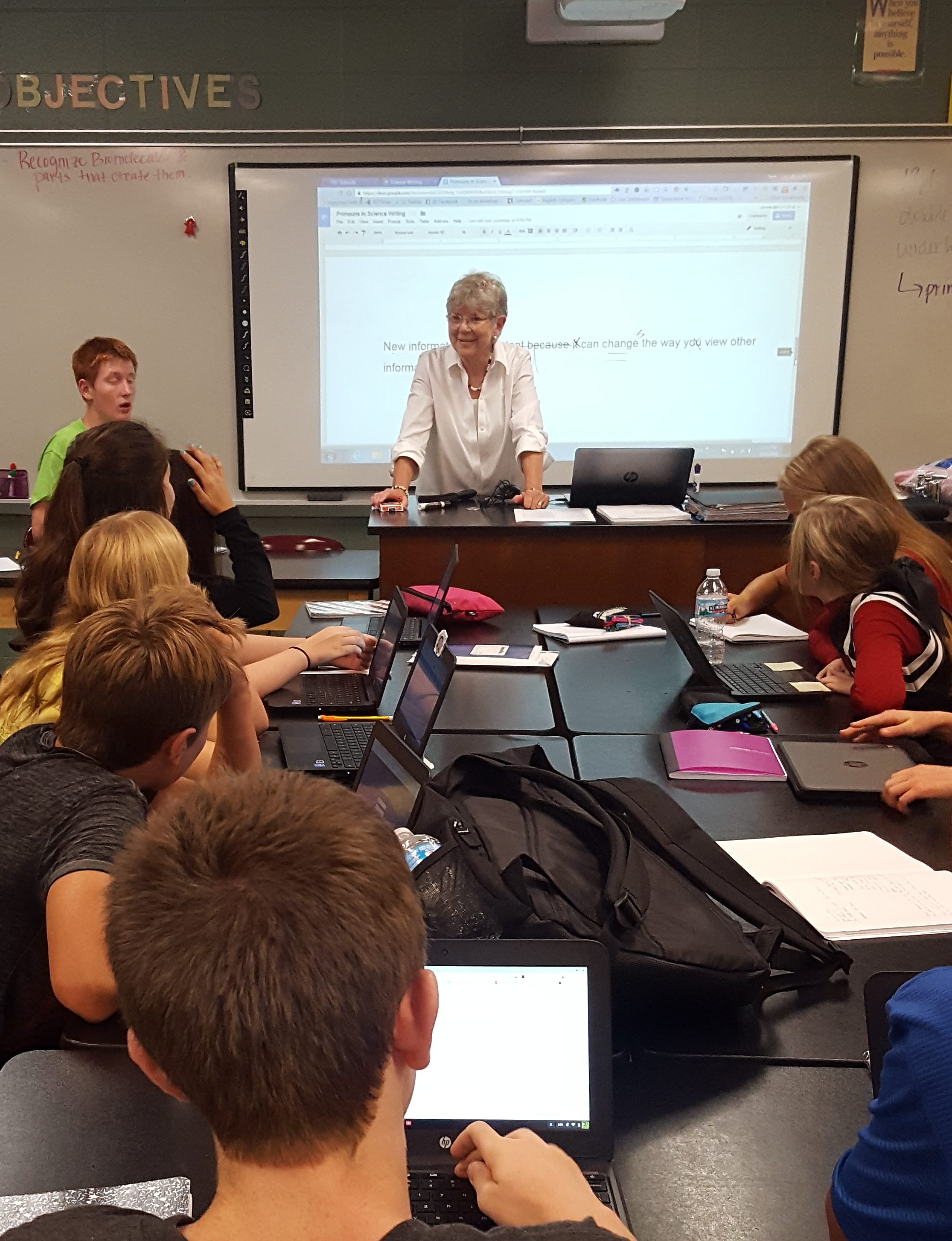
For example:

  • New information is important because it can change the way you view other information.

became  New information changes the way other information is viewed.

  • We couldn’t figure it out but as we received new information and hints, we got closer and eventually we got it.

became Understanding developed gradually.

  • New information and scientific processes are important because they help further our understanding and develop our research.

became Scientific inquiry yields new understandings that, in turn, inform further research.

By the end of that second year, students were more sensitive to language and could quickly spot a sentence written in the active voice and change it into the passive.  But still, the overall scores on the Science Fair projects didn’t budge.  Seventy-six percent remained the average.

By the third year, we decided that we needed to take a much more robust co-teaching approach. Mrs. Cox selected a scientific abstract for students to read and dissect, and I prepared a lesson that engaged the students in teasing out the fundamental differences between writing for English class and writing like a scientist. Those differences included using the passive voice, avoiding pronouns, and redefining description to mean facts and processes, not “colorful” language.  In English class, students reach for strong verbs, vivid adjectives, figurative language, and even auditory devices like assonance and onomatopoeia. None of that obtains in a journal article for science.

In addition, I taught the students how to document their sources using MLA format, 8th edition. (Yes, they could have used APA, but our teachers have made the decision to use MLA from middle school through early high school in order to be consistent.  Once students have the documentation process down, transferring to APA or any other system will be easy.)

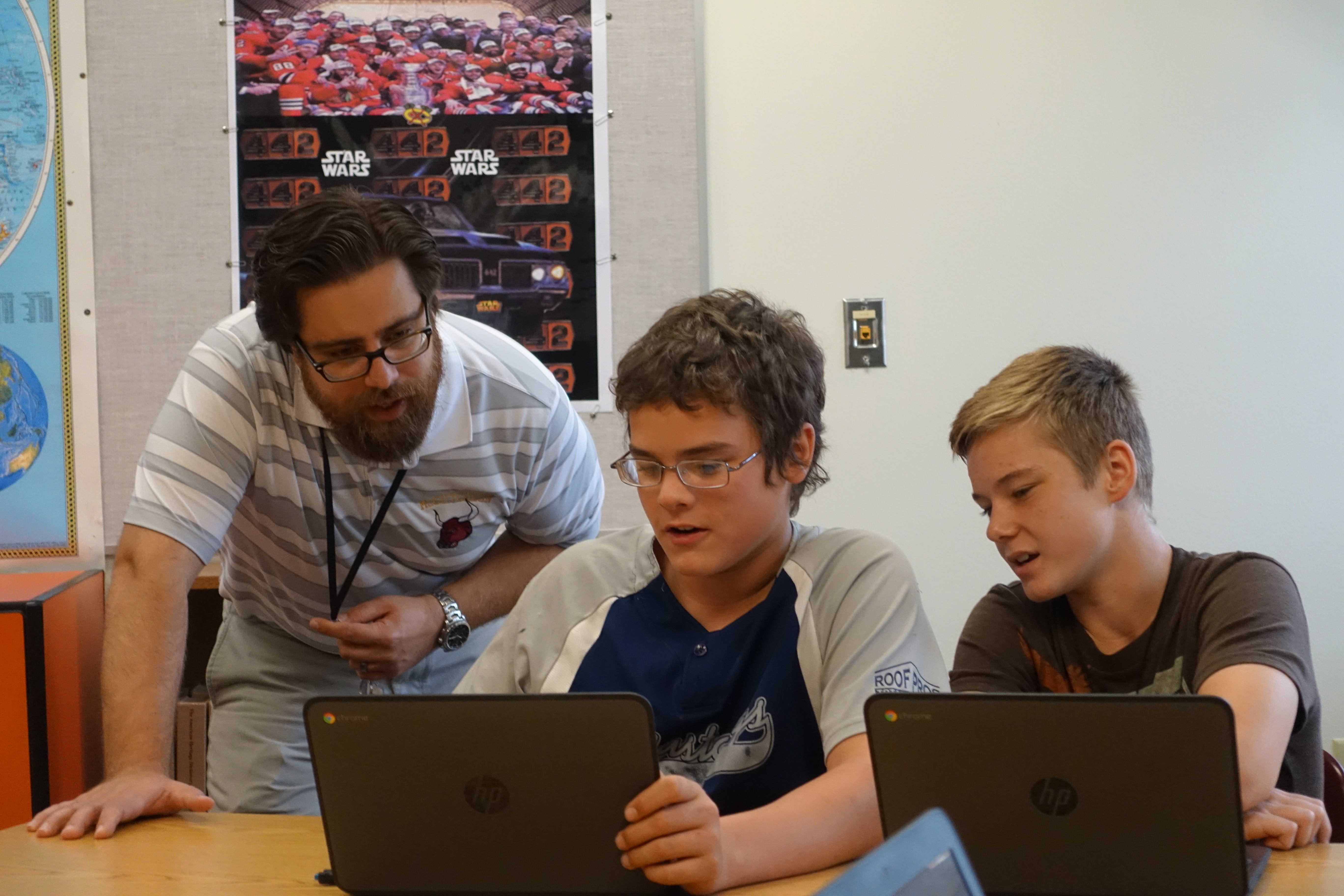
I was in Mrs. Cox’s classroom often enough this year that I learned the students’ names. By October, I felt like a teacher, not a coach. I even helped with drafts and with grading the final projects—that surely made me feel like a teacher!
And the results: This year the average score jumped to 80.5%.  The students garnered top scores at the regional science fair. One young man, who won gold at the regional competition, qualified for the state science fair and won the Stockholm Award–an honor that brings with it the chance to win a trip to Sweden and participate in a competition there.

Co-teaching the Science Fair project has been fulfilling for both of us. This kind of coaching, where the emphasis is on student learning, in this case through co-teaching, provided sound and appropriate professional development for me, the instructional coach, and for my colleague, the 9th grade Honors Biology teacher.

We both learned new skills.

Mrs. Cox can teach these English lessons now herself (although we do have one more tweak we want to make next year), but the co-teaching idea has spread. Next year I’ll be working with an 8th grade science teacher and a 12th grade Anatomy and Physiology teacher with the very same goal in mind: improving the quality of science writing and thereby augmenting student learning.

And this time, those teachers and I will dive into the deep end right from the start.
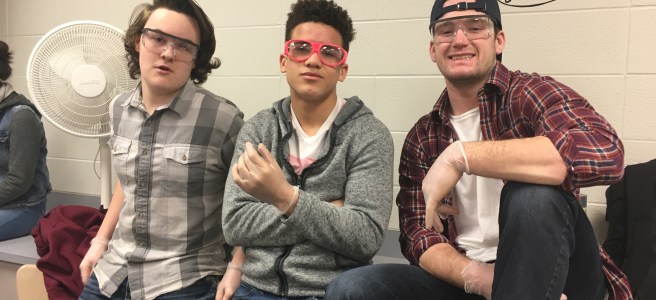
Wicked Cool: Science in English Class

file_000-2“It was wicked cool.”

That’s how one 10th grade student at McCutcheon High School summed up the collaborative learning experience orchestrated by English teacher Jennie Ruiz and science teacher Chris Pfledderer.

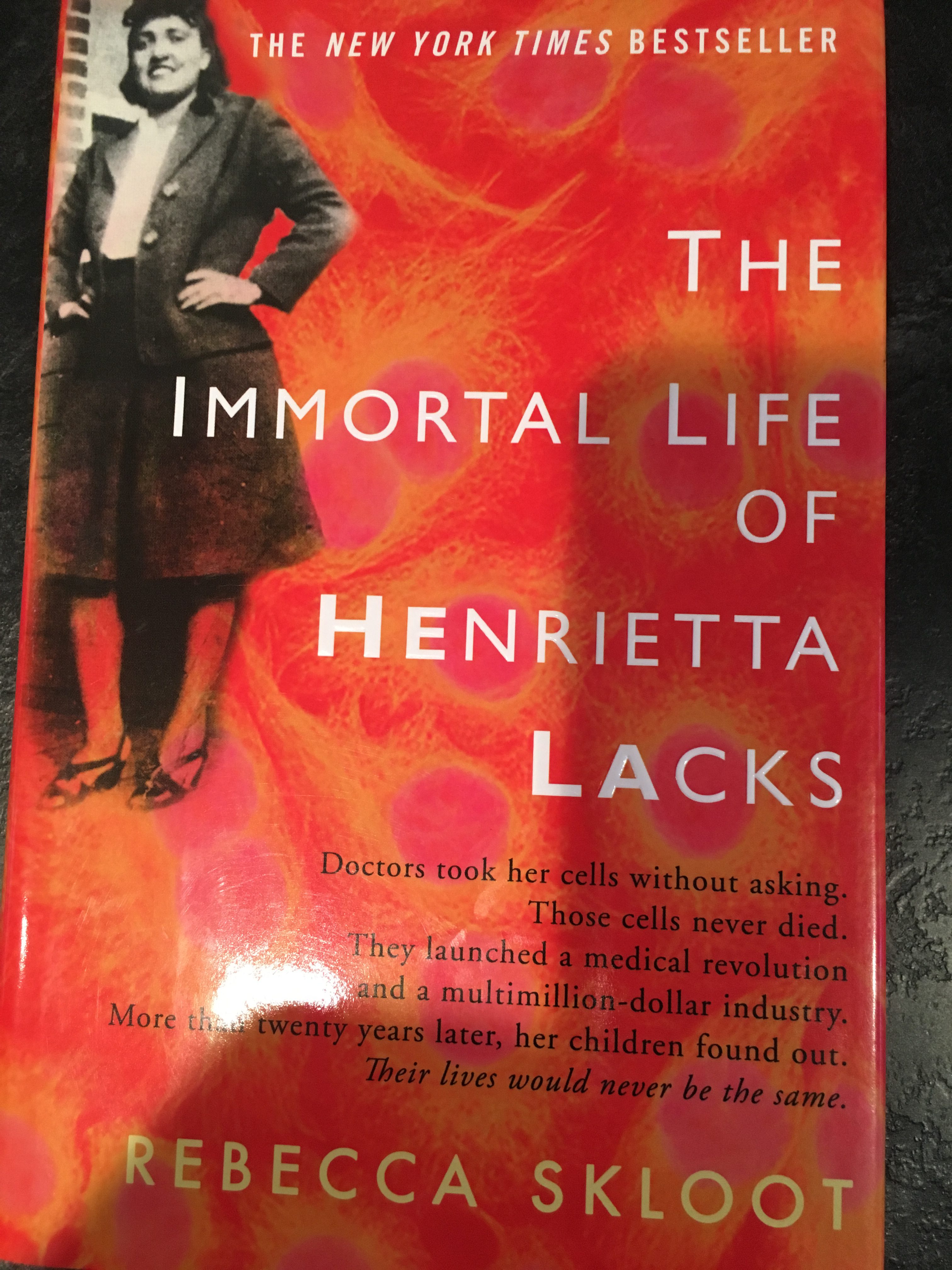
Ms. Ruiz’ students had read The Immortal Life of Henrietta Lacks, the non-fiction account by Rebecca Skloot of the journey of the cancer cells taken by researchers at Johns Hopkins in 1951 from a living patient, Henrietta Lacks. These cells produced a medical breakthrough: For the first time, human cells grew successfully under laboratory conditions. The cells continued to grow in the lab, and samples were shared throughout the world, enabling scientists to conduct experiments they’d not been able to before. The cells still grow today, though Mr. Pfledderer explained that they’re no longer pure because of all the work that has been done with them. In fact, he said, other cells are more often used today—bacteria and insect cells—to conduct research, but the HeLa cells, as they are called (for Henrietta Lacks), were the first.

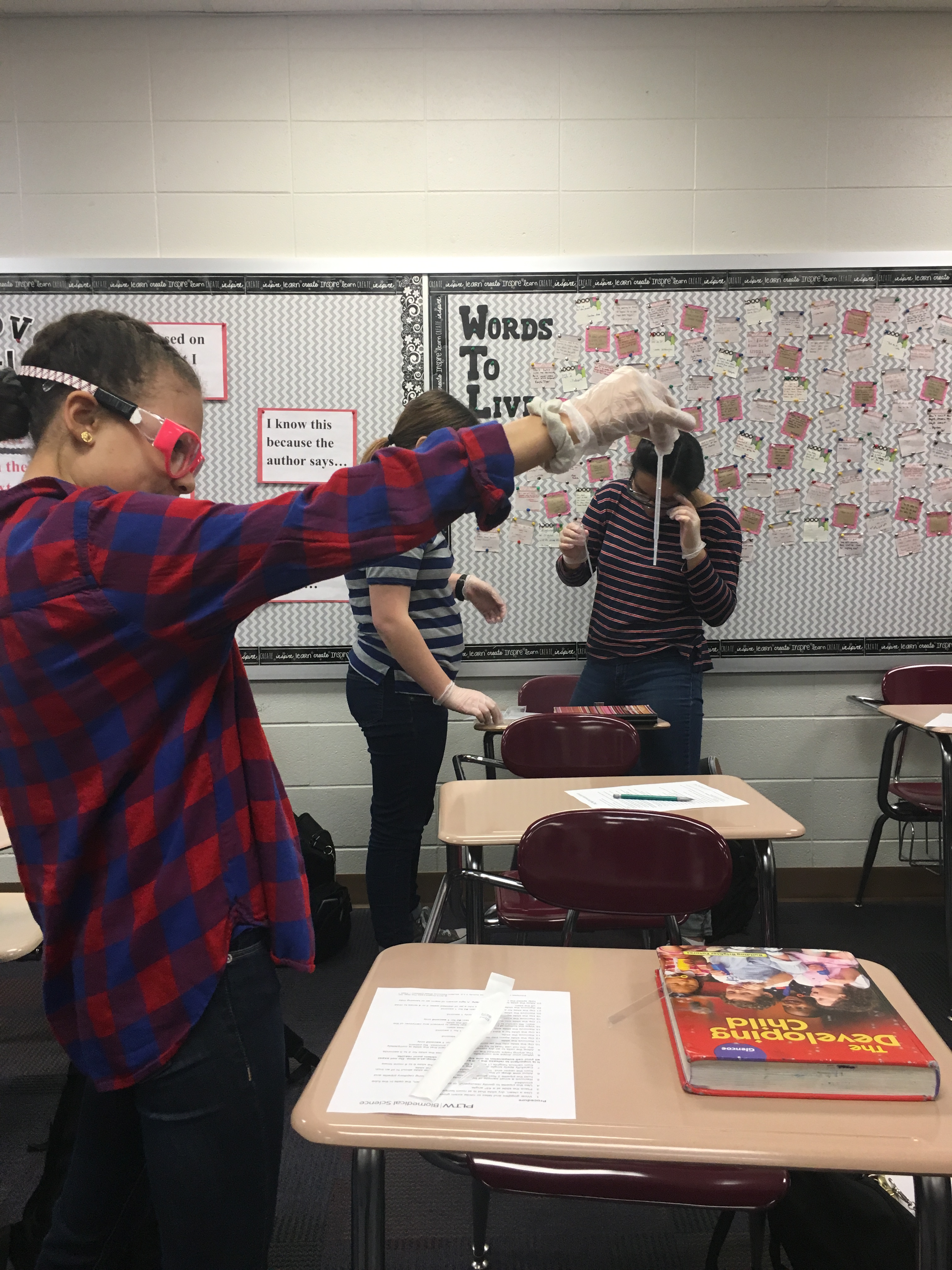
file_004-1-copyThe lab took two days to complete. On the first day, Mr. Pfledderer demonstrated the procedure for staining the HeLa cells so that they could be viewed under the microscope. He supervised as students dropped a suspension of cells onto a slide from a height of several feet, hoping that the force of the fall would break open the cell membrane and nucleus so the chromosomes would be available to stain. Then the students waited for the slides to dry. file_005-3

This may have been the hardest part of the experiment. Waiting, blowing gently on the slide, and resisting the urge to hurry the process taxed their patience. “We need a hairdryer!” I heard one boy say. (Never mind that the force of air would have spoiled the slide; the printed directions clearly stated that heat should not be used to hurry the process.)

When the slides were finally dry, Mr. Pfledderer explained, the students would dip the slides three times into Stain #1, wipe the bottom of the slide, and then dip it three times into Stain #2. Finally, the slide would be immersed in distilled water. Students would leave the slides on a counter in Mrs. Ruiz’ classroom to dry overnight.

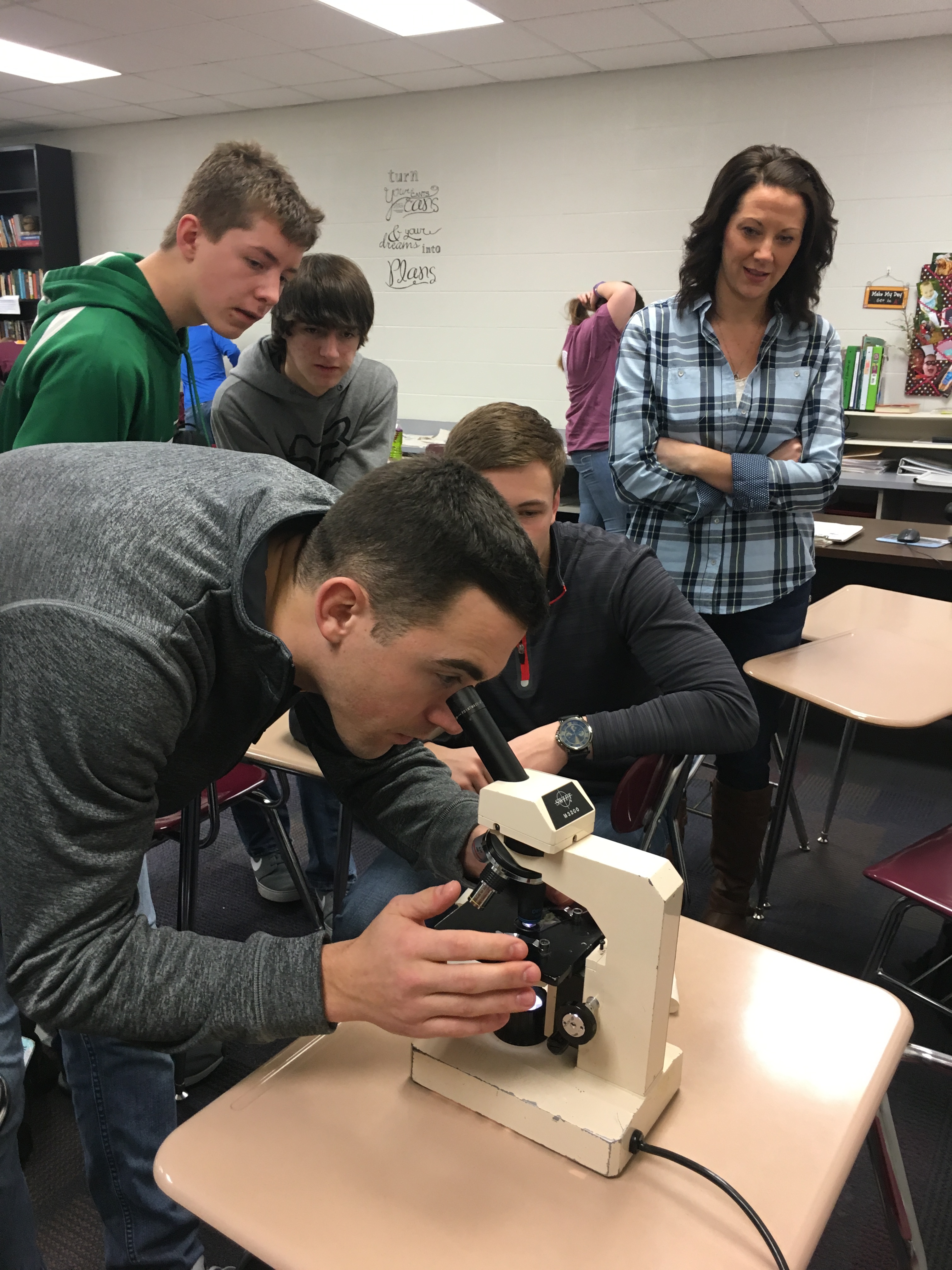
file_007-2The next day, Mr. Pfledderer rolled a cart of microscopes into her classroom.  He reviewed the process of focusing the three lenses and reminded the students to move the slide—slowly—on the stage. “A tiny movement by you will be a giant move through the lens,” he explained.

Pairs of students grabbed microscopes and searched for outlets around the room. The English room rapidly became an informal lab as students placed their slides and searched for chromosomes.

“You won’t all get one,” Mr. Pfledderer had cautioned them the day before. “We hope some of you will.”

Hands waved, voices called out for the science teacher to look at the purple blobs the students discovered on their slides.

file_000-3“That’s a floating piece of cell membrane,” he told one pair.

“Just a blob,” he told another.

“Yep! That’s a chromosome!” he congratulated one duo. With that, other students flocked to see the chromosome on their slide. iPhones emerged from back pockets and purses as students took pictures by pressing the aperture of the phone to the eyepiece of the microscope. file_002-2

Henrietta Lacks was a poor, black woman, and her cells were grown and distributed without her consent or her living family’s knowledge. That fact has spawned controversy, for not only are the cells famous, but biotech companies have profited from using them. Until Ms. Skloot wrote her book, the Lacks family had received none of the profit.

The case poses important ethical questions for science: What obligation do researchers have to obtain consent for tissue preservation and use? Who should benefit monetarily from discovery and invention? In other words, who should profit from scientific progress?

Laws, in fact, were different in the 1950s, so Johns Hopkins—which has since established a scholarship in Henrietta Lacks’ name—did nothing illegal. The cells from a living cancer biopsy had grown unexpectedly, miraculously even. The goal was scientific research, and the windfall cell reproduction eventuated in discoveries related first to the polio epidemic that was sweeping the country at the time and later benefitted research into leukemia, AIDS, chemotherapy and gene mapping, to name a few. In short, many modern advances in science and medicine are indebted to HeLa cells and thus, in the point of view of some, to Henrietta Lacks.

The question is a knotty one with no easy or practical solution. Rebecca Skloot, the author, has established a foundation to support education and other needs for Henrietta Lacks’ descendants.

When the lab was over, Mrs. Ruiz asked the students to reflect on the experience. One student wrote, “To be honest, when I was looking at the cells, I didn’t think about the person behind them. I was just looking and feel like that is what the scientists were doing. They were just doing their jobs, like they did to all of the other cells in the lab.”

The student continued: “Yes, I believe that they [Henrietta Lacks’ family] should have gotten money because they were poor.” But, he asked rhetorically, “If they were rich, would you have the same feeling toward them not getting money?”

Another student wrote, “Doing this kind of made me feel bad because these cells once belonged to a woman who didn’t even know that people like 10th grade English students would be looking at her cells. Even though I felt bad about that, I still had a lot of fun and I think it was a very good learning experience. I also enjoyed how it connected English to science.”

And this entry: “I didn’t really understand what HeLa cells would look like until now. Would they look like normal cells? Would they look immortal? Monster like? Now that I have seen and witnessed HeLa cells, I know that they are just the same as yours and mine would be.”

Watching the lesson unfold, I could see that Mrs. Ruiz and Mr. Pfledderer had brought non-fiction reading to life and may even have sparked an interest in science that wasn’t there before. Students thought seriously and deeply about what they had read and experienced, and that is the goal of education. 

Wicked cool.

file_006-2


Museum Visits–Making Them Sticky

a-a-museum

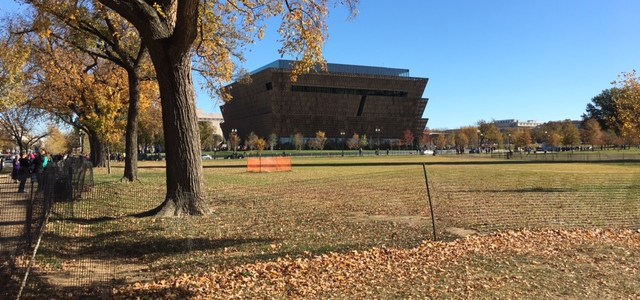
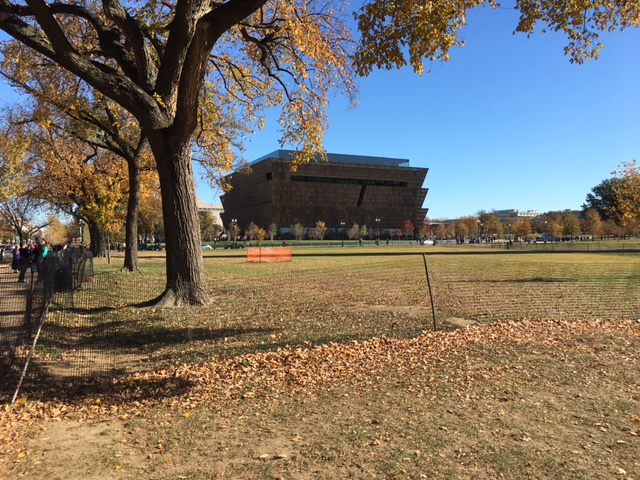
I’ve been spending a lot of time in museums lately.  A few weeks ago, I was privileged to visit the Smithsonian’s Museum of African-American History and Culture in Washington, D.C. The praise for this newest addition to the Smithsonian has been sky high, and it isn’t hyperbole to say the museum is spectacular.  By now, people know when they visit that their tour will start on the underground floors and progress in a spiral through 500 years of history—starting with the slave trade, traveling through all of American history, and ending on the top floors with a celebration of African-American accomplishments and triumph.  As a friend of mine who was with me that day said, “You are sick to your stomach, then tearful, and then you feel like dancing.”

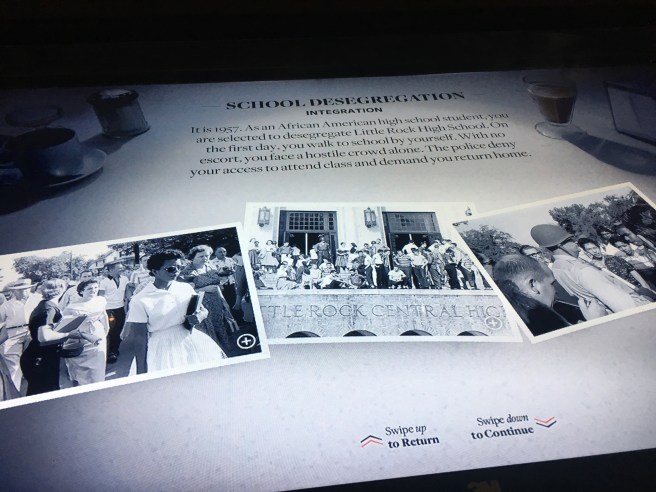
The Museum is huge, vast in its scope, deep in its detail. I started by taking notes of things I didn’t know, not realizing I could take pictures on my phone (of most exhibits). But by the time I reached Jefferson, I couldn’t take notes anymore. There was simply too much information. I took a few pictures, but even that mode of recording information was inadequate to the task. I kept going, through the Civil War, through Reconstruction, through early 20th century. And then I reached the Civil Rights movement–the time period I remember, know something about personally.  And still, the explosion of information overwhelmed me. There was so much I didn’t know.

file_003

Aware that I wouldn’t be back for a long time, I wanted to take everything in, skip nothing, but museum fatigue set in. I’d already spent five hours and only had a little time left. I’d been admonished not to miss the top floors, so in my remaining hour, that’s where I headed. Thank goodness, for even though I skimmed the exhibits there, I wouldn’t have wanted to miss the jubilation at the top.

When teachers take their students to museums, they usually don’t have six hours–even if the field trip is to Washington D.C. and they’re staying several days.  Maybe brevity is a good thing because museum fatigue (a real phenomenon–not just a term I made up) would set in well before the six hours I stayed.

Coming away from a museum like this one with an overall impression (as in my friend’s summation about revulsion, empathy, and joy) is important in itself, of course. Context matters. But to make the memory “sticky,” it’s important to personalize the experience in some way.  If you’ve ever been to the United States Holocaust Memorial Museum in D.C., you remember how visitors receive an identity card when they enter. At the end of their visit, they find out what happened to the person they’ve become as they’ve experienced the Holocaust.

This isn’t possible in the African-American History Museum–slave records are incomplete and depersonalized and the time span (500 years) is too long for this same strategy–but objects,  events, and even concepts can become personal.  Here are some ways that can be done–for this museum or any other.

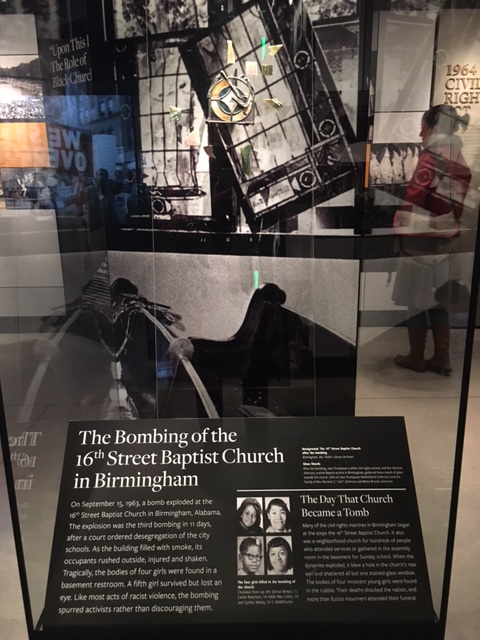
  1. If you’re doing a study of African-American history in your classroom ahead of time, have each student choose a specific event, a particular individual, or an important topic to “specialize” in. Then, at the Museum, the student’s mission will be to find the exhibit where that event or that individual or that topic is depicted. The task will be to pause for a significant amount of time in front of it (or interact with it) and take notes, even pictures (if pictures are allowed).Upon returning to the classroom, students report out–orally or in writing–about “their” exhibit. What new information was learned? What displays or pictures or graphics brought the information to life? Was it covered more deeply–or less so–than the student had covered it? How did it relate to exhibits around it? Were there other events or people that were similar?                                                                                                                                      bombing-of-birmingham-church
  2. If you’re not studying African-American history ahead of time, go to the Museum website (https://nmaahc.si.edu/) before you visit the Museum itself.  Have students click on Museum Collections and choose an area of interest.  Objects in the collection are cataloged by topic, date, place, name and object type. By expanding the information on any one of the thousands of items in the collection, students can see if that item is on display and the location of the object in the Museum. To make this more than a scavenger hunt, have the student prepare an oral or written report on exactly what the item was, how it was used, to whom it belonged and how it was situated in the exhibit. In other words, ask them to explain the context of the item.

One of the most successful museum visits I ever made with students was to an exhibit in 2001 to the Indianapolis Museum to see “Gifts to the Czars,” a collection of dazzling items that had been brought to the Russian czars by ambassadors from around the world from 1500 to 1700. The items were treasures from the Armory Museum in Moscow. I brought students to this museum to prepare them for reading Animal Farm–to contrast the opulence and luxury of palace life with the squalor and deprivation peasants faced in pre-Revolutionary Russia. No amount of my say-so was as effective in conveying the richness of the Russian Empire as the bejeweled gold and silver pieces, the inlaid and encrusted objects that were taken as mere gifts to the czars.  

3. At the Museum, I asked students to find one object in the exhibit that intrigued them, pause in front of it for at least 5 minutes, and with words and sketches, capture the detail they saw.  In the collection: sabers and swords, shields, textiles, horse trappings, an empirical eagle with a tray for holding the czar’s crown, a Baroque basin, serving dishes and wall decorations. Something of interest for everyone.  The temptation today would be to take a cell phone picture, but it is the 5 minutes of close visual inspection that made the assignment work. Five minutes is an awfully long time for a 9th grader, but the longer they looked, the more they saw. The follow-up to this assignment was a creative writing piece, based on the known facts, and a map showing the route the ambassador would have taken from his home–say, Istanbul or Stockholm–to Moscow at that time. 

A similar activity could be done in any museum, but the temptation to take a cell phone shot and move on would have to be overcome. As I recall, I had to approach the 5-minute rule as a challenge to my students. Could they do it: Hold still for 5 minutes? (Click here for the original assignment.)

A side note: When a few of those same students went to Russia with me a year or so later, we visited the Armory Museum.  Some of the items they’d identified were back on display there. Students who found “their” object were genuinely excited!

saber-and-scabbard-of-the-grand-attire-631-jpg__800x600_q85_crop

In any event, the point is this: To heighten the impact of a museum visit, find a way for the students to identify with the exhibit you are taking them to see.  Years later–and even on the spot–the time spent in any museum can be just a blur, but if the student–or the teacher–heads into it with a personalizing assignment in mind, that at least will stick–long after the overall impression has faded.

A Change of Environment

dsc00686Olivia had some advice for 8th graders considering enrolling in the Maverick Launch program at my high school: “Don’t be worried,” she said. “This is a safe place. You’re always welcome here.”

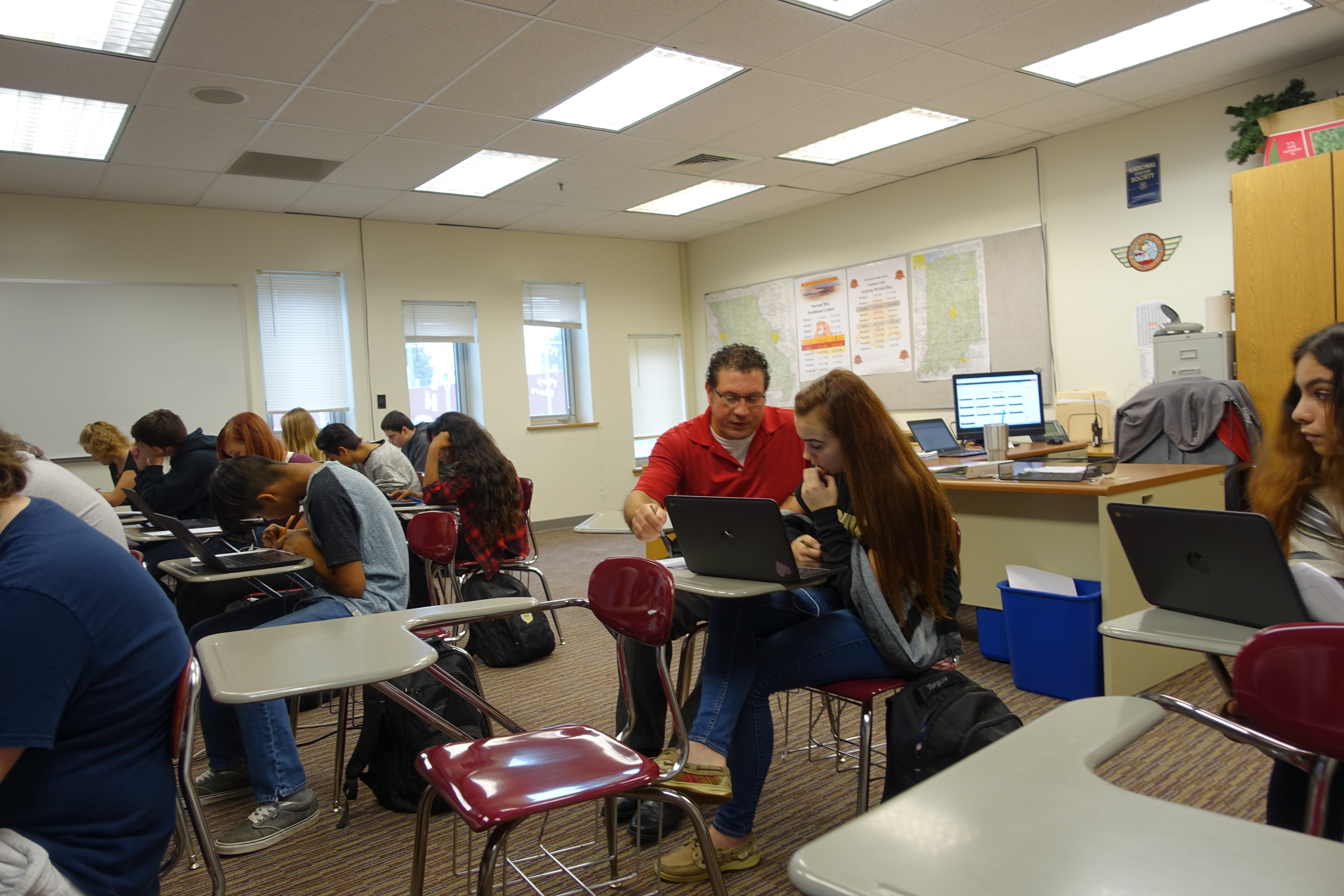
Recently, I spent a day in McCutcheon High School’s freshman intervention program, called the Maverick Launch, which was initiated a few years ago to meet the needs of incoming at-risk students. Really, this is a school-within-a-school, an innovation in education that has brought success to targeted students in many districts across the country. Maverick Launch is the name of the program—the school mascot is an unbranded steerand it is also the name of the building where approximately 100 lucky students attend high school every day.

“The best thing about Maverick Launch,” a freshman girl, Brittney, told me in an interview a few days later, “is the help from teachers.”

Maverick Launch students follow the same rigorous curriculum as every other freshman student at McCutcheon High School (English students had just read the Odyssey and algebra students were graphing linear equations), but there are only 15-20 students in each class. Thus, learning is much more personalized than it can be in classes that regularly exceed thirty.

Another big difference is that Launch students have two math classes and two English classes every day. One English class focuses on literature; the other on writing and language skills. In math, the first hour is for the presentation of new materials; the second for homework and extra help. The students also take science and FACS every day with their cohort.
Because of the additional English and math learning opportunities, Maverick Launch students can earn two extra credits their freshman year. The extra support means an increased expectation that they will pass Indiana’s graduation qualifying exam sophomore year, and the extra credit hours provide room in the students’ schedules for elective classes in later years.

Students also take two classes each day in the main building, blending easily with the larger student body. “I expected to be treated differently by the kids in the main building, Ethan said, “but I am not.” Like other freshmen, Maverick Launch students choose from the full array of high school course offerings for those two hours, enrolling in such classes as World History, PE, 3D Art, a world language class, computer applications—wherever their interests lie.

Maverick Launch students participate as well in McCutcheon sports and extra-curricular clubs. This year, 47% of the Maverick Launch students are on an MHS sports team and 75% are involved in at least one extra-curricular activity.

Students report other benefits to enrollment in Maverick Launch, too. For starters, former Maverick Launch students are welcome to return anytime throughout high school for extra academic help. Some even choose to serve as teacher’s aides for their former instructors.

Another plus has been the friendships formed in this small-school environment. “We’re like one big family out here,” said Andrew, a graduate of the program.
During my day with the Launch students, I encountered a young man I’d seen in action the previous year in middle school. Robert. He’d been a difficult student—uncooperative, disengaged, often rude. I didn’t even recognize him when I saw him in the Launch. He was working with another student on a collaborative project and he looked happy. His teachers loved him. Something important had changed.

dsc00681

In this small and supportive environment, it is clear that students are developing habits of learning that will increase their chances for success during the rest of their high school career. They raised their hands, came to class on time, kept their voices down, and apparently did their homework. Not a one balked at giving an oral presentation that was slated for 1st hour the day I was there. They didn’t pack up early and rush the door at the end of the class period. I could tell these were behaviors they’d been taught and ones their teachers expected them to observe. But the atmosphere wasn’t robotic; it wasn’t even regimented. Classes felt relaxed, low-key. 
I noticed as I traveled from class to class that the teachers are consistent in terms of their expectations and procedures–and that leads to a safe and welcoming setting. Kids know what to expect.
Once, during a math class I observed, students began drifting during the teacher’s presentation. He said, in an even tone and barely missing a beat, “I’m reviewing now from Friday. I need your attention. Those of you holding up your head with your hands: Exercise your neck muscles. Hands down. Sit up straight.” All this was delivered in the same voice Mike Etzkorn, the lead teacher in the Maverick Launch, uses for instruction. His redirect was not a chastisement, just a summons to the task at hand.

This is the same teacher who allows earbuds while students are working on the “homework” problems he’ll go over with them the second time they meet, later on in the day. He knows that some kids concentrate better when they’re oblivious to classroom distractions.

This is the same teacher who asked every student, as he made his way around the room, “Are you doing okay?” To one girl, who was randomly hitting the keys on her computer, he said, “Are you just playing?” When she replied that she didn’t understand, he bent down and re-explained.dsc00693

This is the same teacher who said to students, “I’m not ready for you to start the homework”—not, “You’re not ready.” The message came through as “You can do this, but I haven’t spent enough time helping you understand.”

It would be easy to say that the small class size or the double dose of math and English is responsible for the success these students meet, but it’s more than these two factors, critical as they are. These teachers have formed caring relationships with their students, all of whom have learning challenges of one kind or another. Sometimes that caring is communicated in very simple ways: reminding students of their choices when their classwork is complete, giving them a 2-minute warning that lunch is about to start (There are no bells in the Maverick Launch), nudging them about a quiz the next day. Sometimes it’s by asking about the weekend or letting students who need to listen to music as they work, or sitting down next to a student to help her through a problem.

The teachers are consistent in their approach, clear in their directions, and non-judgmental in their reactions. The students trust them because they’re predictable.

dsc00705Mr. Etzkorn explained that the goal is to ease the transition from middle school to high school by establishing a caring, familylike environment. The teachers work as a team. In fact, they meet together at the end of every day–while their students are taking one of those classes in the main building–to plan, confer, and strategize. That planning time together is another ingredient in the recipe for success. The teachers see their students from multiple perspectives and know how they’re doing in subjects other than their own. They know when any particular student is having a bad day, and they all learn about everyone’s challenges and successes.

In this school-within-a-school, Mr. Etzkorn told me, “Students are given the time they need to mature and grow academically.”

In the end, it’s the atmosphere these teachers have established that makes all the difference.

Paul Tough, a journalist-turned-education-sage wrote a book a few years ago called How Children Succeed. In that book, he confirmed everything I’ve known for years—from experience and by instinct—about why some kids are successful and why some aren’t. It isn’t about IQ; it isn’t about money and family resources.

It’s about having the discipline to make yourself study when you’d rather be playing video games or texting or driving around town with your friends on a fine spring night. It’s about persistence—about seeing a teacher after school to get something explained, about giving up a lunch period to visit the math lab, or revising that paper when the assignment to do so is optional. It’s about memorizing the formulas and going over the study notes. It’s about setting a goal and moving toward it, step by step by step.

But Tough has good news: These “character” traits, as he calls them, can be taught.

dsc00709In his most recent book, Helping Students Succeed, Tough writes: “If we want to improve a child’s grit or resilience or self-control, it turns out that the place to begin is not with the child himself. What we need to change first is his environment.” Tough’s new book addresses the academic failure that 51% of America’s public school students experience because of poverty and its attendant problems. Poverty may be the root cause of the problems some Maverick Launch students experience, but not all of them. Similarly, they are not students who were identified because of poor discipline records, yet some are familiar enough with the principal’s office. What they do have in common is that all of them were identified in middle school, for one reason or another, as being at risk of not graduating from high school.

Robert, the boy I saw whose experience in the Launch environment has been transformative, is learning how to be a student. In this nurturing environment, he is experiencing success. He is developing the traits of character and the habits of learning that promise a better future.

He is not alone.

When these students move into the main building their sophomore year, their chances for continued success will have improved exponentially. Impressively, one-third of former Maverick Launch students are able to complete their high school coursework and graduate early.

Abby, a sophomore who was enrolled in the Maverick Launch program last year, is now a teacher’s aide during her study hall period. She told me this: “The teachers connect with everyone. They take their time to help you understand.” And then she added, “I’m grateful for all the program did for me.”

She is not alone.

The Unsung Heroes Project

DSC_0070

So many young people today are without real heroes. Their knowledge of individuals who have made a difference in the world usually extends only as far as celebrities and sports stars, perhaps to someone in politics. Worthy as some of these people may be, students are generally unaware of the range of actions that can be considered heroic and, even more importantly, of the people in their own community who have made a difference by standing up for, rescuing, or serving another person, cause, idea, or the community itself.

The last three years that I was in the classroom, my 9th grade Honors English students and I undertook a project that expanded their understanding of what it means to be a hero.  This was the Unsung Hero Project, inspired and supported by the Lowell Milken Center in Fort Scott, Kansas. I’ve blogged about this project before (Great Expectations: The Unsung Hero Project and Unsung Heroes, Reprise), but I’ve never outlined exactly what my students did. Recently I was asked to do that, so I’m sharing my description here along with some pictures of students at work on the project.

This classroom undertaking is an example of project-based learning. Through their work on this project, students developed skills in research, collaboration, writing, and the use of technology.  And, as important (if not more so) than anything else they learned, they were inspired by real live heroes in our own community.

Semester One

Students received intensive writing instruction the first semester, especially regarding formal writing conventions and organization of ideas. I spent time on sentence combining techniques (compound, complex, compound-complex sentences, introductory modifiers, appositives) before as well as during the time the students wrote their essays (February and March), and I hit topics such as pronoun antecedents pretty hard. Other grammatical topics I covered on an “as needed” basis. I also “unpacked” the skills required for a research paper, teaching basic bibliography skills, outlining, and internet search techniques in the first semester in preparation for the more complex research the students conducted during the second.

Collaboration is a vital component of this project, so I employed a variety of strategies for developing collaborative skills from the very beginning of the year. My goal was for students to be comfortable working together so that when they began the Unsung Heroes project in the second semester, they could work together efficiently, productively, and equitably.

The first step in the project itself was to define, through class discussion, what exactly we meant by the word “hero.”  Here’s what the students came up with one year: A hero is a person who, with no expectation or recognition or reward, has made a difference by standing up for, rescuing, or serving another person, cause, idea, or the community itself.  Definition Lessons 035

We had a few models, too: Atticus Finch served as the fictional model for a community hero (we read To Kill a Mockingbird in the fall) and the non-fiction model was Irena Sendler. The Courageous Heart of Irena Sendler is available on DVD from Hallmark; the book Life in a Jar is available through Amazon. Other models were individuals profiled in the Christian Science Monitor’s series “People Making a Difference” (available online at the Monitor website). We read a number of these essays and practiced defining a hero by breaking down the stories and aligning them with the students’ definition.

Semester Two

Students formed groups of three, self-selecting their partners, and established an account on google.docs, an online tool for writing collaboratively, simultaneously, in real time (a new technology tool eight years ago when I first began this work!).

Then students selected a hero/heroine from a list I provided for them of people in our community who had been in some way heroic. Some of the individuals came to my/our attention because they had received a very small local award for their efforts. Some were suggested by friends in the community, the faculty at my school, and (by the second and third year) various individuals who had read the first volumes of the book. Once the students selected a cause/person, I contacted that individual, soliciting their involvement. No one ever turned us down, by the way, and I would have been surprised if they had.

The next step was the research paper, probably the most complex instructional piece. The students worked collaboratively to research the cause their hero had championed. Thus, when they met the hero and interviewed him/her, they were already “experts” on the topic. The hero didn’t have to start from scratch to educate the students. The research paper included an outline, an annotated bibliography, internal documentation, and a Works Cited page in MLA format.

Most students established email contact with their hero right away and were able to ask him/her for advice and recommendations for resources as they researched the topic. The heroes were usually glad to steer the students to appropriate resources and helped them narrow their topic appropriately.

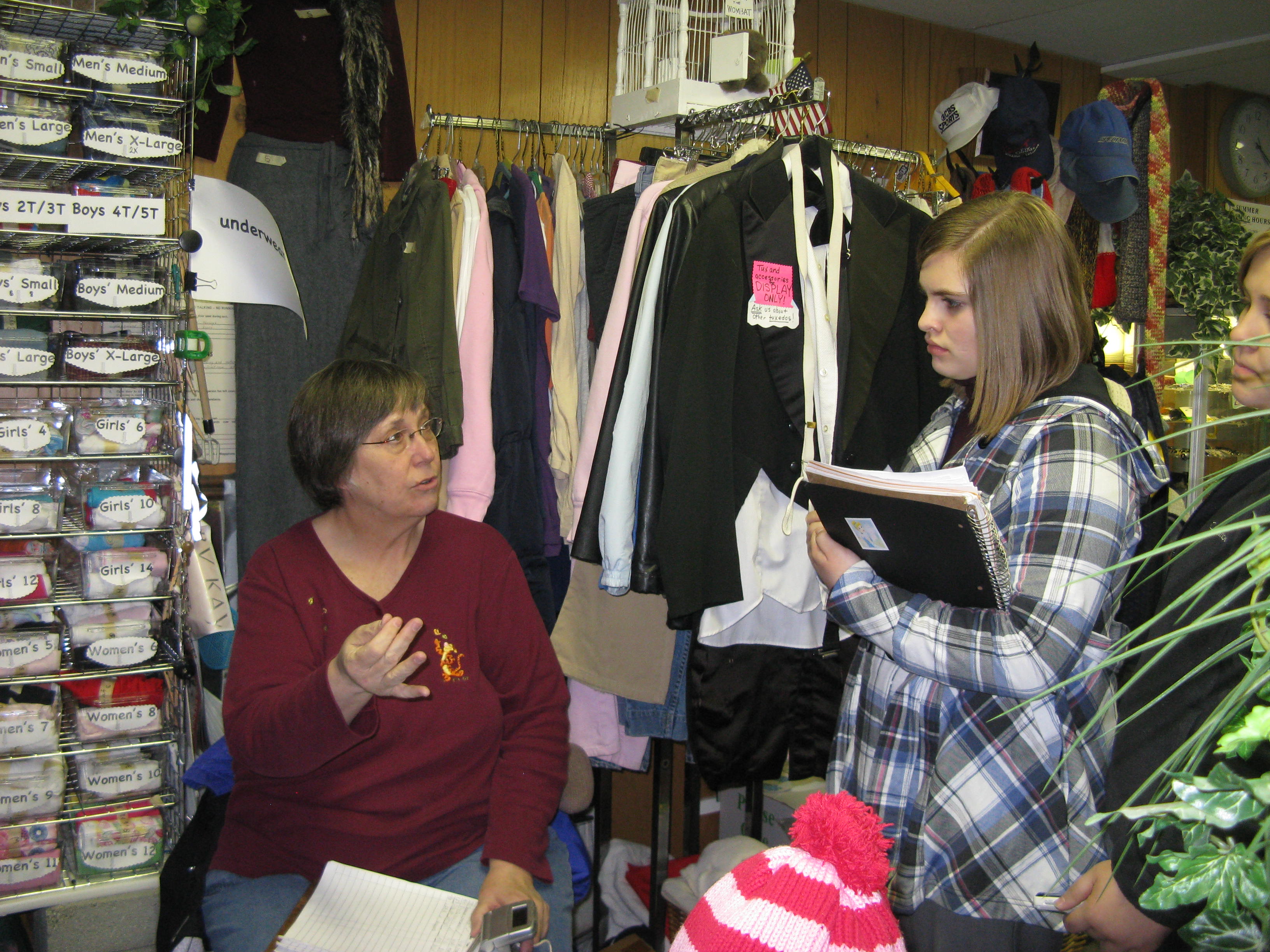
Unsung Heroes II 024Once the research paper was underway, the students set up an interview with their hero. We tried to conduct all the interviews on the same day in the school library, but of course, not everyone was available on the day we selected, and in some cases, it was inconvenient for the hero to come to school at all. I sometimes drove groups of students to on-site locations and arranged for their parents to pick them up. To be honest, when the hero was associated with a facility—such as the Boys and Girls Club and a second-hand store for impoverished families—it is helpful for the students to see the facility.

Students set up the interview by phone or by email. Although I coached them in the art of interviewing, I stayed out of the interviews myself (aside from taking photographs). Afterward, the students typed up their notes in narrative form or in Question/Answer format—and then they started in on the essay. Their essays went through several revisions. Early versions were read by their peers and by me, and these revisions dealt with structure, the balance between narration and  quoted material, and the weaving of information from their research with what they had learned from their hero. Line editing came last, and both the students and I did this at various times.

P1010472One of my concerns as a teacher of writing was that “voice” would be lost in a collaborative project, and to a certain extent, it was. However, what usually happened is that one of the students emerged as the primary writer, so meshing styles and voices wasn’t as severe a problem as I had originally anticipated. They also each wrote a reflection. I was light-handed with these—I didn’t want to extinguish their individual voices—and by this time, the students were expert at line editing. People who have read the book who are not from this community and don’t know the heroes have told me that the reflections are the most interesting part of each book. That doesn’t surprise me—there students wrote from their hearts.

Students submitted their work to me as a Word document, and I did take over as the master technician on setting up the pages. Eventually, the document turned into a pdf file. The students selected the font and the layout, and they designed the front and back covers as well.

The books could have been published using an online company, but the submission deadlines for these companies did not work with the school calendar very well, so I elected to work with a local printing service. Frankly, I am glad I did. We were able to receive a galley, make final corrections, and still meet our publication deadline. Besides, the printer I worked with had a lot of good advice for us and accommodated our schedule well. He even attended our celebration at the end because he had had a hand in this production, too.

Unsung Heroes in Our Community was developed with the support of the Lowell Milken Center for Unsung Heroes (LMC) in Fort Scott, Kansas, whose mission is to “galvanize a movement to teach respect and understanding among all people regardless of race, religion or creed.” The spirit of the Center is embodied in the Hebrew expression, tikkun olam, which means “to repair the world.” The LMC accomplishes its mission of teaching respect and understanding by supporting education projects that feature Unsung Heroes—people who, like Irena Sendler, have acted to repair the world. The project was funded by grants from the Kiwanis Foundation and the Public Schools Foundation of Tippecanoe County.

Unsung Heroes in Our Community was an extensive project, and one that made me—still makes me—very proud. At the end of each year, we held a celebration to which all the heroes were invited as well as the principal and the school district administrators, the students’ parents, the press, and our donors. DSC_0002

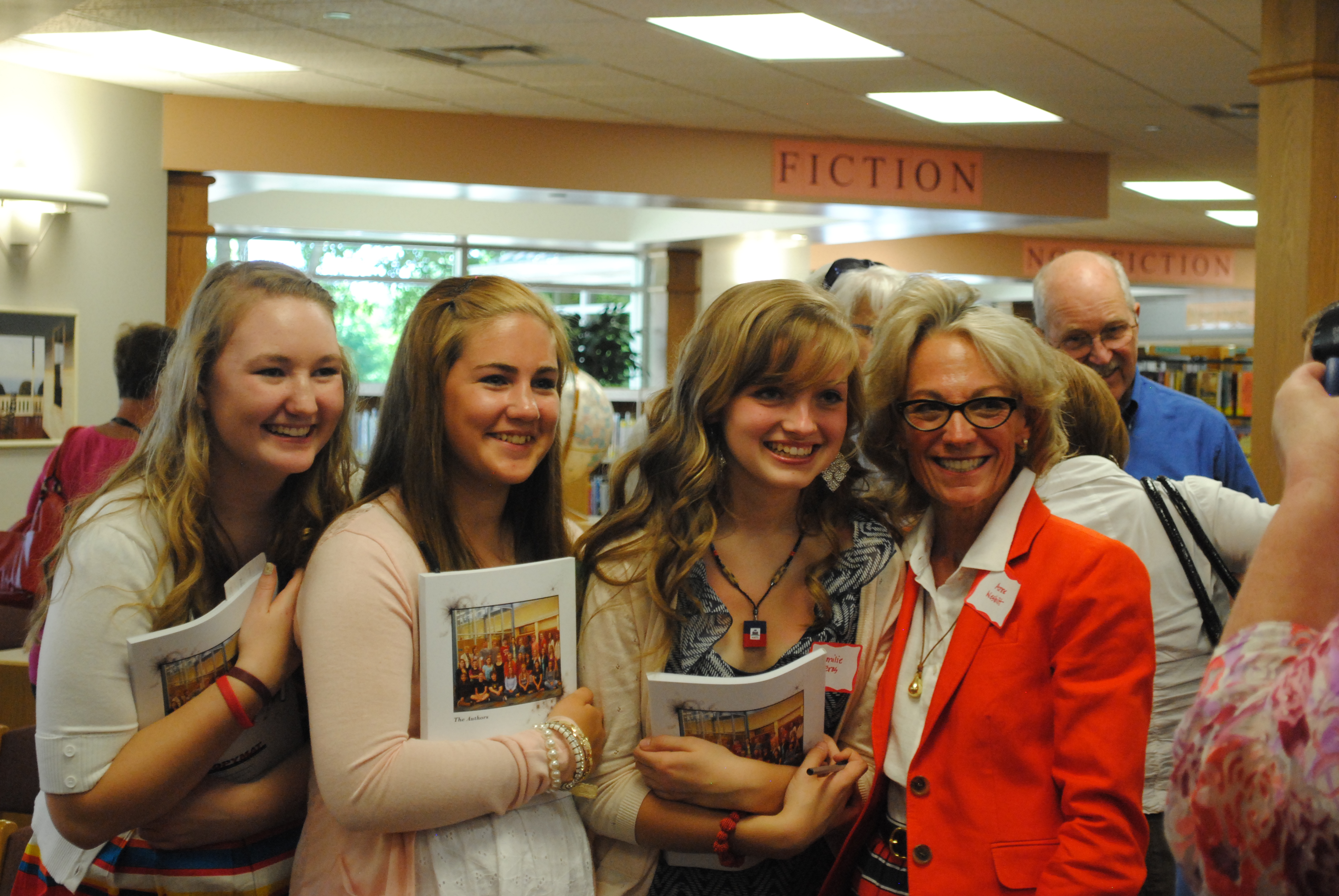
At the celebration, the students introduced their heroes, a few students spoke to the audience about the process and what they had learned, and often the heroes made little speeches themselves. All this was followed by a mass book signing. The heroes were even more enthusiastic than the students about collecting signatures! DSC_0113

The book is now in our local public libraries, our local historical society, and in the collection at the Indiana State Historical Society in Indianapolis. Last year, two students were cited in the newspaper by our local historian for information they discovered about the Underground Railroad in our town. Volume I of Unsung Heroes in Our Community was enthusiastically reviewed on the radio last summer  and the book was also featured on local television. Some of our heroes, in fact, later became subjects for a local TV program, “Heroes Among Us.” DSC_0140

This project is well worth the time, energy, and effort it takes to orchestrate. Project-based learning is meaningful to students because it is “real” (as one of the students told me). At the same time, a project like this directly addresses state academic standards and district curriculum expectations. For the teacher, bringing a project such as this to fruition necessitates a thorough understanding of the standards and curriculum, of course, but beyond that, it is a matter of organization and planning and, above all, faith in the students. Their gain in research and composition skills, in comfort with technology, and in the ability to work collaboratively is extraordinary.

DSC_0010The book made an impact on the students beyond the skills they gained and the recognition they garnered. Their definition of a hero expanded from the vision of a super-powered individual in a cape and Spandex to someone who serves others. My students were inspired by the person whose life and work they researched. Someday, when they themselves confront an injustice, meet with a challenge, or perceive a community need (as they undoubtedly will), I am confident that they will recall the courage, selflessness, and determination of these local heroes to “repair the world.” I believe that from these individuals’ examples, my students will draw the strength to act heroically themselves.

Preserving the Past: A Cemetery Restoration Project

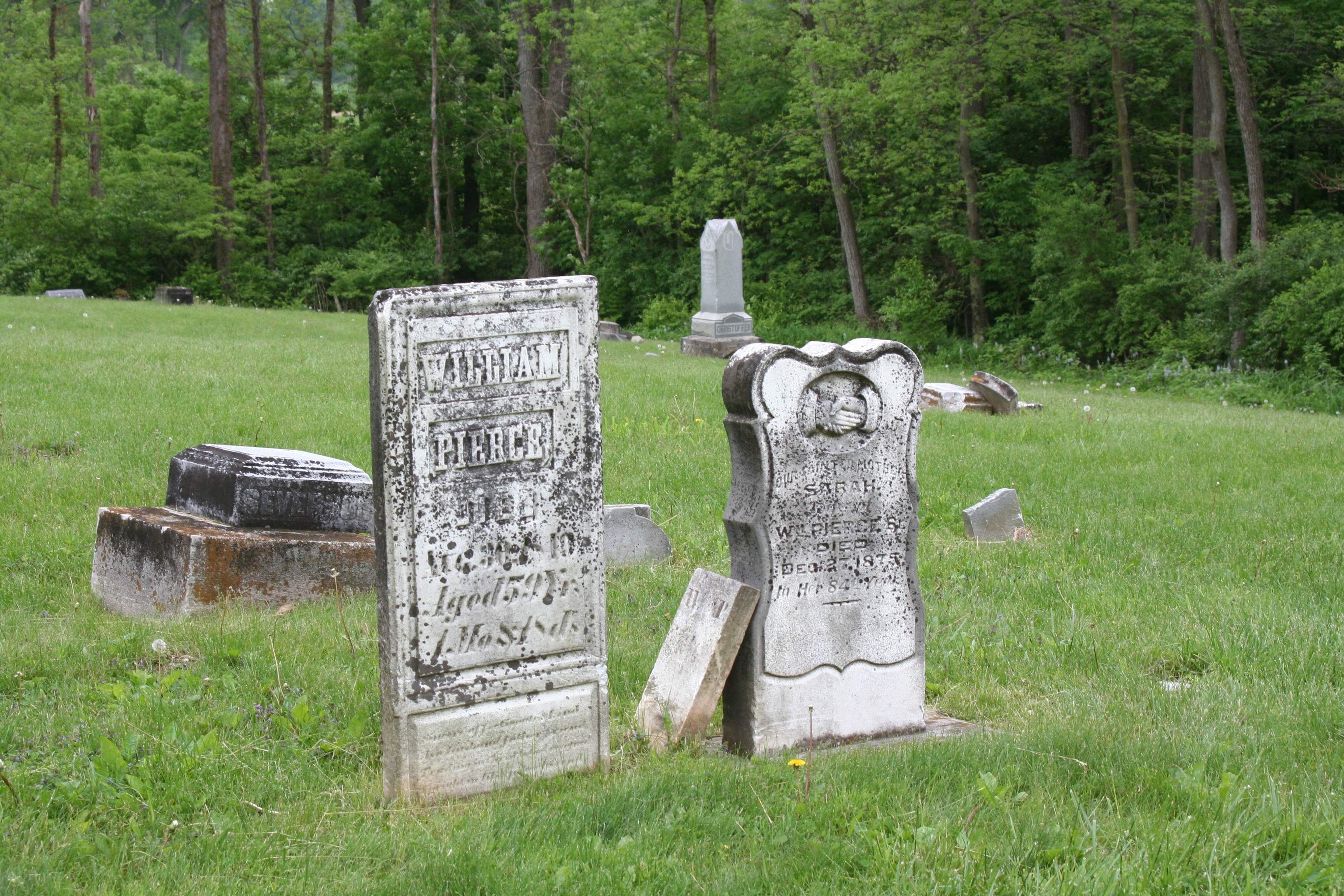
IMG_8062Pierce Cemetery is, in the words of high school social studies teacher Ashley Greeley, “in embarrassing shape.”  It is a true pioneer cemetery—that is, original settlers in this area of Indiana are buried there—but the grounds of the cemetery have been neglected for decades.  Monuments have toppled, slabs have cracked, stones have sunk deep into the ground. But last week, members of Ms. Greeley’s AP US History class (APUSH, as it’s called) began putting the place to rights—and learning some local history along the way.

Students began with research about their own families, learning their way around online genealogical resources with a subject that was somewhat familiar.  Then, Ms. Greeley assigned teams of students the name of someone who is buried in Pierce Cemetery.

To ensure some success in the research, students were assigned individuals for whom at least some information is known. Ms. Greeley had help in selecting the names from Lou Ann Clough (“LA”), archivist at the Tippecanoe County Historical Society, and Shane Weist, another local historian who was recently honored—one of 73 people in the country—by the Daughters of the American Revolution for his work in historical preservation. Previously, LA received this same Historical Preservation Recognition Award from the DAR, so the students were in good hands with LA, Shane, and Ms. Greeley as their guides to local history.

Ashley Greeley met Shane Weist and LA Clough last fall on Veterans Day when she and a handful of students showed up to help with the clean-up of Greenbush Cemetery, one of Lafayette’s oldest burial grounds.  The students had enjoyed the restoration work and that got Ms. Greeley to thinking about the cemetery that is literally in Harrison High School’s own back yard.

Cleaning up Pierce Cemetery would be a way for her to highlight local history—this is, after all, Indiana’s bicentennial year—and at the same time underscore the APUSH goal of applying historical thinking skills.  Ms. Clough was a guest speaker in the class. She explained the resources available to students  online and at the Tippecanoe County Historical Society.  At her invitation, seven students made an after school trip downtown to the Historical Society to use the Alameda McCollough Research Library. There they looked at actual documents relating to their person or family.

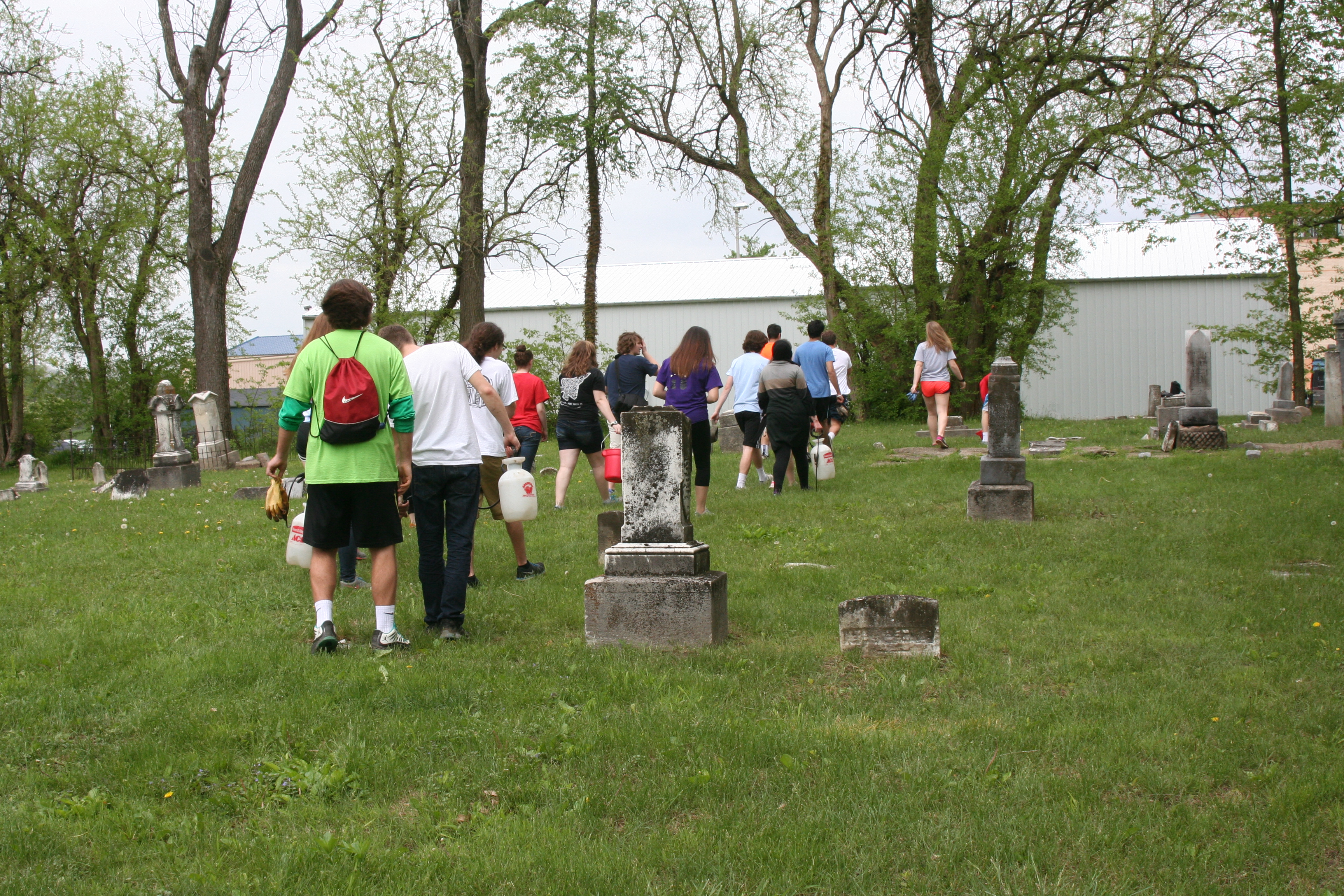
Permission to proceed with the work in the cemetery itself was secured from the Tippecanoe Township trustee, and then, on several May afternoons, Mr. Weist met the students on the cemetery grounds. He explained cemetery etiquette and cleaning procedures and directed the students as they cleaned the markers belonging to “their” people and their people’s relatives.

The students cleaned the stones with water—gently sprayed with a hose connected to a hand-held, hand-pumped container—and Revive, a professional masonry cleaner.  “Never power wash a gravestone,” Weist told the students.  “You’ll degrade the stone.”  Similarly, he cautioned that bleach should never be used as a cleaning agent.  Softly sprayed water and a mild solution of Revive was miraculous itself: Names appeared, dates became readable, carved symbols emerged like magic. “This is so satisfying!’ remarked one student, as information about a woman she’d had trouble researching began to reveal itself.

This slideshow requires JavaScript.

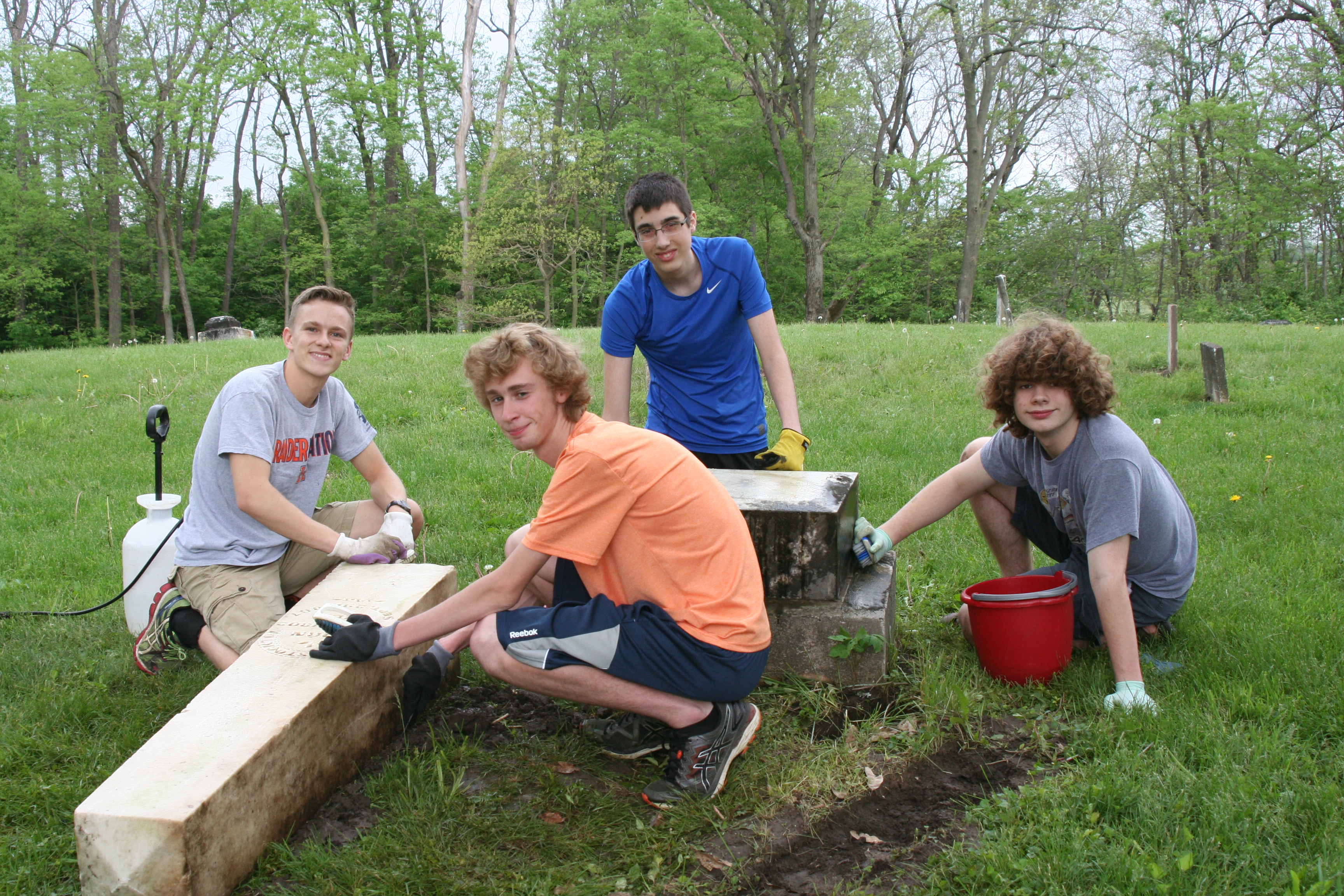
Weist, who is certified by the state of Indiana to do cemetery restoration, helped one team of students restore a monument that had fallen years ago.  After the boys had cleaned the fallen obelisk, they washed the two stones that it had once rested upon.  A “stack” compound (a mix of cement and lime) the consistency of peanut butter was spread on an area of the base of the first stone.  When the mortar had dried sufficiently, the boys placed the second stone on top of the first.  A joint compound—caulking—was worked around the seam to guard against moisture penetrating the joint—and then the process was repeated to ready the spot on the second stone where the obelisk would stand.  Of course, it would be impossible to know which side of the obelisk originally faced forward, towards the entrance to the cemetery, but since there was carving on three sides, the team’s guess was pretty good. The stone no longer lies neglected at an angle on the ground. The obelisk stands tall, the family name facing forward now. IMG_8081

The students took pride in cleaning and restoring the graves. They began to see connections among members of the families buried there—a woman in one location, buried with her spouse, belonged to a family on the other side of the cemetery.  A first wife was buried with her parents—she’d died young—but her husband had remarried and was buried with his second wife and their children just behind her. Children aged only a few days had been lovingly laid to rest, joined years later by their parents. In one case, a modest marker for a 4-year old was side-by-side with a replacement stone, a grander marker shared by the little boy and his older brother, who died years later at age 26.

IMG_8037A Revolutionary War soldier is buried at Pierce and several Civil War soldiers as well.  Veterans of other wars, too, have found their final resting place in Pierce, and the students marked the graves with fresh American flags.

A group of boys, thrilled with the results of their elbow grease—the obelisk they had worked on  restored to nearly its original white—smiled for the camera. Said one boy in their group, “We’re having so much fun we don’t need to be asked to smile.” IMG_8058

To fund the project, Ms. Greeley applied for and won our school district’s competitive Anne de Camp Award for Creative Teaching. She used the money for the cleaning supplies, for gravestone rubbing paper and special wax crayons, and for a Shutterfly book she and the students will create to document their project.

Work remains for the APUSH classes in years to come, but several students asked Shane Weist if they could help him with other cemetery restoration projects. The boy who didn’t need to smile for the camera is thinking about tying his Eagle Scout project to the restoration of Pierce.

Cemeteries like Pierce are “excepted” pieces of real estate.  That is, the grounds surrounding the cemetery are privately owned (in this case, by the school district), but the cemetery itself is not part of the school property. It belongs to the township.  Neglected for many decades and unused for burials in recent history, Pierce Cemetery had fallen, quite naturally, into disrepair.  “I’ve been waiting for you,” LA Clough said to Ms. Greeley when the teacher first called her.  Clough has been mapping cemeteries all over Tippecanoe County, but restoration work is laborious. It calls for a group effort.

Because of the students’ industry, Pierce Cemetery already looks remarkably better than it did last fall when Ms. Greeley first conceived of the project. Soon she and her students will be able to say, “Pierce Cemetery was in embarrassing shape—but now it’s not.”

IMG_8017


Pictures Worth 1000 Words

Boss Tweed, a huge man in stature as well as impact, was the mayor of NYC and the engine that drove the Tammany Hall political machine.  He and his cohorts practiced graft on a giant scale, just like everything else he did.  Tweed didn’t worry much about his constituents squawking because most of them couldn’t read the newspapers.  He was brought low by one Thomas Nast, a cartoonist whose drawings appeared in Harper’s Magazine.  Nast exposed Tweed, and Tweed ended up in jail.  He escaped once to Spain, but was captured and returned to prison where he died in 1878. He famously said, “I don’t care a straw for your newspaper articles.  My constituents don’t know how to read.  But they can’t help seeing them damn pictures.”

Moral of the story: A picture is worth 1000 words.

So I am re-discovering.

Boss Tweed pixOne morning, not so many weeks ago, I was invited to attend an AP US History class where the topic was Boss Tweed.  I listened to the lecture and to the discussion that ensued and took notes the old-fashioned way: I wrote down words and numbers and dates and tried to capture the essence of the lecture in longhand.

That afternoon, not entirely by chance, I listened to a TedX Talk by Rachel Smith called “Drawing in Class.”  This blog is a shout-out to Rachel Smith.  She’s changed everything for me and, I hope, for a lot of people besides me.

I stumbled across her talk because I was looking for easy and/or effective note-taking strategies for a professional development presentation I was putting together for middle school teachers.  So far in my research, I’d  come across links to strategies I’d known about for years—like Cornell notes—and some clever ideas such as using highlighters to mark up texts in answer to a specific research question.  I’d learned that there’s no one right way to take notes (a big relief) and that some techniques—like trying to write down everything a speaker says—are largely ineffective.  Nothing new there.  And then I stumbled upon Rachel Smith’s TedX Talk.

When Rachel Smith was in school, she got in trouble for drawing in class.  She describes, in her talk, a scenario I remember from my own school days of teachers berating kids for doodling—when, in fact, they were creating graphic representations of what they were learning.  (A colleague—now an art teacher—told me she’d even been kicked out of Sunday school for drawing in class!)  Smith makes the point that drawing while she listened helped her focus—not to mention that her drawings captured the content in memorable images.

Now she makes a living drawing pictures of group discussions and collaborative proceedings.  I watched as she demonstrated how she draws words and images as people talk.  I wondered if 7th graders would be able to do this—listen and draw simultaneously—particularly if they aren’t “artistic” to begin with.

But maybe, I thought, even if they couldn’t draw fast enough to record a presentation as it was unfolding, maybe could they draw pictures after a presentation—as a way of summarizing the content.  I decided to try it myself.  I pulled out my lecture notes about Boss Tweed, and that’s what I drew.

The picture I created brings the story back for me in an instant—much faster than reading my original notes.  Could we teach kids to draw pictures as a summary exercise?  I’ve since made several presentations to my colleagues about Visual Notetaking, which (I’ve learned), is more common than I realized.

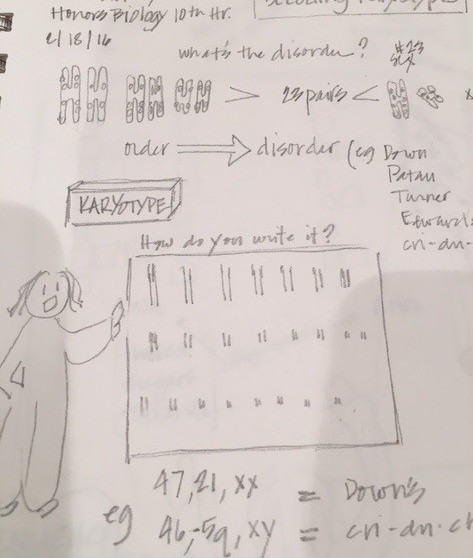
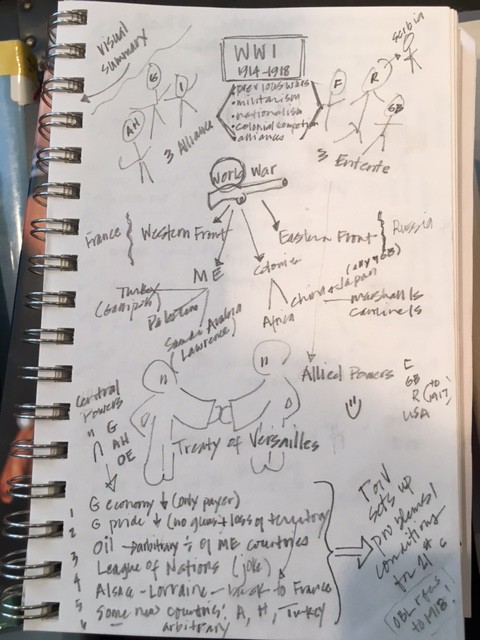
Since then, I’ve been drawing pictures in other classes I’ve attended.  Here’s a chemistry lesson on the heating curve, a biology lesson on karyotypes, and a visual summary of WWI and the Treaty of Versailles.

Ploss V-N


Cox V-N


Jordan Versailles


In the case of the two science classes, I recorded my visual notes as the class unfolded.  The WWI summary is an after-the-fact graphic.  Either way, I had to listen as the lesson unfolded, process the information on the spot, and then create an image that matched the content. Talk about focus!  No mental drifting possible.  And that is just the point.  Kids who doodle are likely processing—and learning in a mode that is natural for them.

You might notice that my people all look the same—except that Boss Tweed has a belly, the biology teacher has hair, and the people shaking hands at the Treaty of Versailles are standing sideways.  Rachel Smith makes the excellent point that novice artists like me need to develop a “library of images” that they can draw in an instant—and she ends her TedX Talk by teaching her audience how to draw a stylized “star person.”  Lesson learned.

All you need is a pencil and a blank sheet of paper.  Over time, you’ll develop that library of images.  Give this notetaking or summarizing strategy a try and teach it to your students.  I’d like to hear if you, too, rediscover that old truth: A picture is worth 1000 words.


If you’re new to visual notetaking, as I was, here is the link to Rachel Smith’s TedX Talk: https://www.youtube.com/watch?v=3tJPeumHNLY

Here is a link to the Pinterest page I put together on various notetaking strategies. https://www.pinterest.com/powleys/note-taking-strategies/

Here is a link to a Scholastic article by Meghan Everette on visual notetaking with directions for teaching kids how to do it:  http://www.scholastic.com/teachers/top-teaching/2016/03/visual-note-taking-keep-focus-and-improve-retention

On Track to the End

You could tell it was the end of the 3rd quarter just from the daily announcements:

Tickets for the spring musical, awards from the art show, final competitions for dance team and Super Bowl.  Athletic awards banquets, FFA Dinners, state championships for speech and robotics and then the biggest finale of all: the March Madness of Indiana basketball.

And then we were released for Spring Break.  A week to go somewhere far away from school or to sleep in, catch up, and get ready for the last push: 4th quarter, the culmination of the academic year.

But more often than we like to admit, when we get back from Spring Break, a lot of us will come face-to-face with the equivalent in teaching of running out of money before you run out of month.

There’s way too much left to “cover” before the last bell rings in May.

If you find yourself in this predicament, here are five simple steps to solve the problem of too much curriculum and too few days.  And some advice for how to prevent this from happening next year.

1.  Make a list of the curriculum topics you have yet to cover.

2.  Decide which ones are “Imperative” and which ones merely “Important.” Use the chart below for your list.  Then ask yourself the questions in Step 3. They  will help you sort the Imperatives from the Importants.

Start with a list of the topics.

Topic Imperative Important

3.  Ask yourself some questions about those topics to help you sort them into one of the two columns to the right.

  • Is the topic a skill you need to teach?

Skills trump content most of the time. Skills, the students have to have; chunks of content are often dispensable. For example, in American Literature, the textbooks contain selections from a pantheon of great writers. Will the students survive if they don’t read something by Willa Cather? By John Steinbeck? By Truman Capote?  Those authors are favorites of mine, and of course they’re Important, but in the big scheme of things, students won’t be scarred for life if they miss reading “A Wagner Matinee” or Of Mice and Men or “Miriam.”  Capote isn’t an Imperative.

But research skills? Those are important for academic success in any class, and it’s the English teacher’s job to teach them.  So don’t cut out the research project.  Look instead for ways to streamline it.

Think about the skills in your discipline that the students have to have, that the teacher next year is depending upon their having learned.  Put your time and effort into those topics.

  • Is it a piece of sequential learning that you can’t skip?

In math and world languages and other linear-sequential subjects, you simply can’t skip some things. There are processes and constructions kids have to know in order to progress to the next level.  These are Imperatives.  What can you do to compact the instruction so that you’re spending less time on each topic before moving on to the next?

Can you do the homework in class so that you see the mistakes the students are making as they make them—and offer correctives right then and there?

Can you put kids in cooperative groups and have them help each other?

Can you cut down the number of examples or possibly stop elaborating so much?

  • Is it an activity, rather than a topic, that you could dispense with or truncate?

 An easy one to rethink is a film.  Do you have to show it?  Eliminating a movie can save a couple of days at least.  Can’t cut it out entirely? What about showing excerpts only? What about an after-school showing with popcorn and soft drinks?

Is it a culminating project that involves teaching a process as much as the content?  For example, a debate on an issue the students have been studying.  Without some instruction in process, a full-on debate can deteriorate into a shouting match.  What about conducting a Socratic Seminar or a Pinwheel discussion—something easier to model that doesn’t take up so much time—but still gets various points of view out there.

95An independent research activity can be a huge time suck.  What about putting the kids in groups and conducting the inquiry as a team?  They can jigsaw their discoveries and divide up the presentation work as well.  By working together, they get the advantage of collaborative learning—often more productive anyway than learning alone—and you can likely save a day or so of time online and/or in the library.

Teamwork saves time generally and it allows you to capitalize on the students’ natural disposition to chatter. Set up your expectations so that they stay on task.  Consider using a rubric for daily effort to reinforce your expectation that the students stay focused.  They can fill it out themselves—most kids are honest—and you’ve got override privileges if they misjudge themselves.

  • How can you use a process you have to teach as a vehicle for teaching content? In other words, can you create a twofer?

I remember one year when I was teaching Animal Farm, as I did every year in 9th grade. I was short on time that year and needed to take students through the research process and give them enough background in Russian history that they would be able to see the novel as allegory.  I ended up dividing 300 years of Russian history into six time periods and/or areas of interest.  Students worked independently on a research question of their own, but they were organized in groups, each group addressing one of the six interest areas/time periods.  As they researched their own sub-topics, they had a cohort of friends who were working on sub-topics from the same time period.  The students worked collaboratively even though each one submitted his or her own paper.  In the end, each group made a 5-6 minute presentation to the class on their period in Russian history.  In this way, the class took a whirlwind tour of Russia—from Peter the Great to the launch of Sputnik. The students helped each other understand their period in Russian history, but also work through the processes at play in research and reporting.  As I said, a twofer.

4. Open up a blank calendar (or dig out a 2016 calendar you stashed in a drawer somewhere) and literally block out the days. Don’t forget that Finals Week is lost for teaching new material, and be sure to save a couple of days for review.  Pare each topic or unit down to its essentials and fill in the days.  You may find you have only a few days to teach something that usually requires two weeks.  When that happens, you’ll whittle the content down to the necessities by necessity.  You’ll be amazed at how quickly what is really imperative will surface—and the rest, the important but not the imperative—will just fall away.

5. Stick to your game plan. Don’t allow yourself to deviate from it or you’ll have to go through this process again.  Day by day, one day at a time, you’ll get to the end of the year.  You’ll find actually that it’s a sprint—after Spring Break, everything goes fast—but if you follow your plan, you’ll stay on the track to the end.

This falling behind has happened to all of us, even veterans who’ve been at teaching for a long time.  In fact, it commonly happens to veterans because the longer we teach, the more in-depth we go about our favorite topics and pretty soon, we’re way off track.  For a new teacher, the problem more likely arises because it just takes longer to teach things than you had supposed it would.  Plus, there were more interruptions than you had expected or planned for.  Either way, for both the veteran and the novice, the problem is one of pacing.

So add this to your resolutions for next year: Map out the year (easier to do when you’ve been through it once) and stick to your objectives.

And take this tip seriously: When planning units for next year, add an extra day to each unit you map out.  Then you have a day for re-teaching or for interruptions or for something unexpected or just because you’ve fallen behind.  We never have enough days, so if you do end up with a day left over, you can just add it to the next unit!  You’ll be glad you can.

Under Discussion: Reciprocal Teaching

Here’s a problem that teachers have to deal with all too often: Kids come to class not having read the assigned text, or chapter, or article.  What to do to move forward?

The solution for some has been to do an end run around such assignments by having the students read the piece in class instead. That takes a lot of instructional time and leads to strategies like Round Robin Reading (RRR) and its cousins, Popcorn Reading and Combat Reading.

RRR is not a comprehension strategy; it’s a management tool.  Kids keep quiet and listen because they might be called on next.  Worrying that they might get called on next means they’re not paying attention to what is currently being read. If the teacher is obvious about who’ll read next, the students know when their turns are coming and are rehearsing while someone else is laboring away at her chunk of the text.

RRR is not a valid fluency strategy, either: With no chance to rehearse what they’re reading, poor oral readers won’t do well—and on top of that, they’re modeling poor reading for others.  And, there’s the embarrassment factor. I can remember from my own schools days that some kids hated reading aloud because they anticipated stumbling, and the good readers hated it when the poor ones read for just that reason.

But after all these years, teachers still use RRR.  It’s primarily a management strategy.  Kids are quiet, occupied, and the assignment gets read.

So okay.  You still have to lick the didn’t-read-the-assignment-before-class problem.  What could you do instead?

How about trying this strategy: Reciprocal Teaching.

Like literature circles, Reciprocal Teaching (RT) depends on students assuming specific roles: Summarizer, Clarifier, Questioner, and Predictor. In their groups of four, students read the text—or chunk of text—in class and then discuss what they’ve read with each other.  Each student has a reading purpose. The Summarizer knows he’ll have to recap what happened in the story or outline the main points if the piece is non-fiction.  The Clarifier will keep an eye out for words or phrases that might be confusing. The Questioner asks like a teacher, probing the text not just with recall questions (especially if the students are secondary level) but with “What ifs?” and “I wonders…” and other idea extenders.  The Predictors make an educated guess about what comes next—they’re like “the weatherman” one student told me.

Naturally, the teacher needs to be sure the students understand the demands of the four roles.  With older students, that may only require a simple explanation.  At any age, it may require modeling or even a dry run or two.  As with any new skill, the students have to be trained or their conversations won’t be productive.

Reciprocal Teaching can be used with fiction, but it was originally designed for use with non-fiction: a chapter in a textbook, a newspaper article, an argumentative essay, a short informative piece. As they take turns leading the discussion, students practice summary skills, learn to think beyond the text, help each other discern meaning from context, and importantly, grapple with text structure.  This last is a significant challenge. Kids know the story arc well by the time they reach middle school.  Being the weatherman for a fictional piece isn’t hard because middle school students know how foreshadowing works, and they’ve had enough experience with stories to imagine plot turns and story endings that aren’t pat.  But they’ve had less experience with the structures of non-fiction.  Reciprocal Teaching gives them practice at discerning how a non-fiction piece is laid out—to learn about order of importance, problem/solution, cause/effect, comparison/contrast, chronological order, and other methods of organization–to predict what comes next in an informative or argumentative piece.

Website sources such as those listed at the end of this article spell out the details of structuring a Reciprocal Teaching lesson.  Bookmarks with question stems and note-taking sheets are provided on many websites.

Recently I’ve seen Reciprocal Teaching in action.  In fact, I modeled the strategy in a 6th grade classroom, which is where the “weatherman” quip originated.  The students were quick to catch on and excited to implement the strategy.  All the groups were reading the same book: Julie of the Wolves. The students loved talking through that day’s chapter with each other. Days later, after several rounds using the Reciprocal Teaching process as it has traditionally been practiced, the 6th graders suggested a new spin. Let the summarizers all talk together and choose the best summary, the clarifiers work through a variety of confusions to share with the class, the questioners ask questions of each other and then pose the best to the class, and the predictors to consider a variety of options and present their consensus to the class.  Another variation you might try is having each group of four make up a quiz over the assigned section and exchange quizzes with another group. You, the teacher, are the final judge of the quality of the questions: Students get all the points you’ll assign if their questions are thoughtful and carefully written.

Reciprocal Teaching 1Or, each group can read a different piece.  I also recently presented Reciprocal Teaching as a comprehension strategy and an alternative to RRR to a group of high school teachers.  After the workshop, one 10th grade teacher selected articles from internet and newspaper sources that all related to the concept of ambition. Each piece explored the topic from a different perspective. His students read the articles in small groups and then reported the gist of each to the rest of the class. All this was in preparation for a unit on ambition with Macbeth as the anchor text. His students staked out corners in the classroom, spots in the hallway, and tables in the cafeteria to hold their discussions.  I listened in and was reminded not of wooden Q-A sessions where the teacher decides what ideas to privilege and what details are important, but of adult book club conversations.

Another colleague, a high school health teacher, had been using RRR for years.  Once he learned about the advantages of Reciprocal Teaching, he deliberately reorganized his classroom, moving the desks from conventional rows into clusters of fours. His students—who definitely hadn’t been reading their assignments—had taken to the strategy immediately.  They’d developed independence as readers rather quickly.  The teacher found that he was able to circulate among the clusters and keep an ear on their discussions—a much better management strategy, he found, than casting an eye on the students from the front.

One of my colleagues, a high school music teacher and band director, used Reciprocal Teaching as a strategy for students to review for the final exam.  The students enjoyed the process and the conversations about the musical language he wanted them to understand and use on the final went beyond simply recalling definitions.  Watch this video to see what Dan Peo did.  Be warned: the process was noisy.  https://drive.google.com/a/tsc.k12.in.us/file/d/0B1xPdu7aOTwqVlFHWmo1bHcyZTA/view?usp=sharing

Reciprocal Teaching is, at its heart, far more than a strategy to manage the classroom, but if that’s the starting place, that’s okay.  Once teachers see how well Reciprocal Teaching works and how much students like the process of learning from each other, they choose RT.  It’s an effective way to build comprehension skills and teach text structures.  Instructional time is put to good use—and the assignments all get read.


http://eclass.uoa.gr/modules/document/file.php/PHS122/%CE%91%CF%81%CE%B8%CF%81%CE%B1/Reciprocal%20teaching.pdf

This is the original research reported by Annemarie Palinscar and Ann L. Brown (1984) in Cognition and Instruction. The authors developed the strategy, Reciprocal Teaching, and in this paper describe its effectiveness in improving comprehension skills among seventh graders.

http://www.readingrockets.org/strategies/reciprocal_teaching

This explanation for elementary school teachers has clear directions and a video of a teacher modeling the process for a group of students. Downloadable bookmarks and a worksheet are provided.

http://www.readingquest.org/strat/rt.html

Another clear set of directions from a web site for social studies teachers. This site explains that the order in which the group members “present” is not fixed.  The teacher should prescribe the order that makes sense.

Back to Basics–or, Why We Still Teach the Five Paragraph Theme

P1010159When I was still in elementary school, my mother signed me up for piano lessons. My teacher introduced me to the piano by pointing out middle C and then demonstrating scales—as piano students for generations have been introduced to the keyboard. I didn’t have a natural talent for music or a particular desire to play the piano, and I mostly remember epic battles with my mother about practicing. I didn’t want to.  She insisted. I resisted.  She won.

I learned the basics and played The Happy Farmer at my first recital. The struggle over practicing continued, but eventually, I learned enough to play Für Elise at another recital. My mother clapped for me, but I think the piano lessons stopped not long after that performance.

I was a fledgling piano student no different than the majority of students in my classes have been fledgling writers. They began telling stories and formulating their ideas as long ago as kindergarten where they learned that all stories have a beginning, a middle, and an end. Having been taught in the early grades to write one paragraph, they next learned to write three: an introductory paragraph, a body paragraph, and a concluding paragraph. By middle school, that 3-paragraph theme expanded analogously to the 5-paragraph theme.

Yes, you can have more than 5 paragraphs, we more than occasionally have to tell high school students. And you can have fewer. Eventually, sometime during high school (depending upon their readiness or level of achievement), students come to see that no matter how many body paragraphs there are (Look at a high school research paper—there might be as many as 30!), there’s always a beginning, a middle, and an end.

The 5-paragraph theme, thus, is a scaffold to help kids recognize the basic structure of a composition. And that’s the very reason why, over the years, some people have denigrated the 5-paragraph theme and its conventions: It’s a formula, akin to paint-by-number.

(Similarly, it isn’t until late in high school that students learn that the thesis statement isn’t always the last sentence in the first paragraph—it might be the first, or buried in the middle of the introduction, or not expressed until the very end of the piece, or even not expressed at all, just implied.)

I agree that the 5-paragraph theme is a formula—one that’s often too rigidly demanded.  But, most kids need something formulaic when they first begin to write. Think of any skill we teach.  We start with the time-honored way of doing whatever it is—swinging a golf club, pitching a ball, drawing a figure, or playing the piano: Time-honored because for most of the population, that method works. It works with writing, too. Most kids leave school able to write satisfactory—at least, serviceable—prose.

When we get the basics right, we can move on and branch out and take risks and, for some few, demonstrate artistry.  But no matter what, there’s still and always a beginning, a middle, and an end.

Actually, my mother’s applause at that recital was probably born of relief. I lost my way in the middle of Für Elise. I simply blanked on what came next.  But no way was I going to quit in front of all those people. I improvised (unaware that nearly everyone else in the room had played Für Elise at some point in their lives and knew immediately what I was doing). Finally, by running the measures I did remember up the scale (and adding a few little flourishes of my own along the way), I restarted my memory and played the piece out to a satisfactory end.

Like most of our students, who never become authors, I never became a pianist—but I do still understand how the piano is played.