Under Discussion: Getting Them to Talk

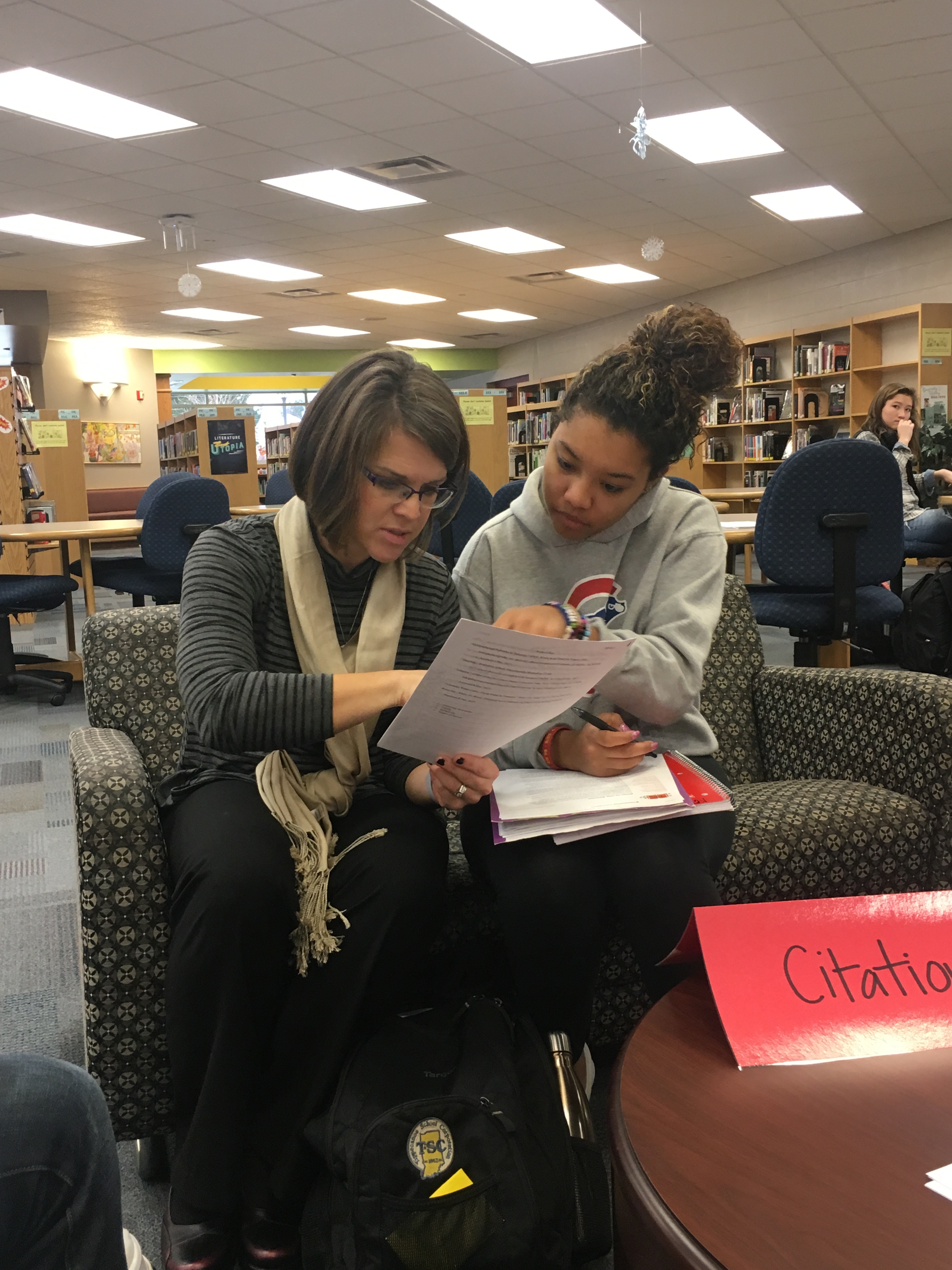
FullSizeRender (1)A teacher asked me the other day, “How do you get them to talk?”

I had just seen the same kids who wouldn’t raise their hands and answer her questions about the bell work they had just completed come into the room talking like crazy at the start of the hour. I’d seen them turn in their seats and continue to talk to each other—until class started. They did have voices.

But of course, the questions about the bell work were posed by the teacher, the topic was academic, and too much was riding on raising their hands.

  • Some didn’t know the answer and didn’t want to look “dumb.”
  • Some had the answer but didn’t want to be branded as “smart.”
  • Some had an idea—but didn’t want to risk being wrong.
  • Some knew the answer but just weren’t saying. Lots of reasons why.
  • Some were shy and not yet comfortable in the class. It is still the start of the year.

I remember learning to break icy silences like this, so here is what I told the teacher. It’s what I learned over the years about getting the kids to talk.

To start with, some conditions promote participation and, eventually, real discussion, better than others.

The seating arrangements: When desks are in rows, the student answering the question speaks to one person only—the teacher.  If recitation—simple Q and A—is what you expect, rows are okay; but if the goal is dialogue among the students, sitting in rows discourages that.

Even setting up the room so that two banks of desks face each other or are at least on a diagonal—a herringbone design—can help. Now they’re not talking to the backs of heads.

Circles, of course, are wonderful, but a circle is difficult if there are many students, big desks, and a small room.  Plus, there’s all that space gone to waste in the middle.

For years, I arranged my room in a U—two of them, to be precise. One had 19 chairs and inside that U was another, with 11 chairs. (I taught the students how to quickly rearrange the desks in rows for tests. For that matter, I taught them, too, how to rearrange the desks into pods for group work.) The U shape allowed the students to see the faces of a good many of their peers, so when we moved beyond recitation to real discussion, they were more likely to address each other, not me. Which is what I wanted.

My dream-come-true happened in my last years in the classroom when my room had 6 tables that broke apart into single desks. The students had swivel chairs. (Yes, I had to stop a few “spinners” from distracting others—and making me dizzy just watching them!—but that was quickly and easily halted.) The tables were perfect for group work and because they broke apart, the students could easily set them up for tests—and put them back again when a test was over.

The teacher’s position: Sometimes you want to be the “sage on the stage,” standing above the students and posing questions to a seated audience. In that case, rows are traditional and can work. But for discussion, a subtle change in your position makes a big change in audience response. Try sitting among the students in an empty student desk. Or, if the conversation you are looking for is to be strictly among the kids, sit off to the side. If you sit down—not at your desk, but in a student desk—you’ve changed the climate dramatically.

When my desks were in that U-shaped configuration, I sat in a student desk at the top of the U—in the gap between the two ends.  I could see everyone, direct traffic, keep track of who was participating and who wasn’t, and even write things down (which is much harder to do when you’re standing).

Wait time: This is an old piece of advice, but still so important. You have to give the students a few seconds to think before they speak. Not only will they provide better answers—more reflective, more detailed—but you’ve signaled that you value reflection first and open mouth second. Every prospective teacher learns about “wait time” in preparation for teaching, but that wait time is easier said than done. As a culture, we are uncomfortable with pauses, distressed by silence. That partly explains the vocalized pauses teachers of speech and debate struggle to eliminate—those ums and ahs that unconsciously creep into our speech.

In his book, Teach Like a Champion, Doug Lemov suggests what he calls “Narrated Wait Time.” That is, when the room is silent and you are waiting for an answer, throw out a comment that will help the students monitor the time (“I’m waiting for 10 more seconds before I call on someone”) or even guide them down the right path (“Think of a character in another book we’ve read who has had this same kind of problem”). Then wait a few more seconds.

Related to this is another strategy: Let them take a minute to write down an answer so they feel prepared. Sometimes when students don’t respond it’s because they’re tongue-tied. Having a prepared response builds confidence.

Your questions:

Avoid yes/no questions. What else is left to say after the answer is given?

Be explicit about what you are looking for.

Explain the similarities between these two characters. (If you just say “How are these two characters alike?” the answers will be short. Requiring students to explain provokes a more detailed response.)

Why do Russians think Stalingrad, not D-Day, was the turning point in WWII? Explain their point of view. (This is a complex question. It requires students not only to know what happened at Stalingrad as well as on D-Day, but to compare and contrast the two events and step outside the comfort zone of the conventional American point of view.)

What evidence do we have that climate change is happening? (Notice that asking for evidence avoids nebulous and unsupported answers that begin with “I feel that…” or “I think that…”, demanding, instead, that students present pertinent facts, not unsubstantiated opinions.

Here’s a source for great questions: www.edutopia.org/blog/rethinking-whole-class-discussion-todd-finley

Your responses:

Just as you will expect the students to be courteous to each other, you need to be careful about your responses to them. “Can you tell me a little more about that” sounds better than “Is that all?”  “You’re on the right track. Can anyone else add to that?” is nicer, too.  You don’t want to accept wrong answers, but you have to be supportive of attempts—otherwise, students will shut down. Whoever volunteers to be humiliated?

Teach them how to respond: Consider posting sentence stems as reminders when you’re first getting started.

  • I agree with James, but I want to add this…
  • I don’t agree, James, because…
  • That’s an interesting (unusual/thoughtful/surprising/etc.) way to look at the situation, but here’s my take:
  • I’d like to add to what Sally said.
  • I didn’t understand it that way. What I got out of it was…

An excellent list of sentence stems—that teachers can use as well as students—appears on Te@chThought: http://www.teachthought.com/learning/sentence-stems-higher-level-conversation-classroom/

Collaboration helps:

Think/Pair/Share is another confidence-building strategy for discussion. You may have used this for reinforcing concepts, but it can also be used for developing ideas. Two people seated next to each other turn in their seats and for a brief amount of time, discuss the question and come up with an answer. Keep the time short—very short—or the talk will deteriorate into social conversation. And, be explicit about how they share—especially important if the students have never done this before. Model the exchange of ideas for them so they have the language of collaboration.

Group Share is essentially the same thing, but three or four people work together to come up with an answer. Usually the question is more complex, the time allotted is longer, and the discussion afterward is extended. Again, keep to a strict time limit, model the process, and instruct the students to choose a spokesperson who will deliver the consensus response. After each group has reported out, a fuller discussion starts spontaneously because the groups don’t always agree.

If all else fails, try this:

I’m by and large not a believer in extra credit, but many teachers, for good reasons, are. Many people award participation points—or expect students to earn them. Also for good reasons.

One year I came up with this strategy for a class who wouldn’t talk. We were reading Field of Dreams (This was before it became a movie). I took a great big sheet of white construction paper, used a water glass as a template, and drew around the glass to make circles on the paper. Using my amazing artistic skills, I turned each circle into a baseball, wrote the students’ names on the baseballs, and laminated the sheets.

When they entered the room, I’d hand them their baseballs. (The leftover baseballs told me who was absent: Presto! Attendance taken!) Then, as I explained on the first day, my expectation was that everyone would speak at least once a period. They had to raise their hands, I called on them, and as they spoke, I collected their cards.

This strategy really worked for me. I did get them talking because that extra point (In the beginning, I did count their contributions as extra credit) was a huge motivator. After a while, I dropped the extra credit, moved to participation points, and eventually got rid of all points—but by then we were done with the book, too. But, the students had opened up. The ice was broken and they were no longer so hesitant to speak.

This strategy is similar to the one elementary teachers frequently use: calling on a student whose name is on a Popsicle stick or drawing a name from a fishbowl. The difference is, with the baseball, the student has the choice of when to speak—a powerful bit of control for someone in high school.

Of course it wasn’t a perfect strategy. A student could use his card right away and then sit back and relax. A student who wanted to contribute more than once still could, but only when the others had all had a chance. But the baseball card strategy wasn’t a permanent solution anyway. It was a device to, so to speak, get the ball rolling.

How to get them to talk: The question is under discussion, and I’d be interested to know how you do it.

Attitude Shift

Spanish IV chart picture (2)For teachers, August means the excitement of new students, new classes, new lesson plans–and the end of long mornings, lazy afternoons, and late nights.  For teachers in many school districts, August also means developing goals for the coming year–and then working all year to achieve them. In many districts, such goal-setting is a part of the evaluation process. To be successful, teachers must show not just that they did what they said they’d do, but that their goals had a positive impact on student learning. They need to demonstrate with data that students learned or that what the teacher did had a positive impact on student learning.

Sometimes, the goal is to change students’ attitudes. Quantifying an attitude shift–in a simple and direct way–is harder than, say, reporting the average percentage increase on vocabulary tests. This post is an update on a strategy I developed for documenting such attitude shifts. The update comes at the end and describes a speaking goal that a Spanish IV teacher in my district set and achieved.

A couple of years ago, in my capacity as an instructional coach for teachers in my district, I hit upon a use for Post-it Notes that involves measuring shifts in attitude. I wanted to know, originally, where the secondary teachers I was working with stood vis-à-vis implementation of the Common Core, and then, after I had finished with my professional development presentations on the subject, whether what I’d said and had the teachers do had had an impact. I wanted to know if what I was doing was changing attitudes.

How do you measure an attitude shift?

Furthermore, I wanted to share that information with the teachers.

Instantly.

How could I do that?

Somehow, I hit upon the idea, at the start of my Common Care presentations, of giving everyone in attendance a Post-it note (all the same color) and asking them to array their notes along a spectrum from left to right. I drew a line across the whiteboard at the front of the room and at strategic points along the line, I wrote the following summations of opinion:

  • Far Left: This is just one. more. thing.  It’s all going to go away, so why should I change?
  • Left: You’re kidding? Really? Okay, but where do I start? I’ve got a lot to learn.
  • Center: I’m on the fence.
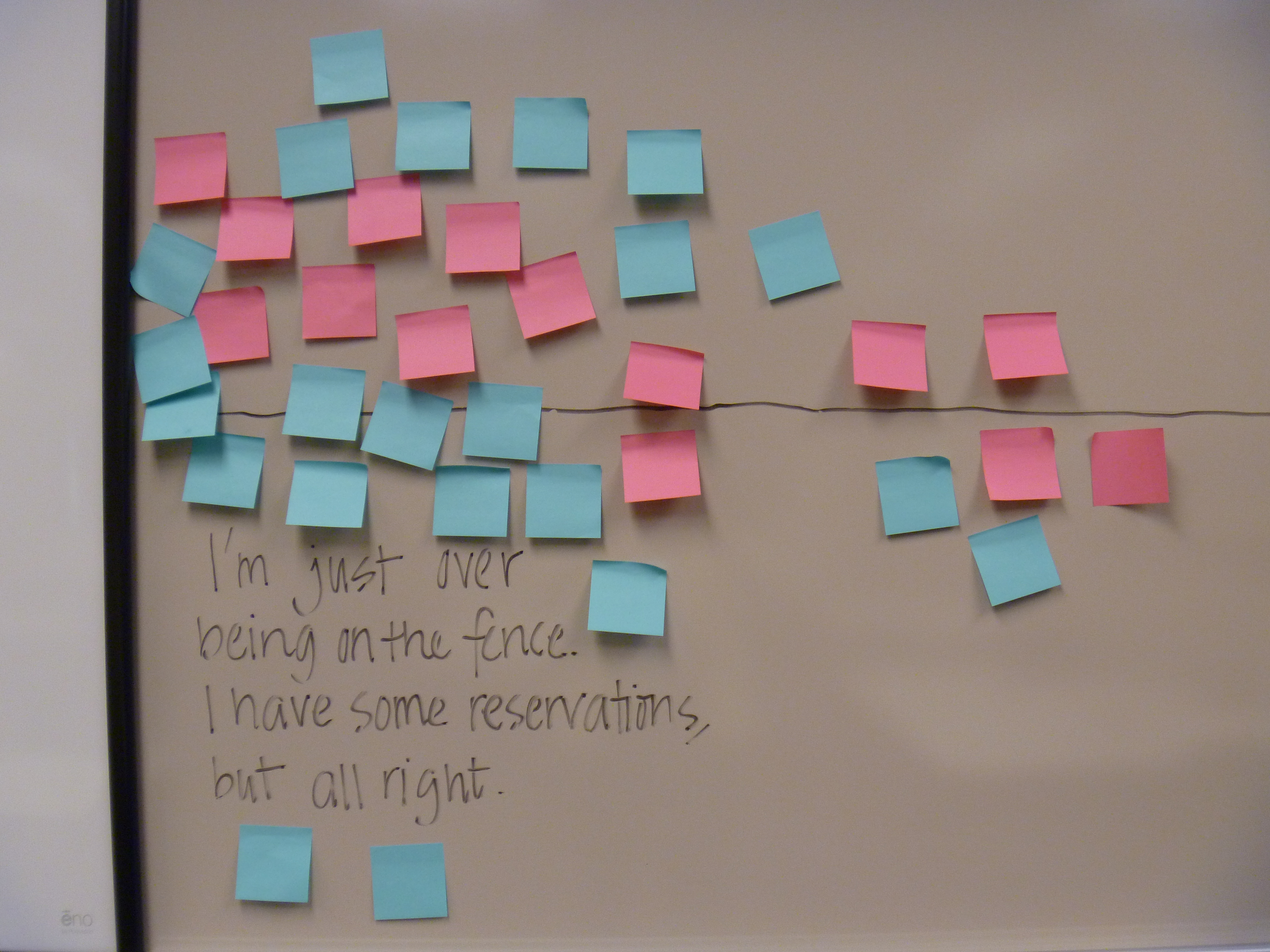
  • Right: I’m just over being on the fence. I have some reservations, but all right.
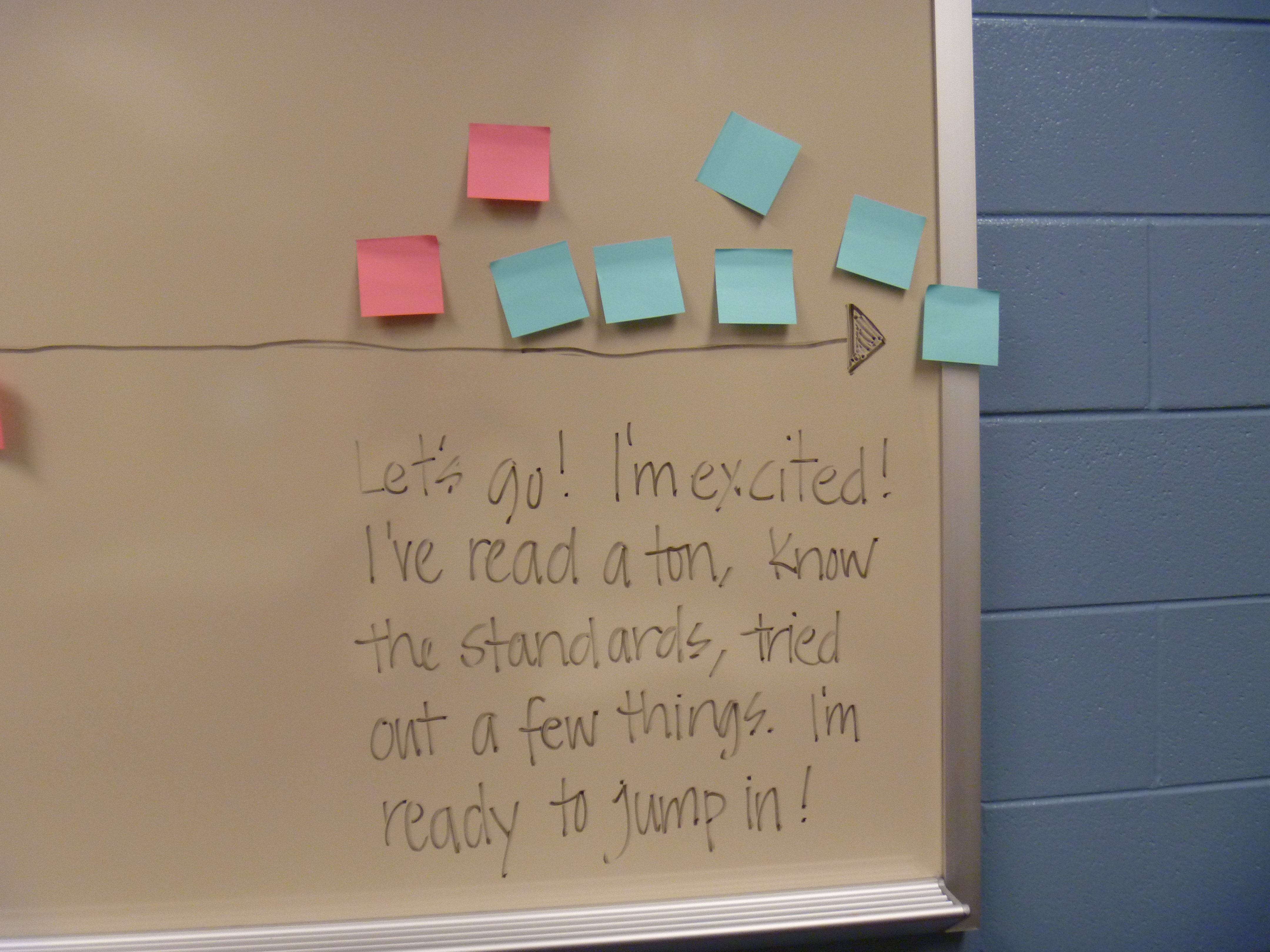
  • Far Right: Let’s go! I’m excited! I’ve read a ton, know the standards, tried out a few things. I’m ready to jump in!

The teachers had no idea that I planned to ask the same question again at the end of my sessions. They assumed my visual survey was just a way to assess prior knowledge (which it was) and take a reading on staff opinion (which it also was). They did not write their names on the Post-its and I didn’t watch while they affixed theirs to the wall.

When the workshop was finished, several hours later, I gave everyone another Post-it—this time in a different color—and asked them to do the same thing: Place their Post-it on the wall somewhere along the same spectrum. I deliberately turned my back so I couldn’t see who put theirs where.

P1030326Here’s what the Post-its revealed. (Pink is “before”; blue is “after.”) Of course, the response wasn’t universally enthusiastic—I didn’t expect that—but I was gratified to see that the overall shift was from left to right, proving, above all, that understanding something goes a long way towards supporting it. Or put another way: Education matters.
P1030328Since then, I’ve shown teachers who are trying to measure an attitude shift in their classes this same (quick and non-scientific) strategy, and it has worked for them, too.

For example, here’s one from a business teacher who wanted to know if her financial literacy course had made an impact on her students’ spending habits. She extended the concept to measure the shift in two classes simultaneously.

At the start of the term, the five points on her line were these:

  • Far left: Spend every cent I can get my hands on—and more.
  • Left: Hmmm. Maybe I should save some.
  • Center: Save half (if I can). Spend half.
  • Right: Budget for expenses. Save all I can.
  • Far Right: Invest so my money can make money.

Freeeland 2In this picture, you see the results from two classes: one pink, the other yellow.  The spread on the bottom is the beginning of the semester; the one on top, the end. Notice the movement to the right in both classes–although the two yellow Post-its on the left represent the same two students, before and after. (Ah, well. Some people never learn.)

Because these Post-its would be up on the wall for the whole semester, we both assumed students would forget where they’d placed theirs. So the teacher had her students write their names on the backs of those little pieces of paper. That way, by turning them over at the end and finding their names, the students could see how far they’d come individually.Freeland 1

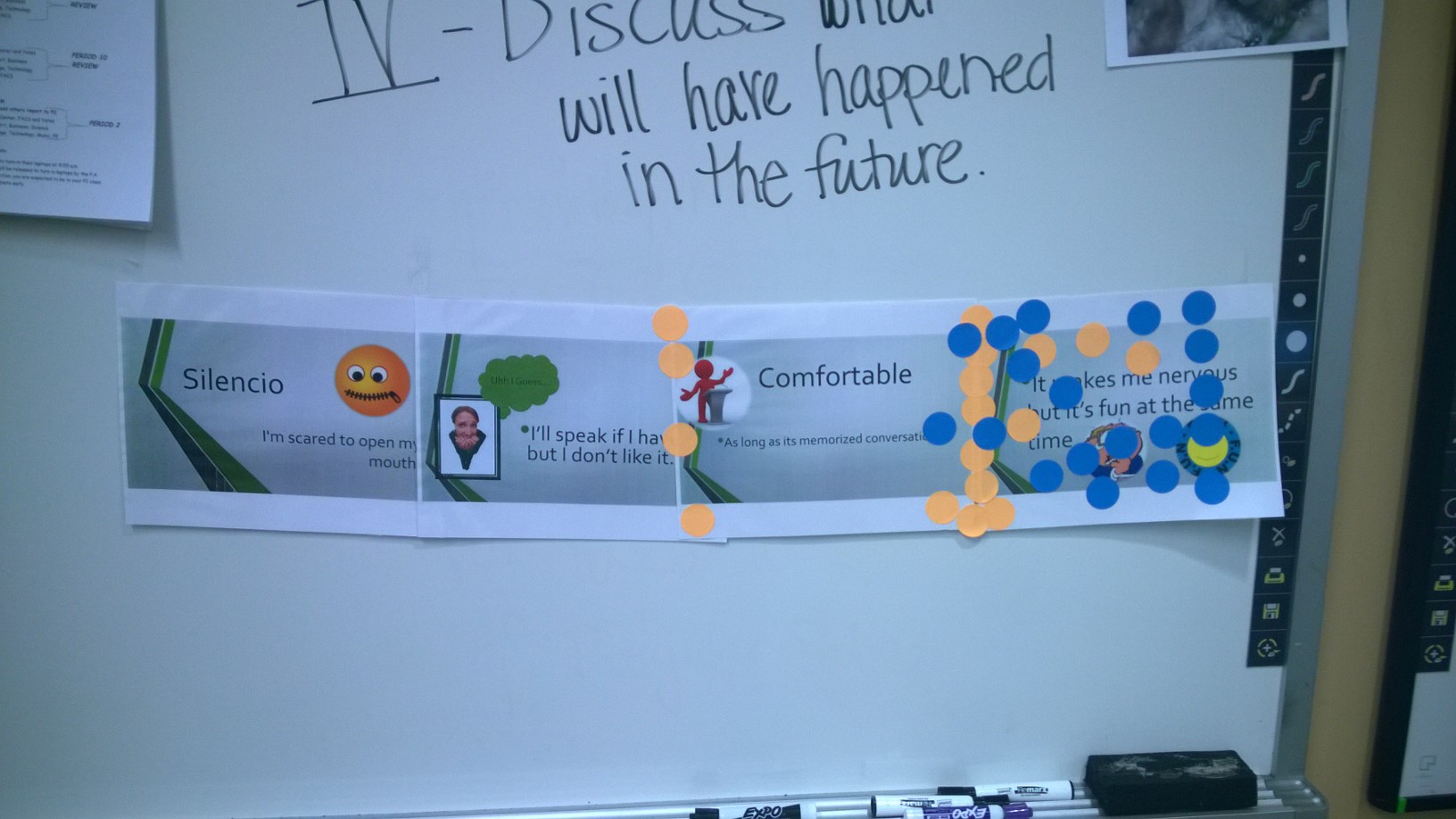
Last year, another colleague, a high school Spanish teacher,used the strategy to measure the development of her students’ comfort level with speaking Spanish. The purpose of learning a language is to be able to communicate in that language, but developing speaking skills is usually a challenge—for both the teacher and the students. Adults (and I’m counting high school students as grown-ups here) often feel inadequate when they open their mouths to speak in a foreign language. They know the words they use are basic, and the grammatical mistakes they make are embarrassing—because they wouldn’t make those same mistakes in their native language. So my colleague and I brainstormed a long list of opportunities, first just to hear spoken Spanish outside the classroom and then to interact with fluent Spanish speakers—a list of possibilities that grows progressively more interactive and engaging as the year goes along. Of course, the activities were a requirement of the course because her hope was that through authentic speaking experiences, students would become more comfortable—and ultimately more fluent.

To measure the students’ growth, here is the 4-point continuum my colleague used:

  • Far left: Silencio! I’m scared to open my mouth!
  • Left: I’ll speak if I have to, but I don’t like it.
  • Right: Comfortable—as long as it’s memorized conversation!
  • Far Right: It makes me nervous, but it’s fun at the same time!

She planned to have the students chart their progress three times during the year: in August, in January, and in May. That meant three colors of Post-it Notes. Except that a good idea just got better! Fearful that after a whole year the Post-its would lose their sticky and flutter to the floor, my colleague wrote the attitude points on pieces of construction paper, laminated the paper, and had the students use large Avery dots to mark their progress.

The first time she had the students place their Avery dots on the continuum, we both experienced a minor panic. So many were already on the right hand side! Room for growth was minimal. Perhaps the problem could have been avoided by having a 5-point continuum. Perhaps it was something in the wording that yielded so many “3s.”

A little nervous about what a mid-year reading might yield, my colleague decided not to take a reading again until the end of the year. By the time she did, the students had forgotten all about the tally in the fall. During class, she sent her students, one at a time, outside the classroom where, they posted their new blue Avery dots. At the end of the class, when she looked at the results, she saw that every one of the students’ attitudes had shifted farther to the right. The goal had been achieved; the students had developed the confidence they needed to be, not just comfortable, but enthusiastic about speaking Spanish with native speakers.

This year, my colleague is expanding her list of activities and recruiting Spanish-speaking adults in the community–many, the parents of students in our school–to be the language partners for her students.

So here is my question: What attitude shift would you like to effect that the Post-it Note strategy could help you document?

Spanish IV chart picture (2)

Taming the Beast: ELLS and the Five-Paragraph Theme

P1040079The question came from an English teacher at the conclusion of an after-school workshop I’d conducted at one of the high schools I serve: Why do my ELL students have trouble writing essays in English (besides having a limited vocabulary)?

One of our students from Mexico, who had just spoken to my colleagues about the ways in which teachers can help English Language Learners navigate the culture of an American high school, unlock the English language, and facilitate learning the content of their classes, attempted to describe the difference between writing an essay in school in Mexico and writing an essay in English class here in America. “Well,” she said, “we have more like summary.” Considering her current limitations in English, she did pretty well, but had she known the term “five-paragraph theme,” she might have been more precise.

The question rang a bell with me, though, and I remembered a session I’d attended in 2004 at the National Council of Teachers of English (NCTE) conference in San Francisco where the message from the speaker was this: The written discourse pattern in Mexican Spanish is different from English. We need to explicitly teach our ELLs the organizational pattern of written English.

A few days after my workshop was over, I went on an internet search to find the scholarly work behind that 2004 statement, and aided by our high school librarian, whose help was indispensable, uncovered the research that informed it. I’d tucked the information away 11 years ago because, unlike the states on the edges of our country, my district in rural Indiana had a tiny ELL population in 2004 and no program at all for these students. I myself had no ELL students at that time. I had attended the ELL  sessions at NCTE because I wanted to help my district establish such a program.

What I learned from reading the research was this: Patterns of language and the expectations for written discourse differ from country to country. That seems obvious, of course, and broadly speaking, we know it intuitively because of any cross-cultural experiences we may have had and academically because of the linguistics classes we took in college.

However, what I wanted to know were the practicalities: the precise differences between written discourse in English and written discourse as learned in school in Mexico—or, even deeper, in the pattern of social discourse generally in Mexico. The author of the article is explicit about those differences but cautions that the study is limited to Mexican Spanish and studies in secondary schools in Mexico. Puerto Rican Spanish, for example, shares some characteristics with Mexican Spanish language patterns but is not entirely the same. Furthermore, the characteristics of written Spanish demonstrated by Hispanic students born, raised, and schooled here in the States are not the same. The research article addresses the discourse patterns of secondary students in Mexico. But that’s entirely relevant to my colleagues: In my district, few of our ELL students are from anywhere else but Mexico, and many of them come to us as high-schoolers or middle schoolers. Thus, the findings reported by the researcher are pertinent to my district and my colleagues.

 So here’s what I learned. (If I spoke Spanish myself, perhaps I’d have known all this, but I don’t, so the specifics were revelatory.) In written Mexican Spanish, the vocabulary tends to be “fancy” and “flowery”; the tone, “formal.” Sentences are generally longer than English sentences, often characterized by what English teachers would mark as run-ons—that is, two sentences joined by a comma (i.e., comma splices). The long sentences these students produce in English may seem like a jumble of compound-complex constructions, the word order may seem unusual to an English teacher, and the ideas, repetitious. That’s because an acceptable sentence pattern in written Mexican Spanish is to state an idea, follow it with a comma, and then repeat the idea using synonyms. There may be frequent or lengthy deliberate digressions, following which, the writer brings the reader back to the main topic. English teachers would mark such a digression as “off-topic.” It doesn’t adhere to the organizational pattern we teach in most American schools—introduction, three supports, and a conclusion (in short, the five-paragraph theme), pictured here in my favorite, definitely irreverent, graphic by Boynton. I call it “The Beast.”

Boynton's Beast
Boynton’s Beast

Such an essay would be unusual in written Spanish in Mexico because the writer’s mission is more likely explanation than an evidence-based essay in which the writer enumerates his points. In essays in secondary schools in Mexico, according to the research, students rarely use enumeration (e.g., 1, 2, 3; first, second, third; at first, then, finally) as an organizational strategy. In short, what constitutes a logical essay is different in Mexican Spanish than it is in English.

On top of all that, English speakers tend to be blunt and to the point. We are linear in our presentation of information.  Spanish-speakers, not so much. In fact, following a straight-line way of organizing information can be interpreted by Spanish speakers as rude. So, a Spanish-speaking student writing in English could be struggling not to offend—especially difficult if you have a limited vocabulary and little understanding that the five-paragraph theme approach is the preferable style in English. Furthermore, the researcher pointed out, direct and unelaborated prose in Spanish can be dull; such a writer can even sound childish. Having internalized that, Spanish-speaking students from Mexico could be struggling not to be boring or sound juvenile. They might not realize that their English teachers would applaud brevity and welcome direct statements.

For English teachers, the message is straightforward: It is extremely important to explicitly teach the structure of English composition to our ELL students: i.e, the five-paragraph theme format–or, if they are younger, the five-sentence paragraph. Scaffolds for this format abound, and providing a simple worksheet for organizing information might be more powerful than one might think in terms of supporting ELL students.

Of course, English teachers have been offering graphic organizers and outlines for this kind of writing for as long as I’ve been in the classroom and probably for years before that. It’s nothing new. What we may not know, especially if we don’t speak Spanish, have never been to Mexico, or haven’t thought about it, is how important it is to be explicit. To compare and contrast the written discourse conventions of English and Mexican Spanish for our ELLs, to be clear about our expectations, and to analyze their written work, looking (if they are from Mexico) for these particular differences and pointing them out. Not because the five paragraph theme is better or that it is always the best way to express ideas, but because the ability of ELLs to communicate in the format that is widely taught and widely expected in this country is paramount for their success.

Our ELLs may not be from Mexico. We may not know the precise variations from English that their language conventions dictate. Nevertheless, just as we know that there are cultural differences from country to country, we need to recognize that differences exist in discourse patterns, too. We need to remember that it takes a long time to unlearn a pattern you’ve been taught from an early age. If a student doesn’t “get it,” even after several tries, the problem is not a deficiency. The problem is unlearning what’s been second nature. Writing reveals patterns of thought; those don’t change overnight.

So, no matter how you feel about the five-paragraph theme (and English teachers either love it or hate it–in both cases, for good reasons), it’s a scaffold for writing that will help non-native English speakers understand the way written discourse is structured in English. Like all scaffolds, it can gradually be removed, but for beginners and for ELLs with low English proficiency, it can be the support that enables success.

Help your students tame the “Beast.” Here are some links to useful graphics and outlines that you can use to scaffold the five-paragraph theme:

https://goo.gl/mNiYK3  (Many graphics)

https://goo.gl/2MQN47 (Many worksheets and outlines)

Read the original research:

Montano-Harmon, M. 1991. Discourse Features of Written Mexican Spanish: Current Research in Contrastive Rhetoric and Its Implications. Fullerton, CA: California State University.

http://www.cervantesvirtual.com/obra-visor/hispania–14/html/p0000013.htm

National Treasure

To and for all the amazing teachers I know during this, Teacher Appreciation Week: Our world is better and our students’ lives are richer because you have been a classroom teacher. Thank you for all you do every single day.

It’s fashionable right now to blast educators, to focus on data-specific measures of effectiveness, and to prescribe corporate take-overs for failing schools. The critics say “failing schools,” but that’s code for failing teachers. The critics ought to come with me when I am in a school in my role as an instructional coach.

When I enter my colleagues’ classrooms, I am quickly swept up by the lesson—enthralled by the teacher, captivated by the content, and excited to be on the other side of the desk, learning.

In the past month, here are some of the places these fabulous teachers have taken me:

  • To Austria in 1877 when two men stole Haydn’s head from his grave for analysis by phrenologists. Indeed, pseudo-scientists found the “music bump” was significantly developed—but it was nearly another century before Haydn’s head was reunited with his body.
  • Out on the open seas with the commander of the Pequod, Captain Ahab, in mad pursuit of Moby-Dick, the great white whale who had taken his leg.
  • To a 1940s wedding, where the bride wore a dress she had made of parachute silk: the tight-fitting sleeves  were pleated at the elbow so she could move her arms, and the neckline was high, as modest as the times.
  • To Versailles with Wilson, Clemenceau, Orlando, and David Lloyd George, hammering out the Treaty that ended WWI but set the stage for so many more 20th century conflicts.
  • To the Middle East—via computer and a stunning visual from the LondonTimes—to learn about the Arab Spring.

Here are some other things I have learned—or relearned, as the case may be:

  • How to figure percents (6th grade math)
  • How to make a coiled basket (7th grade art)
  • How airbags work (a high school chemistry lesson in stoiciometry and the gas laws)
  • The seven characteristics of a folk tale (6th grade English)
  • Why artists make still life drawings—and how to do it (8th grade art)
  • How to make ice cream in a plastic bag (8th grade science)
  • How the metric system works (7th grade science) 

Over and over and over again, I am impressed by the good teaching I see—and the more I see, the more frustrated I become with the voices of people who haven’t been in a classroom in a very long time—or perhaps haven’t even taught a day in their lives. Some of the best teachers in the world are at the front of the classrooms I’ve visited.

Every good lesson has a story arc: a beginning, a middle, and an end.

Some teachers pique their students’ interest with a question: When will the force of the water from a fire hose be stronger? When it’s on the up side of the parabola or the down?

Some do it with a demonstration: An art teacher I recently watched gathered her students around her to demonstrate still life drawing. She talked out loud throughout her demo, questioning her kids about why she was doing what she was, reminding them of what they already knew, and prepping them for what they soon would do that was new.  Then they set off to do a still life on their own.

Others tell a story (like the one about Haydn’s head), or read aloud (These aren’t always English teachers—reading aloud is how the airbag class started!). They hook their kids and then jump into the lesson.

Sometimes they use “props”—like several teachers I’ve seen who have individual whiteboards for writing down answers and holding them up so the teacher can gauge the class’s understanding—or popsicle sticks and clay to make prototype chairs and tables—or crazy assortments of objects all spray-painted white (in the case of the still life drawings).  Sometimes they send students to the Internet to find a specific answer or just to find out what they can about a particular topic.

In a Family and Consumer Science class (FACS), girls AND boys were dressing models in the fashions of the decades. They were using figures and clothing that reminded me of the paper dolls I played with as a child—except that these dolls were figures on one side of a computer screen and the students “dragged and dropped” clothing from the other side onto the models, making the equivalent of dressing room changes until they had the dolls attired as they liked.

Sometimes the interactive whiteboard facilitates instruction—like the American history teacher who used it to show the students the map of Europe pre- and post-WWI—or the world history teacher who showed the class a virtual timeline of the conflicts in the Middle East.  English teachers dissect essays right before the students’ eyes or use the screen to show a timely YouTube video. 

But technology isn’t all. There are old-fashioned storytellers among us—like the teacher whose students were enthralled with the story of Wilson’s 14 Points and how the Big Four at Versailles—or the Big Three, once Orlando left—hammered out the agreement that brought an end to WWI. She captured the personalities of these four men and brought them together as if they were characters in a book—and brought the story of the Versailles Treaty to life.

A middle school world history teacher has his students capture the essence of a country’s culture in haiku; the students in a middle school English class create a collective self-portrait with “I Am From” poems.  Another English teacher directs graduating 8th graders to produce “The Soundtrack of my Life”: Each student writes about key events in his or her life and records it all on a CD. I’ve watched an extraordinary music teacher inspire her students to write essays about the reciprocal relationship between music and culture and listened as another music teacher led his students in a discussion of an NPR piece on tempo.

Sometimes, of course, the ending is a homework assignment, but in the best classrooms, that assignment is tied directly to the main idea of the day or to a point in the lesson—if it’s a two-day or three-day lesson—that will help the students transition to the next day’s focus. Sometimes homework comes in the form of a paper, a project, or a short reflection. Sometimes it’s problems to work or issues to resolve, an article to read or pieces to practice. Sometimes it’s reading on in a book, and sometimes there is no homework at all. There isn’t a formula for the ending: The teacher needs to know whether the students understood the lesson of the day and where she should pick up the next day, and there’s more than one way to find that out and move instruction forward. Sometimes closure is accomplished with those individual whiteboards or with exit passes or with questions the students submit. But there’s always a “wrap.” A good teacher doesn’t let the kids just drift out the door without a finish.

They’re ingenious, these teachers I’ve seen. They’re thoughtful, funny, clever, compassionate, kind. They challenge their students, to whom they are devoted, and they’re earnest about learning new skills and expanding their expertise. They’re dedicated to their task.  I know math teachers who are concerned about reading comprehension and differentiating instruction and collaborative learning.  I know special education teachers who attend high school workshops about strategies they’ll probably never use and courses their students will probably never take—but the teachers want to stay current with mainstream teaching.  Even veteran teachers continue to learn. The English teacher who swept me up in the story of Moby-Dick has been teaching for over 40 years—but she still comes to my after-school workshops on reading comprehension just in case I have something new to teach her

Of course there are teachers who don’t yet have all the skills they need—I wouldn’t have a job if everyone knew everything and no one needed anything.  Sure we all can learn more—none of us teaches a perfect lesson every single day.  It’s true that every field is changing and that, as a group and as individuals, we need to make changes.  The knowledge base in every field is rapidly increasing, too, and the range of skills our kids need is expanding. The technology we are privileged to use is constantly evolving.  But so many amazing educators are committed to making the necessary changes because they are committed to serving their students well. 

I wish our critics would pay attention for a change to the extraordinary teaching happening in our schools. I wish they would not lump us all together, call us collectively the equivalent of a bad apple. I wish they would recognize that educators are, quite to the contrary, our national treasure.

Without Words

P1040079The first student I remember coming into my class with no knowledge of English arrived in the early 1980s. I’ll call her Laila. She had recently arrived in this country, the first of her siblings to follow their father to America. He had fled Afghanistan when the Soviets invaded, coming to this country as a refugee. He was able to get protected status, a green card, and then later sign for visas for all the rest of his family. They came one-by-one or in twos, secretly, across the Khyber Pass to Pakistan and then to India where they waited until they could get passage to America.

Laila was the first of the siblings to attend school in the USA, and when I reunited with her many years later, she described for me the embarrassments, trials, and anguish of attending middle school not speaking the language. Boys snickered when she said she wanted to be a doctor, others asked her how to say dirty words in Farsi. Math class was a refuge because she could do it, and so, she said, was my room. I didn’t—and still don’t—even remember doing most of what she told me I had done. It must all have come as common sense to me, gathering material for her and making special word books. But many of the things she said I had done had made her feel included.

As I said, it must have been common sense, for I certainly knew nothing at the time about how to help English Language Learner (ELL) students. She remembered that in the spring of that 8th grade year she had to make a speech in my class. I suggested the topic “My First Month in America,” and she did speak–and the other students were enthralled–and I gave her an A and that made her day/week/month. Such a little thing. It reminds me what an impact–for good or for bad—the little things we do can have.

Lately I have been thinking about the ELL students of today; in my district, they’re mostly Spanish-speaking kids.

Other teachers think about them, too. In fact, teachers at both of the high schools where I serve as an instructional coach have approached me this year, asking what they can do to help the ELL students in their classes—especially, but not only, the ones who have little or no English at their command.

Of course they know that learning a language takes time. They know that gaining academic proficiency can take years. Of course they know there’s no magic bullet. But because they are teachers, they want to help and are frustrated when they can’t. Teachers care about their students—all of them. Still, it’s hard to imagine how you can help when you’ve got five or six classes and anywhere between 120 and 160 students and you have to prep three separate lessons every day and parents are emailing and extra-curricular responsibilities are looming and papers are piling up faster than snow melts in summer.

Yes, the students have an ELL teacher—and she works wonders. But you can only process so much a day. I remember that when I—a non-Spanish speaker—visited Peru a few years ago, I spent most of my time on the bus that carried us from place to place looking at signs and billboards, trying to memorize words.  I was learning about the culture at the same time I was learning the language, and that’s sometimes even harder—and certainly more fraught with danger—than building a word bank. By the end of the trip, 10 days later, I was thrilled when I could negotiate the purchase of a toothbrush. And that only took a few words: toothbrush and how much. What followed was some fumbling with money and help, please.

I decided to shadow some beginning ELL students for a few days and, to attempt to simulate their experience, attend their Heritage Spanish class. By the way, it’s an error to think that because these kids speak Spanish easily, they also read and write it comfortably. That’s why they take Spanish in school and get world language credit for doing so. They may have grown up speaking Spanish, but their parents may not read and write Spanish themselves and they may have passed on speaking errors, just as English-speaking parents sometimes do. (Think of kids who say “I seen it.”)

One day in December, I was able to interview several of these students. I asked the questions, a Cuban-American substitute teacher (who just happened to be in the building that day) interpreted for all of us, and my colleague (the ELL teacher) took notes so I didn’t have to.

Here’s what I learned from our Spanish-speaking ELL students, and here are the suggestions I will be passing on to content-area teachers about what they can do to help ELL students learn English and learn their content.  (And by the way, these ideas will help everyone in the room. There’s nothing strictly ELL about them.)

Greet the students at the door: Say their names, and if you know “Hello” in Spanish, say it. Pronounce their names right, though. In fact, that might be your first conversation. I remember practicing once with a girl from China. She tried to excuse me—say it didn’t matter that I kept stumbling—but I knew it did. Eventually, my tongue ceased twisting around the syllables and saying her name became as easy as saying Jack’s and Emily’s. I realized from being in classrooms all day long that a student could go through a whole school day without anyone using his name or talking to him directly. Imagine how that would feel.

To a person, every ELL student I spoke with said that the teachers who “cared” about them were the teachers they would work the hardest for. Teachers who “cared” were the ones who took the time to treat them as individuals by doing things as simple as greeting them at the door or once in a while using a Spanish word. Really.

Seating arrangements: Put them in the front. Seating an ELL student at the back makes it harder for them to see and hear. Besides, consistently seating ELL students at the back communicates to everyone else that they’re not really part of the class. Yes, they may choose to sit there—but you can un-choose that spot for them.

Let them sit together if you have more than one ELL student—if they choose to. You can’t assume they’ll be friends any more than you can assume any two other students will get along. ELL students come from all over. They’ve got class and country biases, too. They told me so. But most of the time, they’re relieved to be together because they can help each other figure out what’s going on.

When you work in groups, spread the ELL students out among the groups as soon as you sense they’re comfortable with that. If you need to keep two together, you can do that with a group of four. You might consider “Study Buddies” for those times when you give over class time for homework. Pair the ELL student with a willing English speaker who can check that something is copied down right from the board, verify pronunciation, practice vocabulary.

Those objectives of the day: We are obliged to post these every day, so I suggest using them to advantage to teach vocabulary and focus the students’ thoughts.  Print the objective in big, black letters at the front of the room. Make it visible and legible from everywhere in the room. Write it in kid-friendly language. At the beginning of the class, point to the objective and say that this is the goal for the day. At the end of the hour, return to the objective and say it was the goal of the day. This will help ELL kids catch on to the purpose of the activities you do. And it will help every other student, too.

Why black? Because red and green and other colors don’t show up on the board as well. Why print? Because cursive is harder to read—and more kids than the ELL students don’t read cursive. Really.

Make it pop: Put key words on the board or create a word wall. This was a huge aha moment for me. When I attended the Spanish Heritage class, I listened to what the teacher was saying—but I didn’t have a clue. I don’t speak Spanish. When she wrote a key word on the board, I could see that often it was a lot like English—and I caught on. I still flunked the quiz at the end of the hour, but I got the main idea.

So, point out key words or put them on a word wall and then point to them, say them out loud, tap them, throw a ball at them—anything to reinforce them for the student.

Slow down:  Everything you say, everything they hear has to pass through the translator in their heads. It takes a very long time for anyone to get past this stage. The more complex the topic, the longer the sentence, the more time it takes.

  • Slow down for directions, assignments, explanations.
  • Break lectures into segments.
  • If you can, create a PowerPoint to play behind you.
  • Create fill-in-the-blank note-taking guides.
  • Write directions out as well as giving them orally.
  • Use graphic organizers, color coding, other visual aids.
  • Call on someone in the class to paraphrase what you just said: Your words will come out in simpler language and reinforce the message for everyone.

Use checks for understanding and use them frequently: Don’t wait till the end of the lesson to ask if everyone understood, if anyone has a question. Knowing precisely where in the lesson an ENL student stopped processing will help you tailor your instruction—and it will also give you clues about how much English the student has.  Here are some easy ones to implement:

  • Thumbs up/thumbs down
  • Exit passes
  • Stop light method
  • White boards (for individuals and/or for group answers)
  • Post-it notes on the desk

Use these checks for understanding with everyone in the class—it isn’t only the ENL students who get lost.

Let them speak Spanish: They’ll switch to English as soon as they can.

  • If you have two ELL students, let them talk the lesson over in Spanish if they like.
  • If you have one who is proficient and one who is not, ask the more fluent student to translate for both of you when you talk to the beginning ELL student one-on-one. That’s going to help all three of you.
  • Don’t worry that they’re talking about you. You can tell from their tone whether they’re on task, gossiping, or being disrespectful. If they’re not on task, shut them down.
  • Use Google Translator to put your assignments, directions, worksheets, etc. into Spanish. No, the translator isn’t perfect, but it’s good enough that beginning students will get the idea. Plus, it’s another indication that you care. You might be aghast at how badly electronic translators can mangle a passage, but in the beginning, they can be a huge help. The kids told me so.

Demo, demo, demo: Make your delivery lively. Gestures, charades, pantomime, movement—all of this reinforces language. Vocal variety matters: Not being loud, but being expressive. Intonation carries meaning.

Use any Spanish you know: How about posters with words in Spanish and in English? If you speak the language, don’t be afraid to use it to help. The ELL students will begin using English as soon as they can because, like all kids, they want to fit in.

Communicate with their parents: Same as anyone. Try this website to create permission slips, thank you notes, invitations to parent conferences, pats-on-the-back notes home, etc. They print in Spanish and in English!  http://casanotes.4teachers.org

Call for help:  Spanish-speaking faculty, the ELL teacher, the ELL support staff, district level coordinators and instructional coaches will help. You just have to them know you need it.

 Above all:  Don’t give up on these kids—and encourage them not to give up on themselves. It takes time to learn a new language—but they will. Case in point:  When I found Laila again, years after she had left my classroom, she had a Ph.D. under her belt. She had become a doctor.

Give the kids time.

They’ll get there.

About the Dog

But I must have been reasonably awake, or I would not have received the impression that was creeping into me. It was not unlike one I had last winter, and I shivered, though the night was hot. The feeling grew until the atmosphere in the courtroom was exactly the same as a cold February morning, when mockingbirds were still, and the carpenters had stopped hammering on Miss Maudie’s new house, and every wood door in the neighborhood was shut as tight as the doors of the Radley place. A deserted, waiting, empty street, and the courtroom was packed with people.

I thought I was done writing about To Kill a Mockingbird, but a colleague recently asked me a question about the dog.

Tim Johnson, I mean: the rabid dog that Atticus shoots in Chapter 10.

Sometimes Chapter 10—the mad dog chapter—is anthologized as a stand-alone short story. In that case, it’s a lovely piece about a boy coming to see his father as a hero. Chapter 11 isn’t accorded the same status—I don’t see it ever as a stand-alone—but these two chapters, which seem to most students at first read to be unrelated to either the Boo Radley story or the Tom Robinson story are, I contend, the two most important chapters in the book. In them, Harper Lee lays the groundwork for the major themes of the novel, and the story of Atticus shooting the dog does more than round out his character by giving us some background information on his “talent.” It establishes him for certain as the hero of the story: an epic hero, to be precise. The Mrs. Dubose chapter gives us the hero’s own definition of courage.

But back to the dog.

Tim Johnson is very much a character in this story. His name is the first clue. He’s not Spot or Old Blue or Rover or any other identifiable dog name. He’s Tim Johnson. A human’s name.

That Atticus kills him is the second clue that he’s important.

Tim Johnson is lurching down the street on a cold February morning. Calpurnia summons the sheriff in a frantic phone call, herds the children inside, and defies common sense and convention by running up on the Radley’s front porch to warn the occupants not to open their door. A mad dog is coming.

photo of rabies notesThe day before we discuss Chapter 10 in class, my homework assignment is for students to look up “rabies” online and write down its causes, its symptoms, and its treatment. The next day, we brainstorm all of that on the board.

The key thing is this: Rabies is a disease of the central nervous system, a disease of the mind. It makes the dog (or person) who has it irrational, unpredictable, and erratic. The victim will attack anything in its path. Rabies spreads by a bite—by mouth—and the treatment is painful. Treated too late, the disease is fatal.

For a dog as far gone as Tim Johnson, the only thing to do is to shootphoto 2 of rabies notes him. And that is what Atticus does. He stands in the middle of a deserted street, takes aim, fires, and the dog falls over, dead.

Like all epic heroes, though, Atticus is reluctant to undertake this task; he steps in only because no one else can or will. Heck Tate relies on Atticus to do the job because, as we (along with Jem and Scout) find out, Atticus was called “Ol’ One Shot” when he was a boy.

At this point, I just let that information sink in and we go on to Chapter 11. Here we learn that Atticus thinks the vitriolic Mrs. Dubose is the “bravest lady he ever knew.” She fights a morphine addiction so she can die free and clear. No need for that. She’s going to die, so who cares if she’s addicted? Atticus says she’s brave because “It’s when you know you’re licked before you begin but you begin anyway and you see it through no matter what.”

This is all groundwork for the trial. Established beyond a doubt as the hero of the book, we now want to know, will our hero live up to his own definition of courage in the second half of the book? And what about that dog? What does Tim Johnson represent?

Occasionally, an alert student will remember that Atticus referred to “Maycomb’s usual disease” when he was talking to his brother, Jack—and that we all read “prejudice” into that remark. Once in a great while, a student will remember (or the teacher–that would be me–will recall) the description in Chapter 5 of Miss Maudie vehemently attacking the nut- grass in her yard, telling the children that “one sprig of nut-grass can ruin a whole yard.” The wind, she said, would spread the seed all over Maycomb County—an occurrence that would resemble an “Old Testament pestilence.”

If they do remember this early groundwork, that reinforces the unmistakable connection students make when Bob Ewell takes the stand in Part II of the novel. Irrational, unpredictable, and erratic, Bob spews his verbal venom on Tom Robinson, Mayella Ewell’s target and the only witness to Bob Ewell’s vicious response when he sees her through the window, accosting Robinson. Rabies, of course, is meant to represent prejudice…

“And Bob’s the mad dog!” I usually don’t need to draw the analogy myself. The students get it.

Atticus knows how the trial will end before it even begins—but he goes forward with his defense of Tom anyway. Why?

Because he must.

He’s already explained that to his brother Jack. It’s the right thing to do, but he runs the risk of his children being morally injured—the trial and the vitriol may be so hard on them that they’ll be resentful and catch the disease. But if he doesn’t do the right thing, he tells Jack, he couldn’t look his children in the eye. So it’s at great personal risk—typical of the epic hero—that he steps forward to do what heroes do.

And why does Ewell bring charges against Tom? Tom isn’t going to report him. No way. So why does Ewell do it?

Because he can.

Prejudice has completely consumed him.

Prejudice has so poisoned the town (except for a few souls like Atticus, Miss Maudie, and we later discover, Judge Taylor and Heck Tate) that Ewell seizes his opportunity to attack Tom. He knows full well that Tom will be convicted. For once in his life, Ewell thinks, he will be the recipient of the town’s gratitude and be “one up” on his moral superior, the black man who lives down the road.

Except that, when the trial is over, the town despises Ewell all the more. The people know the truth, even though the men on the jury convict Tom. Except for a Cunningham who makes the jury deliberate for a few hours—a record for a case like this in the 1930s—the men on the jury are, after all, only men. They’ve been infected, too, and can’t see beyond society’s unwritten black and white rules.

Just as Atticus is only a man. He lifts the gun in the courtroom, fires—and misses. But everyone knows the truth. He has made them know it.

Mayella is shamed, Ewell is despised even more, Atticus is sickened, and Jem learns a bitter truth: The justice system he idealizes is flawed. An innocent man has been convicted. Even his father, whom he idolizes by now, can’t make things right. With this loss of innocence, Jem comes of age.

A lot is being said about close reading these days, and that’s exactly the way all this about mad dogs—and later about mockingbirds—is revealed. With that and some carefully placed questions. I don’t lecture—that’s not my style and not my forte. But we read and reread, the students and I, and through that process, from all corners of the room, comes the understanding that the dog and Bob Ewell are inextricably linked, that the two episodes are meant to be compared.

A single, strangely-constructed sentence seals it: A deserted, waiting, empty street, and the courtroom was packed with people.

So about the dog…

Call and Response

Once in a while, someone is gracious enough to invite me into their room, not to observe or to lend a hand, but to teach the class. To orchestrate the lesson. To set the purpose, plan the activity, lead the students, and make the close.  Last week, a colleague asked me to do just that. I’ve been singing ever since.

It isn’t easy for a high school teacher to surrender his or her classroom to the instructional coach. In elementary school, people come into and leave from classrooms all day long. The principal drifts in and out and is not just there for formal evaluations. Volunteer parents, reading tutors, paras, aides, and specialists of all kinds are constants in the elementary classroom background, and when someone else leads a lesson, it’s not a big deal. Kids don’t wonder why.

But in a secondary classroom, there are no reading tutors and parent volunteers. Aides are largely silent, and when the principal is present, it is almost always to conduct an evaluation. So if someone else leads the class, unless it’s a guest speaker with credentials to warrant a special presentation on the topic at hand, inquiring students are likely to wonder, “Why isn’t my teacher doing this?” Or the teacher may fear that the kids are wondering that.

It takes an unusually confident person–or a person who’s comfortable saying he or she isn’t an expert at everything–to let the coach model a strategy or demonstrate a technique.

It’s not without danger for me, either, teaching that class.  My reputation is on the line and so is my own self-esteem. The students aren’t mine. I have no relationship with them. Nothing to draw on if the lesson goes awry. No prior knowledge about their dispositions, proclivities, interests, or backgrounds. I don’t know their hot buttons or what might make them laugh or cry. I’ve got to establish credibility in the first fifteen seconds and maintain momentum for the whole fifty minutes. If it goes right, it feels at the end like a song.

Recently, I had a conversation with a singer-songwriter new to my town and at the beginning of her career. On a nippy Saturday morning, I watched her perform at our local Farmers Market. She was pounding the keyboard with gusto and singing her heart out. The people gathered around her were swaying back and forth, keeping time with their feet, nodding and bending in sync with her rhythm. It was as much fun to watch them as it was to watch her.

Afterwards, I remarked on the energy she expended, the connection she’d created, and the fun she seemed to be having. “Call and response” she said, using the term to describe the electricity between the performer and the audience–and I thought to myself then, that’s just what teaching, when it goes well, is: call and response. Like an old-time preacher and the congregation.

The lesson I taught last week was Robert Burns’ poem, “To a Mouse.” The class had just finished Of Mice and Men, and the teacher had asked me to model for the students the close reading technique I love so well, the one I call the “slow reveal,” where line-by-line the teacher guides the student from the beginning to the end of the poem, helping the students discover for themselves the gradual accumulation of meaning.

I had created a two-columned handout for the students, the poem as Burns originally wrote it and, beside it, the standard modern translation. I asked the students to skim the original first to find the line that Steinbeck was alluding to when he wrote Of Mice and Men, and then my colleague played an online recording of that original poem. They could find the line–The best laid schemes o’ mice and men/Gang aft agley–but the poem mystified almost everyone.

We dispensed with the Gaelic for the time, and worked our way through the modern version, focusing our attention on words they didn’t know– timorous, dominion, social union, ensuing–and the capitalized words–Man and Nature. I drew their attention to the two colons–a punctuation mark with authority, used twice in this poem, in both cases to announce a key idea. In the first instance:

But Mousie, you are not alone

In proving that foresight may be vain:

The best laid schemes of mice and men

Go oft astray

And  leave us nothing but grief and pain

Instead of promised joy!

More words to be sure we know: Foresight. Vain. Prospects. I hear a few gasps as students make the connection to Lennie and George and the collapse of their dream of a little plot of land where they could live and raise rabbits and live off the “fatta the lan’.”  I slip in the word allusion again and move to the turn, a word in a poem that signifies the poet is going to stand an idea on its head.

And Burns does. Nice as the connection of the penultimate stanza is to George and Lennie’s schemes gone awry, it is not all that Burns has to say. The last stanza features  another colon announcing another idea, the one that has propelled this poem about a mouse whose home has been plowed up by a farmer from the realm of simple and sweet to profound and memorable.

In this last stanza, the poet makes the distinction between Man and Nature, between the farmer and the mouse, (as Steinbeck implies centuries later, between George and Lennie): Still, you are blessed, compared with me!

What? The mouse is luckier than the man? How can that be?

I say: “See that word Still? What does it mean here?”

They say: “But.”

“Yet.”

“However.”

“Even though everything I have said is true, there’s more.”

I say: “Yes!”

Still, you are blessed, compared with me!

Only this moment touches you:

But oh! I backward cast my eye

On prospects turned to sadness!

And though forward I cannot see,

I guess and fear!

They say:

“The farmer is cursed by his memory of the past!”

“By its disappointments.”

“He fears the future!”

“He can’t see what will happen and he’s afraid.”

“The mouse lives only in the present!”

“So what do you think?” I ask. “Who is luckier? Lennie or George?  Don’t shout it out. Think before you answer. Relate your answer to the story and explain yourself.”

Hands everywhere.

“Lennie: He dies happy, looking across the water and imagining the farm.”

“Lennie: Because George has to live with what he’s done for the rest of his life.”

“George: Because at least he’s alive!”

“Lennie: Because he doesn’t experience regret. Or fear. He just thinks about those rabbits.”

Then my colleague played the recording again–the original.

But Mousie, thou art no thy lane,

In proving foresight may be vain:

The best laid schemes o’ mice an’ men

Gang aft agley,

An’ lea’e us nought but grief an’ pain,

For promis’d joy!

Still thou art blest, compared wi’ me!

The present only toucheth thee:

But och! I backward cast my e’e,

On prospects drear! An’ forward, tho’ I canna see,

I guess an’ fear!

Ah…it makes sense now. Some of the students even prefer the Gaelic. Especially Gang aft agley. Much more expressive, much more memorable than Go oft astray.

At the end of the hour, as the class was filing out, a boy approached me. He’d been too shy to speak up in class, but he was brave enough to say to me privately, “I was going to say George because Lenny has only one emotion, really. One idea. He’s limited. George can experience things. He can do new things and feel things and see color and well…learn.”

Call and response. Like a song.

Post-it Note Progress

P1030322Discovered by serendipity, the Post-it note is a staple today in offices, industries, and retail stores. According to my source, it’s one of the top five office supply items of all. FedEx leaves Post-it Notes on the door when no one is at home to receive a package. The post office uses Post-its for forwarded mail. That label across the bottom of the envelope, which sticks completely and for the full length of the paper—but can be peeled off completely as well—represents an advancement in Post-it Note technology, showing us that good ideas just get better.

Post-its are ubiquitous in classrooms, too. Every teacher I know uses them. I use them—and teach kids to use them—to

  • Substitute as a place to write margin notes in their rented textbooks
  • Write summaries (the size of the Post-It determines the length of the summary)
  • Jot down ideas or questions for discussion
  • Create temporary labels for piles of materials
  • Mark significant passages or reading progress

There are even Post-its the size of posters. Teachers without whiteboards write daily objectives on these giant Post-its, swapping them out from day to day. Groups jot their notes or their conclusions on these temporary posters and hang them on the walls to serve as speaking notes. They can leave the notes up afterward for the whole class to review.

A couple of years ago, in my capacity as an instructional coach for teachers in my district, I hit upon another use for Post-its, one that involves measuring shifts in attitude. I wanted to know, originally, where the secondary teachers I was working with stood vis-à-vis implementation of the Common Core, and then, after I had finished with my professional development presentations on the subject, whether what I’d said and had the teachers do had had an impact. I wanted to know if what I was doing was changing attitudes.

How do you measure an attitude shift?

Furthermore, I wanted to share that information with the teachers.

Instantly.

How could I do that?

Somehow, I hit upon the idea, at the start of my Common Care presentations, of giving everyone in attendance a Post-it note (all the same color) and asking them to array their notes along a spectrum from left to right. I drew a line across the whiteboard at the front of the room and at strategic points along the line, I wrote the following summations of opinion:

  • Far Left: This is just one. more. thing.  It’s all going to go away, so why should I change?
  • Left: You’re kidding? Really? Okay, but where do I start? I’ve got a lot to learn.
  • Center: I’m on the fence.
  • Right: I’m just over being on the fence. I have some reservations, but all right.
  • Far Right: Let’s go! I’m excited! I’ve read a ton, know the standards, tried out a few things. I’m ready to jump in!

The teachers had no idea that I planned to ask the same question again at the end of my sessions. They assumed my visual survey was just a way to assess prior knowledge (which it was) and take a reading on staff opinion (which it also was). They did not write their names on the Post-its and I didn’t watch while they affixed theirs to the wall.

When the workshop was finished, several hours later, I gave everyone another Post-it—this time in a different color—and asked them to do the same thing: Place their Post-it on the wall somewhere along the same spectrum. I deliberately turned my back so I couldn’t see who put theirs where.

P1030326Here’s what the Post-its revealed. (Pink is “before”; blue is “after.”) Of course, the response wasn’t universally enthusiastic—I didn’t expect that—but I was gratified to see that the overall shift was from left to right, proving, above all, that understanding something goes a long way towards supporting it. Or put another way: Education matters.

P1030328Since then, I’ve shown teachers who are trying to measure an attitude shift in their classes this same (quick and non-scientific) strategy, and it has worked for them, too.

For example, here’s one from a business teacher who wanted to know if her financial literacy course had made an impact on her students’ spending habits. She extended the concept to measure the shift in two classes simultaneously.

At the start of the term, the five points on her line were these:

  • Far left: Spend every cent I can get my hands on—and more.
  • Left: Hmmm. Maybe I should save some.
  • Center: Save half (if I can). Spend half.
  • Right: Budget for expenses. Save all I can.
  • Far Right: Invest so my money can make money.

Freeeland 2In this picture, you see the results from two classes: one pink, the other yellow.  The spread on the bottom is the beginning of the semester; the one on top, the end. Notice the movement to the right in both classes–although the two yellow Post-its on the left represent the same two students, before and after. (Ah, well. Some people never learn.)

Because these Post-its would be up on the wall for the whole semester, we both assumed students would forget where they’d placed theirs. So the teacher had her students write their names on the backs of those little pieces of paper. That way, by turning them over at the end and finding their names, the students could see how far they’d come individually. Freeland 1

This year, another colleague, a high school Spanish teacher, is going to use the strategy to measure the development of her students’ comfort level with speaking Spanish. The purpose of learning a language is to be able to communicate in that language, but developing speaking skills is usually a challenge—for both the teacher and the students. Adults (and I’m counting high school students as grown-ups here) often feel inadequate when they open their mouths to speak in a foreign language. They know the words they use are basic, and the grammatical mistakes they make are embarrassing—because they wouldn’t make those same mistakes in their native language. So my colleague and I brainstormed a long list of opportunities, first just to hear spoken Spanish outside the classroom and then to interact with fluent Spanish speakers—a list of possibilities that grows progressively more interactive and engaging as the year goes along. Of course, the activities are a requirement of the course because her hope is that through authentic speaking experiences, students will become more comfortable—and ultimately more fluent.

To measure the students’ growth, here is the continuum my colleague will use:

  • Far left: Silencio! I’m scared to open my mouth!
  • Left: I’ll speak if I have to, but I don’t like it.
  • Center: Comfortable—as long as it’s memorized conversation!
  • Right: It makes me nervous, but it’s fun at the same time!
  • Far right: I love it. I enjoy speaking Spanish!

She plans to have the students chart their progress three times during the year: in August, in January, and in May. That means three colors of Post-it Notes.

Except that a good idea just got better! Fearful that after a whole year the Post-its will lose their sticky and flutter to the floor, my colleague is going to write the attitude points on pieces of construction paper, laminate the paper, and have the students use large Avery dots (in three colors) to mark their progress.

And now I am curious: How could you use this visual survey strategy? What attitude shift would you like to measure?


Link: www.todayIfoundout.com/index.php/2011/11/post-it-notes-were-invented-by-accident/

Time for Reflection

P1040504If you’re traveling abroad with students—whether touring, volunteering, or participating in an exchange, you don’t have to worry that your charges will take plenty of pictures. Given the omnipresence of cell phones, not to mention that a carefully chosen camera is pretty much de rigeur for a trip abroad, you can be sure the kids will catch those Kodak moments. What could get lost, though, are verbal images—the pictures people paint with words. Journal entries recall different details about a trip than photographs do. Words capture mood and tone and nuance–subtleties that cameras often miss.

Furthermore, journal entries lend themselves to reflective thinking. You’re going abroad for a reason: to learn a language, to fulfill a mission, to discover another country and culture, to make friends with people from afar. You, as the teacher leader, want to facilitate the reflection that comes at the end of a trip because reflection spells the difference between mere observation—noticing a difference between cultures, say—and internalization—altering one’s viewpoint because of that observation.

For example, when I traveled with students to Russia, almost the first thing they noticed was that the Russians didn’t stick to a timetable. My students would be up, dressed, and ready to embark on the day’s adventure at the appointed time. We’d (most of us) gather at the school—and invariably have to wait—sometimes a half-hour, sometimes, forty-five minutes—for everyone to arrive. No one apologized, and the bus driver didn’t blink an eye. The fact that Russians were frequently “late” might have remained an observation but that we teachers specifically asked the students to reflect on the importance of schedules in the US. Then they would discover, though dialogue with their counterparts, that the Russians thought the Americans were obsessed with time. We all wore watches, and our magazines are full of ads for watches. A timepiece—the Rolex—is even a status symbol. In school, we Americans live by bells. And bells at odd hours: 10:02, 11:18, 1:44, for example. When the bells don’t ring, schools are paralyzed. It was all pretty funny and certainly instructive: Through reflection, we learned that understanding a cultural difference like that could help us avoid being irritated with each other and, ultimately, avert conflict.

Making time for reflection is critical for achieving the goals of any trip abroad. Here are five ways to do it:

1. Take turns taking notes: Purchase a journal that is reserved just for the purpose of taking lecture notes. When you’re in a museum or art gallery or at a presentation, have the students alternate taking those notes. Only one person needs to focus on writing down the facts, the dates, the statistics. Everyone else can use their personal journals to record impressions or draw pictures or make diagrams—whatever will help them to remember. Later, you can Xerox the official notes for everyone else—or, if the notes are taken on an iPad—you can instantly email them to everyone else.

2. Keep a group journal: In this case, you purchase a journal that is the official Log of the Day. The students circulate the book, taking turns writing about the events of a particular day. While you might think this would result in dry reading—a straight chronology—it doesn’t. The students will comment on what they are seeing and doing, and their reactions to the experiences of the day will dominate the discussion. Their voices will be strong, clear, and uninhibited. They know their audience—each other. An internal dialogue will quickly develop. Nicknames, group jokes, asides, graphic symbols, and friendly joshing back and forth will capture the students’ personalities and recall the trip later from a completely different perspective. As a writing teacher, I came to cherish these group journals. I would only occasionally see the book as it changed hands, but at the end of the trip, they’d give it back to me. I’d make copies for everyone. Once again, technology has improved since my day, so today the same thing could be accomplished with an iPad.  In that case, the entire piece could be forwarded to everyone at the end of the trip.

3. Make it a point to conference every day for at least half an hour. By carving out a little time just for your group to talk together, you can take the group pulse and get a feel for how individuals are reacting to the cultural differences they are experiencing. My students lived with Russian families—their Russian “bothers” and “sisters” had lived with them in the fall in Indiana. Questions of etiquette frequently arose. How do I refuse more food? How does the shower apparatus work? Why isn’t there any hot water? Is it okay to change money on the street? Sometimes the questions were more serious than that. Medical issues. Homesickness. A death in the family. Once, a tornado had destroyed the home of one of my students. Problems like these involve everyone when you are a group abroad. Cut off from family, the group becomes your family. It’s also a good time to pose questions of your own: What has been your biggest challenge so far? What has surprised you? What have you changed your mind about? What has been the most fun? Has that surprised you? What lessons have you learned so far?

4. Give students a list of journal topics that will inspire reflection:

• Three things I should have brought…
• Three things I didn’t need to bring…
• Three things I didn’t expect…
• Three things I’ll never forget…
• Something I’d like to forget…

• Things I love about Russia (or any country)…

• Things I miss about the USA…
• Things that made me sad…
• Things that made me glad…

• A surprise
• A disappointment
• A moment of gratification
• A moment of annoyance
• A wish
• A hope
• A dream

• Advice I’d give to someone else traveling here…
• Advice for people traveling to America…

5. At the very end of the trip, set aside an evening just for reflection. You can do this in a hotel gathering place—a lobby or a floor lounge or even in someone’s room if it’s large enough. You can sit in a circle on the floor in the airport while you’re waiting for a flight. But don’t let the students disband without discussion and final assessments.

Here are some of my favorite final questions and some  answers from some of my Russia Travelers:

What do you admire about Russia?
• People who hadn’t met me brought me food.
• Their knowledge of their history. So many of our kids don’t care or know our history.
• The boatload of information coming out of nowhere whenever we walked anywhere.
• Nothing is wasted. We had leftovers for breakfast.
• Art and monuments everywhere. Even the bus stops on the way to St. Petersburg were mosaics!
• Walking arm in arm is okay.
• They don’t label people. They don’t make assumptions.
• Russians are more easy-going.
• Hard-working people working in their dacha gardens.
• The whole dacha thing is so mellow.
• They live so simply [at the dacha]. They get water from a well. They’re self-sufficient.
• I admire the desire to communicate. Her mother tried to talk to me in English.
• Sasha’s mother used a dictionary to communicate with me.
• Articulate, poetic answers.
• They appreciate their history. They are proud to be Russian.

What do Russians seem to value?
• Sit down dinners: They take pleasure in eating meals together. They take time to sit down even when something is on the schedule.
• Close-knit families.
• Friendships are really close—people go out of their way to help friends.
• Pride in their country, their city—it’s somehow different than American patriotism.
• You can be late here.
• Conversation at dinner.
• Pushkin—Even the bus driver could recite Pushkin by heart. We have nothing like it.

What do you realize Americans value?
• Convenience
• Independence
• Sanitation—you can drink water out of taps.
• Good roads
• Hot water
• Space
• Privacy
• Structure and schedules
• Laws and government: Taxes do help us—I understand that now.
• Direct answers.

What have you learned from your experience?
• Patience
• Independence
• Appreciation. I take things for granted at home.
• I’m okay. I can handle myself. Now I am not too scared to travel.
• People are people no matter where you are.
• A week [in the country] and all the girls were sitting together finishing each other’s sentences—people are the same everywhere.
• We were on the other side of the world, but we were at home.
• It meant the world when his father spoke to me in English.
• I learned I could do this. Growing up, I couldn’t spend the night at a friend’s…but I wasn’t homesick…here I am halfway around the world and I wasn’t homesick at all.
• I learned I can step out of my worrying self.
• I’m not the only person in the world.
• Everyone doesn’t speak English. We’re all the same, but the common barrier is communication…yet we found a way around it.
• Russians think America is so wonderful. I want to say, “Do you see where you live?”
• They haven’t sold out their culture. A fortress is next to a block of apartments. In America, “old” becomes a park you have to go to or it’s a space for advertising—it isn’t just a part of what’s there. Russians embrace their culture.

How will this experience affect you in the future?
• I’m not so scared to try something.
• I don’t have walls anymore…I knew this exchange would open doors…
• I have more confidence in myself now.
• I always hated cities before we came, but I learned I can’t be so close-minded. You just have to try it.
• This experience has made me stronger. I felt isolated sometimes, but I could get through it…if I could do this, I can do anything.
• I found my Russian family, but I feel like we were all a family.

What was the hardest part?
• Walking away.


Becoming Hemingway–or at least Improving Your Prose

P1000007A new app for writers emerged last week: the Hemingway app.

Hemingway, of course, was famous for his spare writing style: straightforward language, short sentences, action verbs, and not so many adjectives. A simple style, some say.

I have to say, the app is fun, and running a few of my own paragraphs through the program verified that doing so is a quick way to detect overuse of adverbs, instances of passive voice, and any long, confusing sentences that would be better broken apart. These are writing problems that result in convoluted sentences.

Theoretically, if you eliminate those three problems in your writing, you’ll approach Hemingway’s plain, terse style. Although there’s more to being Hemingway than that, it would be instructive and possibly amusing for students studying The Old Man and the Sea or A Farewell or Arms or any of Papa’s short stories to put their own prose through the Hemingway app’s paces.

But if your students use Word—or if you do yourself—here’s a way to use Word’s grammar checker to challenge students to improve their prose—and address more issues than the three mentioned above.

When the grammar/spell check finishes, Word reports the writer’s “stats.” Many of these counts (e.g., number of words, number of words in a sentence, number of sentences in a paragraph, number of characters in a word) can be used instructionally. For instance, you can challenge students to write longer sentences—so that average sentence length increases–or to use words with more than one syllable so that the average number of characters in a word increases.

There’s also a way to use those stats to help a student lift the entire level of the paragraph or essay he has written. The next to the last score that Word reports is the Flesch-Kincaid Readability score, a measure of the reading level of the text. You do have to caution students about this score. The Flesch-Kincaid score is the reading level of their writing, so a Flesch-Kincaid score of 4.5 means that a fourth grader in the middle of the year could read and understand what has been written, not that the student is writing “like a 4th grader.” (You also have to caution them not to take the score too seriously.)

The Flesch-Kincaid Reading Ease score is a variation on this theme. A slightly different score, the Reading Ease number indicates just how comfortably the text can be read. The higher the number, the easier the text supposedly is. Secondary students shouldn’t aim for 90, though, because then their writing would be suitable for small children. The easy reading range for 13-15-year-olds is 60-70, according to Flesch-Kincaid.

To begin, you’ll need to enable the readability statistics reporting function on Word’s grammar checker.
File > Options > Proofing
• Check the box that says “Show Readability Statistics.”
• Just below that box, a drop-down menu says ” Grammar.” Change that to “Grammar and Style.” (The grammar checker will be much more useful overall if “Grammar and Style” is the default.)
• Click “OK.”

If you have emphasized some specific writing strategies in your instruction—like sentence combining or the use of transition words—you can challenge your students to apply those strategies to their own writing. These instructional strategies are, in my experience, the most effective ones for elevating the reading level of a piece of writing using Word’s grammar checker:
• Combining sentences with coordinating conjunctions (i.e, creating compound sentences)
• Combining sentences using semi-colons
• Using colons correctly
• Combining sentences with subordinating conjunctions (i.e., creating complex sentences)
• Adding transition words and phrases
• Adding adjectives and otherwise elaborating
• Using words of more than one syllable

What follows is a series of paragraph revisions. The original paragraph was one I fabricated, but you could use a real student’s work to demonstrate this revision method for your students—or try this out with something you’ve written. The number at the end of each paragraph revision is the Flesch-Kincaid readability score for that rendition):

My name is Jose Carter. I am in 7th grade. I like to play football. I like to play basketball. I do not like baseball, though. It is too slow for me. I also like fast cars. I have three sisters. They can be real pains sometimes but sometimes they are a lot of fun. We have a good time during Christmas vacation. We live in a house on a big hill so we slide on the hill a lot. We also have a pond on our property. We go ice-skating whenever the pond is frozen. 2.1

My name is Jose Carter. I am in 7th grade. I like to play football and basketball, but I do not like baseball. It is too slow. As you can imagine, I also like fast cars. I have three sisters who can be real pains sometimes, but sometimes they are a lot of fun. For example, we have a good time during Christmas vacation. Since we live in a house on a big hill, we go sledding whenever there is enough snow. We also have a pond on our property, so we go ice-skating whenever the pond is frozen. 3.2

Hello! I am Jose Carter, a 7th grader at Any Middle School where I am on the football and basketball teams. I do not play baseball, though, because it is a slow sport, and I like speed. As you can imagine, I also like fast cars. Maybe that is why I enjoy sledding down the big hill on our property during Christmas vacation so much. When there is snow, my three sisters (who can be real pains sometimes) and I enjoy this activity very much. We also like ice-skating, which we also do whenever the pond on our property is frozen. 4.3

Let me introduce myself: I am Jose Carter, also known as “Speedy.” I am a 7th grader at Any Middle School and a proud member of the football and basketball teams. I have considered playing on the baseball team, too, but I really do not enjoy that sport because it is so slow-moving. You can probably tell from reading this that I like speed, and thus, as you can imagine, I also like fast cars. Maybe that is why I enjoy sledding down the big hill on our property during Christmas vacation so much. When there is enough snow, my three sisters and I, through repetitive runs down that hill, are able to create a thrillingly slick track. We also enjoy ice-skating on the pond on our property; once again, we carefully groom the ice so that it remains slick and we can travel fast across the frozen surface. 5.2

Using the grammar checker to improve writing can go beyond just checking for spelling errors, comma usage, capital letters, and subject-verb agreement problems. Some students will rise to the challenge of using it to revise their sentences, and they’ll make multiple revisions. But even reluctant revisionists will see improvement in their writing with just one or two attempts.

The grammar checker won’t cure everything—no more than the Hemingway app will turn our students into Hemingway—but such programs have the appeal of games, and a lot of kids like that.

Give it a shot yourself.