Hunger Fighters

Get out of your comfort zone and try to understand people’s lives that are different than yours.   –Sir Fazle Hasan Abed, recipient of the 2015 World Food Prize
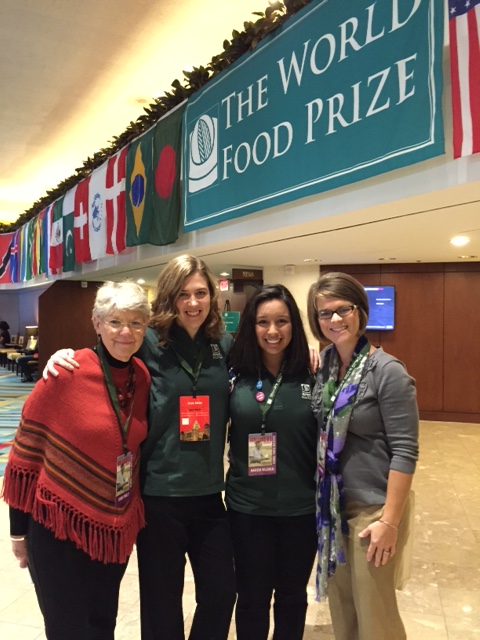
4 of us.jpeg
Rachel researched water sanitation and access in the DRC; Marisa’s paper was about water sanitation in India.

The World Food Prize honors scientists and humanitarians around the world who have made a significant contribution to the fight against hunger. It was established by Norman Borlaug, who is sometimes called “The man who saved 1 billion lives” for his work in developing a drought-resistant variety of wheat that, over time, saved those estimated one billion lives. Scientists such as Purdue’s Dr. Gebisa Ejeta (2009) and Dr. Philip Nelson (2007) have been recognized for their work in fighting hunger as have humanitarian leaders of the caliber of this year’s winner, Sir Fazle Hasan Abed, the visionary from Bangladesh who founded BRAC, the world’s largest NGO.

In 1970, Borlaug received the Nobel Peace Prize. In 1986, he conceived the idea of the World Food Prize to honor individuals who had made significant contributions to ending world hunger.  Later still, in 1994, he established the World Food Prize Global Youth Institute, a competition in which high school students study food security issues in countries around the world. After months of research and essay writing, students submit their essays and then present their work orally at regional competitions. The winners there attend the World Food Prize/Global Youth Institute in Des Moines, Iowa, where they interact with some of the most prestigious scientists in the world, learning more about solutions to world hunger and exchanging ideas with these leaders in the field.

Indiana students talk with WFP Laureate Gabisa Ejeta.
Indiana students talk with WFP Laureate Gebisa Ejeta.

I’ve just returned from the World Food Prize/Global Youth Institute proceedings in Des Moines. My colleague and I have three years of sponsoring students under our belts; we’ve sent students on to Iowa every year—and every year we’ve come away from this amazing conference recommitted to the cause. I’ve written about the World Food Prize essay contest before (See https://sarahpowley.wordpress.com/2013/05/03/winners-all/ and https://sarahpowley.wordpress.com/2013/11/08/changed-lives-the-world-food-prize/), but I can’t help writing again about the incredible opportunities this program extends to students and the profound impact it has upon their lives.

As a former English teacher, of course I value the writing and thinking skills that such a challenging paper demands. Gathering information and evaluating it for its recency, credibility, and specificity; sorting and organizing it all into a coherent problem/solution format; and then writing the paper in tight but fluid prose is no mean feat.

To be in the presence of great scientists—at the regional competition and again at the Institute—is awe-inspiring. Most students have no idea what a professional conference looks like, let alone even know that professionals in any field gather regularly to present papers, engage in dialogue, participate in panel discussions about timely topics, and hammer out approaches to common problems. Watching leading scientists, small holder farmers, representatives from NGOs, and agribusiness growers present information about (for example) aquaculture, conservation agriculture, and the nutritional impact of sweet potatoes in Africa is mind-expanding. Who would think such topics would captivate high school students whose background is not necessarily agriculture? But the students were not just snagged; they were hooked by the passion of the speakers and the complexity of the world of agriculture. They recognized the importance of something they’d always taken for granted—food—and the urgency of the challenge to feed 9 billion by 2050.

The culminating event for the high school students is a presentation at the end of the Institute to a panel of scientists and agriculture experts (even the laureates themselves, including this year’s winner) who read the students’ papers and interact with them.

One of our students, Rachel, in introducing herself prior to presenting her paper on water sanitation and access in the Democratic Republic of Congo, declared, her tone earnest and her demeanor sincere, “I didn’t think this experience would affect me the way it did. Food is the key to everything. I didn’t really realize that before I wrote my paper.”

rachel.jpeg
Rachel and two other students discussing their presentations.

I had watched Rachel intently throughout the conference. Because she has always been a little bit shy, I wondered if she would feel overwhelmed by the experience in Iowa. But the reverse happened. It was like watching a flower unfold in Disney’s Fantasia. She sat at lunch and dinner with students, teachers, and professionals from all over the world, gaining confidence every time she initiated a conversation or answered a question. Her public speaking skills soared: Her own presentation was animated, thoughtful, and nuanced by very natural vocal and facial expressions. One of the experts evaluating her performance told he was “touched” by her comments about the impact of the experience on her thinking.

But the benefits don’t end there, with students developing an English teacher’s skill set.

The impact on career choices, college majors, even the choice of a particular college is significant.  Rachel said she had come into the program certain she wanted to pursue criminology but was now considering a career in public relations or international relations.  Another student, one I don’t know personally said, “This program made me consider college majors I’d never thought of. It made me aware of issues I’d never heard of.”

Students who attend the Institute in Des Moines—the top essayists—become eligible to apply for 2-month summer internships to do real science themselves. Last year, 23 students were awarded Borlaug-Ruan Internships to pursue science in locations around the world. They worked with top scientists in all areas of agriculture, agronomy, and food science. Each of the students returned to Iowa this past week to give a poster presentation of their research.

This slideshow requires JavaScript.

Students who attend the Institute in Des Moines are also eligible to apply for Carver-Wallace internships here in the United States.  So far, 110 students have been Carver-Wallace Fellows; among them, one of our own students. Caroline, who competed two years ago, interned at the USDA facility on the Purdue campus the summer after high school; her experience there morphed into a job with the USDA while she attended college at Purdue.

The mission of the Global Youth Institute is to inspire students to answer the call to fight hunger in the world—as scientists, humanitarian aid workers, journalists, business leaders, growers, teachers, and manufacturers (among other occupations).

“Even if you become, say, a banker,” Sir Fazle Husan Abed elaborated in his luncheon address, “you’ll be a better banker for that. Doing for others leads to a satisfying life. If that is not your occupation, make it your preoccupation.”

In the next 40 years, according to a senior officer from DuPont who spoke in Des Moines, we will need to provide more food than we have produced in the last 10,000 years. The world needs young people to make fighting hunger their life’s work. Reaching out to them—when they’re on the brink of life decisions—is what the World Food Prize/Global Youth Institute does well.

Some, of course, won’t go into agriculture or nutrition or science. But no matter their career path, they’ll never forget the message they’ve learned, the skills they’ve gained, or the opportunities afforded them because of their participation in the Global Youth Institute. They’ll never take food for granted again.

Traveling Companions

Was there ever a trip I took that didn’t involve a book—or a stack of books?

I don’t think so.

When I was a child, my family journeyed every summer from our home in Illinois to our grandparents’ summer cottage in northern Wisconsin—loaned to us by them for six weeks in June and July. We traveled in two cars—my mother and father driving, and we four children and our two Springer spaniels distributed evenly between them—on a journey that took (in those years before interstate highways) all day. Each of us kids brought along treasures to help the time pass. I brought books—as many as I could fit into a small brown cosmetic case that belonged to my grandmother. Stacked there neatly, and cushioned by a sack of anise candy, the books kept me company all day long and well into the weeks ahead.

During my elementary school years, most of my vacation reading material came from the last Scholastic Book Club order of the school year. A few of the books I brought were old favorites from my bookcase—The Secret Garden, Anne of Green Gables, Understood Betsy—and sometimes my grandmother gave me a new book as an early birthday present just before the trip got underway. When I was a little older, the books were fatter and there weren’t so many of them—Little Women and Jane Eyre lasted longer than the car trip—but they, too, traveled with me in the little brown cosmetic case.

I remember deliberating for weeks about those books. If they were to be new ones, I had to be sure I would like them—I didn’t want to waste space on something that would lose its appeal within a few pages. That meant a series book, or an author I already knew, or at least a topic that I knew would hold my interest. So yes to Betsy Ray and Nancy Drew and Cherry Ames. Yes to Beverly Cleary and Louisa May Alcott. Yes to books about children with problems and the teachers and therapists who helped them, yes to books about children in other countries, and yes to biographies of writers and pioneers of all kinds.

I kept that up every summer—selecting books to accompany me on my travels—never suspecting that my choices were doing anything more than sweetening my days.

Later in life (as an English teacher, of course), when I traveled to Russia with my students, I carried along books I intended to leave behind. I suggested to my students that they do the same. The books had to be ones I could part with (The DaVinci Code) because the space they occupied in my carry-on would be given over on the return trip to my purchases. The books had to be intriguing enough to compete with the novelty of living in a foreign country (Year of Wonders), but universal enough that my Russian friends would want them (Harry Potter).

Don’t Let’s Go to the Dogs Tonight: left in a Moscow hotel.  The History of Love: left in a cardboard box filled with books in English that to this day circulates among young women working for NGOs in Rwanda. Something else, not so memorable, left in the airport in Lima. Another quick read, swapped out for The Human Comedy in a coffee shop in Colorado. I’ve left books behind all over the country and in places around the world. I see now that what I have done is leave bits of myself behind as well.

I still deliberate about the books I’ll read in the summer. These days when I travel, it’s often to a place where internet technology isn’t available and cell phones don’t work: it’s just the books I’ve selected and me, together for a stretch.  Of course, I’ve got a Kindle now, but not the ability to order a title from my living room or (yes) my bed.  So even the electronic library I amass each summer is carefully chosen ahead of time, and the same constraints apply: no set-asides if I can help it, yes to familiar authors and new information that I’ll happily anticipate settling in with, yes to long-time favorites.  That means that Maisie Dobbs and V. I. Warshawski can come along any time, as can anything by Barbara Kingsolver or Colum McCann. This year I’ve stacked up the audio tape of All the Things We Cannot See (my favorite read of the past winter), a reflective piece on health care called God’s Hotel (recommended by friends), Archangel (a National Book Award winner), and a classic I haven’t read in years: A Tale of Two Cities. And about mid-July, I am expecting a literary guest to arrive: Miss Jean Louise Finch.  Yes, I am anxiously awaiting To Set a Watchman. For good or bad or somewhere in between, it’s going to be wonderful to spend time with Scout again.

But as I was selecting my companions for this summer, I was struck not only by the longevity of this ritual, but by the impact of my choices. The books I selected in the summers when I was a child and the ones I choose today have done much more than help me pass time in a pleasant way. They’ve been formative, exerting on my personality the power and influence of theirs.

When books end, we don’t ever really set them aside. Oh, they take up space on our shelves, but they also take up residency in our minds. They are a part of who we are, remembered fondly as old friends, embraced as traveling companions on the trip through our lives.

Maybe that is why, when I encounter titles I know at a used book sale, or on a shelf in a coffee house, or in a collection set aside for hotel guests, they are immediately recognizable to me, dressed as they often are in tattered covers and battered spines. I can’t resist snatching them up, as if responding to a call:  “Remember me? Here I am!”

So yes, I quite often say. Let’s travel together again. You’ll be very good company indeed!

A version of this post appeared last summer in the online site Nerdy Book Club.

National Treasure

To and for all the amazing teachers I know during this, Teacher Appreciation Week: Our world is better and our students’ lives are richer because you have been a classroom teacher. Thank you for all you do every single day.

It’s fashionable right now to blast educators, to focus on data-specific measures of effectiveness, and to prescribe corporate take-overs for failing schools. The critics say “failing schools,” but that’s code for failing teachers. The critics ought to come with me when I am in a school in my role as an instructional coach.

When I enter my colleagues’ classrooms, I am quickly swept up by the lesson—enthralled by the teacher, captivated by the content, and excited to be on the other side of the desk, learning.

In the past month, here are some of the places these fabulous teachers have taken me:

  • To Austria in 1877 when two men stole Haydn’s head from his grave for analysis by phrenologists. Indeed, pseudo-scientists found the “music bump” was significantly developed—but it was nearly another century before Haydn’s head was reunited with his body.
  • Out on the open seas with the commander of the Pequod, Captain Ahab, in mad pursuit of Moby-Dick, the great white whale who had taken his leg.
  • To a 1940s wedding, where the bride wore a dress she had made of parachute silk: the tight-fitting sleeves  were pleated at the elbow so she could move her arms, and the neckline was high, as modest as the times.
  • To Versailles with Wilson, Clemenceau, Orlando, and David Lloyd George, hammering out the Treaty that ended WWI but set the stage for so many more 20th century conflicts.
  • To the Middle East—via computer and a stunning visual from the LondonTimes—to learn about the Arab Spring.

Here are some other things I have learned—or relearned, as the case may be:

  • How to figure percents (6th grade math)
  • How to make a coiled basket (7th grade art)
  • How airbags work (a high school chemistry lesson in stoiciometry and the gas laws)
  • The seven characteristics of a folk tale (6th grade English)
  • Why artists make still life drawings—and how to do it (8th grade art)
  • How to make ice cream in a plastic bag (8th grade science)
  • How the metric system works (7th grade science) 

Over and over and over again, I am impressed by the good teaching I see—and the more I see, the more frustrated I become with the voices of people who haven’t been in a classroom in a very long time—or perhaps haven’t even taught a day in their lives. Some of the best teachers in the world are at the front of the classrooms I’ve visited.

Every good lesson has a story arc: a beginning, a middle, and an end.

Some teachers pique their students’ interest with a question: When will the force of the water from a fire hose be stronger? When it’s on the up side of the parabola or the down?

Some do it with a demonstration: An art teacher I recently watched gathered her students around her to demonstrate still life drawing. She talked out loud throughout her demo, questioning her kids about why she was doing what she was, reminding them of what they already knew, and prepping them for what they soon would do that was new.  Then they set off to do a still life on their own.

Others tell a story (like the one about Haydn’s head), or read aloud (These aren’t always English teachers—reading aloud is how the airbag class started!). They hook their kids and then jump into the lesson.

Sometimes they use “props”—like several teachers I’ve seen who have individual whiteboards for writing down answers and holding them up so the teacher can gauge the class’s understanding—or popsicle sticks and clay to make prototype chairs and tables—or crazy assortments of objects all spray-painted white (in the case of the still life drawings).  Sometimes they send students to the Internet to find a specific answer or just to find out what they can about a particular topic.

In a Family and Consumer Science class (FACS), girls AND boys were dressing models in the fashions of the decades. They were using figures and clothing that reminded me of the paper dolls I played with as a child—except that these dolls were figures on one side of a computer screen and the students “dragged and dropped” clothing from the other side onto the models, making the equivalent of dressing room changes until they had the dolls attired as they liked.

Sometimes the interactive whiteboard facilitates instruction—like the American history teacher who used it to show the students the map of Europe pre- and post-WWI—or the world history teacher who showed the class a virtual timeline of the conflicts in the Middle East.  English teachers dissect essays right before the students’ eyes or use the screen to show a timely YouTube video. 

But technology isn’t all. There are old-fashioned storytellers among us—like the teacher whose students were enthralled with the story of Wilson’s 14 Points and how the Big Four at Versailles—or the Big Three, once Orlando left—hammered out the agreement that brought an end to WWI. She captured the personalities of these four men and brought them together as if they were characters in a book—and brought the story of the Versailles Treaty to life.

A middle school world history teacher has his students capture the essence of a country’s culture in haiku; the students in a middle school English class create a collective self-portrait with “I Am From” poems.  Another English teacher directs graduating 8th graders to produce “The Soundtrack of my Life”: Each student writes about key events in his or her life and records it all on a CD. I’ve watched an extraordinary music teacher inspire her students to write essays about the reciprocal relationship between music and culture and listened as another music teacher led his students in a discussion of an NPR piece on tempo.

Sometimes, of course, the ending is a homework assignment, but in the best classrooms, that assignment is tied directly to the main idea of the day or to a point in the lesson—if it’s a two-day or three-day lesson—that will help the students transition to the next day’s focus. Sometimes homework comes in the form of a paper, a project, or a short reflection. Sometimes it’s problems to work or issues to resolve, an article to read or pieces to practice. Sometimes it’s reading on in a book, and sometimes there is no homework at all. There isn’t a formula for the ending: The teacher needs to know whether the students understood the lesson of the day and where she should pick up the next day, and there’s more than one way to find that out and move instruction forward. Sometimes closure is accomplished with those individual whiteboards or with exit passes or with questions the students submit. But there’s always a “wrap.” A good teacher doesn’t let the kids just drift out the door without a finish.

They’re ingenious, these teachers I’ve seen. They’re thoughtful, funny, clever, compassionate, kind. They challenge their students, to whom they are devoted, and they’re earnest about learning new skills and expanding their expertise. They’re dedicated to their task.  I know math teachers who are concerned about reading comprehension and differentiating instruction and collaborative learning.  I know special education teachers who attend high school workshops about strategies they’ll probably never use and courses their students will probably never take—but the teachers want to stay current with mainstream teaching.  Even veteran teachers continue to learn. The English teacher who swept me up in the story of Moby-Dick has been teaching for over 40 years—but she still comes to my after-school workshops on reading comprehension just in case I have something new to teach her

Of course there are teachers who don’t yet have all the skills they need—I wouldn’t have a job if everyone knew everything and no one needed anything.  Sure we all can learn more—none of us teaches a perfect lesson every single day.  It’s true that every field is changing and that, as a group and as individuals, we need to make changes.  The knowledge base in every field is rapidly increasing, too, and the range of skills our kids need is expanding. The technology we are privileged to use is constantly evolving.  But so many amazing educators are committed to making the necessary changes because they are committed to serving their students well. 

I wish our critics would pay attention for a change to the extraordinary teaching happening in our schools. I wish they would not lump us all together, call us collectively the equivalent of a bad apple. I wish they would recognize that educators are, quite to the contrary, our national treasure.

Without Words

P1040079The first student I remember coming into my class with no knowledge of English arrived in the early 1980s. I’ll call her Laila. She had recently arrived in this country, the first of her siblings to follow their father to America. He had fled Afghanistan when the Soviets invaded, coming to this country as a refugee. He was able to get protected status, a green card, and then later sign for visas for all the rest of his family. They came one-by-one or in twos, secretly, across the Khyber Pass to Pakistan and then to India where they waited until they could get passage to America.

Laila was the first of the siblings to attend school in the USA, and when I reunited with her many years later, she described for me the embarrassments, trials, and anguish of attending middle school not speaking the language. Boys snickered when she said she wanted to be a doctor, others asked her how to say dirty words in Farsi. Math class was a refuge because she could do it, and so, she said, was my room. I didn’t—and still don’t—even remember doing most of what she told me I had done. It must all have come as common sense to me, gathering material for her and making special word books. But many of the things she said I had done had made her feel included.

As I said, it must have been common sense, for I certainly knew nothing at the time about how to help English Language Learner (ELL) students. She remembered that in the spring of that 8th grade year she had to make a speech in my class. I suggested the topic “My First Month in America,” and she did speak–and the other students were enthralled–and I gave her an A and that made her day/week/month. Such a little thing. It reminds me what an impact–for good or for bad—the little things we do can have.

Lately I have been thinking about the ELL students of today; in my district, they’re mostly Spanish-speaking kids.

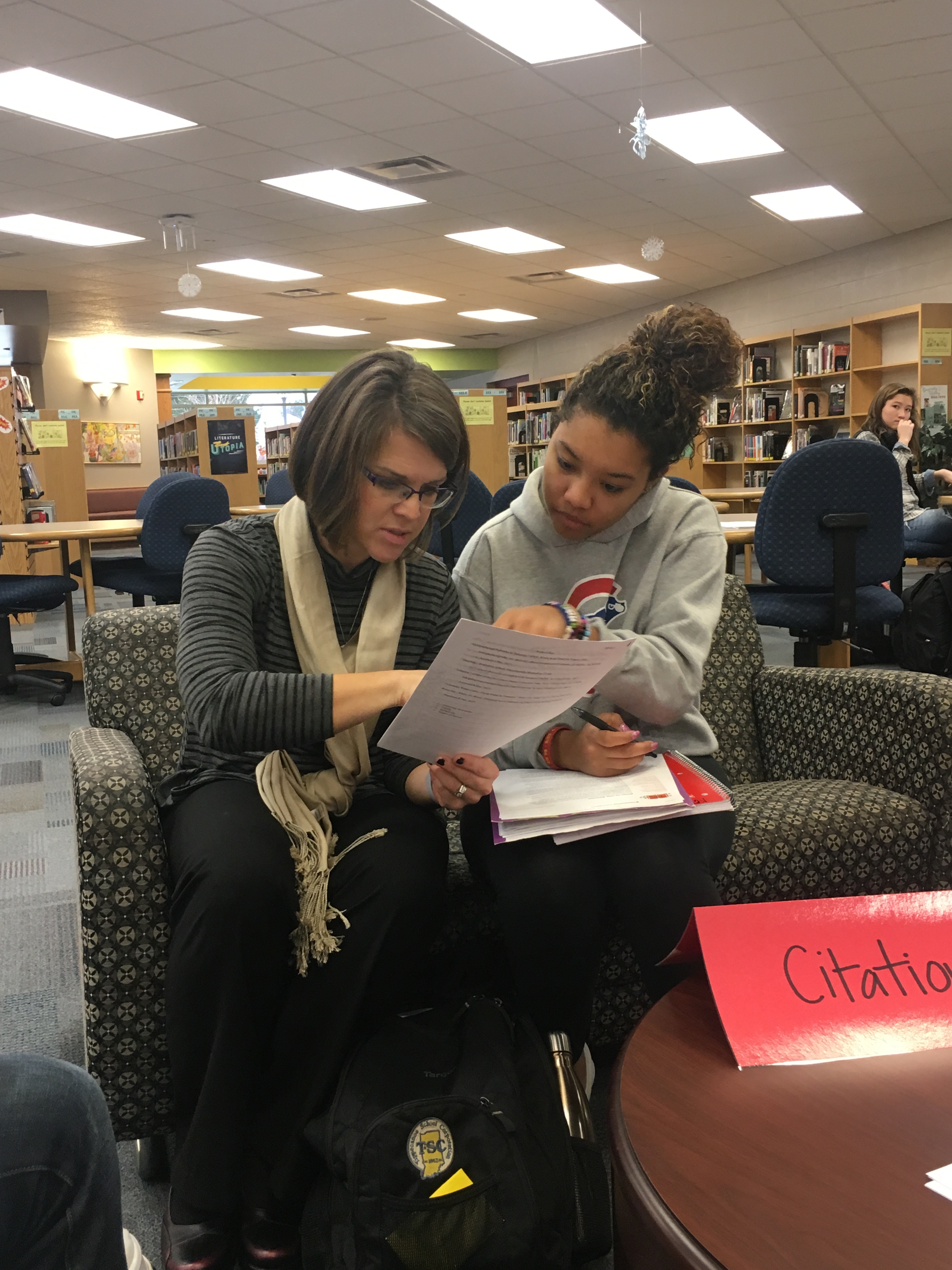
Other teachers think about them, too. In fact, teachers at both of the high schools where I serve as an instructional coach have approached me this year, asking what they can do to help the ELL students in their classes—especially, but not only, the ones who have little or no English at their command.

Of course they know that learning a language takes time. They know that gaining academic proficiency can take years. Of course they know there’s no magic bullet. But because they are teachers, they want to help and are frustrated when they can’t. Teachers care about their students—all of them. Still, it’s hard to imagine how you can help when you’ve got five or six classes and anywhere between 120 and 160 students and you have to prep three separate lessons every day and parents are emailing and extra-curricular responsibilities are looming and papers are piling up faster than snow melts in summer.

Yes, the students have an ELL teacher—and she works wonders. But you can only process so much a day. I remember that when I—a non-Spanish speaker—visited Peru a few years ago, I spent most of my time on the bus that carried us from place to place looking at signs and billboards, trying to memorize words.  I was learning about the culture at the same time I was learning the language, and that’s sometimes even harder—and certainly more fraught with danger—than building a word bank. By the end of the trip, 10 days later, I was thrilled when I could negotiate the purchase of a toothbrush. And that only took a few words: toothbrush and how much. What followed was some fumbling with money and help, please.

I decided to shadow some beginning ELL students for a few days and, to attempt to simulate their experience, attend their Heritage Spanish class. By the way, it’s an error to think that because these kids speak Spanish easily, they also read and write it comfortably. That’s why they take Spanish in school and get world language credit for doing so. They may have grown up speaking Spanish, but their parents may not read and write Spanish themselves and they may have passed on speaking errors, just as English-speaking parents sometimes do. (Think of kids who say “I seen it.”)

One day in December, I was able to interview several of these students. I asked the questions, a Cuban-American substitute teacher (who just happened to be in the building that day) interpreted for all of us, and my colleague (the ELL teacher) took notes so I didn’t have to.

Here’s what I learned from our Spanish-speaking ELL students, and here are the suggestions I will be passing on to content-area teachers about what they can do to help ELL students learn English and learn their content.  (And by the way, these ideas will help everyone in the room. There’s nothing strictly ELL about them.)

Greet the students at the door: Say their names, and if you know “Hello” in Spanish, say it. Pronounce their names right, though. In fact, that might be your first conversation. I remember practicing once with a girl from China. She tried to excuse me—say it didn’t matter that I kept stumbling—but I knew it did. Eventually, my tongue ceased twisting around the syllables and saying her name became as easy as saying Jack’s and Emily’s. I realized from being in classrooms all day long that a student could go through a whole school day without anyone using his name or talking to him directly. Imagine how that would feel.

To a person, every ELL student I spoke with said that the teachers who “cared” about them were the teachers they would work the hardest for. Teachers who “cared” were the ones who took the time to treat them as individuals by doing things as simple as greeting them at the door or once in a while using a Spanish word. Really.

Seating arrangements: Put them in the front. Seating an ELL student at the back makes it harder for them to see and hear. Besides, consistently seating ELL students at the back communicates to everyone else that they’re not really part of the class. Yes, they may choose to sit there—but you can un-choose that spot for them.

Let them sit together if you have more than one ELL student—if they choose to. You can’t assume they’ll be friends any more than you can assume any two other students will get along. ELL students come from all over. They’ve got class and country biases, too. They told me so. But most of the time, they’re relieved to be together because they can help each other figure out what’s going on.

When you work in groups, spread the ELL students out among the groups as soon as you sense they’re comfortable with that. If you need to keep two together, you can do that with a group of four. You might consider “Study Buddies” for those times when you give over class time for homework. Pair the ELL student with a willing English speaker who can check that something is copied down right from the board, verify pronunciation, practice vocabulary.

Those objectives of the day: We are obliged to post these every day, so I suggest using them to advantage to teach vocabulary and focus the students’ thoughts.  Print the objective in big, black letters at the front of the room. Make it visible and legible from everywhere in the room. Write it in kid-friendly language. At the beginning of the class, point to the objective and say that this is the goal for the day. At the end of the hour, return to the objective and say it was the goal of the day. This will help ELL kids catch on to the purpose of the activities you do. And it will help every other student, too.

Why black? Because red and green and other colors don’t show up on the board as well. Why print? Because cursive is harder to read—and more kids than the ELL students don’t read cursive. Really.

Make it pop: Put key words on the board or create a word wall. This was a huge aha moment for me. When I attended the Spanish Heritage class, I listened to what the teacher was saying—but I didn’t have a clue. I don’t speak Spanish. When she wrote a key word on the board, I could see that often it was a lot like English—and I caught on. I still flunked the quiz at the end of the hour, but I got the main idea.

So, point out key words or put them on a word wall and then point to them, say them out loud, tap them, throw a ball at them—anything to reinforce them for the student.

Slow down:  Everything you say, everything they hear has to pass through the translator in their heads. It takes a very long time for anyone to get past this stage. The more complex the topic, the longer the sentence, the more time it takes.

  • Slow down for directions, assignments, explanations.
  • Break lectures into segments.
  • If you can, create a PowerPoint to play behind you.
  • Create fill-in-the-blank note-taking guides.
  • Write directions out as well as giving them orally.
  • Use graphic organizers, color coding, other visual aids.
  • Call on someone in the class to paraphrase what you just said: Your words will come out in simpler language and reinforce the message for everyone.

Use checks for understanding and use them frequently: Don’t wait till the end of the lesson to ask if everyone understood, if anyone has a question. Knowing precisely where in the lesson an ENL student stopped processing will help you tailor your instruction—and it will also give you clues about how much English the student has.  Here are some easy ones to implement:

  • Thumbs up/thumbs down
  • Exit passes
  • Stop light method
  • White boards (for individuals and/or for group answers)
  • Post-it notes on the desk

Use these checks for understanding with everyone in the class—it isn’t only the ENL students who get lost.

Let them speak Spanish: They’ll switch to English as soon as they can.

  • If you have two ELL students, let them talk the lesson over in Spanish if they like.
  • If you have one who is proficient and one who is not, ask the more fluent student to translate for both of you when you talk to the beginning ELL student one-on-one. That’s going to help all three of you.
  • Don’t worry that they’re talking about you. You can tell from their tone whether they’re on task, gossiping, or being disrespectful. If they’re not on task, shut them down.
  • Use Google Translator to put your assignments, directions, worksheets, etc. into Spanish. No, the translator isn’t perfect, but it’s good enough that beginning students will get the idea. Plus, it’s another indication that you care. You might be aghast at how badly electronic translators can mangle a passage, but in the beginning, they can be a huge help. The kids told me so.

Demo, demo, demo: Make your delivery lively. Gestures, charades, pantomime, movement—all of this reinforces language. Vocal variety matters: Not being loud, but being expressive. Intonation carries meaning.

Use any Spanish you know: How about posters with words in Spanish and in English? If you speak the language, don’t be afraid to use it to help. The ELL students will begin using English as soon as they can because, like all kids, they want to fit in.

Communicate with their parents: Same as anyone. Try this website to create permission slips, thank you notes, invitations to parent conferences, pats-on-the-back notes home, etc. They print in Spanish and in English!  http://casanotes.4teachers.org

Call for help:  Spanish-speaking faculty, the ELL teacher, the ELL support staff, district level coordinators and instructional coaches will help. You just have to them know you need it.

 Above all:  Don’t give up on these kids—and encourage them not to give up on themselves. It takes time to learn a new language—but they will. Case in point:  When I found Laila again, years after she had left my classroom, she had a Ph.D. under her belt. She had become a doctor.

Give the kids time.

They’ll get there.

Beyond the Pages

A few days ago, a young teacher (once upon a time,  a student at my high school) approached me after a workshop I’d conducted. “Tell me,” he said, “that I really did meet Gwendolyn Brooks when I was in high school. Her poetry has made such an impact on me.  She’s the opposite of me: black/white; female/male. She was old; I was young. But, I really connected with her. ‘We real cool’…She gets it. She really gets it.”

He was about to introduce her poetry to his 7th graders, so I dug through my personal “archives”—fat 3-ring binders with memos, schedules, programs evaluations, contracts, and photographs that I’ve kept all these years—and found a poster, a program, and a newspaper article from 1994 to help him recall the events of that day. The search took me back, too—refreshed my own memory of what was, for seven years, an extraordinary interdisciplinary, literary arts program in my high school. We called it Beyond the Pages.

 Some snapshots from those days:

  • Gwendolyn Brooks carried books in her deep, omnipresent satchel. In the middle of an intense conversation with a teenage writer, this Pulitzer Prize-winning poet reached into her bag, withdrew a volume of her poetry, and gave it to the student.
  • W. P. Kinsella, author of Shoeless Joe, carried a photograph of the real Moonlight Graham in his wallet. While he was talking with students in my class, he casually removed the wallet from his pocket and passed the picture around the room.
  • Retired Chicago Tribune editor, John T. McCutcheon, Jr., carried words and images from history-making news events in his memory. He described the atmosphere in the pressroom during the Watergate era to a hushed audience of high school journalists and their teachers.

Beyond the Pages brought students face-to-face with authors whose work they had studied. In the library, in classrooms, in the halls, and even in the cafeteria, writers with international reputations talked casually with McCutcheon students, carrying them beyond the pages of their textbooks to interactions with the authors themselves.

The goal was simple: to spark students’ interest in reading.  National statistics showed then—20 years ago—that the percentage of students who read for pleasure every day dropped by half between elementary school and high school–from 45% in Grade 4 to 24% in Grade 12.  Beyond the Pages was a commitment to reversing this trend.

IMG_1755The program began with a dream.  The English curriculum already included W. P. Kinsella’s Shoeless Joe when I met the author at a writing workshop in (of course) Iowa.  After listening to Kinsella discuss his book, I approached him: “If we asked you, would you come?” He told me to contact his agent.

I did.

Dream became reality when the principal endorsed the idea and the English Department signed on to plan the visit.  The success of that first event spurred the decision to continue the program on an annual basis. Eventually, Beyond the Pages branched out beyond the English Department, becoming interdisciplinary and theme-related.  Not only did teachers in other departments incorporate the writer’s work into their lessons, but faculty from many different departments served on the steering committee.  Students were represented on the committee, too, and they helped with promotional activities, art work, and myriad details.

The authors were guests at the school for one to three days.  While they were with us, they participated in a variety of small group interactions and addressed the students in all-school convocations.  The format changed from year to year; activities were tailored to the writer and to the connection between his or her work and the curriculum. Delightful spontaneous events also transpired.

  • Before Kinsella visited, my students studied his work and developed a list of interview questions. When he arrived, the television production class filmed an hour long interview in the school’s TV studio. I still have the tape.
  • In 1996, seven local writers—in a warm-up to Esmeralda Santiago’s visit—discussed their careers in small seminars.
  • In 1997, actress Annie Corley (a graduate of the high school) conducted mock-auditions in the school’s sound studio using real television scripts from episodes of Friends.
  • Scott Russell Sanders’ visit occurred when one English class was writing term papers on Indiana authors. He graciously made time for the young woman writing about him to conduct an impromptu interview.
  • W. P. Kinsella took a break from filming his interview to meet the special needs students whose classroom was next to the TV studio. The students were studying careers at the time, so Kinsella talked to them about the writing life.
  • And Gwendolyn Brooks gave her home address to several earnest young writers and encouraged them to send her their poems.

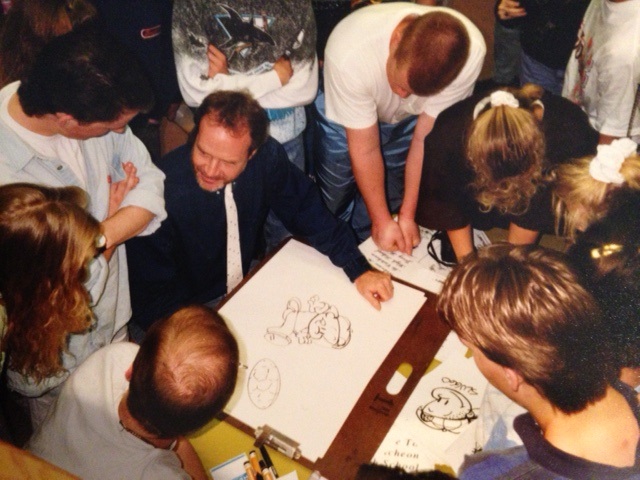
Jerry ScottThe program served 1100 high school students and 70 staff members, and each year the literary celebration expanded to include students and teachers from elementary schools within the district.  In 1993, for example, cartoonist Jerry Scott taught an auditorium full of 4th, 5th, and 6th graders how to draw the cartoon character NANCY.

Fundamental to the program’s success:

Teachers and students were given the opportunity to lead and the responsibility for the success of the program.

Teachers contracted with the artists, conducted the fund-raising efforts, organized the events, handled the publicity, planned the dinners, wrote the grants for funding, arranged transportation and accommodations for the authors, and conducted evaluations.  The Advanced Home Economics students prepared a luncheon for the guest author.  Students served on the steering committee, designed and printed the posters and programs, produced artistic displays, ushered, ran errands, and more.  The preparation for Gwendolyn Brooks’ visit took seven months of planning, 350 combined teacher hours of preparation, and the active involvement of scores of students—but it was done in a spirit of community. It felt like love, not labor.Brooks signing autographs

Beyond the Pages was grounded in the curriculum.

  • Every English class studied Gwendolyn Brooks’ poetry in preparation for her appearance, and students clamored for more. When she read aloud at an all-school convocation, students listened spellbound.  For the first time ever, some students told us, they felt the power of poetry.
  • When Jerry Scott brought his cartoon characters to life on an overhead projector and told students he was the “shortest short story writer in the world,” creative writing students had already written their own short stories and tried their hand at cartooning.
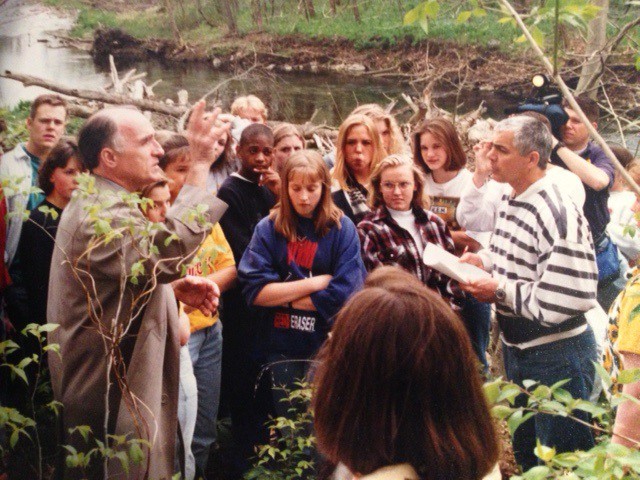
  • Before Scott Sanders visited McCutcheon in 1995, students in geography classes had created murals to illustrate his book Wilderness Plots. The murals were hung in the auditorium and became a focal point during Sanders’ special session with these students. In their biology and agriculture classes, students had begun creating a prairie on school property and identifying botanical species on an adjacent woodlot.  When the author arrived, the students took him on a tour of their “outdoor lab” and discussed the projects planned for the future.Sanders
  • In 1995, two other authors whose writing focuses on the geography and history of early Indiana appeared at the school in the spring to climax a year-long interdisciplinary study of “The Wilderness Experience.” Author James Alexander Thom, who had written about the Shawnee chief Tecumseh in Panther in the Sky, shared Native American stories with American history students.  Dark Rain Thom, a Shawnee clan mother, assembled her collection of Native American artifacts in the school library and provided a narrated tour of her exhibit.

The program caught the imagination of the community.

The boldness of the project–inviting best-selling authors to a public school–captured the attention of the local media.  Newspaper, television, and radio coverage helped to spread the word beyond the school.  The program was even in the sports pages.  In 1992, Kinsella opened the baseball season at McCutcheon by pitching the first ball on the school’s own “field of dreams.”

Most years, members of the public were invited to attend an evening reading or a performance at the high school.  Attendance grew from 200 in 1992 to over 750 in 1994, the year that Gwendolyn Brooks spoke.  Beyond the Pages became a community event.  

We believed that these encounters with professional writers would be motivational for Santiagostudents. Indeed, English teachers saw an uptick in students’ understanding of how a writer works and an increase in their appreciation for books.  We provided students with rare opportunities to see professional writers at work and to ask questions about craft as well as biography.  One student wrote afterwards about Kinsella, “He taught me that writing takes a lot of preparation and time.”  Another student remarked that “it helps students write better if they understand how a professional does it.”

And individual students—like the young teacher who started me on this journey through my archives—were inspired and even changed by their interactions with the authors.

I’d be interested to learn about programs today in other schools in other places. Are author visitations still happening?  Who has come to your school? How was your program organized? What was the impact? Please respond in the comment box if you have memories from Beyond the Pages or stories to share about your own school’s program. I’m hoping events like this still go on.

Balancing Act

Earlier in the week, we had sleet and freezing rain; falling temperatures in the early hours of the day created patches of ice on the roads and walks.  Driving to school that morning, I saw a small figure straddling the sidewalk a block ahead of me: a very tiny woman, I thought, trying to walk on the ice.  Her arms were extended parallel to the sidewalk, and they jerked alternately up and down, in the way of someone trying to maintain balance.  She wasn’t making much progress.

But as I drew closer, I realized that the little old woman I was seeing from behind was actually a very young girl.  Her pink cotton scarf was tied babushka fashion, and her snow jacket was too big. She wore a skirt that peeked out from under the jacket and hardly covered her knees. Heavy black boots with thick rubber soles accentuated her thin legs. It was those rubber soles that were causing her to slip and slide.

She didn’t seem to be unnerved by the ice, although she was definitely scrambling—rapidly shifting her weight from leg to leg, stepping forward and sliding back and never gaining ground.  She couldn’t make headway—or maybe she wasn’t trying.  It seemed to me, the longer I watched from the car, that her repetitive motions were experimental, not frantic at all. Something in her attitude conveyed the impression that she was practicing at moments of unsteadiness, even finding pleasure in mastering the near-falls, the sudden shifts, and the involuntary responses of her body trying to right itself.  She was learning to walk on ice.

She looked up and ahead then, and my eyes followed an invisible line between the child and her parents—the mother with a bundled baby in her arms—who were waiting ahead at the corner.  They had turned around to watch their performer on the ice, so I could see that they were calling to her, but they were laughing and enjoying their child’s experiment with balance.  They didn’t seem to be in a hurry.  They weren’t nagging or impatient in their stance.  I slowed to a crawl so I could continue to watch the little girl. When I finally reached the corner, a four-way stop, I sought the mother’s eyes.  We both grinned.

It was the image of the child that arrested my own forward motion that morning, but it is the picture of the parents at the other end of the line that has stayed with me ever since. Often enough in life we encounter unexpected patches of ice, dangerous slicks that unbalance us—or threaten to—and send us sprawling to the ground.  A little practice with uncertainty and an occasional encounter with struggle serve children well. They need to have had some practice with adversity in order to keep their footing later in life should the ground below them turn treacherous.

It is a balancing act for parents, too, no matter how old or young their children are, a trick to know when to prevent experience, when to permit experiment, and when to intervene.  I remember my own children’s struggles as they grew in independence.  The first night away from home brought on a wave of homesickness for one of them.  She survived the night, however, and learned something of self-reliance. In junior high school, a skiing trip with a group of friends sounded exciting—but she had had no experience on the slopes.  She went on the trip, and she learned to ski: Her self-confidence soared.  A few years later, a camping expedition with her friends meant she’d climb Long’s Peak in Colorado.  I would not be there to hold her hand—or my breath.  But she went, and I cherish a photograph someone took of her: my daughter, standing victorious at the top.

There was adventure in all of these experiences—and the potential for danger.  To stand at a distance as one’s child—or one’s student—takes a run at the ice means holding the instinct for rescue in check in order to send a more important message. That invisible line between a watchful parent and an eager child vibrates with a message of faith, of belief in the child’s ability to succeed. The message these parents were sending to their daughter this morning as she walked along on the ice will prepare her to approach life with confidence, to engage in its struggles with spirit, to feel pride when she reaches solid ground, and to move forward always, embracing the world before her.

There’s a lesson in this balancing act—for the parents of our students and for us, the teachers at the front of the room. Instinct screams at us to protect our children and to make learning easy for our students. It is important to keep a watchful eye, but we can’t–and shouldn’t–prevent the learning that comes from an occasional fall. Our children will move with confidence when they know how to walk on ice.

Primary Source

Why We MarchIf you live long enough, you become a primary source.

I was the guest speaker in an AP US History class about three weeks ago, there to talk about my brief stint in Chicago the summer before I married—marching there with MLK, Jr., the types of jobs I did for VISTA, and the state of the Chicago Public Schools 49 years later. Neighborhoods are unchanged; schools are still segregated. Poverty is at the heart of it. If you follow school politics, you know the Chicago Public Schools are in an even more deplorable condition than they were a half century ago.

The teacher had read my blog post about JFK and touching—or maybe not touching—him when his motorcade came through my town during the 1960 presidential campaign. When she asked me to talk to the class about what I remembered, the substance was scanty—all inspiration and no information. But our conversation drifted to the Civil Rights Movement and for that I had more content—or thought I did. I agreed to talk to her classes.

When I got down to thinking about what I would say, of course, my memories turned out to be pretty meager in this department, too. It would have taken me about one minute to relay the following: “I was in Chicago; King came; I marched. We met in Grant Park, went through the streets of Chicago, ended at City Hall. He was up on a platform and I was too far away to touch him. We all joined hands. We did sing “We Shall Overcome.” I felt good.

So I had to do some research. I started with a box of letters and memorabilia from my college days. My mother had saved every letter I wrote home for the four years I was in college. In that box was a red pocket folder with a few “artifacts” from my time in Chicago the summer after graduation. In the folder was a flyer: Why We March. No date, but a little printer’s mark, indicating that the item was printed, not xeroxed, and a few details of the back story.

Names: Ben Willis and Mayor Daley. Al Raby. The Coordinating Council of Community Organizations.

I found a book–out of print—and ordered it: Northern Protest by James R. Ralph, Jr., Turns out, his account of King in Chicago had been a source for Isabel Wilkerson, whose astounding and fascinating story of the great migration of southern blacks, The Warmth of Other Suns, captured a Pulitzer Prize in 1994.

In Ralph’s book, I found the date of the March: July 26, 1965. 15,000 people. The largest civil rights demonstration Chicago had ever seen—so said the Chicago Daily News.

I read further in the book and then online about 1966, the year King returned and lived in Lawndale (western suburb, black, the destination of many African-Americans migrating from the South) and the cat and mouse game Daley played with him, the marches that turned violent. All the online texts were about 1966; the Eyes on the Prize video, all about 1966; the accessible newspaper coverage, all about 1966.

How could I prove I had been there? Even the papers in the online Southern Christian Leadership Conference archives are about 1966.

Finally, I found two articles in the Chicago Defender, the leading Frican-American  newspaper of the day, about the 1965 march—written two days after it was over. The Tribune archives for that year: not online. The Sun-Times? I’d have to sign up for a 7-day free subscription and then I’d probably forget to cancel it.

Finally, finally, I happened upon an edu site (Students, listen: edu sites always yield the best stuff!)—the University of Illinois at Chicago–that had a summary of 1965 and had reproduced on their site the very flyer I had in my hands. Oh, wow! I’d hit pay dirt and was excited beyond belief.

So funny. The kids would have believed me, but I wanted the proof that what I held was indeed a primary source. This was, after all, an AP history course.

That summer–1965–Al Raby, a black schoolteacher from the South side, had become the head of an umbrella group of community organizations, all (until then) working independently for better schools, better housing, better employment opportunities. But the focus was on the schools, still (11 years after Brown vs. The Board of Education) 90% segregated. The CCCO marched every day that summer on City Hall. They wanted Daley to dismiss Ben Willis, the Superintendent, because his policies perpetuated segregation. Recently, the schools had gone to double shifts because they were so crowded–that is, the black schools had gone to double shifts. Some white schools had empty desks. But the CCCS was getting nowhere–Daley was a formidable and cagey foe–so they appealed to King, who had led a huge rally at Soldier Field the summer before in 1964 (estimated attendance: from 30,000 to as many as 60,000) and was at that moment looking to expand the movement into a northern city.

A perfect meeting of purposes.

King was in Chicago in 1965 on a five-city tour called the People to People campaign to see which city would be best—Chicago, Cleveland, Philadelphia, New York, or DC—for his northern protest, his “Freedom Summer” in the north. That was to have been what 1966 would be.

Of course, it didn’t turn out that way. In 1966, King moved into an apartment in Lawndale, deliberately moving there to draw attention to housing inequities. He was still interested in employment and education, but the focus that summer was on open housing. I explained to the students about redlining—the sly and exclusionary tactic of delineating certain areas of the city and then refusing to sell property in those areas or provide financing to people of color who wanted to buy there.Online, I had found maps of Chicago with the neighborhoods clearly marked off. I brought these to class, and I reminded the students of Lorraine Hansberry’s powerful play, written in 1957, A Raisin in the Sun—still in our 9th grade English anthologies—about a black family that prepares to move into a white suburb of Chicago (a play with connections to Hansberry’s own family story). Many of the students had read the drama, nodded in recognition. I recited some lines from Langston Hughes, lines the students knew (Thanks, English teachers!!!):

What happens to a dream deferred?
Does it dry up, like a raisin in the sun?

Or does it explode?

It exploded in 1966: rioting, marches that turned violent, Dr. King himself hit by a rock thrown at a march in Marquette Park on the South Side. And Daley repeatedly outmaneuvering King. Ultimately, fearing violence in Cicero (a white community that bordered Lawndale and the West Garfield area where I’d been stationed in 1965), King settled with Daley–a 10 point agreement that did make some inroads–and called off the Cicero march. Stokely Carmichael and others, though, went ahead with it on their own, and the march in Cicero did turn violent–bloody and awful.

But in 1965, the year I was there, Chicago was by and large peaceful. It gave King hope that the non-violent tactics of the south could work in the north.

Consider this: If King hadn’t come to Chicago–or any other place–the laws would not have changed; even less, the climate. If the Civil Rights Movement of my day had never happened, would there have been a Women’s Movement, a Native American Movement, Stonewall and the Gay Rights Movement, a Latino Movement? King’s compromise in 1966 was a setback, and the assassination was devastating…but ultimately, progress.

But so much, too much, left to do.

The kids asked me how I reacted to MLK’s assassination. I put my head down on the dining room table and cried, I told them. I remember that distinctly. It was the death of a hero.

The message to the students: Your voice matters. I was one insignificant person in 15,000 that day–but 15,000 insignificant people were not insignificant in their impact. 15,000 helped to convince King to come. He came, and even though he didn’t achieve exactly what he sought, progress was made.

You can change the world, I told the students. You can. But you must stand up, speak up for what is moral and right.

Apparently, the talk was inspiring. Kids clapped, thanked me, and some came back to hear the presentation twice. (I talked to four classes.) The teacher asked me to partner with her next year and do all this during the Civil Rights Unit instead of as a guest speaker. To which I readily agreed and suggested that next year the kids do the research, now that I know it is there and so much is available online.

In all these years, I have not spoken at length about marching with King, though it is something I look back on as significant in my life. Oh, I had mentioned it a few times to kids in school, but not as part of a long discussion with facts and details and questions and answers. I was never quite comfortable. In the first place, I had forgotten the facts. In the second, I was stopped by the feeling that throwing it into a conversation—even one about racism in this country or one about the pernicious effects of poverty—would have been gratuitous, even self-congratulatory. And what was there to congratulate myself about? Of course I marched.

So here I am, old enough to be a primary source and to have had the chance to tell this story.

What did it feel like to speak to these students? Was I comfortable? For starters, time seemed to melt away. Once the details came back to me—through the research—it didn’t feel like nearly fifty years had gone by. It didn’t feel like it had been that long ago. And, armed with information, yes, I was quite comfortable. I had something to say beyond a one-minute delivery of basic information. The students asked great questions, stayed awake the whole time, and seemed to genuinely care about the topic. They put me at ease and at the same time, lit my fire.

I was comfortable because I was at the front of a classroom, not at a dinner table, not in some random gathering place where the conversation is supposed to be focused on a problem, not on personal biography. The occasion and the venue were right.

But maybe it is even more simple than that.

Maybe it is just this: I do love to teach.

The Sacred Valley: Peru, 2009

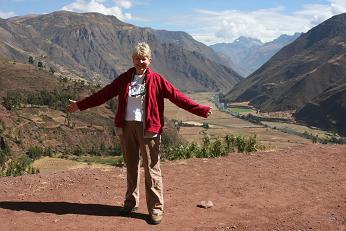
Summer is fast approaching. Teachers who are traveling abroad with students next month are checking their lists and making last minute tweaks to their travel plans at the same time they are winding down the school year. In 2009, I traveled to Peru with a colleague who was doing just that. She and her husband had recently inaugurated a short-term travel abroad program called HOST–for Hands-on Spanish Travel. The program was a cultural and linguistic immersion experience–we stayed with host families in Lima–and it was a service learning-based program, too–we worked in an orphanage that year. Today, HOST partners with high schools and colleges in the US, offering study abroad programs in Spanish-speaking countries in the Americas and in Spain. I savored every moment of that trip to Peru, but this day in the Sacred Valley was especially memorable.

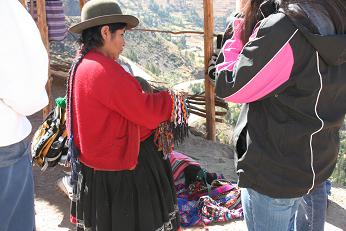
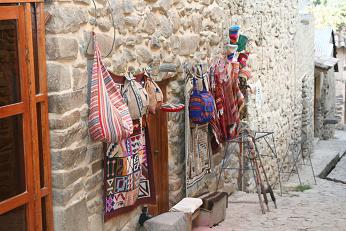
sm vendorAt every turnout where the bus stopped on the journey to Pisac and at the top of the mountain we’d descend to reach the market at Pisac, as if to warm us up, to whet our appetites for buying, to prepare us for the panoply of choices available there, full-skirted women wearing brown felt hats and red wool jackets, long black braids down their backs and dancing black-eyed children with adoring, pleading, coaxing voices sold us water and water bottle holders, beaded strings for our sunglasses, chullos and whistles and musical instruments. No end to the items they offered, no end to our need for novelty, no end to our need not to disappoint…

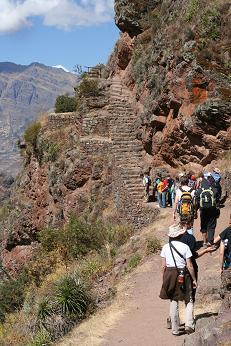
sm Pisac TrailCemetery holes in lacy, eroded hillsides, precursors of those we had seen in the hillside in Lima… delicate yellow wildflowers holding their own in dry, vast space…terraces and granaries where Incan farmers long ago worked out the exact altitude at which to grow each of the varieties of corn and potatoes…Incan walls, stones set to withstand earthquakes and the destruction of men…steep stone steps cut into the earth, staircases of them, one after the other, meant to ease the descent—or the climb—but not for us: legs the wrong length, bodies unused to the effort, the altitude, the sun. But exhilarating nonetheless, the walk to Pisac. Accomplishment. Activity. Away from crowds and buying and selling and tasting. Shared venture.

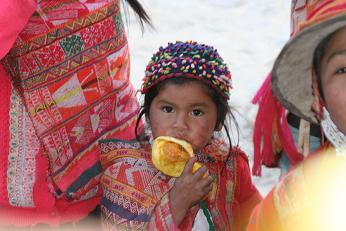
sm 10 child with orangeA rest, a respite: a pig roast, freshly baked bread, a mother teaching her child to take stitches, another black-eyed child sucking on an orange turned inside out. A stroll through the market and frenzied buying. This time the bigger items: blankets and shawls, t-shirts, carved animals, leather pouches and silver bangles. For me: bits of cloth glued on white cardboard, woven designs in black on rust, subtle patterns…

sm 10 girl in pinkOur guide, Nilo, prepares the students for their long walk up the steps to Ollantaytambo’s fortress. I photograph a winsome little girl in pigtails dressed in filthy pink pants and winter jacket. She speaks a little English, knows enough to ask for a sol in exchange for her picture. Who is exploiting whom here? We’re both complicit. But I want the picture and I don’t need the sol. Later, I spend the rest of my soles on straps for walking sticks. A strange request, it seems to the vendor…straps but no sticks. Coming home from Rwanda with sticks, I had to lay them on top of my suitcase and shrink wrap the whole thing…or else pay $300 in excess baggage fees. No thanks. Not again. Just the straps.

sm 10 walls as shopsAnd then a walk down a cobbled lane where even the walls had become shops, a peek into one family’s store where the grandson charmed us and we looked at the sweaters and shawls hung on the walls and laid in piles on a table. A shop bare but for that table, the mother and grandmother seated cross-legged on the floor, weaving. Two granddaughters, yet to learn the skill, the boy to learn what? To market it all? Another craft? A trade? Weaving was in the bloodline, “as old as the sun,” the grandmother told Lee Ann. She bought a loosely woven sweater; I took a photograph of them all.

Boys playing in sand, covering their toes and shaking their feet loose; lace curtains at a doorway, shoes on the threshold. A Mototaxi—more than one—coming up the street from the train station at the end. We’d see the station itself the next day on our way to Machu Picchu. A decoration on top of a house—a bird’s nest of symbolic animals and flags and twigs all laced together to bring happiness and good luck to the marriage. Men coming home from work, sacks slung over their backs, their wives or sweethearts beside them and sometimes their children scampering along, too, escorts back to the town. For us, a surprise in the other direction: an oasis in Ollantaytambo: Hotel Pakaritampu, an orange adobe inn—La Casa del Amanecer—luring us in…the gardens, artful and opulent mounds of bright flowers, paved sidewalks inviting us to follow to an airy, modern, uncluttered front desk…an agradable ambiente…we should keep it in our memories forever…a destination for a weekend, an escape for the mind…

sm 10 sunsetAnd then, the sunset, the final glory of the day. White-capped Chicon Mountain in the background, jagged brown peaks like teeth snapping the sky, the sun on the landscape, brilliant orange, the fields looking almost like sand. A woman and her dog, their backs to us, traverse the field, return for the night. Two men are crouched over cloths and bundles spread on the ground. We settle in for the long, dark bus ride back to Cusco. End of the sacred day.

What you have given me…

Thank you, Lee Ann

Links:

www.facebook.com/handsonspanishtravel

www.hands-onspanish.com


What is Russia?

The Sochi Olympics have me thinking about the summers when I took students to Russia on an exchange program. The kids–in their twenties now–are thinking about those days, too. I know because they’ve been reconnecting on Facebook and emailing me. We are all acquainted with the unfinished public buildings, the difficulties of getting around, the stray dogs, and the other objects of humor so glibly reported on in the press. We know very well the dark side of Russian history. But more deeply than any of that, we know that what we took away from our experiences ten years ago would last all our lives. See what that was:

“What is Russia? Provide a brief definition.”

It sounded like an exam question. Alina, one of the Russian students, asked it at the end of our three-week exchange with students at the Pskov Humanitarian Lyceum. No one took it for a quiz at all; nevertheless, the American students reflected before they replied.  What came to my mind as I waited for their responses was Churchill’s remark: “A riddle wrapped in a mystery inside an enigma.”

But the students weren’t hampered by such long-ago images as they articulated their impressions. Anna and Hillary responded first and simultaneously.

“History,” they said.

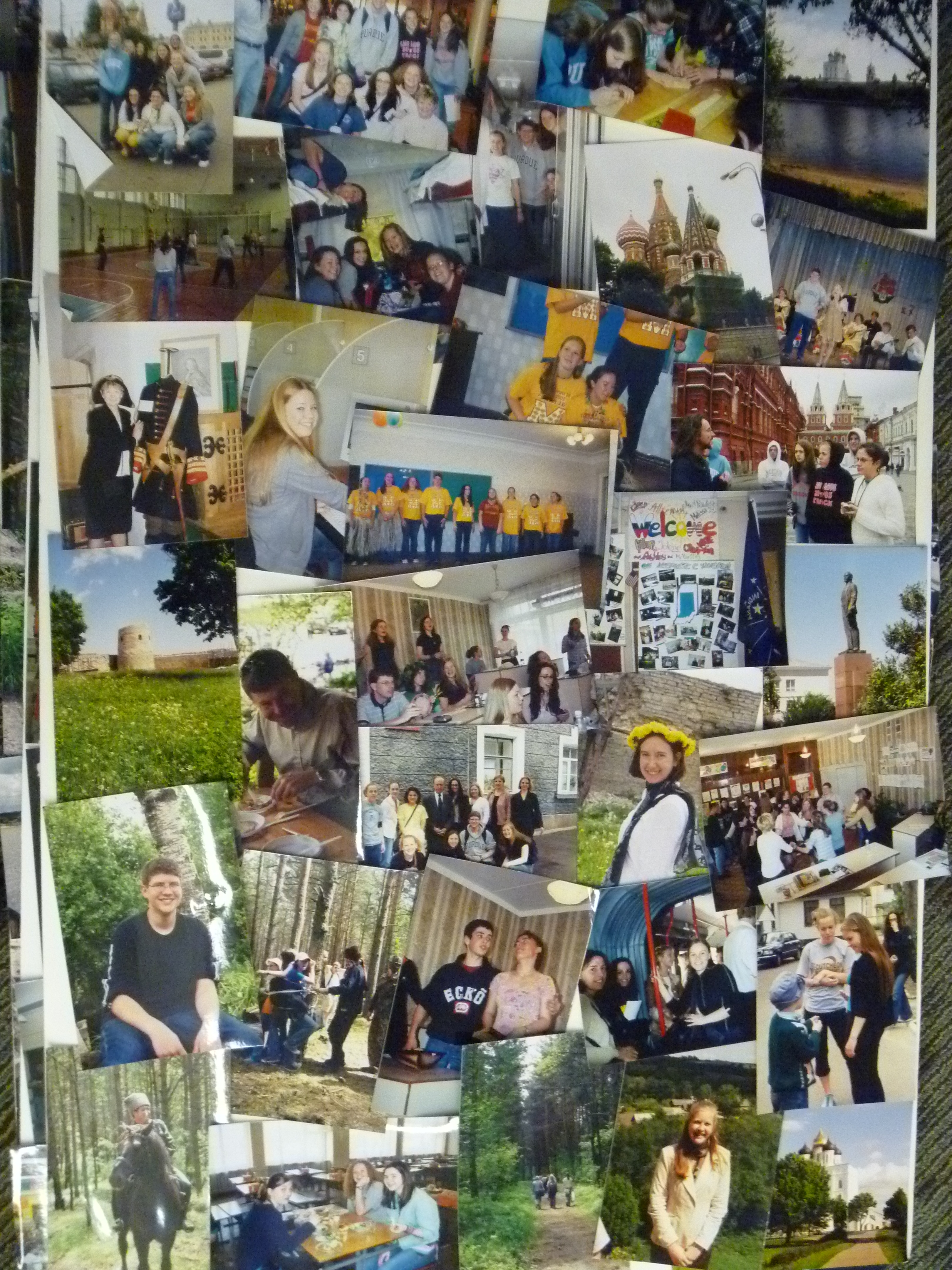
Indeed, we had experienced the history of Russia throughout P1000702our visit. The Pskov town fortress dates back to the 11th century; that year, in fact, Pskov was celebrating its 1100th birthday. Pskov was its own principality until 1510 when it surrendered its ancient veche, or assembly, and came under the control of Moscow. We visited Pechory, a monastery on the Estonian border where Ivan the Terrible decapitated the Father Superior, Cornelius, whom he supposed to be a traitor, and watched his head roll down the cobblestone walk. The Empress Elizabeth abandoned her carriage on a visit to Pechory—it’s still on display along that same steep walk. And in the caves of Pechory, Orthodox monks hid from the Nazis during the Great Patriotic War. We hiked at Izborsk, a nearby fortress that dates back to 1232. Here we waded in a stream whose waters, according to local legend, promise health or wealth or beauty, your choice to wish for.

“Is it only me, or is Russia beautiful?” Kate wrote in our group journal in praise of Izborsk.

We spent an afternoon at Peterhof, the summer palace of Peter the Great. We strolled—and stopped to stare incredulously at Peter’s four magnificent water cascades, each more elaborate than the next, and at the palaces of Marly, Monplaisir, Hermitage, and the Grand Palace itself. We watched children play on the trick stones that Peter designed for children. Little ones, sometimes holding their parents’ hands, ran back and forth in the fountains, pretending to avoid the spots that triggered hidden sprays, hoping to be doused, shrieking excitedly when they were. Some of the students posed in the fountains—under umbrellas. We dipped our hands in the Gulf of Finland and heard from our guide about Peter’s war on the Swedes that culminated in victory in 1709. We could see St. Petersburg, the city Peter built to be his new capital, in the distance across the water.

Later, we toured St. Petersburg itself and had a look at the Russia I, II, III Posters 014famous statue of Peter the Great, the Bronze Horseman. The custom in Russia is for brides and grooms to lay flowers at the bases of historical monuments. While we were there, two couples laid flowers at Peter’s feet. We saw the incredible Church of the Stained Blood, built by Tsar AlexanderIII to honor his father, AlexanderII, who had been assassinated in that very place in 1881.  We walked around St.Isaac’s Cathedral, where the city’s treasures were hidden from the Nazis—we could see the attackers’ bullet holes in the monolithic columns. We were glad to learn the Nazis had never penetrated the building.

Of course we stopped at the WinterPalace, now the famous HermitageMuseum. The grandeur and size of the Hermitage amazed us. Our guide said that it would take eight hours a day for eight years to see everything. We had two hours. At the Hermitage, we split into pairs, each couple making a beeline for the period or style of art that they found most appealing. Some visited the Impressionists; others took in the Flemish painting. Two pairs went to the Egyptian exhibit. Nikita, one of the Russian students, translated the exhibit signs for us when our skills in deciphering Cyrillic failed. We saw clay vessels, fragments of cloth, an actual mummy, and a sarcophagus opened to display the case within the case.

“Look!” exclaimed Ashley. “It’s just like a matryoshka doll, only vertical!”

Nikita smiled.

“Russia is ornate,” said Allie. “Even the railings have detail.”

She was referring to the railings our tour guide had pointed out along one of the bridges in St. Petersburg, but the imperial architecture, the interiors of the monasteries, the carvings in walls along the city streets, the gates between buildings, even the doors to business establishments are ornate. When we saw the Armory collection in Moscow, we understood “ornate” even better. Robes, wedding dresses, vessels of all kinds, chargers for serving food, plates, chalices, crosses and Bible covers, even the Tsars’ carriages have been preserved through the centuries.

“Preservation,” Ashley added. “It’s not just one person or small group; everyone values the past and is keeping it alive.”

In Pushkin Hills, we saw the ongoing excavation of a church that had burned to the ground after the Soviets took power, and we observed the restoration of a monastery, now a convent for Orthodox nuns, at Elizarovo. In fact, the students had helped with both projects. Under the direction of a well-known archeologist, they’d removed the first layer of turf in a small area at the church site. At Elizarovo, they’d painted window frames, hoed in the monastery’s garden, and washed some of the double-hung cloirestory windows that were caked with whitewash and dust from rebuilding efforts. St.Basil’s in Moscow was partially covered with scaffolding, as were churches in Pskov. In St. Petersburg, spruced up in celebration of its 300th anniversary, we saw, through a window into a less public side of the Hermitage, a stash of renovation materials and a faded green wall that had yet to be repainted to match the façade.

“Russia is culture.” Melissa turned in her seat to explain her impression. “It’s the national dress and the folk songs and dances.”

On the first full day in Russia the students had been invited to School #26, a magnet school for the arts, to attend a performance by a folk music ensemble, a group of select high school students. The students played traditional instruments— wooden spoons, the balalaika, the tambourine—and invited our young men to join the Russian girls who were singing on stage in traditional costumes. Back at the Pskov Humanitarian Lyceum, the music and dance teachers taught the Americans some Russian folk songs and dances. Later still, the Americans and their Russian friends learned more folklore at the regional museum where they attended a Russian tea party, the table dominated by an enormous samovar, and participated in songs and dances that were led by a member of a local folk music troupe who was dressed in a colorful sarafan.

“Children,” was my answer. I’d noticed, of course, that most adults in Russian towns wore dark colors—a defense against dust and the expense of dry cleaning—but in contrast, all of a sudden I’d see a child who looked like a bright yellow chick or a big blue gumdrop holding onto her mother or grandmother’s hand. And the hats! All the small children wore wonderful hats—blue velour with yellow stripes, pink or beige straw hats with decorative satin rose petals, denim hats with daisies embroidered on the brims—and I longed for a telephoto lens to snap their pictures unaware.

Then Clinton offered this definition: “It’s hospitality,” he said. “Anything I needed or wanted was provided for me.” When we first arrived in Pskov, spilling giddily off the train and into the arms of the Russian families whom we’d so eagerly looked forward to seeing, some of the parents apologized because their apartment buildings were currently without hot water. Our students took the announcement of cold showers in stride, but their Russian mothers heated water for them daily, and two of the parents, who worked at a local hotel, made arrangements for the “unfortunate” ones to shower there occasionally!

The mothers opened their cupboards and refrigerators to the American students, cooking special Russia dinners for them and searching out foods that would suit American palates. “Eat, eat,” they constantly urged, and while we could never satisfy their need to fill us full, we ate heartily and learned to love certain foods especially. Everyone loved blini, served with sour cream, jam, honey, or just plain butter.  Some students liked the borscht and most liked a Georgian specialty, cheburek, which the students ate regularly at a café on Oktvabrskii Street. Russian pizza and the incredibly beautiful pastries were “hits,” and everyone loved the chocolate, too. Almost everyone developed a fondness for tea and the rituals surrounding it, and it wasn’t unusual to find an American student ordering tea at lunch or in mid-afternoon. The most popular food item of all, however, was the incomparable Russian ice cream. Again and again we visited the booth by the bus stop where a “scoop ice cream” vendor presented an ever-changing selection of flavors.

The Russian families—the parents and the students—extended themselves in every way, in many cases giving up bedrooms so the American students could have a room of their own. The families helped us with telephone calls, with the Internet café, with changing money. They bought bus passes for us in advance of our visit and showed us how to ride like Russians (jump on quickly, show the pass later) lest we be left curbside, waiting in a non-existent line to board. They took us shopping in town and over and over again to “the market.”

Russia? “It’s my second home,” pronounced Karen, and she wasn’t thinking just of the hospitality that had been extended to all of us by our families or of occasions like a trip we’d taken to Sacha’s family’s dacha. As had happened for the Russian students in the United States, all of the Russian parents brought the American students “into the family,” and soon the adjective Russian disappeared when our students referred to them.

Karen meant, too, what we all had come to understand: that the relationships we’d formed and the friends we had made defined our Russian experience more significantly than anything material, anything historical, or anything cultural ever could. During our three weeks, there had been official welcomes from the school principal, from teachers who had prepared special lessons for us, from the Chairman of the city Duma and from the Vice-Mayor of Pskov. There had been formal interactions with the professors and students at the Pskov Pedagogical Institute. All of them were important, but none made as indelible an impression as did the commonplace, often spontaneous, social activities that transpired between the brothers and sisters, between the Americans and their host families.

Allie and Anna cooked a spaghetti dinner together for their host families, and Karen and Melissa made spiced chicken for theirs. Yulia and Karen, whose birthdays are at the end of May, had a birthday party and invited the others. Irina’s mother, who works at a hospital, took Jolene along one day—an impromptu “Take Your Daughter to Work Day.” A large group, accompanied by the teachers and Sasha’s father, went to a disco one night. The students danced together and found no differences in style that they couldn’t absorb. Even the music, half in English and half in Russian, bridged the potential divide.

Our Farewell Party at Alina’s family dacha lasted from late afternoon until the teenagers’ curfew at 11:00. The back yard was a sea of purple lupine, gathered from an adjacent field and stashed in buckets everywhere. Plastic chairs and café tables with umbrellas, rented from town by the parents, were sprinkled about the yard. Volleyball, croquet, and even a karaoke machine provided entertainment, and the fare was the ever-popular shashlik.

When the games were over and the meal was done, when we’d finished with gifts and speeches, lead teacher “Mrs. Irina” introduced the culminating activity. She distributed a handful of colored embroidery thread to each student and teacher and invited the recipients to separate the strands and tie the strings around the wrists of the people to whom they’d like to say a specific “thank-you.” Of course, the tears started as each student and all of the teachers approached each other and the parents to privately convey their thanks.

In the end, each person’s wrist was encircled with a wide, colorful band made of the individual strands. “What is Russia?” Alina’s unintentional quiz question had helped us focus our thoughts about our visit to Russia. Ashley remarked at the end of the discussion that Russia is like the Hermitage. “You could never see it all,” she said.

We agreed with her, but still, we realized we would come home from our three-week visit with fresh, joyful, and positive impressions of the country. There is no mystery, puzzle, or enigma in this. Our idea of Russia, outlined by the history and culture we were shown, has been colored brightly and deeply by the friendships and love that our exchange created. And, like the thick bands upon our wrists, woven of single strands of gratitude, so the idea we have of Russia is all of these impressions together, impressions for which we are grateful still to our many Russian friends.

Remembering JFK

I wrote this piece about JFK eleven years ago when I was teaching 12th grade English. I was modeling for my students, furnishing an example for the essays they would write about a significant moment in their lives. On the 50th anniversary of Kennedy’s death (2013), I offered it as a reflection on the extent and depth of the impact Kennedy had on so many young people of my generation, on me. Looking back all these many years later, I can’t imagine a better way to have spent my life or a better way to have served my country. Because that is what teachers do: We serve. Through our instruction, our example, and our own perseverance, we shape the country—even the world—for years to come. 

It is true what they say about historic moments: You remember where you were, what you were doing. I was standing on the steps of Harrison Hall—the science building—at DePauw University in Greencastle, Indiana, the morning that John F. Kennedy was shot. Someone told me the bare facts when I came out of the building after my zoology class. I hurried back to my living unit and crowded around the TV set with my friends, hanging on every word that came out of Parkland Hospital and the Dallas Police Station, every scrap of information from Walter Cronkite. No one spoke.

I had seen Kennedy in person just two years before. He was coming to Iowa on a campaign trip in September and would take part in a motorcade through downtown Davenport.  My government teacher had dismissed class for the afternoon so that we seniors could be part of the crowd that would line the streets that day, so that we could see for ourselves the handsome young senator from Massachusetts who had so fired our imaginations. Those of us who drove to school took those who didn’t in our cars. We sped downtown, found parking places, and raced on foot to the levee. We must have scoped this all out ahead of time—or our teacher had—for we knew right where to stand. Maybe the parade route was in the newspaper.

Just so you know—and so you understand how a single teacher could dismiss school for the afternoon—I attended high school in Davenport, Iowa, a town across the Mississippi River from my home in Illinois. I was a day student at a school for girls, grades K-12. When I enrolled in the 8th grade, there were eight students in my class. By the time I graduated, we were a class of seventeen, considered big in comparison to other classes. Mr. Hostetter, our government teacher and the teacher of every history class I took in high school (American, Ancient, British, and World as well as Government in my senior year), was also the Dean of Students and sometimes even the bus driver. However, by the time Kennedy came to town, I was driving myself to school.

We were kids in gray uniforms—maybe that was how we managed to hold our positions at the front of the crowd. People shouted and squealed and elbowed their way forward, jockeying for a clear view. Most were adults, but we recognized kids from the public high schools, too. We waited impatiently for the car to come, probably for an hour or so, all that time staking our territory against the urgency of other admirers and the aggressiveness of those who just wanted a look at the audacious young Democrat whose Catholic background made him a novelty in this overwhelmingly Protestant, Republican community.

He was handsome indeed. Intense eyes, a shock of loose, casual hair that swept back off his face in a fresh and unconstructed way—so different from the bald President Eisenhower and his dark, slicked-back Vice-President, Nixon. Kennedy smiled at us directly; we saw white, even teeth and a shine in those eyes. His arm stretched out across the window ledge of the convertible. I reached for it…and he took it.

I think.

Maybe it was my friend Pam whose hand he shook. Isn’t that funny? The high point of the story and I can’t remember if it was she or I who actually touched his hand. Probably it was she or I wouldn’t have this doubt about which of us it was. Certainly she had as much claim to the shock of it as I did. Both of our fathers were Republican businessmen—and her father was ardently involved in Republican politics as well. Our parents thought our infatuation with Kennedy was just that: a crush that would pass. My father said I was a “tide-bucker,” not a Democrat at all.

But it wasn’t about political parties. I was inspired by Kennedy. He touched a nerve in me with his sympathy for the poor and oppressed. I knew I wanted to make a difference in people’s lives, not just enjoy my own. So when Kennedy said in his inaugural address in that January of my senior year, “Ask not what your country can do for you, ask what you can do for your country,” I knew he was speaking directly to me, directly to my generation, to all the kids who had lined the streets in the cities along the campaign trail. He called upon us in that speech to participate in a struggle against “the common enemies of man: tyranny, poverty, disease, and war itself… Can we forge against these enemies,” he asked, “a grand and global alliance…that can assure a more fruitful life for all mankind?  Will you join in that historic effort?”

Yes, I vowed. I will.

After college, I joined VISTA,  the domestic Peace Corps (now called Americorps) and after that, I became a teacher. I didn’t serve in inner-city schools—my family and I have never lived in big cities. I didn’t become a union organizer, though I do, proudly, belong to the union. I didn’t burst onto the national scene and transform education policy, either.

But I did love my students in all their splendid diversity. I tried to teach perseverance so that they would be successful. I tried to instill a love of learning. In a variety of ways, curricular and extra-curricular, I exposed my students to a wider world than they had yet known in hopes that they would learn to appreciate others and live caring lives.

Looking back all these many years, I can’t imagine a better way to have spent my life or a better way to have served my country. Because that is what teachers do: We serve. Through our instruction, our example, and our own perseverance, we shape the country—even the world—for years to come.

Kennedy reached out his hand, and I took it.

All of my life since, I have tried to pass on that handshake.